Front matter
Reading edition
Note: Images of the original pages are available through Internet Archive. See http://archive.org/details/cu31924027487747
Transcriber's Note:
Minor corrections were made to the original publication. Images of the original cover and title page are included at the end of the text.
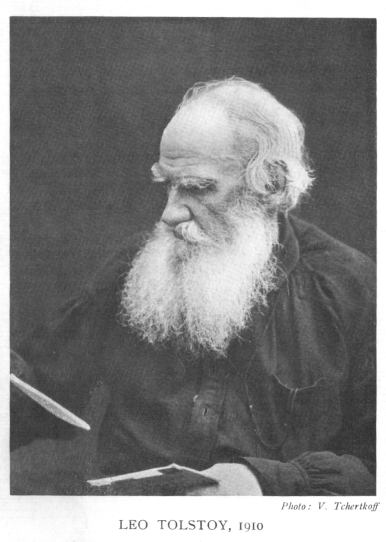
THE LAST DAYS OF TOLSTOY
BY
VLADIMIR TCHERTKOFF
TRANSLATED FROM THE RUSSIAN BY
NATHALIE A. DUDDINGTON
1922
LONDON: WILLIAM HEINEMANN
Printed in Great Britain
CONTENTS
Introduction
Public opinion demands that facts with regard to Tolstoy's going away should be revealed—The conditions of Tolstoy's life were a test of his consistency—Why is it necessary to publish the circumstances of his going away?—The importance of Tolstoy's example—Misrepresentation of the causes of his going away—The moral duty of his friends to defend his memory—My task.
PART I
WHY TOLSTOY DID NOT LEAVE HIS HOME
(Letter to H. Dosev)
Dosev's mistake, common to many—Tolstoy's true motives—His independence of the opinion of men—The limit of his yielding—In order to go away he had to feel the necessity for doing so—It was easier to go than to remain—Tolstoy's sufferings at Yasnaya Polyana (from his intimate diary)—The mistake of passing censure upon his life at Yasnaya—He fulfilled that which God required of him—His love for his wife and his confidence in her—His self-sacrifice for her sake—We must believe in his conscientiousness—The heroism of his life in his family.
PART II
WHY TOLSTOY WENT AWAY
Chapter I.—The conditions of life at Yasnaya Polyana
Wealthy surroundings—False position in the eyes of men—Spiritual break with his wife.
Chapter II.—Change for the worse in his wife's attitude to him
Change for the worse in the conditions of life at Yasnaya with regard to the management of the estate, to the relations with the peasants, and in his wife's attitude to him—Tolstoy gives up landed property—His readiness to go away and the causes of his delay in making a final decision.
Chapter III.—The history of the will
Tolstoy's attitude to property in general and to literary property in particular—His differences with his wife on that score—Tolstoy's firmness in renouncing the copyright of his works—His wife's opposition—Short history of the drawing up of the will.
Chapter IV.—Intervals of rest—in other people's houses
Mental and physical revival—Creative work.
Chapter V.—The last period
Summer of 1910—Period of suffering that undermined his health.
Chapter VI.—Mental agony
Tolstoy's disappointment at the impossibility of awakening his wife's spiritual consciousness—Recognition that his further stay at Yasnaya Polyana is unnecessary—The harm that his staying there did to Sofya Andreyevna.
Chapter VII.—The night of Tolstoy's going away
The last touch—Preparations and departure—Entries in the diary.
Chapter VIII.—Tolstoy's relation to his wife
Letters to her in 1897 and after his departure—Reasons why he did not wish to see her.
Chapter IX.—The motives that decided his going away
The last straw—Mistaken judgments about Tolstoy's going away.
Chapter X.—The significance of Tolstoy's going away and of the whole spiritual achievement of his life
The one desire of his life, to do the will of God—The inevitability of the end.
PART III
TOLSTOY'S ATTITUDE TO HIS SUFFERINGS
The growth of his inner consciousness during the second period of his life. Extracts from the diary for 1884—Differences with his wife—On the border of despair—Feeling of solitude—Memory of his mother and his longing for her (1906)—Striving after God. Extracts from diary and letters from 1889-1910—Family trials—The cross of his life, till the end—His words about Sofya Andreyevna and consciousness of his guilt (from a conversation with, and the letters to Tchertkoff)—The mystery of another's soul—Tolstoy's thoughts that give a general meaning to his interpretation of suffering ("The Reading-Cycle," "The Way of Life").
Appendix I
The inevitable one-sidedness of quotations made from Tolstoy's writings for the purposes of the present narrative—His many-sided personality—His power of controlling his sufferings and his natural joy of life—The attainment of the true good.
Appendix II
My personal attitude to Tolstoy's wife—The experience and observation of thirty years—My task is not to censure anyone but to vindicate truth.
INTRODUCTION
So much misunderstanding, misrepresentation, partiality and personal prejudice has accumulated in connection with the last years and days of Leo Nikolaevitch Tolstoy's life, that before starting upon this first detailed account of his "going away" I find myself compelled, at the risk of wearying the reader's patience, to begin with a somewhat lengthy introduction.
Now that Tolstoy's wife[1] is dead, the chief obstacle to revealing the true causes of his going away from Yasnaya Polyana is removed. Like other friends of Leo Nikolaevitch, I have said nothing for ten years. During this time many people, some of them particularly deserving of confidence and respect, have asked me to publish all that I know about this event. As an instance I will quote a letter from Mrs. Mayo, a well-known English authoress and admirer of Tolstoy.[2]
"Old Aberdeen, Scotland, Jan. 17, 1914.
"Dear Mr. Tchertkoff,
"Some of us in Great Britain feel that the time has come when it is highly desirable that we should hear the story of the tragedy which beset the last years of Leo Tolstoy's life, from one who was in its scene.
"We can understand and respect your reticence up to this point. But now so many rumours, derogatory to Tolstoy, and therefore likely to diminish the weight of his teaching, are spreading over the world, and seem to be the subject of a very active propaganda even in this country.
"Hitherto, however, we have heard little or nothing save from those who were notoriously out of sympathy with his principles, and who did not scruple to put obstacles in the way of the carrying out of his last will.
"Further, it has been unfortunate that the Life of Tolstoy best known in Britain is the work of one who, far from being a disciple, is not even a neutral or impartial recorder, but is in flat antagonism to Tolstoy's leading principle of non-resistance to evil by violence.
"Therefore we appeal to you, Tolstoy's personal friend and fellow-worker, that you should let us hear the facts of the case as you saw them.
"Some of us feel that Tolstoy's own works explain enough. I remember when I read the last page of the paper 'Living and Dying,' in his Three Days in the Village, written only a few months before his death, I realised that Tolstoy's spiritual anguish was being strained almost beyond endurance.
"Again, I repeat that we all deeply respect the reticence you have hitherto maintained. But there is a time to speak and a time to keep silent. History shows us again and again how impossible it is to unearth the truth when eye-witnesses are gone. Thus are engendered the most misleading and mischievous myths.
"I trust that you will give this matter your deepest consideration, and I remain,
"Yours with much regard, (Mrs.) "Isabella Fyvie Mayo."
I have received many such requests, both spoken and written, from many different people, some of whom were noted for their tact and reserve, and whose opinion therefore carried special weight in this delicate
I feel that the time has come at last to speak openly of what I know. I approach my task with no light heart, but with a full consciousness of the moral responsibility which it involves. In doing so I have but one wish: to say nothing that is superfluous or out of date, and to keep back nothing which I feel it my duty to Leo Nikolaevitch and to other people to reveal.
In Leo Nikolaevitch Tolstoy's life two circumstances deserve special notice. In the first place, the immediate external conditions in which he was placed—that is, all he had to endure in his family life and home surroundings—seemed to be specially designed as a severe trial for him. If someone wanted to put to a practical test Leo Nikolaevitch's sincerity, consistency and spiritual strength in carrying out his conception of life, he could not have placed him in conditions more suited for the purpose than those in which Leo Nikolaevitch lived for the last thirty years of his life. Secondly, it is remarkable that Leo Nikolaevitch bore this trial irreproachably, though it was more severe than anyone unacquainted with his intimate life could suppose.
There was a time when all educated Russians imagined, in their spiritual blindness, that Tolstoy's "easy" life in Yasnaya Polyana was a fresh example of the inconsistency with which great thinkers fail to apply to themselves the lofty truths they preach. Tolstoy's enemies rejoiced, and regarded his supposed inconsistency as a proof of his theory being inapplicable in practice. His friends found extenuating circumstances for his guilt, and thought that we should be grateful to Tolstoy for the spiritual food he had given us, and not be too hard upon his human weaknesses. And yet during all this time, with a firmness which nothing could shake, and sometimes at the cost of incredible suffering, Leo Nikolaevitch was carrying on the most heroic work of self-abnegation, consistency and self-restraint of which man is capable. He realised in his actions and in all his personal life that which he preached, and both in his life and his death he exemplified the complete renunciation of all personal desires and the whole-hearted service of God, in which he believed the purpose and the meaning of human life to consist.
I am well aware that this assertion may appear to be an exaggeration. Some readers
Written documents which I have in my keeping sufficiently reveal the general character of the conditions in which Leo Nikolaevitch had to live. But if there were only these data to go upon, one would have to resign oneself to inevitable blanks and omissions. The readers would have to treat these documents like learned investigators treat their historical material—that is, to fill up the blanks with their own surmises, to connect the disconnected, and to reconcile contradictions in accordance with their personal predilections and the degree of their inventiveness. Among the extensive material relating to Tolstoy's life there already exist, and will no doubt appear in the future, communications which more or less misrepresent the facts and even contain downright falsehoods. To the malicious joy of Tolstoy's enemies there
Under such circumstances, the future biographers of Tolstoy would have—as is usually the case—to steer a middle course between all the contradictory data in their possession. In doing so they will not be able to avoid the misleading influence of the unreliable documents—and this, indeed, is already noticeable in some of the recent biographies. In view of this, it is particularly important that some contemporary of Tolstoy who was particularly intimate with him, enjoyed his full confidence and had a first-hand knowledge of the true conditions of his home life, should leave a consecutive exposition of all the relevant and well-authenticated facts. It is desirable, too, that this person should not be one of Tolstoy's relatives, and would therefore be free from all family prejudices and predilections.
Not in virtue of any personal merits, but only owing to certain external circumstances, I satisfy these conditions, and cannot help feeling that fate itself lays upon me the moral duty of undertaking such a work.
A detailed account is necessary not only for the sake of "historical accuracy" in the biography of the great man; it is needed in the interests of humanity in order to preserve in all its intact wholeness the striking example of Tolstoy's life; for this life incontestably proves the possibility of carrying out in practice the lofty truths to which he gave verbal expression.
It would be a mistake to agree with only such truths as are proclaimed by men who perfectly realise in the practice of their own lives that which they preach. It is part of our nature that a man may be clearly conscious of truths so lofty that it is beyond his power to put them into practice. They may be practised by his contemporaries who have more strength than he has, or by future generations who will have attained a higher degree of moral perfection. But it is also part of our nature that the example of a man who realises in his own conduct, in spite of any privations and suffering, and even at the cost of his life, that which he preaches, always arouses the enthusiastic sympathy of others, and becomes a powerful help and encouragement to many who strive to follow the ideals proclaimed by such a man.
Even if in his personal life Tolstoy were
Now that Leo Nikolaevitch's widow, for whose sake we have refrained from publishing the facts, is no longer alive, it is not only permissible for us, his friends, to come forward in his defence but, in view of all that has happened, it is our bounden duty to tell the truth about his life and death, so as to counteract all the slanders that have been set going by his enemies.[3]
I have also heard another argument from persons who would have preferred, for the sake of their vanity, that Tolstoy's family tragedy should have remained secret. They said that Leo Nikolaevitch himself never defended himself against those who slandered him. He preferred to bear the censure of
It is impossible to agree with this. One may well understand that Leo Nikolaevitch concealed his sufferings. He drew strength and derived satisfaction from the consciousness that he was living not before men, but before God. Far from standing in need of human approbation, he thought that unjust condemnation on the part of men was good for him in so far as it forcibly drove him to that road upon which one has nothing but the voice of God in one's own soul for guidance. But does this mean that we too must say nothing about Tolstoy's heroic life and conceal his moral rectitude now, when he is not among us?
We have not, cannot have, and ought not to have, the same motives which in this respect influenced him. It is good for me, for my soul, to be unjustly condemned owing to the fact that I do not want to justify myself and am sparing the real culprit. But there is nothing good in my being silent when another person is unjustly condemned or slandered in my presence, while I have the
These are the reasons that have led me to undertake the biographical work of which the present narrative of Tolstoy's going away forms, so to speak, only one separate chapter.
All the events of cosmic life are so inextricably interwoven that, were it possible to change in the past some one of them, even the apparently most insignificant, it would be necessary to change at the same time absolutely all the other concurrent and preceding circumstances. Therefore in order to investigate fully the conditions which have occasioned this or that event in a person's life, one would have to consider the whole past history of mankind, both the external and the internal or spiritual. And since it is impossible even in thought to
Thus in the story of Tolstoy's "going away" which occupies us now, no investigation, however careful, can exhaust all the outer and inner circumstances, receding into an endless past, that have brought about the event in question. Besides, even in the domain of Tolstoy's personal life which admits of inquiry, the direct and indirect causes of his "going away" are so numerous and many-sided that it is beyond the power of a single individual to make an exhaustive enumeration of them. The colouring given in such cases to the circumstances under investigation and the very drift of the inquiry depend so largely upon the personal point of view and the mood of the writer, that, try as he may to be impartial, his selection and treatment of causes will inevitably be more or less one-sided. Therefore in order to bring to light the causes of Tolstoy's "going away," it is extremely important that the greatest possible number of his contemporaries should record and preserve for future generations the facts known to
So far as I am concerned, I quite realise that the small beginning which I venture to make with the present narrative is only a drop in the sea of all the facts, observations and deductions which it would be desirable to gather together before Tolstoy's contemporaries leave the scene of this earthly life.[4]
In composing the present book I have tried to distinguish as sharply as possible between: (1) facts and circumstances which I knew for certain, and therefore have stated them without any reservations; (2) facts and circumstances of the certainty of which I personally am convinced, though I do not
Being compelled in the present narrative to be as brief as possible, I am unable to substantiate all my assertions by documentary and other evidence in my possession. I am therefore addressing myself here only to such readers who can take my word for it that I give out as facts only that which is known to me for certain, and do not permit myself any embellishments or exaggeration. But in the other, still unwritten, book to which I have referred, Tolstoy's Moral Achievement, the subject of his family life as a whole will be extensively treated and I shall quote my data in full.
If I often permit myself to include in the narrative my personal valuation of the events, this is certainly not because I want to force my own opinions on the reader instead of barely stating the facts and letting him draw his own conclusions. I quite recognise the advantages of a so-called objective narrative, but it was not what in the
As to a detailed objective exposition of all the circumstances connected with Tolstoy's "going away," I believe that, desirable as it is, the time for it has not yet come, for the persons who possess most information on the subject have not yet had time to publish the numerous and varied details known to them. Let us hope that they will not put off this task for so long that they will be dead before they have fulfilled it. And if my present contribution will induce them also to give out something of what they know, even if it were solely with the object of contradicting me, I should be very glad of it, as indeed of any corrections of
V. Tchertkoff.
Moscow, Lefortovsky pereulok, 7. January 1922.