VIII THE LAST DAYS OF PEKIN
Myrta Leonora Jones translation
I
Pekin, Wednesday May 1.
I returned yesterday from my visit to the tombs of the emperors after three days and a half of journeying in the haze created by the "yellow wind," beneath a heavy sun constantly obscured by the dust. I am back once more in Pekin, with our chief general, in my old rooms in the Palace of the North. Yesterday the thermometer registered 40° in the shade, to-day only 8° (a difference of 32° in twenty-four hours). An icy wind drives the rain-drops that are mingled with a few white flakes, and the neighboring mountains behind the Summer Palace are quite covered with snow. Yet there are people in France who complain of our springs!
Now that my expedition is over, I ought at once to go back to Taku and the squadron, but the general wants me to stay for a great fête he is to give to the staff officers of the allied armies, and so I have telegraphed to the admiral, asking for three days more.
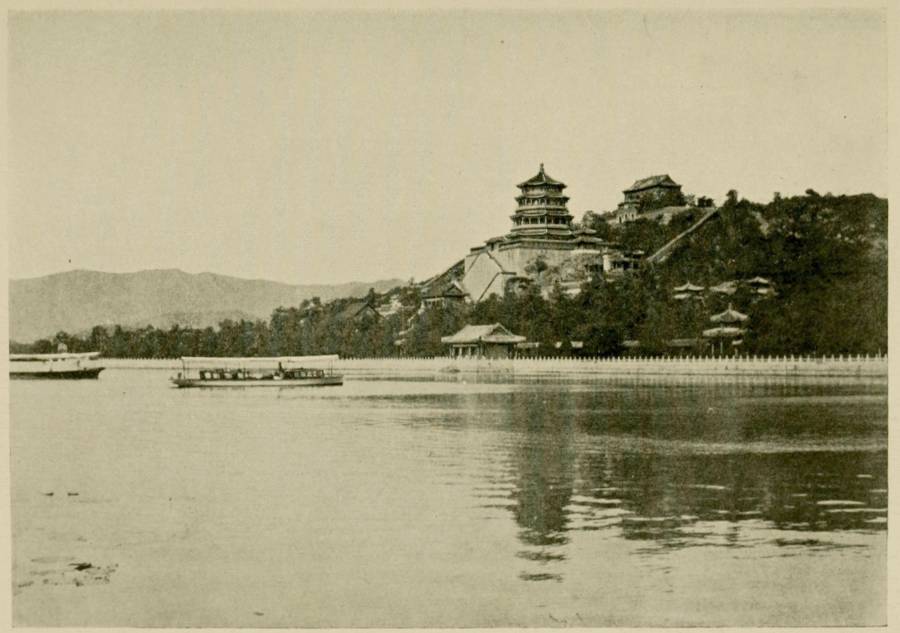
Copyright, 1901, by J. C. Hemment The Lake and Southern View of Summer Palace
In the evening I walk on the esplanade of the Rotunda Palace in company with Colonel Marchand. The weather is bad, stormy, and cold, and the twilight comes on too early on account of the rapidly moving clouds. As the wind parts them one gets glimpses of the mountains behind the Summer Palace, snowy white against a background of dark clouds.
Confusion reigns about us, but it is the confusion of a fête instead of that incidental to battle and death, as I had known it here last autumn. Zouaves and African chasseurs are running about, carrying ladders, draperies, and armfuls of branches and flowers. The old cedars in the vicinity of the beautiful pagoda shining with enamel, lacquer, and gold, are disguised until they look like fruit-trees; upon their almost sacred branches are thousands of yellow balls that look like big oranges. Chains supporting garlands of Chinese lanterns go from one to the other.
It is Colonel Marchand who has planned it all. "Do you think it will be pretty? Do you think it will be a little unusual? You see, I want to do it better than the others."
The others were the Germans, the Americans, and all the rest of the Allies who have given these fêtes before the French. So my new friend has been in the most feverish state of activity for five or six days, in attempting to do something that has never been done before, working far into the night with his men, who share his enthusiasm, putting into this play-work the same passionate effort he put into conducting his little army across Africa. From time to time, though, his smile betrays that he is finding amusement in all this, and will not take its possible failure tragically, if wind and snow come to upset the fairyland of his dreams.
No, but this cold is annoying all the same! What shall we do, since it is to take place in the open air on the terraces of the palace, if the north wind should blow? What of the illuminations, of the awnings? And the women, won't they freeze in their evening gowns? For there are women even here in the heart of the Yellow City.
Suddenly a gust of wind breaks down a whole string of lanterns with pearl pendants, which are already hung from the branches of the old cedars, and upsets a row of the flower-pots, which have been brought up here by the hundreds to give life to these old gardens.
Thursday, May 2.
Messengers have been sent to the four corners of Pekin, announcing that this evening's fête has been postponed until Saturday, in the hope that the bad weather will be over by that time. So I have had to send a despatch, asking the admiral for a prolongation of my freedom. I came away for three days and have remained almost a month, and am wearing shirts and waistcoats borrowed here and there from my various army friends.
This morning I have the honor of breakfasting with our neighbor in the Yellow City, Marshal von Waldersee.
Covers are laid for the marshal and his staff in a large room finished in marquetry and carvings, in a part of the palace untouched by the flames. They are all correctly attired in irreproachable military garb in the midst of this fantastically Chinese setting.
It is the first time in my life that I have sat down at a table with German officers, and I had not anticipated the pang of anguish with which I arrived among them as a guest. Oh, the memories of thirty years ago, and the special aspects which that terrible year had for me!
That long winter of 1870 was passed in a wretched little boat on the coast of Prussia. How well I remember my watch on the cold decks,—child that I was, almost,—and the silhouette of a certain King William that so often appeared on the horizon in pursuit of us, at the sight of which we always fled, its balls whizzing behind us over the icy waters. Then the despair of feeling that our small part there had been so useless and unavailing! We knew nothing about it until long afterward; news came seldom, and when it did come it was in little sealed papers that we opened tremblingly. Over each fresh disaster, over each new story of German cruelty, what rage filled our hearts,—childlike in the excess of their violence,—what vows we made among ourselves never to forget! All this came to me pell-mell, or rather a rapid synthesis of it all, on the very threshold of this breakfast-room, even before I had crossed the sill, from the mere sight of the pointed helmets that hung along the wall, and I felt like going away.
But I did not, and the feeling disappeared in the dark backward and abysm of time. Their welcome, their handshakes, and their smiles of good fellowship made me forget it in a second, for the moment at least. At any rate, it seems that there is not between them and us that racial antipathy which is less easily overcome than the sharp rancor of war.
During breakfast this Chinese palace of theirs, accustomed to the sound of gongs and flutes, echoes to the strains of "Lohengrin" or the "Rheingold," played in the distance by their military band. The white-haired marshal was good enough to give me a seat near him, and, like all of our people who have had the honor to come under his influence, I felt the charm of his exquisite distinction of manner, of his kindness and goodness.
Friday, May 3.
More and more people are coming back to Pekin, until it is almost as crowded as of yore. The people are very much occupied with funerals. Last summer the Chinese here were killing one another; now they are burying one another. Every family has kept its dead in the house for months, according to their custom, in thick cedar coffins, which somewhat modify the odor of decay; they bring the dead their daily meals as well as presents; they burn red wax candles for them; they give them music; they play the flute and the gong in the continual fear of not paying them enough honor and of incurring their vengeance and their ill will. The time has come now to take them to their graves, with processions a kilometre long, with more flutes and gongs, innumerable lanterns and gilded emblems, which they hire at high prices; they ruin themselves for monuments and offerings; they scarcely sleep for fear of seeing their dead return. I do not remember who it was who described China as "a country where a few hundred millions of living Chinese are dominated and terrorized by a few thousand millions of dead ones." Tombs everywhere and of every form; one sees nothing else on the plains of Pekin. As for all the thickets of cedar, pine, and arbor-vitæ, they are nothing but funeral parks, walled in by double or triple walls, a single park often being consecrated to one person, thus cutting the living off from an enormous amount of space.
A defunct Lama, whom I visited to-day, occupies on his own account a space two or three kilometres square. The old trees in his park, scarcely leafed out as yet, give little shade from the sun, which is already dangerously hot. In the centre of it is a marble mausoleum,—a pyramidal structure with small figures and masses of white carvings which taper skyward, terminating in gilt tips. Scattered about under the cedars are crumbling old temples, built long ago to the memory of this holy man, enclosing in their obscurity a whole population of gilded idols that are turning to dust. Just outside, the cindery soil where no one ever walks, is strewn with the resinous cones from the trees, and with the black feathers of the crows, who inhabit this silent place by the hundreds. As in the imperial woods, April has brought out a few violet gillyflowers and a quantity of very small iris of the same color.
All the woods which are used for burial places—and the country is encumbered with them—resemble this one, and contain the same old temples, the same idols, and the same crows.
The plains of Petchili are an immense necropolis, where the living tremble lest they offend one of the innumerable dead.
Pekin is not only being repeopled, but rebuilt; hastily though, out of small blackened bricks from the ruins, so that the new streets will probably never display the luxurious façades, the lacy, gilded woodwork of former times.
The great eastern artery that crosses the Tartar City is, of all the streets of old Pekin, the nearest to what it used to be; life here is becoming intense, the people swarm. For the length of a league this avenue, which is fifty metres wide,—of magnificent proportions, although now very much injured,—is invaded by thousands of platforms, sheds, tents, or in some cases simply umbrellas stuck in the ground, where the people who serve horrible drinks and food dispense their wares, always in delicate China very much decorated; there are charlatans, acupuncturers, Punch-and-Judy shows, musicians, and story-tellers. The crowd is divided into an infinite number of currents by all these small shops and theatres, like the waters of a river filled with islands, so that there is a constant eddy of human heads black with dust and filth. Rough, hoarse vociferations, in a quality of voice unfamiliar to our ears, are heard on all sides, to an accompaniment of grating violins, noisy gongs and bells. The caravans of enormous Mongolian camels, which all winter encumber the streets in endless processions, have disappeared in the solitudes of the North, together with their flat-faced drivers, who wish to escape the torrid heat; but their place in the central part of the street, reserved for animals and vehicles, is taken by numerous small horses and tiny carriages, and the cracking of whips is heard on all sides.
On the ground in front of the houses, spread out upon the mud and filth, the extravagant rag-fair that began last autumn is still going on; the remains of so much pillage and burning are left that it seems as though there was no end to them,—magnificently embroidered clothing spotted with blood, Buddhas, grotesque figures, jewels, dead men's wigs, cracked vases, or precious fragments of jade.
Behind all these ridiculous things, behind all this dusty display, the greater number of the houses, in contrast with the poverty-stricken appearance of the crowds, seem astonishingly rich in carvings and decorations,—a mass of openwork and fine gilding from top to bottom. Indefatigable artists, with the Chinese patience and skill which confound us, have carved crowds of little figures, monsters, and birds in the midst of flowers, and trees on which you can count the leaves.
Last summer, while the Boxers were burning so continually, these astonishing façades, representing an incalculable amount of human labor, were consumed by the hundreds; they made Pekin a veritable museum of carving and gold, the like of which men of to-day will never again have the time to construct.
Saturday, May 4.
The fête given by our general to the staff officers of the Allies is really coming off to-night. But before this we are to have a celebration among ourselves: the inauguration of a new boulevard in our quarter, from the Marble Bridge to the Yellow Gate,—a long boulevard whose construction was entrusted to Colonel Marchand, and which is to bear the name of our general. Never since the far-distant epoch when her network of paved avenues was laid out has Pekin seen such a thing,—a straight, level roadway, without ruts or humps, where carriages may drive rapidly between two rows of young trees.
There is a great crowd to assist at this inauguration. On both sides of the new, freshly gravelled, and still empty avenue—barred off by sentinels and ropes from one end to the other—all our soldiers are lined up, with a sprinkling of German soldiers too, for they are quite neighborly with ours, and a few Chinese, both men and women, in festive array. Quaint, charming babies, with cat-like eyes that slant upward toward the temple, occupy the first row, directly behind the rope; our soldiers are carrying some of them so that they may see better, and one big Zouave is walking up and down with two Chinese children, three or four years old, one on each shoulder. There are people on the roofs, too,—many of the convalescents are standing about on the tiled roof of our hospital, and some African chasseurs, seeking a choice place, have climbed the Gothic tower of the church, which, with the big tricolored flag floating in the breeze, dominates the entire scene.
There are French flags over all the Chinese doors, and they are arranged in groups, like trophies, with lanterns and garlands on all the poles. It is like a sort of foreign exotic Fourteenth of July; if it were in France the decorations would be commonplace; but here, in Pekin, they are touching and fine, especially when the military band arrives, and the "Marseillaise" bursts forth.
The inauguration consists simply of a sort of charge, executed on the fresh gravel by all the French officers, from the Yellow Gate to the other extremity of the boulevard, where the general awaits them on a balcony trimmed with garlands of green, and smilingly offers them champagne. Then the frail barriers are removed, the crowd disperses gaily, the children with the cat-like eyes trudge off over the well-rolled avenue, and all is over.
When we have all returned to France, and Pekin is again in the hands of the Chinese, I fear that this Avenue du Général-Vayron—though they now appear to appreciate it—will not last two winters.
II
Eight o'clock in the evening. The long May twilight is almost over, and the curious lanterns, some of glass with long strings of pearls, others of rice-paper in the form of birds or of lotus blossoms, are everywhere lighted among the old cedar branches on the esplanade of the Rotunda Palace, which I had known plunged in such a melancholy abyss of sadness and silence. To-night all is movement, life, gay light. Already uniformed officers of all the nations of Europe, and Chinese, in long silken robes, with official head-dresses from which depend peacock feathers, are going and coming amid the wonderful decorations. A table for seventy is set under a tent, and we are awaiting our incongruous assembly of guests.
Followed by small suites, they arrive from all quarters of Pekin, some on horseback, others in carriages, in chairs, or in sumptuous palanquins. As soon as any person of distinction appears at the lower door of the inclined plane, one of our military band, who is on the lookout, orders the playing of the national air of his country. The Russian Hymn follows the German, or the Japanese the march of the Bersaglieri. Even the Chinese air is heard, for some one pompously enters with a large red paper, which proves to be the visiting-card of Li-Hung-Chang, who is below, but who, in accordance with the etiquette of his country, is announced before he makes his appearance. Preceded by similar cards, the Chief-Justice of Pekin and the Representative Extraordinary of the Empress are the next to arrive. These Chinese princes, who are to assist at our fête, come in gala palanquins, with a cavalry escort, and they make their entrance with the most inscrutable expressions on their faces, followed by a band of servants dressed in silk. It was hard to have them! But Colonel Marchand, with the general's permission, made it a point of honor to invite them. Mixed in with our Western uniforms, mandarins' robes and pointed hats with the coral button are numerous. Their presence at this barbarian feast right in the heart of the Imperial City, which we have profaned, will remain one of the most singular inconsistencies of our time.
Such a length of table as there is,—its legs resting on an imperial carpet which seems to be made of thick yellow velvet! Bunches of flowers are arranged in priceless, gigantic old cloisonné vases that have been taken out of the reserves of the Empress for a single night. Marshal von Waldersee, with the wife of the French minister at his side, occupies the seat of honor; then two bishops in violet robes, the generals and officers of the seven allied nations, five or six women in evening dress, and, lastly, the three great princes of China, so enigmatical in their embroidered silks, their eyes partly concealed by their ceremonial hats and falling plumes.
At the close of this strange dinner, when the roses in the big, precious vases are beginning to hang their heads, our general, toward the close of his toast, turns to the Yellow Princes: "Your presence here among us," he says, "is a sufficient proof that we did not come here to make war against China, but only against an abominable sect," etc.
Then the Empress's representative takes up the ball with a suppleness characteristic of the far East, and, without turning a hair, replies (he was secretly a furious Boxer): "In the name of Her Imperial Chinese Majesty, I thank the generous nations of Europe for having extended a helping hand to our government in one of the gravest crises it has ever passed through."
A stupefied silence follows, and then glasses are emptied.
During the banquet the esplanade is filled with many uniformed and gaily dressed persons, of all sorts and colors, who are invited for the evening. The toasts having come to an end with the reply of the Chinese, I lean over the edge of the terrace to watch from on high and from afar the lighting up of the entire place below.
Coming out from under the awnings and the cedar branches, which obscure the view, it is a surprise and a delight to see the borders of the lake and the melancholy, silent landscape,—in ordinary times dark, disturbing, ghostly places as soon as night approaches,—as the lights come on as if for some fantastic apotheosis.
Soldiers have been stationed in all the old palaces and temples that are scattered amongst the trees, and in less than an hour, by climbing along the enamelled tiles, they have lighted innumerable red lanterns, which form lines of fire, outlining the curves of the multiple-storied roofs and emphasizing the Chinese characteristic of the architecture and the eccentricity of the miradors and towers. All along the tragic lake where the bodies still lie, concealed in the grass, is a row of lights; and as far as one can see the entire shadowy park, so ruined and desolate, creates an illusion of gaiety. The old dungeon on the Island of Jade throws out bright rays and blue fire. The Empress's gondolas, so long stationary, and more or less damaged, are out to-night on the reflecting waters, which, with the lights, remind one of Venice. For a single night an appearance of life pervades these phantoms of real things. And all this, never seen before, will never be seen again.
What an astounding contrast with what I used to see when I was alone in this palace in the autumn twilight! Along the lake groups of people in ball dress instead of corpses,—my only neighbors last year,—and the soft mildness of this May night instead of the glacial cold with which I used to shiver as soon as the sun began to go down.
In the foreground, at the entrance to the Marble Bridge, the great Arc de Triomphe of China, resplendent with gilding, shines out against the evening sky, its values all emphasized by a profusion of lights. Then the bridge across the lake is much lighted, although it seems luminous itself in its eternal whiteness. In the distance the whole phantasmagoria—empty palaces and pagodas—emerges from the obscurity of the trees, and is reflected in the water in lines of fire.
Our five hundred guests are scattered about in sympathetic groups on the borders of the lake beneath the spring-like verdure of the willows, along the Marble Bridge or in the imperial gondolas. As they come down from the terrace they are given gaily decorated lanterns on little sticks, so that after a time these balls of color, scattered along the paths, seem from a distance like a company of glow-worms.
From where I stand women in light evening wraps may be seen on the arms of officers, crossing the white paving-stones of the bridge, or seated in the stern of the long imperial barques, softly propelled by the oarsmen. How strange it seems to see these Europeans, almost all of whom underwent the tortures of the siege, walking quietly about in dinner dress in the retreat of the sovereigns who had secretly conspired to kill them!
Decidedly the place has lost all its horrors; there is so much light, so many people, so many soldiers, that all the vague forms of ghosts and evil spirits have been driven away for the night.
Something like approaching thunder is heard in the distance, which proves to be the noise of about fifty tambourines announcing the arrival of the procession. It was to form at the Yellow Gate, so as to follow the line of the new avenue, and to disband at the foot of the Rotunda Palace. The lights of the first division appear at the entrance of the Marble Bridge, and begin to cross its magnificent white archway. Cavalry, infantry, and music, all seem to be rolling on in our direction, with enough noise from the brasses and the tambourines to make the sepulchral walls of the Violet City tremble, while above the heads of the thousands of soldiers groups and rows of extravagantly Chinese colored lanterns are swinging to the movement of the horses' hoofs or to the rhythm of human shoulders.
The troops have passed, but the procession is not nearly over. A sharp, delirious noise that gets on one's nerves follows the marches played by our musicians,—the noise of gongs, zithers, cymbals, bells. At the same time gigantic green and yellow banners, curiously slashed and of unusual proportions, begin to appear on the Marble Bridge, borne by an advancing company of tall, slender persons, with astonishing underpinnings, who are swinging along like bears. They prove to be my stilt-walkers from Y-Tchou and from Laï-Chou-Chien from the vicinity of the tombs, who have taken a three or four days' journey in order to participate in this French fête!
Behind them a crescendo of gongs, cymbals, and other diabolical Chinese instruments, announces the arrival of the dragons,—red and green beasts twenty metres long. In some way or other they are lighted from within, which by night gives them an incandescent appearance; above the heads of the crowds they twist and undulate like the sulphurescent serpents in a Buddhist hell. The entire scene reflected in the water—the outline of palace and pagoda with their multiple roofs—is emphasized by lines of red lights that shine brightly this moonless and cloudy night.
When the big serpents have gone past, the Marble Bridge continues to pour at our feet a stream of humanity, although an irregular one, which moves tumultuously along with a formidable noise. It is the rest of our troops, the free soldiers following the procession with lanterns, also singing the "Marseillaise," or the "Sambre-et-Meuse," at the top of their lungs. Along with them are German soldiers arm-in-arm with them, increasing the volume of sound by adding their voices to the others, and singing with all their might the old French songs.
Midnight. The myriads of little red lanterns on the cornices of the old palace and pagodas have burned themselves out. Obscurity and the usual silence have come back to the lake and to the imperial woods. The Chinese princes have discreetly withdrawn, followed by their silk-robed attendants, and have been borne far away in their palanquins to their own dwellings in another part of the shadowy city.
It is now time for the cotillon, after a ball that was necessarily short,—a ball that seemed an impossibility, for there were scarcely a dozen dancing women, even including a pretty little twelve-year-old girl and her governess, to five hundred dancing men. It took place in the beautiful gilt pagoda, converted for the night into a ball-room; the dancers occupied the centre of the great empty space beneath the downcast gaze of the big alabaster goddess in the golden robes, who was my companion of last summer in the solitude of this same palace, together with a certain yellow and white cat. Poor goddess! A bed of natural iris has been arranged for the evening at her feet, and the injured background of her altar draped in blue satin, against the magnificent folds of which her figure stands out in ideal whiteness; her golden dress, embroidered with sparkling stones, shows to great advantage.
In spite of all effort to light this sanctuary and to decorate it with lanterns in the form of flowers and birds, it is too freakish a place for a ball-room. It is impossible to light up the corners and the gilded arches of the ceiling, and the presiding goddess is so mysteriously pale as to be embarrassing with that smile of hers, which seems to pity the puerility of our Occidental hopping and skipping; her eyes are downcast, that she may not see. This feeling of embarrassment is not peculiar to myself, for the young woman who is leading the cotillon, seized by some sudden fancy, leaves the room, taking with her the tambourine she is using in the figure that has just begun, and is followed by both dancers and onlookers, so that the temple is emptied, and our poor little cotillon, languidly continued for a time in the open air, comes to an end under the cedars of the esplanade, where a few lanterns are still burning.
One o'clock in the morning. Most of the guests have departed, having far to go in the darkness before reaching their dwellings. A few of the particularly faithful among the "Allies" remain, it is true, around the buffet where the champagne continues to flow, and the toasts to France grow warmer and warmer.
I was about to go off alone to my own palace, not far away, and was, in fact, already on the inclined plane leading to the Lake of the Lotus, when some one called out: "Wait for me; it will rest me to go along with you."
It was Colonel Marchand, and we walked along together over the Marble Bridge. The great winding sheet of silence and of night has fallen upon the Imperial City that had been filled for a single evening with music and light.
"Well," he questioned, "how did it go? what was your impression of it all?" And I replied as I felt,—that it was magnificently unusual, in a setting absolutely unparalleled.
Yet my friend Marchand seems rather depressed, and we scarcely speak, except for the occasional word that suffices between friends. There was, for one thing, the feeling of melancholy that comes from the fading away into the past of an event—futile though it was—which had brought us a few days' distraction from the preoccupations of life; and more than all this, there was another feeling, common to us both, which we understood almost without words as our heels clicked on the marble pavement in the silence that from moment to moment grew more solemn. It seemed to us that this evening had commemorated in a way the irremediable downfall of Pekin, or rather the downfall of a people. Whatever happens now, even though the remarkable Asiatic court comes back here, which seems improbable, Pekin is over, its prestige gone, its mysteries are open to the light of day.
Yet this Imperial City was one of the last refuges on earth of the marvellous and the unknown, one of the last bulwarks of a humanity so old as to be incomprehensible—nay, almost fabulous—to men of our times.

THE BEST BOOKS COMPANIONS