Front matter (continued 2)
Reading edition
At Ocean Island we recognized your Majesty's ship as soon as she appeared on the horizon. Our feelings of gratitude may perhaps be imagined, but can only be thoroughly appreciated by those who have been placed in a similar situation. On our arrival in port we were welcomed with the most warm-hearted cordiality, and since have received abundant proofs of the kind feelings of the Hawaiian people.
One officer and four men belonging to my vessel bravely and generously volunteered on a long sea voyage in a small boat for the relief of their shipmates. These finally, with one exception, made sacrifice of their lives upon the shores of the island of Kauai. Your Majesty's subjects on that island received the survivor of the boat's crew with great kindness and hospitality. They were most solicitous to recover the remains of my officer and his men, and to inter them in a suitable and Christian manner. I desire again to return thanks for all that has been done for the Saginaw's officers and crew.
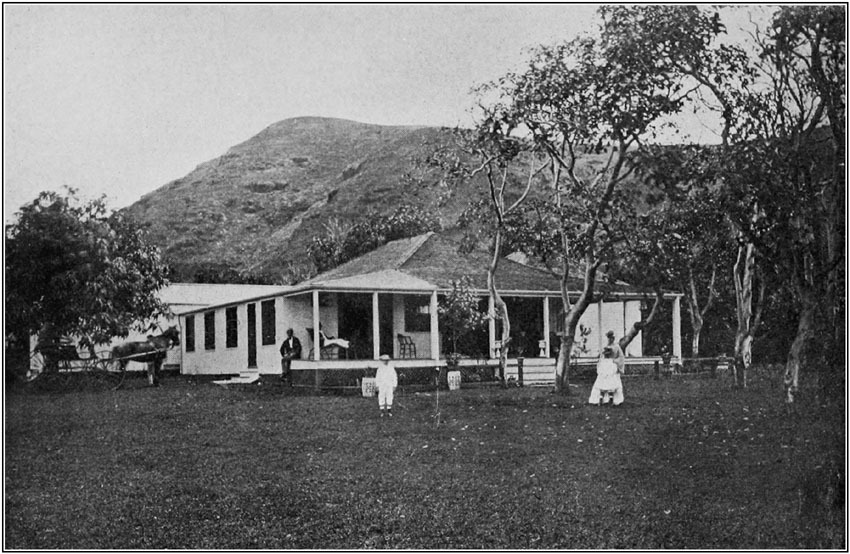
MR. JOHN PATY'S BUNGALOW AT HONOLULUToList
His Majesty replied to the captain as follows:—
Captain—I am pleased to see you here to-day and congratulate you and the officers and crew of the late United States Ship Saginaw upon the delivery from their unpleasant position upon a desolate island. I am glad that my Government has been enabled to render you assistance. The officers of your Service in this ocean have always shown themselves prompt to go to the assistance of distressed men of all nations, and I have lately had a proof of their prompt humanity in the offer of Captain Truxton, of the ship Jamestown, to assist some of my subjects in the Micronesian Islands, and in the efficient aid which he rendered them. Such interchanges tend to promote personal and national friendship.
I sympathize with you, Captain, for the loss of your ship—a misfortune always keenly felt by a sensitive officer, however unavoidable it may have been. I sympathize with you for the loss of the gallant officer and men who, after a long voyage in an open boat, met their death on the shores of Kauai. Such examples of devotion to duty are a rich legacy to all men. Permit me, Captain, to express a hope that you and your officers who have shared with you your service in this ocean for some time past and your peril in the late shipwreck may live to attain the highest honors in your profession.
On Saturday last there was held a sale by a local auctioneer of such articles belonging to the Navy Department as we were able to bring away from Ocean Island. Among them was included the gig which Halford brought from the island of Kauai. We were surprised to learn later that the boat had been bid in by a syndicate of our friends for presentation to us as a souvenir. It has been accepted and we are considering plans for its future preservation. I went down to the dock yesterday to see it prepared for shipment, and its sad story was almost told in the scars upon it. Its bow was bound with iron straps and a large gap in the starboard side was covered with canvas. Its wounds seemed almost as making a mute appeal for sympathy, and expressed the struggle it had gone through.
Halford's Story
When we left Ocean Island, November 18th, we ran to the north to latitude 32°, there took the westerly winds and ran east to, as Mr. Talbot supposed, the longitude of Kauai (Kowee), but it proved ultimately that we were not within a degree of that longitude. We then stood south. Five days out we lost all light and fire and had no means of making either—no dry tinder or wood, although we had flint and steel. About five or six days before making Kauai we succeeded in getting a light with a glass taken from an opera glass. We suffered much from wet, cold, and want of food. The ten days' ration of bread in a canvas bag was mostly spoiled; the two tins of cooked beans could not be eaten, causing dysentery, as did also the boiled wheat; the gallon of molasses leaked out, and the sugar, tea, and coffee were spoiled by wetting. To the dessicated potato, five five-pound tins of which were given us at the last moment before sailing, we attributed the preservation of our lives from starvation. For the last week it was all we had, mixed with a little fresh water.
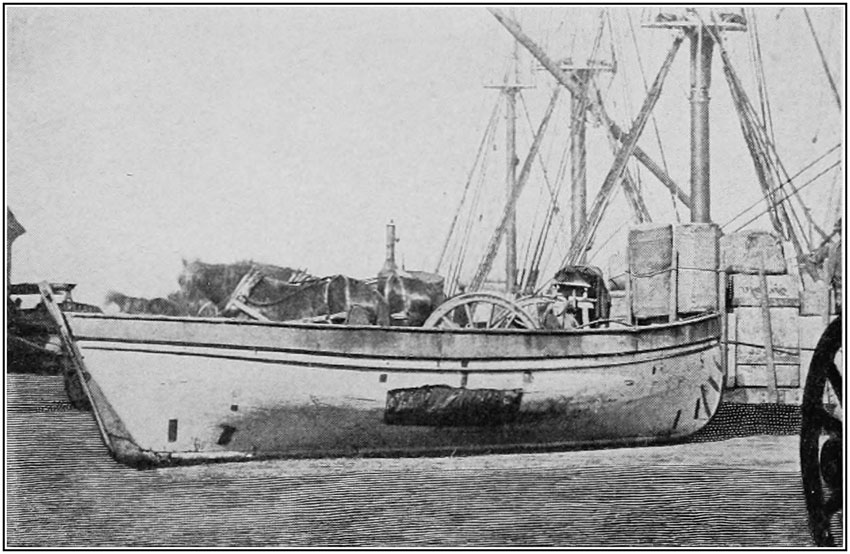
STARBOARD SIDE OF THE GIG AFTER HER EVENTFUL JOURNEYToList
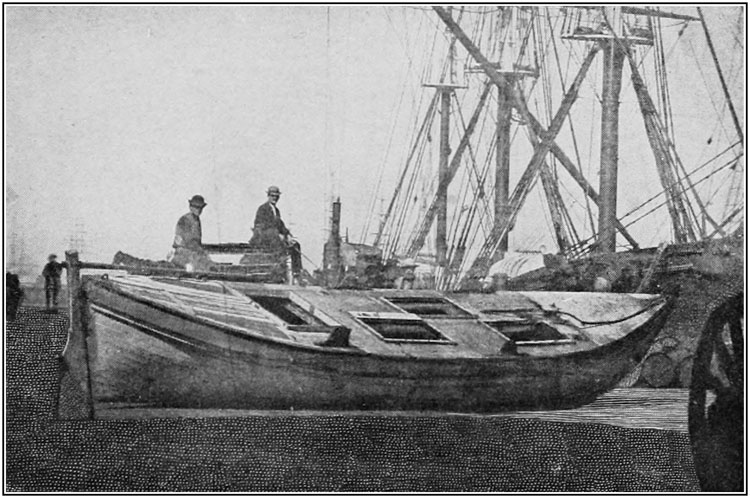
DECK VIEW OF THE GIG AFTER HER EVENTFUL JOURNEYToList
We had heavy weather while running to the eastward; hove to with the sea anchor twice, the last time lost it. We then made another drag from three oars, which was also lost. Then we made still another from two oars and a square of sail by crossing them. That lasted for three turns of bad weather; but the third time it broke adrift and all was lost.
Mr. Talbot was ill with diarrhœa for seven or eight days, but got better, although he continued to suffer much from fatigue and hardship. He was somewhat cheerful the whole passage. Muir and Andrews were sick for two or three weeks. Francis was always well.
We did not make land within a week of what we expected. The first land we saw was Kawaihua Rock, at the southern end of Niihau (Neehow) Island, on Friday morning, December 16th. We stood north by east, with the island in sight all day. During that night and Saturday stood northeast by north, and on Saturday night headed east and south southeast.
Sunday morning the wind allowed us to head southeast with the island of Kauai in sight, and Sunday night we were off the Bay of Halalea on the north coast. We then hove to with head to the northwest, the wind having hauled to the westward. We laid thus until eleven P.M. It being my watch on deck, I called Mr. Talbot and told him that the night was clear and I could see the entrance to Halalea Harbor. He ordered the boat to be kept away and steered for the entrance. As we came near the entrance it clouded up and became dark, so we hove to again with head to the northwest. At one A.M. I called my relief. Andrews and Francis came on deck, as did also Mr. Talbot. After I went below the boat was again kept away toward the land for a short time and again hove to. At a little past two A.M. Sunday morning she was kept away again for the third time. I remained below until I felt from the boat's motion that she was getting into shoal water. Then I awoke Muir and told him it was time we went on deck. He did not go, but I did. Just as I got to the cockpit a sea broke aboard abaft. Mr. Talbot ordered to bring the boat by the wind. I hauled aft the main sheet with Francis at the helm and the boat came up into wind. Just then another breaker broke on board and capsized the boat. Andrews and Francis were washed away and were never afterwards seen. Muir was still below, and did not get clear until the boat was righted, when he gave symptoms of insanity. Before the boat was righted by the sea Mr. Talbot was clinging to the bilge of the boat and I called him to go to the stern and there get up on the bottom. While he was attempting to do so he was washed off and sank. He was heavily clothed and much exhausted. He made no cry. I succeeded in getting on to the bottom and stripped myself of my clothes. Just then the sea came and righted the boat. It was then that Muir put his head up the cockpit, when I assisted him on deck. Soon afterward another breaker came and again upset the boat; she going over twice, the last time coming upright and headed on to the breakers. We then found her to be inside of the large breakers, and we drifted toward the shore at a place called Kalihi Kai, about five miles from Hanalei. I landed with the water breast-high and took with me a tin case of dispatches and letters. On board there was a tin box with its cover broken containing navigation books, charts, etc., also Captain Sicard's instructions to Lieutenant Talbot, with others, among which were Muir's and Andrews's discharge papers; they having been shipped November 15th for one month. (They belong to the contractors, in whose employ they were previous to that time.) This box also contained Francis's and my transfer papers and accounts destined for the Mare Island Navy Yard. This box with everything not lashed fell into the water when we were first upset.
I landed about three A.M., but saw no one until daybreak, when, seeing some huts, I went to them and got assistance to get the boat onto the beach. I had previously, by making five trips to the boat, succeeded in bringing ashore the long tin case first mentioned, the chronometer, opera glasses, barometer, one ship's compass, boat's binnacle compass, and had also assisted Muir to the shore. He was still insane, saying but little and that incoherently. He groaned a great deal.
I was now much exhausted and laid myself down to rest until sunrise, when I looked for Muir and found him gone from the place I left him. Soon after I found him surrounded by several natives, but he was dead and very black in the face.
During the day I got some food and clothing from the natives—one of them called Peter. After resting myself Peter and I went on horseback over to Hanalei to Sheriff Wilcox and Mr. Burt. Then we returned with the sheriff and coroner to Kalihi Kai, where an inquest was held over the bodies of Lieutenant Talbot and Muir, the former having drifted ashore just before I left Kalihi Kai for Hanalei. Mr. Talbot's forehead was bruised and blackened, apparently from having struck the boat or wreckage.
After the inquest the two bodies were taken to Hanalei, put into coffins and buried the next day in one grave at a place where a seaman belonging to the U.S.S. Lackawanna was buried in 1867. Funeral services were performed by Mr. Kenny by reading the Episcopal burial service, and the two Misses Johnson (daughters of an American missionary) singing.
Before I left Hanalei for Honolulu it was reported by a half-white who had been left to watch the shore at Kalihi Kai that Andrews's body had come ashore and had been taken care of.
Captain Dudoit, the schooner Wainona, offered to bring me direct to Honolulu, leaving his return freight at Wainiea for another trip. I accepted the same through Mr. Bent, and we sailed for Honolulu on the evening of Tuesday, December 20, and arrived at Honolulu at eleven A.M., December 24, bringing with me the effects saved as aforementioned. I went, on landing, immediately to the United States Consul's office, where I saw him and the Minister President and told to them my story.
(Note. The reader may remember the incident I related as occurring at the time we were provisioning the gig; the discovery that the boiled rice had fermented and the hasty substitution of the dessicated potatoes. Halford was emphatic to me in the assertion that the potato was the preserver of their lives and that mixed with water it constituted their only food during the last week of their sufferings. The dessicated potato was at that time a part of the Navy ration. It was also called "evaporated," and was prepared by thoroughly drying the potato and coarsely grinding it. In appearance it resembles a very coarse meal.)
Halford has told me of several remarkable incidents which happened during the voyage of the gig and which, although not considered essential in his official statement, would be lifelong memories to him.
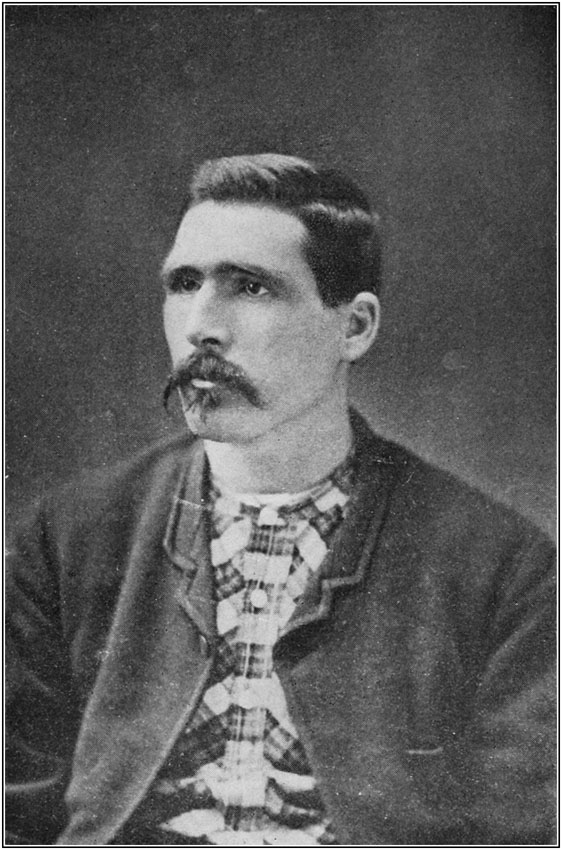
WILLIAM HALFORD The only survivor of the gig's crew. (Now a retired chief gunner in the Navy.)ToList
Of one of these he says—and I give his own words: "We were scudding before a gale of wind under a reefed square sail. A nasty sea was running at the time. I was standing in the after hatch steering; had the reeving string of the cover that was nailed around the combings drawn tight under my armpits to keep out the sea as it washed over the boat, when I felt a shock. The boat almost capsized, but the next sea lifted her over. I looked astern and saw a great log forty or fifty feet long and four or five feet in diameter, water-logged and just awash. We had jumped clean over it. It was a case of touch and go with us."
Of another incident he says: "One night I had relieved Peter Francis at the tiller and he had crawled forward on deck. Somehow or other he got overboard; luckily we had a strong fishing-line trailing astern all the voyage, but never got as much as a bite until it caught Francis and we got him on board again. It was a bright moonlight night."
Of another happening he says: "Then, when our provisions had run out entirely, a large bird came and landed on the boat and looked at me as I stood at the tiller. The other four at this time were very weak from want of food and from dysentery; they were more dead than alive. I caught the bird, tore off the feathers, cut it up in five pieces, and we all had a good meal. It was raw, but it tasted good. About thirty-six hours after this, just at break of day, as I was sitting at the tiller, I felt something strike my cheek. It was a little flying-fish. I caught it, and soon a school of them came skipping along, several dropping on deck. I captured five or six of them and they gave us the last meal we had on the gig: for at daylight I saw land—Tahoora or Kaula Rock."
Our captain has made the following report to the Secretary of the Navy, which adds to and confirms the story of the lone survivor of the gig:—
Honolulu, Hawaiian Islands, January 18, 1871.
Sir:—I forward herewith the brief report called for by regulation of the death of Lieutenant J.G. Talbot (and also three of the crew of the United States Steamer Saginaw) at the island of Kauai (Hawaiian Group).
I feel that something more is due to these devoted and gallant friends, who so nobly risked their lives to save those of their shipmates, and I beg leave to report the following facts regarding their voyage from Ocean Island and its melancholy conclusion.
The boat (which had been the Saginaw's gig and was a whaleboat of very fine model) was prepared for the voyage with the greatest care. She was raised on the gunwale eight inches, decked over, and had new sails, etc.
The boat left Ocean Island November 18, 1870. The route indicated by me to Lieutenant Talbot was to steer to the northward "by the wind" until he got to the latitude of about 32 degrees north, and then to make his way to the eastward until he could "lay" the Hawaiian Islands with the northeast trade winds. He seems to have followed about that route. The boat lost her sea anchor and oars in a gale of wind and a good deal of her provision was spoiled by salt water. The navigation instruments, too, were of but little use, on account of the lively motions of the boat. When she was supposed to be in the longitude of Kauai she was really about one and one half degrees to the westward; thus, instead of the island of Kauai she finally sighted the rock Kauhulaua (the southwestern point of land in the group) and beat up from thence to the island of Kauai. She was hove off the entrance of Hanalei Bay during part of the night of Monday, December 19th, and in attempting to run into the Bay about 2.30 A.M. she got suddenly into the breakers (which here made a considerable distance from the shore) and capsized.
I enclose herewith a copy of the deposition of William Halford, coxswain, the only survivor of this gallant crew; his narrative being the one from which all accounts are taken. I have not seen him, personally, as he left here before my arrival.
Peter Francis, quartermaster, and John Andrews, coxswain, were washed overboard at once and disappeared. Lieutenant Talbot was washed off the boat, and when she capsized he clung to the bottom and tried to climb up on it, going to the stern for that purpose; the boat gave a plunge and Halford thinks that the boat's gunwale or stern must have struck Mr. Talbot in the forehead as he let go his hold and went down.
James Muir was below when the boat struck the breakers, and does not appear to have come out of her until she had rolled over once. He must have suffered some injury in the boat, as he appears to have been out of his mind and his face turned black immediately after his death. As will be seen by Halford's statement, Muir reached shore, but died of exhaustion on the way to the native huts.
The body of John Andrews did not come on shore until about December 20th. All clothes had been stripped from it. The body of Peter Francis has never been recovered.
The bodies are buried side by side at Hanalei (Kauai). The service was read over them in a proper manner. Suitable gravestones will be erected over them by subscription of the officers and crew of the Saginaw.
As soon as we had gotten on Ocean Island after the Saginaw's wreck, Lieutenant Talbot volunteered to take this boat to Honolulu, and the rest volunteered as soon as it was known that men might perhaps be wanted for such service.
Mr. Talbot was a very zealous and spirited officer. I had observed his excellent qualities from the time of his joining the Saginaw (September 23, 1870) in Honolulu. During the wreck and afterwards he rendered me the greatest assistance and service by his fine bearing, his cheerfulness, and devotion to duty. His boat was evidently commanded with the greatest intelligence, fortitude, and gallantry and with the most admirable devotion. May the Service always be able to find such men in the time of need.
The men were fine specimens of seamen—cool and brave, with great endurance and excellent physical strength. They were, undoubtedly, those best qualified in the whole party on Ocean Island to perform such a service. Both Lieutenant Talbot and his men had very firm confidence in their boat and looked forward with cheerfulness to the voyage. Such men should be the pride of the Navy, and the news of their death cast a deep gloom over the otherwise cheerful feelings with which the Kilauea was welcomed at Ocean Island.
I do not know that I sufficiently express my deep sense of their devotion and gallantry; words seem to fail me in that respect.
Previous to the sailing of the boat from Ocean Island I had enlisted John Andrews and James Muir as seamen for one month. Since I have ascertained their fate I have ordered them to be rated as petty officers (in ratings allowed to most of the "fourth rates"), as I have thought that all the crew of that boat should have stood on equal footing as regards the amount they might be entitled to in case of disaster, as they all incurred the same risk.
Andrews and Muir belonged to the party of Mr. G.W. Townsend (the contractor at Midway Islands), and it was made a condition, by them, of their enlistment that it should not interfere with their contract with Mr. Townsend. It was intended as the security of their families against the risk incurred while performing the great service for the shipwrecked party. I have forwarded their enlistment papers to the Bureau of Equipment and Recruiting.
I am very respectfully, Your obedient Servant, Montgomery Sicard, Lieut. Comdr. U.S.N. Comd'g.
Hon. George M. Robeson, Secretary of the Navy.
In God's Country again
San Francisco, February 8, 1871. After a pleasant voyage in the Moses Taylor we are again, all hands,—minus our gallant comrades,—on American soil, and the cruise of the Saginaw is officially closed. The officers have taken up quarters on shore, and the crew temporarily transferred to the U.S. Steamer Saranac for discharge or detail as their period of enlistment may require. The gig came with us and will be temporarily stored until it is decided as to her future. We have started a subscription for a suitable memorial to the gig's heroes, and the other ships of the squadron have generously offered their help. The most approved plan seems to be a marble tablet on the walls of the chapel at the Naval Academy, and the captain has made a sketch of one as it would appear there.
(Note. November 1, 1871. The tablet as designed has been completed and delivered at the Naval Academy. The following picture shows its appropriate character, and I deem it a fitting conclusion to my story. The gig is also to go to the Naval Academy to be deposited in the Museum.)
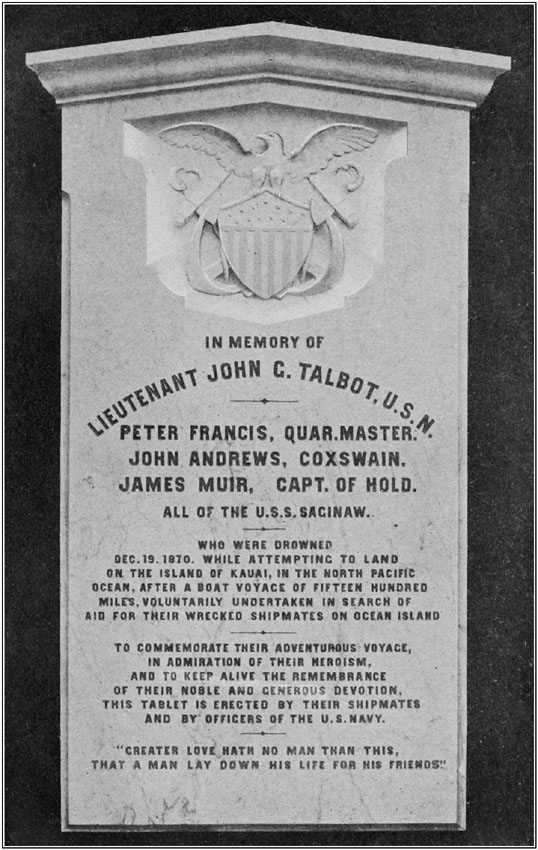
THE TABLET Now on the walls of the chapel at the United States Naval AcademyToList
THE END
APPENDIXToC
I
I have been asked several times how it came about that our good ship could have met her sad fate when so recently out of port, her officers knowing the existence of the dangers so near. I have confined my narrative to personal experiences and to incidents of the life under the conditions surrounding us. However, as such questions may arise in the mind of some readers and in order to enlighten them, I set down below some copies of the results from official investigations by those higher in authority.
First: There is the report of the Court of Inquiry held upon our arrival in San Francisco, which reads thus:—
The Court is of the opinion that the wrecking of the Saginaw was caused by a current, as the evidence shows care in running the vessel at a safe rate of speed and the log-line was found to be correct two days before and had been used only ten hours at sea afterward, and that Lieutenant Commander Montgomery Sicard used due vigilance and care in the navigation of his vessel, and after striking upon the reef that he exercised sound judgment and exhibited great skill and prudence.
This was followed later by the Secretary of the Navy's annual report to the President, from which the following is an extract:—
Leaving Midway Islands on the 28th of October, Commander Sicard, of the Saginaw, determined to run to Ocean Island, a small island lying about one hundred miles to the westward of Midway, to rescue any sailors who might have been wrecked there and who, being out of the ordinary track of vessels in that part of the Pacific Ocean, would have little chance of relief from any other source. This expedition, though in the direct line of his duty as the commander of a naval vessel, was fraught with the usual perils of navigation in unknown and dangerous waters, and about three o'clock on the morning of the 29th of October, the Saginaw, running slowly in the darkness, was wrecked on a reef outlying the island for which she was bound. With much exertion and the exercise of much energy and skill, all on board, including the officers and men of the ship and the working party from Midway Islands, were safely landed, with a small allowance of provisions and materials rescued from the wreck. Cast upon the shores of an uninhabited island with scanty means of subsistence, out of the line of travel, and more than one thousand miles from the nearest port of refuge or relief, then it was that the commanding officer of the Saginaw illustrated the benefits of the comprehensive education and strict training which he had received at the hands of the Government and exhibited the high personal qualities which characterize him as an officer. Ably seconded by his subordinate officers of every grade, Commander Sicard took immediately every possible means for the health, safety, and final relief of those who were committed to his command. Whatever could be saved from the wreck was at once secured; measures were immediately taken to keep up the health, spirits, and discipline of the men: fresh water was distilled by means of an old boiler, and everything was organized so that there was no waste of either provisions, material, or labor.
The boat fittest for the service was promptly repaired, provisioned, and equipped, as far as might be, for the perilous voyage. Manned by one officer and four men, all of whom volunteered for the service, it was dispatched to Honolulu, the nearest port from which relief could be expected. After her departure work was vigorously pushed on the island; and when finally rescued, the shipwrecked marines with well-directed labor had almost completed, from the material of their old ship, a new schooner perfectly seaworthy and sufficient, under favorable circumstances, to carry the whole shipwrecked party to a port of safety. I have thus collated some of the facts of this case to illustrate my high opinion of the energy and ability displayed by Commander Sicard and his comrades on this occasion and to show how well such conduct repays the favor of the Government.
After relating the history of the boat's voyage which we have already read, the Secretary concludes as follows:—
The death of Lieutenant Talbot closed a career of unusual promise, and in it the Navy lost a brilliant and beloved member. A skillful sailor, an accomplished officer, and a Christian gentleman, his self-sacrifice has arrested the attention of his comrades and will remain an example to the Service which in life his virtues adorned and whose highest qualities were illustrated in the crowning heroism of his death. His comrades of humbler rank will not be forgotten; with him they faced the dangers of the lonely ocean and offered their lives with his to save their shipwrecked messmates, and no one can estimate how much of danger and suffering, perhaps death, was saved through the courage and endurance of the sole survivor of that gallant boat's crew.
II
The following is a list of the officers and crew of the Saginaw as it appeared on the pay-roll at the time she was wrecked; I feel that I should name them all in recognition of a comradeship in suffering never to be forgotten where each one performed his duty unflinchingly:—
Officers
Montgomery Sicard, lieutenant commander. John G. Talbot, lieutenant. J.K. Cogswell, Perry Garst, and A.H. Parsons, ensigns. George H. Read, passed assistant paymaster. James Butterworth, passed assistant engineer. H.C. Blye, passed assistant engineer (in charge of contractor's party). John J. Ryan, C.D. Foss, Herschel Main, and Jones Godfrey, second assistant engineers. George H. Robinson, master's mate.
Petty Officers
Peter Francis, quartermaster. Nicholas Barton, quartermaster. Thomas Hayes, sailmaker's mate. John Lane, boatswain's mate. James Foschack, gunner's mate. J.M. Logan, yeoman. William Halford, coxswain. Samuel A. Thompson, master at arms. Charles Hale, paymaster's yeoman. A.E. Myfinger, cabin steward. Solomon Graves, cabin cook. Joseph Ross, wardroom steward. George D. Wauchoss, wardroom cook. Henry B. Clark, third-class apothecary. William Edman, ship's cook. Henry Wallace, steerage steward. L. McCabe, steerage cook.
First-class firemen, Francis Scott, Lorenzo Coburg, George White.
Second-class fireman, George Hubert.
Seamen, William Cairns, Michael Lynch, Henry D. Vivian, Daniel Collins.
Ordinary seamen, Joseph A. Bailey, John H. Wallace, Dennis A. Fitzgerald, John Daley, Charles Brown, Dennis M. Hayes, Michael Jordan, Edward James.
Landsmen, James Nichols, W.J. Evans, Edward O'Brien, Thomas Kearney, J.R. Miller, Martin Doran, William Fallon, Thomas Larkin, Joseph McLaughlin, George Saunders, William Combs, Joseph A. Agarrie, Michael Garvey, John Murphy, John Downs, James McNamara, John Riley, Thomas Melody, James M. Nolan.
Marine guard, Charles A. Martin, orderly sergeant; John G. Moore, corporal; Phillip Morris, corporal.
Privates, D.G. Brennan, Thomas Wiseman, David Muir, James Sarsfield, Thomas Jones, John McGrath, Lewis Peck.