Introductory material (continued 2)
Reading edition
Questions arise here which it is quite necessary for us to answer at once. Why, indeed, do we Americans lay such great store by our peculiar racial heritage? Are not our recent immigrants, taken as a whole, as "good" as we? If we do not desire to bring children into the world, should not our country be left to others who are willing to undertake the responsibilities of parenthood? Hence, why are we not disposed to accept our dissolution silently and go to the grave with a smile?
The answer to these questions is implied in the title of this article. It is the cherished belief of the members of the Knights of the Ku Klux Klan that democracy—democracy in all its aspects, the social spirit of democracy, the practice of democracy, the regeneration of the soul of mankind through democracy—that this is the greatest of all values created by modern civilization. We hold further that the part played by the American people in the evolution of democracy has been of primary importance. Despite all our mistakes, and they have been many, we have succeeded. And our success, even with its limitations, has been, we fully believe, as a light and as a leading to all the world. It was our glorious privilege to unlock the prison door of France when our sister republic was first created in the French Revolution. It was largely the success of universal, white, male suffrage in America which impelled our brethren of the British Empire to undertake the same colossal experiment. No doubt our history has been the subject of far too much fervid eloquence and vain boasting. We have not often hesitated to tell all the world about ourselves. Here I am seeking merely to state the simple facts, because without them the standpoint and argument of the Knights of the Ku Klux Klan could not be understood.
Among the most false of theories which sane minds ever gave themselves over to believing, has been that which claims that the democratic system, if only put on trial, will work among any people at any time. Indeed, many persons otherwise well informed still accept this folly. They believe that democracy is a sort of "universal truth." All that we must do is to preach it to all mankind as a sort of saving gospel. All the heathen need do is to accept it, believe it, and forthwith practice it. Oh, vanity of vanities! It has been three hundred years since the English Bill of Rights was signed by King James First and nearly one hundred and fifty years since our American Declaration of Independence. And now the Great War has ended with our seeking to ram democracy down the throats of nations which do not want it. What blows in the face our optimism receives from the simplest facts of history! One hundred and thirty years ago the French revolutionists attempted to pull down every throne in Europe and plant democracy in every land. And then only seven years ago the hosts of the Kaiser made their plunge toward Paris in order to destroy the French Republic and establish absolutism and kultur in its place.
No! The practice of democracy does not spread around the world as rapidly as we can tell people how nice it is and how much we like it ourselves. Democracy has been a slow, delicate and perishable growth among a specific group of Europeans. These peoples have been much favored through a peculiar heritage. No doubt, ages ago, it took the ancestors of man a long, long time to stand upright. Some quadrupeds seem to have tried but never could learn the new method, so they still amble along half the time on all fours. So to-day it seems to take a considerable period for the masses to learn how to rule themselves successfully. Yet we ought not to be utterly discouraged. If the facts indicate that some peoples can never learn, that is no reason at all why we should surrender our own learning and growth in order to be equal again with the weaker brethren.
Democracy is on trial. It is on trial in America just as much as anywhere else. It is being weighed and revalued before the whole world. We have seen many a European people after being overurged to accept a republican form of government, again returning to autocracy. The Greek majority which recently voted to bring back the Kaiser's ally, King Constantine, and the Kaiser's sister, the Queen, was rather staggering in its size. If a vast majority of the Greeks in their home country joyously accept monarchy and Hohenzollernism, how can we expect our Greek immigrants here in the United States to enthuse over our republican institutions? They come, like others, as everybody knows, to avail themselves of the opportunity to advance their material interests. This has been true with the majority of our immigrants for over fifty years. Who, indeed, can blame them for taking advantage of economic conditions in America? Indeed, these immigrants of every sort and kind are well within their rights. If some of them seem to make too much money out of us, is it not because some of our employing class first urged their coming in order to make money out of them? We brought them in because we thought they would be cheap and profitable to us. Some of them have proved in the long run to be very dear and unprofitable.
Let me here make a general observation regarding the attitude of my colleagues and myself in connection with this whole matter of immigration. Where, in these chapters, mention is made of any particular race or group of immigrants, not the slightest offense is intended. But too often our squeamish fear of giving offense to the over-sensitive has prevented our discussing this most crucial of our national problems. Everyone feels free to-day to discuss Russia, to investigate Russia, to come to conclusions with reference to what is being done in Russia, and to make suggestions as to a Russian policy. Why, then, we ask in the name of all common sense, should it be an offense to anyone to discuss the millions of Russians who live in the United States? How do they make a living, and what is their percentage of national increase? Are they or are they not desirable immigrants? The same holds good of the Germans, the Irish, and of every other racial element which is increasing among us. All this is interesting to us and greatly important. It is interesting and important in more ways than one. What the immigrants may and should demand, what the Negro or the Japanese are quite right in demanding of us, is that we as native-born, white Americans should discuss these questions of population in a way that is at once honorable and kindly. We must stick to the facts. We may indulge neither in slander nor in base insinuation. Those of our immigrant population who have been received into citizenship may ask especial consideration. We, of the Klan, on our part propose to bring facts in support of a policy. There may be those who wish to disagree with us publicly. If so, we shall expect to be asked to consider only facts brought in rebuttal. As man to man, marshalling fact for fact, let us sit down together and seek to sift this matter to the bottom.
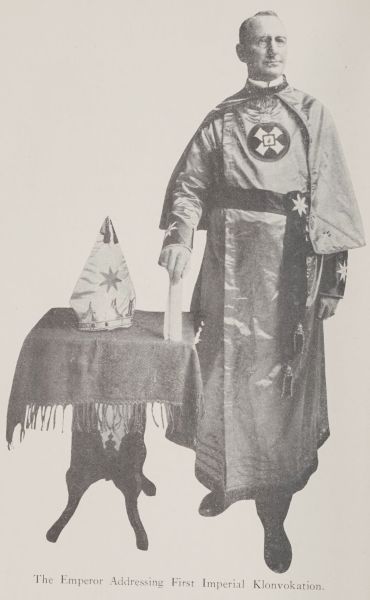
The Emperor Addressing First Imperial Klonvokation.
CHAPTER XI
Our Cities a Menace to Democracy
Referring again to the menace of the American city to American institutions, I desire to remind the reader of the thought of some of our most profound thinkers on the great problems of democracy. Some of these views expressed at different periods of our history were prophetic, and some of them were conclusions, as though the visions of the seers were being fulfilled. In the early days of the republic when there were no great cities in our country and when the tide of immigration had just begun to flow to our shores and settle in the growing centers along the Atlantic seaboard, Mr. Jefferson said, "The American city is a cancer on the body politic." He seemed to foresee, at the very beginning of the republic, the deadly poison of anti-democracy generated among the alien people congested in our cities. In 1866 Wendell Phillips, a powerful advocate of emancipation, said, after the great conflict was ended and the Negroes free, "The time is coming when the American city will strain the government as slavery never did." He, too, foresaw the virus which the city would spread to the entire nation, attacking and consuming the great principles of democracy upon which the republic was founded. In recent years, Lord Bryce, Ambassador of Great Britain to the United States, after years of study and careful investigation, wrote that classic entitled "The American Commonwealth." In this work there was much commendation of American institutions, but the book was not without candid criticism. He said that "the conspicuous failure of American democracy is in its great cities." The clear meaning of the eminent Englishman was that the American people remained really democratic only in the rural sections and the villages. Already conglomerate population from every clime and shore had destroyed democracy in our congested centers. Only recently Mr. H.G. Wells, one of the most conspicuous, progressive thinkers in the world, looked upon New York with its seething millions, heard its Babel of languages, felt its delirious fever, and then calmly announced that Petrograd in its rust and desolation was a picture of New York in the future. In our greatest city, this profound student of social and political life saw unmistakable evidence of the real and seething madness of Bolshevism which meant the overthrow and the utter collapse of all things democratic.
We are told to-day (1920) that millions of workers in our great cities are unemployed. I reflect at once upon the figures which are placed before us. In round numbers we have, this winter, about six millions of unnaturalized foreign working people living in our cities, and almost exactly the same number of employed on our hands. What would they have us do? Are six millions more to come to us and thus give us a total of twelve millions of unemployed? What would these people all do for a living? There are simply not enough jobs in the cities for them, and it seems evident that there will not be in our generation. It is these masses, which, by sheer force of number, gave us the present insoluble problem of the city. Our cities can maintain their large populations only if the country population is increased to supply them food and raw materials on the one hand, and with markets on the other.
Overgrown cities are in themselves a menace. When the surplus is composed of unassimilated and unemployed aliens the menace is doubled,—nay, it is multiplied tenfold. The great city as at present constructed and conducted corrodes the very soul of our American life. Factory work, with every new invention of automatic machinery, progressively selects those who are more and more unfit to be Americans. A factory manager in Chicago recently amended a new rule for the selection of employees. He would hire no blondes. The big blonde people, he said, "would not stay at their machines until the whistle blew." He was evidently hunting for a people who could be trained never to move a foot, or an eye, for ten hours a day. The growth of an American is ordinarily impossible under the conditions of either great wealth or great poverty. The city simply can not furnish the character-building elements which must needs go into the making of an American. Every American child should be born to a vast heritage. This heritage should include a fine healthy parentage, clean birth, gentle care, proper nourishment and opportunity for play and education in the open country.
Is there no cause for the Knights of the Ku Klux Klan among the robust, native-born folk of the countryside? Is not the menace of the city to our ideals and institutions an urgent demand for the organization of our unspoiled rural life to save the nation from infection by the great cities?
It may be that we are too late in starting this movement of "America for Americans and Americans for America." No doubt it should have been begun thirty years ago. But if we can find some method by which, after ten years of entire rejection, immigration can be narrowly and rigidly restricted, and by which the surplus population can be distributed over the vast, uncultivated area of our great country, and slowly wrought into our social life, there is yet a hope left for our country. But if alien populations are permitted, as in the past, to flood our land, colonize in our great cities, and propagate their kind with such amazing rapidity, while only native-born Americans continue to till the soil and propagate their kind in an appallingly decreasing ratio, then our country is lost and everything the fathers strove to build for posterity will sooner or later be wiped out. We do not in the least seek to hide the fact that the Ku Klux Klan is making a last stand for America as the home of Americans and Americanism.
CHAPTER XII
The Failure of Democracy in Central and Eastern Europe
To the average country-born American the period of the war has been a time of painful disillusionment. There may have been among us some who, before the war, had some accurate knowledge of what was going on in the world; but the great mass of Americans were very much shocked by the succeeding event. We took the statements of the leaders of the people in Germany and Russia at their face value. It seems to me to be very much worth while, at present, to trace the various events by which we were led into knowing what central and eastern Europe were really thinking and doing. Let us recall our first period of disappointment. We had always believed that the parties of the people in Germany, especially the great social-democratic party, had the power to prevent the Kaiser from undertaking a war of conquest. The declaration of war was to be the signal for a revolution and the creation of a republic. This was rather taken for granted, without investigation, by reading people all over the world. When we saw the entire German nation, with hardly an exception, turn quite insane with the war spirit, we sat back and wondered what this people was really like.
It was also a generally accepted theory among us that the German immigrants who came to us had left Germany because they disliked the tyranny of its government. Then, in 1914, with a suddenness that quite took our breath away, came the propaganda of "Kultur." The entire German nation, through every means it had of speaking to the outside world, informed us blandly that it possessed a system of society infinitely more efficient and desirable than democracy. "It is Germany's duty under God," wrote Bernhardi, "to give her superior culture (Kultur) to all inferior peoples." Indeed, the war itself was generally interpreted by Germans as an act of charity and self-sacrifice upon their part. At the time the idea was so new to us that it took us just three years to really comprehend what was going on in Europe. Even President Wilson, in 1916, declared publicly that we did not know the real causes of the War.
We may or may not have completely destroyed the Germany autocracy; but we may be sure we have by no means done with the system of Kultur. It is all too easily put into practice. The stupendous machinery and organizations of modern industry presents a perfect maze of social problems for solution. Kultur is, by far, the easiest way out. The direction of the whole business of life is simply turned over to a "great man" or to a small clique. People everywhere are naturally lazy and morally irresponsible. For the thinking and characterful minority there come times of mental anguish and disillusionment. To-day the times tempt us to despair. We are almost driven to lose faith in the majority and so in government by the majority. "Why not try a change," "it could not be worse;" we hear it said on every hand. So, perhaps, we in America may yet try Kultur. Certainly we shall if we again have unrestricted immigration. When democracy fails, some form of monarchy will be our only salvation from oligarchy; and an oligarchy is more dangerous to freedom than monarchy. A monarchy, with our peculiar industrial development and our great propertyless masses, means Kultur.
In the midst of the Great War came the Russian revolution. We sat back and said, "How fine! Now they are going to follow our example by building a great Russian Republic, which will soon break down the German autocracy." Even now most of us do not begin to understand what has really happened. What we do know is that the Bolshevists have not only created a state of universal starvation, disease, and despair throughout Russia, but they have also tried to spread their system throughout Europe and the world. To this end they have made foreign war and conducted an enormous and costly world propaganda. As I write we learn that, while we were voting credits and collecting funds for the starving in Russia, they were paying $30,000 to a single agent to execute a single murderous bomb-plot in New York City.
In our last chapter we quoted Mr. H. G. Wells's statement that New York City will be the next Petrograd. This observation can be, by no means, taken jocularly. Go in our present course, and Bolshevism will be, in all our larger cities and industrial districts, the natural alternative for monarchy. Compelled to choose between the two, our original American people will probably divide and civil war will result. Lenine and Trotsky did not create Bolshevism. Bolshevism grew as naturally as a rank weed on a dunghill. It sprang from ignorance and poverty and despair. It will appear wherever ignorance, poverty and despair are mixed together. Quite likely we shall have, with unrestricted immigration, a Bolshevist revolution first, then monarchy and Kultur.
A great many persons are disposed to compare the present state of central and eastern Europe with the conditions in France at the time of the French Revolution. I, for one, am not at all impressed by this easy explanation. The French Revolutionists represented and advocated a movement toward democracy for all Europe. Both the Germans and Russians have burst out upon us shouting that, in their peculiar system of tyranny and slavery, they had something better than democracy to proffer us. The average reading American throws up his hands and cries, "What in Heaven's name, will China next urge upon us, or Africa?"
What has happened to us is, after all, upon reflection, quite simple. We are placed on the defensive for democracy. And we have wisely given over trying to urge our point of view and our peculiar system upon those who not only reject it but openly despise it. No doubt this has been a severe shock to our ancient national conceit. Let me again emphasize that democracy seems to be, for the present, limited to the boundaries of certain peculiar nations. Other peoples may evolve into democracy later. But their steps will be slow. Their experience will be gained gradually. We can not help them much, if at all, by urging them merely to follow our example. Meanwhile, if there be anything precious in democracy for us, we had better bestir ourselves to save what we have left of it.
CHAPTER XIII
Foreign Outposts in the United States
Four distinct national elements in the United States showed, in lesser or greater part, disloyalty and pro-Germanism during the War. These were the Germans, the Jewish Bolsheviki, the Sinn-Feiners, and the French-Canadians. Of course these four were no different from most other foreign-speaking elements. Only their standpoints and loyalties were clearly brought out by the war—that was all. Italian or Portuguese, Greek or Slav, in case their home country had been lined up against the United States, would have acted in just the same way.
Here we must touch upon a fact which is pretty widely known or taken for granted. There is a fundamental difference between this later immigration and that of the middle portion of the nineteenth century. The Germans, Hungarians, and Italians of 1848-70, for instance, came to America for the same reason as most of the original British and Irish. They were seeking freedom and democracy. Their purposes were idealistic. They sought in the new country not only economic opportunity but political liberty which were denied them in the old. They were Americans at heart before they left their old home.
The new immigration is totally different. This later swarm has come mostly to get jobs and money. Among them, no doubt, there are a few who are gifted with qualities of mind and character which make this description inapplicable. I am referring to the many, not the few. In Southern and Eastern Europe they form the lowest grade of the working class and include a large percentage of beggars and peddlers, of thieves and criminals. The average immigrant of this sort has been accustomed to a condition of poverty unknown to, and almost unimaginable to, the average American. His physical standards of living are such as to make his competition with the original American worker unfair and deadly. Great masses of them have come without the slightest intention of remaining with us and adopting American standards. Herded together under the most unsanitary conditions, hoarding up their wages with a greed incomprehensible to an American, crowds of them rush back to the country of their origin as soon as their savings are sufficient for their purposes. Meanwhile they are replaced by others until the standards of living of the American-born wage-earners are hopelessly undermined. Each immigrant who comes to us under these conditions prevents the founding of an American home and the birth of American children. Let us hasten to add that their coming and going can not in any way be held as an accusation against themselves. Responsibility lies entirely with us. Employers who bring them over, or prevent their rejection, under the conditions stated, are guilty of a monstrous crime against civilization. This crime is comparable to only one other in our history—the African slave-trade of the seventeenth and eighteenth centuries.
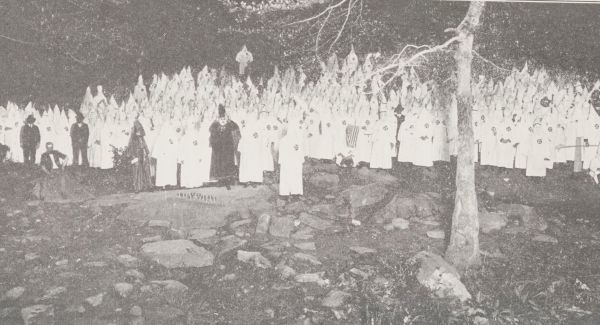
Where the Water Gushes From the Rock Klansmen Assemble Each Year to Drink the Libation of Fellowship.
Meanwhile every conception and institution upon which our social and political life is established is torn from its mooring and broken up by the force of the inpouring waves. In Southern and Eastern Europe and in the Near East, these masses are, or have been, until very recently, ruled as they were in the Middle Ages. Rebellion against tyrants to them means acceptance of Anarchism or Bolshevism, or at least German state Socialism. East of the Rhine and south of the Alps they are capable at present only of running wildly about from one tyranny to another, from one stupid blunder to another and back again. If this population in Europe is proving itself to be totally incompetent to govern itself, how can we expect it to take an intelligent and useful part in all the complexities of democracy here? If a million Hungarians, for instance, have failed at every point of the political compass in Hungary, how, in Heaven's name, can we expect them to succeed in New York or Chicago? That mass of Hungarians, like Italians and Germans, like Jews and Greeks, induces the vilest sort of boss rule. They are largely kept away from our public schools by clerical opposition to our school system. A slave population in Europe, they become a slave population here. Politically they are the willing tools of every hidden and dangerous force at work in our public life.
It is no part of my purpose to arouse, in the slightest degree, hatred of these people. Many of them are kind, innocent, simple, unknowing creatures. As strangers in a strange land, they deserve every degree of consideration, every means of help at our hands, which it is in our power to give to them. Their natural inclination, as well as their great numbers, are responsible for that separation from us which the foreign quarter implies. The continued use of foreign languages, and the clinging to foreign customs, are things which should never have been tolerated on our soil. By herding together they bring up their children in a foreign atmosphere, thus perpetuating and increasing the weaknesses and dangers which they have brought into our national life. I used the word "increasing" advisedly. In Europe each unit of this backward and inept mass of poor is merged in a nation which understands him and where he, in turn, somewhat understands his surroundings. But segregated by language and nationality here, they are broken away from their old moorings without binding themselves to the new. In the old world they are led politically, sometimes, by men of education and ideals. With us they fall easy prey to any fool and fakir and dishonest representative of the political machine or vicious interest which may seek to prey upon them and mislead them.
A few particular facts concerning propagandistic activities among our immigrant population may be illuminating if set down together. During the war the pro-Germans organized and conducted a most elaborate and expensive propaganda among our Ukrainian immigrants. This was done in order to weaken Russia at home, both before and after the revolution.
Sinn-Fein Irish, because of their inveterate hatred of the British, were in many cases used to spread pro-German propaganda. This was effectual both before and after we went into the war.
A very large percentage of the Russian Jews in New York City and elsewhere were, at the beginning of the war, pro-German because they were anti-Russian. After we entered the war they were bitterly anti-American because they were pro-Bolshevist. No possible turn of events could make them take a pro-American position upon any issue under the sun. This is the element, by the way, which used funds from Russia to carry on its pro-Bolshevistic propaganda among our Negroes. In certain places, including New York City, it urged the Negroes to arm themselves and fight the whites.
The French-Canadian immigrants among us number, with their children, nearly half a million. During the war they were, strange as it may seem, anti-French. The French-Canadian population is completely dominated, politically, socially and intellectually, by their clergy. These clericals still hate France and the French Government because the French Revolution overthrew the power of the Roman Church in France. They still belong to the ancient regime. So they naturally took the side of the ancient regime, the German side. Among us, they were largely passive. In Canada they actively opposed every war activity of their government from start to finish of the war.
Of the Asiatics there are two main elements—the Japanese and the East Indians. Of the East Indians there are not many, but their number is steadily increasing. They are being widely used to stir up an Indian revolution against the British Empire. Whether this is or is not justified we are not discussing here. The point is that this foreign element is using America as a vantage-point from which to make war upon another country.
Finally, we come to the Japanese. Here we find the climax of this whole matter. The religion of the Japanese immigrants is, primarily, Mikado-worship. Sums of money to build the temples for this delectable form of religious expression are furnished largely by the Japanese government. When we ponder these facts we may well ask whether we as a nation do not ourselves require a guardian. We resemble a five-year old child with a purse full of money, sitting in a poker game with greedy and astute gamblers. To carry our sentimentalism so far, to overwork the theory of the brotherhood of man to such an extent as this, is to court total disaster. We as a nation are asleep because selfish, corrupt and designing interests among us have drugged us out of our senses. These great interests want cheap labor. They are aided in their designs by a crowd of well-meaning but ignorant sentimentalists, most of whom do not dream that they are helping to destroy our American nation in order to experience an emotional satisfaction. The employers get their cheap labor, and the sentimentalists their self-satisfaction. We, the foolish majority, are losing our freedom and our country. If the facts do not cry us into action, why multiply words? All America is hoping, praying and preparing for peace with Japan. But to further permit even the smallest amount of Japanese immigration will surely tend to war. In the event of war any American in Japan will undoubtedly take the side of his own country. We shall fully expect him to do so. For the same reason the hundred and fifty thousand Japanese in our own country will prove to be a hundred and fifty thousand skillful and resolute enemies. Making an American out of a Japanese under the conditions above described is as impossible as making a sheep out of a goat, or a dog out of a cat. As to whether or not we are superior to the Japanese, is not the matter at issue here. The important fact right here is that we differ greatly from each other in the basic things of life, and these differences are largely inherited qualities. Furthermore, these differences must surely make Japanese amalgamation with our people wholly undesirable. Such a mixture of bloods runs counter to a fundamental principle of biology which all high-school children learn as a matter of course. The offspring of such a blending of widely different stocks are likely to be unstable in mind. In general they can not qualify as to either the physical, mental or moral standards of either race. In amalgamation there is likely to be a loss from the standards of either side.
The Japanese child in the United States is sent to a school owned and controlled by the Japanese Government. There he is taught the language, ideals and duty of an abject subject of the Mikado. Finally, the Japanese birth rate in California is sixty-nine per thousand annually, the white birth rate nineteen per thousand.
"But the pure descendants of the Japanese immigrants may surely change and become real Americans," I hear somebody saying. Meanwhile, we have just been informed that the son of German parents in Cincinnati, who had accepted a Captain-Surgeon's commission in our army and gone to France had not been perfectly Americanized. The fellow was hanged for inoculating our soldiers with disease germs instead of typhoid serum. This creature was born and reared not in the United States, but in the German section of Cincinnati. With this in mind we expect to Americanize the Japanese, the very breath of whose intense religious emotion is the sacred worship of their absolute and august ruler, the Mikado!
Be it a million Russians or a million Japanese, a million Italians or a million French-Canadians—either their importation or their birth upon our soil prevents by the stifling force of economic competition the birth of a million Americans. In the name of Almighty God and our country, what has become of our brains? These facts are enough to make any of us not totally bereft of his senses to go into the highways and the byways crying for the Knights of the Ku Klux Klan, or if some man has a better plan for safeguarding the nation conjuring him in God's name to proclaim it.
CHAPTER XIV
The Racial Limitations of Democracy
Democracy is the practice of self-government by the people. It is the rule of law instead of persons; of the majority instead of the minority or individual. As a system both of government and social life it has but recently been either widely accepted in theory or established in practice. A short three hundred years mark its very real advance in the modern world. Only during the past hundred years has majority rule been accepted as desirable or possible among a very few of the more advanced countries. If we examine the political map of the world we find that the triumphs of democracy are limited to but a few nations. We may generalize by observing that a very few nations have but recently succeeded in making democracy work.
What part is democracy likely to play in various quarters of the world during our present century? Are we to see, now that Europe and Asia are torn from end to end by revolutions, a sudden adaptation of all these backward peoples to the democratic method? All recognize that we are just now going through one of the greatest of revolutionary periods in history. Maybe the millenium of universal freedom and democracy is even now at hand. Let us see.
The practice of political democracy to-day is practically limited to two main groups of nations—the English-speaking and the Latin. Of the latter group, Spain alone tarries in the Middle Ages. Besides these we have Holland and the three Scandinavian countries, which, while ruled by kings, are democratic in both thought and practice. In a previous chapter we have described the pitiful surrender of the German people to absolute monarchy and state socialism, and their recent trembling efforts toward freedom, as well as the sad miscarriage of the attempted democratic revolution in Russia.
Beyond the limits of Europe, the two Americas, and English-speaking colonies over seas, there is little enough hope for the growth of democracy anywhere in the immediate future. The most fulsome optimism can not expect the Chinese republic to succeed in our day. For a long time in the future, as in the past, the "white man's burden" is going to include practically the whole of Asia and Africa.
The limitations of democracy are set by many considerations. These involve first the state of biological evolution in which a particular race finds itself; second, the particular history of the particular country under discussion. The African Negro can not realize democracy to-day because he is psychically, and hence morally unfitted for its responsibilities. The cause here is biological. The German people are the first cousins of the English, being much the same in blood. The difference between the two peoples are not biological, but historical.
Democracy in practice requires certain mental and moral qualities. The most outstanding among these are intellectual acumen and a knowledge of public affairs. Among the moral essentials are a spirit of good sportsmanship, a profound regard for the rules of common honesty, and above all, a fine sense of personal honor. Democracy must be based upon character. Every qualification we have mentioned necessitates a large measure of economic freedom; for without this, the individual is enslaved and driven in things political. They imply, also, freedom from tyranny of intermeddling by any religious power. Unity of church and state, or the interference in politics by a religious organization for ulterior purposes, makes true democracy impossible. The individual citizen must always have perfect freedom of political choice. For the masses in any nation to acquire these qualities is to place that nation in the very front rank of the world's political civilization.
We now come to the most important element of all. In any well ordered democratic country there must be a high degree of unity in both the thought and feeling of the people. There is a principle of mechanics involved here. If the machine is to run at all, its parts must function together properly. If it is to run smoothly, without mishap of any sort, then those parts must have been most carefully fitted and adjusted together. If a population is seriously divided along lines of race, language, religion, or social classes, in just so far is a working democracy made difficult. Given enough differences and the machine breaks down. For instance, Switzerland is often cited as a country where democracy works even though the people are divided into three language groups. Nothing is more untrue. In Switzerland the entire population is united because almost everybody uses two or three languages in common instead of one. Religious differences among the Swiss are not dangerous to democracy because church and state are completely separated, and it is taken for granted that no church shall meddle in the slightest degree in political affairs.
Any larger disunity robs a nation of its hope of democracy. Witness the peculiar failure in the democratic effort in Russia, where the fanatical sect of Bolsheviki has set up a dictatorship in the name of the wage-working class alone. What a lesson can be learned from Poland, where religious difficulties have recently resulted in bloody riots; or in Italy, where Nationalists, Socialists, Communists and Catholics, each organized into a party, have recently gone out seeking the blood of one or more of the opponents. In this the famous words of Lincoln forever come into mind. "A house divided against itself can not stand. This nation can not endure half slave and half free. It will be all the one thing or all the other." Democracy in America has been successful hitherto because we have been enabled, first and last, at whatever sacrifices, to preserve our national unity.
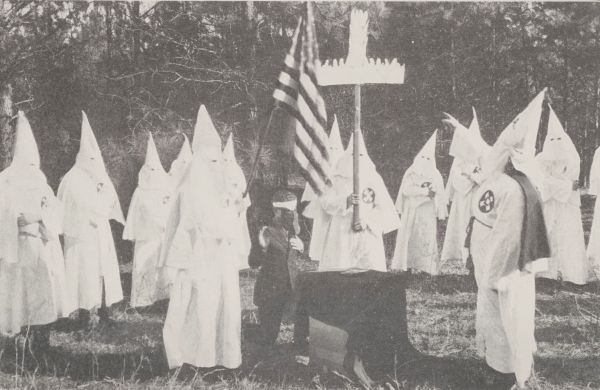
THE OATH OF ALLEGIANCE Where Country, Our Home, The Klan and Each Other are Secured
Democracy is limited to those nations whose citizens possess these peculiar and lofty qualifications of mind and character. It is limited to nations which are blessed with unity and solidarity among its people. It is further limited to nations which have grown into the practice of democracy during long experience. Instead of asking what nations and peoples are likely to fail at democracy, we had better start by inquiring as to what few nations are fortunate enough to possess all of these qualifications which, taken together, make democracy possible.
Democracy, we shall all agree, can not develop among the Australian bushmen. It will not develop among the gypsies. It will not develop, for a long time, among the African Negroes. Democracy will grow slowly among the white peoples of central and eastern Europe. It will probably grow much more slowly among the brown and yellow peoples of Asia. We can best advance the cause of democracy in our time by saving it and developing it in those countries where it has been already pretty well established. Surely the greatest possible service we can render the cause of democracy among the peoples not yet wholly fitted for its practice is to give them a high and striking example of its success in our own country. The supreme battle for democracy in this our day is taking place in the minds and hearts of American citizens. There is no immediate cause for doubt and worry concerning the preservation of democracy in Great Britain and France. There is cause for deepest concern in our own country, whose democracy is threatened from every side, by greedy and designing powers above, as by a great mass of incompetent, unprincipled and undemocratic voters from below.
CHAPTER XV
The American Negro as Ward of The Nation
Grover Cleveland once declared that one American problem for which he saw no solution whatever was the problem of the Negro. If we were in The land of the beginning again, that country of our dreams, we should, of course, not bring the Negro to our shores. It is easy to idealize our American ancestors, but no doubt they made enough errors in their time. Their most gigantic blunder, one to make Providence himself almost despair of humanity, was the Afro-American slave trade. "Man's inhumanity to man" brings at last the greatest of all sorrows upon him who works the inhumanity.
The first emotion that thought of the great problem of the Negro must awaken in the hearts of all Americans is humility. Before Almighty God we must resolve in this matter to do justice, and more than justice. Here more than any other place, we must be moved by Christlike kindness and love. The bane of us Americans, in all periods of our history, has been carelessness. We have a tendency to let things drift from bad to worse. Such has been particularly the case with reference to our attitude toward the Negro. It is high time that we applied to our public thinking some of that sounder knowledge of society and social laws which recent years have given to us.
Why should the simple truth give offense to anybody? The Negro in Africa is a childish barbarian. Left to himself, he has never at any time or place evolved even the beginning of a civilization. Do what we may in the way of an education, the mind of the pure Negro, compared to the white, on the average does not get beyond the age of twelve years. To ignore this fact is to get into error from the start. Continue to ignore this fact, especially in the execution of larger national policies, and we shall invite, as we have done in the past, trouble that is deep and dangerous. Two facts should be remembered if we would make real progress in this discussion. The first is that only those who live among the Negro and so learn to know him at first hand can really understand his manifold traits. To sit down five hundred miles from the nearest considerable Negro population and write books about the Negro is not likely to help much.
The second fact to be kept constantly in mind relates to our population of mixed blood. Every distinguished leader of the Negro race in the United States has been part white. In fact, a majority of the more distinguished have contained only a small infusion of Negro blood. It is the presence of this Mulatto element which clothes the whole problem in porcupine quills. It is this portion of our colored population which is restless and often unhappy to the point of bitterness because of our present policy with reference to the Negro. If there were no mixed population to consider our problem would not be nearly so difficult.
I have always felt that superficial minds have a peculiar tendency to lay hold of the Negro problem. For instance, witness the illogical claims of some of those who think they are the special friends of the Negro and who continually emphasize the necessity for an enlarged sphere for Negro opportunity. On the one hand they boast of the very great progress the Negro has made during his half century of freedom. On one page they will emphasize Negro accomplishment. More than half of our adult Negro population, for instance, can read and write. Tens of thousands of Negro families own their own farms or city homes. An even greater number of Negroes are attending high schools and colleges. Then, on the very next page, the same author will take pains to show that the Negro is most foully treated. He is kept in ignorance and poverty. The wicked white population which surrounds him denies him every advantage and means of progress. Of course both of these tales can not be true at the same time.
Those of us who grew up among the Negroes and have lived with them on terms of mutual kindness and of helpfulness all our lives are inclined to the conclusion that it is easy to exaggerate the progress of the Negro. The record of what we people of the South have done and have tried to do for the Negro during these fifty years is an open book to all the world. It need not be described or analyzed here. Our task has not been easy. In general, I think we have tried to do it in a way to win both the approval of our own conscience and the commendation of our fellow citizens of other sections of the country. Yet we have acted not only according to our means, but also according to our knowledge of what could be accomplished. In so far as we have failed we simply ask that our fellow citizens of the North and West make special effort to understand the true cause of our failure.
This brings us to the main issue of this discussion. The Negro problem is not peculiar to the South. The Negro problem is the burden of the nation as a whole. The Negro was brought here during the seventeenth and eighteenth centuries on the merchant ships which sailed mostly from the ports of Great Britain and New England. Some few put forth from Philadelphia and New York, but none from the South. This was not due to the fact that all Southern people were morally above taking advantage of the African slave trade. It was because commerce on the high seas was not developed in the South. We were then wholly agricultural. But the fact remains. The Negroes were brought to us by the ships of old England and New England. For this terrible error of all the English-speaking world of colonial times we in the South have paid and paid and paid. We have paid by reason of the very fact of slavery, which continued so long among us because no one knew how to make an end of it. We have paid and are still paying in the form of the most inefficient labor force in the world. We paid in the War Between the States and during the Reconstruction, until extinction threatened us; and we still pay. Not the least portion of our bill is the disesteem in which we are often so wrongly held by those of our own language and blood throughout the world. Yet we patiently await the day of complete understanding, of perfect reconciliation.
How long will it be before our modern knowledge of the fundamental facts of American history are accepted and used in our political and social thinking? Slavery continued in the South and died out in the North not because our people were different at the start. They were quite the same. But the climate was different. Crops were different. In the South the slaves produced cotton, tobacco, and sugar-cane during a long growing season, and hence slaves were profitable to their masters. In the North where they produced only food and fodder crops during a short growing season, slaves were an economic loss. Short summers and long winters do not permit the Negro to become a permanent inhabitant of Northern climes. So the few Northern slaves were mostly sold South and total emancipation followed.
Meanwhile, let it not be forgotten that during the period when cotton was king, the North shared with the South in the profits of slave labor. The economic system of our country was based upon cotton and tobacco. For a full generation it took the following form: the South sent her products to Europe, America received, in return, not commodities but capital. This capital was invested in railroads and other public improvements. Pennsylvania, New York and New England furnished the articles of manufacture which the South needed at prices much higher than obtained in Europe. These high prices were maintained through a protective tariff. The profits of slave labor were thus divided between the South and the North. When, in the Constitutional Convention of 1787, Virginia led the border states in demanding the Constitutional prohibition of African slave trade, the New England delegates joined with those of the far South in keeping this nefarious traffic open for twenty-one years more. When we say to-day that the problem is in every sense a national problem, we base our statement not only upon present necessity—but also upon the basis of historical facts which lead to definite conclusions.
Finally, the title of this chapter has a wider significance which I would emphasize with all possible vigor. In maintaining that the Negro is a ward of the nation I wish to place emphasis upon WARD. The Negro's presence among us requires an ever greater interest and care on our part. It is high time that the people of the South made a wider appeal to their fellow citizens of the North and West. A stupendous moral responsibility is involved in the presence of these ten millions of black people. Not only the past, but the future, too, is looking down upon us. All Americans may well realize that in this, as in so many other matters, we are being weighed in the balance as a nation. As a people we are fortunate in being quick to let bygones be bygones. We of the South know that if other sections come to understand us and our peculiar problem better, not only we, but they also, will be the ultimate gainers. The sooner the nation unites in looking upon our ten millions of colored folk as ten millions of children for whose protection and care we are morally responsible, the sooner we shall all be placed upon solid ground.
Let me repeat here what I have been constantly touching upon in these chapters. The maxims of our democracy are not for universal application. Some Europeans are a hundred years, others five hundred years, behind us in the process of democratic evolution. We may guess, but we can not know, how long they will be in catching up. How far behind them the Negro may be in these things I leave for the anthropologists to determine or surmise. But what we of the South assuredly know, because of our experience, is just this—to treat the Negro as the political equal of the white is to do grave injustice not only to the white, but to the Negro as well. We can not justly enforce the laws among children that we make for adults. To enforce the white man's law, in all cases, upon the Negro is an injustice so great that the effort often causes sorrow to every normal mind among us. Cared for and protected as a child, the Negro's better qualities are developed and made evident by his works. But when he is burdened by moral and legal responsibilities which neither his mind nor his character is prepared to bear, in the vast majority of cases he breaks and falls under the load. The errors of our mistaken policies during the past fifty years have caused unfathomable suffering among our Negroes. Our country took its foolish fling and sowed its wild oats of democratic Utopia during Reconstruction days. We proved then that the vote is an unmitigated curse to the Negro. From this curse he still suffers. We were forced by Federal act to make him everywhere subject to the white man's civil and criminal law. Often enough the white man's law sends him to the penitentiary for twenty years when twenty days of hard work upon the public highway would be punishment enough for his unthinking crime. In this matter we have simply tried to put a gallon of water into a quart bottle. So we have spilled much water and come near breaking the bottle. The people of the Philippine Islands are, on the average, much more highly developed than our Negroes. Yet the better advised among them realize that they are not yet ready to get on without our supervision and help.
Let me not be misunderstood. I am not here trying to offer any permanent solution for certain aspects of this problem. That solution if ultimately sought will require, for many years, the painstaking and united efforts of our best thinkers in all sections. I am now merely stating certain facts and principles upon which any future solution whatsoever must be based. All I ask is that we take these facts into every phase of our argument. The Negro is not yet prepared, mentally or morally, to share all the results of our civilization with us. Amid the great complexities of modern social and political life, it is difficult indeed to prepare our white electorate to bear the responsibilities of government. Wherever the Negro numbers twenty per cent of our population, his vote on election day would endanger democracy. In every state where he lives there are and will be vicious white demagogues who will work upon his credulity to mislead him and misuse him politically. Where he numbers forty per cent of the population, his suffrage would throw us back to Reconstruction times and make democracy impossible. Let us not refuse to shoulder the full burden of this responsibility. But the burden belongs rightfully to the Nation as a whole, not to the people of the South alone. We of the South know full well that, once rightly understood by thoughtful minds in other sections, we can ask the nation to undertake those larger policies of reform and readjustment which conditions undoubtedly require.
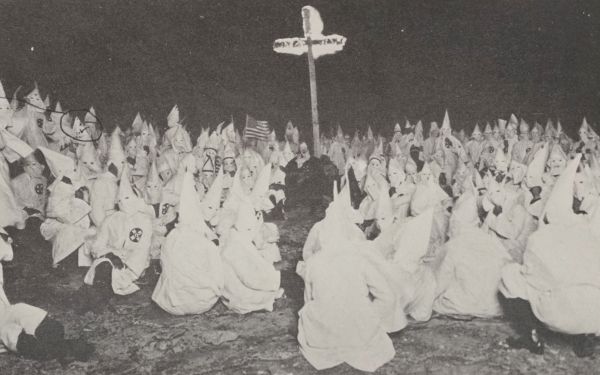
Revealing the Mysteries at Midnight
CHAPTER XVI
We Americans are a Peculiar People
Even among the various nationalities of the white race there are very great differences of character and temperament. To try to overlook these, to declare that they do not exist, is both dishonest and dangerous. Moved by the inspiration of a common cause in the Great War, no doubt the American troops and the French people made every possible effort to be agreeable and companionable. Still their very real differences caused friction. We recognize all sorts of peculiar characteristics among individuals. Why this folly of trying to deny their existence among nations? Sound conclusions in any matter are reached only by starting with facts. But the humanitarian and sentimental purposes which some of us have in mind often lead to the misuse of facts. Self-deception is the very last support upon which to build a sense of international or interracial friendship and good will.
Democracy, as a working system, as we have said in previous articles, is peculiar to a few nations of the white race. As such it is perhaps the greatest social and spiritual adventure in the history of humanity. Democracy can thrive only where it sinks its roots deep into the personality of the individual soul. In a successful democracy the citizen must be free, honest, intelligent, informed, sportsmanlike, and willing to be always active in the performance of his political duties. These qualities can not be brought forth by the hocus-pocus of wishing them upon anybody. They are the result of a long evolution. They have grown, thus far, only in particular environments and only among peculiar peoples whose whole history furnishes the essential background.
It is often pointed out as an evidence of the success which follows the mixing of our various nationalities, that we original Americans have resulted from the greatest of all mixtures. We began, in Colonial times, as English, Welsh, Scotch and Irish; as French, Dutch, German and Swedish elements. The results of this mixture, we conclude, have been entirely satisfactory. But right here we are apt to come to error.
True, the original American people were formed by the mixture of these various nationalities. Yet the success of out great experiment was due to the fact of a much greater social unity than at first appears on the surface. Our American people were drawn, mostly, from a single European class. This was the class of small property-holders and skilled workers. They came from the progressive countries to the north and west of Europe. What members of the British country gentry who came to Virginia and South Carolina were quickly unified with those among whom they settled. Indeed, ever since Magna Charta, the English country gentry were thrown together, especially in the House of Commons, with the representatives of the small farmers and the towns people. To ignore this fact of essential unity is to leave Hamlet out of the play. The dominant group, the great majority in every colony, was this mixture of gentry, independent small farmers, shopkeepers and skilled mechanics. This was then the rising class of Europe, struggling to find itself; hungering to give expression of its peculiar form of civilization; ardent in its desire for larger freedom. These facts can not be over-emphasized.
The original settlers, in large part, came to America to find the freedom and political opportunity they so richly deserved. If they did not, at once, always grant freedom to others in their own settlements, there was plenty of room for the others elsewhere. The Baptists, driven out of Massachusetts, found refuge in Rhode Island. The Quakers, whipped out of New England, discovered room and to spare in Pennsylvania. The Cavaliers, forced into exile during the Puritanic tyranny of the Commonwealth period, settled in Virginia and South Carolina. When the French Protestants came, after the Revocation of the Edict of Nantes in 1685, they were not really foreigners in America. They possessed the same faith, they were guided by exactly the same system of morals, they were the same class of people basically, as those among whom they settled. One of the most liberal and democratic groups to organize a colony were the English Catholics of Maryland. The secret of understanding the beginnings of America is to know that there was room for everybody and for everybody's beliefs. Even the bigot in Europe eventually became the liberal here. The indentured servant, of whom there were comparatively few, eventually found freedom and acquired property in the wilderness.
It was this abundant opportunity to possess free land which finally led to the complete triumph of our democracy. The real America has always been country America. The settlers came from Europe ready in mind and heart for the great adventure. The effort required independence, self-reliance and high courage. The weaklings failed and died. With every movement into the wilderness these mightier qualities of body, mind, and soul were renewed and developed. So our American democracy came, at last, to its greatest triumph west of the Alleghenies. Here the limitations upon opportunity which obtained in the coastal colonies were not to be found. Here was, at last, rich soil in abundance for any hand that could wield the axe or hold the plow. Under the leadership of men like Jefferson, Jackson and Lincoln there was finally builded a great nation upon the broad foundation of universal white male suffrage. Here came, with the nineteenth century, the realization of the democratic visions of twenty-five hundred years. Here our American vanguard of democracy, at last, placed the banner of its hope and its triumph upon the topmost pinnacle.
Sometimes we refer to these pioneer Americans as "common people." In fact they were most uncommon. The wilderness environment made them deeply spiritual, even mystical. In men like Andrew Jackson and Abraham Lincoln their basic qualities, however crude the outward aspect, took on the forms of genius. The mind and the spirit of this individualistic American is seen in everything he was and did. He built his solitary house, hidden among the trees, upon his own land. In physical form and manner he came to resemble the native Indian quite as much as the European. He grew to be slender, "rangey," keen of eye, and ready of hand—a "Jack of all trades." This type to-day can not possibly live in American cities as it is unless it keeps one foot in the country.
As to unlovely qualities, we Americans have no doubt been richly endowed. The frontiersman farmer readily enough fights his neighbor with fists or firearms. The laws we make for ourselves we often find too irksome to obey. We are careless, often inefficient, and most wasteful of our national resources. Recently we have been led far astray by the deceitfulness of riches. Finally we are apt to become blind to the quieter graces and refinements of life. In certain sections an original austerity gives way these days to pleasures that do not really please anybody. Having conquered a continent with such tumult and shouting, we have not yet learned how to live sanely or even safely. The finer values of life easily elude us, even when we try to seek them out. Yet, are we entirely in error when we claim that we, as a people, have had something valuable placed in our keeping by our history and evolution? Are we not worth preserving in the world? We know that we are. Even in the moments marked by failure and humility we can not lose our national pride and sense of worth.
Assuredly, we Americans are a peculiar people. The conditions of our European origin gave us a careful selection of personal qualities. Our remarkable environment has upbuilded us. Infinite possibilities have been opened up to us through the extent and resources of our country. We have lacked nothing needful to a great destiny. Our future has seemed so certain that we have never permitted it to be questioned. So have we been prepared to become the ancestors of a glorious and ever unfolding race. And now, within the short span of half a dozen years, we are given over to every terrible doubt and misgiving. Ours has been, were we but so minded, the wonderful privilege of continuing to select the ancestors of America's future. We have shamelessly neglected this privilege which is, indeed, the most sacred of duties. The ancestors of America's future sons and daughters have been recently drawn, in large part, from the most stolid peasantry and denizens of the slums of Europe and Asia, simply because these sell themselves cheapest in the labor markets of the world. So we are self-accursed. History may unfold every page of her story and discover nowhere a profounder reason than this for damning a great nation to destruction.
Our peculiar Nordic civilization, the creation, par excellence, of the whitest of the white European races, has found but one primary field for its larger expansion. That field is North America. Both South America and Africa lie too much within the tropics to make of them the home of our race. The Southern extremity of South America, including Argentina and Chile, possesses a soil and climate comparable to our own in the Northern and border states. But the incoming Mediterranean people are giving this temperate area the aspect of a subtropical civilization.
The larger portions of both tropical South America and all of Africa will no doubt be kept for or won for the darker peoples. The white population of South Africa is now less than twenty per cent of the whole. Australia, too, is largely tropical. Within the greater portion of her territory the Nordic white man can hardly conserve, through centuries, his distinctive physical and spiritual qualities. Our North American continent was destined by history to be the greater Nordic Europe. Here our stalwart race has been offered a gigantic area for its expansion—a suitable field upon which to play its mighty part in all the future. Indeed, this marvelous home is suited by nature to meet our reasonable needs for many thousands of years. An intelligent population policy might have permitted us to welcome from Northern Europe a considerable number of immigrants throughout the twentieth century.
Restricted to Europe and a few outlying insular colonies, our race will, at an early date, cut but a sorry figure beside the populations of the colored peoples on the one hand, and the undeveloped white peoples on the other. The British Empire is to-day more than three-fourths colored. The World War has only hastened the sinking of the hopes of the European. The "natural" tendency in racial evolution is always for the races with the more developed standards of life and culture to be dragged down and engulfed by the surrounding world of less developed peoples. A high standard of living with leisure among the masses must be jealously preserved from competition or it will become extinct in another generation. The most expensive thing in the world is a moral ideal. The most wasteful system of government is a democracy. But these things are worth the cost. We Americans have set out upon a great adventure in social life. We have made some valuable discoveries. Our spiritual possessions are numerous and valuable. We can not successfully give them to all the world by first letting the world take them away from ourselves. The "rising tide" of the colored peoples and the backward white peoples, their ultimate domination of the human process, to-day OVER-TOPS IN IMPORTANCE EVERY OTHER FACT IN THE WORLD.
We are throwing away North America as the home of our people and our civilization. Were we to open our gates to hostile armies and welcome the yoke of servitude to a foreign autocracy, the results, in the end might be less tragic. In the Hawaii of to-day, with its white American element a small minority and rapidly becoming a fading remnant, we see the North America of to-morrow. Across the length and breadth of our Continent falls the darkening shadow.
CHAPTER XVII
Giantism—the National Disease of America
Giantism is a disease. In the human body it is caused when certain glands do not function properly. A child does not stop growing in the right way or at the right time. Perhaps the whole body, more often parts of the body, grow to enormous size. The head or the hands may become too large. The features are apt to be made ugly by frightful distortions. For any child to grow too fast is dangerous. For certain organs or features, or the whole body, to keep on growing when the time has come for them to retain normal size is in itself a sign of this terrible disease of—Giantism.
Economic and social giantism is the curse of the United States. Our larger cities have grown far beyond the bounds of national safety. New York, Chicago, and a dozen other large cities are monstrosities. It will take a full generation, with no immigration at all, and the forces of reform fully mobilized, to bring them to correspond properly with the other parts of our country. Everywhere the disease works havoc. We crowd a few square miles with stupendous structures, leaving narrow chasms for streets. Each new building shuts the light and air away from many others. Then we pack ourselves into these buildings more like stifled vermin than human beings. Whereupon we go about the world boasting in a loud voice, as though we deserved praise for our achievement.
Giantism is found in every form of our national activity. We measure the greatness of a university by the size and number of its buildings, or by the millions of money which constitute its endowment. The richest among us in money figure most in the newspapers, which proves that they are considered by the public to be the most important. An author is held in esteem in proportion to the number of copies of his books which are sold. Works of art prove interesting because they bring fabulous prices on the market. At every census the inhabitants of our cities and states wait with bated breath to discover whether or not they have increased in numbers more than their neighbors.
Giantism everywhere. To boast of the greatest city as the city with the most people is like boasting of an enormous scrofulous swelling. We even boast of the height of mountains, the size of lakes, or the length of rivers, as though we had created them all. One state cries out that it is the first in the production of hogs, another that it slaughters more wild animals and peddles more furs than any other. Often there are not nearly enough houses to shelter the people of a "great" city; many of the students of a "great" university may leave as ignorant as they came, and weaker in mind and morals. The colossal battleships we build are used as targets before the sound of our boasting has died away. Our piled up statistics of "progress" mostly prove our degeneracy.
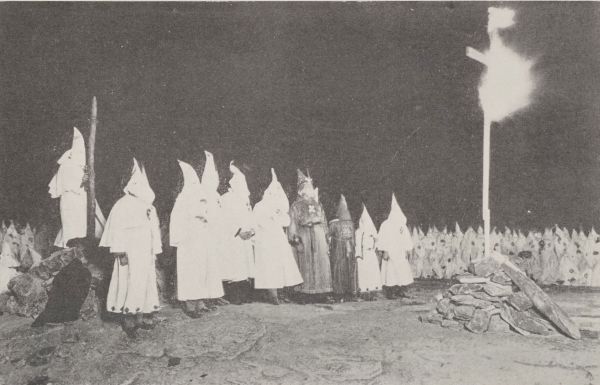
The Fiery Cross on the Mountain Top.
All this seems to escape the accredited leaders and teachers of the people. The tendency shows in us as individuals. A large proportion of our people are cursed by overeating, lack of exercise and overweight. Meanwhile the unemployed may starve. Everywhere that old and absolutely sound principle of "plain living and high thinking" is surrendered for the exact opposite. In all our great cities we build palatial private residences which are more fit for cold storage houses than for human habitations. A woman pays fifty thousand dollars for a fur wrap weighing two pounds. If the most abominable whiskey at ten dollars a quart did not find plenty of purchasers, the price would be falling instead of rising. Behold the size, weight and contents of our Sunday newspapers! They need no further describing here. A popular magazine recently contained eighty-two pages of advertising, and less than twenty pages of reading matter. In whole sections of our cities natural human affection is lavished on expensive dogs. In other sections the swarming children of the poor lack food, shelter, clothing, affectionate care and education. Meanwhile we boast of both the number of children and the value of the dogs. Fatty degeneration of the heart is one symptom of giantism.
If we continue in the way we are going, our future national self can be easily enough pictured. Any amateur mathematician can plot the curve of our "progress." Our wealth to-day totals two hundred and fifty billions. Pretty soon we shall be worth a full trillion. The last census of New York gives its population as 5,620,000. Of this total a single Brooklyn insane asylum contains four thousand. Several of our states spend as much of their taxes to care for the insane as to educate their young. Let us have pencil and paper and calculate how many will be shut up in lunatic asylums or homes for other defectives, and what will be the cost of their keep, when we number three hundred millions of people. If we bring all the underfed masses, all the beggars and peddlers and criminals from every country in the world, and thrust them into our over-populated cities to prey upon us, then, assuredly, we shall have soon enough more inhabitants than China or India. Some of our private dwellings now cost as high as eight millions each and the windows are boarded up because the owners live in Europe. According to our present standards that, too, may be taken as an indication of our "progress" and "greatness."
Of course the masses of the factory and office population, and most of the idle rich, are physical weaklings. They get no adequate exercise. They breathe no clean air. In some of our southern states the curse of degenerating factory labor for young children is still permitted by law. But whether enslaved in factory, idle upon the streets, or shut up in a crowded apartment the child of the city has no fair chance to grow. Always the thought—this mass of weaklings is fit only to be the subject of a more or less absolute monarch. They can not be citizens in a republic that is a reality. Any strong, healthy, normal American farmer turns from looking upon these city types, hopeless for his country. Our cities are not built to live in. They are built to get rich in. Jefferson was right. Unless they are reformed they will destroy both democracy and civilization. Somehow we must spread our cities out in the air and sun upon the countryside.
The old America of our fathers is everywhere fading from sight. The new America is full upon us. And that new America is rapidly becoming a stench in the nostrils of the decent and intelligent minority. We Americans must change our ways. We need a great revival—a revival of common sense and healthy-mindedness. Our national life is starving for the want of fine, thoughtful, educated, young persons with the courage to wish themselves poor. Our whole national life must change its direction. We are not going ahead. We are going backward. Instead of seeking to find, through our wealth, a richness of mind and heart, we crave yet more bigness and fatness in things purely physical. We seek our brother's purse strings instead of the affection of his heart. We are holding fast to lies instead of the truth. All this abnormal, distorted growth is making us ugly and disgusting in almost every feature. In us the better America will soon be hardly recognizable.
Never before have we so much needed the stalwart teaching of those who have led us in our greater past. These still speak to us if we would but listen. Benjamin Franklin still says on every page of "Poor Richard's Almanac" that "We are giving too much for our whistle," and that an old coat is often more to be desired than a new one. The tall Thomas Jefferson still rises above the petty minds about us to say that it were better that we had a nation composed of two persons, a man and a woman, who were truly free, than a nation with millions enslaved. The calm voice of Robert E. Lee urges upon our hearts that he who does his duty with all the strength he has may well leave even the matter of victory or defeat to Almighty God. During these later years, the entire nation has claimed to do honor to the name of Abraham Lincoln, even while we forget everything he stood for, by word and deed, when he was among the living. He is much honored for making the black man free. We have forgotten that great speech of his in which he declared that the white man's freedom should be forever guaranteed by free soil as a national institution. One Robert E. Lee or Abraham Lincoln is worth a great city full of crowding and scheming neurotics, treading upon one another's toes, always trading in their eternal souls for a chance to get rich and then mostly losing out and dying in misery and poverty.
Present-day America is unworthy of the mighty voices which have, in the past, led her and called her to the leadership of the world. Those voices spoke to us when we were weak, unformed and poor, yet so rich in thought and in the impelling forces of our national soul.
CHAPTER XVIII
Drifting
Our country is not lacking in incurable optimists, more commonly known as fools. Do we not always hear, they repeat, the cry of "Wolf, wolf" by night, and do we not always wake up in the morning quite safe and sound? I maintain that these poor words of mine are no mere warning of the wolf. Yesterday he was in close pursuit. To-day his jaws are closing upon our flesh. This outcry wrung from pain and fear is due to no imaginary ills.
We are drifting on every hand. The stupendous national problems which beset our country internally can not be counted off on the fingers of both hands. The exploitation of our farmers is leaving our countryside, the cradle of our national character and well-being, depleted of population. The Great War is over, but high prices largely remain. We have not even approached a solution of the problem of both safeguarding and properly controlling the nation's greater industries. Labor strikes take on the nature of social revolutions. The advocacy of Bolshevism arouses mighty crowds to wild enthusiasm. The children of the rich and poor alike grow up without proper normal training, not to speak of spiritual vision. With millions of people lacking houses to live in, we find ourselves with millions of people unemployed. The problem of the Negro is no nearer permanent solution than it was forty years ago. I might go on adding to this list indefinitely.
Throughout the length and breadth of the land our political life draws ever weaker character and poorer mind to political leadership. Strength, purposefulness and astuteness, when united together, are used mostly to win riches. The weaker brethren are more and more being drawn into the public service, into the pulpit and into the profession of teaching. If we really wanted, as in the past, our first-class men to preach to us, to teach us, and to direct our government, we could easily enough secure their services.
A century ago our national problems were exceedingly simple. Their full meaning and purport could be quickly explained and grasped. To-day our economic and social problems are infinitely complex. Keeping the trains running between New York and San Francisco in the year 1921 is a vastly different piece of business than keeping the stage coaches running between New York and Boston in 1787. But the average of intelligence and character in both our state legislatures and in Congress is far lower than it was in 1787. If any be disposed to deny this, let him make a comparison between the debates of the Federal Convention of 1787 and the debates of our Federal Congress or the average state legislature of to-day. Our political mind, in so far as we have any, is still living on the contributions of our national past. The last quarter of the century, especially, has registered failure with reference to almost every internal national problem presented by our time.
Reflect, for a moment, upon the present colossal issues of municipal government. A hundred thousand, a million, or five millions of persons are forced, for better or for worse, for good or for evil, to live together. In the recent municipal elections, the great city of New York continued the domination of Tammany Hall, by a vote of more than two to one. The people of Buffalo elected a mayor who received a majority of votes because he promised upon election to throw the Eighteenth Amendment of the Federal Constitution into the waste basket. Youngstown, Ohio, and Indianapolis, Indiana, elected "freak" mayors, ignorant and inexperienced, whose campaigns for office both they and those who heard them treated as huge practical jokes. The great city of Cleveland, Ohio, containing nearly a million inhabitants, elected as mayor a man who was expelled from the position of Chief of Police because of proved irregularities and unfitness to hold office. In the midst of our war with Germany, Chicago re-elected as mayor a man who, throughout the war, was an outspoken enemy of his country. In the outright venality of every sort, the government of the city of Chicago, I am informed, exceeds any in the country, even New York. Through the South we have not been able to secure since the War Between the States, as a general thing, that fine type of political leader who did such honor to our section in the earlier period. Our country is not receiving from the South that contribution of leadership which history might lead us to expect. The industrial North and East should naturally lead the nation in the solution of the peculiar problems of industrialism. Its remnant of American population readily admit their utter failure. We of the South can offer no help.
A full generation of so-called reforms have ended largely in failure. Even seats in the United States Senate now go to the highest bidder like old furniture at an auction sale. The minority which is decent, honest, and informed, is giving up the fight. The ballot in the hands of ignorant and untrained immigrants, of Negroes, and of illiterate native whites, has proven to be a terrible flare-back, burning our hope of progress to ashes. Again force the ballot upon the southern Negro and we of the South will outdo the North in political failure and decay.
Our greater internal public problems, only a few of which I have enumerated at the beginning of this article, will ever grow more complex in character, more threatening in aspect. Who can expect men with neither work nor property to take an idealistic attitude toward our government and the public service? Their vote must express their meanest immediate interests. He who stands in the bread line votes for sugar in his coffee and a bigger slice of bread. Every unemployed man is a prospective Bolshevist. Every illiterate man who votes inevitably supports bossism and graft rule. With such an electorate how can we move safely and intelligently into the uncharted and terrifying future? Soon we must rule the great industrial organizations by law, or they will rule us ignoring the law. Meanwhile the efficiency of the individual wage-worker is decreasing. His joy in his work becomes less and less. His loyalty to his task has almost struck the zero point. Ignore the problem of the white small farming class yet a little longer, and we shall be driven into farming on a great scale, with armies of stolid peasants doing the work. We already have agricultural communities where a score or a hundred small farms have recently been joined together in one estate. What a sign post of our times to see the old farm house made to serve as the dwellings for the immigrant serfs who till the land! So "Wealth accumulates and men decay." It is with a shudder that any patriot foresees the time when the countryside, like the city, shall have lost its free, independent population. In our South this small, free, white farming class requires special consideration. The danger of its submergence and total loss here is greater than in any other part of the country.
As an American, ardent alike for Americanism and the Americanization of our foreign born, I have often enough been accused of narrowness. I saw others burning with enthusiasm over the hope of the League of Nations, but I felt my own heart chilled by the sense of the shortcomings of my own country. With the majority I was hesitant. The map of the world to-day, in all its parts, strikes suffering into the heart that feels. The blood lines in every direction indicate that the world as a whole is drifting from failure unto failure. Europe is struggling helplessly in the midst of storm and crying piteously for help which never comes. With the German financial system broken down, France, denied the reparation she expected, is immersed in gloomy despair. The smaller nations East and Southeast of Germany are collapsing, if not already fallen down, starving and diseased; their peoples are becoming every day more helpless and hopeless. Italy, wasted by the war, is now in the throes of civil strife and revolution. Russia, the first white nation of the world, continues to rot in her insane orgies. With the passing months and years hope for the early salvation of Russia no longer deceives us. The battle lines of the Greek army, facing the Turks in Asia Minor, are awaiting reinforcements and supplies in order to resume the offensive. The four hundred millions of China, torn from without for a generation, lacerated by revolution and civil wars for ten years, have merely proven to us their incapacity for self-help. India is in revolution and Egypt cut adrift. All the world is more decadent to-day than when America entered the war. Again and again the nations come to us begging for the strong arm of leadership. Again and again they go from us, broken hearted and bowed down by the weak words of our indecision and failure. Yet again they come because elsewhere there is no help to ask.
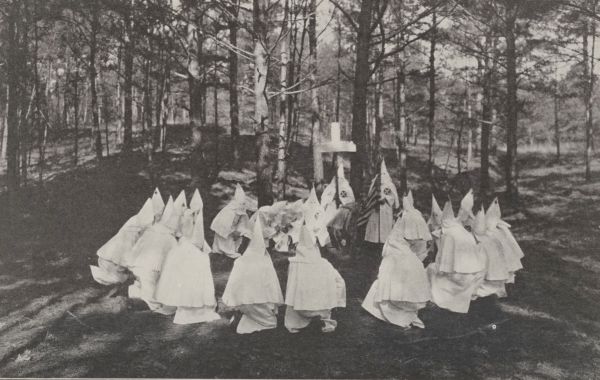
The Imperial Wizard Kneeling and Kissing the Flag, the only Flag to which a Klansman Kneels.
Such is the world which our times have given so largely into our keeping. This world demands a leadership such as gave our country unity under the Constitution of 1787. The giants of those days—a full dozen strong, loom large over the succeeding generations, and like Titans of old, their deeds illuminate our whole history. Much accursed as we are to-day by petty minds and selfish hearts in high places, we read the history of our heroic period with deepest yearning that the mighty dead might rise up and speak to us the living words we need to hear. We feel so helpless, so lost, and gone astray. What mind and character we may still have has ceased to function normally. From now on we may expect a steady drift toward monarchy. In a decadent republic monarchicalism is a natural growth. First comes a great class of the rich on the one hand and a great class of poor on the other. Both tend, because of their conditions, toward corruption. Both corrupt the state. The one will barter the ten commandments to keep what it has; the other to get what it wants. For a time the proletariat is oppressed with free corn and the circus, with organized charities, baseball and the movies. No republic can long endure on that regimen. Gold has already paved the way that leads to the United States Senate. All that is needed is more gold and the way will be smoothly paved to the throne of Caesar or Belshazzar.
It has always seemed to me that our stupendous national sacrifices during the War Between the States have never been recovered. We lost a million of the sturdiest and best men who ever grew to manhood in the world. So did that generation lose a million homes. We have to-day, instead of the ten millions of their descendants, equally divided between the city and country, some twenty millions of unskilled foreign workers crowded into the cities alone. With the close of the War Between the States we ceased, in every section, to produce first class national leaders. To-day Charles Murphy has replaced Alexander Hamilton. In Illinois, Lincoln the Great gives way to William Hale Thompson the Little. The passing of Woodrow Wilson from the public life leaves the South searching, perhaps in vain, for a leader to present to the service of the republic. Into our Southern political life, as into that of the North a generation ago, there is creeping the hireling of special interests. Only the ignorant can say that we have not fallen on times that are weak and evil and failing at every point.
So we drift—on and on; when to drift at all is to drift toward the abyss. With each setting sun we become less capable of doing well the great task assigned to us. We are deceived by the superficial results of mechanical progress. Hence we do not care to know that each waning summer marks a loss for us in all the fundamental determinants of blood, of character, of all the elemental forces. These basic elements of our peculiar civilization can be maintained only through the most watchful care. A single careless deed done to-day by the nation and countless ages must pay an ever increasing price of failure and misery. Our English-speaking peoples are as a ship of democracy struggling in the sea of unfaith,—an ocean of the world's failure and despair. We are driven before a furious gale; great waves wash over our decks. We drug ourselves into believing the theory that somehow Divine Providence always has cared for, and always will care for, the children, the lunatics and the United States. Of course this theory is trash. The Almighty helps only those that help themselves.
You millions of the middle classes of America, living in comfortable ease—upon your conscience is the greater burden placed! Will you continue to fiddle while the common weal is in flames? The future throughout your country and the world will hold you responsible! "BE . NOT DECEIVED, GOD IS NOT MOCKED. WHATSOEVER A MAN SOWETH, THAT ALSO SHALL HE REAP."
CHAPTER XIX
"The Federal Union—It Must Be Preserved"
The American government under God shall not perish from the earth.
In 1830 Andrew Jackson arose before a group of distinguished men assembled at a dinner in Washington and proposed the toast which forms the title of this chapter. It seems to me that this expression of the iron resolve of the old war-worn hero should be placed among those statements of our great leaders which have been as divine commands in the great crises which our country has experienced. Jackson loved the Union. In 1830 few people understood those peculiar underlying forces which were drawing the Union apart. It is evident to us now, after studying the history of the generation preceding the Civil War, that only a Union which exists in the minds and hearts of all its citizens can be an enduring entity. It may seem rather trite to say again that national unity is based first of all upon an individual sentiment. Even during the War Between the States this love of the Union as an ideal never ceased to animate the people of the South. They sought merely to rebuild the Union on a different basis. After the surrender at Appomattox the South faithfully accepted the old Union under the changed conditions of its re-establishment. Since that time their loyalty to the Union, as it is, has never been questioned. All must now recognize that until the great differences which severed the Union had been finally settled, the Union itself could not be re-established.
If a nation is to exist at all, certain basic principles and forms of procedure must be generally accepted by all its citizens. As regards these essential things we cannot afford to differ at all and yet try to live side by side. In English-speaking countries, for instance, we must needs all accept and support the constitutional bill of rights. Without freedom of speech, of the press and religious worship, to mention three of the more important guaranteed constitutional rights, any English-speaking country would very quickly find itself in the throes of revolution and civil war. We must agree, also, to be subject to the same general principles of morality. If a citizen argues, for instance, that the crimes of robbery and murder are sound and correct modes of political procedure, he thereby rejects his citizenship. We must all agree to live peaceably and lawfully under the same constitutional and legal system. Finally, to attain national unity and national peace we must not only accept, but unitedly support, with affection and enthusiasm, the prevailing system of law and social order. That great poet of democracy, Walt Whitman, expresses this thought so exquisitely:
"To hold men together by paper and seal, or by compulsion, is no account;
That only holds men together which aggregates all in a living principle, as the hold of the limbs of the body, or the fibres of plants."
Our American people, if we are to be perfected in unity, must come to be a sort of family.
Differences of personality among individuals, differences of opinions among groups, differences which show themselves in a variety of religious beliefs and political policies, all these are not only natural but necessary to civilization and progress. Absolute unity in thought and action can be attained only among a tribe of savages. The political unity of an absolute monarchy is a leftover from savagery. Above all, these valuable and desirable differences show in all the interesting variations to be discovered in our cultural life. In the education of children these differences of personality should be not only tolerated but purposely developed. The growth of this quality of personality is one of the most precious results of our democratic civilization. Yet it can not be too much emphasized that all these differences must work themselves out and perform all their desirable functions within the restricted bounds of a generally accepted law and custom. Otherwise nationality is impossible; and this is but another way of saying that human society is impossible.
Imagine a group of relatives and friends sitting down to break bread together. They differ in age, in appearance, in understanding, and in almost every purpose of life. Some will reject soup, and others fish. As the dinner proceeds sharp differences of opinion lend interest to the conversation. In our present day society any two members of this group may well belong to two different political parties and two different religious organizations. Yet if there is to be a true companionship in this place, how dominating must be the things that unify! This group, to get on well, must speak the same language and abide by the same established forms of social manners. In all the deepest things there must be the same regard for essentials, the same attitude toward life. In the mind of each, unity with all the others must be truly desired as a spiritual attainment. How seldom do we pause to reflect upon how many such principles and forms are taken for granted, every day and all day, in ordinary business and social intercourse. If people are to live together happily they must not only tolerate one another. They must enjoy companionship, one with the other.
On the same soil you can not have, permanently, two systems of law. Two basic forms of moral conduct can not function side by side. If there are two groups of people in any society, one of which totally rejects the other, trouble is sure to come. Given two groups of people with such a gulf fixed between as is never crossed, for instance, by intermarriages, and it is time to hoist the danger signal. Civil strife lurks in the offing.
That generation of Americans which grew up under the shadow of the Civil War, and in the terrible period of Reconstruction, has had occasion to have burned in its inmost consciousness, as by intense religious conviction, this necessity of national unity. Such a complete sense of unity, such a practice of solidarity, I have visualized for my country. It is the disunity of the present which, with "Hope deferred, maketh the heart sick." About us on every hand are discordant voices, clashing interests, screaming recriminations and blazing hatreds. Our republic cannot continue unless we re-establish, and that very soon, a status of civil peace in the minds and hearts of all our people.
Everybody who reads the newspapers or talks with his neighbors knows that the conflict between labor and capital is drifting us into another civil war. We can already reach ahead in imagination and fix our eyes upon the dreadful moment when the forces of class revolution will raise their standards and move to the attack. Among thousands it is being openly advocated. Among great numbers of quieter citizens of all classes it is accepted as a sort of grim necessity. Men seem always to be ready enough to fight. However, a sound national life can not be maintained by crushing down the masses, any more than freedom and progress can be secured for anybody through a Bolshevistic revolution. And how much more deadly is disunity between classes than between sections!
How difficult it is to make men so desirous of peace that they will consecrate their lives to secure its conditions! Are there none among us so devoted to our Union, so ardent in the cause of peace, that they are willing to rally around the principles which will make both peace and unity possible? I steadfastly maintain that, if properly led, a majority of Americans are willing to think and act in order to forestall anarchy and civil war. A vast majority of our farming people and middle classes are ready to demand, as Andrew Jackson demanded in 1830, that the nation do lawful justice to all. We who still constitute the solid body of the nation wish to urge upon the wage-working people with all our hearts that America and Americanism can solve their great problem without rebellion and bloodshed. And we are just as ready to assure those who own and direct capital, even those who are so often hated because of their great riches, that no penny shall ever be taken away from them without due process of law. Surely a majority of us have not yet lost faith in the very foundations of our democratic union. The recent stupendous events in revolutionary Europe should cause every thoughtful American mind to re-examine most carefully the principles of our government and of our democracy. We stoutly maintain that these principles and the constitution based upon them furnish a peaceful means, even a brotherly means, for the solution of the labor problem. But if, under the dangerous conditions which impend, our Federal Union is to be preserved, our love for it must draw us ever closer together in its service. Every principle of the bill of rights must be steadfastly defended. Embittered hatreds and suspicions must be allayed. The nation as a whole must be persuaded to take counsel in a quiet way. To those who shriek out upon us that "Might makes right," and that "Government is founded upon power and wealth alone," we must be able to reply that our Constitution and laws are still vitalized by the love of our American hearts, and by our willingness to sacrifice self for the sacred things of the Union. May we not still reply, also, that freedom is only curtailment of power—power to rule over others—and that true freedom can be experienced only in a nation whose citizens highly resolve to protect the freedom, the rights and interests of all.