Front matter (continued 2)
Reading edition
Similarly James Forrest Carroll was able to reproduce the science of the aliens.
All of this took time, of course—weeks. Weeks of testing and trying and fumbling. As Volta might be baffled by a common transformer where, though the input is shorted together through loops of wire and the output is similarly shorted, yet there is transfer of energy, so Carroll was baffled by the strange and bizarre thing that grew in the cellar of his Wisconsin home.
It was a large circular loop of silver-plated copper tubing. It was mounted on a cylindrical slug of high-permeability alloy which was magnetized to a high charge. The crystal was common enough but its connection made little sense from the Terran point of view. The Ancients used to use crystals for jewelry and would have been bewildered at the modern idea of cutting them in slabs to make standards of frequency.
Finally he surveyed his work with a satisfied smile. He snapped it on and a shining plane of totally reflecting energy filled the circular loop of wire.
"It isn't Lewis," he said. "It's James Forrest Carroll Through The Looking Glass!"
Rhinegallis shook her head. "The proper title is 'Alice Through The Looking Glass'," she told him.
"You have a rather extensive Terran education," he observed.
"Would any Terran be without an education?" she countered.
"Doubtless far superior to any normal person," he grunted, "thanks to that mental educating dingus of yours."
"And partly due to hard work," she said. "Give me some credit."
He smiled wanly. Then he snapped the instrument on and off and looked at the perfect plane with interest.
"Wonder if it might be possible to warp it into a perfect parabola," he said thoughtfully.
"I wouldn't know," she replied, "but it would make a fine telescope, wouldn't it?"
"Whole gear weighs about five pounds." He grinned. "The thousand-inch mirror would be a definite practicality. What we couldn't see with that!"
"Might as well go," she said humorously. "You're like the man who discovered motive power and then used it to yell over great distances with instead of going there."
"So far," he said seriously, "there's little to be gained by this gimmick. I'm like the first man on earth to own a telephone. I've no one to talk to."
"But tell me, what did he do?"
Carroll smiled in a superior fashion. "What I'm going to do to try this out," he said. "I'm going elsewhere with a second model and establish my own line of communication.
"So far as I know the only other ones are in the hands of your people—and normal, happy, serious-minded folk seldom call their enemies on the telephone to pass the time of day. So, Rhine, if you'll stay here—"
"I've no place to go," she told him. "I'll stay. You'll not be long?"
"I've got to build it first," he said. "I've got the parts here but it's not assembled."
"But—"
"It's 'tinkertoy' fashion in a suitcase," he said. "I obviously can't carry a six-foot circle of half-inch copper tubing fastened to a podium of heavy metal through the streets of Ladysmith without trouble. I'm leaving tonight, Rhine. You wait for me here."
"I'll wait," she said with a smile.
Doctor Pollard blinked when Miss Farragut announced James Forrest Carroll.
"By all means," he said, and then sat back to see what Carroll had to offer.
Carroll came to the point at once. "I have proof," he said.
"You have proof," smiled Pollard, "but you leave too many holes in the matrix."
"Meaning?" asked Carroll.
"From time to time," replied Pollard, "men have come forward with the idea that all Sol is being guarded or watched or kept suppressed by some alien culture. Charles Fort said 'Maybe we're Property!' and others have had the same idea.
"This alien culture always is superior of mind and body and capable of furthering any evidence to dispute its being. The discoverer is hunted down and chased but usually eludes the aliens long enough before he is caught to tell the world about it.
"Now," continued the doctor, "aside from the fact that all stories must have some sort of sensible ending your tale misses one vital point that all such tales seem to.
"That is just the simple fact that these omnipotent, omniscient and omnipresent beings who have kept the world in ignorance for twenty thousand years have not the intelligence to slay the single discoverer!"
Carroll smiled. "I was not slain because I was useful to them. I've spent weeks with them."
Carroll spent the next hour telling Dr. Pollard of his experiences among the aliens. He omitted only the truth about Rhinegallis.
Pollard's comment in his own shorthand was, "Perfect self-justification."
"Now," said Carroll. "May I show you something that I've stolen from them?"
"Of course."
Carroll opened his suitcase and set the metal podium on the floor. He unrolled the length of silver-plated copper tubing and shaped it into a circle. He fastened the terminals to the podium with thumbscrews. Then he snapped the switch and the shimmering plane appeared.
"Wonderful," said Pollard hollowly. "But what is it?"
Carroll smiled. "You are a hard man to convince," he said. "But now that I have shown you this, I shall show you one of them!"
Carroll stepped into the shimmering plane and disappeared.
Pollard gave a cry of fright and raced around to the other side of the plane but Carroll had gone. Then he shrank from the thing; it was as though the shimmering plane of perfect mirror was beckoning to him. And for one of the few times in his life, Dr. Pollard knew and recognized a psychopathic fear of the Unknown.
Carroll, however, knew the facts. He stepped into the basement of his home with the same motion that had carried him over the podium into the mirror in Pollard's office.
"Now," he told Rhinegallis, "I'm taking Dr. Pollard a live specimen!"
He grabbed Rhinegallis by the wrist and dragged her through the mirror into Pollard's office again.
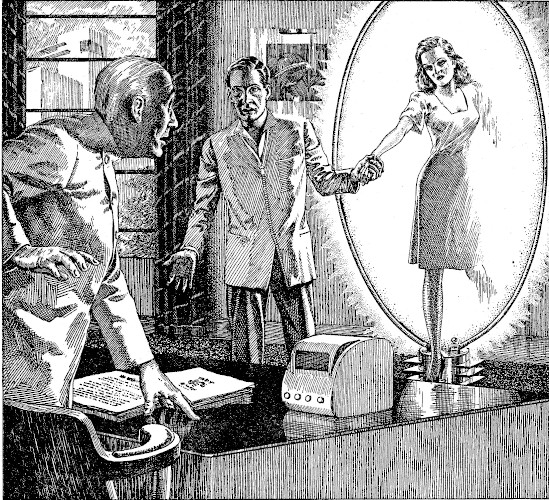
Carroll grabbed Rhinegallis by the wrist and dragged her through the mirror into Pollard's office.
"Here," he said, "is Rhinegallis, one of the inimical aliens."
Pollard was dumbfounded.
Carroll hurled the girl at Pollard. "I want as complete a medical examination as you can give," he said. "Obviously if she and her race evolved on some distant stellar system, she can not be more than humanoid. Follow?"
Pollard nodded. He faced the girl uncertainly and said, "Do you mind?"
Rhinegallis blazed.
"Of course I mind," she snapped, eyes flashing.
Carroll seated himself indolently on Pollard's desk. "If you are really alien," he observed ironically, "you will most heartily object!"
"I'm Terran," she insisted.
"Then why cavil at proving it?" he urged.
"I don't have to!"
"I'm afraid you do," he said. "Fact of the matter is I'm still holding a rather high position in the Lawson Laboratory. I can—and will—order Dr. Pollard to do it!"
Rhinegallis faced the doctor. "I'll not have it."
Carroll spread his hands out in a self-satisfied gesture. "Q.E.D.," he said. "Aliens will object. True Terrans have nothing to fear."
Rhinegallis turned upon him angrily. "How about you?" she snapped. "Are you willing to have yourself examined?"
"Dr. Pollard knows me," he said simply. "There is no reason for me to go through with this."
"I have friends."
"Aliens!" He turned to Pollard. "You have always disbelieved me," he said. "Had I brought you here by any other means Pollard would have believed that there was nothing to my tale and would have given you at the most a very superficial examination.
"However, after bringing you through the teleport, he is amazed enough to wonder. Pollard, I charge you. Give her as complete an examination as is within your ability and power!"
Pollard turned to Rhinegallis and asked her name.
"I am Rita Galloway," she said. "And I'm Terran!"
"Normally," he said with a half-smile, "no one is expected to go through such an outrageous thing. But do you really mind?"
Rhinegallis paused. "Not really; I have nothing to hide. But like all people I resent any invasion of my privacy. The Constitution stipulates that such shall not be done except with just cause. Not that an innocent man has anything to fear. It is just protection for the integrity of the individual. However, if you insist."
"Thank you," said Pollard. "Into this office, please."
Carroll followed.
"Not you," snapped Pollard.
"I'm watching," Carroll insisted.
"Look," said Pollard testily, "you may give orders to have things done that I do not approve of but you have no right to tell me how to run my life. We'll have none of it!"
"But—"
"Want it done?" demanded Pollard.
"I—"
"Look, Carroll, you can't fire me. You may still hold a responsible position but it is an honorary status. Now, if you want me to go ahead, just sit quietly and wait!"
"I'll wait," said Carroll.
Three hours later, Pollard emerged from the inner office with several sheets of paper. "She is of Anglo-Russian origin and shows the racial characteristics of that mixture.
"Her blood type is Type Three, Rh Negative, Sub-classification three-GH. Temperature, blood-pressure, and heart normal save for a slight murmur. Saliva test perfection itself. Blood count slightly low—normal enough and not near anemia.
"She is, physically, biologically, and emotionally, a specimen of excellent health, female, age twenty four years. Appendix removed five years-odd ago. Unmarried. Spent some time in the tropics but is naturally light complected."
Pollard shuffled the papers as Rhinegallis entered the room.
"In the interim," he continued, "I've had her checked on. The Bureau of Identification confirms her fingerprints and physical characteristics, Social Security Number and blood type. Photo checks despite several years interim.
"Born in Indiana, raised in Chicago on Drexel Avenue. Schooled primarily in Chicago, left college after three years. Father and mother deceased. Now," he said angrily, "is there anything more you need?"
Carroll blinked. "I should have guessed," he replied very slowly.
"Guessed? Guessed what?"
Carroll nodded slowly. "Doctor, forgetting the present situation, what is your opinion on the evolution of an extra-solar race?"
"I'll try to forget the present idea," replied the doctor, "and tell you that so far as I can judge, it would be utterly impossible for any race not our own to have more than a very few superficial items of resemblance to the human. More than likely they would evolve in an entirely different shape, though very necessarily functional."
Carroll nodded. "How about brain surgery?"
"What about it?"
Carroll shunned the doctor at that point. He faced Rhinegallis with a bitter smile. "So you have Terran characteristics. And your offer of affection might have been honest—despite the alien brain inside your skull!"
Rhinegallis gasped. "You accuse me of—"
"Well, there must be some logic in it!"
CHAPTER IX
Court Is Dismissed
Insistently the communicator on Pollard's desk buzzed and Miss Farragut called him. The doctor excused himself and left them alone.
"There must be proof," insisted Carroll.
"There has been plenty of it," she told him.
"There's one thing that your alien brain in a human body will not do," he said. "The rest can be managed. You can falsify records—perhaps you were a natural child of Terran parents—Terran parents with alien brains—as yours is now. I don't know but I'll find out."
"How?"
"Pollard's psychiatric notes," he said explosively. He headed for the examination room and looked around. There, behind the door, was a pile of papers on a small table. To get at them Carroll nudged the door shut. It went closed with a faint thud.
Almost instantly afterwards there came the sounds of many feet in the other room.
Rhinegallis screamed something out of fright and peril. There were the sounds of a scuffle, after which came.... Silence!
Carroll hurled the door open and raced across Pollard's office toward the teleport. As he reached there he saw the last traces of Rhinegallis's feet being dragged over the bottom of the wire circle into the mirror. With a cry of anger, Carroll hurled himself into the teleport just as the office door burst open to admit Pollard and Majors.
Carroll's return passage through the teleport was rough. He bumped someone and his force sent them sprawling. Then he was through and facing Kingallis, who was still reeling backwards.
Carroll plunged forward and caught Kingallis by the throat. The alien twisted out of Carroll's grasp and fought back. Carroll hit him hard and followed it with an insane rush that carried them to the far end of the cellar, where Kingallis tripped on a small box and went down with Carroll on top. Carroll rapped the alien's head against the concrete floor and stunned him.
Kingallis returned almost instantly.
Carroll looked down in his face and snarled, "Now—why?"
"Why?" asked the alien defiantly.
"Yes—why? Why is all this going on?"
"The universe is not big enough to hold us both," snapped Kingallis.
"Then it is true. You and your people have been suppressing our research because you fear that we will be able to beat you. And we will, Kingallis. We will!"
"You won't live long enough," snarled the alien.
Carroll's mind worked rapidly. If nothing else, he had now discovered the truth of why. The alien culture wanted universal conquest. To gain it, they were suppressing all research on the Lawson Radiation, which was their main hope for victory. Instead of fighting to suppress it, they had found it much easier to weasel their way in and fake a report here and line there with a mere handful of men. No science could advance when true discoveries were reported as failures and false data were supplied to send the investigators along blind trails.
But now there was real danger. Since Terra was cognizant of the peril Terra would be destroyed. Destroyed or conquered early—the aliens not waiting for the normal development of their plans of expansion.
Carroll looked around for something to tie Kingallis with. And he saw—
Rhinegallis, supine upon the floor, a wide thick strap constricting her ribs. Her eyes were closed. The pulse in her shapely throat was fluttering weakly.
"You swine!" said Carroll.
Kingallis threw him off, leaped to his feet and raced for the teleport disc. He plunged through as Carroll dropped to the floor on one knee and started to fumble at the heavy strap.
He tore his fingers and he cursed, and he looked wildly for something to cut the thing with. His eyes caught the tinsnips on the bench and he arose to get them as Pollard came through the teleport.
Back in Pollard's office the psychologist looked at the perfection of the silvery plane and shuddered mentally. Then he said, "I don't know what's up, but I'm going—through!"
Majors nodded. He had not seen Carroll using the thing at all. His mind was baffled but not psychopathically afraid of any gadget that made men disappear so quickly.
Pollard stepped gingerly into the circle and came through. It was like walking through a ring. There was neither pain nor strain nor feeling. He might have been stepping over a slight, wide sill. Then he was looking down at Carroll, who was fumbling at the strap. Carroll cut it through as Pollard knelt beside the girl.
Then as Pollard made an instant check of the girl's heart and sighed with relief, Carroll rose and turned on the doctor.
"Now," he said, "are you satisfied?"
"Satisfied?" echoed the doctor.
"They almost got her!" snarled Carroll.
"Oh?"
"The teleport is theirs. They have many of them. They were worried about discovery, so they came and—"
"They did?" asked the doctor sarcastically. He turned to Majors. "I was wrong," he said.
"Wrong?"
Pollard nodded sadly. "I believed that Carroll would not direct his hate towards anything living. I did not anticipate his fastening the embodiment of his hallucination upon a human being!"
Carroll turned to Pollard with a glassy stare. "Just what do you mean?" he asked in a flat voice.
"That was an attempt at sheer wanton murder!" replied the doctor.
Majors looked down at the girl and his face went black with anger.
"Why," he said, "that's Rita Galloway!"
Pollard looked at Majors. "Who?"
"Rita Galloway. The head librarian over at the Scientific Section of the Foundation Library."
"She is Rhinegallis of the aliens," said Carroll quickly.
Pollard shook his head. Majors growled. He started to speak and then closed his lips tightly.
"Go ahead," said Pollard.
"All right," snarled Majors. "It was my fault!"
"Your fault?" exploded Pollard.
"Yes. The day after Carroll took that delivery job from little Sally, he spent the evening in the Library looking up some rather complex stuff. Miss Galloway was called upon quite often, so she said, and came to me because she knew we were interested in Carroll.
"Shut up, Carroll, and sit down before I kill you! I told her the entire score and she said that if Carroll was truly as interested as he seemed she was going to ask for a leave of absence and see that he was helped. He seemed to be interested in her."
"Does helping him include running off to Wisconsin with him?" asked Pollard.
"They had words with her brother Kingston," said Majors. "Seems that her brother was concerned about her reputation, and said as much. Carroll made some remark about there being little in common between them, that no human being would find her interesting from a physical standpoint, just as she would find any normal relationship with any human being completely devoid of satisfaction.
"Kingston Galloway instantly took this to be a slur upon his sister's character and he jumped Carroll—also making it quite plain that he would stand for no more foolishness. Carroll clipped him hard and left, taking Rita with him. I got that from Kingston, who was out loaded for murder."
Pollard nodded. "A complex case of misdirected opinions," he said with a grim smile. "Carroll thoroughly believes that she is alien and as such incapable of forming any true association with a human. He says so and her brother misconstrues his belief into an insult to her character."
Majors turned on Carroll. "This is a matter for the police," he snapped. "Come along!"
Carroll paused, looking down at the girl. Pollard scooped her up across his arms and went through the teleport. By the time that Carroll and Majors followed Doctor Pollard was working over the girl in his laboratory.
Carroll shrugged. "If he fails," he said, indicating Pollard, "we might be able to hold an autopsy."
Majors turned away, sick at heart.
Attorney Barnett rose impressively.
"Your Honor, and Gentlemen of the Court," he said. "We do not deny the allegation. We wish to point out, however, that despite my client's state of mind he has and will be of continued value to civilization.
"Incarceration in a penitentiary will not permit him to continue his research. He should be permitted this outlet. Therefore, for my first witness I call Doctor Harold Pollard."
Pollard was put through the legal ritual and took the stand.
"Pollard, what happened to James Forrest Carroll?"
Pollard cleared his throat. "James Forrest Carroll followed the pattern of several of the top physicists working on the Lawson Radiation," he said. "May I express a pertinent opinion?"
"Objection!" shouted prosecution.
Judge Hawley frowned. "Is the opinion based on the crime?"
"No, your honor. It is pertinent to all such cases."
"Objection overruled."
"May I take exception?" asked Frank Barre, the State's Attorney.
"Let us examine the personal opinion first," replied the judge.
Pollard nodded. "It has been the opinion of the men at the Lawson Laboratory that all of these men have discovered something that has driven them into amnesia. Amnesia, you understand, is the mind's withdrawal from a distasteful reality.
"Of all of them, however, Carroll is the only one who has shown a sign of recovery from a state of complete amnesia pertaining to his work. Carroll returned with an hallucination of a strange alien culture at work to suppress any research."
"I want to establish Doctor Pollard's reputation and ability as a physician, surgeon, and practising psychiatrist," said Barnett.
Frank Barre stood up. "Waived," he said. "Prosecution agrees that Doctor Pollard's training and position are impeccable."
"Thank you," replied Barnett. "Go on, Doctor Pollard."
"In usual cases of paranoia the subject develops a persecution complex. Usually it is directed against his fellow man. In Carroll's case this was fastened upon the mythical race on another star.
"Carroll believes the Lawson Radiation to be the wasted energy from a space drive capable of interstellar travel. This alien race is supposed to be suppressing the research for a reason not quite clear, though Carroll believes—"
"Tell us what you know, Doctor Pollard."
"As with usual cases Carroll went to great pains to produce certified evidence. While preparing the so-called facts, Carroll is in a state of self-hypnosis—hallucination—in which he was actually living with the aliens; and stealing their stuff. When he brings his evidence forward he attributes it to their culture rather than the product of his own brilliant mind."
"And what do you recommend?" asked Barnett.
"Since the Lawson Radiation was the thing that caused his downfall in the first place whatever he found was important. We may have been lax in our efforts to bring Carroll 'back'. Yet, we feel that any measure that will help us to know what it is—is permissible.
"Even attempts at murder?"
Pollard shuddered. "Of course not," he said. "I should have said any legal measure."
"Thank you," replied Barnett. "I'll now call James Forrest Carroll. I want the Court to hear his own story."
"Carroll," said Barnett, once the man was legally installed on the witness stand, "did you try to kill Rita Galloway?"
"No!"
"Did you try to kill a woman you knew as Rhinegallis?"
"No!"
"Then who did try to kill her?"
"Her brother, Kingallis!"
"Do you see this man in the courtroom now?"
"Yes," said Carroll pointing to a man at the witnesses's table. "That is Kingallis."
"We will show later that the witness identified has been known all of his life as Kingston Galloway, and is the brother of the woman." Then Barnett faced Carroll again. "Do you mind talking about this?"
Carroll shook his head as he said, "Not at all. I have been most deeply frustrated. Time after time I have produced evidence to show the truth of the matter. I have gained no one who will believe me."
"You say that Kingallis tried to kill his sister. Why?"
"Because she betrayed him by helping me."
"Your honor, you will recognize the importance of this statement. It—like so many others—is a half truth. It is true and yet the implication is not the same. The fact is, your honor, that Carroll actually has reason to believe that Kingallis came through the teleport to take revenge. This is part of the hallucination."
He turned again to Carroll. "You claim you were held against your will in a building in Virginia?"
"I was."
"Then tell me how it was that you were seen performing your job during the time you claim to have been prisoner—and disappeared at the time you went to Wisconsin with Rita Galloway?"
Carroll smiled. "By the same explanation as the twin Sallys. One, you remember, went into the black car so that the men could read the day's reports and fix those that were informative. The other went into the drugstore for a bite to eat in order to fill in the interim. There was a man made up to resemble me."
"You see, your honor, Carroll believes his hallucination implicitly."
"Obviously."
Barnett faced Carroll. "Prosecution claims that you, yourself, attacked the girl in a state of anger because she proved your beliefs wrong—and in hallucinatory hope that a complete autopsy would prove you correct."
"This is untrue."
"Your inventions—"
"They are not my inventions. They are thefted from the alien library."
"Carroll, you have a brilliant mind."
"I was mentally strong enough to defy their thought machines," replied Carroll.
"And you have an extensive education in physics and science?"
"I have."
"Now tell me, are any of these inventions beyond understanding?"
"Naturally not. They are based upon physical laws that are at present unknown on Terra."
"As—say—electricity was unknown in the days of Galileo?"
"About like that."
"Then, Carroll, it might be possible that you yourself made these discoveries?"
"I might have," admitted Carroll. "But—"
"Under a hallucination? To prove to your own mind that you were stealing something of scientific excellence?"
"There is the matter of the language."
"Irrelevant. It is a tongue no one here understands."
"Kingallis! Vol thes nil kantil res vi pon tere...."
Kingston Galloway blinked as Carroll tongued his syllables, then began to laugh.
"You see," said Barnett, "anyone can mouth meaningless words and call them a language. You can, if you are brilliant, even assign meanings to them. Esperanto, among others, is a manufactured language."
"Yet I claim it true."
"What about your own future?"
"I care nothing for myself, it is only the future of Sol that concerns me."
"Your honor," said Barnett, "There are two things I want to say before I close. One is that James Forrest Carroll is not sane. Therefore he should be committed to an institution. The other is that James Forrest Carroll, for all of his insanity, is still a brilliant physicist.
"He knows something about the Lawson Radiation that men have gone mad for previously, that men have sought for thirty years, that time and money has been spent for. Therefore, in this institution, James Forrest Carroll should be permitted to experiment at his own will.
"For if nothing else he will produce many other marvelous things in an effort to prove that the science of the aliens is far greater than ours."
The judge asked Carroll, "You have a reason for believing all this?"
"I know why. The alien culture wants to conquer the universe. Because we are very close to them in scientific achievement they have cause to fear us.
"The Lawson Radiation is the spilled energy from their interstellar ships and possession of this secret will permit Terra—or any other system—to fight them on their own terms, even to beat them back to their own system. Therefore they are suppressing all research by clever misdirection."
"I see. You seem to have an answer to every angle," mused the judge.
"The trouble is," said Carroll, "that people insist upon judging me in accordance with their own views—which means that they have an answer to my every objection."
"In other words," smiled the judge, "the world is wrong and you are right?"
"Precisely."
"You know what is said about such people?"
Carroll smiled. "They said the same thing about Galileo, Columbus, the Wright brothers, Bell, Edison and Marconi," he said.
"It is often hard to tell," said the judge. "However, there are some good ways."
Carroll faced the judge. "Sentence me," he said in a surly tone. "For only by silencing me can you stop me from seeking you out."
"Me?" asked the judge in surprise.
"Either you are Terran and must therefore do everything to help me unravel this mad pattern or you are really an alien who has succeeded in penetrating to a high place in our civilization—and are therefore interested in seeing that my knowledge of you is not given any recognition."
"But why—"
"It has been said that when the superman arrives, he will be well concealed and will occupy a high place in the world without anybody knowing about it. You may or may not be. Yet by your decision you will prove it to me!"
"I see no reason to defend my opinion against your attack," replied the judge. "However, in view of the circumstances, I hereby direct the jury to return a verdict of 'guilty of criminal assault while in an insane condition' and a sentence of committal to an institution until such a time as you are pronounced sane and rational. Court is dismissed!"
CHAPTER X
Flight from Asylum
James Forrest Carroll was very careful in the days that followed. With meticulous care he watched those about him in the asylum, always wary of showing either too much interest or too much neglect. The other inmates did not bother him particularly nor did they irritate him. Not even the fact that he was committed to an insane asylum caused him to lose heart.
Carroll cared little for his immediate surroundings for he knew that once he made his point and carried it to the awakened Solar System, not only would all of the past suspicion be forgotten but he would receive an even greater reward for having suffered to carry on.
Then, as the flush of newness wore away, the guards and attendants let him alone more. All of them were trained in handling the insane and they treated each new inmate with considerable suspicion until the exact nature of the patient's instability was known.
Carroll's main and only argumentative period came when he was not permitted to work as he pleased. And so long as no one mentioned the word 'alien' in any way he was silent—lost in his thoughts and his plans.
As soon as they furnished him with working space, Carroll knew that his incarceration was a godsend. For—barring the chance that one of the guards might be alien—if he could not get out they could not get in. This was security.
The one off-chance worried Carroll. It would be hard enough to segregate the few humanoid aliens from the mass of humanity. But with the aliens occupying human bodies it was impossible. Just how it was done Carroll could not say but he considered the problem and arrived at a solution from sheer deductive reasoning.
It was pathologically impossible to consider surgery—the gross transplantation of a brain. For one thing—among many—there is the matter of blood supply. Incorrect blood matching causes death in a transfusion. This is not because of the mismatch in the blood stream per se, it is because the metabolism of the entire human body is not matched to the different type of blood.
To transplant a brain would require that something be done about the blood supply—if changed to match the brain the body would die, if not the brain would die. And there was no remote possibility that any alien brain would match human blood.
It is even difficult in many cases to graft skin from one part of a human's body to another, let alone grafting skin from one to another body—and the possibility of cross-grafting across the line of demarcation between Terran species was unthinkable.
Just with common skin.
The brain?
Impossible!
There was, however, the whole matrix of mental gadgets, hypnotic beams, educators and other gewgaws of the alien culture. The old thought patterns could easily be erased and replaced by a new system. That would—despite theological arguments to the contrary—result in a new person. For all beings are what their experiences and their training makes them.
A sentience produced in a humanoid body on a remote planet and mentally hurled into a human brain will change the human to an alien in thought and deed—but capable of living as a human! There is nothing in thought that is inimical as there would be in the sheer complexity of biochemistry.
Thoughts, even nasty vagrant thoughts, do not kill. But how large is the lethal dose of polio virus or potassium cyanide or unmatched blood?
An autopsy they might some day perform, but unless they could read her thoughts, they would find nothing! How then to identify the alien?
Nay! How then to prove that there were aliens!
There were both excitement and suspicion when Carroll built the teleport in his asylum laboratory. It was too much like incarcerating a man who had the ability to walk out of the place without half-trying. In fact, as one of the guards put it, that's exactly what it was.
It was Majors who smiled and shook his head. He pointed out that so far there were but two of them, one in the office of the psychologist Pollard and the other in the Wisconsin home of the inmate himself. Both were turned off.
Majors, not really understanding the principle of the things, had them both placed in a sealed room. Whether Carroll could turn on an inert machine from a remote place he did not know and he was taking no chances.
But Carroll's experiments with his new teleport seemed innocuous enough. For several days he fiddled with the tuning and synchronizing controls that were used to tune one teleport to the other.
He kept constantly 'ON' the switch that remotely operated any distant teleport that his own happened to be tuned to but his work did very little good. He found the two that were sealed in the tiny room and knew them for what they were. Carroll was seeking the teleports of the aliens.
For days he searched the—subspace?—for the alien teleports and found none. Then in a desperate measure, Carroll finally went through to the room in the Lawson Laboratory and, using some of his store of tools, broke the sealed door.
Brashly Carroll stole an automobile. Equally rash, he drove at breakneck speed along the roads that led him up into the Virginia mountains along the back-path that he had traversed only once before in a conscious condition, and then from the opposite direction with Rhinegallis pointing out the way.
It took many hours before he came to the little side-road that led like a mountain goat's retreat up into the top hills. It changed from a side-road to a mere trail and then branched from a mere trail to an unkempt, rutted footpath that jounced the automobile terribly.
Miles along this rocky path, Carroll turned into a clearing—a well-remembered clearing, and he looked across it—in surprise. The building itself was gone! No wonder he could find no teleports!
And the words of Kingallis returned to him. "You won't live long enough!" the alien had said. "The universe isn't big enough for both of us!"
The rats had deserted the doomed ship!
It was so pat—so perfect! Now they would say that there never had been any aliens. At every turn Carroll was blocked and stopped and frustrated. How long the aliens had been guarding Terra he did not know. Perhaps about the time that the Lawson Radiation was discovered, or perhaps even before.
No matter how good they were at intercepting things, the aliens could not keep some things from leaking out. They might have been here for centuries awaiting the man Lawson who was the discoverer.
They might have been covering information that would have led to the discovery until they could no longer stop it. At that point in the rise of any culture the discovery of such a factor would be almost automatic....
Taking any science as a parallel, civilization makes its discoveries as it is ready for them. The discovery of radio would have been impossible before the knowledge of electricity. Nuclear physics would have been impossible without a working knowledge of simple chemistry.
Each science stood upon the shoulders of the other. Electronics aided astronomy, mechanics aided electronics and chemistry aided mechanics. Physics gave men more information about chemistry and chemistry was a foundation stone for electronics.
How long that had been here Carroll did not care. The pertinent thing at present was the simple fact that now they were gone!
Gone because they dared not stay!
Carroll cursed. It was his fault. Whatever was being done to eliminate Terra as a threat to the aliens' ideas of aggrandizement was being done because James Forrest Carroll had been instrumental in uncovering their schemes. Had he remained in ignorance there would have been no reason for their latest plan—conquest for aggrandizement does not include extermination.
To exterminate an enemy spells economic failure. There is little glory in being the Lord of All when All consists of burned planets, dead cultures and the hollow grinning skulls of a billion billion intelligences.
Homage comes not from a skull.
There, in the moonlight of the clearing where once stood a large alien edifice, Carroll took from the back seat of his stolen car the knocked-down teleport and set it up alongside the road. He stepped into it and emerged in his asylum laboratory.
He ignored the fact that both car and teleport were stolen and abandoned. The only thing of importance now was the safety—the personal safety—of all Terrans, whether they believed or not. That he alone had good reason to believe in the threat was unimportant. There have been many cases in the world of history when one man alone stood against the world and was right.
Let them scoff.
Yet Carroll felt the full impact of helpless frustration. He was pitted against an alien culture capable of scientific marvels such as the teleport and interstellar travel and other things. They were capable of destroying the solar system while the only man who stood against them was incapable even of discovering how they intended to do it.
He threw himself into his work and the days sped past as he built and experimented and planned—and all too occasionally failed. When his cohorts came to him with the announcement that the first sixty-foot paraboloid of revolution was to be initiated that day at the Lunar Observatory Carroll merely nodded and returned to his work.
He cared not at all that the new observatory was to be called the Carroll Observatory in honor of the man who made possible the perfect reflector. At that time, Carroll was busy with his invisible fields of force and spacial planes of stress and did not want to be bothered with trivia—especially trivia that he had really had no hand in inventing.
A lot of good the Carroll Observatory would be to mankind if the Solar System were destroyed!
Majors entered Dr. Pollard's office with a large glossy photograph in one hand. Pollard looked up amusedly as Majors said, "I'm getting psycho, I guess."
"Yes? And what makes you think so?"
Majors laughed. "Because every time I get a problem I seem to come to you instead of going where it can be answered by theoreticians and physicists."
Pollard smiled. "I think you come here because this is one place where you can hold your own with another man who can hold his own with you," he observed.
"Well," admitted Majors, "you don't understand theoretical physics as well as I do and psychology is over my head. Anyway, what do you make of this?"
The photograph was of a patch of sky. Pollard shook his head.
"Is this a test question?" he asked. "Remember, I'm the psychiatrist and I'm supposed to hand the patient strange items and ask them what they see in them."
Majors laughed. "This is a section of Boötes."
"Boötees," murmured Pollard irrelevantly, "are knitted gadgets you put on babies' feet."
"All right, I'll leave quietly," chuckled Majors. "Seriously, though, look at this." He pointed out a tiny smudge among the myriad of stars.
"Well?" asked the doctor.
"It shouldn't be."
"Maybe a flaw?"
"Nope," objected Majors. "It persists through twenty-seven photographs made one minute apart—each exposed for one minute."
"Um. What is it?"
"Don't know," replied Majors. "But it is darned interesting."
"Boötes is the region from whence comes the Lawson Radiation, isn't it?"
Majors nodded. "That's why they sent it to me. It was taken by the Carroll Telescope on Luna, a sort of tribute to Carroll that the first photographs and work done by his invention be directed at that portion of the sky he worked so long on—to his own downfall."
"Tell me, Majors, do you often get these kind of smudges?"
"Not this kind but there have been other kinds."
Dr. Pollard looked at the smudge. "Let's take this to Carroll," he suggested. "Maybe it might mean something to that hidden portion of his mind that refuses to admit what it knows about the Lawson Radiation."
"Through the teleport?"
"Why not? If it's not available at the other end, we'll just meet a solid mirror and can't step through. That worried me for a long time, that idea of not having a place to go to. Just step out into—heaven knows what—because the other end wasn't connected. Come on!"
The teleport in Carroll's asylum laboratory gave the physicist warning that they were coming through. He turned as they entered with an annoyed smile on his face. Before him was a long paper record of Lawson Radiation recordings that Carroll was studying through a magnifier.
Majors handed Carroll the photo, saying, "What do you make of this?"
"It's a bad blur—like a misfocused image," replied Carroll.
"Yes—but why?"
"You've heard of the Einstein Lens?"
"Vaguely, but thought it was just a dream—a probability that never happened."
Pollard shook his head. "I don't know about it at all," he admitted.
Carroll smiled tolerantly. "Light has energy and energy has mass," he said. "Ergo light has mass. Masses attract one another according to the Newtonian Law of Gravitation. Ergo light is bent by passing close to a mass."
"I see," said Pollard leaping to the right conclusion. "Then light radiated from a very distant galaxy may pass close enough to a dark mass—with Terra, the mass and the galaxy in line—to have the distant galaxy focus itself here?"
"Yes," replied Carroll. "The mass acts as a biconvex lens because it bends all tangential light toward the center as the beam passes."
"But the Einstein Lens effect doesn't make smudges like this," objected Majors.
Pollard whistled. "You mean to say that the Einstein Lens is known to be a fact?"
"Right. Several cases are known and accepted as such!"
"Well!"
Carroll looked up from the smudge. "A negative lens," he said, "would cause diffusion like this."
Majors blinked. "That would mean—oh, no!"
"Negative matter," said Carroll promptly.
"Um. You postulate a negative mass in line with the light from a star?"
Carroll nodded.
Majors smiled and took out a roll of thirty-five millimeter film. He handed it to Carroll.
"I took the liberty of making smaller prints," he said. "Those are the other thirty-five pix made near that area. You'll see the initiation of the smudge on the second, and the completion of it on the twenty-eighth. The others are just spares."
Carroll looked at the smudges, one after the other.
"You'll note that the thirteenth, the twentieth, and the twenty-fifth have rather larger areas," said Majors. "Also, on the thirty-first—after the body presumably has passed out of line—there is one more faint flare-point. That was minutes after the thing passed out of line."
Carroll read the pictures carefully and then without a word he turned to the desk. He picked up the tape of Lawson Radiation recordings and handed it to Majors.
"Here," he said, "is correlation between astronomical fact and the Lawson Radiation."
There were four definite pips on the line. Four spikes that reached up, with each spike labelled as to the time of reception. Though the intrinsic time did not match by hours the spacing between the pips and the flared photographs was perfect.
"Then what?" asked Majors, and Pollard held his breath.
"A mass of negative matter passing through space," said Carroll, "would naturally be struck occasionally by meteors or small celestial bodies."
"But if negative matter is repulsive instead of attractive?" objected Majors.
"Then," said Carroll simply, "the only masses that can strike the repulsive celestial negative-mass are those other masses that possess the velocity that corresponds to the velocity of escape in normal mass!"
Majors looked thoughtful.
"I get it," said Majors. "The velocity of escape is that velocity attained by any mass in falling to the earth from an infinite distance. Converted, any mass given that velocity upon the instant of departure need have no more acceleration applied in order that the mass be driven to an infinite distance against gravity. Follow?"
"Uh-huh," said Pollard.
"In the case of a repulsive mass—negative mass—in order for any other object to strike it it must possess enough energy to overcome the repulsion. This would be the inverted equivalent of the velocity of escape!"
"Negative mass and positive mass would cancel one another?"
Carroll nodded. "Producing the Lawson Radiation!"
"Then all these years we have been following a bit of negative mass getting hit by normal meteors."
Carroll shook his head. "You check the orbit of that mass," he said, "and you'll find out that it is due to strike Sol!"
"You know?"
"I suspect," said Carroll. "The aliens must destroy us lest we destroy them. This is their way. We must stop that mass!"
"Look," said Majors. "Let's find out the course of that celestial object first!"
"It will be," said Carroll.
"Carroll," objected Majors, "why must you insist upon blaming the aliens for something that is definitely a matter of celestial chance?"
"Because it is not celestial chance," snapped Carroll. "And I'll yet prove it!"
CHAPTER XI
Prophets of Doom
Rita Galloway came at Pollard's request, and the doctor told her about the new developments. She listened with interest, finally nodded with comprehension.
"So that," she said, "is what drove him mad?"
Pollard smiled. "Obvious, isn't it?"
"Not too obvious to one who is not completely informed as to the workings of the mind."
Pollard smiled again. "Sorry," he said. "I thought it was simple. It may be me, but I will try to show you that the mechanics of the mind are as logical in madness as in sanity—or in plain cause-and-effect mechanical systems.
"Somehow during his researches in the Lawson Radiation he stumbled upon the truth. He studied it, not daring to believe at first the possibility of a negative mass. Yet the facts were there and in some manner Carroll managed to develop a system of physical mathematics that tended to prove his point.
"I have no doubt, Rita, that if we find any tampering with the Lawson Laboratory records, they will have been tampered with by Carroll himself, who refused to let this bizarre affair be known until he was certain.
"You see, Carroll knew the storm of protest that would arise if any physicist tried to promulgate such a theory without almost certain proof. So he concealed it. But he studied it thoroughly. And in his studies he discovered that this negative mass was heading for Terra."
Majors cleared his throat. "Tell me, Doctor Pollard, how you make these vast assumptions? Aren't you like the classical definition of a physicist? You know, a man of limited reason who can leap from an unfounded theory to a foregone conclusion?"
Pollard laughed. "Rita was not there. But you were. Did you note how quickly Carroll picked out the point? One look at the photographs, one look at the Lawson Record and one statement of fact—all tied in to absolute perfection. Carroll knew that his theory was terribly thin—also he knew the futility of trying to stop a cosmic body approaching Terra. The combination drove him into hallucination."
"Amnesia?"
"Yes. It all ties in. Every bit."
"Go ahead and tie, Doc."
Pollard nodded. "His is a classic form of schizophrenia. For his years of study he is presented with the knowledge of certain destruction. This is terrible to face per se. It is terrible to think of one's self telling the world that he has just discovered the first true and provable link in the ending of the Solar System. It is like uttering the clarion of doom.
"Now remember," said Pollard, pointing off the pertinent spots on his fingers, "that Carroll probably tampered with the records or at least did not list the truth. Tampered with or falsified. That's point number one. Secondly, the true schizophrenic-paranoid cannot rail against a mechanistic fate.
"He must find some sentience to fight, some evil mind to combat. For the paranoid feels that he can win in the end, which of course would be impossible against a case of mechanistic doom. Therefore Carroll needed some sentient manifestation of this doom, something that he could strike at, fight against. Therefore he has accused an 'alien culture' of tampering with the records to prevent us from knowing the truth.
"I tried to tell him of many others who claimed to have discovered a 'master-mind' that treated humans as we treat goldfish and guinea pigs. I tried to ask him why, if these master minds are so omnipotent that they can spend fifty thousand years watching an experiment in humanity, they were not smart enough to do away with the one man in that time that might cause them trouble. That's the link that stumbles most Prophets of Doom."
He paused.
"But James Forrest Carroll is completely self-justified. His explanation was simple enough to sound right. He merely claimed that, since his mind was sufficiently strong to best their 'hypnosis beams', they kept him alive to study him. You see? He is so mighty that they do not dare. True paranoia.
"Now, point three. Carroll is a brilliant man with a vast imagination. Yet his training as a physicist kept him from trying many wild schemes or things that might be against the teachings of modern physics. Therefore he attributes the many superscientific marvels to the techniques of the 'aliens'. In truth no Terran physicist would believe them possible. The conscious mind rejects the idea of the teleport for instance.
"But there was terrible compulsion. He must avert the destruction of Sol. This he can do, he believes, by learning much of the alien science and turning their own trick against them. Things that no sensible physicist would even consider must be given a try in this period of emergency. Therefore he went into hallucination in order to invent this 'science'—because his conscious mind tells him that it is impossible."
"Aren't you missing the motivation?" asked Majors.
"Not at all, I just stated it. His subconscious mind knew that the only way to stop this catastrophe was to try the products of an untrammelled imagination."
"Rather complex, don't you think?"
"Not to the mind. It is all self-justification. Remember the attack on Rita? Her ribs constricted by a heavy leather strap? A normal man with the impulse to kill doesn't go to such bizarre lengths. A shot, a stab, a bit of poison.
"Also," added the psychologist, "it is commentary on the mind of the paranoid that cruel and unusual forms of torture and death are uppermost. Since in Carroll's deluded mind this attack was to be used as proof of the alien culture, the crime must be made to look alien and unearthly.
"Well," said Pollard with a deep sigh, "We have smoked him out at last. We have uncovered the hidden truth in Carroll's mind. Rita, we need you again."
"I know," she said quietly.
"You forgive him?"
"Of course," she said. "And if I did not I should cover it. After all, this is no longer a matter of men and women and minor hates. This is Man against the Universe. And if I must sacrifice myself to see that Sol remains I shall, and gladly."
"How about your brother?"
"He hates Carroll. Terribly."
Majors grunted. "We'll take care of him. Maybe he's the real madman in this scramble."
"At any rate," said Pollard, "we all have something tangible to fight, now. Go to him, Rita. You have his confidence, even though he believes you to be one of the 'aliens'."
"Go to him?" she asked with a smile, "I'll not have to. Carroll will come to me."
"You seem certain."
"You may scoff at feminine intuition," she said with a laugh, "but in some cases it works. You see, no matter what Carroll thinks of me, he is aware of the fact that I am a woman. Meanwhile I'll merely borrow that portable teleport and wait."
The room was dark save for a slight streak of yellow moonlight. As the night progressed, the streak of moonlight passed across the room, illuminating the sleeping girl, the dresser, the desk, the teleport, the blank wall.
And in the early morning hours the perfect plane of the teleport flashed briefly to admit James Forrest Carroll. Blinking, he looked around the darkened room until his eyes adapted themselves. Then he made his way to the side of the bed. The motion of the bed as he sat upon the edge awakened the girl, who sat up quietly enough to allay Carroll's fears that she would shriek.
"Rhine," he said softly.
"Yes," she replied.
"I need your help."
"I know. I'll give it."
"You will?" was his reply. The tone of his voice was indefinable. There was mingled wonder, and scorn, and suspicion.
"I will."
He laughed sardonically. "Now you'll help," he said. "Why didn't you help me when they accused me of trying to murder you?"
She shook her head sadly, and reached for his hand. He tried to withdraw but she held it fast.
"James," she said with a note of pleading in her voice. "Please believe me. I wanted to. But you see, my testimony was worthless. All I remember was a blow on the back of the head. Blinding lights, roaring sound and waves of pain that came and went in crescendo and diminuendo until I came to in Doctor Pollard's surgery."
"They blamed me."
"I know," she said.
"Perhaps you blamed me too." His hand tightened on hers as though he were silently praying for her denial.
Rhine lifted her other hand and put its palm against his cheek. "James," she said softly, "I did not see nor did I hear, but I know that whoever it was it was not the man who is here tonight."
He smiled quietly. "I keep forgetting the quality of mind that I am up against," he said.
"Mind?"
"Mind—or mentality," he said. "You see, Rhine, parallel evolution is impossible. So is the idea of brain transplantation. Hence the only way in which your race can invade ours is by mental replacement, invasion, control—or by wiping the other brain clean and clear and taking over. This leaves you an alien mind in a human body."
She laughed faintly. "I've often told you that you nor anybody else would ever get evidence to prove that I am not a very human person," she said softly. Her hand upon his cheek moved slightly and then slid around to the back of his head. She drew it forward and met his lips with hers.
For but a brief instant he resisted. Then he yielded as her lips parted beneath his invitingly. His arms went around her and he cradled her close to him and he knew with sweet completeness that, alien mind or not, there was no question nor doubt about her responding to him.
Minutes later she leaned back in his arms and chuckled at him. He grunted a wordless demand to explain.
"Why," she said, still chuckling, "you'd have a terrible time explaining to any one of a hundred billion human beings that I am utterly alien and that this friendship of ours is strictly platonic and developed out of a desire for mutual desire for protection against our respective races."
Carroll looked around. The streak of moonlight had moved. It was now casting a pale golden light on an easy chair. Draped across the easy chair back was a pale green negligee almost as intangible and diaphanous as the moonlight. Carroll blushed and remembered where he was—and also why he had come.
"Rhine," he said. "You'll come with me?"
"Of course," she told him.
His suspicion returned vaguely. "Tell me," he pleaded, "Is it because you know that there is no return for you or—"
"Sol is menaced," she replied simply. "Sol must be saved and you are the only man in the world that can do it. I want Sol saved."
"But why?" he demanded.
"Because," she replied.
Carroll shook his head. Question and answer were pat. Human, alien, animal, vegetable or mineral—the same question and the same answer!
Rhine chuckled again. "Beat it," she said. "But leave the teleport running. I'll be through as soon as I'm dressed."
He nodded, arose and went through the teleport. Rhinegallis followed him in about ten minutes and once more they were in the laboratory of Carroll's Wisconsin home.
CHAPTER XII
Negative Matter
For an instant their gaze held.
"Now," asked Carroll, "what is the Lawson Radiation?"
"Should I know?" she queried by way of reply.
"I think so."
"Why?"
"As an emissary, you should."
She laughed. "I'm still giving no evidence, James. I cannot. I am human."
He looked down at her, and the recollection of her kiss was strong. "There are times," he said ruminatively, "when you most certainly are!"
She let her eyes drop. Then she raised them again. "I know very little about it," she told him. "And practically nothing but what you've told me. A lot about alien mathematics and sciences. I think that somewhere in the maze of data there will be the answer you seek."
"And that," he replied, "may be either a chance statement based upon good prediction or the remark of an alien who knows where the body is hidden but will say nothing more than, 'Getting warmer'."
"So what do we do?" she asked. "Shall we let this simmer down to the old unanswerable argument as to my mental status or shall we forget that and take to real investigation?"
"Investigation," he said. "You're a darned good librarian, Rhine. You tabulate and I'll try to juggle it out."
Rhine went to the draftman's table and sat down.
"I've maintained all along that the Lawson Radiation was the by-product of faster-than-light travel," he said. "Ignoring the argument of aliens and such, we have good evidence at present. There is a body of negative mass approaching Terra. This negative mass is approaching Terra at a velocity not only exceeding the velocity of light but traveling several hundred times the velocity of light."
He paused. Then he sat down—hard.
"What's the matter?" she asked, seeing the look of consternation on his face.
"The photographs," he said bleakly.
"Yes?"
"Can a rifle bullet traveling faster than sound be heard before it arrives?" he asked enigmatically.
"No."
"Then a body traveling faster than light cannot be seen before it arrives! Those pictures show a region of the sky and a few stellar catastrophes that took place years ago when the light left there unless—"
"Unless what?"
"Unless the telescope made of the teleport mirror effect utilizes a type of radiation that propagates faster than light."
Rhine nodded. "If celestial bodies can travel faster than light," she said, "it stands to reason that some form of energy can travel faster than light also. After all, matter is one form of energy."
Carroll smiled quietly. "This is negative matter," he said. "And so far as I have been able to calculate, the only thing that can avoid the Einstein increase in mass with increase in energy would be some object having negative mass. But negative mass is as meaningless a term as negative energy."
"A gentleman by the name of Dirac got the Nobel Prize for postulating states of negative kinetic energy," said Rhine.
"The positron," nodded Carroll.
"Then it must make sense."
"It does. A normal body possessing energy tends to dissipate that energy by transferring the excess to other bodies possessing less than it does. A body possessing negative energy would demand that energy be applied to it in order for it to acquire a state of energy equilibrium.
"The positron, according to Dirac, is a state of negative kinetic energy which is satisfied only when the energy of an electron is applied to it. In the process known as 'pair-production', where hard gamma strikes matter and releases an electron and a positron, it is actually a case of separating the electron from its positron, leaving in effect a 'hole' in the level of energy.
"It is a man whose bills are not paid but are merely covered by written and certified checks. Send away one check and you have a debit in the man's account. The positron is satisfied very quickly, however, since there is a large excess of free electrons to fall into place.
"These cancel the positron—and that process produces hard gamma rays again—of the same energy content as required to cause the 'pair production' in the first place. About one million electron volts plus," he added.
She hesitated a moment.
"Now—about this negative mass," she said.
"Simple," he said. "Very simple. A negative mass is the only thing that can exceed the speed of light. Similarly negative energy is the only kind that can propagate in excess of light. So now let's juggle equations until we can reproduce the same."
Rhine nodded, picked up a pencil and then looked at him expectantly.
"Put down," he said with a smile, "the first equation that ever told the truth about the relationship between mass and energy. Energy 'E' equals Mass 'M' times the squared speed of light, 'C2'."
"And from there?"
"And from there we start juggling until we find out how to introduce the negative factor. And I do not mean by dividing by the square root of minus one," he told her.
Doctor Pollard looked up at the man who stood before his desk. "Mr. Galloway," he said, "You may believe yourself normally right but you are ethically wrong."
"Morals and ethics be hanged!" snarled Rhine's brother. "That nut has kidnaped my sister again."
"Not without her aid," smiled Pollard.
"Aid be hanged too!" shouted Kingston Galloway. "He tried to kill her once and he may try again."
"Look," said Pollard quietly. "There are times when personality and identity mean nothing. I think well of my life, as much as you think of yours. Yet I'd feel less than human if I permitted myself and my ideas to stand in the way of civilization."
"Stop talking like a superior being and come down to facts," yelled Kingston Galloway.
"I am. James Forrest Carroll is the only man on earth who can save Terra from certain destruction. Your sister can be of help to him."
"How?" demanded Kingston.
"Rita is an excellent librarian. She has the ability to recall facts and figures beyond most people. She has almost an eidetic memory. Whether Carroll is sane or completely schizophrenic-paranoid, his statements and his theories are solid when based upon his own line of reason.
"That his line of reason does not agree with heretofore known physical facts is of no consequence since several of the unsound, unscientific, un-factual reasonings have produced things that work. Unsound as they may seem, they are not unreasonable—excepting to us who can not reason that way."
"Get to the point."
"Whether Carroll urges Rita to display a horde of facts because he thinks they come from an alien mind in a human body, or whether he understands the truth—that they are merely repeats of his own statements made when he does not recall them—the fact remains that Rita is his tabulator, his encyclopedia of fact, his memory. She and she alone can put down concurrently things he has reasoned out, once when himself and next when he is—un-sane."
"But she's in danger!"
"So are we all," replied Pollard easily. "And Rita herself knows the danger. And," he added with a snort of derision, "of what good is your so-called moral integrity going to do you a year from today if James Forrest Carroll is stopped from preventing the calamity due to erase Sol from existence in a month?"
"He's a madman. How can you believe that this danger really exists?"
"The danger is what drove him mad."
"And made him believe that Rita and I are aliens?"
"Merely manifestations of the hallucination."
Kingston Galloway growled in his throat. "I ought to kill you," he snarled. "Not only have you left my sister unprotected, but you've condoned her kidnaping and now you sit there and tell me that the fate of the world lies in the mind of a lunatic."
Pollard smiled. "There have been many historic times when civilization was nearly torn down by a madman. Let history record once when civilization was saved by one."
"At my sister's expense!" Kingston stormed, barely able to control his rage.
Pollard shook his head. Then he said patiently, "James Forrest Carroll was driven mad by this knowledge of inescapable doom, because his subconscious mind knew that the answer was hidden in the realm of physics termed 'unreasonable' to the true physicist.
"Once James Forrest Carroll has succeeded in removing this menace he will know that amnesia and mental retreat are not necessary for the preservation of his sanity. There will undoubtedly be evidences, too, to support the 'unreasonable' physics in terms of what we know to be true. Thus Carroll will be completely self-justified and will be returned to normal."
"You talk a lot about self-justification," snarled Kingston.
"Everybody is self-justified," said Pollard. "Sanity is when the self-justification of the individual is, within certain limits, similar to the self-justification of the average human being. Insanity is when the self-justification of the individual lies outside of reasonable limits. Once Carroll's self-justification—which is one more way of saying his 'viewpoint'—is reasonably similar to others, sanity will return."
"And in the meantime, what about Rita?"
"Rita is at worst a good soldier," said Pollard. "At best, she alone will realize the full truth. But just remember neither morals nor ethics mean a thing to a civilization that has just perished before a nova. And I have more than a little respect for the morals and ethics of both Carroll and your sister under any circumstances."
"But she's my sister and he's—"
"Shut up. You're talking like a fool. They're doing nothing wrong. Stop them and you'll destroy the earth. Perhaps if you'd left him alone—them alone—Carroll might not have identified you with his hallucinatory aliens."
"Yeah? And just what is an alien?" demanded Kingston.
"An alien," smiled Pollard, "is any man who does not think as you do!"
"Bah!" cried Kingston, turning on his heel. He left the office swearing eternal vengeance.
An hour later, Majors came bursting into Pollard's office. "Pollard!" he exclaimed. "Listen! That wildman Kingston Galloway has just collected a gang of his cohorts, friends and buddies and they've all taken off like wildmen. They're heading for Wisconsin!"
"The stupid idiot!" exploded Pollard, coming out of his chair. "Come on!"
Rhinegallis clasped Carroll's arm tightly as she stood beside him and looked at the almost-vibrant blackness that seemed to shimmer in the encircling wire mounted on the wall. Carroll was too busy to pay attention to her clasp.
He was busy adjusting knobs on a haywire equipment on the bench beside him. The shimmering blackness flared briefly at one side, turned milky for an instant near the top—and then a pinprick of utter—nothingness—appeared to one side of the circle.
Carroll adjusted knobs, brought the spot of sheer black into the center of the artificial plate and then expanded it. It was noticeable only because it—as a circle of utter no-response—was less energetic than the misty background.
"That," he said, "is it."
"The negative mass?"
He nodded. "Is the 'fence' ready?"
"Checked."
"Now's as good a time as any," he said laconically. He left the vantage-point and went to another panel in the laboratory and began to throw switches.
Five miles from Carroll's home a ten mile circle of wire came to life. Set on insulators mounted on trees in a rough circle, the area ten miles in diameter shimmered with a thin, misty film of energy—the same energy as that of the teleport.
It thickened as Carroll adjusted the driving gear, thickened and became more positive until it was as shiningly opaque as the teleport screen-mirror. Trees in the circle, cut clean at the surface of the mirror fell, impelled by gravity into the screen. Then above the perfect plane of energy was nothing.
The trimmed trees fell helter-skelter into a deep gorge from a smaller teleport plane twenty miles to the north.
Then the perfect plane bowed downward into a shallow paraboloid of revolution. As it went down the up-thrusting trees were trimmed off and the matter in them converted into energy. A minute but perfect sphere appeared atop a pillar of energy not far from the rim of the paraboloid.
Down went the center of the paraboloid, down into the bowels of the earth, and the sphere of stored energy grew rapidly. Down went the center, deep, until a perfect parabolic reflector ten miles in diameter and twelve miles deep resulted. The cubic mile after cubic mile of earth, rock, water, and forest were stored as energy in the sphere, now a full three feet in diameter.
A landslide started near the rim, and earth rumbled forward down the side of the depression, disappearing as it touched the outside of the energy-shell that was Carroll's reflector. The rim of trees that supported the energizing ring fell into the widening inverted funnel but its job was over. The mirror was stable, held by the energy contained in the perfect sphere on the column near its edge.
The rumbling stopped as stability came. The roar, all of it sheer physical sound from tortured earth, died and left a hollow vacancy in comparison.
Then Carroll took a small set of levers and manipulated them like a man flying a drone airplane. The sphere of energy left the column and was driven over the gaping maw of the mighty reflector. Down it dropped until it was at the exact focus of the paraboloid. There it compressed to almost a point.
"This," said Carroll, "is it!"
He reached for the master switch just as a flashing bolt of coruscating energy dazzled across the room, searing his arm.
"King!" screamed Rhinegallis. "Don't!"
CHAPTER XIII
Last Chance
Through the door swarmed Kingallis and four of his henchmen. They paused to get their bearing and then they plunged forward, shouting. Rhine made ineffective gestures against them—pure instinct, for her senses were shocked by their abrupt appearance.
Carroll cursed. His sense of timing told him that there was no second to waste, yet his right arm hung useless and he was reeling weakly from the shock. They did not fire again as they came swarming across the floor, but their interception of his move was as effective. Kingallis, with an angry shout, caught Carroll and hurled him away from the panel.
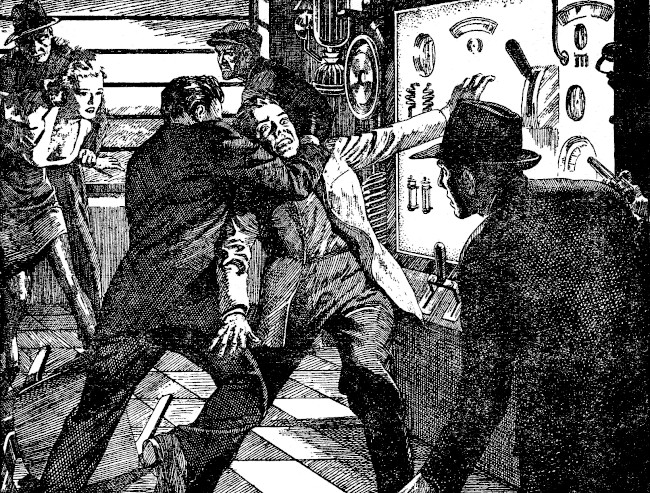
Kingallis caught Carroll and hurled him away from the panel.
Two of the others took Rhine by the arms and drew her back out of the way.
"Now!" snarled Kingallis, with sheer animal tones in his voice. "We'll see about this!"
He waved the other two aside and back and then stepped forward to slap Carroll across the face. The blow, meant as an insult strong enough to arouse fighting instinct, was strong enough to stagger Carroll.
"Weakling," scoffed Kingallis. He back-handed the staggering physicist again and again, driving Carroll against the far wall of the laboratory.
"Come on and fight," sneered Kingallis.
Rhine shrieked in mad anger. "Fight?" she shrilled, "after you've shot him?"
Kingallis kicked Carroll in the abdomen. "Coward!" screamed Rhinegallis. With a superhuman strength born of sheer madness, Rhine hurled herself out of the hands of her captors and raced across the floor. Her fingernails came down across her brother's face drawing a torrent of blood from torn eyelids. At the same time she kneed him in the stomach. Her blow was more effective than Kingallis's had been on Carroll. He stumbled back writhing in pain.
But only for a moment—he straightened and cursed blackly, stepped forward and slapped Rhine across the face, hurling her back into the hands of the others by the force of the blow. Then he turned quickly for Carroll had recovered.
But instead of going to Rhine's rescue Carroll turned and raced madly across the floor. He hurled his good shoulder against the master switch, driving it home.
Relays slapped home—
And light itself was tortured. The very walls of the laboratory seemed to shake and waver because of the mighty electrostatic stresses set up in the continuum of space. The square, precision-machined equipment warped into non-mechanical distortions.
Vastnesses of energy flowed in a mad vortex. Steep gradients of electrostatic charge flowed back and forth like the surface of a stormy sea, and corona discharge hissed and trickled out of all sharp corners.
The nerves tingled and muscles twitched; normal senses produced abnormal stimuli. In one man's hand one of the weapons discharged into the floor and he tried to hurl it from him with a cry of pain. He could not open his clenched hand.
Twitching with every erratic reversal of the charged field that surrounded the area, James Forrest Carroll painfully pulled himself to his feet and looked across the shimmering room. Pride and self-confidence added to his will-power. He stood there as his tingling brain considered the facts of the matter.
Regardless of what happened now—regardless of himself or of anybody—he had won this battle. He laughed and in the tortured continuum of the place his laugh sounded like a mad cackle.
Fear was painfully slow in coming to the faces of Kingallis and his cohorts. Then it came—fear and the realization of danger. King gave an angry, wordless cry and tried to cross the laboratory floor. He could not quite make it.
Carroll turned his back on them and watched the viewplate on the far wall. It was wavering and distorted but it showed the sky and the sphere of negative mass.
Out in the parabolic reflector, the tiny compressed sphere of energy disappeared into a hole of blackness, from which expanded an exploding shell of sheer light-energy. Against the reflector it poured in a howling torrent and into the sky it went—and disappeared.
Faster than the light it created it went, on and out into space. Gone—unseen—undetectable—save for the black circle on the wall of Carroll's laboratory.
There it was evident as a column, a cylinder that blazed like the fury it was. How long it lasted is beyond guesswork. Its duration was several seconds in the making, its velocity the speed of light multiplied by an unknown quantity that registered in the thousands.
It was—the Lawson Radiation—the Lawson Radiation multiplied and increased as the light from the sun is greater than the pale ineffective illumination coming from a Will O' the Wisp.
It only took seconds, while the continuum heaved and strained to regain its equilibrium and the sensitive nervous systems of those in the laboratory tingled and screamed to the dictates of flowing energy. Seconds only it took for that flying column of energy to reach the black circle that was the negative mass that menaced Terra.
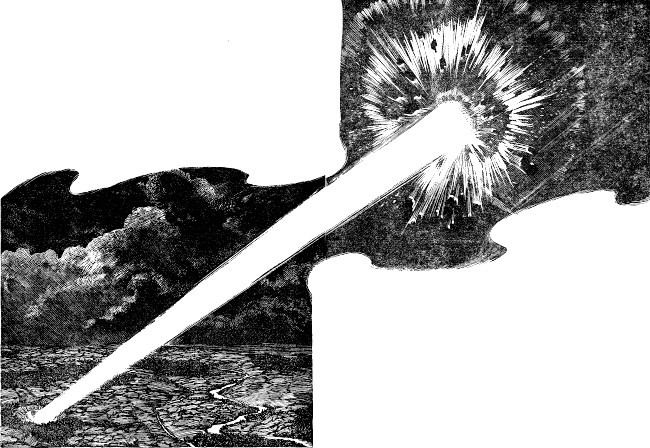
It took only seconds for the flying column of energy to reach the black circle of the negative mass that menaced Terra.
Yes, seconds only, it took. The negative mass that menaced Sol could not have been far away.
Then cylinder and sphere met in a singular lack of display. The cylinder, narrow but shining, bored into the sphere, dark and menacing. Perceptibly, the sphere slowed, dragged, came to a halt—then accelerated in the reverse direction.
In milliseconds the celestial body of negative mass had been stopped and re-started on its return trip. It accelerated swiftly, the acceleration-factor itself rising as the energy from the column became the energy of motion of the negative mass.
A negative mass—similar to a negative energy-level—demands energy before it can be stable. Its demands were satisfied and then satiated. It raced into unthinkable velocities before the column of energy was all used up and still the column poured into the negative mass.
It could not have been accomplished against a positive mass but the negative mass possessed negative inertia. The harder it was driven, the less energy it took to drive it harder.
Across space it went, becoming a pinpoint in Carroll's artificial viewplate. The stars of the galaxy behind it shone brightly—all but the one directly in line with the flight of the negative mass.
Then, as the spacial stresses diminished and a man could think again in that area, there was a tiny flash on the viewplate.
And James Forrest Carroll laughed. "Finis!" he roared.
King shook himself. "You madman! You destroying fiend—get him!"
The laboratory echoed and re-echoed with the wild thunder of released energy. Rhine dropped beside Carroll. Her right hand flicked up to a switch on the panel, and out of thin air there appeared a tenuous inverted bowl of light. Flying bits of metal as well as the bursts of released energy deflected from the inverted bowl.
Painfully, Carroll stood up and advanced across the floor towards Kingallis and his cohorts. He walked through a veritable tornado of sheer death, and Rhinegallis followed him because to get outside of his protecting shield was to die.
They looked at him as they would have viewed a specter, for he advanced through their hail of death unharmed. In fright they herded back, their weapons lowered helplessly.
Cornered and helpless against the teleport they waited, shivering in fright.
"You said once," snarled Carroll, "that the universe was not large enough for your kind and mine. As I have destroyed your world so I'll destroy you!"
He lunged forward, and they turned and rushed madly into the teleport. Carroll shook his head.
"They—?" asked Rhine, shakily.
"The spacial stress is still present," he quavered. "They were teleported into the nearest and strongest field." He turned and stumbled across the floor to the controls and shut off the gigantic reflector. The rumblings started as a final landslide tumbled down the declivity into the bowl. The screams of King and his cohorts were lost in the thunder of avalanche.
James Forrest Carroll sat in the easy chair in Pollard's office and smiled tolerantly at the psychologist.
"Sure, sure," he said easily. "All in my mind."
Pollard grunted. "Well, it is."
"Baloney. I suppose Kingallis didn't come to prevent me from destroying his world?"
"He came—"
"Knowing," said Carroll, "that if he stopped me he and his kind could go on with their mad plan for conquest. May I ask about this?" he held up his injured arm.
"When I last saw Kingston Galloway—" started Majors.
"You call him Kingston Galloway," laughed Carroll. "But I know he is Kingallis. Now go ahead."
"He and his bunch were carrying pistols."
"He shot at me with some sort of energy weapon. This is a burn, not a bullet-hole!"
Majors shook his head. "Not a chance. Admitting that what you sent out was an energy-beam, it is still impossible to believe that a hand-sized energy weapon is practical."
"Granted," said Carroll. "But then there's this evidence. Explain this, will you? I don't mind getting my arm burned badly if it will only make you believe."
Doctor Pollard shook his head with a smile. "Stigmata," he said. "The 'Bleeding Madonna' who exhibits wounds and bleeding from hands, feet, sides and forehead on Good Friday. A sheer mental phenomenon—psychosomatica. This is the same. You are so convinced as to the positiveness of these aliens that your mind produced this burn as evidence."
"Brother, this ain't no mental mirage," snapped Carroll.
"No one said it was. But the power of the human mind is such that the cellular structure of the body will exhibit burn-trauma when the mind believes it so. So one of them creased your arm and you reacted as though it were the burn your mind believed it to be.
"We've been through all this before. It's just cause and effect and result. This time it is only the latter that counts. You've destroyed the menace that drove you insane."
"Look," said Carroll, "I've been through it."
"And nothing you've turned up with can be construed as any evidence beyond the manufacture of your own mind. And nothing that you will ever find—"
Carroll nodded angrily. "I've got a couple of projects yet. One is the hand-held weapon—just to prove to the bright boys who think this bum wing is thought-up—that such is possible. The other may bring proof, but it may take some time.
"I've still got me a job. I'm going to develop the faster-than-light space drive and go out looking for aliens. They had interstellar travel. They all couldn't have been destroyed."
"Forget it, Carroll."
"Forget it?" exploded the physicist. "Forget it when I've a whole world of physics waiting for me to develop? Not on your life!"
He stood up and grinned at them boyishly. Then he left and as the door closed Majors looked askance at Pollard.
Pollard smiled. "He'll forget it," he said. "The aliens will become dimmer and dimmer in his memory until they are gone. But right now we have a fairly stable James Forrest Carroll on our hands. And, Majors, the final therapy is out there waiting for him. Fine girl."
"Rhine," said Carroll softly as the door closed behind him. "Rhine."
"I'm—waiting," she replied. "But why not call me Rita. Everybody else does."
"I know," he said, looking at her pointedly. "But I'm amused, sort of."
"Why?"
"Because the one thing that permitted you to gain access to our research was the thing that licked your pals."
"And?" she asked, puzzled.
"People too often try to divorce the mind from the body," he told her. "It can't be done."
"I don't follow."
"Infants are all brought into this world alike from a mental standpoint. Yet within a few short months each is a separate identity with a different personality, no matter how similar the environment and heredity. This is because the mind of man is but the accumulated result of what his sensory channels bring it.
"An alien you were once, Rhine. But from the instant that you took over that very nice Terran body your mind began to receive information and experiences through the sensory channels of a Terran body.
"Every item, every experience, brought to your mind through Terran channels forced your mind to interpret it in terms of Terran nervous stimuli. Therefore, from the second instant after taking over, you began to change subtly to the Terran."
"Go on—tell me the rest," she said with a smile.
"Day by day, week by week, you will become more and more Terran. Eventually, your alien experiences will fade and you will be as one of us and no longer alien."
"You know," she said shyly, "someday I intend to present you with a little alien."
"That'll be interesting," he chuckled. "You are becoming more and more Terran even now."
"But not," she said with absolute finality, "until we have paid a visit to the clergy!"
"See what I mean?"
She laughed—very humanlike.