Chapter II · THE ADVANCE OF SCIENCE, 1881–1906 (continued 2)
Reading edition
Two general principles which Mr. Darwin fully recognised appear to me to deserve more consideration and more general application to the history of species than he had time to give to them, or than his followers have accorded to them. The first is the great principle of ‘correlation of variation,’ from which it follows that, whilst natural selection may be favouring some small and obscure change in an unseen group of cells—such as digestive, pigmentary or nervous cells, and that change a change of selective value—there may be, indeed often is, as we know, a correlated or accompanying change in a physiologically related part of far greater magnitude and prominence to the eye of the human onlooker. This accompanying or correlated character has no selective value, is not an adaptation—is, in fact, a necessary but useless by-product. A list of a few cases of this kind was given by Darwin, but it is most desirable that more should be established. For they enable us to understand how it is that specific characters, those seen and noted on the surface by systematists, are not in most cases adaptations of selective value. They also open a wide vista of incipient and useless developments which may suddenly, in their turn, be seized upon by ever-watchful natural selection and raised to a high pitch of growth and function.
The second, somewhat but by no means altogether neglected, principle is that a good deal of the important variation in both plants and animals is not the variation of a minute part or confined to one organ, but has really an inner physiological basis, and may be a variation of a whole organic system or of a whole tissue expressing itself at several points and in several shapes. In fact, we should perhaps more generally conceive of variation as not so much the accomplishment and presentation of one little mark or difference in weight, length, or colour, as the expression of a tendency to vary in a given tissue or organ in a particular way. Thus we are prepared for the rapid extension and dominance of the variation if once it is favoured by selective breeding. It seems to me that such cases as the complete disappearance of scales from the integument of some osseous fishes, or the possible retention of three or four scales out of some hundreds present in nearly allied forms, favour this mode of conceiving of variation. So also does the marked tendency to produce membranous expansions of the integument in the bats, not only between the digits and from the axilla, but from the ears and different regions of the face. Of course, the alternative hairy or smooth condition of the integuments both in plants and animals is a familiar instance in which a tendency extending over a large area is recognised as that which constitutes the variation. In smooth or hairy varieties we do not postulate an individual development of hairs subjected one by one to selection and survival or repression.
Disease.—The study of the physiology of unhealthy, injured, or diseased organisms is called pathology. It necessarily has an immense area of observation and is of transcending interest to mankind who do not accept their diseases unresistingly and die as animals do, so purifying their race, but incessantly combat and fight disease, producing new and terrible forms of it, by their wilful interference with the earlier rule of Nature.
Our knowledge of disease has been enormously advanced in the last quarter of a century, and in an important degree our power of arresting it, by two great lines of study going on side by side and originated, not by medical men nor physiologists in the narrow technical sense, but by naturalists, a botanist, and a zoologist. Ferdinand Cohn, Professor of Botany in Breslau, by his own researches and by personal training in his laboratory, gave to Robert Koch the start on his distinguished career as a bacteriologist. It is to Metschnikoff the zoologist and embryologist that we owe the doctrine of phagocytosis and the consequent theory of immunity now so widely accepted.
We must not forget that in this same period much of the immortal work of Pasteur on hydrophobia, of Behring and Roux on diphtheria, and of Ehrlich and many others to whom the eternal gratitude of mankind is due, has been going on. It is only some fifteen years since Calmette showed that if cobra poison were introduced into the blood of a horse in less quantity than would cause death, the horse would tolerate with little disturbance after ten days a full dose, and then day after day an increasing dose, until the horse without any inconvenience received an injection of cobra poison large enough to kill thirty horses of its size. Some of the horse’s blood being now withdrawn was found to contain a very active antidote to cobra poison—what is called an antitoxin. The procedure in the preparation of the antitoxin is practically the same as that previously adopted by Behring in the preparation of the antitoxin of diphtheria poison. Animals treated with injections of these antitoxins are immune to the poison itself when subsequently injected with it, or, if already suffering from the poison (as, for instance, by snake-bite), are readily shown by experiment to be rapidly cured by the injection of the appropriate antitoxin. This is, as all will admit, an intensely interesting bit of biology. The explanation of the formation of the antitoxin in the blood and its mode of antagonising the poison is not easy. It seems that the antitoxin is undoubtedly formed from the corresponding toxin or poison, and that the antagonism can be best understood as a chemical reaction by which the complex molecule of the poison is upset, or effectively modified.
The remarkable development of Metschnikoff’s doctrine of phagocytosis during the past quarter of a century is certainly one of the characteristic features of the activity of biological science in that period. At first ridiculed as ‘Metschnikoffism,’ it has now won the support of its former adversaries.
For a long time the ideal of hygienists has been to preserve man from all contact with the germs of infection, to destroy them and destroy the animals conveying them, such as rats, mosquitoes, and other flies. But it has now been borne in upon us that, useful as such attempts are, and great as is the improvement in human conditions which can thus be effected, yet we cannot hope for any really complete or satisfactory realisation of the ideal of escape from contact with infective germs. The task is beyond human powers. The conviction has now been arrived at that, whilst we must take every precaution to diminish infection, yet our ultimate safety must come from within—namely, from the activity, the trained, stimulated, and carefully guarded activity, of those wonderful colourless amœba-like corpuscles whose use was so long unrecognized, but has now been made clear by the patiently continued experiments and arguments of Metschnikoff, who has named them ‘phagocytes.’ The doctrine of the activity and immense importance of these corpuscles of the living body which form part of the all-pervading connective tissues and float also in the blood, is in its nature and inception opposed to what are called the ‘humoral’ and ‘vitalistic’ theories of resistance to infection. Of this kind were the beliefs that the liquids of the living body have an inherent and somewhat vague power of resisting infective germs, and even that the mere living quality of the tissues was in some unknown way antagonistic to foreign intrusive disease-germs.
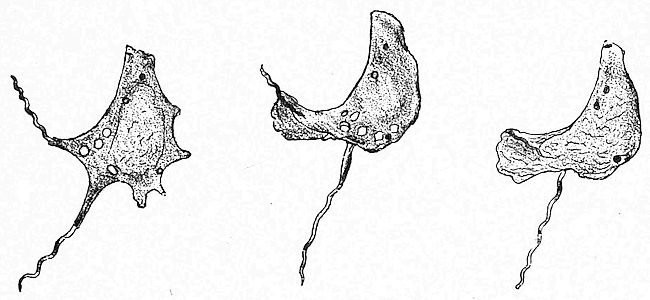
Fig. 37.
Fig. 38.
Fig. 39.
Fig. 37.—Phagocyte or colourless corpuscle of a guinea-pig in the act of engulphing two Spirilla or parasitic vegetable microbes of a spiral shape. Fig. 38.—The same half an hour later, one of the Spirilla is nearly completely engulphed. Fig. 39.—The same ten minutes later still, one of the Spirilla is completely absorbed into the substance (protoplasm) of the phagocyte. (From Metschnikoff’s book, “Immunity,” kindly supplied by the Cambridge University Press.)
The first eighteen years of Metschnikoff’s career, after his undergraduate course, were devoted to zoological and embryological investigations. He discovered many important facts, such as the alternation of generations in the parasitic worm of the frog’s lung—Ascaris nigrovenosa—and the history of the growth from the egg of sponges and medusæ. In these latter researches he came into contact with the wonderfully active cells, or living corpuscles, which in many low forms of life can be seen by transparency in the living animal. He saw that these corpuscles (as was indeed already known) resemble the well-known amœba, and can take into their soft substance (protoplasm) at all parts of their surface any minute particles and digest them, thus destroying them. In a transparent water-flea Metschnikoff saw these amœba-like, colourless, floating blood-corpuscles swallowing and digesting the spores of a parasitic fungus which had attacked the water-fleas and was causing their death. He came to the conclusion that this is the chief, if not the whole, value of these corpuscles in higher as well as lower animals, in all of which they are very abundant. It was known that when a wound bringing in foreign matter is inflicted on a vertebrate animal the blood-vessels became gorged in the neighbourhood and the colourless corpuscles escape through the walls of the vessels in crowds. Their business in so doing, Metschnikoff showed, is to eat up the foreign matter, and also to eat up and remove the dead, wounded tissue. He therefore called these white or colourless corpuscles ‘phagocytes,’ the eater-cells, and in his beautiful book on Inflammation, published twenty years ago, proved the extreme importance of their activity. At the same time he had shown that they eat up intrusive bacteria and other germs (see figs. 37 to 43); and his work for the last twenty years has mainly consisted in demonstrating that they are the chief, and probably the only, agents at work in either ridding the human body of an attack of disease-causing germs or in warding off even the commencement of an attack, so that the man or animal in which they are fully efficient is ‘immune’—that is to say, cannot be effectively attacked by disease-germs.
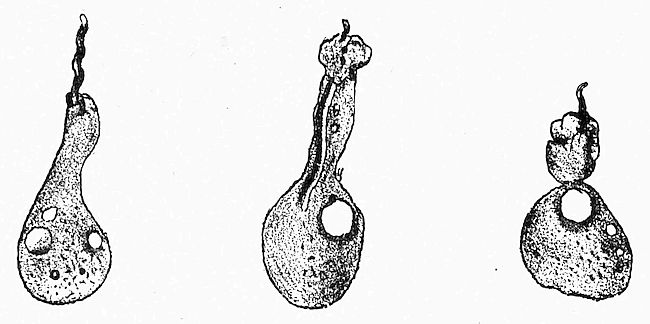
Fig. 40.
Fig. 41.
Fig. 42.
Fig. 40.—Phagocyte of a guinea-pig in the course of engulphing a very mobile undulating spirillum. Fig. 41.—The same, forty minutes later. Fig. 42.—The same taken half an hour after Fig. 41. (From Metschnikoff’s “Immunity.”)
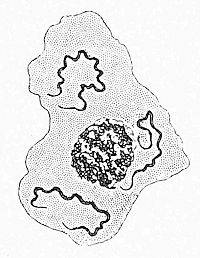
Fig. 43.
A large kind of phagocyte of the guinea-pig, killed and stained for microscopic examination. It shows the large spherical nucleus and three specimens of the spirillum of relapsing-fever which have been engulphed, and are lying within its protoplasm. They would have been slowly digested—that is to say, dissolved by the digestive juices within the phagocyte. (From Metschnikoff’s “Immunity.”)
Disease-germs, bacteria, or protozoa produce poisons which sometimes are too much for the phagocytes, poisoning them and so getting the upper hand. But, as Metschnikoff showed, the training of the phagocytes by weak doses of the poison of the disease-germ, or by weakened cultures of the disease-germ itself, brings about a power of resistance in the phagocytes to the germ’s poison, and thus makes them capable of attacking the germs and keeping them at bay. Hence the value of inoculations.
The discussion and experiments arising from Metschnikoff’s demonstrations have led to the discovery of the production by the phagocytes of certain exudations from their substance which have a most important effect in weakening the resistance of the intrusive bacteria and rendering them easy prey for the phagocyte. These are called ‘sensitisers,’ and have been largely studied. They may be introduced artificially into the blood and tissues so as to facilitate the work of the phagocytes, and no doubt it is a valuable remedial measure to make use of such sensitisers as a treatment. Dr. Wright considers that such sensitisers are formed in the blood and tissues independently of the phagocytes, and has called them ‘opsonins,’ under which name he has made most valuable application of the method of injecting them into the body so as to facilitate the work of the phagocytes in devouring the hostile bacteria of various diseases. Each kind of disease-producing microbe has its own sensitiser or opsonin; hence there has been much careful research and experiment required in order to bring the discovery into practical use. Metschnikoff himself holds and quotes experiments to show that the ‘opsonins’ are actually produced by the phagocytes themselves. That this should be so is in accordance with some striking zoological facts, as I pointed out nearly twenty years ago.[20] For the lowest multicellular animals provided with a digestive sac or gut, such as the polyps, have that sac lined by digestive cells which have the same amœboid character as ‘phagocytes,’ and actually digest to a large extent by swallowing or taking into their individual protoplasm raw particles of food. Such particles are enclosed in a temporary cavity, or vacuole, into which the cell-protoplasm secretes digestive ferment and other chemical agents. Now there is no doubt that such digestive vacuoles may burst and so pour out into the polyp’s stomach a digestive juice which will act on food particles outside the substance of the cells, and thus by the substitution of this process of outpouring of the secretion for that of ingestion of food particles into the cells we get the usual form of digestion by juices secreted into a digestive cavity. Now this being certainly the case in regard to the history of the original phagocytes lining the polyp’s gut, it does not seem at all unlikely, but on the contrary in a high degree probable, that the phagocytes of the blood and tissues should behave in the same way and pour out sensitisers and opsonins to paralyse, and prepare their bacterial food. And the experiments of Metschnikoff’s pupils and followers show that this is undoubtedly the case. Whether there is any great variety of and difference between ‘sensitisers’ and ‘opsonins’ is a matter which is still the subject of active experiment. Metschnikoff’s conclusion, as recently stated in regard to the whole progress of this subject, is that the phagocytes in our bodies should be stimulated in their activity in order successfully to fight the germs of infection. Alcohol, opium, and even quinine, hinder the phagocytic action; they should therefore be entirely eschewed or used only with great caution where their other and valuable properties are urgently needed. It appears that the injection of blood-serum into the tissues of animals causes an increase in the number and activity of the phagocytes, and thus an increase in their resistance towards pathogenic germs. Thus Durham (who was a pioneer in his observations on the curious phenomena of the ‘agglutination’ of blood corpuscles in relation to disease) was led to suggest the injection of sera during surgical operations, and experiments recently quoted by Metschnikoff seem to show that the suggestion was well founded. Both German and French surgeons have employed the method with successful results, and the demonstration that an immense number of microbes are thus taken up and destroyed by the multiplication (due to their regular increase by cell-division) of the phagocytes of the injected patient. After years of opposition bravely met in the pure scientific spirit of renewed experiment and demonstration, Metschnikoff is at last able to say that the foundation-stone of the hygiene of the tissues—the thesis that our phagocytes are our arms of defence against infective germs—has been generally accepted.
Another feature of the progress of our knowledge of disease—as a scientific problem—is the recent recognition that minute animal parasites of that low degree of unicellular structure to which the name ‘Protozoa’ is given, are the causes of serious and ravaging diseases, and that the minute algoid plants, the bacteria, are not alone in possession of this field of activity. It was Laveran—a French medical man—who, just about twenty-five years ago, discovered the minute animal organism in the red blood-corpuscles, which is the cause of malaria (see fig. 44). Year by year ever since our knowledge of this terrible little parasite has increased. We now know many similar to, but not identical with it, living in the blood of birds, reptiles, and frogs (see fig. 45).
It is the great merit of Major Ross, formerly of the Indian Army Medical Staff, to have discovered, by most patient and persevering experiment, that the malaria parasite passes a part of its life in the spot-winged gnat or mosquito (Anopheles), not, as he had at first supposed, in the common gnat or mosquito (Culex), and that if we can get rid of spot-winged mosquitoes or avoid their attentions, or even only prevent them from sucking the blood of malarial patients, we can lessen, or even abolish, malaria.
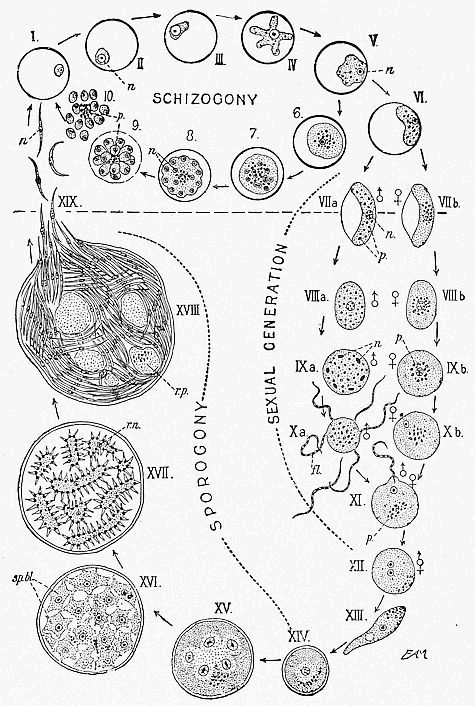
Fig. 44.
SCHIZOGONY
SPOROGONY
SEXUAL GENERATION
A diagram showing the life-history and migration of the Malaria parasite, Laverania Malariæ, as discovered by Laveran, Ross, and Grassi. The stages above the dotted line take place in the blood of man. The oblong-pointed parasite is seen entering the blood at n just below No. 1. The circles represent the red blood-discs of man. Schizogony means multiplication by simple division or splitting, and it is seen in Nos. 6, 7, 8, 9, and 10. The stages below the dotted line are passed in the body of the spot-winged gnats of the genus Anopheles. A peculiar crescent or sausage-shaped condition is assumed by the parasite inside the red corpuscle No. VI. These are found to be of two kinds, male and female, Nos. VIIa and VIIb. They are swallowed by the spot-winged gnat when it sucks the blood of an infected man. Here in the gut of the gnat they become spherical; the male spheres produce spermatozoa No. Xa, which fuse with and fertilize the female spheres or egg-cells No. XI. An active worm-like form No. XIII results, which pushes its way partly through the wall of the gnat’s gut, and is then nourished by the gnat’s blood. It swells up, divides internally again and again, and is enclosed in a firm transparent case or cyst, Nos. XIV to XVIII. The cysts are far larger in proportion than is shown in the diagram, and are visible to the naked eye. The final product of the breaking up, which is called sporogony, is a vast number of needle-shaped spores or young (called Exotospores, as opposed to the Enhæmospores, which are formed in the human blood, as seen in Nos. 9 and 10, and serve there to spread the infection among the red corpuscles). The needle-shaped spores formed in the gnat’s body accumulate in its salivary glands, and pass out by the mouth of the gnat when it stabs a new human victim who thus becomes infected, No. XIX.
Had the sausage-like phases Nos. VIIa and VIIb been swallowed by a common gnat or mosquito of the genus Culex they would have been digested and destroyed. It is only in species of gnats of the kind known as Anopheles that the parasite can undergo its sexual development and subsequent process of the formation of cysts and needle-shaped exotospores. (After Minchin in Part I. of Lankester’s “Treatise on Zoology,” published by A. and C. Black.)
This great discovery was followed by another as to the production of the deadly ‘Nagana’ horse and cattle disease in South Africa by a screw-like, minute animal parasite Trypanosoma Brucei (see fig. 46 B). The Tsetze fly (see fig. 48 A, B), which was already known in some way to produce this disease, was found by Colonel David Bruce to do so by conveying by its bite the Trypanosoma from wild big-game animals, to the domesticated horses and cattle of the colonists. The discovery of the parasite and its relation to the fly and the disease was as beautiful a piece of scientific investigation as biologists have ever seen. A curious and very important fact was discovered by Bruce—namely, that the native big game (zebras, antelopes, and probably buffaloes), are tolerant of the parasite. The Trypanosoma grows and multiplies in their blood, but does not kill them or even injure them. It is only the unaccustomed introduced animals from Europe which are poisoned by the chemical excreta of the Trypanosomes and die in consequence. Hence the wild creatures—brought into a condition of tolerance by natural selection and the dying out of those susceptible to the poison—form a sort of ‘reservoir’ of deadly Trypanosomes for the Tsetze flies to carry into the blood of new-comers. The same phenomenon of ‘reservoir-hosts’ (as I have elsewhere called them) has since been observed in the case of malaria; the children of the native blacks in Africa and in other malarious regions are tolerant of the malarial parasite, as many as 80 per cent. of children under ten being found to be infected, and yet not suffering from the poison. This is not the same thing as the immunity which consists in repulsion or destruction of the parasite.
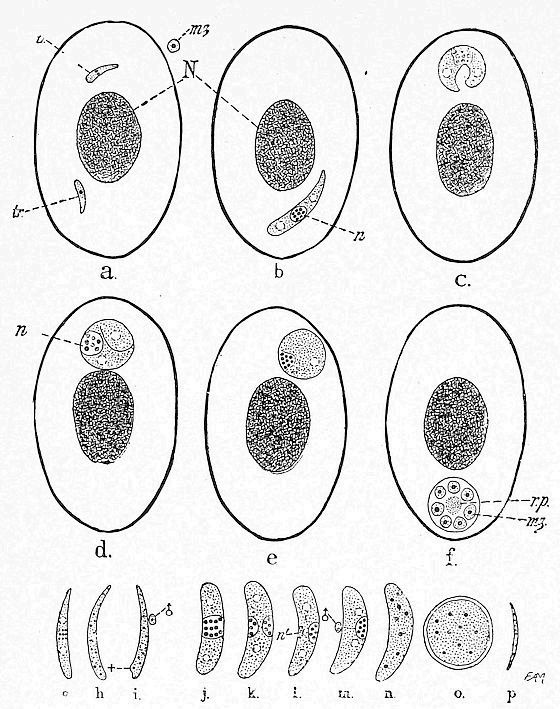
Fig. 45.
Lankesterella ranarum (Lank.), the parasite of the red blood-corpuscles of the edible Frog, described originally as Drepanidium ranarum by Lankester in 1882, and previously without name in 1871. The large ovals represent the red corpuscles of the frog; the dark central mass is the nucleus, N. In A two spindle-shaped parasites are seen; in B one larger parasite with nucleus n preparing to divide; in C the parasite is ∨-shaped. In D the parasite has become spherical, and is so in E also. In F the spherical parasite has divided into a number of spores mz, with a central residual body np. The figures G to N represent supposed stages in conjugation of small and large forms; O is an encysted phase; and P a spore or sporozoite of the sexual generation similar to the needle-shaped exotospores of Laverania. (See Fig. 44.) All the figures magnified 2,250 diameters. (After Hintze from Minchin’s section on Sporozoa in Lankester’s “Treatise on Zoology.”)
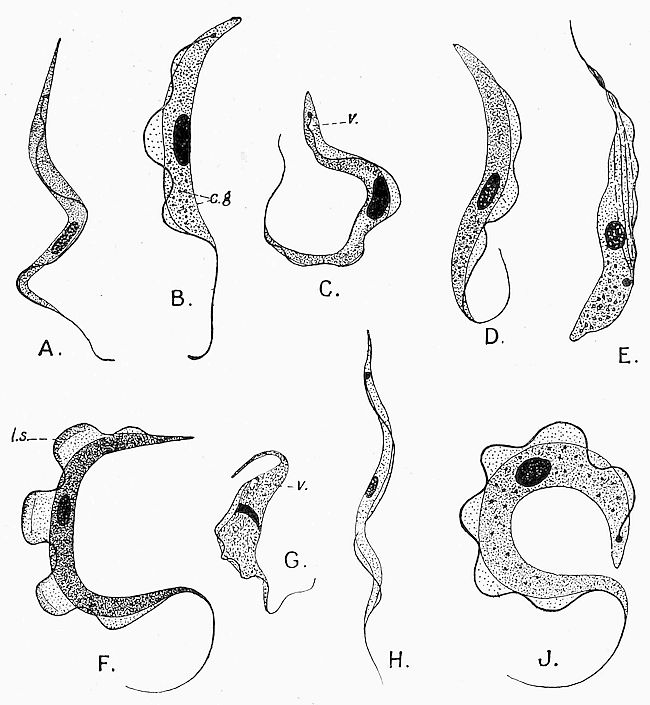
Fig. 46.
Various species of Trypanosoma from the blood of mammals, birds, and reptiles. A. T. Lewisii, from the blood of rats; B. T. Brucei, the parasite of the Nagana or Tsetze-fly disease, found in the blood of horses, cattle, and big game; C. T. gambiense, the parasite causing Sleeping Sickness in man; D. T. equinum, which causes the mal de caderas in South American horse ranches; E. T. noctuæ, from the blood of the little owl, Athene noctua; F. T. avium, found in the blood of many birds; G. a species found in the blood of Indian pigeons; H. T. ziemanni, a second species from the blood of the little owl; J. T. damoniæ, from the blood of a tortoise; c.g., granules; v., vacuole; l.s., fold of the crest or undulating membrane.
These figures are from Dr. Woodcock’s article on the “Hæmoflagellates” in the Quarterly Journal of Microscopical Science, April and June, 1906. (See also the figures in the next chapter relating to Sleeping Sickness.)
The Trypanosomes have acquired a terrible notoriety within the last four years, since another species, also carried by a Tsetze fly of another species, has been discovered by Castellani in cases of Sleeping Sickness in Uganda, and demonstrated by Colonel Bruce to be the cause of that awful disease.[21] Over 200,000 natives of Uganda have died from it within the last five years. It is incurable, and, sad to relate, not only a certain number of European employés have succumbed to it in tropical Africa, but a brave young officer of the Army Medical Corps, Lieutenant Tulloch, has died from the disease acquired by him in the course of an investigation of this disease and its possible cure, which he was carrying out, in association with other men of science, on the Victoria Nyanza Lake in Central Africa. Lieutenant Tulloch was sent out to this investigation by the Royal Society of London, and I will venture to ask my readers to join that body in sympathy for his friends, and admiration for him and the other courageous men who risk their lives in the endeavour to arrest disease.
Trypanosomes are now being recognised in the most diverse regions of the world as the cause of disease—new horse diseases in South America, in North Africa, in the Philippines and East India are all traced to peculiar species of Trypanosome. Other allied forms are responsible for Delhi-sore, and certain peculiar Indian fevers of man. A peculiar and ultra-minute parasite of the blood cells causes Texas fever, and various African fevers deadly to cattle. In all these cases, as also in that of plague, the knowledge of the carrier of the disease, often a tick or acarid—in that of plague the flea of the rat—is extremely important, as well as the knowledge of reservoir-hosts when such exist.
The zoologist thus comes into closer touch than ever with the profession of medicine, and the time has arrived when the professional students of disease fully admit that they must bring to their great and hopeful task of abolishing the diseases of man the fullest aid from every branch of biological science. I need not say how great is the contentment of those who have long worked at apparently useless branches of science—such as are the careful and elaborate distinction of every separate kind of animal and the life-history and structure peculiar to each—in the belief that all knowledge is good, to find that the science they have cultivated has become suddenly and urgently of the highest practical value.
I have not time to do more than mention here the effort that is being made by combined international research and co-operation to push further in our knowledge of phthisis and of cancer, with a view to their destruction. It is only since our last meeting at York that the parasite of Phthisis or Tubercle has been made known; we may hope that it will not be long before we have similar knowledge as to Cancer. Only eighteen months have elapsed since Fritz Schaudinn discovered the long-sought parasitic germ of Syphilis, the Spirochæta pallida (see fig. 6). As I write these words the sad news of Schaudinn’s death at the age of thirty-five comes to me from his family at Hamburg—an irreparable loss.
Let me finally state, in relation to this study of disease, what is the simple fact—namely, that if the people of Britain wish to make an end of infective and other diseases they must take every possible means to discover capable investigators, and employ them for this purpose. To do this, far more money is required than is at present spent in that direction. It is necessary, if we are to do our utmost, to spend a thousand pounds of public money on this task where we now spend one pound. It would be reasonable and wise to expend ten million pounds a year of our revenues on the investigation and attempt to destroy disease. Actually what is so spent is a mere nothing, a few thousands a year. Meanwhile our people are dying by thousands of preventable disease.
2. The Advancement of Science as Measured by the Support given to it by Public Funds, and the Respect Accorded to Scientific Work by the British Government and the Community at Large.
Whilst I have been able, though in a very fragmentary and incomplete way, to indicate the satisfactory and, indeed, the wonderful progress of science in the last quarter of a century, so far as the making of new knowledge is concerned, I am sorry to say that there is by no means a corresponding ‘advancement’ of Science in that signification of the word which implies the increase of the influence of science in the life of the community, the increase of the support given to it, and of the desire to aid in its progress, to discover and then to encourage and reward those who are specially fitted to increase scientific knowledge, and to bring it to bear so as to promote the welfare of the community.
It is, unfortunately, true that the successive political administrators of the affairs of this country, as well as the permanent officials, are altogether unaware to-day, as they were twenty-five years ago, of the vital importance of that knowledge which we call science, and of the urgent need for making use of it in a variety of public affairs. Whole departments of Government in which scientific knowledge is the one thing needful are carried on by ministers, permanent secretaries, assistant secretaries and clerks who are wholly ignorant of science, and naturally enough dislike it, since it cannot be used by them, and is in many instances the condemnation of their official employment. Such officials are, of course, not to be blamed, but rather the general indifference of the public to the unreasonable way in which its interests are neglected.
A difficult feature in treating of this subject is that when one mentions the fact that ministers of State and the officials of the public service are not acquainted with science, and do not even profess to understand its results or their importance, one’s statement of this very obvious and notorious fact is apt to be regarded as a personal offence. It is difficult to see wherein the offence lies, for no one seeks to blame these officials for a condition of things which is traditional and frankly admitted.
This is really a very serious matter for the scientific world to consider and deal with. We represent a line of activity, a group of professions which are in our opinion of vital importance to the well-being of the nation. We know that those interests which we value so highly are not merely ignored and neglected, but are actually treated as of no account or as non-existent by the old-established class of politicians and administrators. It is not too much to say that there is a natural fear and dislike of scientific knowledge on the part of a large proportion of the persons who are devoid of it, and who would cease to hold, or never have held, the positions of authority or emolument which they now occupy, were scientific knowledge of the matters with which they undertake to deal required of them. This is a thorny subject, and one in which, however much one may endeavour to speak in general terms, it is difficult to avoid causing personal annoyance. Yet it seems to me one of urgent importance. Probably an inquiry into and discussion of the neglect of science and the questionable treatment of scientific men by the administrative departments of Government might with advantage be undertaken by a committee appointed by our great scientific societies for the purpose.
At the same time public attention should be drawn in general terms to the fact that science is not gaining ‘advancement’ in public and official consideration and support. The reason is, I think, to be found in the defective education, both at school and university, of our governing class, as well as in a racial dislike among all classes to the establishment and support by public funds of posts which the average man may not expect to succeed by popular clamour or class privilege in gaining for himself—posts which must be held by men of special training and mental gifts. Whatever the reason for the neglect, the only remedy which we can possibly apply is that of improved education for the upper classes, and the continued effort to spread a knowledge of the results of science and a love for it amongst all members of the community. If believers in science took this matter seriously to heart they might do a great deal by insisting that their sons, and their daughters too, should have reasonable instruction in science both at school and college. They could, by their own initiative and example, do a good deal to put an end to the trifling with classical literature and the absorption in athletics which is considered by too many schoolmasters as that which the British parent desires as the education of his children.
Within the past year a letter has been published by a well-known nobleman, who is one of the Trustees of the British Museum, holding up to public condemnation the method in which the system laid down by the officials of the Treasury and sanctioned by successive Governments, as to the remuneration of scientific men, was applied in an individual case. I desire to place on record here the Earl of Crawford’s letter to the ‘Times’ of October 31, 1905, for the careful consideration of those who desire the advancement of science. When such things are done, science cannot be said to have advanced much in public consideration or Governmental support.
To the Editor of the ‘Times.’
Sir,—The death, noted by you to-day, of my dear friend and colleague Dr. Copeland, His Majesty’s Astronomer for Scotland, creates a vacancy in the scientific staff of Great Britain.
Will you permit me, Sir, to offer a word of warning to any who may be asked to succeed him?
Students or masters of astronomy are not, in the selfish sense, business men, nor are they as a general rule overburdened with this world’s goods. It behoves them henceforth to take more care as to their future in case of illness or physical infirmity and not to trust to the gratitude or generous impulse of the Treasury Department.
In old days it was the custom when a man distinguished in science was brought into a high position in the Civil Service that he was credited with a certain number of years’ service ranking for pension. This practice has been done away with, and a bargain system substituted. A short while ago the growing agonies of heart disease caused Dr. Copeland to feel that he was less able to carry on the duties of his post, and he determined to resign; but he learnt that under the scale, and in the absence of any special bargain, the pension he would receive would not suffice for the necessities of life. The only increase his friends could get from the Treasury was an offer to allow him about half-a-crown a week extra by way of a house.
Indignant and ashamed of my Government, I persuaded Dr. Copeland to withdraw his resignation and to retain the official position which he has honoured till his death.
I trust, Sir, that this memorandum of mine may cause eminent men of science who are asked to enter the service of the State when already of middle age to take heed for their future welfare.
I am, Sir, your obedient servant, Crawford.
2 Cavendish Square, October 28.
It is more agreeable to me not to dwell further on the comparative failure of science to gain increased influence and support in this country, but to mention some instances on the other side of the account. As long ago as 1842 the British Association took over and developed an observatory in the Deer Park at Kew, which was placed at the disposal of the Association by Her Majesty the Queen. Until 1871 the Association spent annually a large part of its income—as much in later years as 600l. a year—in carrying on the work of the Kew Observatory, consisting of magnetic, meteorological and physical observations. In 1871 the Association handed over the Observatory to the Royal Society, which had received an endowment of 10,000l. from Mr. Gassiot for its maintenance, and had further devoted to that purpose considerable sums from its own Donation Fund and Government Grant. Further aid for it was also received from private sources. From this Observatory at last has sprung, in the beginning of the present century, the National Physical Laboratory in Bushey Park, a fine and efficient scientific institution, built and supported by grants from the State, and managed by a committee of really devoted men of science who are largely representatives of the Royal Society. In addition to the value of the site and buildings occupied by the National Physical Laboratory, the Government has contributed altogether 34,000l. to the capital expenditure on new buildings, fittings, and apparatus, and has further assigned a grant of 6,000l. a year to the working of the laboratory. This institution all men of science are truly glad to have gained from the State, and they will remember with gratitude the statesmen—the late Marquis of Salisbury, the Right Hon. Arthur J. Balfour, Mr. Haldane, and others—as well as their own leaders—Lord Rayleigh, Sir William Huggins, and the active body of physicists in the Royal Society who have carried this enterprise to completion. The British Association has every reason to be proud of its share in early days in nursing the germ at Kew which has at length expanded into this splendid national institution.
I may mention also another institution which, during the past quarter of a century, has come into existence and received, originally through the influence of the late Lord Playfair (one of the few men of science who has ever occupied the position of a Minister of the Crown), and later by the influence of the Right Hon. Joseph Chamberlain, a subsidy of 1,000l. a year from the Government and a contribution of 5,000l. towards its initial expenses. This is the Marine Biological Association,[22] which has a laboratory at Plymouth (see fig. 47), and has lately expended a special annual grant, at the spontaneous invitation of His Majesty’s Treasury, in conducting an investigation of the North Sea in accordance with an international scheme devised by a central committee of scientific experts. This scheme has for its purpose the gaining such knowledge of the North Sea and its inhabitants as shall be useful in dealing practically and by legislation with the great fisheries of that area. The reader will, perhaps, not be surprised to hear that there are persons in high positions who, though admittedly unacquainted with the scientific questions at issue or the proper manner of solving them, are discontented with the action of the Government in entrusting the expenditure of public money to a body of scientific men who give their services, without reward or thanks, to carrying out the purposes of the international inquiry. Strange criticisms are offered by these malcontents in regard to the work done in the international exploration of the North Sea, and a desire is expressed to secure the money for expenditure by a less scientific agency. I do not hesitate to say here that the results obtained by the Marine Biological Association are of great value and interest, and, if properly continued and put to practical application, are likely to benefit very greatly the fishery industry; on the other hand, if the work is cut short or entrusted to incompetent hands it will no doubt be the case that what has already been done will lose its value—that is to say, will have been wasted. There is imminent danger of this perversion of the funds assigned to this scientific investigation taking place. There is no guarantee for the continuance of any funds or offices assigned to science in one generation by the officials of the next. The Mastership of the Mint held by Isaac Newton, and finally by the great chemist Thomas Graham, has been abolished and its salary appropriated by non-scientific officials. Only a few years ago it was with great difficulty that the Government of the day was prevented from assigning the Directorship of Kew Gardens to a young man of influence devoid of all knowledge of botany!
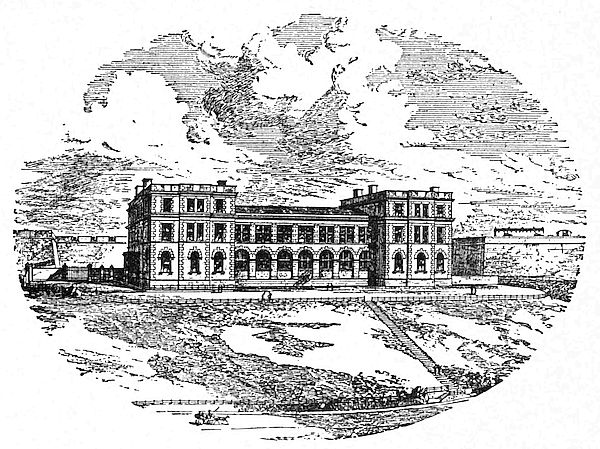
Fig. 47.
The Laboratory of the Marine Biological Association on the Citadel Hill, Plymouth, overlooking Plymouth Sound. The laboratory was built with the aid of funds raised by public subscription and a contribution of £5,000 by H.M. Government, and cost £12,200. The Association has expended, exclusive of this sum, since the opening of the laboratory in 1884, about £62,000, or an average of £3,000 a year on the maintenance of the laboratory, steam-boat and fishing-boats, and in payment of a staff of scientific observers. Of this sum the Government has contributed one-third, the rest has come from private donations and subscriptions, and from the “earnings” of the laboratory by sale of specimens, admission fees to the tank-room, &c. The journal of the Association, published at intervals, records a vast amount of scientific work, advancing our knowledge of marine life and of the life-history of fishes.
In addition to the above expenditure and results, the Association has superintended and most carefully directed the expenditure of £6,000 a year during the past five years in the investigation of the southern area of the North Sea and of the Channel at the request of H.M. Government, the work being part of the International Investigation of the North Sea. The very voluminous results of these inquiries are published in special reports by the International Committee. Full particulars of the work of the Marine Biological Association can be obtained from Dr. E. J. Allen, the Director, the Laboratory, Citadel Hill, Plymouth, who will also receive donations and applications for membership of the Association.
One of the most solid tests of the esteem and value attached to scientific progress by the community is the dedication of large sums of money to scientific purposes by its wealthier members. We know that in the United States such gifts are not infrequent; they are rare in this country. It is, therefore, with especial pleasure that I call attention to a great gift to science in this country made only a few years ago. Lord Iveagh has endowed the Lister Institute, for researches in connection with the prevention of disease, with no less a sum than a quarter of a million pounds sterling. This is the largest gift ever made to science in this country, and will be productive of great benefit to humanity. The Lister Institute took its origin in the surplus of a fund raised (at my suggestion and with my assistance as secretary) by Sir James Whitehead when Lord Mayor, some sixteen years ago, for the purpose of making a gift to the Pasteur Institute in Paris, where many English patients had been treated, without charge, after being bitten by rabid dogs. Three thousand pounds was sent to M. Pasteur, and the surplus of a few hundred pounds was made the starting-point of a fund which grew, by one generous gift and another, until the Lister Institute on the Thames Embankment at Chelsea was set up on a site presented by that good and high-minded man, the late Duke of Westminster.
Many other noble gifts to scientific research have been made in this country during the period on which we are looking back. Let us be thankful for them, and admire the wise munificence of the donors. But none the less we must refuse to rely entirely on such liberality for the development of the army of science, which has to do battle for mankind against the obvious disabilities and sufferings which afflict us and can be removed by knowledge. The organisation and finance of this army should be the care of the State.
It is a fact which many who have observed it regret very keenly, that there is to-day a less widespread interest than formerly in natural history and general science, outside the strictly professional arena of the school and university. The field naturalists among the squires and the country parsons seem nowadays not to be so numerous and active in their delightful pursuits as formerly, and the Mechanics’ Institutes and Lecture Societies of the days of Lord Brougham have given place, to a very large extent, to musical performances, bioscopes, and other entertainments, more diverting, but not really more capable of giving pleasure than those in which science was popularised. No doubt the organisation and professional character of scientific work are to a large extent the cause of this falling-off in its attraction for amateurs. But perhaps that decadence is also due in some measure to the increased general demand for a kind of manufactured gaiety, readily sent out in these days of easy transport from the great centres of fashionable amusement to the provinces and rural districts.
Before concluding this retrospect, I would venture to allude to the relations of scientific progress to religion. Putting aside the troubles connected with special creeds and churches and the claims of the clerical profession to certain funds and employments to the exclusion of laymen, it should, I think, be recognized that there is no essential antagonism between the scientific spirit and what is called the religious sentiment. ‘Religion,’ said Bishop Creighton, ‘means the knowledge of our destiny and of the means of fulfilling it.’ We can say no more and no less of Science. Men of Science seek, in all reverence, to discover the Almighty, the Everlasting. They claim sympathy and friendship with those who, like themselves, have turned away from the more material struggles of human life, and have set their hearts and minds on the knowledge of the Eternal.