Introductory material (continued 2)
Leo Wiener translation
No proofs were given of the teaching, except the truth, except the correspondence of the teaching with the truth. The whole teaching consisted in the knowledge of the truth and in following it, in a greater and ever greater approximation to it, in matters of life. According to this teaching, there are no acts which can justify a man, make him righteous; there is only the model of truth which attracts all hearts, for the inner perfection—in the person of Christ, and for the outer—in the realization of the kingdom of God. The fulfilment of the teaching is only in the motion along a given path, in the approximation to perfection,—the inner,—the imitation of Christ, and the outer,—the establishment of the kingdom of God. A man's greater or lesser good, according to this teaching, depends, not on the degree of perfection which he attains, but on the greater or lesser acceleration of motion.
The motion toward perfection of the publican, of Zacchæus, of the harlot, of the robber on the cross, is, according to this teaching, a greater good than the immovable righteousness of the Pharisee. A sheep gone astray is more precious than ninety-nine who have not. The prodigal son, the lost coin which is found again, is more precious, more loved by God than those who were not lost.
Every condition is, according to this teaching, only a certain step on the road toward the unattainable inner and outer perfection, and so has no meaning. The good is only in the motion toward perfection; but the stopping at any stage whatsoever is only a cessation of the good.
"Let not thy left hand know what thy right hand doeth," and "No man, having put his hand to the plough, and looking back, is fit for the kingdom of God." "Rejoice not, that the spirits are subject unto you; but rather rejoice, because your names are written in heaven."
"Be ye perfect as your Father which is in Heaven is perfect." "Seek the kingdom of God and His righteousness."
The fulfilment of the teaching is only in unceasing motion,—in the attainment of a higher and ever higher truth, and in an ever greater realization of the same in oneself by means of an ever increasing love, and outside of oneself by an ever greater realization of the kingdom of God.
It is evident that, having appeared in the midst of the Jewish and the pagan world, this teaching could not have been accepted by the majority of men, who lived a life entirely different from the one which this teaching demanded; and that it could not even be comprehended in its full significance by those who accepted it, as it was diametrically opposed to their former views.
Only by a series of misconceptions, blunders, one-sided explanations, corrected and supplemented by generations of men, was the meaning of the Christian teaching made more and more clear to men. The Christian world-conception affected the Jewish and the pagan conceptions, and the Jewish and pagan conceptions affected the Christian world-conception. And the Christian, as being vital, penetrated the reviving Jewish and pagan conceptions more and more, and stood forth more and more clearly, freeing itself from the false admixture, which was imposed upon it. Men came to comprehend the meaning better and better, and more and more realized it in life.
The longer humanity lived, the more and more was the meaning of Christianity made clear to it, as indeed it could not and cannot be otherwise with any teaching about life.
The subsequent generations corrected the mistakes of their predecessors, and more and more approached the comprehension of its true meaning. Thus it has been since the earliest times of Christianity. And here, in the earliest times, there appeared men, who began to assert that the meaning which they ascribed to the teaching was the only true one, and that as a proof of it served the supernatural phenomena which confirmed the correctness of their comprehension.
It was this that was the chief cause, at first, of the failure to comprehend the teaching, and later, of its complete corruption.
It was assumed that Christ's teaching was not transmitted to men like any other truth, but in a special, supernatural manner, so that the truth of the comprehension of the teaching was not proved by the correspondence of what was transmitted with the demands of reason and of the whole human nature, but by the miraculousness of the transmission, which served as an incontrovertible proof of the correctness of the comprehension. This proposition arose from a lack of comprehension, and its consequence was an impossibility of comprehending.
This began with the very first times, when the teaching was still understood incompletely and often perversely, as we may see from the gospels and from the Acts. The less the teaching was understood, the more obscurely did it present itself, and the more necessary were the external proofs of its veracity. The proposition about not doing unto another what one does not wish to have done to oneself did not need any proof by means of miracles, and there was no need for demanding belief in this proposition, because it is convincing in itself, in that it corresponds to both man's reason and nature, but the proposition as to Christ being God had to be proved by means of miracles, which are absolutely incomprehensible.
The more obscure the comprehension of Christ's teaching was, the more miraculous elements were mixed in with it; and the more miraculous elements were mixed in, the more did the teaching deviate from its meaning and become obscure; and the more it deviated from its meaning and became obscure, the more strongly it was necessary to assert one's infallibility, and the less did the teaching become comprehensible.
We can see from the gospels, the Acts, the epistles, how from the earliest times the failure to comprehend the teaching called forth the necessity of proving its truth by means of the miraculous and the incomprehensible.
According to the Acts, this began with the meeting of the disciples at Jerusalem, who assembled to settle the question which had arisen as to baptizing or not baptizing the uncircumcised who were still eating meats offered to idols.
The very putting of the question showed that those who were discussing it did not understand the teaching of Christ, who rejected all external rites—ablutions, purifications, fasts, Sabbaths. It says directly that not the things which enter a man's mouth, but those which come out of his heart, defile him, and so the question as to the baptism of the uncircumcised could have arisen only among men who loved their teacher, dimly felt His greatness, but still very obscurely comprehended the teaching itself. And so it was.
In proportion as the members of the assembly did not understand the teaching, they needed an external confirmation of their incomplete understanding. And so, to solve the question, the very putting of which shows the failure to comprehend the teaching, the strange words, "It has seemed good to the Holy Ghost, and to us," which were in an external manner to confirm the justice of certain establishments, and which have caused so much evil, were, as described in the Book of Acts, for the first time pronounced at this meeting, that is, it was asserted that the justice of what they decreed was testified to by the miraculous participation of the Holy Ghost, that is, of God, in this solution. But the assertion that the Holy Ghost, that is, God, spoke through the apostles, had again to be proved. And for this it was necessary to assert that on the day of Pentecost the Holy Ghost came down in the shape of tongues of fire on those who asserted this. (In the description the descent of the Holy Ghost precedes the assembly, but the Acts were written down much later than either.) But the descent of the Holy Ghost had to be confirmed for those who had not seen the tongues of fire (though it is incomprehensible why a tongue of fire burning above a man's head should prove that what a man says is an indisputable truth), and there were needed new miracles, cures, resurrections, putting to death, and all those offensive miracles, with which the Acts are filled, and which not only can never convince a man of the truth of the Christian teaching, but can only repel him from it. The consequence of such a method of confirmation was this, that the more these confirmations of the truth by means of stories of miracles heaped up upon one another, the more did the teaching itself depart from its original meaning, and the less comprehensible did it become.
Thus it has been since the earliest times, and it has been increasingly so all the time, until it logically reached in our time the dogmas of the transubstantiation and of the infallibility of the Pope, or of the bishops, or of the writings, that is, something absolutely incomprehensible, which has reached the point of absurdity and the demand for a blind faith, not in God, not in Christ, not even in the teaching, but in a person, as is the case in Catholicism, or in several persons, as in Orthodoxy, or in a book, as in Protestantism. The more Christianity became diffused, and the greater was the crowd of unprepared men which it embraced, the less it was understood, the more definitely was the infallibility of the comprehension asserted, and the less did it become possible to understand the true meaning of the teaching. As early as the time of Constantine the whole comprehension of the teaching was reduced to a résumé, confirmed by the worldly power,—a résumé of disputes which took place in a council,—to a symbol of faith, in which it says, I believe in so and so, and so and so, and finally, in the one, holy, catholic, and apostolic church, that is, in the infallibility of those persons who call themselves the church, so that everything was reduced to this, that a man no longer believes in God, nor in Christ, as they have been revealed to him, but in what the church commands him to believe.
But the church is holy,—the church was founded by Christ. God could not have left it to men to give an arbitrary interpretation to His teaching,—and so He established the church. All these expositions are to such an extent unjust and bold that one feels some compunction in overthrowing them.
There is nothing but the assertion of the churches to show that God or Christ founded anything resembling what the churchmen understand by church.
In the Gospel there is an indication against the church, as an external authority, and this indication is most obvious and clear in that place where it says that Christ's disciples should not call any one teachers and fathers. But nowhere is there anything said about the establishment of what the churchmen call a church.
In the gospels the word "church" is used twice,—once, in the sense of an assembly of men deciding a dispute; the other time, in connection with the obscure words about the rock, Peter, and the gates of hell. From these two mentions of the word "church," which has the meaning of nothing but an assembly, they deduce what we now understand by the word "church."
But Christ could certainly not have founded a church, that is, what we now understand by the word, because neither in Christ's words, nor in the conceptions of the men of that time, was there anything resembling the concept of a church, as we know it now, with its sacraments, its hierarchy, and, above all, its assertion of infallibility.
The fact that men named what was formed later by the same word which Christ had used in respect to something else, does in no way give them the right to assert that Christ established the one, true church.
Besides, if Christ had really founded such an institution as the church, on which the whole doctrine and the whole faith are based, He would most likely have expressed this establishment in such definite and clear words, and would have given the one, true church, outside of the stories about the miracles, which are used in connection with every superstition, such signs as to leave no doubts concerning its authenticity; there is nothing of the kind, but there are now, as there have been, all kinds of institutions which, each of them, call themselves the one, true church.
The Catholic catechism says: "L'église est la société de fidèles établie par notre Seigneur Jésus-Christ, répandue sur toute la terre et soumise à l'autorité des pasteurs légitimes, principalement notre Saint Père—le Pape," meaning by "pasteurs légitimes" a human institution, which has the Pope at its head and which is composed of certain persons who are connected among themselves by a certain organization.
The Orthodox catechism says: "The church is a society, established by Jesus Christ upon earth, united among themselves into one whole by the one, divine teaching and the sacraments, under the guidance and management of the God-established hierarchy," meaning by "God-established hierarchy" the Greek hierarchy, which is composed of such and such persons, who are to be found in such and such places.
The Lutheran catechism says: "The church is holy Christianity, or an assembly of all believers, under Christ, their chief, in which the Holy Ghost through the Gospel and the sacraments offers, communicates, and secures divine salvation," meaning, by this, that the Catholic Church has gone astray and has fallen away, and that the true tradition is preserved in Lutheranism.
For the Catholics the divine church coincides with the Roman hierarchy and the Pope. For the Greek Orthodox the divine church coincides with the establishment of the Eastern and the Russian Church.[8] For the Lutherans the divine church coincides with the assembly of men who recognize the Bible and Luther's catechism.
Speaking of the origin of Christianity, men who belong to one or the other of the existing churches generally use the word "church" in the singular, as though there has been but one church. But this is quite untrue. The church, as an institution which asserts of itself that it is in possession of the unquestionable truth, appeared only when it was not alone, but there were at least two of them.
So long as the believers agreed among themselves, and the assembly was one, it had no need of asserting that it was the church. Only when the believers divided into opposite parties, which denied one another, did there appear the necessity for each side to assert its authenticity, ascribing infallibility to itself. The concept of the one church arose only from this, that, when two sides disagreed and quarrelled, each of them, calling the other a heresy, recognized only its own as the infallible church.
If we know that there was a church, which in the year 51 decided to receive the uncircumcised, this church made its appearance only because there was another church, that of the Judaizing, which had decided not to receive the uncircumcised.
If there now is a Catholic Church, which asserts its infallibility, it does this only because there are the Græco-Russian, Orthodox, Lutheran Churches, each of which asserts its own infallibility, and thus rejects all the other churches. Thus the one church is only a fantastic conception, which has not the slightest sign of reality.
As an actual, historical phenomenon there have existed only many assemblies of men, each of which has asserted that it is the one church, established by Christ, and that all the others, which call themselves churches, are heresies and schisms.
The catechisms of the most widely diffused churches, the Catholic, the Orthodox, and the Lutheran, say so outright.
In the Catholic catechism it says: "Quels sont ceux, qui sont hors de l'église? Les infidèles, les hérétiques, les schismatiques." As schismatics are regarded the so-called Orthodox. The Lutherans are considered to be heretics; thus, according to the Catholic catechism, the Catholics alone are in the church.
In the so-called Orthodox catechism it says: "By the one church of Christ is meant nothing but the Orthodox, which remains in complete agreement with the œcumenical church. But as to the Roman Church and the other confessions" (the church does not even mention the Lutherans and others), "they cannot be referred to the one, true church, since they have themselves separated from it."
According to this definition the Catholics and Lutherans are outside the church, and in the church are only the Orthodox.
But the Lutheran catechism runs as follows: "Die wahre Kirche wird daran erkannt, dass in ihr das Wort Gottes lauter und rein ohne Menschenzusätze gelehrt und die Sacramente treu nach Christi Einsetzung gewahrt werden."
According to this definition, all those who have added anything to the teaching of Christ and the apostles, as the Catholic and Greek Churches have done, are outside the church. And in the church are only the Protestants.
The Catholics assert that the Holy Ghost has uninterruptedly operated in their hierarchy; the Orthodox assert that the same Holy Ghost has operated in their hierarchy; the Arians asserted that the Holy Ghost operated in their hierarchy (this they asserted with as much right as the now ruling churches assert it); the Protestants of every description, Lutherans, Reformers, Presbyterians, Methodists, Swedenborgians, Mormons, assert that the Holy Ghost operates only in their assemblies.
If the Catholics assert that the Holy Ghost during the division of the Arian and of the Greek Churches left the apostatizing churches and remained only in the one, true church, the Protestants of every denomination can with the same right assert that during the separation of their church from the Catholic the Holy Ghost left the Catholic Church and passed over to the one which they recognize. And so they do.
Every church deduces its profession through an uninterrupted tradition from Christ and the apostles. And, indeed, every Christian confession, arising from Christ, must have inevitably reached the present generation through a certain tradition. But this does not prove that any one of these traditions, excluding all the others, is indubitably the correct one.
Every twig on the tree goes uninterruptedly back to the root; but the fact that every twig comes from the same root does in no way prove that there is but one twig. The same is true of the churches. Every church offers precisely the same proofs of its succession and even of the miracles in favour of its own authenticity; thus there is but one strict and precise definition of what the church is (not as something fantastic, which we should like it to be, but as something which in reality exists), and this is: the church is an assembly of men, who assert that they, and they only, are in the full possession of the truth.
It was these assemblies, which later on, with the aid of the support of the temporal power, passed into mighty institutions, that were the chief impediments in the dissemination of the true comprehension of Christ's teaching.
Nor could it be otherwise: the chief peculiarity of Christ's teaching, as distinguished from all the former teachings, consisted in this, that the men who accepted it tried more and more to understand and fulfil the teaching, whereas the church doctrine asserted the full and final comprehension and fulfilment of this teaching.
However strange it may seem to us people educated in the false doctrine about the church as a Christian institution, and in the contempt for heresy, it was only in what is called heresy that there was true motion, that is, true Christianity, and it ceased to be such when it stopped its motion in these heresies and became itself arrested in the immovable forms of the church.
Indeed, what is a heresy? Read all the theological works which treat about heresies, a subject which is the first to present itself for definition, since every theology speaks of the true teaching amidst the surrounding false teachings, that is, heresies, and you will nowhere find anything resembling a definition of heresy.
As a specimen of that complete absence of any semblance of a definition of what is understood by the word "heresy" may serve the opinion on this subject expressed by the learned historian of Christianity, E. de Pressensé, in his Histoire du Dogme, with the epigraph, "Ubi Christus, ibi Ecclesia" (Paris, 1869). This is what he says in his introduction: "Je sais que l'on nous conteste le droit de califier ainsi," that is, to call heresies "les tendances qui furent si vivement combattues par les premiers Pères. La désignation même d'hérésie semble une atteinte portée à la liberté de conscience et de pensée. Nous ne pouvons partager ces scrupules, car ils n'iraient à rien moins qu'à enlever au christianisme tout caractère distinctif."
And after saying that after Constantine the church actually misused its power in defining the dissenters as heretics and persecuting them, he passes judgment on the early times and says:
"L'église est une libre association; il y a tout profit à se séparer d'elle. La polémique contre l'erreur n'a d'autres resources que la pensée et le sentiment. Un type doctrinal uniforme n'a pas encore été élaboré; les divergences secondaires se produisent en Orient et en Occident avec une entière liberté, la théologie n'est point liée à d'invariables formules. Si au sein de cette diversité apparait un fond commun de croyances, n'est-on pas en droit d'y voir non pas un système formulé et composé par les représentants d'une autorité d'école, mais la foi elle même, dans son instinct le plus sûr et sa manifestation la plus spontanée? Si cette même unanimité qui se revèle dans les croyances essentielles, se retrouve pour repousser telles ou telles tendances, ne seront-nous pas en droit de conclure que ces tendances étaient en désaccord flagrant avec les principes fondamentaux du christianisme? Cette présomption ne se transformera-t-elle pas en certitude si nous reconnaissons dans la doctrine universellement repoussée par l'église les traits caractéristiques de l'une des religions du passé? Pour dire que le gnosticisme ou l'ebionitisme sont les formes légitimes de la pensée chrétienne, il faut dire hardiment qu'il n'y a pas de pensée chrétienne, ni de caractère specifique qui la fasse reconnaître. Sous prétexte de l'élargir on la dissent. Personne, au temps de Platon, n'eut osé de couvrir de son nom, une doctrine qui n'eut pas fait place à la théorie des idées, et l'on eut excité les justes moqueries de la Grèce, en voulant faire d'Epicure ou de Zénon un disciple de l'Académie. Reconnaissons donc que s'il existe une religion et une doctrine qui s'appelle le christianisme elle peut avoir ses hérésies."
The whole discussion of the author reduces itself to this, that every opinion which is not in agreement with a code of dogmas professed by us at a given time is a heresy; but at a given time and in a given place people profess something, and this profession of something in some place cannot be a criterion of the truth.
Everything reduces itself to this, that "Ubi Christus, ibi Ecclesia;" but Christ is where we are. Every so-called heresy, by recognizing as the truth what it professes, can in a similar manner find in the history of the churches a consistent explanation of what it professes, using for itself all the arguments of De Pressensé and calling only its own confession truly Christian, precisely what all the heresies have been doing.
The only definition of heresy (the word ἁίρεσις means part) is the name given by an assembly of men to every judgment which rejects part of the teaching, as professed by the assembly. A more particular meaning, which more frequently than any other is ascribed to heresy, is that of an opinion which rejects the church doctrine, as established and supported by the worldly power.
There is a remarkable, little known, very large work (Unpartheyische Kirchen und Ketzer-Historia, 1729), by Gottfried Arnold, which treats directly on this subject and which shows all the illegality, arbitrariness, senselessness, and cruelty of using the word "heresy" in the sense of rejection. This book is an attempt at describing the history of Christianity in the form of a history of the heresies.
In the introduction the author puts a number of questions: (1) regarding those who make heretics (von den Ketzermachern selbst); (2) concerning those who were made heretics; (3) concerning the subjects of heresy; (4) concerning the method of making heretics, and (5) concerning the aims and consequences of making heretics.
In connection with each of these points he puts dozens of questions, answers to which he later gives from the works of well-known theologians, but he chiefly leaves it to the reader himself to make the deduction from the exposition of the whole book. I shall quote the following as samples of these questions, which partly contain the answers. In reference to the fourth point, as to how heretics are made, he says in one of his questions (the seventh): "Does not all history show that the greatest makers of heretics and the masters of this work were those same wise men from whom the Father has hidden His secrets, that is, the hypocrites, Pharisees, and lawyers, or entirely godless and corrupt people?" Questions 20 and 21: "And did not, in the most corrupt times of Christianity, the hypocrites and envious people reject those very men who were particularly endowed by God with great gifts, and who in the time of pure Christianity would have been highly esteemed? And, on the contrary, would not these men, who during the decadence of Christianity elevated themselves above everything and recognized themselves to be the teachers of the purest Christianity, have been recognized, in apostolic times, as the basest heretics and antichristians?"
Expressing in these questions this thought, among others, that the verbal expression of the essence of faith, which was demanded by the church, and a departure from which was considered a heresy, could never completely cover the world-conception of the believer, and that, therefore, the demand for an expression of faith by means of particular words was the cause of heresy, he says, in Questions 21 and 33:
"And if the divine acts and thoughts present themselves to a man as so great and profound that he does not find corresponding words in which to express them, must he be recognized as a heretic, if he is not able precisely to express his ideas? And is not this true, that in the early times there was no heresy, because the Christians did not judge one another according to verbal expressions, but according to the heart and acts, in connection with a complete liberty of expression, without fear of being recognized as a heretic? Was it not a very common and easy method with the church," he says in Question 21, "when the clergy wanted to get rid of a person or ruin him, to make him suspected as regards his doctrine and to throw over him the cloak of heresy, and thus to condemn and remove him?
"Though it is true that amidst the so-called heretics there were errors and sins, yet it is not less true and obvious from the numberless examples here adduced" (that is, in the history of the church and of heresy), he says farther on, "that there has not been a single sincere and conscientious man with some standing who has not been ruined by the churchmen out of envy or for other causes."
Thus, nearly two hundred years ago, was the significance of heresy understood, and yet this conception continues to exist until the present time. Nor can it fail to exist, so long as there is a concept of the church. Heresy is the reverse of the church. Where there is the church, there is also heresy. The church is an assembly of men asserting that they are in possession of the indisputable truth. Heresy is the opinion of people who do not recognize the indisputableness of the church truth.
Heresy is a manifestation of motion in the church, an attempt at destroying the ossified assertion of the church, an attempt at a living comprehension of the teaching. Every step of moving forward, of comprehending and fulfilling the teaching has been accomplished by the heretics: such heretics were Tertullian, and Origen, and Augustine, and Luther, and Huss, and Savonarola, and Chelcický, and others. Nor could it be otherwise.
A disciple of Christ, whose teaching consists in an eternally greater and greater comprehension of the teaching and in a greater and greater fulfilment of it, in a motion toward perfection, cannot, for the very reason that he is a disciple of Christ, assert concerning himself or concerning any one else, that he fully understands Christ's teaching and fulfils it; still less can he assert this concerning any assembly.
No matter at what stage of comprehension and perfection a disciple of Christ may be, he always feels the insufficiency of his comprehension and of his fulfilment, and always strives after a greater comprehension and fulfilment. And so the assertion about myself or about an assembly, that I, or we, possess the complete comprehension of Christ's teaching, and completely fulfil it, is a renunciation of the spirit of Christ's teaching.
No matter how strange this may seem, the churches, as churches, have always been, and cannot help but be, institutions that are not only foreign, but even directly hostile, to Christ's teaching. With good reason Voltaire called the church "l'infâme;" with good reason all, or nearly all, the Christian so-called sects have recognized the church to be that whore of whom Revelation prophesies; with good reason the history of the church is the history of the greatest cruelties and horrors.
The churches, as churches, are not certain institutions which have at their base the Christian principle, though slightly deviated from the straight path, as some think; the churches, as churches, as assemblies, which assert their infallibility, are antichristian institutions. Between the churches, as churches, and Christianity there is not only nothing in common but the name, but they are two absolutely divergent and mutually hostile principles. One is pride, violence, self-assertion, immobility, and death; the other is meekness, repentance, humility, motion, and life.
It is impossible at the same time to serve both masters,—one or the other has to be chosen.
The servants of the churches of all denominations have tried, especially of late, to appear as advocates of motion in Christianity; they make concessions, wish to mend the abuses which have stolen into the church, and say that for the sake of the abuses we ought not to deny the principle of the Christian church itself, which alone can unite all men and be a mediator between men and God. But all this is not true. The churches have not only never united, but have always been one of the chief causes of the disunion of men, of the hatred of one another, of wars, slaughters, inquisitions, nights of St. Bartholomew, and so forth, and the churches never serve as mediators between men and God, which is, indeed, unnecessary and is directly forbidden by Christ, who has revealed the teaching directly to every man, and they put up dead forms in the place of God, and not only fail to reveal God to man, but even conceal Him from them. Churches which have arisen from the failure to comprehend, and which maintain this lack of comprehension by their immobility, cannot help persecuting and oppressing every comprehension of the teaching. They try to conceal this, but this is impossible, because every motion forward along the path indicated by Christ destroys their existence.
As one hears and reads the articles and sermons, in which the church writers of modern times of all denominations speak of Christian truths and virtues, as one hears and reads these clever discussions, admonitions, confessions, which have been worked out by the ages, and which sometimes look very much as though they were sincere, one is prepared to doubt that the churches could be hostile to Christianity: "It certainly cannot be that these people, who have produced such men as Chrysostom, Fénelon, Butler, and other preachers of Christianity, should be hostile to it." One feels like saying: "The churches may have deviated from Christianity, may be in error, but cannot be hostile to it." But as one looks at the fruits, in order to judge the tree, as Christ has taught us to do, and sees that their fruits have been evil, that the consequence of their activity has been the distortion of Christianity, one cannot help but feel that, no matter how good the men have been, the cause of the churches in which they have taken part has not been Christian. The goodness and the deserts of all these men, who served the churches, were the goodness and the deserts of men, but not of the cause which they served. All these good men—like Francis d'Assisi and Francis de Lobes, our Tíkhon Zadónski, Thomas à Kempis, and others—were good men, in spite of their having served a cause which is hostile to Christianity, and they would have been better and more deserving still, if they had not succumbed to the error which they served.
But why speak of the past, judge of the past, which may have been falsely represented to us? The churches with their foundations and with their activity are not a work of the past: the churches are now before us, and we can judge of them directly, by their activity, their influence upon men.
In what does the activity of the churches now consist? How do they act upon men? What do the churches do in our country, among the Catholics, among the Protestants of every denomination? In what does their activity consist, and what are the consequences of their activity?
The activity of our Russian, so-called Orthodox, Church is in full sight. It is a vast fact, which cannot be concealed, and about which there can be no dispute.
In what consists the activity of this Russian Church, this enormous, tensely active institution, which consists of an army of half a million, costing the nation tens of millions?
The activity of this church consists in using every possible means for the purpose of instilling in the one hundred millions of the Russian population those obsolete, backward faiths, which now have no justification whatsoever, and which sometime in the past were professed by people that are alien to our nation, and in which hardly any one now believes, frequently even not those whose duty it is to disseminate these false doctrines.
The inculcation of these alien, obsolete formulas of the Byzantine clergy, which no longer have any meaning for the men of our time, about the Trinity, the Holy Virgin, the sacraments, grace, and so forth, forms one part of the activity of the Russian Church; another part of its activity consists in the activity of maintaining idolatry in the direct sense of the word,—worshipping holy relics and images, bringing sacrifices to them, and expecting from them the fulfilment of their wishes. I shall not speak of what is spoken and written by the clergy with a shade of learning and liberalism in the clerical periodicals, but of what actually is done by the clergy over the breadth of the Russian land among a population of one hundred million people. What do they carefully, persistently, tensely, everywhere without exception, teach the people? What is demanded of them on the strength of the so-called Christian faith?
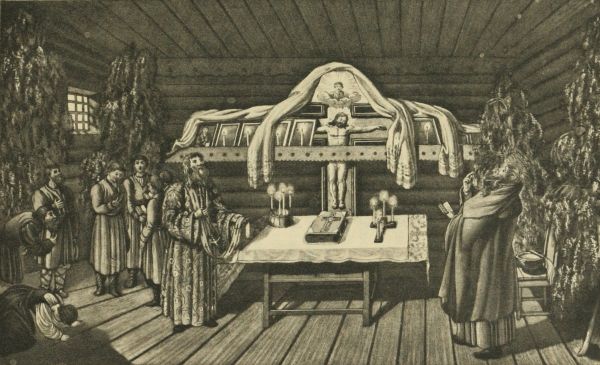
Russian Peasants at Mass
Photogravure from Drawing by Carl Buddeus
I will begin with the beginning, with the birth of a child: at the birth of a child, the clergy teaches that a prayer has to be read over the mother and the child, in order to purify them, since without this prayer the mother who has given birth to a child is accursed. For this purpose the priest takes the child in his hands in front of the representations of the saints, which the masses simply call gods, and pronounces exorcising words, and thus purifies the mother. Then it is impressed on the parents, and even demanded of them under threat of punishment in case of non-fulfilment, that the child shall be baptized, that is, dipped three times in water by the priest, in connection with which incomprehensible words are pronounced and even less comprehensible acts performed,—the smearing of various parts of the body with oil, the shearing of the hair, and the blowing and spitting of the sponsors on the imaginary devil. All this is supposed to cleanse the child and make him a Christian. Then the parents are impressed with the necessity of giving the holy sacrament to the child, that is, of giving him under the form of bread and wine a particle of Christ's body to eat, in consequence of which the child will receive the grace of Christ, and so forth. Then it is demanded that this child, according to his age, shall learn to pray. To pray means to stand straight in front of the boards on which the faces of Christ, the Virgin, the saints, are represented, and incline his head and his whole body, and with his right hand, with fingers put together in a certain form, to touch his brow, shoulders, and stomach, and pronounce Church-Slavic words, of which all the children are particularly enjoined to repeat, "Mother of God, Virgin, rejoice!" etc. Then the pupil is impressed with the necessity of doing the same, that is, crossing himself, in presence of any church or image; then he is told that on holidays (holidays are days on which Christ was born, though no one knows when that was, and circumcised, on which the Mother of God died, the cross was brought, the image was carried in, a saintly fool saw a vision, etc.,) he must put on his best clothes and go to church, buy tapers there and place them in front of images of saints, hand in little notes and commemorations and loaves, that triangles may be cut in them, and then pray many times for the health and welfare of the Tsar and the bishops, and for himself and his acts, and then kiss the cross and the priest's hand.
Besides this prayer he is enjoined to prepare himself at least once a year for the holy sacrament. To prepare himself for the holy sacrament means to go to church and tell the priest his sins, on the supposition that his imparting his sins to a stranger will completely cleanse him of his sins, and then to eat from a spoon a bit of bread with wine, which purifies him even more. Then it is impressed upon a man and a woman, who want their carnal intercourse to be sacred, that they must come to church, put on metallic crowns, drink potions, to the sound of singing walk three times around a table, and that then their carnal intercourse will become sacred and quite distinct from any other carnal intercourse.
In life people are impressed with the necessity of observing the following rules: not to eat meat or milk food on certain days, on other certain days to celebrate masses for the dead, on holidays to receive the priest and give him money, and several times a year to take the boards with the representations out of the church and carry them on sashes over fields and through houses. Before death a man is enjoined to eat from a spoon bread with wine, and still better, if he has time, to have himself smeared with oil. This secures for him happiness in the next world. After a man's death, his relatives are enjoined, for the purpose of saving the soul of the defunct, to put into his hands a printed sheet with a prayer; it is also useful to have a certain book read over the dead body and the name of the dead man pronounced several times in church.
All this is considered an obligatory faith for everybody.
But if one wants to care for his soul, he is taught, according to this faith, that the greatest amount of blessedness is secured for the soul in the world to come by contributing money for churches and monasteries, by putting holy men thus under obligation to pray for him. Other soul-saving measures, according to this faith, are the visiting of monasteries and the kissing of miracle-working images and relics.
According to this faith, miracle-working images and relics concentrate in themselves particular holiness, strength, and grace, and nearness to these objects—touching, kissing them, placing tapers before them, crawling up to them—contributes very much to a man's salvation, and so do masses, which are ordered before these sacred objects.
It is this faith, and no other, which is called Orthodox, that is, the right faith, and which has, under the guise of Christianity, been impressed upon the people for many centuries by the exercise of all kinds of force, and is now being impressed with particular effort.
And let it not be said that the Orthodox teachers place the essence of the teaching in something else, and that these are only ancient forms which it is not considered right to destroy. That is not true: throughout all of Russia, nothing but this faith has of late been impressed upon the people with particular effort. There is nothing else. Of something else they talk and write in the capitals, but only this is being impressed on one hundred million of people, and nothing else. The churchmen talk of other things, but they enjoin only this with every means at their command.
All this, and the worship of persons and images, is introduced into theologies, into catechisms; the masses are carefully taught this theoretically, and, being hypnotized practically, with every means of solemnity, splendour, authority, and violence, are made to believe in this, and are jealously guarded against every endeavour to be freed from these savage superstitions.
In my very presence, as I said in reference to my book, Christ's teaching and his own words concerning non-resistance to evil were a subject of ridicule and circus jokes, and the churchmen not only did not oppose this, but even encouraged the blasphemy; but allow yourself to say a disrespectful word concerning the monstrous idol, which is blasphemously carried about in Moscow by drunken persons under the name of the Iberian Virgin, and a groan of indignation will be raised by these same churchmen. All that is preached is the external cult of idolatry. Let no one say that one thing does not interfere with the other, that "these ought ye to have done, and not to have left the other undone," that "all, therefore, whatsoever they bid you observe, that observe and do; but do not ye after their works: for they say, and do not" (Matt. xxiii. 23, 3). This is said of the Pharisees, who fulfilled all the external injunctions of the law, and so the words, "whatsoever they bid you observe, that observe," refer to works of charity and of goodness, and the words, "but do ye not after their works, for they say, and do not," refer to the execution of ceremonies and to the omission of good works, and have precisely the opposite meaning to what the churchmen want to ascribe to this passage, when they interpret it as meaning that ceremonies are to be observed. An external cult and serving charity and truth are hard to harmonize; for the most part one thing excludes the other. Thus it was with the Pharisees, and thus it is now with the church Christians.
If a man can save himself through redemption, sacraments, prayer, he no longer needs any good deeds.
The Sermon on the Mount, or the symbol of faith: it is impossible to believe in both. And the churchmen have chosen the latter: the symbol of faith is taught and read as a prayer in the churches; and the Sermon on the Mount is excluded even from the Gospel teachings in the churches, so that in the churches the parishioners never hear it, except on the days when the whole Gospel is read. Nor can it be otherwise: men who believe in a bad and senseless God, who has cursed the human race and who has doomed His son to be a victim, and has doomed a part of humanity to everlasting torment, cannot believe in a God of love. A man who believes in God-Christ, who will come again in glory to judge and punish the living and the dead, cannot believe in Christ, who commands a man to offer his cheek to the offender, not to judge, but to forgive, and to love our enemies. A man who believes in the divine inspiration of the Old Testament and the holiness of David, who on his death-bed orders the killing of an old man who has offended him and whom he could not kill himself, because he was bound by an oath (Book of Kings, ii. 3), and similar abominations, of which the Old Testament is full, cannot believe in Christ's moral law; a man who believes in the doctrine and the preaching of the church about the compatibility of executions and wars with Christianity, cannot believe in the brotherhood of men.
Above all else, a man who believes in the salvation of men through faith, in redemption, or in the sacraments, can no longer employ all his strength in the fulfilment in life of the moral teaching of Christ.
A man who is taught by the church the blasphemous doctrine about his not being able to be saved by his own efforts, but that there is another means, will inevitably have recourse to this means, and not to his efforts, on which he is assured it is a sin to depend. The church doctrine, any church doctrine, with its redemption and its sacraments, excludes Christ's teaching, and the Orthodox doctrine, with its idolatry, does so especially.
"But the masses have always believed so themselves, and believe so now," people will say to this. "The whole history of the Russian masses proves this. It is not right to deprive the masses of their tradition." In this does the deception consist. The masses at one time, indeed, professed something like what the church professes now, though it was far from being the same (among the masses, there has existed, not only this superstition of the images, house spirits, relics, and the seventh Thursday after Easter, with its wreaths and birches, but also a deep moral, vital comprehension of Christianity, which has never existed in the whole church, and was met with only in its best representatives); but the masses, in spite of all the obstacles, which the government and the church have opposed to them, have long ago in their best representatives outlived this coarse stage of comprehension, which is proved by the spontaneous birth of rationalistic sects, with which one meets everywhere, with which Russia swarms at the present time, and with which the churchmen struggle in vain. The masses move on in the consciousness of the moral, vital side of Christianity. And it is here that the church appears with its failure to support, and with its intensified inculcation of an obsolete paganism in its ossified form, with its tendency to push the masses back into that darkness, from which they are struggling with so much effort to get out.
"We do not teach the masses anything new, but only what they believe in, and that in a more perfect form," say the churchmen.
This is the same as tying up a growing chick and pushing it back into the shell from which it has come.
I have often been struck by this observation, which would be comical, if its consequences were not so terrible, that men, taking hold of each other in a circle, deceive one another, without being able to get out of the enchanted circle.
The first question, the first doubt of a Russian who is beginning to think, is the question about the miracle-working images and, above all, the relics: "Is it true that they are imperishable, and that they work miracles?" Hundreds and thousands of men put these questions to themselves and are troubled about their solution, especially because the bishops, metropolitans, and all the dignitaries kiss the relics and the miracle-working images. Ask the bishops and the dignitaries why they do so, and they will tell you that they do so for the sake of the masses, and the masses worship the images and relics, because the bishops and dignitaries do so.
The activity of the Russian Church, in spite of its external veneer of modernness, learning, spirituality, which its members are beginning to assume in their writings, articles, clerical periodicals, and sermons, consists not only in keeping the masses in that consciousness of rude and savage idolatry, in which they are, but also in intensifying and disseminating superstition and religious ignorance, by pushing out of the masses the vital comprehension of Christianity, which has been living in them by the side of the idolatry.
I remember, I was once present in the monastery bookstore of Óptin Cloister, when an old peasant was choosing some religious books for his grandson, who could read. The monk kept pushing the description of relics, holidays, miraculous images, psalters, etc., into his hands. I asked the old man if he had the Gospel. "No." "Give him the Russian Gospel," I said to the monk. "That is not proper for him," said the monk.
This is in compressed form the activity of our church.
"But this is only true in barbarous Russia," a European or American reader will say. And such an opinion will be correct, but only in the measure in which it refers to the government which aids the church in accomplishing its stultifying and corrupting influence in Russia.
It is true that nowhere in Europe is there such a despotic government and one to such a degree in accord with the ruling church, and so the participation of the power in the corruption of the masses in Russia is very strong; but it is not true that the Russian Church in its influence upon the masses in any way differs from any other church.
The churches are everything the same, and if the Catholic, the Anglican, and the Lutheran Churches have not in hand such an obedient government as is the Russian, this is not due to the absence of any desire to make use of the same.
The church, as a church, no matter what it may be, Catholic, Anglican, Lutheran, Presbyterian,—every church, insomuch as it is a church, cannot help but tend toward the same as the Russian Church,—toward concealing the true meaning of Christ's teaching and substituting in its place its own doctrine, which does not put a person under any obligations, excludes the possibility of understanding the true activity of Christ's teaching, and, above all else, justifies the existence of priests who are living at the expense of the nation.
Has Catholicism been doing anything else with its prohibition of the reading of the Gospel, and with its demand for unreasoning obedience to the ecclesiastic guides and the infallible Pope? Does Catholicism preach anything different from what the Russian Church preaches? We have here the same external cult, the same relics, miracles, and statues, the miracle-working Notre-Dames, and processions. The same elatedly misty judgments concerning Christianity in books and sermons, and, when it comes to facts, the same maintenance of a coarse idolatry.
And is not the same being done in Anglicanism, Lutheranism, and in every Protestantism which has formed itself into a church? The same demands from the congregation for a belief in dogmas which were expressed in the fourth century and have lost all meaning for the men of our time, and the same demand for idolatry, if not before relics and images, at least before the Sabbath and the letter of the Bible. It is still the same activity, which is directed upon concealing the real demands of Christianity and substituting for them externals, which do not put a man under any obligations, and "cant," as the English beautifully define the occupation to which they are particularly subject. Among the Protestants this activity is particularly noticeable, since they do not even have the excuse of antiquity. And does not the same take place in the modern Revivalism,—the renovated Calvinism, Evangelism,—out of which has grown up the Salvation Army? Just as the condition of all the church doctrines is the same in reference to Christ's teaching, so are also their methods.
Their condition is such that they cannot help but strain all their efforts, in order to conceal the teaching of Christ, whose name they use.
The incompatibility of all the church confessions with Christ's teaching is such that it takes especial efforts to conceal this incompatibility from men. Indeed, we need but stop and think of the condition of any adult, not only cultured, but even simple, man of our time, who has filled himself with conceptions, which are in the air, from the fields of geology, physics, chemistry, cosmography, history, when he for the first time looks consciously at the beliefs, instilled in him in childhood and supported by the churches, that God created the world in six days; that there was light before the sun; that Noah stuck all the animals into his ark, and so forth; that Jesus is the same God, the son, who created everything before this; that this God descended upon earth for Adam's sin; that He rose from the dead, ascended to heaven, and sits on the right of the Father, and will come in the clouds to judge the world, and so forth.
All these propositions, which were worked out by the men of the fourth century and had a certain meaning for the men of that time, have no meaning for the men of the present. The men of our time may repeat these words with their lips, but they cannot believe, because these words, like the statements that God lives in heaven, that the heavens opened and a voice said something from there, that Christ rose from the dead and flew somewhere to heaven and will again come from somewhere in the clouds, and so forth, have no meaning for us.
It was possible for a man, who regarded the heaven as a finite, firm vault, to believe, or not, that God created the heaven, that heaven was opened, that Christ flew to heaven; but for us these words have no meaning whatsoever. Men of our time can only believe that they must believe so; but they cannot believe in what has no meaning for them.
But if all these expressions are to have a figurative meaning and are emblems, we know that, in the first place, not all churchmen agree in this, but that, on the contrary, the majority insist on understanding Holy Scripture in a direct sense, and, secondly, that these interpretations are varied and not confirmed by anything.
But even if a man wishes to make himself believe in the doctrine of the churches, as it is imparted,—the general diffusion of knowledge and of the Gospels, and the intercourse of men of various denominations among themselves, form for this another, even more insuperable obstacle.
A man of our time need but buy himself a Gospel for three kopeks and read Christ's clear words to the woman of Samaria, which are not subject to any other interpretation, about the Father needing no worshippers in Jerusalem, neither in this mountain, nor in that, worshippers in spirit and in truth, or the words about a Christian's being obliged to pray, not in temples, as the pagans do, and in the sight of all, but in secret, that is, in his closet, or that a disciple of Christ must not call any one father or teacher,—a man needs but read these words, to become convinced that no ecclesiastic pastors, who call themselves teachers in opposition to Christ's teaching, and who quarrel among themselves, form an authority, and that that which the churchmen teach us is not Christianity. But more than that: if a man of our time continues to believe in miracles and does not read the Gospel, his mere intercourse with men of other denominations and faiths, which has become so easy in our time, will make him doubt in the authenticity of his faith. It was all very well for a man who never saw any men of another faith than his own to believe that his own faith was the correct one; but a thinking man need only come in contact, as he now does all the time, with equally good and equally bad men of various denominations, which condemn the doctrines of one another, in order to lose faith in the truth of the religion which he professes. In our time only a very ignorant man or one who is quite indifferent to the questions of life, which are sanctified by religion, can stay in the church faith.
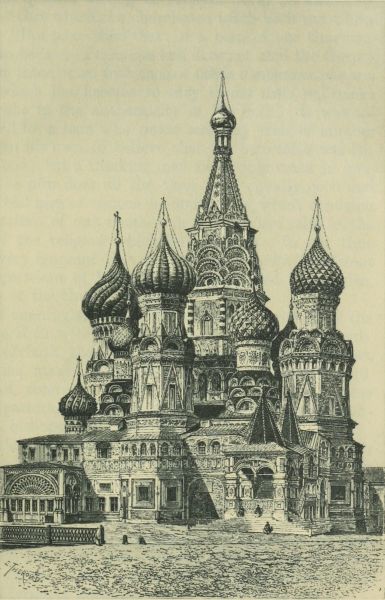
Church of Vasili the Blessed, Moscow
Photogravure from Drawing by E. Thérond
What cunning and what effort must be exerted by the churches, if, in spite of all these conditions which are subversive of faith, they are to continue building churches, celebrating masses, preaching, teaching, converting, and, above all, receiving for it a fat income, like all these priests, pastors, intendants, superintendents, abbots, archdeacons, bishops, and archbishops.
Especial, supernatural efforts are needed. And such efforts, which are strained more and more, are used by the churches. With us, in Russia, they use (in addition to all other means) the simple, coarse violence of the civil power, which is obedient to the church. Persons who depart from the external expression of faith and who give expression to it are either directly punished or deprived of their rights; while persons who strictly adhere to the external forms of faith are rewarded and given rights.
Thus do the Orthodox; but even all other churches, without exception, use for this all such means, of which the chief is what now is called hypnotization.
All the arts, from architecture to poetry, are put into action, to affect the souls of men and to stultify them, and this action takes place without interruption. Particularly evident is this necessity of the hypnotizing action upon men, in order to bring them to a state of stupefaction, in the activity of the Salvation Army, which uses new, unfamiliar methods of horns, drums, songs, banners, uniforms, processions, dances, tears, and dramatic attitudes.
But we are startled by them only because they are new methods. Are not the old methods of the temples, with especial illumination, with gold, splendour, candles, choirs, organs, bells, vestments, lackadaisical sermons, and so forth, the same?
But, no matter how strong this action of hypnotization may be, the chief and most deleterious activity of the churches does not lie in this. The chief, most pernicious activity of the church is the one which is directed to the deception of the children, those very children of whom Christ said that it will be woe to him who shall offend one of these little ones. With the very first awakening of the child, they begin to deceive him and to impress upon him with solemnity what those who impress do not believe in themselves, and they continue to impress him, until the deception, becoming a habit, is engrafted on the child's nature. The child is methodically deceived in the most important matter of life, and when the deception has so grown up with his life that it is difficult to tear it away, there is revealed to him the whole world of science and of reality, which can in no way harmonize with the beliefs instilled in him, and he is left to make the best he can out of these contradictions.
If we should set ourselves the task of entangling a man in such a way that he should not be able with his sound reason to get away from the two opposite world-conceptions, which have been instilled in him since his childhood, we could not invent anything more powerful than what is accomplished in the case of every young man who is educated in our so-called Christian society.
What the churches do to people is terrible, but if we reflect on their condition, we shall find that those men who form the institution of the churches cannot act otherwise. The churches are confronted with a dilemma,—the Sermon on the Mount, or the Nicene Creed,—one excludes the other: if a man sincerely believes in the Sermon on the Mount, the Nicene Creed, and with it the church and its representatives, inevitably lose all meaning and significance for him; but if a man believes in the Nicene Creed, that is, in the church, that is, in those who call themselves its representatives, the Sermon on the Mount will become superfluous to him. And so the churches cannot help but use every possible effort to obscure the meaning of the Sermon on the Mount and to attract people toward itself. Only thanks to the tense activity of the churches in this direction has the influence of the churches held itself until now. Let a church for the shortest time arrest this action upon the masses by means of hypnotizing them and deceiving the children, and people will understand Christ's teaching. But the comprehension of the teaching destroys the churches and their significance. And so the churches do not for a moment interrupt the tense activity and hypnotization of the adults and the deception of the children. And it is this activity of the churches, which instils a false comprehension of Christ's teaching in men, and serves as an obstacle in its comprehension for the majority of so-called believers.
IV.
Now I will speak of another putative comprehension of Christianity, which interferes with the correct comprehension of it,—the scientific comprehension.
The churchmen regard as Christianity that conception of it which they have formed, and this comprehension of Christianity they regard as the one indubitably true one.
The men of science regard as Christianity only what the different churches have been professing, and, assuming that these professions exhaust the whole significance of Christianity, they recognize it as a religious teaching which has outlived its time.
To have it made clear how impossible it is with such a view to understand the Christian teaching, we must form an idea of the place which the religions in general and Christianity in particular have in reality occupied in the life of humanity, and of the significance which is ascribed to religion by science.
As an individual man cannot live without having a definite idea of the meaning of his life, and always, though often unconsciously, conforms his acts to this meaning which he ascribes to his life, even so aggregates of men living under the same conditions,—nations cannot help but have a conception about the meaning of their collective life and the activity resulting therefrom. And as an individual, entering into a new age, invariably changes his comprehension of life, and a grown man sees its meaning in something else than in what a child sees it, so an aggregate of people, a nation, inevitably, according to its age, changes its comprehension of life and the activity which results from it.
The difference between the individual and the whole of humanity in this respect consists in this, that while the individual in the determination of the comprehension of life, proper to the new stage of life into which he enters, and in the activity which arises from it, makes use of the indications of men who have lived before him and who have already passed through the period of life upon which he is entering, humanity cannot have these indications, because it all moves along an untrodden path, and there is no one who can tell how life is to be understood, and how one is to act under the new conditions into which it is entering, and in which no one has lived before.
And yet, as a married man with children cannot continue to understand life as he understood it when he was a child, so humanity cannot in connection with all the various changes which have taken place,—the density of the population, and the established intercourse between the nations, and the improvement of the means for struggling against Nature, and the accumulation of science,—continue to understand life as before, but must establish a new concept of life, from which should result the activity which corresponds to that new condition into which it has entered or is about to enter.
To this demand responds the peculiar ability of humanity to segregate certain people who give a new meaning to the whole of human life,—a meaning from which results the whole new activity which is different from the preceding one. The establishment of the new life-conception, which is proper for humanity under the new conditions into which it is entering, and of the activity resulting from it, is what is called religion.
And so religion, in the first place, is not, as science thinks, a phenomenon which at one time accompanied the evolution of humanity, and later became obsolete, but is a phenomenon always inherent in the life of humanity, and is in our time as inevitably inherent in humanity as at any other time. In the second place, religion is always a determination of the activity of the future, and not of the past, and so it is obvious that the investigation of past phenomena can in no way include the essence of religion.
The essence of every religious teaching does not consist in the desire to express the forces of Nature symbolically, or in the fear of them, or in the demand for the miraculous, or in the external forms of its manifestation, as the men of science imagine. The essence of religion lies in the property of men prophetically to foresee and point out the path of life, over which humanity must travel, in a new definition of the meaning of life, from which also results a new, the whole future activity of humanity.
This property of foreseeing the path on which humanity must travel is in a greater or lesser degree common to all men, but there have always, at all times, been men, in whom this quality has been manifested with particular force, and these men expressed clearly and precisely what was dimly felt by all men, and established a new comprehension of life, from which resulted an entirely new activity, for hundreds and thousands of years.
We know three such conceptions of life: two of them humanity has already outlived, and the third is the one through which we are now passing in Christianity. There are three, and only three, such conceptions, not because we have arbitrarily united all kinds of life-conceptions into these three, but because the acts of men always have for their base one of these three life-conceptions, because we cannot understand life in any other way than by one of these three means.
The three life-conceptions are these: the first—the personal, or animal; the second—the social, or the pagan; and the third—the universal, or the divine.
According to the first life-conception, man's life is contained in nothing but his personality; the aim of his life is the gratification of the will of this personality. According to the second life-conception, man's life is not contained in his personality alone, but in the aggregate and sequence of personalities,—in the tribe, the family, the race, the state; the aim of life consists in the gratification of the will of this aggregate of personalities. According to the third life-conception, man's life is contained neither in his personality, nor in the aggregate and sequence of personalities, but in the beginning and source of life, in God.
These three life-conceptions serve as the foundation of all past and present religions.
The savage recognizes life only in himself, in his personal desires. The good of his life is centred in himself alone. The highest good for him is the greatest gratification of his lust. The prime mover of his life is his personal enjoyment. His religion consists in appeasing the divinity in his favour, and in the worship of imaginary personalities of gods, who live only for personal ends.
A pagan, a social man, no longer recognizes life in himself alone, but in the aggregate of personalities,—in the tribe, the family, the race, the state,—and sacrifices his personal good for these aggregates. The prime mover of his life is glory. His religion consists in the glorification of the heads of unions,—of eponyms, ancestors, kings, and in the worship of gods, the exclusive protectors of his family, his race, his nation, his state.[9]
The man with the divine life-conception no longer recognizes life to consist in his personality, or in the aggregate of personalities (in the family, the race, the people, the country, or the state), but in the source of the everlasting, immortal life, in God; and to do God's will he sacrifices his personal and domestic and social good. The prime mover of his religion is love. And his religion is the worship in deed and in truth of the beginning of everything, of God.
The whole historical life of humanity is nothing but a gradual transition from the personal, the animal life-conception, to the social, and from the social to the divine. The whole history of the ancient nations, which lasted for thousands of years and which came to a conclusion with the history of Rome, is the history of the substitution of the social and the political life-conception for the animal, the personal. The whole history since the time of imperial Rome and the appearance of Christianity has been the history of the substitution of the divine life-conception for the political, and we are passing through it even now.
It is this last life-conception, and the Christian teaching which is based upon it and which governs our whole life and lies at the foundation of our whole activity, both the practical and the theoretical, that the men of so-called science, considering it in reference to its external signs only, recognize as something obsolete and meaningless for us.
This teaching, which, according to the men of science, is contained only in its dogmatic part,—in the doctrine of the Trinity, the redemption, the miracles, the church, the sacraments, and so forth,—is only one out of a vast number of religions which have arisen in humanity, and now, having played its part in history, is outliving its usefulness, melting in the light of science and true culture.
What is taking place is what in the majority of cases serves as a source of the coarsest human errors,—men who are standing on a lower level of comprehension, coming in contact with phenomena of a higher order, instead of making efforts to understand them, instead of rising to the point of view from which they ought to look upon a subject, judge it from their lower point of view, and that, too, with greater daring and determination the less they understand what they are talking about.
For the majority of scientific men, who view Christ's vital, moral teaching from the lower point of the social conception of life, this teaching is only a very indefinite, clumsy combination of Hindoo asceticism, Stoical and Neo-platonic teachings, and Utopian antisocial reveries, which have no serious significance for our time, and its whole meaning is centred in its external manifestations,—in Catholicism, Protestantism, the dogmas, the struggle with the worldly power. In defining the significance of Christianity according to these phenomena, they are like deaf persons who should judge of the meaning and the worth of music according to the appearance of the motions which the musicians make.
The result of it is this, that all these men, beginning with Comte, Strauss, Spencer, and Renan, who do not understand the meaning of Christ's sermons, who do not understand why they are uttered and for what purpose, who do not even understand the question to which they serve as an answer, who do not even take the trouble to grasp their meaning, if they are inimically inclined, deny outright the rationality of the teaching; but if they wish to be condescending to it, they correct it from the height of their grandeur, assuming that Christ wanted to say precisely what they have in mind, but did not know how to say it. They treat his teaching as, in correcting the words of an interlocutor, self-confident men generally speak to one whom they regard as standing below them, "Yes, what you mean to say is this." This correction is always made in the sense of reducing the higher, divine life-conception to the lower, social conception.
People generally say that the moral teaching of Christianity is good, but exaggerated,—that, in order that it should be absolutely good, we must reject from it what is superfluous, what does not fit in with our structure of life. "For otherwise the teaching, which demands too much, which cannot be carried out, is worse than one which demands from men what is possible and in conformity with their strength," think and assert the wise interpreters of Christianity, repeating what was long ago affirmed and still is affirmed, and could not help but be affirmed, in relation to the Christian teaching, by those who, having failed to comprehend the teacher of it, crucified Him,—by the Jews.
It turns out that before the judgment of the learned of our time, the Jewish law, A tooth for a tooth, and an eye for an eye,—the law of just retaliation, which was known to humanity five thousand years ago,—is more useful than the law of love which eighteen hundred years ago was preached by Christ in place of this very law of justice.
It turns out that everything which has been done by the men who comprehended Christ's teaching in a direct manner and lived in conformity with such a comprehension, everything which all true Christians, all Christian champions, have done, everything which now transforms the world under the guise of socialism and communism,—is exaggeration, of which it is not worth while to speak.
Men who have been educated in Christianity for eighteen centuries have convinced themselves in the persons of their foremost men, the scholars, that the Christian teaching is a teaching of dogmas, that the vital teaching is a misconception, an exaggeration, which violates the true legitimate demands of morality, which correspond to man's nature, and that the doctrine of justice, which Christ rejected and in the place of which he put his own teaching, is much more profitable for us.
The learned consider the commandment of non-resistance to evil an exaggeration and even madness. If it be rejected, it would be much better, they think, without observing that they are not talking of Christ's teaching at all, but of what presents itself to them as such.
They do not notice that to say that Christ's commandment about non-resistance to evil is an exaggeration is the same as saying that in the theory of the circle the statement about the equality of the radii of a circle is an exaggeration. And those who say so do precisely what a man, who did not have any conception as to what a circle is, would do if he asserted that the demand that all the points on the circumference should be equally distant from the centre is an exaggeration. To advise that the statement concerning the equality of the radii in a circle be rejected or moderated is the same as not understanding what a circle is. To advise that the commandment about non-resistance to evil in the vital teaching of Christ be rejected or moderated means not to understand the teaching.
And those who do so actually do not understand it at all. They do not understand that this teaching is the establishment of a new comprehension of life, which corresponds to the new condition into which men have been entering for these eighteen hundred years, and the determination of the new activity which results from it. They do not believe that Christ wanted to say what he did; or it seems to them that what he said in the Sermon on the Mount and in other passages He said from infatuation, from lack of comprehension, from insufficient development.[10]
Therefore I say unto you, Take no thought for your life, what ye shall eat, or what ye shall drink; nor yet for your body, what ye shall put on. Is not the life more than meat, and the body than raiment? Behold the fowls of the air: for they sow not, neither do they reap, nor gather into barns; yet your heavenly Father feedeth them. Are ye not much better than they? Which of you by taking thought can add one cubit unto his stature? And why take ye thought for raiment? Consider the lilies of the field, how they grow; they toil not, neither do they spin: and yet I say unto you, That even Solomon in all his glory was not arrayed like one of these. Wherefore, if God so clothe the grass of the field, which to-day is, and to-morrow is cast into the oven, shall He not much more clothe you, O ye of little faith? Therefore take no thought, saying, What shall we eat? or, What shall we drink, or, Wherewithal shall we be clothed? (For after all these things do the Gentiles seek:) for your heavenly Father knoweth that ye have need of all these things. But seek ye first the kingdom of God, and His righteousness; and all these things shall be added unto you. Take therefore no thought for the morrow: for the morrow shall take thought for the things of itself. Sufficient unto the day is the evil thereof (Matt. vi. 25-34).
Sell that ye have, and give alms; provide yourselves bags which wax not old, a treasure in the heavens that faileth not, where no thief approacheth, neither moth corrupteth. For where your treasure is there will your heart be also (Luke xii. 33-34).
Go and sell that thou hast, and follow me, and who hath not forsaken father or mother, or children, or brethren, or fields, or house, cannot be my disciple.
Turn away from thyself, take thy cross for every day, and come after me. My meat is to do the will of Him that sent me, and to do His work. Not my will be done, but Thine; not what I want, but what Thou wantest, and not as I want, but as Thou wantest. The life is in this, not to do one's will, but the will of God.
All these propositions seem to men who are standing on a lower life-conception to be an expression of an ecstatic transport, which has no direct applicability to life. And yet these propositions just as strictly result from the Christian conception of life as the tenet about giving up one's labour for the common good, about sacrificing one's life in the defence of one's country, results from the social conception.
Just as a man of the social life-conception says to a savage, "Come to your senses, bethink yourself! The life of your personality cannot be the true life, because it is wretched and transitory. Only the life of the aggregate and of the sequence of personalities, of the tribe, the family, the race, the state, is continued and lives, and so a man must sacrifice his personality for the life of the family, the state." Precisely the same the Christian teaching says to a man of the aggregate, of the social conception of life. "Repent, μετανοεῖτε, that is, bethink yourselves, or else you will perish. Remember that this carnal, personal life, which originated to-day and will be destroyed to-morrow, cannot be made secure in any way, that no external measures, no arrangement of it, can add firmness and rationality to it. Bethink yourselves and understand that the life which you live is not the true life: the life of the family, the life of society, the life of the state will not save you from ruin." The true, rational life is possible for man only in proportion as he can be a participant, not in the family or the state, but in the source of life, the Father; in proportion as he can blend his life with the life of the Father. Such indubitably is the Christian life-comprehension, which may be seen in every utterance of the Gospel.
It is possible not to share this life-conception; it is possible to reject it; it is possible to prove its inexactness and irregularity; but it is impossible to judge of the teaching, without having first grasped the life-conception from which it results; still less possible is it to judge about a subject of a higher order from a lower point of view, to judge of the tower by looking at the foundation. But it is precisely this that the learned men of our time are doing. They do so because they abide in an error, which is like the one of the churchmen, the belief that they are in possession of such methods of the study of the subject that, as soon as these methods, called scientific, are used, there can be no longer any doubt as to the correctness of the comprehension of the subject under advisement.
It is this possession of an instrument of cognition, which they deem infallible, that serves as the chief obstacle in the comprehension of the Christian teaching by unbelievers and so-called scientific men, by whose opinion the vast majority of unbelievers, the so-called cultured men, are guided. From this imaginary comprehension of theirs arise all the errors of the scientific men in respect to the Christian teaching, and especially two strange misconceptions which more than any other impede the correct comprehension of it.
One of these misconceptions is this, that the Christian vital teaching is impracticable, and so is either entirely unobligatory, that is, need not be taken for a guide, or else must be modified and moderated to such an extent as to make it practicable in our society. Another misunderstanding is this, that the Christian teaching of love of God, and so the service of Him, is an obscure, mystical demand, which has no definite object of love, and so must give way to a more precise and comprehensible teaching about loving men and serving humanity.
The first misconception about the impracticableness of the teaching consists in this, that the men of the social comprehension of life, being unable to comprehend the method by means of which the Christian teaching guides men, and taking the Christian indications of perfection to be rules which determine life, think and say that it is impossible to follow Christ's teaching, because a complete fulfilment of this teaching destroys life.
"If a man fulfilled what was preached by Christ, he would destroy his life; and if all men should fulfil it, the whole human race would come to an end," they say.
"If we care not for the morrow, for what we shall eat and drink and be clothed in; if we do not defend our lives; if we do not resist evil with force; if we give our lives for our friends, and observe absolute chastity, no man, nor the whole human race, can exist," they think and say.
And they are quite correct, if we take the indications of perfection, as given by Christ, for rules, which every man is obliged to carry out, just as in the social teaching everybody is obliged to carry out the rule about paying the taxes, about taking part in court, etc.
The misconception consists in this, that Christ's teaching guides men in a different way from the way those teachings guide which are based on a lower life-conception. The teachings of the social life-conception guide only by demanding a precise execution of the rules or laws. Christ's teaching guides men by indicating to them that infinite perfection of the Father in heaven, toward which it is proper for each man to strive voluntarily, no matter at what stage of perfection he may be.
The misconception of people who judge about the Christian teaching from the social point of view consists in this, that they, assuming that the perfection pointed out by Christ may be attained completely, ask themselves (even as they question themselves, assuming that the social laws will be fulfilled) what will happen when all this shall be fulfilled. This assumption is false, because the perfection pointed out by Christ is infinite and can never be attained; and Christ gives His teaching with this in view, that complete perfection will never be attained, but that the striving toward complete, infinite perfection will constantly increase the good of men, and that this good can, therefore, be increased infinitely.
Christ does not teach angels, but men, who live an animal life, who are moved by it. And it is to this animal force of motion that Christ seems to apply a new, a different force of the consciousness of divine perfection, and with this He directs the motion of life along the resultant of two forces.
To assume that human life will go in the direction indicated by Christ is the same as assuming that a boatman, in crossing a rapid river and directing his boat almost against the current, will move in that direction.
Christ recognizes the existence of both sides of the parallelogram, of both the eternal, indestructible forces, of which man's life is composed,—the force of the animal nature and the force of the consciousness of a filial relation to God. Without saying anything of the animal force, which, asserting itself, always remains equal to itself and exists outside of man's power, Christ speaks only of the divine force, calling man to recognize it in the highest degree, to free it as much as possible from what is retarding it, and to bring it to the highest degree of tension.
In this liberation and increase of the force does man's true life, according to Christ's teaching, consist. The true life, according to the previous conditions, consisted in the execution of rules, of the law; according to Christ's teaching, it consists in the greatest approach to the divine perfection, as pointed out to every man and inwardly felt by him, in a greater and ever greater approach toward blending our will with the will of God, a blending toward which a man strives, and which would be a destruction of life as we know it.
Divine perfection is the asymptote of the human life, toward which it always tends and approaches, and which can be attained by it only at infinity.
The Christian teaching seems to exclude the possibility of life only when men take the indication of the ideal to be a rule. It is only then that the demands put forth by Christ's teaching appear to be destructive of life. Without these demands the true life would be impossible.
"Too much should not be demanded," people generally say, in discussing the demands of the Christian teaching. "It is impossible to demand that we should not care for the future, as it says in the Gospel; all that we should do is not to care too much. It is impossible to give everything to the poor; but we should give a certain, definite part to them. It is not necessary to strive after chastity; but debauchery should be avoided. We must not leave our wives and children; but we should not be too much attached to them," and so forth.
But to speak in this manner is the same as telling a man who is crossing a rapid river, and who is directing his course against the current, that it is impossible to cross the river by going against the current, but that to cross it he should row in the direction he wishes to go.
Christ's teaching differs from previous teachings in that it guides men, not by external rules, but by the internal consciousness of the possibility of attaining divine perfection. And in man's soul there are not moderated rules of justice and of philanthropy, but the ideal of the complete, infinite, divine perfection. Only the striving after this perfection deflects the direction of man's life from the animal condition toward the divine, to the extent to which this is possible in this life.
In order to land where you wish, you must direct your course much higher up.
To lower the demands of the ideal means not only to diminish the possibility of perfection, but to destroy the ideal itself. The ideal which operates upon people is not an invented one, but one which is borne in the soul of every man. Only this ideal of the complete, infinite perfection acts upon people and moves them to activity. A moderated perfection loses its power to act upon men's souls.
Christ's teaching only then has force, when it demands full perfection, that is, the blending of God's essence, which abides in the soul of every man, with the will of God,—the union of the son and the Father. Only this liberation of the son of God, who lives in every man, from the animal, and his approximation to the Father form life according to Christ's teaching.
The existence of the animal in man, of nothing but the animal, is not the human life. Life according to the will of God alone is also not the human life. The human life is the resultant from the animal and the divine lives, and the more this resultant approaches the divine life, the more there is of life.
Life, according to the Christian teaching, is a motion toward divine perfection. No condition, according to this teaching, can be higher or lower than another. Every condition, according to this teaching, is only a certain step, indifferent in itself, toward the unattainable perfection, and so in itself forms neither a greater nor a lesser degree of life. The increase of life, according to this teaching, is only an acceleration of motion toward perfection, and so the motion toward perfection of the publican Zacchæus, of the harlot, of the robber on the cross, forms a higher degree of life than the immovable righteousness of the Pharisee. And so there can be no obligatory rules for this teaching. A man who stands on a lower step, in moving toward perfection, lives more morally and better, and better performs the teaching, than a man who stands on a much higher stage of morality, but who does not move toward perfection.
In this sense the lost sheep is dearer to the Father than one which is not lost. The prodigal son, the lost coin which is found again, are dearer than those which were not lost.
The fulfilment of the teaching consists in the motion from oneself toward God. It is evident that for such a fulfilment of the teaching there can be no definite laws and rules. All degrees of perfection and all degrees of imperfection are equal before this teaching; no fulfilment of the laws constitutes a fulfilment of the teaching; and so, for this teaching there are, and there can be, no rules and no laws.
From this radical distinction of Christ's teaching as compared with previous teachings, which are based on the social conception of life, there results the difference between the social and the Christian commandments. The social commandments are for the most part positive, prescribing certain acts, justifying men, giving them righteousness. But the Christian commandments (the commandment of love is not a commandment in the strict sense of the word, but an expression of the very essence of the teaching)—the five commandments of the Sermon on the Mount—are all negative, and they all show only what men may not do at a certain stage of human development. These commandments are, as it were, signals on the infinite road to perfection, toward which humanity walks, signals of that stage of perfection which is possible at a given period of the development of humanity.
In the Sermon on the Mount Christ has expressed the eternal ideal toward which it is proper for men to tend, and that degree of its attainment which can be reached even in our time.
The ideal consists in having no ill-will against any one, in calling forth no ill-will, in loving all; but the commandment, below which, in the attainment of this ideal, it is absolutely possible not to descend, consists in not offending any one with a word. And this forms the first commandment.
The ideal is complete chastity, even in thought; the commandment which points out the degree of attainment, below which, in the attainment of this ideal, it is absolutely possible not to descend, is the purity of the marital life, the abstaining from fornication. And this forms the second commandment.
The ideal is not to care for the future, to live only in the present; the commandment which points out the degree of the attainment, below which it is absolutely possible not to descend is not to swear, not to promise anything to men. And this is the third commandment.
The ideal is never, under any condition, to make use of violence; the commandment which points out the degree below which it is absolutely possible not to descend is not to repay evil with evil, but to suffer insult, to give up one's cloak. And this is the fourth commandment.
The ideal is to love our enemies, who hate us; the commandment which points out the degree of the attainment, below which it is possible not to descend, is to do no evil to our enemies, to speak well of them, to make no distinction between them and our fellow citizens.
All these commandments are indications of what we are fully able not to do on the path of striving after perfection, of what we ought to work over now, of what we must by degrees transfer into the sphere of habit, into the sphere of the unconscious. But these commandments fail to form a teaching, and do not exhaust it, and form only one of the endless steps in the approximation toward perfection.
After these commandments there must and will follow higher and higher ones on the path to perfection, which is indicated by the teaching.
And so it is the peculiarity of the Christian teaching that it makes higher demands than those which are expressed in these commandments, but under no condition minimizes the demands, either of the ideal itself, or of these commandments, as is done by people who judge the teaching of Christianity free from the standpoint of the social conception of life.
Such is one misconception of the scientific men concerning the meaning and significance of Christ's teaching; the other, which flows from the same source, consists in the substitution of the love and service of men, of humanity, for the Christian demand for loving God and serving Him.
The Christian teaching of loving God and serving Him, and (only in consequence of this love and this service) of the love and service of our neighbour, appears obscure, mystical, and arbitrary to the men of science, and they completely exclude the demand of love of God and of serving Him, assuming that the teaching about this love of men, of humanity, is much more intelligible and firm and better grounded.