"The King's Assegai" (continued 3)
Reading edition
“Things looked plainer now. One unexpected meal had come down to these wizards through the pit into which we had both fallen. On hearing the noise of my descent, in their eagerness for that which should yield another, they must have climbed up to drag me down. Au! it was fearful, the thought of such a fate; and, lest fear should again overpower me, I resolved to act. So with a shout I leaped across the floor of the pit. It crackled with bones.
“Those abatagati did not rise; they sat there and screamed. Au! that was a scream—one to come back to a man in his sleep, and cause him to start up trembling! It rang through that frightful den as though to pierce the very rocks. Something was hurled at me, but I stepped aside, and it shivered against the rock behind. It was the skull of a man. Another flung a weighty object which struck me full in the chest, nearly overturning me. Whau, Nkose! Then was horror indeed! That which had so nearly overthrown me was a human leg freshly torn off, and was that of Gungana himself. What an omen, that the man whom I had killed should even in death continue to fight against me!
“Then in my fury I sprang at them, crashing their brains out with my heavy knobstick till I had killed several. The others threw themselves on the ground and screamed dismally. No attempt at resistance made they; indeed, it seemed as though they were hardly able to rise. And then through my rage it flashed upon me that, were I to slay them all, there would be none to reveal the way out; for a way out there must be, and that a secret one; for, save the hole by which I had fallen down, no passage of any kind was there to be seen. So, standing over the three that yet remained alive, I held aloft my great knobstick, all dripping with blood, and bade them show me the way forth.
“They screeched and chattered, not understanding a word I said. So I made signs by pointing to the hole I had dropped down by, and then making as though I would walk through the rock. This they understood, and with much head-shaking and gesture pointed high above their heads. But all I could see there was solid rock.
“Yet—there was a crack; then two or three, letting in the light. It seemed to me, on looking long at this, that a flat, irregular hole was there stopped up by a slab of rock, and it was from the ground about twice the height of a tall man. Still, what could it mean? How could these miserable beings have entered by that—still more, how could they get out by it? More and more wonders were here.
“Not one word of their chattering could I understand. But at length, after trying all manner of signs, one of them seemed to convey to me two things—that they entered and went out by means of a thong, and that I must sit down and wait. Again I threatened them with death, but it was of no use. They could do no more than they had done—they still could only sign to me to wait and watch.
“Au, Nkose! Truly indeed did the old Mosutu speak when he predicted that I should pass through horrors which the imagination of man could not invent. For as the long watches of that awful day went by, and I sat there in that darksome den lighted by a crevice here and there in the rocks, sat there among skulls and crackling bones, while opposite me cowered the three evil shapes of those hideous beings among the corpses—more hideous still—of their kind, while on the ground in front of them lay the mangled and torn remains of my own countryman, whom I myself had given over to this fate, then indeed it seemed as though I were one already dead and passed away.
“Sometimes I would sing to drive away the awful thoughts which were crowding upon me, but then the Izimu would sign wildly for me to desist, pointing above their heads to the supposed doorway. Au! I would not live through that day again—no, not to reign as King over the Amazulu or over the Amandebili for twice the life-time of a man. For that long day came to an end at last, and then, instead of the bright threads of sun-dart through the crevices, there came greyness as though the shades of evening were falling. Think of it, Nkose! The day had been bad enough. But night, black rayless night, spent down there among these abatagati, among all the foul horrors of these Izimu—eaters of men!
“I had risen, and was preparing in my rage to slay those who were left, lest they should bind their magic around me and fall upon me in the darkness, and my fate should be even as that of Gungana, when I perceived them making quick signs to me to sit down, at the same time pointing to the stone overhead. Then I heard sounds above.
“With all the blood in my body tingling, I crouched in the shadow at the further end of the den, and sitting upon my shield to hide it, I fixed my eyes upon the stone which had been pointed out to me. I saw it move—move away with a rasping noise—and there was a hole wide enough to give passage to a man’s body. Two or three heads appeared against this and were withdrawn, amid mutterings in an unknown tongue.
“I saw something drop down the rock till it reached the bottom of the den. It was a line. Immediately a man, passing himself backwards through the hole, slid down this. I, crouching in shadow, was unseen by him, and, gripping my weapons, I gathered myself for a spring, for I could see that deliverance was to be now or never, and resolved with all my might that it should be now.
“He dropped upon the rocky floor, and stood upright. He was entirely naked, and in build and feature very like the mountain tribe against whom we had been fighting. He was armed with an assegai and battle-axe, and as he stood there rolling his eyes around, I could see the three miserable wretches shivering and speechless with fear.
“He made one spring, and drove his assegai through the body of the foremost; then, not waiting till the wretch was dead, he knelt upon the still struggling carcase, and with the axe hacked off the head, flinging it with a laugh across the horrible hole. It bounded over the crackling bones, nearly striking me where I sat. Then, dragging the spouting carcase to the line, he began to make fast the feet preparatory to the hauling of it up.
“Now, I began to see clearly where I was, and all manner of tales heard in childhood crowded back. Not these miserable beings, who were shut up in this place, were eaters of men—though probably they had been driven by hunger to devour the corpse of Gungana. Those who kept them there were the cannibals, and now I remembered wild and hideous legends of just such practices current among certain of the mountain tribes, and how their captives were shut up in caves or hollows and eaten one by one as they were required. I saw, too, how it was that the place was strewn with skulls. For some dark reason or other the heads were flung away here as I had seen this one flung. Those whom I had first found here were ‘cattle.’ It was the slaughterhouse of the Izímu.
“As the man bent down to knot the feet of the corpse to the line, I stepped lightly up behind him, and with one swift blow of my heavy knobstick shattered his skull to atoms. Then, tying around me the end of the line, which was of raw hide and strong, I signed to the two still alive that they should call to those above to draw up the line. This they did, being crafty enough to hope that my escape was to compass their own.
“Fortunately for me, the aperture was not large enough to admit the passage of more than one body at a time, wherefore, when my head rose above the surface, the only things I saw were the backs of eight or ten men who had hauled me to the surface by the simple plan of walking away with the other end of the thong! They must have thought that the slayer and the ‘ox’ were being drawn up together, from the weight of it. How they were tugging and straining! Au, Nkose! you would have laughed aloud to have seen the scare on the faces of those men when they turned round to behold—not the dead carcase, their expected cannibal feast, but a big live Zulu warrior, fully armed with shield and weapons, charging upon them like lightning, roaring out the war-shout with all the power of his lungs! Hau! Did they run? Did they scream? Hau! I saw nothing but their backs as they leaped away among the rocks in all directions, and, indeed, it is little to be wondered at if they did. And I, Nkose—having sufficiently frightened them, I did not linger either.
“When I emerged from the hole into the broad light of day—the shades of evening, rather, for it was growing dark—I saw that I was in a small rocky hollow, in the middle of which a fire was burning, doubtless for cooking the expected meal of the Izimu. But having given those who fled a sufficient fright, I lost no time in doing as they did, and fleeing myself. The growing darkness, too, was in my favour, and as I gained the outer ridge of the hollow, I saw beneath, a long rugged slope falling into the far depths of the defile up which our impi had marched the day before, and then my heart felt light again, and I began to sing softly to myself for joy, for now I could find my way back to Ekupumuleni. My enemy Gungana was cleared out of my path, I had fought well and bravely, and Kalipe, the war-chief who would succeed him, and who was kindly disposed towards me, would ‘point at’ me at the Tyay’igama dance. Then, after all I had gone through and my strange experiences, the face of the King would soften towards me, and I should obtain my heart’s desire. And, as though it were a good omen, I almost stumbled over a young buck crouching on the mountain-side, to send an assegai through which was as a flash of time. But I dared not light a fire, lest scattered bands of enemies should still be lurking about; yet, as I was nearly starving, in any event I could not have waited. So I devoured great portions of the animal raw, as I walked, carrying the remainder with me. Then a great weariness came upon me, and, crawling into a hole among the rocks, I slept until the next sun was very high.
Chapter Twelve.
A Wild and Desperate Scheme.
“Not until I was clear of the mountains did I dare to travel daring the light of day, for it seemed certain we had not entirely stamped out those abatagati. Now and then I could see them in small parties creeping warily about the mountainside, and though I was well armed, yet I was but one man and they were many. So by day I lay in some safe hiding-place and rested, travelling only at night. Whau! but I liked it not. Those great mountain ranges seemed full of ghosts and the whispers of wizard voices in the darkness. But I had got rid of my enemy Gungana, who was ever striving to turn the King’s ear against me, and it seemed that now things would go well. So I sang softly to my guardian serpent as I stepped through that shadowy place, and my heart felt strong again.
“At length I came in sight of Ekupumuleni, lying fair and proud in its immense circle, and I loved the sight, for it spake to me of all that makes the life of a warrior glad—of our nation’s greatness, of the mustering of impis, of the war dance and the beer-drinking, of our tales and songs round the fires on cold nights, of adventure and of love. I stretched out my hands to the kraal Ekupumuleni, and I cried aloud the praises of the Black Elephant who sat therein.
“As I drew near I met no one at first, for our herds were all feeding on the other side. Then I came upon a group of old amakehla who had just sat down to take snuff, and among them was my father, Ntelani, who, as I have said, loved me not overmuch. And when he saw me he cried out in astonishment, bringing his hand to his mouth and spilling the snuff from his spoon.
“‘Ha, it is his ghost!’ he said; ‘for was he not killed?’
“‘No ghost is it, my father,’ I answered, sitting down among them. ‘I was not killed, but lost myself in the pursuit. The calf of the cow has come home again.’
“Then they questioned me, but I parried all their answers, telling them nothing, for I had determined to keep what I had seen for the ears of the King first, though I was not sure whether I ought not to bury it entirely, and place a flat stone upon it for ever, lest I opened a way to the izanusi at any time to lay a charge against me of having brought foul múti from among the abatagati of the mountains. But my reserve angered them, and my father said:
“‘This calf bleats overload. Perchance he will bleat still louder before long, but not with delight.’
“I liked not his tone as he said this, and his look was one of malice. Immediately my heart felt heavy again, as though some evil awaited, so I bade them farewell and sped on to the kraal gates.
“Here I was hailed by many, for all thought of me as among the dead, several days having elapsed since the battle. But I spoke to none, pushing past all until I reached the entrance to the Isigodhlo, and there I threw down my shield and weapons, and called loud to those who attended within that the calf had returned to the kraal after strange wanderings. This I was bound in duty to do, for Umzilikazi made a point of being immediately informed when anything occurred; indeed, no event was too trifling and insignificant to be unworthy of his notice, although nine times out of ten he would appear to know nothing about it.
“I had not long stood thus without the fence before I received a summons to enter. Umzilikazi was seated upon a lion-skin in front of his house, and I thought he looked pleased as I drew near and shouted:
“‘Bayéte, ’Nkulu, ’nkulu! The calf has returned to the kraal of the Black Elephant.’
“‘Welcome, Untúswa!’ said the King. ‘I had thought to find another chief-runner—another inceku.’
“And then he bade me sit down and tell all that had befallen me.
“Now, Nkose, while I was beginning to tell my story, I thought, and thought hard, and, as a consequence, I determined to make no mention whatever of Gungana. If I should narrate his loathsome end, always suppressing how he had got into the hole, there were not wanting those who would assert that I had brought about his death. Even the King himself might suspect it. Indeed, I would have avoided all mention of the slaughter-cave of the Izimu, but my serpent whispered to me that one day it might come about that some of these abatagati would be taken alive and brought before the King, and the whole story would come out. And then where would I be? Apart from the deadly crime of concealing aught from the King, should I not by my reticence have laid myself out to a charge of wizardry of the worst kind? So, except in the matter of Gungana, I told my story to the King, even as I have told it to you, Nkose. He listened with the deepest attention, but when I told how my appearance at the end of the line had scared the Izimu, who had expected to haul up dead meat, the King laughed as I never heard man laugh before or since.
“‘Whau! That is a great tale!’ he cried. ‘In truth, Untúswa, thy doings have been strange. But these Baputi—they fought well! Think you that the Izimu are of their tribe?’
“‘That I know not, O Great Great One. They seemed to me of the same race.’
“‘Ha! I like not these wizards who hide behind rocks. I lose too many warriors for their wretched cattle and women, and their own miserable carcases slain. I have a mind to leave them in peace now.’
“Thus the King talked on familiarly with me, as was his wont. At last he bade me depart. But I, noting his good-humour, and that he seemed glad to see me once more, reckoned the moment a favourable one, and renewed my request to be allowed to tunga. Immediately the countenance of the Great Great One grew stern and his speech changed.
“‘What was the condition I named the first time you asked this, son of Ntelani?’ he said. ‘What was my “word” to you then?’
“‘The “word” of the King was: “Perform some act bolder than any act I have ever heard tell of.”’ I answered. ‘Thus did the Great Great One speak.’
“‘Thus did I speak, Untúswa. And it seems to me that the condition has not yet been accomplished. Now go.’
“I was of a different opinion, but not another word did I say. I cried out ‘Bayéte.’ and left the King.
“Then those among whom I moved hailed me joyfully, and would have heard my story; but in truth I was ill inclined for mirth and chatter. I felt sore at heart and revengeful. Thrice had the King put me off, and who had fought his battles more bravely than I—who had slain more of his enemies in open fight? So I left my comrades, being minded to wander alone.
“‘Greeting, son of Ntelani!’
“I turned quickly at the harsh, quavering croak. I was passing the hut of old Masuka. He it was who had hailed me.
“‘Ha-ha!’ he chuckled. ‘Do you desire to behold more múti, O traveller through the heart of the earth?’
“I answered him roughly, for he seemed but to mock me.
“‘An induna’s head-ring upon a floor of bones,’ he went on, speaking softly as though to himself. ‘The dead within the living.’
“‘Hau!’ I cried, bringing my hand to my mouth and fairly leaping, so astounded was I. But the old man met my glance with ever so faint a grin as I stared wildly at him. This was too marvellous. What did not this terrible old wizard know? The grim secret of Gungana’s end could not have been more exhaustively described.
“‘What is not possible to thee, O my father!’ I exclaimed. ‘Help me to gain my heart’s desire, thou who didst promise that I should obtain it. For again has the King refused it.’
“‘What was the condition the King attached to the fulfilment of his promise, Untúswa?’ he said, fixing his snake-like eyes upon my face.
“‘That I should perform some act braver than any he had ever heard tell of.’
“‘Then—perform it. Perform such an act, son of Ntelani;’ and, laughing softly, Masuka turned and went into his hut.
“Angry that he should mock me, yet dreading his knowledge and power, I left him. Then, for solitude, I wandered out of the kraal, and unconsciously directed my way towards where the cattle were being herded—unconsciously, because in my then mood I had no desire to encounter Nangeza. Of what avail was it, since my head-ring was as far distant as ever?
“Soon I came upon one I recognised. This was Nangeza’s little sister, Sitele. But she was alone, and it seemed to me that on beholding me she wished to avoid speech with me, for she immediately began driving calves in a direction where it was not in the least necessary, or even desirable, they should go. So I called out to her, and she stopped.
“‘Why are you alone, Sitele?’ I said. ‘Where is Nangeza?’
“‘Can I see people at a distance?’ was the answer. ‘She is not here.’
“I could see her manner was full of confusion, and now I began to fear I knew not what.
“‘Where is she, Sitele?’ I cried again.
“‘Au! I know not. She dwells in my father’s house no more.’
“That was quick work! Who could have sent lobola and taken her away in those few days during which I had been absent?
“‘Who has taken her, Sitele? Gungana is dead.’
“‘There is a greater than Gungana.’
“‘Kalipe?’ I cried, my thoughts flying to the King’s favourite war-chief. ‘Is it Kalipe?’
“‘There is a greater than Kalipe.’
“‘Ha! the King!’
“‘She is in the Isigodhlo,’ said the child, fixing her eyes in fear upon my face. And well she might, for I forgot all control, and my eyes blazed furiously as I gripped my assegai and poured forth words which had any man heard, I should have seen not another sun to set. For I was mad. Not only had the King been making a mock of me all this time, but now he had put forth his hand and taken her upon whom my heart was set. I was young then, Nkose, and therefore a fool, and did not reason as I should have done that there were other girls among the Amandebili as good as Nangeza.
“‘Hau! Do we not all lie beneath the foot of the Elephant, and his tread is light!’ I said, remembering myself. ‘Farewell, Sitele. The Great Great One has chosen well.’
“And I walked away.
“But although I thus spoke before the child, I was full of rage in my heart, and pondered over plans of deadly vengeance, wherein, of course, I was a fool, as an angry man ever is. And he who ponders vengeance against kings may well ponder also on the land of shadows and perpetual sleep, for into it must he soon assuredly fall.
“As this was borne in upon my mind, I threw off my recklessness, and went among my fellows and laughed and feasted. The Tyay’igama dance had been held before my return, so I missed that opportunity of making my deeds known in the sight of all men. Yet what mattered it, since the King still turned a deaf ear to my prayer, whatever brave acts I might perform? And no more war expeditions were then sent forth, our time being passed in hunting game and exploring the country far and wide.
“At last I saw Nangeza. She was walking in a long file of other girls carrying bowls of the King’s beer, for although he had taken her into the Isigodhlo, Umzilikazi had not yet taken her to wife, though he might at any moment do so. No speech dared I obtain with her, but she understood my glance, and it would be hard but that I would find some opportunity. And this at length occurred.
“She was hoeing a corn-patch bordered by thick bush which lay along the stream. It was the middle of the day, and there were few people about; wherefore I thought, ‘If I neglect to seize this opportunity when shall I find another?’ So, while the other girls who were with her had their backs turned, I showed myself and beckoned her. She understood, and after I had waited some time, she joined me.
“She was hurried and rather frightened, which was not in the least surprising, for every moment she passed with me she was risking her life. But I whispered to her the tale I had not told the King, namely, how I had slain Gungana in pursuance of the plot we had laid together previously. She looked at me, and her face was full of admiration, of awe at my daring.
“‘You are indeed great, Untúswa, and dare all things,’ she said. But still she shook her head. Things were different now. The King had taken her.
“Then I reminded her of her prediction, that I should one day do great things, and that I meant to do them. Still she said that we had better speak with each other no more, lest we both lost our lives, for in a matter such as this the King would be merciless.
“‘Attend now, Nangeza!’ I said at last, when we had talked for as long as we dared. ‘I have served the King well, and he has requited me ill. Now I will bear it no longer. I will leave, and seek out some other tribe beyond the mountains or elsewhere, and of that tribe I will make myself chief. And you shall accompany me. So shall the plan you proposed but a short while back find fulfilment.’
“‘Are you going to move the world, Untúswa?’ she asked, laughing.
“‘I will do great things,’ I answered. ‘How many tales have we among the people about men like myself who have made themselves into chiefs and kings! Well now, let us throw our lives into the venture, and strike a blow to be great or to fall in the attempt.’
“‘We are very much more likely to do the last, Untúswa,’ she said, laughing again.
“Now, when I looked at her I felt as though I would dare anything. She looked finer, handsomer than ever, and, being one of the King’s girls, had begun to do her hair up into the reddened cone, such as our married women wear, and which corresponds to our head-ring. This added to her height, and as I stood there I vowed she looked every inch an inkosikazi, and swore that she should certainly be one, did she but trust herself to me. And, although she laughed and shook her head, I knew that the thought, once implanted in her mind, would obtain firm root, for she was full of daring and ambition. Then we bade each other farewell.
“After this meeting with Nangeza all manner of wild and ambitious plans took possession of my mind. I pictured to myself strange tribes among whom I would arrive, and to whom my prowess and valour should ensure me a welcome. Then I would seize the chieftainship, and federate a great nation, even as Tshaka had done, and Nangeza should help me to rule it. Day and night this idea was before me—by day I thought on it, by night I dreamed of it. But I did more. I secreted by degrees stores of provision at intervals between Ekupumuleni and the mountains, and even well into the mountains, with which my former experiences had rendered me familiar. This I did, knowing that in our flight we could carry but little; nor was it done all at once, but took many days, for little indeed could I take away at a time, and suspicion was easily aroused.”
Chapter Thirteen.
In Outlawry.
“Just at this time there arrived chiefs and headmen, delegates from distant tribes, desiring to konza (Acknowledge as suzerain) to Umzilikazi, for the terror of his name and the sound of our arms had gone forth far and wide. These were received in great state, several of our regiments’ being drawn up under arms, a sight which struck such awe into the envoys as to make them declare that, now their eyes had beheld the great King and had looked upon his might, they only desired to lie in his hand. The King accepted the cattle they had brought, and fixed the tribute they should from time to time pay in girls and cattle; also he ordered them to send contingents of youths to Ekupumuleni, that he might inspect them and see if they were good enough to form into regiments, or only to be employed in menial labour. All this the chiefs promised to do, and in truth were they only too glad that they and theirs should be suffered to live, for they had long feared being swept off the face of the earth, stamped flat in the path of this warrior nation moving on towards them.
“But Umzilikazi was a wise and far-seeing ruler. Even as Tshaka had built up the Zulu power by federating kindred tribes into a whole, so did our King intend to consolidate a nation. These subject races would go towards augmenting his sway when their youth should be trained to arms as ours was. Indeed, I have heard it whispered that he even dreamed of one day pitting his forces against the mighty Tshaka himself, and reigning King over the whole Zulu race. So it was his policy to spare these chiefs and the tribes they represented, and to receive them as vassals.
“When these terms had been arranged, the King said:
“‘It seems to me that some are wanting here, that the places of some who should be here are empty.’
“The chiefs looked at each other. There was a tribe to the north, they said, which was not represented. As to it, however, they could say nothing, for they knew nothing, they declared, trembling in their hearts lest Umzilikazi should hold them responsible.
“‘Attend, then,’ he replied. ‘Lose no time in sending to the chiefs of this tribe, that they come and talk with me here before the second moon is full. Failing that, I will send and talk with them.’ And his glance wandered meaningly to the armed regiments. The envoys promised that this should be done, but that if the tribe failed to send delegates it would not be their fault. Indeed, that people was a fighting race, and one with a good conceit of its own power. It might well be that in its blind ignorance it would refuse to hear the word of the Black Elephant who trumpeted at Ekupumuleni.
“‘Then let them beware of the Elephant’s tread,’ answered the King shortly. And then he dismissed the envoys.
“Now, I, standing behind the Great Great One as his shield-bearer, was listening with large ears, and before the delegates departed I strove to have speech with them on the matter of that tribe, its numbers and powers, for it seemed to fit in with my purpose. What if I fled to it, and by my knowledge of the art of war gained a place and position among it? But these men, fearing a trap, spoke as with closed lips, and I learnt little.
“As time went by, certain of those tribes who had sent to konza to Umzilikazi neglected to fulfil the conditions laid upon them. So the King’s ‘word’ went out to them in the form of an impi, which fell upon them unawares and utterly destroyed them. None were spared save three of their chiefs and certain of the women who were young and well-favoured. For the rest, the ashes of their flaming kraals were soaked in their own blood. The three chiefs were brought to Ekupumuleni and there put to death by torture in the sight of all the nation, that all men might know what it meant to break faith with the great King.
“This expedition I did not accompany, for it was composed of very young regiments and almost untried. But now and again, when I would meet or pass old Masuka, he would mutter: ‘Why do you not perform what the King requires, son of Ntelani? Where is the bravest act ever yet done?’ And he would nod, and leer, and chuckle in such wise that in my anger I found myself wishing in my heart I had not saved his life.
“There was at this time another inceku, a ringed man named Njalo-njalo, and this man I hated, for he, suspecting something, used to declare that he would beg the King to give him Nangeza to wife. This he did in malice, for he, too, was jealous me as having the King’s ear, and what made it worse was that I dared not chastise him, for that would be to betray myself completely. But I made up my mind that he should travel the way of Gungana, for the man who would meet with success must suffer no enemy to rest in his path. So I laid numberless traps for him, but he was too crafty to walk into any one of them.
“At length I found Nangeza alone, even as before, at work in the cornfield, and this time she was accompanied by only two young girls who were almost children; and this made things easier, for she bade them continue their hoeing while she herself entered the bush to collect fire-sticks. Ha! then were we together again. The moment was ripe. I told her of all the preparations I had made for our flight, and for long had only been awaiting an opportunity. Such an opportunity had come. There were few if any people about. In a short time it would be dark, and by travelling all night we should soon reach the mountains, where we could easily elude pursuit. She listened, but even then I know not whether she would have consented were it not for an accident.
“Looking out from the cover of our hiding-place, we could see a good distance. The ground on the other side of the cornfield was a gradual slope sprinkled with stunted mimosa, and now something moving over this caught my eye. It was the receding figure of a man, but what seemed strange was a certain stealthiness in his movements as he flitted from bush to bush as though anxious to avoid observation. Even at that distance I recognised Njalo-njalo.
“‘Hau! we are dead already!’ I cried. Not that I felt any real consternation, but I deemed it an excellent opportunity of obtaining through her fears that consent to my plan which fear had up till now withheld. ‘Do you see that man? It is Njalo-njalo. He has been watching us, and has gone to bring an armed force upon our heels. But we shall have a long start, and it will be a swift-travelling impi that will overtake us. Delay not,’ I went on, seeing her still hesitate. ‘To go back now is death, and worse. Remember the fate of the three chiefs.’
“That decided her. She called out to the two girls to continue their work and wait for her—that she had not yet found what she wanted. Then she returned to me, and said: ‘I am ready.’ Thus we began our flight.
“Carefully keeping concealed—and the country on that side was thickly wooded—we travelled rapidly for some distance. Then, as the sun was beginning to sink, we sat down to rest for a moment, and look around.
“We had now reached the top of a long hill of some little height. Looking back, we could see afar off the corn-patch where Nangeza had been working, and—we could see more: shields and the glitter of spear-points. An armed force was moving down the slope upon which I had descried Njalo-njalo, in the distance looking like a swarm of black ants. Already were we pursued.
“But we had a good start. As we rose immediately to continue our flight, I laughed aloud, for I felt as though I could keep on for ever. Not a man in our nation was there who could overtake me, the King’s chief runner. But what of Nangeza? In her lay the weakness. For her I feared. Yet I need not have. Her powers were magnificent. I soon found that she had it in her to travel as fast as I could, and as far. And then we laughed together, for we would lead the King’s messengers of death a long journey indeed. But fast as we fled, still they pursued us; and as we sped onward in the darkness, we could ever and again, when we paused on some high ground to listen, hear the sounds of disturbed animal life behind us, which told of the passing of man.
“Suddenly a lion roared, so near in front of us that the thunders of his voice seemed to shake the ground, rolling in echoes among the hills. Another answered, and then the two mighty beasts kept up such a roaring chorus as to make a man’s heart melt away for fear, situated as I was—as we were—the jaws of the ravening beasts before us in the darkness, the spears of the King’s impi following on behind. There was just the chance that the latter would halt until it grew light, but none whatever that the lions would refrain from springing upon us, having us in the darkness for an easy prey. So we climbed each into a tree, to be beyond that peril, any way; and, indeed, hardly had we done so, than we heard the light tread and deep-toned snuffle of the great beasts ramping beneath. Then they lifted their voices and roared again, and now others replied from afar, and it seemed that the whole land was filled with roaring lions.
“We remained all night in the trees, but with morning, lo! such a mist lay upon the earth that from where we crouched we could hardly see the ground beneath, and our hearts sank; for, not seeing our way, we might walk backward instead of forward, or we might run right upon the spears of those who pursued us. Yet we were not without some hope that the latter, doubting not but that we had been devoured by the lions, might return to the King and report accordingly.
“We were about to descend from our trees, thinking that the mist had lightened, when a sound fell upon our ears; and it was a sound there was no mistaking, for it is like nothing else that I know of—I mean the soft rattle of assegai hafts which a man carries bunched in his hand. Hau! We dared hardly so much as breathe. The sound drew nearer and nearer, and we could hear the rustling as of men forcing their way through bushes. Then we gave ourselves up for lost, as they came immediately beneath, conversing in a low hum.
“‘If the lions have eaten them, they will not have eaten their mútyas, nor Untúswa’s shield and spears,’ a voice was saying. ‘These, at any rate, we must find.’
“I recognised the voice as that of Njalo-njalo, and expected instant discovery. However, they seemed so intent on examining the spoors of the lions that their eyes were all upon the ground, and it never seemed to occur to them to look up; though, indeed, had they searched for us on such a plan in that forest country, their eyes would have been gazing upward all the time; and at length they passed on, yet little comfort did we take to ourselves, for in the mist we knew not which way to travel, whereas, did it lighten, we should be discovered to the messengers of death.
“We waited a little while longer, and then came down from our trees. Yet we decided not to follow on the line we had first intended to take, and which took us into that defile through which the impi had passed to attack the Baputi, because those who sought us would be certain to make for that place first, reckoning that I would surely go there, where the land was already known to me. So we struck off nearly in the opposite direction to that taken by the pursuers, although this brought us back too near to Ekupumuleni. However, we saw them no more, and after three days—for travelling was slow and cautious, and at night we had to climb trees because of the lions—we got among the mountains.
“And now it seemed as though we had left the abodes of men, and were setting forth into an unknown land stretching away beyond the confines of the world; for here were great gloomy valleys and towering cliff-walls, resounding with the deep bark of the baboon and the scream of the eagle. But of man there was no sign. At night we would creep into some crevice or hole in the rocks, but it was seldom we dared make a fire, lest its light should be seen afar. Sometimes, however, we would find a deep cleft where the light would be screened by the rock in front, and then we would rejoice in the warmth while we roasted our game at the comforting blaze, for the mountain—side abounded in several species of small buck, which I had no difficulty in obtaining at any time with assegai or knobstick. But there was other game more fierce, more formidable. Once, indeed, when we were about to take possession of such a cave for our night’s quarters, we found it already tenanted by a fierce and growling leopard. We could see the brute’s glittering eyes in the darkness as it retreated to the back of the hole and crouched there, uttering savage snarls; but that was all we could see of it, so we were fain to leave it in peace. Now and again, too, we would hear the roar of a lion hard by, but this was seldom, for there were few lions among the mountains. They preferred to hunt for their game in the lower country, where it was larger and better, and, indeed, our armies were wont to provide them with not a little prey.”
Chapter Fourteen.
To Doom.
“For ten days longer we wandered through the mountains, and, in truth, it seemed that we were but getting deeper and deeper into them, for we knew not the way, and often our wanderings would bring us into a closed defile, which meant perhaps a whole day’s journey thrown away, for we would have to retrace our steps. Still no sign did we see of the presence of man, no sign of that tribe which was waiting to hail me as chief.
“And now, as the days sped on, the gloom of the mountains, the iron solitude in which we moved, began to tell upon us. At first, with the excitement of our flight stirring our blood, we laughed, and sang, and loved, and were happy as children. But as the days went by we grew more client. We began to think of the life and cheeriness of Ekupumuleni, of our dances and fun, of our laughter from morning till night. I, too, thought of the fierce excitement of the war-dance, of the mad shock and joy of battle, of my comrades in arms whom I delighted to rival in the field, of the King, who had ever shown me favour, whom, in spite of my soreness and anger, I still loved with a loyal affection, and whom I had deserted—for the sake of a girl. Then my good spirit, as well as my evil one, cried out upon me for the chief of all fools. I had deserted my nation; I had renounced bearing arms in its behalf; I had become a wanderer and an outcast—never more to behold the face of my people, never more to converse with their tongue. I might have lived to become head induna, head fighting chief of our armies; and all this I had thrown away—for the sake of a girl.
“Then my heart would grow heavy and bitter as I went forth to hunt, leaving Nangeza in order that I might be alone with my heaviness. There were times when my heart so weighed me down that I was minded to return and pay forfeit with my life, rather than drag it on in ignominy and exile; for now my eyes were opened, and I saw clearly that the man who should throw away his career as a warrior, and such dazzling chances as mine were—for the sake of a girl—is such a fool that he deserves not to live at all.
“Now, of all this, I said nothing to Nangeza; yet I could see that she divined in great measure my thoughts; nor was she pleased thereat—nor, indeed, did she more than slightly share them. For to a woman it matters not overmuch where she is, being devoid of mind; but to us—au! we may become fools, but we know it, Nkose; whereas the more a woman acts like a fool, the more will she cry aloud her wisdom.
“The nights became gloomy and wet and cold, and at times we would see gigantic spectres of men stalking aloft in the mists which overwreathed the cliff-brows; and strange wailing cries would go forth upon the night, as though the ghosts of those who had been slain and devoured by the Izimu and such abatagati were wandering abroad; and we would cower over our fire and still more wish we were back at Ekupumuleni, for we seemed to have got into the drear strongholds of wizardry, which would only end where the limits of the world fall off into dark space. But Nangeza would speak words of encouragement, how any day we might suddenly find ourselves looking down upon a fair and beauteous land beyond this region of gloom, even as we had done when we passed the Kwahlamba mountains to build up a new nation.
“One morning we were journeying, I with my shield and weapons in hand, Nangeza bearing the skin coverings and baskets we had made, for we had brought scarcely anything with us in our flight—thus were we journeying, when suddenly upon the mountain-side we came upon some people. There were perhaps thirty, and they, like ourselves, seemed to be moving from place to place, for the women were laden with household goods as well as with their infants. There were about twelve men with the party, and these, as soon as they saw us, stopped short and held their assegais and axes ready for defence. But I made signs to them that we were for peace, naming to them Masuka’s name, and calling out such words of his language as Masuka had taught me. For I judged these people to be akin to him in race, because in appearance they closely resembled the Baputi against whom we had fought. And it seemed to answer, for they turned to each other and talked very fast, but I could hear the names Masuka and Bapedi often repeated. Then, seeing that we were but two, and one of these a woman, they suffered us to draw near.
“These people were short, but broadly formed, especially as to the flanks. So short were they that Nangeza and I towered above them by the height of our heads, in many cases by even more. Their faces were ugly and wrinkled, and though shrewd, it was the craft and cunning of the monkey. That they were Izimu I had little doubt, so like were they to those I had seen in the cave, and for this reason I did not care to partake of their food, not knowing whether they might set before me the flesh of men. For they seemed desirous of treating us well, once we had made it clear that no impi followed on behind. Yet I bade Nangeza be on the alert, for their fair treatment might be a blind to cover the revenge they should take for their own people whom we had slain.
“So we journeyed with them, discoursing by signs and such few words as Masuka had taught me, and at night we lay down together, but it was little I slept, fearing treachery, and the next day joined others of their people. These, seeing a big Zulu warrior, fully armed, marching towards them, were at first almost as frightened as those others when I had burst upon them from out of the cave. However, they were at length shown we were not enemies.
“The camp of these people was a round hollow under the cliffs, and, indeed, it was as foul and uncleanly as were their persons. Au! it was a horrible place! But we endured it, for we did not wish to arouse their hostility, and also we hoped they would show us some way out of the mountains. So we lay by their fires, yet, as before, not sleeping very soundly.
“‘So this is the tribe of which I am to be chief!’ I said grimly to Nangeza. ‘These are the people out of which we are to weld a nation!’
“‘Not so,’ she answered. ‘We shall find others better than these.’
“It was towards morning, when all is dark and cold, and slumber lieth heaviest upon the eyelids of men. Even then it lay not heavy upon mine, although Nangeza, beside me, was slumbering deeply. But it seemed to me that somebody moved—stealthily moved. And then, in the dim light of dawn, I beheld the man who slept nearest to me roll over towards me, and roll over again—this time nearer. Then he raised his head, I through my eyelids watching him. Nearer still he crept, looked hard at me, and listened. But the sound of my breathing was regular. He was satisfied that I was fast asleep, and crawled back to where he first had lain.
“‘Ha-ha!’ laughed I to myself, gripping my broad spear beneath the skin blanket. ‘Now we shall see! Now we shall see!’
“I dared not waken Nangeza, lest, moving too suddenly, she should put these treacherous abatagati on their guard; wherefore I lay still and watched. Then I saw the man who had first moved raise his arm, and in his hand was a long wand. With this he touched lightly the faces of five or six sleepers lying beyond him. They rose quickly, noiselessly, and in their hideous faces was the expression of a snake which is angry and about to strike. Each held in his hand an assegai and a battle-axe.
“Then I sprang to my feet with a fearful roar. I whirled in among them while yet the terror of surprise was upon them, and cut down two, ripping them with my broad spear. Another I brained with my knobstick, but by that time the whole tribe was upon me shrieking. Assegais whizzed past my ears, one slightly wounding Nangeza, who, wakened suddenly, had sprung to my aid armed with a heavy knobstick of her own.
“‘Come, Nangeza!’ I cried. ‘They are too many. We must run!’
“So we plunged over the lip of the hollow, and side by side coursed down the steep slope without, the whole evil tribe howling upon our heels and flinging their long light-handled spears, too near us to be pleasant. But we soon distanced them, and reaching the bottom of the valley, where the thorn bushes grew thick, we slackened speed and, turning our heads back, jeered those who came on.
“‘Ho, dogs!’ I cried, ‘who are ye that think to outstrip the fastest of the King’s runners?’
“‘Who is running back to the King!’ called out a great voice behind. And starting round to deal with this new enemy, lo! we were surrounded by our own people, hemmed in by spear-points as by a thorn fence, each blade ready to enter our hearts. Our doom had overtaken us at last.
“‘Drop thy weapons or die, son of Ntelani,’ said the leader of the impi. ‘The “word” of the Great Great One was “dead or alive”; if not alive, then dead.’
“I glanced swiftly at the force surrounding us. It numbered about fifty men, all young, strong, determined warriors like myself. To resist would be to die. I looked at the leader, who was well known to me, and friendly. Then I said:
“‘I will disarm, Ngubu. But first let me aid you in stamping out yon race of evil-doers. Then I will offer no resistance. This will be my last battle.’
“‘The King’s orders did not say that, Untúswa. Nothing was in them about fighting,’ answered Ngubu; yet there was a longing look in his face as he glanced at the Baputi who had clustered on the ridge and were watching us, uncertain whether to stand or to fly.
“‘And the girl?’ he said, looking at Nangeza. ‘I will answer for her. You know my word stands, Ngubu, and not to save my own life will I sacrifice yours and those of all here to the wrath of the King. Come! Tarry no longer!’
“‘I will trust you, Untúswa. Whou! but it will be a strange battle for you, and I fear it will indeed be thy last, for I think no man ever yet took away an inmate of the Isigodhlo and lived.’
“‘This cannot be!’ cried another, running up. ‘The King’s orders were to bring back these two. How, then, can you loosen them, perhaps to flee again, Ngubu?’
“‘Peace, Njalo-njalo! I know Untúswa. Now—at them!’
“While we charged up the hill I made up my mind as to one thing, which was, that if this was to be my last battle, so also should it be Njalo-njalo’s last. But the Baputi did not wait for us; they scattered and fled among the rocks, and although we spent half the day hunting them out and slaying all whom we found, the greater portion of them escaped; which enraged me, whom they had treacherously tried to kill when a guest at their fires. In the eagerness of the pursuit I had distanced my own people, when I heard Njalo-njalo’s voice crying: ‘After him! He is trying to escape!’ I turned at this and ran straight back to where he stood amid a group of others.
“‘Trying to escape, is he?’ I roared. ‘Now, Njalo-njalo, come forth and meet me! Assuredly thou art well named—as to thy sleeping powers, that is—for to-day thou shalt sleep “for ever and ever”—but in death!’
(Njalo-njalo means “for ever and ever.”)
“Most of them grinned at this, and Njalo-njalo answered:
“‘You are talking like a fool, boy! Why should I fight one whose life is forfeited to the King?’
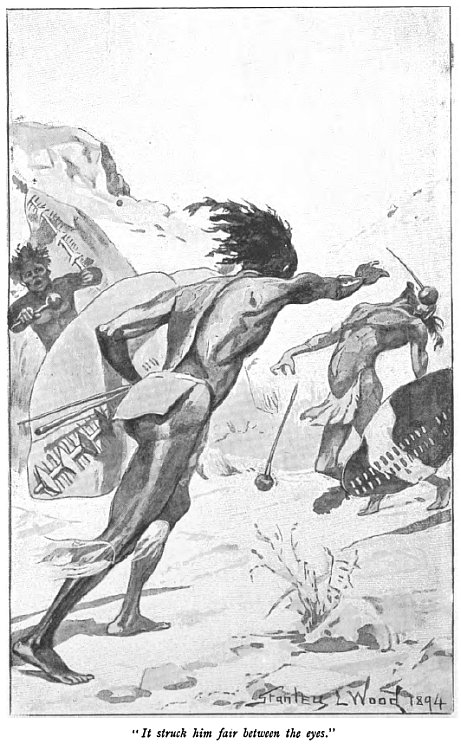
“‘Good! Then I will treat thee even as one of these miserable Baputi.’ And, quick as thought, before a hand could be lifted to prevent it, I hurled my great knobstick at his head. It struck him fair between the eyes, crashing with terrific force. Njalo-njalo dropped like an ox smitten by lightning. He never moved afterward:
“‘He is a coward and deserved such an end!’ I cried. ‘I am not, and my word stands. Take my weapons, men—I disarm.’ And I threw my assegais and shield on the ground beyond reach, and stood waiting.
“They surrounded me at once. Nangeza, who had been helping to kill the Baputi, stood by, also cool, brave, and fearless.
“‘You have made more trouble by slaying Njalo-njalo,’ said Ngubu discontentedly. ‘Whau, Untúswa! It is on us the King’s wrath will fall.’
“‘The King’s wrath never yet fell upon anybody who slew a coward, for he loves not such,’ I answered. ‘And now, Ngubu, being unarmed, I need no bonds. I have done with hope. I care not to flee again into this region of wizards and ghosts.’
“Herein I spoke the truth. So weighed down had my mind become by the gloom and the solitude, and being cut off from my kind, that I welcomed capture. So joyous a sound in my ears was that of their voices, so cheering a sight to my eyes was that of my fellow-warriors in their fighting array, that I even looked with calmness upon the now near approach of my certain death; and thus walking in their midst as one of themselves, except that I was unarmed, I journeyed back to doom.
“Indeed, when after many days we got clear of the mountains and drew near to Ekupumuleni, my guards were even more sad of heart than myself as they thought upon my sure fate. But so glad was I to see the great kraal—‘the resting-place,’ and, as regarded myself, too surely the last—once more, that it was like coming home; but it would be to me in a brief space a home of darkness and of night!
“A guard of women presently met us, accompanied by an inceku, bringing word from the King that Nangeza was to be handed over to them. So they led her away in their midst, and I knew we had looked upon each other’s faces for the last time, unless perchance we should look upon them once more again at the place of doom.”
Chapter Fifteen.
The King’s Sentence.
“As we drew near Ekupumuleni we passed by the mound where the slayers were wont to do their work, and which robe at no long distance from the great kraal. I could see skulls glistening white among the grass on the mound, and I knew that in a very brief space my bones would lie there too, picked clean by the wild beasts of the waste. But even then I cannot say that I exactly feared. Too often had I gazed upon Death’s face and laughed—for, indeed, to look for death was the daily portion of a warrior. Still, that was in the roar and excitement of battle, feeling an enemy sink down beneath each of my blows, while now— It might be that the King in his wrath would order me, would order us, a lingering death of torture. Well, still I was a warrior, and must die, in whatsoever manner death met me, strong, fearless to the last.
“As we entered the lower gate of the kraal, I, in the midst of my guards, unarmed, but unbound and free of limb, I began to hum a song—a song which came to me at the moment, a wild, elated song of battle and of death. My head was thrown back, my eyes looked straight in front of me while I sang, as though I were marching in the ranks of the impi to victory instead of to the evil-doer’s doom. Those who guarded me stared and shrugged their shoulders.
“‘Hau!’ one of them cried. ‘He must be mad! The coming anger of the King, the Great Great One, has turned his brain.’
“‘Not so, Ncongula,’ I answered, for the speaker was well known to me. ‘I come of a House which knows how to die—whose brain the fear of death can never turn. I, Untúswa, the son of Ntelani, can walk forward to death, and sing the while.’
“This was foolish talk and boasting, Nkose. Still, I believed it at the time, and it helped to keep my heart from quailing; for it was a terrible thing I had done, and from its consequences there was no escape.
“The warriors were not mustered under arms, but there was an enormous crowd filling the whole of the great open space, so that it was with difficulty we could make our way through the densely-packed mass. But the peremptory summons of my guards to make way for the property of the King soon opened a lane in the midst. I threw side-glances upon the sea of faces hemming me in, and in most I read expressions of sorrow, especially among those of my own age, for although some of the older men regarded me with jealousy, I was well liked among my companions in arms; and the daring magnitude of my offence had struck them with admiration. Beyond the ring-fence in the background, where stood the huts, heads of women clustered thickly, and even they forgot to use their tongues in the intense excitement of the moment. All this I took in, so that it would remain stamped upon my brain as long as the power of thought should be left. Then I was standing before the King, and raising my hand, I cried ‘Bayéte.’ and bent low before him.
“Umzilikazi was seated at the upper end of the open space, a semicircle of indunas around him. Close beside him, however, squatted the old Mosutu witch-doctor, whose piercing, beady eyes met my glance with a most indescribable expression, the meaning of which I was utterly at a loss to read. I noticed, farther, that Nangeza was not present; but this was only to be expected. When she had been led off by the guard of women, I never expected to behold her face again. Her doom would take place privately. It was only mine—as a necessary warning to those of my own age and standing—that would be pronounced and carried out in the sight of the nation. The great space, as I said, was crowded with dense masses of people; but, except a small body of armed warriors in attendance on the King, all carried sticks only.
“The King’s eyes were fixed upon me, and in them I read no hope; indeed, not one spark of hope had kindled in my heart from the moment of our capture. Then Umzilikazi spoke:
“‘Draw near, son of Ntelani! Welcome, son of Ntelani!’ he said, speaking soft and pleasantly, but in that most terrible voice of all—even that mocking, bitter voice of his. ‘So thou art returned once more? The calf has again returned to the kraal? Welcome, wanderer!’
“‘I lie beneath the foot of the Black Elephant,’ I answered.
“‘Ha! But thou art an Elephant which is blacker still. Hail, Untúswa, builder up of a new nation! Hail, thou mightiest of all kings! Cry him the “Bayéte,” my children! Praise him, ye izimbonga! What! Have ye no titles for Untúswa, the would-be King—the great King of Nowhere?’ And, as he looked from side to side, some of the old men mumbled out certain of the royal titles at me in mockery; but most of those present were silent, being filled with perplexity, perchance remembering that the humour of kings is like the blade of a spear, having two edges, and prone to cut both ways.
“Even as a spear, too, did the bitter derision of the King’s voice cut. Then it flashed across me that Nangeza must have been put to the torture and questioned, for how otherwise could my ambitious dreams and intentions have become known, since I had breathed no word of them to any other, not even to old Masuka?
“‘Behold him, ye people!’ went on the King. ‘Behold him, my shield-bearer, my inceku, my chief runner! The confidence which I placed in him as the first has moved him to try to be greater than I; his opportunities as the second he has used to rob the Isigodhlo; while his powers as the last have enabled him to flee fast and far. As a cow to her calf, so have I been to Untúswa, my inceku, yet he has run away to seek milk elsewhere, and that not alone. Well, Untúswa? And thy voice? Hast thou nothing to say?’
“‘Nothing, O Great Great One,’ I answered, standing there alone, with the eyes of the whole nation upon me. ‘Nothing, for every word is the truth. Even now I walk upon the very edge of the darkness of death, and look forth into the blackness of its night. But let the double doom be mine, O Elephant whose tread, rumbleth the world, and spare the other, for I it was who beguiled her—bewitched her, if you will.’
“At this bold admission a gasp escaped from all who heard it, and men put their hands to their mouths in wonder. But the band of izanusi who scowled hard by broke into mutterings. The eyes of old Masuka, however, began to glow with a strange and glittering light.
“‘Ha! Fearest thou nothing, Untúswa?’ said the King. ‘The death of the hot stones, the stake of impalement, the nest of the black ants?’
“‘I fear but the frown of the King,’ I answered, although in truth a sweat broke out upon me at the mention of these terrible torments, but seldom used among us, and then only at the instigation of the izanusi. ‘But, Father, spare the other—spare Nangeza.’
“If it were possible, I had thought I saw just such an expression pass across the King’s face as sometimes dwelt there when he was especially pleased and good-humoured. But what mockery! As if such a thing could be!
“‘Of the girl I will talk presently. But for thyself, Untúswa—dost thou utter no word for thine own life?’
“‘No word, Great Great One; for the doer of such a deed as I have done hath never yet failed to find death as his reward—never since our nation was a nation. I desire death no more than any other, yet do I not brave it day by day in the service of the King? To ask my life would be but a waste of words.’
“‘And thou, Ntelani! Hast thou no word for the life of thy son?’
“‘No word, Great Great One,’ grunted my father, scowling savagely at me. ‘When my other son, Sekweni, earned death for his reward, did I seek to stay the justice of the King? I did not. Nor do I now. Let this one taste the reward he has won.’
“Then there fell a silence—a silence that one could feel. Even the breathing of that immense crowd seemed hushed; the bent-forward attitude, the parted lips, the eyeballs protruding, betrayed the intensity of the moment. All this I saw in side-glances. In front sat the semicircle of indunas, their faces set in hard, pitiless sternness. The countenance of the King as he sat gazing at me in silence was the only face whose owner was master of his own thoughts. The others were all carried away by the strain of the moment. For my part, I think my head turned slightly to and fro as though in a dream. I looked at the sun, whose setting I was not to see; I looked at the distant mountain ranges and the plains of earth, whose brightness I was destined to behold no more; and then the King spoke:
“‘Even as thou sayest, Untúswa, son of Ntelani, thou hast done a deed the doer of which hath never yet failed to meet with the reward of death. The girl shall die. But for thee, Untúswa, by reason of the great service thou hast done our nation in the past, I grant thee thy life. But thy life only. For thou mayest no more be among my izinceku; no more shalt thou take thy place in the ranks of the warriors, or go out with them to battle, nor shalt thou ever be suffered to tunga. Thy place henceforth shall be among the lowest of the captured slaves who herd the nation’s cattle, bearing no arms but a stick only. Thus I give thee thy life.’
“From a gasp which was first a lamentation as the multitude heard this dread sentence, there grew a great chorus of bonga.
“‘Oh the just, the merciful One! How he pardons, how he spares! Is he not our Father!’
“Thus all men cried aloud by reason of the clemency of the King. Only I stood as I had stood, moving neither hand nor foot—silent.
“‘Well, Untúswa, who art no more a warrior?’ said the King, when the shouting had ceased. ‘Have I not given thee thy life? Look up. Thou wilt see the sun go down this night, thou wilt see it rise and go down many days, many nights. While all the people cry aloud in praise that I have given thee thy life, thou alone remainest mute.’
“‘Because I would prefer death, O Black Elephant!’ I answered, raising my head. And then the tears rained from my eyes, even as from those of a child who is hurt. Yes, Nkose, I, Untúswa, the warrior who feared nothing, and who, when the King’s enemies lay in front of us, suffered no man to come between me and them, I, Untúswa, wept in the sight of the whole nation because of the dread sentence pronounced upon me by the King. For only think what it meant! I, a warrior, who lived but for battle, never again to bear arms! I, in the full flush and strength of my vigorous manhood, never to be allowed to wear the ring; I, an inceku, to descend to herd with the off-scourings of all the miserable and degraded tribes we had swept from our path! Of course, I preferred death ten times over; the death of the hot stones, of the stake of impalement, of the black ants; any death, however hideous, however lingering, to life upon the terms of such awful degradation.
“‘So thou askest for death, son of Ntelani?’ said the King.
“‘I pray for it, O Great Great One.’
“‘Ha! I should have been surprised hadst thou not prayed for it. Well, thou shalt have thy wish.’
“And now, Nkose, I know not how it was, but as Umzilikazi pronounced these words my eyes once more met those of the old Mosutu witch-doctor. They were burning with a strange glitter of intensity. His body was bent half forward in an attitude of anxiety such as I had never beheld in him, even when his own fate hung in the balance. But as I gazed into those burning orbs, something in them brought back the moment when I had dragged old Masuka from beneath the heaps of slain, and when he had pleaded for his life half defiantly while uttering his marvellous divination.
“The slayers advanced a few steps, then halted, and stood watching for a word, a sign, from the King. Then I lifted my voice, and cried:
“‘The Black Elephant is good. I asked a boon, and, lo! it was granted. The Great Serpent is merciful. But now I make a claim. I claim the fulfilment of the King’s promise!’
“The start, the stare, the quick murmur of astonishment which met these words, from all hearers, is hardly to be told. Even the Great Great One showed surprise. But in old Masuka’s glittering eyes there was now another look. It was the look of one who has attained his object—of one who triumphs.
“‘The King’s promise, the “word” of the Great Great One, in whose light we live!’ I cried. ‘The King’s “word” stands, for I have fulfilled its conditions.’
“I saw Umzilikazi start ever so slightly. ‘How so, Untúswa?’ he said. ‘Explain.’
“‘Thus, O Elephant. The words of the King were: “Perform some act, O son of Ntelani; perform some act bolder than any act I have ever yet heard tell of, and you shall be allowed to tunga. Not only that, but I will give you this broad umkonto which I hold in my hand.” Such was the “word” of the Great Great One.’
“‘Yes, that is no lie, Untúswa,’ said the King softly, while all held their breath for his reply. ‘Yet I know not so far what thou hast done to claim the fulfilment of such a promise.’
“‘Whau!’ I cried, bringing my hand to my mouth. ‘I would ask the King, the father of the wise, what bolder thing a man, being young, could do, than to steal one of the King’s girls from the Isigodhlo in broad daylight, and depart with her alone in search of unknown tribes, to reign over a new nation? What bolder act was ever performed, O Black Elephant?’
“‘He is mad!—quite mad!’ burst from the indunas. But the King smiled, and a new and strange look came into his face, yet from it I augured nothing. ‘I think thou hast done even a bolder thing, son of Ntelani,’ he said, ‘and that is to claim the fulfilment of my promise on such a ground. Surely no bolder act was ever heard tell of.’
“And now men found speech and cried aloud in praise of the wisdom of the King—of the truth of his words. Then he went on:
“‘My promise shall be kept,’ he said slowly, but with a dark and terrible meaning; ‘the latter part of it first. Thou shalt have this broad umkonto,’ twirling the great assegai in his hand till it flashed—a band of fire. ‘Oh yes, Untúswa! the “word” of the King stands. Thou shalt have what I promised thee. Prepare, then, to receive thy reward.’
“Then, in my joy, I shouted out the praises of the King, who had changed the doom of eternal degradation he had pronounced upon me to that of death. But a grand and noble death would be mine, that of the spear; yet not that only, for I was to die by the spear of the King—to die by the King’s own hand, for none other might wield the royal weapon for such a purpose. Yet, while I praised, no bonga arose from the multitude. All voices were hushed in expectation.
“Umzilikazi rose and advanced towards me. As he stood facing me, with the bright and gleaming spear uplifted, I looked him straight in the eyes—alone and about to taste death. And then it seemed that this situation was familiar to me—a man standing among men and an assegai descending to his chest. Ha! the third vision of the wizard’s múti! Then I knew not—now I knew who held the spear. Still, I flinched not, though the eyes of the King were terrible in their wrath. ‘Take the reward I promised thee!’ he said.
“‘I welcome death at the hand of the King, the Great Great One!’ I answered, gazing at the uplifted spear.
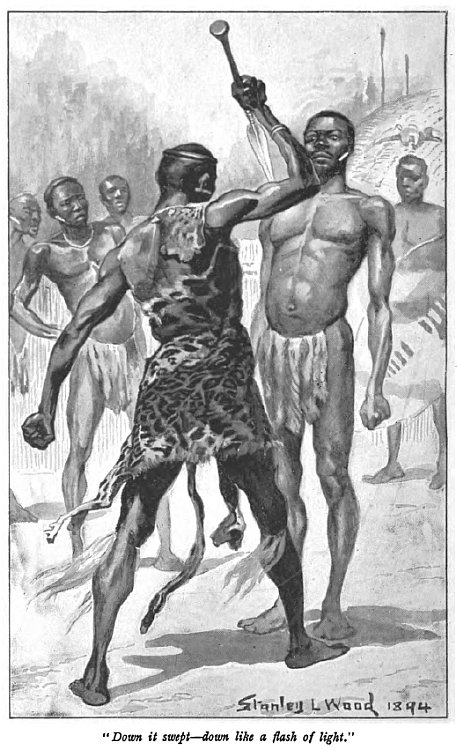
“Down it swept—down like a flash of light—down to my breast which was thrust forward to receive it. But it did not enter. It halted—motionless but for a slight quiver—within a hand’s-breadth of my heart. Still, my eyes left not those of the King, and for a moment thus we stood. Then Umzilikazi spoke:
“‘Once more I grant thee thy life, Untúswa, son of Ntelani, for I think thou art the bravest warrior that ever lived, and fearest death in its cold form no more than in the heat and shock of battle. And I love such. Yet, but for my promise, thou wert already dead. The King’s assegai is thine. Take it.’
“Then it was that my self-command was sorely tried. I was not to die, but to receive honour, for I held in my hand the King’s royal weapon. But my mind had gone through so much that it was hardened—cool and cutting even as the blade of the splendid spear; wherefore I laid the weapon softly down, for I might not address the King armed; and raising both hands aloft, I poured forth words of bonga, such as had surely never been heard before. And the whole nation joined in, and, indeed, even in the far mountains the foul Izímu and such abatagati must have quaked in their dens, for even thither must have reached the vast roaring chorus of the praises of the King.
“‘It is well, my children,’ said Umzilikazi when he again spoke. ‘Never before has such a deed met with other reward than death, never shall it again; and here my “word” will stand as fast as it did in my promise to Untúswa. And thou, son of Ntelani. Go now forth from among us until the moon is full, and speak to no man the while, and the man or woman who speaks to thee shall die. Then it may be that what thou hast done shall be put away. Depart, for he who has done what thou hast done must not mix with his fellows for awhile, lest they make too light of a most weighty matter. Go.’
“So singing aloud the praises of the King, I took up the dark-handled spear and went forth, and built a hut within sight of Ekupumuleni, and in that hut I dwelt alone; yet daily I would stand before it and chant in praise of the King, and all who heard me turned aside. Also I sang many songs of battle. And when the moon was at the full the Great Great One sent for me and ordered me to tunga, and soon afterwards created me second induna in command of the army, Kalipe holding the chief command. Thus, Nkose, did I win the King’s dark-handled spear, and my head-ring at the same time, but the path by which I travelled to reach it would have surely been, but for the King’s promise, the path of death.”
Epilogue.
“Well, Untúswa, I believe now, at any rate, that all the gold this waggon could carry would not purchase that assegai from you,” I said, as soon as the old man had finished. “But what of Nangeza? Was she put to death?”
“She was not. The King pardoned her, too; and when I put on the head-ring he gave her to me to wife.”
“And did she make a good Inkosikazi?”
“Wou!” and the old man brought his hand to his mouth, while his rugged face lighted up with sly fun. “I had better have placed my head beneath the paw of the lion for some other girl. Nangeza wanted to be chief and chieftainess, too. That would not do. We Zulus never allow our wives to be chiefs over us.”
“What became of her?” I said.
But he looked at me a moment, and the mirth dancing in his eyes changed to a flash of satire as he only repeated:
“We Zulus never allow our wives to be chiefs over us, Nkose.”
Then he took snuff.
“And what became of the old Mosutu witch-doctor?” I said, judiciously allowing the fate of Nangeza to remain shrouded in mystery.
“Masuka? Ha! After I was allowed to tunga he came to me and declared that I must give him cattle, for his was the múti which made me great; and, indeed, he told no lie there, for as far as a man’s thoughts can speak, while his tongue must keep silence, old Masuka’s thoughts spoke to me through his eyes that day that I should remind the King of his promise. So I gave him cattle, and from time to time more, for it was a great day for me, that whereon I had saved his life; and the King favoured him, and the old Mosutu lived to a great age and died peacefully.”
“And why did you leave the Amandebili, Untúswa?” I said.
“The man who is high in favour with one King is not always high in favour with him who reigns next, nor with those who sit at his right hand,” he answered. “Umzilikazi has long been dead. Then I heard that a great and merciful King sat in Zululand in the seat of Tshaka. So I returned to konza to Cetywayo, who received me well; nor was I too old to strike a blow for him, for I was enrolled in the Undi regiment, and fought against you English Kwa Jim (at Rorke’s Drift), and again at Kambula. Yes, after all my wanderings, I returned to die in Zululand. And now, Nkose, the sun is getting low, and I have some distance to travel, wherefore I must be gone.”
The like held good as regarded myself. The heat of the day was over, and my “boys,” who all this time had been asleep beneath the waggon, were waking up and preparing to in span for the evening trek. So I loaded up Untúswa with sundry unconsidered trifles, but very precious in Zulu eyes at that time. He was loud in his thanks.
“The story I have told, Nkose, is but that of a small portion of my own life—of a small portion of the earlier wanderings of the Amandebili. Afterwards, how we met and fought the Boers and other peoples—au! that would take long in telling. But if you are in this part again before leaving the Zulu country, it may be that we shall meet, and other strange tales and wonders I shall relate.”
And, uttering a sonorous farewell, the fine old warrior turned, and soon his tall, straight form was out of sight.
Such was the story of the King’s Assegai, as told by Untúswa, the son of Ntelani, and as an episode in the early stages of the Amandebili migration it seems worthy of being retold.
The End.
| Prologue | | Chapter 1 | | Chapter 2 | | Chapter 3 | | Chapter 4 | | Chapter 5 | | Chapter 6 | | Chapter 7 | | Chapter 8 | | Chapter 9 | | Chapter 10 | | Chapter 11 | | Chapter 12 | | Chapter 13 | | Chapter 14 | | Chapter 15 |