Volume 1 — A Brief Bibliography of Municipal Government in the United States.
Reading edition
BY FRANK H. HODDER.
In political science, things near at hand and always with us are slighted, while remote and obscure questions are made the subject of most careful investigation. Taxation is a notable illustration of this fact. There is no act of government which so directly and intimately concerns the whole people, and yet it would be difficult to name one which has received so little careful study. In English there is not a single systematic and comprehensive work on the subject. Similarly with municipal government. With the present distribution of population this department of government controls more than one-fourth of our whole people in all their most important political relations. There is still no systematic treatise on the subject, but public interest has been aroused, and a large number of lectures, articles in periodicals and scientific journals has been printed in recent years. It is a hopeful sign that municipal government is beginning to receive careful attention in colleges. For the purpose of assisting college study of the subject, a list of such literature as could be found was printed some time ago. As it has been found useful in several institutions, it has seemed worth while to extend it and bring it down to date. The study of municipal government at home is very properly preceded by a summary of local government generally and by a glance at municipal government abroad. The order of the references is as follows:
I. Introductory.
1. Local Government Generally.
2. European Cities.
a. London.
b. Paris.
c. Berlin.
d. Other Foreign Cities.
II. American Cities.
1. Legal Status.
2. Statistics.
3. Finance.
4. General Discussions.
5. Municipal Industries.
6. Various Topics.
7. Particular Cities.
a. New York.
b. Other American Cities.
I. INTRODUCTORY.
1. LOCAL GOVERNMENT GENERALLY.
Short accounts of the systems of local government of the principal countries of continental Europe are given in the Cobden Club Essays: Local Government and Taxation, London, 1875, edited by J. W. Probyn. See also F. Béchard’s De L’administration de la France, 2 vols. Paris, 1851, with appendix on municipal organization in Europe.
The best short description of English local government is M. D. Chalmers’s Local Government, “English Citizen” Series, London, 1883. See also Local Administration, “Imperial Parliament” Series, London, 1887, by Wm. Rathbone, Albert Pell and F. C. Montague. For still shorter account read chapter 15 of May’s Constitutional History and article on “Local Government in England” by F. J. Goodnow in the Political Science Quarterly, December, 1887, vol. 2, pp. 338-65, and an article by the same writer on “The Local Government Bill” in the Political Science Quarterly, June, 1888, vol. 3, pp. 311-333. Supplement Chalmers with Cobden Club Essays: Local Government and Taxation in the United Kingdom, London, 1882, edited by J. W. Probyn. The most exhaustive work on English local offices is Rudolph Gneist’s Self-Government: Communalverfassung u. Verwaltungsgerichte in England, untranslated, 3d ed., 1876. For full bibliography see Gomme’s Literature of Local Institutions, London, 1886.
The best short outline of local government in the United States is an article by S. A. Galpin on “Minor Political Divisions of the United States,” in Gen. F. A Walker’s Statistical Atlas of the United States. The papers on the local institutions of several of the States in the Johns Hopkins University Studies in Historical and Political Science are especially valuable. Chas. M. Andrews has articles on Connecticut towns in the Johns Hopkins Studies, vol. 7, and in the Annals of the American Academy of Political Science, October, 1890, vol. 1, pp. 165-91. Especially important is Prof. Geo. E. Howard’s Local Constitutional History of the United States, vol. 1.: “The Development of the Township, Hundred and Shire,” printed as an extra volume in this series. John Fiske’s lecture on “The Town Meeting,” delivered at the Royal Institution, was printed in Harper’s Magazine, vol. 70, pp. 265-272, and in his American Political Ideas, N. Y., 1885. A different view of the present importance of local institutions is taken by Prof. S. N. Patten in an article on the “Decay of State and Local Government,” in the first number of the Annals of the American Academy of Political Science. For comparison of American and foreign methods, read R. P. Porter’s article “Local Government: at Home and Abroad,” Princeton Review, July, 1879, n. s. vol. 4, p. 172, and reprinted separately. See two articles on “Local Government in Prussia,” by F. J. Goodnow in the Political Science Quarterly, December, 1889, vol. 4, pp. 648-66, and March, 1890, vol. 5, pp. 124-58. For further reference on local self-government see W. F. Foster’s Monthly Reference Lists, vol. 2, pp. 23-29, and his pamphlet of References on Political and Economic Topics, p. 24.
For Canada, see J. G. Bourinot’s “Local Government in Canada: an historical study,” in Transactions of the Royal Society of Canada for 1886, vol. 4., sec. 2, pp. 42-70; printed separately by the publishers, and reprinted, with a letter on the municipal system of Ontario, in the 5th series of the Johns Hopkins Studies. A paper on “The Ontario Township,” by J. M. McEvoy, printed in 1889, forms No. 1 of the Toronto University Studies in Political Science.
2. EUROPEAN CITIES.
For the purpose of comparison, some study should be made of municipal government abroad. Dr. Albert Shaw gives a general view of “Municipal Government in Great Britain,” in Notes Supplementary to the Johns Hopkins Studies, No. 1, January, 1889, and in the Political Quarterly, June, 1886, vol. 4, pp. 197-229. Of larger works on English municipal history, mention may be made of J. R. S. Vine’s “English Municipal Institutions; their Growth and Development from 1835 to 1879,” London, 1879. Dr. Chas. Gross has printed a very complete “Classified List of Books relating to British Municipal History,” Cambridge, 1891, as No. 43 of Bibliographical Contributions of Harvard University. Foreign experience is of very little assistance in the solution of the general problem of municipal government in the United States, but it may be useful in indicating improved methods of administration in particular departments of a city government. Several cities that illustrate different forms of municipal government may be taken as examples.
a. London.
Specially excepted from the operation of the Municipal Corporations Act of 1835. For outline of government read Chalmers, chap. 10. For full description see J. F. B. Firth’s Municipal London, 1876, and his Reform of London Government and of City Guilds, “Imperial Parliament” Series, London, 1888. For history of the corporation consult W. J. Loftie’s History of London, 2d ed., 1884, and the same author’s small work, London, published in 1887 in Freeman’s series on “English Historic Towns.” Both books are based on new material, part of it recently discovered by Bishop Stubbs. For additional references, see Gomme, pp. 122-134.
There have been a great many articles on the municipal government of London in recent periodical literature. Among them may be cited those by W. Newall, Contemporary Review, 1873, vol. 12, p. 73, and 1875, vol. 25, p. 437; W. M. Torrens, Nineteenth Century, 1880, vol. 8., p. 766; Alderman Cotton, Benj. Scott, City Chamberlain, and Sir Arthur Hobhouse in Contemporary Review, 1882, vol. 41, pp. 72, 308, and 404 respectively; the Westminster Review, for January, 1887; Dr. Albert Shaw on “How London is Governed,” in the Century, November, 1890, vol. 41, pp. 132-147, and on “Municipal Problems of New York and London,” in the Review of Reviews, April, 1892, vol. 5, p. 282; James Monroe on “The London Police,” in the North American Review, November, 1890, vol. 151, pp. 615-629; Sir John Lubbock on “The Government of London,” in the Fortnightly Review, February, 1892, vol. 51, p. 159; and an article on the “Municipal Administration of London,” in the Edinburgh Review for April, 1892. For a good review of attempts since 1860 to regulate the London gas supply, see an article in the British Quarterly for January, 1879.
A Royal Commission on the City Livery Companies reported May 28, 1884. See the discussion by Sir R. A. Cross, one of the dissenting members of the Commission, in the Nineteenth Century for 1884, vol. 16, p. 47, and by Sir Arthur Hobhouse in Contemporary Review for 1885, vol. 47, p. 1. The most important work on the London guilds is William Herbert’s “History of the Twelve Great Companies of London,” London, 1837. The latest contribution to the subject is Price’s “Description of the Guildhall,” London, 1887.
b. Paris.
A sketch of its government by Yves Guyot, a member of the municipal council, may be found in the Contemporary Review, March, 1883, vol. 43, p. 439. Dr. Shaw gives an excellent short account in an article entitled “The Typical Modern City” in the Century, July, 1891, vol. 42, pp. 449-66. He cites as the principal authority on the subject Maxime Du Camp’s Paris, ses organes, ses fonctions, et sa vie dans la seconde moitie du dix-neuvieme siecle. An extended description is also given in a work entitled Administration de la Ville de Paris, written by Henri De Pontich under the direction of Maurice Block, Paris, Guillaumin, 1884. The Rapports et Documents and Process-Verbaux of the municipal council are printed yearly in three large quarto volumes, and the municipal bureau of statistics issues an annual report.
c. Berlin.
An excellent short account of the government of Berlin is given by Dr. Rudolph Gneist, a member of the municipal council since 1848, in the Contemporary Review, December, 1884, vol. 46, p. 769. See also the report on the “Administration of the City of Berlin” in Foreign Relations for 1881, p. 487, made by Assistant-Secretary of Legation Coleman at the request of Hon. Andrew D. White, then Minister to Germany. Also the articles by Prof. R. T. Ely in the Nation for March 23 and 30, 1882, vol. 34, pp. 145 and 267. In the Nation for September 25, 1892, vol. 55, p. 221, Mr. Leo S. Rowe combats some of Dr. Shaw’s generalizations respecting municipal government in Europe, taking Berlin as his text. The Magistracy of Berlin publish reports at irregular intervals. The first, Bericht ueber die Vervaltung der Stadt Berlin, in den Jahren 1829 bis inclu. 1840, Berlin, 1842, and the second, in den Jahren 1841 bis incl. 1850, Berlin, 1853, are of considerable importance. A third, published in 1863, covers the period from 1851 to 1860, and a fourth, printed in 1882, covers the period from 1861 to 1876. The Director of the Statistical Bureau of the city publishes annually Das Statistische Jahrbuch der Stadt Berlin.
The present municipal system of Prussia dates from the reorganization of the municipalities by Stein and Hardenburg, November 19, 1808. See Seeley’s Life of Stein, part 5, chap. 3, and Meier’s Reform der Vervaltung-Organization unter Stein und Hardenberg, Leipsig, 1881. The present “Municipal Corporation Act,” Stædte-ordnung, was passed May 30, 1853. See Kotze, Die Preussischen Stædte Verfassungen, Berlin, 1879, and Backoffner, Die Stædteordnungen der Preussischen Monarchie, Berlin, 1880, and especially Eugen Leidig’s Preussisches Stadtrecht, Berlin, 1891. See also the articles on local government in Prussia cited above.
d. Other Foreign Cities.
Statistics of all important German cities are given in Dr. M. Neefe’s Statistisches Jahrbuch Deutscher Stædte, Erster Jahrgang, Breslau, 1890. Financial statistics of the great European cities are given in Joseph Körösi’s Bulletin Annual de Finance des Grandes Villes, Dixième Année, Budapest, 1890.
A short account of the municipal government of Vienna is given in a report by Mr. Kasson in Foreign Relations for 1879, p. 64 and an extended account in Dr. Felder’s Die Gemeinde-Vervaltung der Reichs-haupt und Residenzstadt Wien, Vienna, 1872. For the government of Budapest see Dr. Shaw’s article in the Century, June, 1892, vol. 44, pp. 163-179. Prof. F. G. Peabody gives a sketch of Dresden in an article entitled “A Case of Good City Government,” in the Forum, April, 1892, vol. 13, p. 53.
The following relate to various British Cities: Dr. Shaw’s “Glasgow, a Municipal Study,” in the Century, March, 1890, vol. 39, pp. 721-736; the same writer’s “Municipal Lodging Houses,” in No. 1 of the Charities Review, November, 1891; Julian Ralph’s “The Best Governed City in the World” (Birmingham) in Harper’s Magazine, 1890, vol. 81, pp. 99-111; Thos. H. Sherman’s report on “Liverpool, its Pavements, Tramways, Sewers and Artisans’ Dwellings,” in Consular Reports, June, 1890, vol. 33, pp. 284-303; and Consul Smyth’s report on “Tramways and Water Works in England,” in the Consular Report for December, 1891.
II. AMERICAN CITIES.
1. LEGAL STATUS.
For comparison of the provisions of the state constitutions relating to municipal corporations, see F. J. Stimson’s American Statute Law, Boston, 1886, vol. 1, articles 34, 37 and 50. Note the classification of municipalities in Ohio. On the relation of municipalities to the states, consult the chapter on “The Grades of Municipal Government” in Judge T. M. Cooley’s Constitutional Limitations, 6th ed., Boston, 1890, and a short chapter at the close of the same author’s Principles of Constitutional Law. Judge J. F. Dillon’s Treatise on the Law of Municipal Corporations, 4th ed., 2 vols., Boston, 1890, is the standard authority on the subject. Note the introductory historical sketch. A new text-book on the Law of Municipal Corporations, by Chas. F. Beach, Jr., has been recently issued by Houghton, Mifflin & Co. Reference may also be made to Judge Dillon’s Law of Municipal Bonds, Chicago, 1877, and to A Treatise on Municipal Police Ordinances, Chicago, 1887, by N. T. Horr and A. A. Bemis, of the Cleveland bar. The authors of the last work say in their preface that “The necessity for it arises from the fact that, except in those cities and towns where the municipal council has the assistance of regularly employed legal advisers, the limits of lawful legislation are apt to be exceeded.”
Numerous references to articles in law journals are given on pp. 386-388 of Jones’s Index to Legal Periodical Literature, Boston, 1888. An article by J. R. Berryman on “Constitutional Restrictions upon Legislation about Municipal Corporations,” in the American Law Review, May-June, 1888, vol. 22, p. 403, may be cited.
2. STATISTICS.
The Eleventh Census will give very full statistics of cities, but though some of the results have been announced in bulletins, none of the final reports have yet been issued. These results have been summarized by Hon. Carroll D. Wright in the Popular Science Monthly for 1892, vol. 40. On “Urban Population” see p. 459; on “Social Statistics of Cities” p. 607, and on “Rapid Transit,” p. 785.
The following Reports of the Tenth Census treat of this subject: vol. 1, Population; vol. 7, Valuation, Taxation and Indebtedness; vol. 18, Social Statistics of Cities: New England and Middle States (reviewed in the Nation, vol. 44, p. 256); and vol. 19, Social Statistics of Cities: Southern and Western States.
Scribner’s Statistical Atlas of the United States, N. Y., 1883, exhibits the figures of the census graphically (p. xlv, statistics of population). Plate 21 illustrates the growth of American cities since 1790. There were then only eight cities of eight thousand inhabitants, and the population of New York was 33,131. Plate 30 gives ratios of different nationalities to total population in the largest fifty cities. Plate 76 gives net per capita debt in the largest one hundred cities.
On movement of population see an article by B. G. Magie, Jr., in Scribner’s Monthly, January, 1878, vol. 15, p. 418; Prof. Richmond Smith’s “Statistics and Economics,” p. 264 in vol. 3 of the Publications of the American Economic Association; a study on the “Rise of American Cities” by Dr. A. B. Hart in the Quarterly Journal of Economics, January, 1890, vol. 4, pp. 129-157; an article by Lewis H. Haupt on “The Growth of Great Cities” in the Cosmopolitan for November, 1892, and another by John C. Rose, on “The Decrease of Rural Population” in the Popular Science Monthly for March, 1893, vol. 42, pp. 621-38. Cf. work by E. Levasseur, entitled Les Populations Urbaines en France, comparees a celles de l’Etranger, Paris, 1887.
The Annual Statistician, published by L. P. McCarty, San Francisco, gives the following statistics for leading cities: Number of votes registered and polled; number of voting precincts; strength of police; losses by fire and number of fire-engines and firemen; value and capacity of gas and water works; number and character of street lights; vital statistics; number of murders, suicides, and executions; length of street railroads and cost of motive power; telegraph and telephone mileage; number of saloons and cost of licenses; attendance and cost of schools, annual tax-rate, expenditure and the public debt.
3. FINANCE.
Volume 7 of the Reports of the Tenth Census, compiled by Robert P. Porter, gives statistics of local taxation and indebtedness, and a summary of the provisions of the several state constitutions limiting the rate of taxation, the amount of municipal debts, and the purposes for which they may be contracted. See p. 674 for an analysis of the purposes for which the debt outstanding in 1880 was contracted. The Eleventh Census will give similar data. Mr. Porter published an article on municipal debts in the N. Y. Banker’s Magazine for September, 1876, and another in Lalor’s Cyclopædia of Political Science, vol. 1, p. 730. Cf. also his article in the Princeton Review, n. s., vol. 4, p. 172. For a further study of this subject, read Prof. H. C. Adams’s Public Debts, N. Y., 1887, Part 3, chap. 3. See also G. W. Green’s article on “Municipal Bonds,” Lalor’s Cyclopædia, vol. 2, p. 920; Prof. S. N. Patten’s “Finanzwesen der Staaten und Stædte der Nordamerikanischen Union”, Jena., 1878; C. Hale’s “Debts of Cities,” Atlantic, vol. 38, p. 661, for the law of Massachusetts; D. L. Harris’s “Municipal Economy,” Journal of Social Science, vol. 9, p. 149, for the experience of Springfield, Mass., the articles in Bradstreet’s for February 10 and March 3, 1883, for a comparison with local debts in England, and H. B. Gardner’s “Statistics of Municipal Finance” in the Publications of the American Statistical Association, June, 1889, vol. 1, pp. 254-67. On the debt of New York City see the paper by Wm. M. Ivins cited below. A Statement of Facts Concerning the Financial Affairs of the City of Elizabeth, N. J., which has the largest per capita debt in the United States, was published by some of the citizens of that place in January, 1886.
Municipal taxation is treated at length in Prof. R. T. Ely’s Taxation in American States and Cities, New York, 1888. The Reports of the Commissioners Appointed to Revise the Laws for the Assessment and Collection of Taxes in New York, 1871 and 1872, contain much valuable material. The members of the Commission were David A. Wells, Edwin Dodge, and George W. Cuyler. The first report was reprinted in New York by Harpers, and both were reprinted in England by the Cobden Club. Cf. also Wells’s “Theory and Practice of Local Taxation in America,” in the Atlantic Monthly for January, 1874; “Rational Principles of Taxation,” a paper read in New York, May 20, 1874, Journal of Social Science, vol. 6, p. 120; and his “Reform of Local Taxation” in the North American Review for April, 1876. On the evils of double taxation see a paper on “Local Taxation” by William Minot, Jr., read in Saratoga, September 5, 1877, and printed in the Journal of Social Science, vol. 9, p. 67. See Report in 1876 of New Hampshire Tax Commission, composed of Geo. Y. Sawyer, H. R. Roberts, and Jonas Livingstone; and Report of the Michigan Commission, House Journal, February 23, 1882. A similar Commission, appointed by the City of Baltimore, reported in January, 1886. The Report contains, in addition to the recommendations of the Commission, a paper by Prof. R. T. Ely, entitled “Suggestions for an Improved System of Taxation in Baltimore.” A further article on “Municipal Finance” may be found in Scribner’s Magazine, January, 1888, vol. 3, pp. 33-40, and a thesis entitled “Special Assessments: A Study in Municipal Finance,” by Victor Rosewater, is announced for vol. 2 of the “Studies in History, Economic and Public Law,” issued by Columbia College.
4. GENERAL DISCUSSIONS.
Adams, Charles Francis. “Municipal Government: Lessons from the Experience of Quincy, Mass.” Forum, November, 1892, vol. 14, pp. 282-92.
Berryman, J. R. “Constitutional Restrictions upon Legislation about Municipal Corporations.” American Law Review, May-June, 1888, vol. 22, p. 403.
Bowles, Samuel. “Relation of State to Municipal Governments, and the Reform of the Latter.” Journal of Social Science, vol. 9, p. 140.
A paper read in Saratoga, September 7, 1877.
Bradford, Gamaliel. “Municipal Government.” Scribner’s Magazine, October, 1887, vol. 2, pp. 485-493.
Browne, G. M. “Municipal Reform.” New Englander, February, 1886, vol. 45, p. 132.
Bryce, James. “The American Commonwealth.” Lon. and N. Y., 1888.
This well known work contains the following chapters on municipal government: chapters 50 and 51, “The Government of Cities;” chap. 52, “An American View of Municipal Government in the United States,” by Pres. Seth Low; chapters 59-64 explain the working of party machinery; chap. 88, “The Tweed Ring in New York City,” by F. J. Goodnow, and chap. 89, “The Philadelphia Gas Ring.”
Cambridge Civil Service Reform Association. “Prize Essays on Municipal Reform.” 1884.
Contents:—“The Selection of Municipal Officers: their Terms and Tenures,” by T. H. Pease, of Chicago, Ill.; “The Appointment of Municipal Officers,” by John Prentiss, of Keene, N. H.; and “The Selection and Tenure of Office of Municipal Officers,” by Prof. H. T. Terry, of the University of Tokio, Japan.
Chamberlain, Joseph. “Municipal Institutions in America and England.” Forum, November, 1892, vol. 14, pp. 267-81.
Mr. Chamberlain was Mayor of Birmingham 1873-6. He compares its government with that of Boston.
Crandon, F. D. “Misgovernment of Great Cities.” Popular Science Monthly, vol. 30, pp. 296 and 520.
Eaton, Dorman B. “Municipal Government.” Journal of Social Science, vol. 5, p. 1.
A paper read in Boston, May 13, 1873.
Eliot, C. W. “One Remedy for Municipal Misgovernment.” Forum, October, 1891, vol. 12, pp. 153-168.
Fassett, J. S. “Why Cities are Badly Governed.” North American Review, May, 1890, vol. 150, pp. 631-7.
Senator Fassett summarizes the results of the investigation in 1890 of a committee of the New York Senate on cities.
Field, David Dudley. “Our Political Methods.” Forum, November, 1886, vol. 2, pp. 213-22.
Fisher, Wm. R. “Municipal Government.” Publications of the Philadelphia Social Science Association.
This Association has united with the American Academy of Political and Social Science and its publications are now furnished by the Academy.
Fiske, Amos K. “Remedies for Municipal Misgovernment.” Forum, April, 1887, vol. 3, pp. 170-77.
Fiske, John. “Civil Government in the United States.” N. Y., 1890. Chapter 5.
Ford, Worthington C. “American Citizen’s Manual.” N. Y., 1882. Part 1, pp. 66-83, on municipal corporations.
Forum. “The Science of Municipal Corruption.” March, 1893, vol. 15, pp. 43-51. Author’s name not given.
Godkin, E. L. “Criminal Politics.” North American Review, June, 1890, vol. 150, pp. 706-23.
Godkin, E. L. “A Key to Municipal Reform.” North American Review, October, 1890, vol. 151, pp. 422-31.
Grace, William R. “Government of Cities in the State of New York.” Harpers, 1883, vol. 67, p. 609.
Hale, E. E. “The Congestion of Cities.” Forum, January, 1888, vol. 4, pp. 527-35.
Harrison, Carter H. “Municipal Government.” An address delivered before the Nineteenth Century Club of New York City, November 23, 1886.
Ivins, William M. “Municipal Finance.” Harpers, October, 1884, vol. 69, pp. 779-87.
Ivins, William M. “Municipal Government.” Political Science Quarterly, June, 1887.
The author claims that changes in municipal organization have been incident to the extension of the general functions of government, and gives an analysis of the system of government in New York City.
Ivins, William M. “Machine Politics and Money in Elections.” Harper’s “Handy Series,” N. Y., 1887.
This little book describes the working of election laws in New York, gives the amount of assessments paid by candidates for office, and advocates the adoption of the essential features of the English system.
Janes, Lewis G. “The Problem of City Government.” 40 pp. N. Y., D. Appleton & Co., 1892.
This is a lecture before the Brooklyn Ethical Association, printed in a series entitled “Man and the State.”
Johns Hopkins Studies in History and Political Science.
Vol. 3. “The City of Washington,” by J. A. Porter.
Vol. 4. “The Town and City Government of New Haven,”
by Chas. H. Levermore.
Vol. 5. “The City Government of Philadelphia,”
by E. P. Allinson and Boies Penrose.
“City Government of Boston,” by James M. Bugbee.
“City Government of St. Louis,” by Marshall S. Snow.
Vol. 7. “The Municipal Government of San Francisco,”
by Bernard Moses.
“Municipal History of New Orleans,” by W. H. Howe.
Extra vol. 1. “The Republic of New Haven: a History of Municipal Evolution,”
by Chas. H. Levermore.
Extra vol. 2. “Philadelphia, 1681-1887. A Study of Municipal Development,”
by E. P. Allinson and Boies Penrose.
Extra vol. 4. “Local Constitutional History of the United States.”
Vol. I, “The Development of the Township,
the Hundred and the Shire.”
Vol. II will treat of the “Development of City
and Local Magistracies.”
Kasson, John A. “Municipal Reform.” North American Review, September, 1883, vol. 137, pp. 218-30.
Lewis, W. D. “Political Organization of a Modern Municipality.” Annals of the American Academy of Political and Social Science, January, 1892, vol. 2, pp. 26-38. Reprinted separately.
The author is instructor in political economy in Haverford College. The main thought of his paper is that the way to improve city politics is to separate them from national politics.
Low, Seth. “Municipal Home Rule.”
A speech delivered in Brooklyn, October 6, 1882.
Low, Seth. “Municipal Government.”
An address delivered February 19, 1885, before the Municipal Reform League of Rochester, N. Y., and printed by the League.
Low, Seth. “The Problem of Municipal Government.”
An address delivered March 16, 1887, at Cornell University and printed by the University.
Low, Seth, “Obstacles to Good City Government.” Forum, May, 1888, vol. 5, p. 260.
Low, Seth. “The Problem of Municipal Government.”
An article in the Civil Service Reformer for April, 1889, and reprinted as No. 4 of Notes Supplementary to Johns Hopkins University Studies.
Low, Seth. “The Government of Cities in the United States.” Century, September, 1891, vol. 42, pp. 730-6.
Mathews, Robert. “Municipal Administration.”
An address before the Fortnightly Club of Rochester, N. Y., January 20, 1885.
Mayors of Boston, Baltimore, Buffalo and St. Louis. “How to Improve Municipal Government.” North American Review, November, 1891, vol. 153, pp. 580-95.
Morison, Frank. “Municipal Government: a Corporate, not a Political Problem.” Forum, August, 1892, vol. 13, pp. 789-94.
New York. “Report of the Commission to devise a Plan for the Government of Cities in the State of New York.” Assembly Doc., No. 68, vol. 6, 1877.
This is a very able report. The commission was appointed by Governor Tilden, with Wm. M. Evarts as chairman. The amendment to the constitution proposed by the commission was discussed by E. L. Godkin in the “Nation,” vol. 26, p. 108.
New York. “Testimony taken before the Senate Committee on Cities.” Transmitted to the Legislature April 15, 1891. 5 vols.
Vol. 5 contains much information respecting cities in New York and the general laws for the incorporation of cities in other states.
Parker, Francis J. “A Study of Municipal Government in Massachusetts.” Boston, 1881.
This pamphlet resulted from two reports of a commission appointed in 1881 to revise the city charter of Newton, Mass. The discussion was continued by Mr. Parker and Professor W. F. Allen in the “Nation,” September, 1881, vol. 33, pp. 169 and 196.
Parton, James. “Overgrown City Government.” Forum, February, 1887, vol. 2, pp. 539-48.
Parton, James. “Municipal Government.” Chautauquan, January, 1888, vol. 8, p. 203.
Pennsylvania. “Report of a Commission to devise a Plan for the Government of Cities in the State of Pennsylvania.” Harrisburg, 1878.
Prichard, F. P. “The Study of the Science of Municipal Government.” Annals of the American Academy of Political and Social Science, January, 1892, vol. 2, pp. 18-25. Printed separately.
The author advocates the formation of local societies for the purpose of studying the science of government.
Ralph, Julian. “Western Modes of City Management.” Harper’s Magazine, April, 1892, vol. 84, p. 709.
Reemelin, Charles. “City Government.”
A paper read at the meeting of the American Association for the Advancement of Science, held at Ann Arbor, Mich., in August, 1885.
Shapley, Rufus E. “Solid for Mulhooly.”
This admirable satire was called out by the rule of the gas ring in Philadelphia. It was printed anonymously in 1881 and reprinted in vol. 1 of Spofford & Shapley’s “Library of Wit and Humor,” Phila., 1884. It gives an excellent picture of machine methods in large cities.
Sterne, Simon. “Cities, Administration of American” in Lalor’s Cyclopedia of Political Science, vol. 1, pp. 460-68.
Sterne, Simon. “The Administration of American Cities.” International Review, vol. 4, p. 361.
Sterne, Simon. “Suffrage in Cities.” No. 7 in Putnam’s “Economic Monographs.” o. p.
Sterne, Simon. “Constitutional History of the United States.” N. Y., 1882.
Pages 257 and 274 give a brief criticism of municipal government. Mr. Sterne was a member of the New York commission.
Storey, Moorfield. “The Government of Cities.” Proceedings of the National Civil Service Reform League for 1891.
Storey, Moorfield. “Government of Cities.” New Englander, June, 1892, N. S., vol. 4, p. 432.
Teall, O. S. “Municipal Reform.” Cosmopolitan, March, 1891.
White, Andrew D. “The Government of American Cities.” Forum, December, 1890, vol. 7, pp. 357-72.
Wilder, Amos P. “The Municipal Problem: A Plea for Liberty.”
5. MUNICIPAL INDUSTRIES.
Adams, H. C. “Relation of Modern Municipalities to Quasi-Public Works.” Publications of the American Economic Association, vol. 2, 1888.
Allen, Walter S. “The State and the Lighting Corporations.” Annals of the American Academy of Political and Social Science, March, 1892, vol. 2, pp. 131-9.
Baker, C. W. “Monopolies and the People.” New York, 1889. Chapter 5.
Baker, M. M. “The Manual of American Water Works.” Engineering News Co., N. Y.
This trade annual gives for each city date when water works were built; the source and mode of supply; cost, debt, and rate of interest; annual expense and revenue from consumers and the public; the number of miles of pipe and kind of pipe for mains and services; the number of taps, meters, and hydrants; the ordinary and fire pressure and daily consumption. The first works in the United States for public supply were built at Bethlehem, Pa., in 1754. New York was first supplied in 1799, and Philadelphia in 1801. Water in both cities was pumped by steam engines and distributed through bored wooden logs.
Bemis, E. W. “Municipal Ownership of Gas Works in the United States.” Publications of the American Economic Association, vol. 6, 1891.
Bemis, E. W. “Recent Results of Municipal Gas-Making.” Review of Reviews, Jan., 1893, vol. 7, pp. 61-8.
Boston. “Report of Special Committee on Use of Streets by Private Corporations.” City Document 144, September 8, 1890.
Consular Report. “Gas in Foreign Countries.” Washington, 1891.
Other consular reports cited under “Foreign Cities.”
Farrer, T. H. “The State in its Relation to Trade.” London, 1883. “English Citizen Series.”
Chapter 10 gives a brief discussion of the action of the state in the matter of certain undertakings which are total or partial monopolies.
Finley, Robert J. “Electric Street Lighting in American Cities. The question of municipal vs. private supply.” Review of Reviews, February, 1893, vol. 7, p. 68.
Foote, Allen R. “Municipal Ownership of Industries” and “Municipal Ownership of Quasi-Public Works.” Washington, D. C., 1891.
Two pamphlets against public ownership.
Francisco, M. J. “Municipal Lighting.” Rutland, Vermont, 1890.
Arguments against public ownership.
Goodwin, W. W. “Directory of the Gas Light Companies.” N. Y., A. M. Callendar & Co.
This trade annual gives the number of gas companies, number of public lamps, price of gas, method or manufacture, etc., in the cities of the United States.
James, E. J. “The Relation of the Modern Municipality to the Gas Supply.” Publications of the American Economic Association, vol. 1.
Keeler, Bronson C. “Municipal Control of Gas Works.” Forum, November, 1889.
Mikkelsen, M. A. “Electric Street Lighting in Chicago.” Annals of the American Academy of Political and Social Science, March, 1892, vol. 2, pp. 139-44.
Powers, Samuel Leland and Schindler, Solomon. “The Use of Public Ways by Private Corporations. A Discussion.” Arena, May, 1892, vol. 5, pp. 681-93.
Sinclair, A. H. “Municipal Monopolies and their Management.” No. 2, Toronto University Studies in Political Science. Toronto, 1891.
This is an excellent essay on the relation of cities to water works, gas and electric lighting, and street railways. It may be obtained on application to the Education Department of Ontario.
Sinclair, A. H. “The Toronto Street Railway.” Quarterly Journal of Economics, October, 1891, vol. 6, pp. 98-105.
University of Wisconsin. “Joint Debate on Municipal Ownership and Operation of Lighting Works and Street Railways.”
This is a debate by students of the University of Wisconsin, printed in the college paper, “The Ægis,” for March 3, 1893. Arguments for and against public ownership are well stated.
6. VARIOUS TOPICS.
Adams, H. B. “Notes on the Literature of Charities.” Johns Hopkins University Studies in History and Political Science, vol. 5.
References on the charities of Baltimore, Philadelphia, New York and Boston.
Billings, John S. “Public Health and Municipal Government.” Supplement to the Annals of the American Academy of Political and Social Science, February, 1891.
Address before the Academy, January 14, 1891.
Clarke, Thomas Curtis. “Rapid Transit in Cities.” Scribner’s Magazine, May and June, 1892, vol. 11, pp. 567-78 and 743-58.
Gould, E. R. L. “Park Areas and Open Spaces in American and European Cities.” Publications of the American Statistical Association, 1888, vol. 1, pp. 49-61.
Holls, F. S. “Compulsory Voting as a means of Correcting Political Abuses.” Annals of the American Academy of Political Science, April, 1891, vol. 1, pp. 586-614.
Philbrick, John D. “City School Systems.” Circular of Information, No. 1, 1885, issued by the National Bureau of Education.
Purroy, H. D. “English and American Fire Services.” Forum, November, 1886, vol. 5, pp. 299-307.
Shaw, Albert. “Municipal Lodging Houses.” Charities Review, No. 1.
Smith, Irwin F. “Influence of Sewerage and Water Supply on the Death-Rate in Cities.”
A paper read at a Sanitary Convention in Ypsilanti, Mich., July 1, 1885, and reprinted from a Supplement to the Annual Report of the Michigan State Board of Health for the year 1885. Numerous references in the notes.
Sterne, Simon. “The Greathead Underground Electric Railway.” Forum, August, 1891, vol. 11, p. 683.
Thompson, Clifford. “Waste by Fire.” Forum, September, 1886, vol. 2, pp. 27-39.
Warner, Amos G. “The New Municipal Lodging-House in Washington.” Charities Review, March, 1893.
7. PARTICULAR CITIES.
The municipal reports of American cities form the original material for a study of their government. Many of the papers already cited, especially the Johns Hopkins Studies, relate to particular cities, but have been given above because of their more or less general application. New York is taken as a type of our large cities and a few notes are added upon other cities.
a. New York.
For a brief account of the system of Government, see the article on “New York,” by E. L. Godkin in the Encyclopædia Britannica, 9th ed., vol. 17. Dr. J. F. Jameson’s “Origin and Development of the Municipal Government of New York City,” Magazine of American History, May and September, 1882, gives a sketch of municipal government down to 1821. A portion of each volume of the Manual of the Corporation (28 v., 1841-71), after that for 1846, is devoted to a history of the city. The volume for 1868 contains a reprint of old charters. The fact that James Parton in October, 1869, North American Review, vol. 103, p. 413, attributed the growing evils in the government of the city to the abolition of household suffrage, is interesting in connection with the recommendation of the Commission of 1877. See also in the North American Review, “The Judiciary of New York,” July, 1867, vol. 105, p. 148, and Charles Nordhoff’s “Misgovernment of New York,” October, 1871, vol. 113, p. 321. An account of the Tweed ring may also be found in the North American Review, in a series of articles by C. F. Wingate, entitled “An Episode in Municipal Government,” beginning in the number for October, 1874, and ending in the number for October, 1876. On the same subject cf. A. H. Green’s “Three Years’ Struggle with Municipal Misrule in New York City, a Report made by the Comptroller to the Board of Aldermen,” February 18, 1875, and S. J. Tilden’s “Municipal Corruption,” Law Magazine and Review, N. S. vol. 2, p. 525, London, 1873. See also Geo. H. Andrews’s Twelve Letters on the Future of New York, N. Y., 1877. The entire second volume of the Statutes of New York for 1882 is devoted to the present charter of the City of New York, or the “Consolidated Act,” as it is called. The Investigation of the Department of Public Works in 1884 was printed in Senate Doc. No. 57, 1884; and the investigation by the committee, of which Theodore Roosevelt was chairman, was reported in Assembly Docs. Nos. 125, 153, and 172, 1884. The Report of the Investigation of the New York Consolidated Gas Company forms Senate Doc. No. 47, 1886. The committee found that in 1883 the gas trust declared dividends of from 23 to 33 per cent. A pamphlet by Wm. M. Ivins on “The Municipal Debt and Sinking Fund of the City of New York” contained an argument on hearing before the Governor, June 2, 1885, and an historical review of the funded debt and of the operation of the sinking-fund since its foundation. Of recent articles on cost and methods of elections cf. W. M. Ivins’s articles cited above; Theodore Roosevelt’s “Machine Politics in New York City” in the Century, November, 1886, vol. 33, p. 74; E. S. Nadal’s “The New York Aldermen” in the Forum, September, 1886, vol. 2, pp. 49-59; Howard Crosby’s “Letter to the People of New York” in the Forum, December, 1886, vol. 2, pp. 420-28; J. B. Bishop’s “Money in City Elections,” an address read before the Commonwealth Club in New York, March 21, 1887, reported in the Evening Post and printed separately; the same writer’s “The Law and the Ballot,” Scribner’s Magazine, February, 1888, vol. 3, p. 194; and the Nation, vol. 44, pp. 180 and 204; A. C. Bernheim’s “Party Organizations and their Nomination to Public Office in New York City” in the Political Science Quarterly, March, 1888, vol. 3, pp. 97-122, and the same writer on “The Ballot in New York” in the Political Science Quarterly, March, 1889, vol. 4, pp. 130-52; and Dr. Shaw’s “Municipal Problems of New York and London” in the Review of Reviews, April, 1892, vol. 5, p. 282.
b. Other American Cities.
Boston.—Report of the Commission on the City Charter and Two Minority Reports (Docs. 120, 146, and 147, 1884). The first Report contains an outline of the municipal governments of New York, Brooklyn, Philadelphia, Baltimore, St. Louis, and Chicago.
Philadelphia.—Johns Hopkins Studies cited above; E. V. Smalley’s article on the “Committee of 100” in the Century, July, 1883, vol. 4, p. 395; Publications of the Philadelphia Social Science Association for 1876 and 1877, on the subject of building associations; Henry C. Lea had a “Letter to the People of Philadelphia” in the Forum, January, 1887, vol. 2, pp. 532-8. The reform charter or the “Bullitt Bill,” which went into effect April, 1887, is said to be a model municipal constitution.
Chicago.—Reports of the Citizen’s Association, beginning in 1874. Ada C. Sweet, on “Chicago City Government” in Belford’s Monthly for November, 1892.
Charleston.—The Yearbooks contain in the appendices much valuable historical matter. That for 1880 gives a sketch of the development of the city government; that for 1883 a description of the centennial celebration, with an historical review.
Providence.—Town and City Government in Providence, a Study in Municipal History, by Geo. C. Wilson, Providence, Tibbitts & Preston, 1889.
PLATE I.
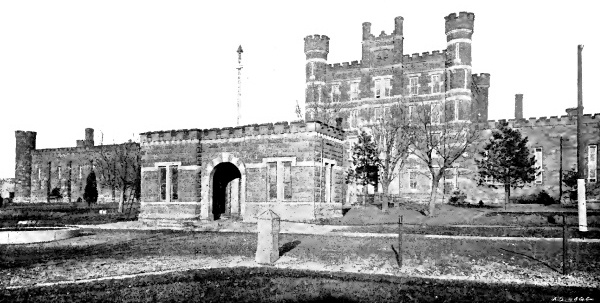
KANSAS STATE PENITENTIARY—MAIN ENTRANCE. E. S. Tucker, Phot.
PLATE II.
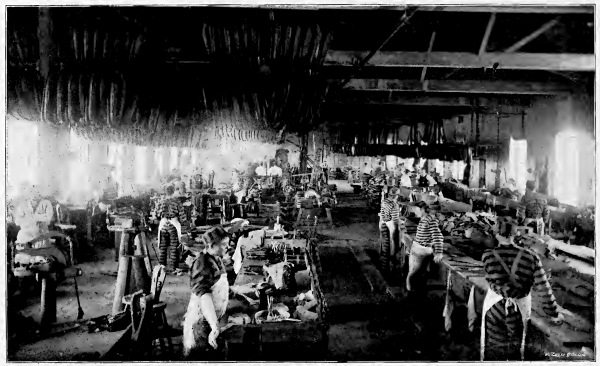
HORSE COLLAR FACTORY. E. S. Tucker, Phot.
PLATE III.
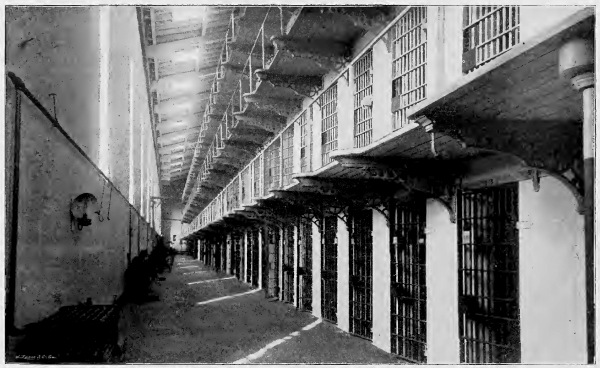
INTERIOR OF CELL HOUSE. E. S. Tucker, Phot.
PLATES IV AND V.
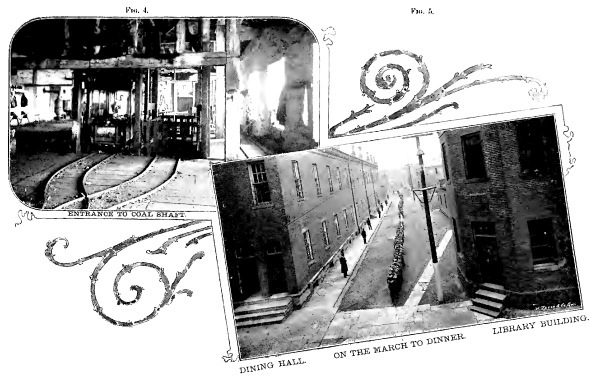
E. S. Tucker, Phot.
PLATES VI AND VII.
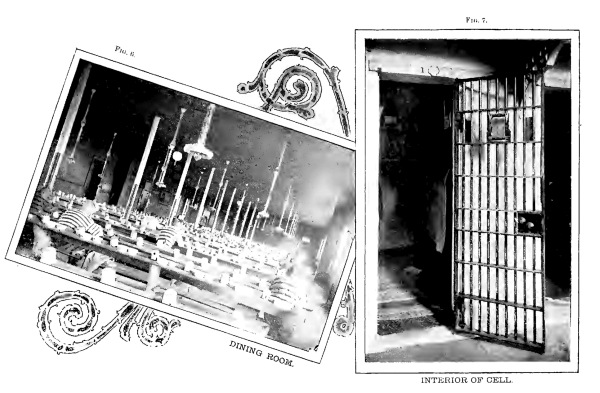
E. S. Tucker, Phot.