TALES OF THE TROJAN WAR
Reading edition
FROM HOMER
THE TROJAN WAR
By Thomas Bulfinch
Minerva was the goddess of Wisdom, but on one occasion she did a very foolish thing; she entered into competition with Juno and Venus for the prize of beauty.
At the marriage of Peleus and Thetis all the gods and goddesses were invited with the exception of Eris, or Discord. Enraged at her exclusion, the goddess threw a golden apple among the guests, with the inscription, “For the fairest,” Thereupon Juno, Venus, and Minerva each claimed the apple.
Jupiter, not willing to decide in so delicate a matter, sent the goddesses to Mount Ida, where the beautiful shepherd Paris was tending his flocks, and to him was committed the decision. The goddesses accordingly appeared before him. Juno promised him power and riches, Minerva glory and renown in war, and Venus the fairest of women for his wife, each attempting to bias his decision in her own favor.
Paris decided in favor of Venus and gave her the golden apple, thus making the two other goddesses his enemies. Under the protection of Venus, Paris sailed to Greece, and was hospitably received by Menelaus, King of Sparta.
Now Helen, the wife of Menelaus, was the very woman whom Venus had destined for Paris, the most beautiful woman in the world. She had been sought as a bride by numerous suitors, and before her decision was made known, they all, at the suggestion of Ulysses, one of their number, took an oath that they would defend her from all injury and avenge her cause if necessary. She chose Menelaus, and was living with him happily when Paris became their guest. Paris, aided by Venus, persuaded her to elope with him, and carried her to Troy, whence arose the famous Trojan war, the subject of the greatest poems of antiquity, those of Homer and Virgil.
Menelaus called upon his brother chieftains of Greece to fulfil their pledge, and join him in his efforts to recover his wife. Most of them came forward, but Ulysses, who had married Penelope, and was very happy with his wife and child, had no wish to embark in such a troublesome affair. He therefore hung back and Palamedes was sent to urge him. When Palamedes arrived at Ithaca Ulysses pretended to be mad. He yoked an ass and an ox together to the plough and began to sow salt. Palamedes, to try him, placed the infant Telemachus before the plough, whereupon the father turned the plough aside, showing plainly that he was no madman, and after that could no longer refuse to fulfil his promise.
Being now gained for the undertaking, he lent his aid to bring in other chiefs, especially Achilles. This hero was the son of that Thetis at whose marriage the apple of Discord had been thrown among the goddesses. Thetis was herself one of the Immortals, a sea-nymph, and knowing that her son was fated to perish before Troy if he went on the expedition, she endeavored to prevent his going. She sent him away to the court of King Lycomedes, and induced him to conceal himself in the disguise of a maiden among the daughters of the king. Ulysses, hearing he was there, went disguised as a merchant to the palace and offered for sale female ornaments, among which he had placed some arms. While the king’s daughters were engrossed with the other contents of the merchant’s pack, Achilles handled the weapons and thereby betrayed himself to the keen eye of Ulysses, who found no great difficulty in persuading him to disregard his mother’s prudent counsels and join his countrymen in the war.
Priam was King of Troy, and Paris, the shepherd, was his son. Paris had been brought up in obscurity, because there were certain ominous forebodings connected with him from his infancy that he would be the ruin of the state. These forebodings seemed at length likely to be realized, for the Grecian armament now in preparation was the greatest that had ever been fitted out.
Agamemnon, King of Mycenæ, and brother of the injured Menelaus, was chosen commander-in-chief. Achilles was their most illustrious warrior. After him ranked Ajax, gigantic in size and of great courage, but dull of intellect; Diomede, second only to Achilles in all the qualities of a hero; Ulysses, famous for his sagacity; and Nestor, the oldest of the Grecian chiefs, and one to whom they all looked up for counsel.
But Troy was no feeble enemy. Priam, the king, was now old, but he had been a wise prince and had strengthened his state by good government at home and numerous alliances with his neighbors. But the principal stay and support of his throne was his son Hector, one of the noblest characters painted by heathen antiquity. He felt, from the first, presentiment of the fall of his country, but still persevered in his heroic resistance, yet by no means justified the wrong which brought this danger upon her. He was united in marriage with Andromaché, and as a husband and father his character was not less admirable than as a warrior. The principal leaders on the side of the Trojans, besides Hector, were Æneas and Deïphobus, Glaucus, and Sarpedon.
THE QUARREL OF THE CHIEFS
By Alfred J. Church
For nine years and more the Greeks besieged the city of Troy. Being many in number, and having strong and valiant chiefs, they pressed the men of the city very hard, so that these durst not go outside the walls. They might have taken it without further loss but that there arose a deadly strife between two of the chiefs, Agamemnon, King of Mycenæ, who was sovereign lord of all the host; and Achilles, who was the bravest and most valiant man therein.
The Greeks, having been away from home many years, were in great want of many things, so it was their custom to leave a part of the army to watch the city, and to send a part to plunder such towns in the country round about as they knew to be friendly to the men of Troy, or as they thought to contain good store of provision or treasure. “Are not all these,” they were wont to say, “towns of the barbarians, and therefore lawful prey to men that are Greeks?” Now among the towns with which they dealt in this fashion was Chrysa, which was sacred to Apollo, who had a great temple therein and a priest. Fearing the anger of the gods, the Greeks had not harmed the temple or the priest; but they had carried off with other prisoners the priest’s daughter, Chryseïs by name. These and the rest of the spoil they divided among the kings, of whom there were many in the army, each ruling his own people. Now King Agamemnon, as being sovereign lord, went not with the army at such times, but stayed behind, having charge of the siege that it should not be neglected. Yet he always received, as was fitting, a share of the spoil. This time the Greeks gave him, with other things, the maiden Chryseïs. Next day there came to the camp the priest Chryses, wishing to ransom his daughter. Much gold he brought, and he had on his head the priest’s crown, that men might reverence him the more. He went to all the chiefs, making his prayer that they would take the gold and give him back his daughter. They all spake him fair, and would have done what he wished, except Agamemnon.
“Get thee out, greybeard!” he cried in great wrath. “Let me not find thee lingering now by the ships, neither coming hither again, or it shall be the worse for thee, for all thy priesthood. And as for thy daughter, I shall carry her away to Argos, when I shall have taken this city of Troy.”
Then the old man went out hastily in great fear and trouble, and he walked in his sorrow by the shore of the sounding sea, and prayed to his god Apollo. “Hear me, god of the silver bow. If I have built thee a temple, and offered thee the fat of many bullocks and rams, hear me, and avenge me on these Greeks!”
And Apollo heard him. He was angry that men had so dishonored his priest, and came down from the top of Olympus, where he dwelt. Dreadful was the rattle of his arrows as he advanced, and his presence was as the night coming over the sky.
He shot the arrows of death, first at the dogs and the mules, and then at the men; and soon all along the shore rolled the black smoke from the piles of wood on which they burnt the bodies of the dead.
On the tenth day Achilles, who was the bravest and strongest of all the Greeks, called the people to an assembly. When they were gathered together he stood up among them and spake to Agamemnon. “Surely it were better to return home than that we should all perish here by the plague. Come, let us ask some prophet, or priest, or dreamer of dreams, why it is that Apollo is so wroth with us.”
Then stood up Calchas, best of seers, who knew what had been, and what was, and what was to come, and spake. “Achilles, thou biddest me tell the people why Apollo is wroth with them. Lo! I tell thee, but thou must first swear to stand by me, for I know that what I shall say will anger King Agamemnon, and it goes ill with common men when kings are angry.”
“Speak out, thou wise man!” cried Achilles; “for I swear by Apollo that while I live no one shall lay hands on thee, no, not Agamemnon, though he be sovereign lord of the Greeks.”
Then the prophet took heart and spake. “It is on behalf of his priest that Apollo is wroth, for he came to ransom his daughter, but Agamemnon would not let the maiden go. Now, then, ye must send her back to Chrysa without ransom, and with her a hundred beasts for sacrifice, so that the plague may be stayed.”
Then Agamemnon stood up in a fury, his eyes blazing like fire. “Never,” he cried, “hast thou spoken good concerning me, ill prophet that thou art, and now thou tellest me to give up this maiden! I will do it, for I would not that the people should perish. Only take care, ye Greeks, that there be a share of the spoil for me, for it would ill beseem the lord of all the host that he alone should be without his share.”
“Nay, my lord Agamemnon,” cried Achilles, “thou art too eager for gain. We have no treasures out of which we may make up thy loss, for what we got out of the towns we have either sold or divided; nor would it be fitting that the people should give back what has been given to them. Give up the maiden, then, without conditions, and when we shall have taken this city of Troy, we will repay thee three and four fold.”
“Nay, great Achilles,” said Agamemnon, “thou shalt not cheat me thus. If the Greeks will give me such a share as I should have, well and good. But if not, I will take one for myself, whether it be from thee, or from Ajax, or from Ulysses; for my share I will have. But of this hereafter. Now let us see that this maiden be sent back. Let them get ready a ship, and put her therein, and with her a hundred victims, and let some chief go with the ship, and see that all things be rightly done.”
Then cried Achilles, and his face was black as a thunder-storm, “Surely thou art altogether shameless and greedy, and, in truth, an ill ruler of men. No quarrel have I with the Trojans. They never harried oxen or sheep of mine. But I have been fighting in thy cause, and that of thy brother Menelaus. Naught carest thou for that. Thou leavest me to fight, and sittest in thy tent at ease. But when the spoil is divided, thine is always the lion’s share. Small indeed is my part—‘a little thing, but dear.’ And this, forsooth, thou wilt take away! Now am I resolved to go home. Small booty wilt thou get then, methinks!”
And King Agamemnon answered, “Go and thy Myrmidons with thee! I have other chieftains as good as thou art, and ready, as thou art not, to pay me due respect. I hate thee, with thy savage, bloodthirsty ways. And as for the matter of the spoil, know that I will take thy share, the girl Briseïs, and fetch her myself, if need be, that all may know that I am sovereign lord here in the hosts of the Greeks.”
Then Achilles was mad with anger, and he thought in his heart, “Shall I arise and slay this caitiff, or shall I keep down the wrath in my breast?” And as he thought he laid his hand on his sword-hilt, and had half drawn his sword from the scabbard, when lo! the goddess Minerva stood behind him (for Juno who loved both this chieftain and that, had sent her), and caught him by the long locks of his yellow hair. But Achilles marvelled much to feel the mighty grasp, and turned, and looked, and knew the goddess, but no one else in the assembly might see her. Then his eyes flashed with fire, and he cried, “Art thou come, child of Jupiter, to see the insolence of Agamemnon? Of a truth, I think that he will perish for his folly.”
But Minerva said, “Nay, but I am come to stay thy wrath. Use bitter words, if thou wilt, but put up thy sword in its sheath, and strike him not. Of a truth, I tell thee that for this insolence of to-day he will bring thee hereafter splendid gifts, threefold and fourfold for all that he may take away.”
Then Achilles answered, “I shall abide by thy command, for it is ever better for a man to obey the immortal gods.” And as he spake he laid his heavy hand upon the hilt, and thrust back the sword into the scabbard, and Minerva went her way to Olympus.
Then he turned him to King Agamemnon, and spake again. “Drunkard, with the eyes of a dog and the heart of a deer! never fighting in the front of the battle, nor daring to lie in the ambush! ’Tis a puny race thou rulest, or this had been thy last wrong. And as for me, here is this scepter: once it was the branch of a tree, but a cunning craftsman bound it with bronze to be the sign of the lordship which Jupiter gives to kings; as surely as it shall never again have bark or leaves or shoot, so surely shall the Greeks one day miss Achilles, when they fall in heaps before the dreadful Hector, and thou shalt eat thy heart to think that thou hast wronged the bravest of thy host.”
And as he spake he dashed his scepter on the ground and sat down. And on the other side Agamemnon sat in furious anger. Then Nestor rose, an old man of a hundred years and more, and counselled peace. Let them listen, he said, to his counsel. Great chiefs in the old days, with whom no man now alive would dare to fight, had listened. Let not Agamemnon take away from the bravest of the Greeks the prize of war; let not Achilles, though he was mightier in battle than all other men, contend with Agamemnon, who was sovereign lord of all the hosts of Greece. But he spake in vain. For Agamemnon answered—“Nestor, thou speakest well, and peace is good. But this fellow would lord it over all, and he must be taught that there is one here, at least, who is better than he.”
And Achilles said, “I were a slave and a coward if I owned thee as my lord. Not so: play the master over others, but think not to master me. As for the prize which the Greeks gave me, let them do as they will. They gave it; let them take it away. But if thou darest to touch aught that is mine own, that hour thy life-blood shall redden on my spear.”
Then the assembly was dismissed. Chryseïs was sent to her home with due offerings to the god, the wise Ulysses going with her. And all the people purified themselves, and the plague was stayed.
But King Agamemnon would not go back from his purpose. So he called to him the heralds, Talthybius and Eurybates, and said, “Heralds, go to the tents of Achilles and fetch the maiden Briseïs. But if he will not let her go, say that I will come myself with many others to fetch her; so will it be the worse for him.”
Sorely against their will the heralds went. Along the seashore they walked, till they came to the tents of Achilles. There they found him sitting, but stood silent in awe and fear.
Achilles spied them, and cried aloud, “Come near, ye heralds, messengers of gods and men. ’Tis no fault of yours that ye are come on such an errand.”
Then he turned to Patroclus, his dearest friend, and said, “Bring the maiden from her tent, and let the heralds lead her away. But let them be witnesses, before gods and men, and before this evil-minded king, against the day when he shall have sore need of me to save his host from destruction. Fool that he is, who thinks not of the past nor of the future, that his people may be safe!”
Then Patroclus brought forth the maiden from her tent and gave her to the heralds. And they led her away, but it was sorely against her will that she went. Achilles went apart from his comrades and sat upon the seashore, falling into a great passion of tears, and stretching out his hands with loud prayer to his mother, who indeed was a goddess of the sea, Thetis by name. She heard him where she sat in the depths by her father, the old god of the sea, and rose—you would have thought it a mist rising—from the waves, and came to where he sat weeping, and stroked him with her hand, and called him by his name.
“What ails thee, my son?” she said.
Then he told her the story of his wrong, and when he had ended he said—
“Go, I pray thee, to the top of Olympus, to the palace of Jupiter. Often have I heard thee boast how, long ago, thou didst help him when the other gods would have bound him, fetching Briareus of the hundred hands, who sat by him, so that the gods feared to touch him. Go now and call these things to his mind, and pray him that he help the sons of Troy and give them victory in the battle, so that the Greeks, as they flee before them, may have joy of this king of theirs, who has done such wrong to the bravest of his host.”
And his mother answered him, “Surely thine is an evil lot, my son! Thy life is short, and it should of right be without tears and full of joy; but now it seems to me to be both short and sad. I will go as thou sayest to Olympus, to the palace of Jupiter, but not now, for he has gone, and the other gods with him, to a twelve days’ feast with the pious Ethiopians. But when he comes back I will entreat and persuade him. And do thou sit still, nor go forth to battle.”
When the twelve days were past, Thetis went to the top of Olympus, to the palace of Jupiter and made her prayer to him. He was loath to grant it, for he knew that it would anger his wife, Juno, who loved the Greeks and hated the sons of Troy. Yet he could not refuse her, and promised that it should be as she wished. And to make his word the surer, he nodded his awful head, and with the nod all Olympus was shaken.
That night Jupiter took counsel with himself how he might best work his will. He called to him a dream, and said, “Dream, go to the tent of Agamemnon, and tell him to set his army in array against Troy, for the gods are now of one mind, and the day of doom is come for the city; so he shall take it, and gain eternal glory for himself.”
So the dream went to the tent of Agamemnon, and it took the shape of Nestor, the old chief whom the king honored more than all beside.
Then the false Nestor spake: “Sleepest thou, Agamemnon? It is not for kings to sleep all through the night, for they must take thought for many, and have many cares. Listen now to the words of Jupiter: ‘Set the battle in array against Troy, for the gods are now of one mind, and the day of doom is come for the city, and thou shalt take it, and gain eternal glory for thyself.”
And Agamemnon believed the dream, and knew not the purpose of Jupiter in bidding him go forth to battle. So he rose from his bed and donned his tunic, and over it a great cloak, fastened the sandals on his feet, hung from his shoulders his mighty silver-studded sword, and took in his right hand the great scepter of his house, which was the token of his sovereignty over all the Greeks. Then he went forth, and first took counsel with the chiefs, and afterwards called the people to the assembly. After the assembly the shrill-voiced heralds called the host to the battle. As is the flare of a great fire when a wood is burning on a hill-top, so was the flash of their arms and their armor as they thronged to the field. And as the countless flocks of wild geese or cranes or swans now wheel and now settle in the great Asian marsh by the stream of Cayster, or as the bees swarm in the spring, when the milk-pails are full, so thick the Greeks thronged to the battle in the great plain by the banks of the Scamander. Many nations were there, and many chiefs, and the bravest and strongest of all was Ajax, son of Telamon, and the best horses were the horses of Eumelus; but there was none that could compare with Achilles and the horses of Achilles, bravest man and swiftest steeds. Only Achilles sat apart, and would not go to the battle.
And on the other side the sons of Troy and their allies came forth from the gates of the city with the most famous of their chiefs.
So the battle was set in array, and the two hosts stood over against each other.
THE FIGHT BETWEEN PARIS AND MENELAUS
By Alfred J. Church
They were now about to fight, when from the ranks of the Trojans Paris rushed forth. He had a panther’s skin over his shoulders, and a bow and a sword, and in either hand a spear, and he called aloud to the Greeks that they should send forth their bravest to fight with them.
When Menelaus saw him he was glad, for he said that now he should avenge himself on the man who had done him such wrong. So a lion is glad when, being sorely hungered, he finds a stag or a wild goat; he devours it, and will not be driven from it by dogs or hunters.
He leapt from his chariot and rushed to meet his enemy; but Paris, having done evil, and being therefore a coward in his heart, was afraid when he saw Menelaus, and fled back into the ranks of his comrades, just as a man steps back in haste when, unawares, he comes upon a snake. Hector saw him and rebuked him. “Fair art thou to look upon, Paris, but nothing worth. Surely the Greeks will scorn us if they think that thou art our bravest warrior, because thou art of stately presence. Thou art a coward; and yet thou daredst to go across the sea and carry off the fair Helen. Why dost thou not stand and abide the onset of her husband, and see what manner of man he is? Little would thy harp and thy long locks and thy fair face avail when thou wert lying in the dust! A craven race are the sons of Troy, or they would have stoned thee ere this.”
Then Paris answered, “Thou speakest well, Hector, and thy rebuke is just. As for thee, thy heart is like iron, ever set on battle; yet are beauty and love also the gifts of the gods, and not to be despised. But now set Menelaus and me in the midst, and let us fight, man to man, for the fair Helen and for all her possessions. And if he prevail over me, let him take her and them and depart, and the Greeks with him, but ye shall dwell in peace; but if I prevail they shall depart without her.”
Then Hector was glad, and going before the Trojan ranks, holding his spear by the middle, he kept them back. The Greeks would have thrown spears and stones at him, only Agamemnon cried aloud and said, “Hold: Hector has somewhat to say to us.”
Then Hector said, “Hear, Trojans and Greeks, what Paris saith: Let all besides lay their arms upon the ground, and let Menelaus and me fight for the fair Helen and all her wealth. And let him that is the better keep her and them, but the rest shall dwell in peace.”
Then Menelaus said, “The word pleaseth me well; let us fight together, and let us make agreement with oath and sacrifice. And because the sons of Priam are men of fraud and violence, let Priam himself come.”
So they sent a herald to King Priam, but he sat on the wall with the old men. And as they talked the fair Helen came near, and they said, “What wonder that men should suffer much for such a woman, for indeed she is divinely fair. Yet let her depart in the ships, nor bring a curse on us and our children.”
But Priam called to her, “Come near, my daughter; tell me about these old friends of thine. For ’tis not thou, ’tis the gods who have brought about all this trouble. But tell me, who is this warrior that I see, so fair and strong? There are others even a head taller than he, but none of such majesty.”
And Helen answered, “Ah, my father! would that I had died before I left husband and child to follow thy son. But as for this warrior, he is Agamemnon, a good king and brave soldier and my brother-in-law in the old days.”
“Happy Agamemnon,” said Priam, “to rule over so many! Never saw I such an army gathered together, not even when I went to help the Phrygians when they were assembled on the banks of the Sangarus against the Amazons. But who is this that I see, not so tall as Agamemnon, but of broader shoulders? His arms lie upon the ground, and he is walking through the ranks of his men just as some great ram walks through a flock of sheep.”
“This,” said Helen, “is Ulysses of Ithaca, who is better in craft and counsel than all other men.”
“’Tis well spoken, lady,” said Antenor. “Well I remember Ulysses when he came hither on an embassy about thee with the brave Menelaus. My guests they were, and I knew them well. And I remember how, in the assembly of the Trojans, when both were standing, Menelaus was the taller, but when they sat, Ulysses was the more majestic to behold. And when they rose to speak, Menelaus said few words, but said them wisely and well; and Ulysses—you had thought him a fool, so stiffly he held his scepter and so downcast were his eyes; but as soon as he began, oh! the mighty voice, and the words thick as the falling snow!”
Then Priam said, “Who is that stalwart hero, so tall and strong, overtopping all by head and shoulders?”
“That,” said Helen, “is mighty Ajax, the bulwark of the Greeks. And next to him is Idomeneus. Often has Menelaus had him as his guest in the old days, when he came from Crete. As for the other chiefs, I see and could name them all. But I miss my own dear brothers, Castor, tamer of horses, and Pollux, the mighty boxer. Either they came not from Sparta, or having come, shun the meeting of men for shame of me” (she knew not that they were sleeping their last sleep far away in their dear fatherland).
And when they had ended talking, the heralds came and told King Priam that the armies called for him. So he went, and Antenor with him. And he on the one side, for the Trojans, and King Agamemnon for the Greeks, made a covenant with sacrifice that Paris and Menelaus should fight together, and that the fair Helen, with all her treasures, should go with him who should win. Hector and Ulysses marked out a space for the fight, and Hector shook two pebbles in a helmet, looking away as he shook them, that he whose pebble leapt forth the first should be the first to throw his spear. And it so befell that the lot of Paris leapt forth first. The two warriors armed themselves and came forth into the space, and stood over against each other, brandishing their spears, with hate in their eyes. Then Paris threw his spear. It struck the shield of Menelaus, but pierced it not, for the spear point was bent back. Then Menelaus prayed to Jupiter, “Grant, Father Jupiter, that I may avenge myself on Paris, who has done me this wrong; so shall men in after time fear to do wrong to their host.” So speaking, he cast his long-shafted spear. It struck the shield of Paris and pierced it through, and passed through the corslet, and through the tunic close to the loin; but Paris shrank aside and the spear wounded him not. Then Menelaus drew his silver-studded sword and struck a mighty blow on the top of the helmet of Paris, but the sword broke in four pieces in his hand. Then he cried in his wrath, “O Jupiter, most mischief-loving of the gods, my spear I cast in vain, and now my sword is broken.” Then he rushed forward and seized Paris by the helmet, and dragged him towards the host of the Greeks. And truly he had taken him, but Venus loosed the strap that was beneath his chin, and the helmet came off in his hand. And Menelaus whirled it among the Greeks and charged with another spear in his hand. But Venus snatched Paris away, covering him with a mist, and put him down in his chamber in Troy. Then Menelaus looked for him everywhere, but no one could tell him where he might be. No son of Troy would have hidden him out of kindness, for all hated him as death.
Then King Agamemnon said, “Now, ye sons of Troy, it is for you to give back the fair Helen and her wealth, and to pay me besides so much as may be fitting for all my cost and trouble.”
But it was not the will of the gods that the sons of Troy should do this thing. So Minerva took upon herself the shape of Laodocus, son of Antenor, and went to Pandarus, son of Lycaon, where he stood among his men. Then the false Laodocus said, “Pandarus, darest thou aim an arrow at Menelaus? Truly the Trojans would love thee well, and Paris best of all, if they could see Menelaus slain by an arrow from thy bow. Aim then, but first pray to Apollo, and vow that thou wilt offer a hundred beasts when thou returnest to thy city, Zeleia.” Now Pandarus had a bow made of the horns of a wild goat which he had slain; sixteen palms long they were, and a cunning workman had made them smooth, and put a tip of gold whereon to fasten the bow-string. And Pandarus strung his bow, his comrades hiding him with their shields. Then he took an arrow from his quiver, and laid it on the bow-string, and drew the string to his breast, till the arrow-head touched the bow, and let fly. Right well aimed was the dart, but it was not the will of heaven that it should slay Menelaus. It struck him, indeed, and passed through the belt and through the corslet and through the girdle, and pierced the skin.
Sore dismayed was King Agamemnon to see the blood; sore dismayed also was the brave Menelaus, till he spied the barb of the arrow, and knew that the wound was not deep. But Agamemnon cried—
“It was in an evil hour for thee, my brother, that I made a covenant with these false sons of Troy. Right well, indeed, I know that oath and sacrifice are not in vain, but will have vengeance at the last. Troy shall fall; but woe is me if thou shouldst die, Menelaus. For the Greeks will straight go back to their fatherland, and the fair Helen will be left a boast to the sons of Troy, and I shall have great shame when one of them shall say, as he leaps on the tomb of the brave Menelaus, ‘Surely the great Agamemnon has avenged himself well; for he brought an army hither, but now is gone back to his home, but left Menelaus here.’ May the earth swallow me up before that day!”
“Nay,” said Menelaus, “fear not, for the arrow has but grazed the skin.”
Then King Agamemnon bade fetch the physician. So the herald fetched Machaon, the physician. And Machaon came, and drew forth the arrow, and when he had wiped away the blood he put healing drugs upon the wound, which Chiron, the wise healer, had given to his father.
THE DUEL BETWEEN HECTOR AND AJAX
By Alfred J. Church
The Greeks went forward to the battle, as the waves that curl themselves and then dash upon the shore, throwing high the foam. In order they went after their chiefs; you had thought them dumb, so silent were they. But the Trojans were like a flock of ewes which wait to be milked, and bleat hearing the voice of their lambs, so confused a cry went out from their army, for there were men of many tongues gathered together. And on either side the gods urged them on, but chiefly Minerva the Greeks and Mars the sons of Troy. Then, as two streams in flood meet in some chasm, so the armies dashed together, shield on shield and spear on spear.
Now when Minerva saw that the Greeks were perishing by the hand of Hector and his companions, it grieved her sore. So she came down from the heights of Olympus, if happily she might help them. And Apollo met her and said, “Art thou come, Minerva, to help the Greeks whom thou lovest? Well, let us stay the battle for this day; hereafter they shall fight till the doom of Troy be accomplished.”
But Minerva answered, “How shall we stay it?”
And Apollo said, “We will set on Hector to challenge the bravest of the Greeks to fight with him, man to man.”
So they two put the matter into the mind of Helenus the seer. Then Helenus went near to Hector, “Listen to me, for I am thy brother. Cause the rest of the sons of Troy and of the Greeks to sit down, and do thou challenge the bravest of the Greeks to fight with thee, man to man. And be sure thou shalt not fall in the battle, for the will of the immortal gods is so.”
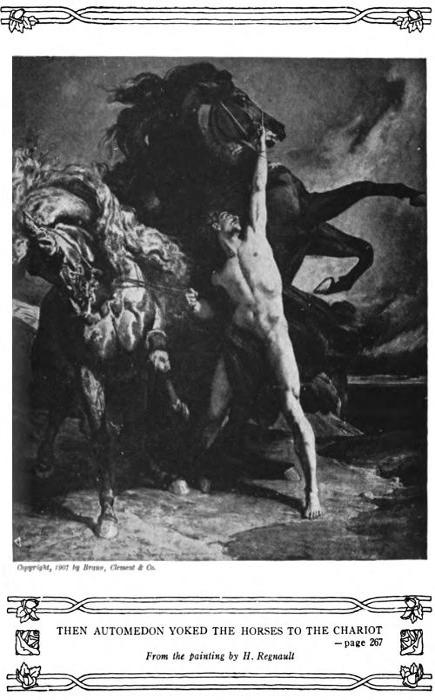
Copyright, 1907 by Braun, Clement & Co.
THEN AUTOMEDON YOKED THE HORSES TO THE CHARIOT
—page 267
From the painting by H. Regnault
Then Hector greatly rejoiced, and passed to the front of the army, holding his spear by the middle, and kept back the sons of Troy; and King Agamemnon did likewise with his own people. Then Hector spake—
“Hear me, sons of Troy, and ye men of Greece. The covenant that we made one with another hath been broken, for Jupiter would have it so, purposing evil to both, till either you shall take our high-walled city or we shall conquer you by your ships. But let one of you who call yourselves champions of the Greeks come forth and fight with me, man to man. And let it be so that if he vanquish me he shall spoil me of my arms but give my body to my people, that they may burn it with fire; and if I vanquish him, I will spoil him of his arms but give his body to the Greeks, that they may bury him and raise a great mound above him by the broad salt river of Hellespont. And so men of after days shall see it, sailing by, and say, ‘This is the tomb of the bravest of the Greeks, whom Hector slew.’ So shall my name live forever.”
But all the Greeks kept silence, fearing to meet him in battle, but shamed to hold back. Then at last Menelaus leapt forward and spake, “Surely now ye are women and not men. Foul shame it were should there be no man to stand up against this Hector. Lo! I will fight with him my own self, for the issues of battle are with the immortal gods.”
So he spake in his rage rashly, courting death, for Hector was much stronger than he. Then King Agamemnon answered, “Nay, but this is folly, my brother. Seek not in thy anger to fight with one that is stronger than thou; for as for this Hector, even Achilles was loth to meet him. Sit thou down among thy comrades, and the Greeks will find some champion who shall fight with him.”
And Menelaus hearkened to his brother’s words, and sat down. Then Nestor rose in the midst and spake—
“Woe is me to-day for Greece! How would the old Peleus grieve to hear such a tale! Well I remember how he rejoiced when I told him of the house and lineage of all chieftains of the Greeks, and now he would hear that they cower before Hector, and are sore afraid when he calls them to the battle. Surely he would pray this day that he might die! O that I were such as I was in the old days, when the men of Pylos fought with the Arcadians! I, who was the youngest of all, stood forth, and Minerva gave me glory that day, for I slew their leader, though he was the strongest and tallest among the sons of men. Would that I were such to-day! Right soon would I meet this mighty Hector.”
Then rose up nine chiefs of fame. First of all, King Agamemnon, lord of many nations, and next to him Diomed, and Ajax the Greater and Ajax the Less, and then Idomeneus and Meriones, and Eurypylus, and Thoas, son of Andræmon, and the wise Ulysses.
Then Nestor said, “Let us cast lots who shall do battle with the mighty Hector.”
So they threw the lots into the helmet of King Agamemnon, a lot for each. And the people prayed, “Grant, ye gods, that the lot of Ajax the Greater may leap forth, or the lot of Diomed, or the lot of King Agamemnon.” Then Nestor shook the lots in the helmet, and the one which they most wished leapt forth. For the herald took it through the ranks and showed it to the chiefs, but none knew it for his own till he came to where Ajax the Greater stood among his comrades. But Ajax had marked it with his mark, and put forth his hand for it, and claimed it, right glad at heart. On the ground by his feet he threw it, and said—
“Mine is the lot, my friends, and right glad I am, for I think that I shall prevail over the mighty Hector, but come, let me don my arms; and pray ye to Jupiter, but silently, lest the Trojans hear, or aloud, if ye will, for no fear have we. Not by force or craft shall any one vanquish me, for not such are the men whom Salamis breeds.”
So he armed himself and moved forwards, smiling with grim face. With mighty strides he came, brandishing his long-shafted spear. The Greeks were glad to behold him, but the knees of the Trojans were loosened with fear and great Hector’s heart beat fast; but he trembled not, nor gave place, seeing that he had himself called him to battle. So Ajax came near, holding before the great shield, like a wall, which Tychius, best of craftsmen, had made for him. Seven folds of bull’s hide it had, and an eighth of bronze. Threateningly he spake—
“Now shalt thou know, Hector, what manner of men there are yet among our chiefs, though Achilles the lion-hearted is far away, sitting idly in his tent, in great wrath with King Agamemnon. Do thou, then, begin the battle.”
“Speak not to me, Jupiter-descended Ajax,” said Hector, “as though I were a woman or a child knowing nothing of war. Well I know all the arts of battle, to ply my shield this way and that, to guide my car through the tumult of steeds, and to stand fighting hand to hand. But I would not smite so stout a foe by stealth, but openly.”
As he spake he hurled his long-shafted spear, and smote the great shield on the rim of the eighth fold, that was of bronze. Through six folds it passed, but in the seventh it was stayed. Then Ajax hurled his spear, striking Hector’s shield. Through shield it passed and corslet, and cut the tunic close against the loin; but Hector shrank away and escaped the doom of death. Then, each with a fresh spear, they rushed together like lions or wild boars of the wood. First Hector smote the middle of the shield of Ajax, but pierced it not, for the spear-point was bent back; then Ajax, with a great bound, drove his spear at Hector’s shield and pierced it, forcing him back, and grazing his neck so that the blood welled out. Yet did not Hector cease from the combat. He caught up a great stone from the ground, and hurled it at the boss of the sevenfold shield. Loud rang the bronze, but the shield broke not. Then Ajax took a stone heavier by far, and threw it with all his might. It broke the shield of Hector, and bore him backwards, so that he fell at length with his shield above him. But Apollo raised him up. Then did both draw their swords; but ere they could join in close battle the heralds came and held their scepters between them, and Idæus, the herald of Troy, spake—
“Fight no more, my sons; Jupiter loves you both; and ye are both mighty warriors. That we all know right well. But now the night bids you cease, and it is well to heed its bidding.”
Then said Ajax, “Nay, Idæus, but it is for Hector to speak, for he called the bravest of the Greeks to battle. And as he wills it, so will I.”
And Hector said, “O Ajax, the gods have given thee stature and strength and skill, nor is there any better warrior among the Greeks. Let us cease then from the battle; we may yet meet again, till the gods give the victory to me or thee. And now let us give gifts the one to the other, so that Trojans and Greeks may say—Hector and Ajax met in fierce fight and parted in friendship.”
So Hector gave to Ajax a silver-studded sword with the scabbard and the sword-belt, and Ajax gave to Hector a buckler splendid with purple. So they parted. Right glad were the sons of Troy when they saw Hector returning safe. Glad also were the Greeks, as they led Ajax rejoicing in his victory to King Agamemnon. Whereupon the king called the chiefs to banquet together, and bade slay an ox of five years old, and Ajax he honored most of all. When the feast was ended Nestor said—
“It were well that we should cease awhile from war and burn the dead, for many, in truth, are fallen. And we will build a great wall and dig a trench about it, and we will make wide gates that a chariot may pass through, so that our ships may be safe, if the sons of Troy should press us hard.”
But the next morning came a herald from Troy to the chiefs as they sat in council by the ship of King Agamemnon, and said—
“This is the word of Priam and the men of Troy; Paris will give back all the treasures of the fair Helen, and many more besides; but the fair Helen herself he will not give. But if this please you not, grant us a truce, that we may bury our dead.”
Then Diomed spake, “Nay, we will not take the fair Helen’s self, for a man may know even though he be a fool, that the doom of Troy is come.”
And King Agamemnon said, “Herald, thou hast heard the word of the Greeks, but as for the truce, be it as you will.”
So the next day they burnt their dead, and the Greeks made a wall with gates and dug a trench about it. And when it was finished, even at sunset, they made ready a meal, and lo! there came ships from Lemnos bringing wine, and Greeks bought thereof, some with bronze, and some with iron, and some with shields of ox hide. All night they feasted right joyously. The sons of Troy also feasted in their city. But the dreadful thunder rolled through the night, for Jupiter was counselling evil against them.
THE DEEDS AND DEATH OF PATROCLUS
By Alfred J. Church
Patroclus stood by Achilles, weeping bitterly. Then said Achilles, “What ails thee, Patroclus, that thou weepest like a girl-child that runs along by her mother’s side and would be taken up, holding her gown, and looking at her with tearful eyes till she lift her in her arms? Hast thou heard evil news from Phthia? Menœtius yet lives, they say, and Peleus. Or art thou weeping for the Greeks, because they perish for their folly?”
Then said Patroclus, “Be not wroth with me, great Achilles, for indeed the Greeks are in grievous straits, and all their bravest are wounded, and still thou cherishest thy wrath. If thou goest not to the battle, fearing some warning from the gods, let me go, and thy Myrmidons with me. And let me put thy armor on me; so shall the Greeks have breathing space from the war.”
So he spake, entreating, nor knew that for his own doom he entreated. And Achilles made reply—
“It is no warning that I heed, that I keep back from the war. But these men took from me my prize, which I won with my own hands. But let the past be past. I said that I would not rise up till the battle should come nigh to my own ships. But thou mayest put my armor upon thee, and lead my Myrmidons to the fight. For in truth the men of Troy are gathered as a dark cloud about the ships, and the Greeks have scarce standing-ground between them and the sea. For they see not the gleam of my helmet. And Diomed is not there with his spear; nor do I hear the voice of Agamemnon, but only the voice of Hector, as he calls the men of Troy to the battle. Go, therefore, Patroclus, and drive the fire from the ships. And then come thou back, nor fight any more with the Trojans, lest thou take my glory from me. And go not near, in the delight of battle, to the walls of Troy, lest one of the gods meet thee to thy hurt; and, of a truth, the keen archer Apollo loves them well.”
But as they talked the one to the other, Ajax could hold out no longer. For swords and javelins came thick upon him, and clattered on his helmet, and his shoulder was weary with the great shield which he held; and he breathed heavily and hard, and the great drops of sweat fell upon the ground. Then at the last Hector came near and smote his spear with a great sword, so that the head fell off. Then was Ajax sore afraid, and gave way, and the men of Troy set torches to the ship’s stem, and a great flame shot up to the sky. And Achilles saw it, and smote his thigh and spake—
“Haste thee, Patroclus, for I see the fire rising up from the ships. Put thou on the armor, and I will call my people to the war.”
So Patroclus put on the armor—corslet and shield and helmet—and bound upon his shoulder the silver-studded sword, and took a mighty spear in his hand. But the great Pelian spear he took not, for that no man but Achilles might wield. Then Automedon yoked the horses to the chariot, Bayard and Piebald, and with them in the side harness, Pedasus; and they two were deathless steeds, but he was mortal.
Meanwhile Achilles had called the Myrmidons to battle. Fifty ships had he brought to Troy, and in each there were fifty men.
Five leaders they had, and the bravest of the five was Pisander.
Then Achilles said, “Forget not, ye Myrmidons, the bold words that ye spake against the men of Troy during the days of my wrath, making complaint that I kept you from the battle against your will. Now, therefore, ye have that which you desired.”
So the Myrmidons went to the battle in close array, helmet to helmet and shield to shield, close as the stones with which a builder builds a wall. And in front went Patroclus, and Automedon in the chariot beside him. Then Achilles went to his tent and took a great cup from the chest which Thetis his mother had given him. Now no man drank of that cup but he only, nor did he pour out of it libations to any of the gods but only to Jupiter. This first he cleansed with sulphur, and then with water from the spring. And after this he washed his hands, and stood in the midst of the space before his tent, and poured out of it to Jupiter, saying—
“O Jupiter, I send my comrade to this battle; make him strong and bold, and give him glory, and bring him home safe to the ships and my people with him.”
So he prayed, and Father Jupiter heard him, and part he granted and part denied.
But now Patroclus with the Myrmidons had come to where the battle was raging about the ship of Protesilaus, and when the men of Troy beheld him, they thought that Achilles had forgotten his wrath, and was come forth to the war. And first Patroclus slew Pyræchmes, who was the chief of the Pæonians who live on the banks of the broad Axius. Then the men of Troy turned to flee, and many chiefs of fame fell by the spears of the Greeks. So the battle rolled back to the trench, and in the trench many chariots of the Trojans were broken, but the horses of Achilles went across it at a stride, so nimble were they and strong. And the heart of Patroclus was set to slay Hector; but he could not overtake him, so swift were his horses. Then did Patroclus turn his chariot and keep back those that fled, that they should not go to the city, and rushed hither and thither, still slaying as he went.
Then did Patroclus forget the word which Achilles had spoken to him, that he should not go near to Troy, for he pursued the men of the city even to the wall. Thrice he mounted on the angle of the wall, and thrice Apollo himself drove him back, pushing his shining shield. But the fourth time the god said, “Go thou back, Patroclus. It is not for thee to take the city of Troy; no, nor for Achilles, who is far better than thou art.”
So Patroclus went back, fearing the wrath of the archer-god. Then Apollo stirred up the spirit of Hector, that he should go against Patroclus. Therefore he went, with his brother Cebriones for driver of his chariot. But when they came near, Patroclus cast a great stone which he had in his hand, and smote Cebriones on the forehead, crushing it in, so that he fell headlong from the chariot. And Patroclus mocked him, saying—
“How nimble is this man! how lightly he dives! What spoil he would take of oysters, diving from a ship, even in a stormy sea! Who would have thought that there were such skilful divers in Troy!”
Then again the battle waxed hot about the body of Cebriones, and this too, at the last, the Greeks drew unto themselves, and spoiled it of the arms. And this being accomplished, Patroclus rushed against the men of Troy. Thrice he rushed, and each time he slew nine chiefs of fame. But the fourth time Apollo stood behind him and struck him on the head and shoulders, so that his eyes were darkened. And the helmet fell from off his head, so that the horsehair plumes were soiled with dust. Never before had it touched the ground, for it was the helmet of Achilles. And also the god brake the spear in his hand, and struck the shield from his arms, and loosed his corslet. All amazed he stood, and then Euphorbus, son of Panthoüs, smote him on the back with his spear, but slew him not. Then Patroclus sought to flee to the ranks of his comrades. But Hector saw him, and thrust at him with his spear, smiting him in the groin, so that he fell. And when the Greeks saw him fall, they sent up a terrible cry. Then Hector stood over him and cried—
“Didst thou think to spoil our city, Patroclus, and to carry away our wives and daughters in the ships? But lo! I have slain thee, and the fowls of the air shall eat thy flesh; nor shall the great Achilles help thee at all—Achilles, who bade thee, I trow, strip the tunic from my breast, and thou thoughtest in thy folly to do it.”
But Patroclus answered, “Thou boasteth much, Hector. Yet thou didst not slay me, but Apollo, who took from me my arms, for had twenty such as thou met me, I had slain them all. And mark thou this: death and fate are close to thee by the hand of the great Achilles.”
And Hector answered (but Patroclus was dead already), “Why dost thou prophesy death to me? May be the great Achilles himself shall fall by my hand.” Then he drew his spear from the wound, and went after Automedon, to slay him, but the swift horses of Achilles carried him away.
Fierce was the fight about the body of Patroclus, and many heroes fell, both on this side and on that, and first of them all Euphorbus, who, indeed, had wounded him. For as he came near to strip the dead man of his arms, Menelaus slew him with his spear. He slew him, but took not his arms, for Hector came through the battle; nor did Menelaus dare to abide his coming, but went back into the ranks of his own people. Then did Hector strip off the arms of Patroclus, the arms which the great Achilles had given him to wear. He laid hold of the body, and would have dragged it into the host of the Trojans, but Ajax Telamon came forth, and put his broad shield before it, as a lion stands before its cubs when the hunters meet it in the woods, drawing down over its eyes its shaggy brows.
And all the while the battle raged about the dead Patroclus. At last Ajax said to Menelaus (now these two had borne themselves more bravely in the fight than all others), “See if thou canst find Antilochus, Nestor’s son, that he may carry the tidings to Achilles, how that Patroclus is dead.”
So Menelaus went and found Antilochus on the left of the battle, and said to him, “I have ill news for thee. Thou seest that the men of Troy have the victory to-day. And also Patroclus lies dead. Run, therefore, to Achilles, and tell him, if haply he may save the body; but as for the arms, Hector has them already.”
Sore dismayed was Antilochus to hear such tidings, and his eyes were filled with tears and his voice was choked. Yet did he give heed to the words of Menelaus, and ran to tell Achilles of what had chanced.
Antilochus came near to Achilles, who, indeed, seeing that the Greeks fled and the men of Troy pursued, was already sore afraid. And he said, weeping as he spake, “I bring ill news—Patroclus lies low. The Greeks fight for his body, but Hector has his arms.”
Then Achilles took of the dust of the plain in his hands, and poured it on his head, and lay at his length upon the ground, and tore his hair. And all the women wailed. And Antilochus sat weeping; but ever he held the hands of Achilles, lest he should slay himself in his great grief.
Then came his mother, hearing his cry, from where she sat in the depths of the sea, and laid her hand on him and said, “Why weepest thou, my son? Hide not the matter from me, but tell me.”
And Achilles answered, “All that Jupiter promised thee for me he hath fulfilled. But what profit have I, for lo! my friend Patroclus is dead, and Hector has the arms which I gave him to wear. And as for me, I care not to live, except I can avenge me upon him.”
THE DEATH OF HECTOR
By Alfred J. Church
Priam stood on a tower of the wall and saw the people flying before the attacks of Achilles, so he hastened down to the gates and said to the keepers, “Keep the wicket-gates open, that the people may enter in.”
So the keepers held the gates open, and the people hastened in, wearied with toil and thirst and covered with dust, and Achilles followed close upon them. At that hour the Greeks would have taken the city of Troy, but that Apollo saved it by putting courage into the heart of Antenor’s son Agenor, and by standing by him that he should not be slain.
Agenor stood thinking within himself—“Shall I flee with these others? Achilles will take me and slay me, and I shall die as a coward dies. What if I stand to meet him before the gates? He, too, is a mortal man and his flesh may be pierced by the spear.”
When Achilles came near he cast his spear, striking the leg below the knee, but the armor was so strong it turned off the spear. But when Achilles would have slain him, lo! Apollo lifted him up and set him within the city, and that the men of Troy might have space to enter, he took upon him Agenor’s shape. The false Agenor fled, and Achilles pursued him.
In the meanwhile the men of Troy flocked into the city, without stopping to ask who was safe and who was dead. Only Hector remained outside the walls, standing in front of the great Scæan gates. But all the while Achilles was fiercely pursuing the false Agenor, till at last Apollo turned and spake to him—
“Why dost thou pursue me, swift-footed Achilles? Hast thus not yet found out that I am a god, and that all thy fury is in vain? All the sons of Troy are safe in their city, and thou art here, far out of the way, seeking to slay me, who cannot die.”
In great wrath Achilles answered him, “Thou hast done me wrong in so drawing me away from the wall, great archer, most mischief-loving of all the gods. Had it not been for this, many a Trojan more had bitten the ground. Thou hast robbed me of great glory, and saved thy favorites. O that I had the power to take vengeance on thee! Thou hadst paid dearly for thy cheat!”
Then he turned and rushed towards the city, swift as a racehorse whirls a chariot across the plain. Old Priam spied him from the walls, with his glittering armor, bright as that brightest of the stars—men call it Orion’s dog—which shines at vintage-time, a baleful light, bringing the fevers of autumn to men. And the old man groaned aloud when he saw him, and stretching out his hands, cried to his son Hector, where he stood before the gates, eager to do battle with this dread warrior—
“Wait not for this man, dear son, wait not for him, lest thou die beneath his hand, for indeed he is stronger than thou. Wretch that he is! I would that the gods bare such love to him as I bare! Right soon would the dogs and vultures eat him. Of many brave sons has he bereaved me. Two I miss to-day—Polydorus and Lycaon. May be they are yet alive in the host of the Greeks, and I shall buy them back with gold, of which I have yet great store in my house. And if they are dead, sore grief will it be to me and to the mother who bare them; but little will care the other sons of Troy, so that thou fall not beneath the hand of Achilles. Come within the walls, dear child; come to save the sons and daughters of Troy; come in pity for me, thy father, for whom, in my old age, an evil fate is in store, to see sons slain with the sword, and daughters carried into captivity, and babes dashed upon the ground. Ay, and last of all, the dogs which I have reared in my palace will devour me as I lie on the threshold of my home. That a young man should fall in battle and suffer such lot as happens to the slain, this is to be borne; but that such dishonor should be done to the white hair and white beard of the old, mortal eyes can see no fouler sight than this.”
Thus old Priam spake, but could not turn the heart of his son. And from the wall on the other side of the gate his mother called to him, weeping sore, and said—
“Pity me, my son; think of how in the old days I stilled thy cries. Come within the walls; wait not for this man, nor stand in battle against him. If he slay thee, neither I, nor thy wife, shall pay thee the last honors of the dead, but far away by the ships of the Greeks the dogs and vultures will devour thee.”
So father and mother besought their son, but all in vain. He was still minded to abide the coming of Achilles. Just as in the mountains a great snake at its hole abides the coming of a man: fierce glare its eyes, and it coils its tail: so Hector waited for Achilles; and as he waited he thought thus within himself—“Woe is me if I go within the walls; Polydamas will be the first to reproach me, for he advised me to bring back the sons of Troy to the city before the night when Achilles roused himself to war. But I would not listen to him. Would that I had! it had been much better for us; but now I have destroyed the people by my folly. I fear the sons and daughters of Troy, what they may say; I fear lest some coward reproach me: ‘Hector trusted in his strength, and lo! he has destroyed the people.’ Better were it for me either to slay Achilles or to fall by his hand with honor here before the walls. Or, stay: shall I put down my shield, and lay aside my helmet, and lean my spear against the wall and go to meet the great Achilles, and promise that we will give back the fair Helen, and all the wealth that Paris carried off with her; ay, and render up all the wealth that there is in the city, that the Greeks may divide it among themselves, binding the sons of Troy with an oath that they keep nothing back? But this is idle talk: he will have no shame or pity, but will slay me while I stand without arms or armor before him. It is not for us to talk as a youth and a maiden talk together. It is better to meet in arms, and see whether the ruler of Olympus will give victory to him or to me.” Thus he thought in his heart.
Achilles came near, brandishing over his right shoulder the great Pelian spear, and the flash of his arms was as the flame of fire, or as the rising sun. And Hector trembled when he saw him, nor dared to abide his coming. Fast he fled from the gates, and fast Achilles pursued him, as a hawk, fastest of all the birds of air, pursues a dove upon the mountains. Past the watch-tower they ran, past the wind-blown fig-tree, along the wagon-road which went about the walls, and they came to the fair-flowing fountain where from two springs rises the stream of eddying Scamander. Hot is one spring, and a steam ever goes up from it, as from a burning fire; and cold is the other, cold, even in the summer heats, as hail or snow or ice. There are fair basins of stone, where the wives and fair daughters of Troy were wont to wash their garments, but that was in the old days of peace, before the Greeks came to the land. Past the springs they ran, one flying, the other pursuing: brave was he that fled, braver he that pursued: it was no sheep for sacrifice or shield of ox-hide for which they ran, but for the life of Hector, the tamer of horses. Thrice they ran round the city, and all the gods looked on.
And Jupiter said, “This is a piteous sight that I behold. My heart is grieved for Hector—Hector, who has ever worshipped me with sacrifice, sometimes on the heights of Ida, and sometimes in the citadel of Troy; and now the great Achilles is pursuing him round the city of Priam. Come, ye gods, let us take counsel together. Shall we save him from death, or let him fall beneath the hand of Achilles?”
Then Minerva said, “What is this that thou sayest, great sire?—to rescue a man whom fate has appointed to die? Do it, if it be thy will; but we, the other gods, approve it not.”
Jupiter answered her, “My heart is unwilling; yet I would do thee pleasure. Be it as thou wilt.”
Then Minerva came down in haste from the top of Olympus, and still Hector fled and Achilles pursued, just as a dog pursues a fawn upon the hills. And ever Hector made for the gates, to get shelter beneath the towers, if haply those that stood upon them might defend him with their spears; and ever Achilles would get before him, and drive him towards the plain. So they ran, one making for the city, and the other driving him to the plain. Just as in a dream, when one seems to fly and another seems to pursue, and the one cannot escape and the other cannot overtake, so these two ran together. But as for Hector, Apollo even yet helped him, and gave him strength and nimble knees, else could he not have held out against Achilles, who was swiftest of foot among the sons of men.
Now Achilles had beckoned to the Greeks that no man should throw his spear at Hector, lest, perchance, he should be robbed of his glory. And when the two came in their running for the fourth time to the springs of Scamander, Jupiter held out the great balance of doom, and in one scale he put the fate of Achilles, and in the other the fate of Hector; and lo! the scale of Hector sank down to the realms of death, and Apollo left him.
Then Minerva lighted down from the air close to Achilles and said, “This, great Achilles, is our day of glory, for we shall slay Hector, mighty warrior though he be. For it is his doom to die and Apollo shall not save him. But stand thou still and take breath, and I will give this man heart to meet thee in battle.”
So Achilles stood, leaning upon his spear. And Minerva took the shape of Deïphobus, and came near to Hector and said—
“Achilles presses thee hard, my brother, pursuing thee thus round the city of Priam. Come, let us make a stand and encounter him.”
Then Hector answered him, “Deïphobus, I always loved thee best of all my brothers; but now I love thee yet more, for that thou alone, while all others remained within, hast ventured forth to stand by my side.”
But the false Deïphobus said, “Much did father and mother and all my comrades beseech me to remain. But my heart was sore troubled for thee, and I could not stay. Let us stand and fight this man, not stinting our spears, and see whether he shall carry our spoil to the ships or we shall slay him here.”
Then the two chiefs came near to each other, and Hector with a waving plume spake first and said, “Thrice, great Achilles, hast thou pursued me round the walls of Troy, and I dared not stand up against thee; but now I fear thee no more. Only let us make this covenant between us: if Jupiter give me the victory, I will do no dishonor to thy body; thy arms and armor will I take, and give back thy body to the Greeks; and do thou promise to do likewise.”
But Achilles scowled at him and said, “Hector, talk not of covenants to me. Men and lions make no oaths between each other, neither is there any agreement between wolves and sheep. So there shall be no covenant between me and thee. One of us two shall fall; and now is the time for thee to show thyself a warrior, for of a truth Minerva will slay thee by my spear, and thou shalt pay the penalty for all my comrades whom thou hast slain.”
Then he threw the mighty spear, but Hector saw it coming and avoided it, crouching on the ground, so that the mighty spear flew above his head and fixed itself in the earth. But Minerva snatched it from the ground and gave it back to Achilles, Hector not perceiving.
Then Hector spake to Achilles, “Thou hast missed thy aim, great Achilles. It was no word of Jupiter that thou spakest, prophesying my doom, but thou soughtest to cheat me, terrifying me by thy words. Thou shalt not drive thy steel into my back, but here into my breast, if the gods will it so. But now look out for my spear. Would it might bury itself in thy flesh. The battle would be easier for the men of Troy were thou only out of the way.”
And as he spake he threw his long-shafted spear. True aim he took, for the spear struck the very middle of Achilles’ shield. It struck, but pierced it not, but bounded far away, for the shield was not of mortal make. And Hector stood dismayed, for he had not another spear, and when he called to Deïphobus that he should give him another, lo! Deïphobus was gone. Then Hector knew that his end was come, and he said to himself, “Now have the gods called me to my doom. I thought that Deïphobus was near; but he is within the walls, and the help which he promised me was but a cheat with which Minerva cheated me. Jupiter and Apollo are with me no more; but, if I must die, let me at least die in such a deed as men of after time may hear of.”
So he spake, and drew the mighty sword that hung by his side: then, as an eagle rushes through the clouds to pounce on a hare or a lamb, rushed on the great Achilles. But he dealt never a blow; for Achilles charged to meet him, his shield before his breast, his helmet bent forward as he ran, with the long plumes streaming behind, and the gleam of his spear-point was as the gleam of the evening star, which is the fairest of all the stars in heaven. One moment he thought where he should drive it home, for the armor which Hector had won from Patroclus guarded him well; but one spot there was, where by the collar-bone the neck joins the shoulder (and nowhere is the stroke of sword or spear more deadly). There he drave in the spear, and the point stood out behind the neck, and Hector fell in the dust.
Then Achilles cried aloud, “Hector, thou thoughtest in the day when thou didst spoil Patroclus of his arms that thou wouldst be safe from vengeance, taking, forsooth, no account of me. And lo! thou art fallen before me.”
But Hector, growing faint, spake to him: “Take the ransom, gold and bronze, that my father and mother shall pay thee, and let the sons and daughters of Troy give me burial rites.”
But Achilles scowled at him, and cried, “Dog, seek not to entreat me! No ransom, though it were ten times told, should buy thee back; no, not though Priam should offer thy weight in gold.”
Then Hector, who was now at the point to die, spake to him: “I know thee well, what manner of man thou art, that the heart in thy breast is iron only. Only beware lest some vengeance from the gods come upon thee in the day when Paris and Apollo shall slay thee, for all thy valor, by the Scæan gates.”
So speaking, he died. But Achilles said, “Die, hound; but my fate I meet when Jupiter and the other gods decree.”
The Greeks came about the dead man, marvelling at his stature and beauty. And one would say to another, “Surely this Hector is less dreadful now than in the day when he would burn our ships with fire.”
Then Achilles devised a ruthless thing in his heart. He bound the body with thongs of ox-hide to the chariot, letting the head drag behind, and thus he dragged Hector to the ships. Priam saw him from the walls, and scarce could his sons keep him back, but that he should go forth and beg the body of his dear son from him who had slain him. And Hecuba his mother also bewailed him, but his wife Andromaché knew not at yet of what had befallen him. For she sat in her dwelling, wearing a great purple mantle broidered with flowers. And she bade her maidens make ready a bath for Hector, when he should come back from the battle, nor knew that he should never need it more. But the voice of wailing from the town came to her, and she rose up hastily in great fear, and dropped the shuttle from her hand and called to her maidens—
“Come with me, ye maidens, that I may see what has befallen, for I heard the voice of Queen Hecuba, and I fear me much that some evil has come to the children of Priam. For it may be that Achilles has run between Hector and the city, and is pursuing him to the plain, for never will Hector abide with the army, but will fight in the front, so bold is he.”
Then she hasted through the city as if she were mad. And when she came to the wall she stood and looked; and lo! the horses of Achilles were dragging Hector to the ships. Then did darkness come on her, and she fell back fainting, and from her fair head dropped the net and the wreath and the diadem which golden Venus gave her on the day when Hector of the waving plume took her from the house of Eëtion to be his wife.
THE RANSOMING OF HECTOR
By Alfred J. Church
After a while, at the bidding of Jupiter, Thetis went to Achilles and found him weeping softly for his dead friend, for the strength of his sorrow was now spent, and she said to him, “It is the will of the gods that thou give up the body of Hector, and take in exchange the ransom of gold and precious things which his father will give thee for him.”
And her son answered, “Be it so, if the gods will have it.”
Then Jupiter sent Iris, who was his messenger, to King Priam, where he sat with his face wrapped in his mantle, and his sons weeping about him, and his daughters wailing through the chambers of his palace.
Then Iris spake. “Be of good cheer, Priam; Jupiter has sent me to thee. Go, taking with thee such gifts as may best please the heart of Achilles, and bring back the body of thy dear son Hector. Go without fear of death or harm, and go alone. Only let an aged herald be with thee, to help thee when thou bringest back the body of the dead.”
Then Priam rose with joy, and bade his sons bring forth his chariot; but first he went to his chamber, and called to Hecuba, his wife, and told her of his purpose, nor heeded when she sought to turn him from it, but said, “Seek not to hold me back, nor be a bird of evil omen in my house. If any prophet or seer had bidden me do this thing, I should have held it a deceit; but now have I heard the very voice of the messenger of Jupiter. Wherefore, I shall go. And if I die, what care I? Let Achilles slay me, so that I embrace once more the body of my son.”
Then he bade them put into a wagon shawls and mantles that had never been washed, and rugs and cloaks and tunics, twelve of each, and ten talents of gold, and two bright three-footed caldrons, and four basins, and a cup of great beauty which the Thracians had given him. The old man spared nothing that he had, if only he might buy back his son. None of the Trojans would he suffer to come near him. “Begone,” he cried, “ye cowards! Have ye nothing to wail for at home, that ye come to wail with me? Surely, an easy prey will ye be to the Greeks, now that Hector is dead.”
Then he cried with like angry words to his sons, Paris, and Agathon, and Deïphobus, and the others—there were nine of them in all—“Make haste, ye evil brood. Would that ye all had died instead of Hector. Surely an ill-fated father am I. Many a brave son I had, as Mestor, and Troïlus, and Hector, who was fairer than any of the sons of men. But all these are gone, and only the cowards are left, masters of lying words, and skilful in the dance, and mighty to drink wine. But go, yoke the mules to the wagon.”
So they yoked the mules to the wagon. But the horses for his chariot Priam, with the herald, yoked himself.
Then Hecuba came near, and bade a woman-servant come and pour water on his hands. And when she had poured, King Priam took a great cup from the hands of his wife, and made a libation to Jupiter, and prayed—“Hear me, Father Jupiter, and grant that Achilles may pity me. And do thou send me now a lucky sign, that I may go with a good heart to the ships of the Greeks.”
And Jupiter heard him, and sent an eagle, a mighty bird, whose wings spread out on either side as wide as is the door of some spacious chamber in a rich man’s house. On his right hand it flew high above the city, and all rejoiced when they saw the sign.
Then the old man mounted his chariot in haste, and drove forth from the palace. Before him the mules drew the four-wheeled wagon, and these the herald Idæus guided. But his chariot the old king drove himself. And all his kinsfolk went with him, weeping as for one who was going to his death. But when they came down from the city to the plain, Priam and the herald went towards the ships of the Greeks, but all the others returned to Troy.
Jupiter saw him depart, and said to Mercury, “Mercury, go, guide King Priam to the ships of the Greeks, so that no man see him before he comes to the tents of Achilles.”
Then Mercury fastened on his feet the fair sandals of gold with which he flies, fast as the wind, over sea and land, and in his hand he took the rod with which he opens and closes, as he wills, the eyes of men. And he flew down and lighted on the plain of Troy, taking on him the likeness of a fair youth.
When they had driven past the great tomb of Ilus, they stopped the horses and the mules, to let them drink of the river. And darkness came over the land; and then the herald spied Mercury, and said—“Consider, my lord, what we shall do. I see a man, and I am sore afraid lest he slay us. Shall we flee on the chariot, or shall we go near and entreat him, that he may have pity upon us?”
Then the old man was sore troubled, and his hair stood up with fear. But Mercury came near and took him by the hand and said—“Whither goest thou, old man, with thy horses and mules through the darkness? Hast thou no fear of these fierce Greeks, who are close at hand? If any one should see thee with all this wealth, what then? And thou art not young, nor is thy attendant young, that ye should defend yourselves against an enemy. But I will not harm thee, nor suffer any other, for thou art like my own dear father.”
“It is well, my son,” said the old man. “Surely one of the blessed gods is with me, in causing me to meet such an one as thou, so fair and so wise. Happy the parents of such a son!”
And Mercury said, “Come, tell me true, old man. Are you sending away all these treasures that they may be kept safe for you far away? Or are all the men of Troy leaving the city, seeing now that Hector, who was their bravest warrior, is dead?”
Then Priam answered, “Who art thou, my son, and what thy race, that thou speakest so truly about my hapless son?”
“Often,” said Mercury, “have I seen Hector in the battle, both at other times, and when he drove the Greeks before him at the ships. We, indeed, stood and watched and marvelled at him, for Achilles would not suffer us to fight, being angry with King Agamemnon. Now, I am a follower of Achilles, coming from Greece in the same ship with him. One of the Myrmidons I am, son of Polyctor, an old man such as thou art. Six other sons he has, and when we drew lots who should come to the war, it fell to me. But know that with the morning the Greeks will set their battle in array against the city, for they are weary of their sojourn, and the kings cannot keep them back.”
Then said Priam, “If they art an attendant of Achilles, tell me true, is my son yet by the ships, or have the dogs devoured him?”
And Mercury answered, “Nor dogs nor vultures have devoured him. Still he lies by the ships of Achilles; and though this is the twelfth day since he was slain, no decay has touched him. Nay, though Achilles drags him round the tomb of his dear Patroclus, yet even so does no unseemliness come to him. All fresh he lies, and the blood is washed from him, and all his wounds are closed—and many spear-points pierced him. The blessed gods love him well, dead man though he be.”
This King Priam was well pleased to hear. “It is well,” he said, “for a man to honor the gods; for indeed, as my son never forgot the dwellers on Olympus, so have they not forgotten him, even in death. But do thou take this fair cup and do kindness to him, and lead me to the tent of Achilles.”
“Nay,” answered Mercury, “thou speakest this in vain. No gift would I take from thy hand unknown to Achilles; for I honor him much, and fear to rob him, lest some evil happen to me afterwards. But thee I will guide to Argos itself, if thou wilt, whether by land or sea, and no one shall blame my guiding.”
Then he leapt into the chariot of the king and caught the reins in his hand, and gave the horses and the mules a strength that was not their own. And when they came to the ditch and the trench that guarded the ships, lo! the guards were busy with their meals; but Mercury made sleep descend upon them, and opened the gates and brought in Priam with his treasures. And when they came to the tent of Achilles, Mercury lighted down from the chariot and said—
“Lo! I am Mercury, whom my father Jupiter hath sent to be thy guide. And now I shall depart, for I would not that Achilles should see me. But go thou in, and clasp his knees, and beseech him by his father and his mother and his child. So shalt thou move his heart with pity.”
So Mercury departed to Olympus, and King Priam leapt down from the chariot, leaving the herald to care for the horses and the mules, and went to the tent. There he found Achilles sitting; his comrades sat apart, but two waited on him, for he had but newly ended his meal, and the table was yet at his hand. But no man saw King Priam till he was close to Achilles, and he caught his knees and kissed his hands, the dreadful murderous hands that had slain so many of his sons. As a man who slays another by mishap flies to some stranger land, to some rich man’s home, and all wonder to see him, so Achilles wondered to see King Priam, and his comrades wondered, looking one at another. Then King Priam spake—
“Think of thy father, godlike Achilles, and pity me. He is old, as I am, and, it may be, his neighbors trouble him, seeing that he has no defender; yet so long as he knows that thou art alive, it is well with him, for every day he hopes to see his dear son return from Troy. But as for me, I am altogether wretched. Many a valiant son I had—nineteen born to me of one mother—and most of them are dead, and he that was the best of all, who kept our city safe, he has been slain by thee. He it is whom I have come to ransom. Have pity on him and on me, thinking of thy father. Never, surely, was lot so sad as this, to kiss the hands that slew a son.”
The words so stirred the heart of Achilles that he wept, thinking now of Patroclus, and now of his old father at home; and Priam wept, thinking of his dead Hector. But at last Achilles stood up from his seat and raised King Priam, having pity on his white hair and his white beard, and spake—
“How didst thou dare to come to the ships of the Greeks, to the man who slew thy sons? Surely thou must have a heart of iron. But sit thou down: let our sorrows rest in our hearts, for there is no profit in lamentation. It is the will of the gods that men should suffer woe, but they are themselves free from care. Two chests are set by the side of Father Jupiter, one of good and one of evil gifts, and he mixes the lot of men, taking out of both. Many noble gifts did the gods give to King Peleus, my father; wealth and bliss beyond that of other men, and kingship over the Myrmidons. Ay! and they gave him a goddess to be his wife. But they gave also this evil, that he had no stock of stalwart children in his house, but one son only, and I cannot help him at all in his old age, for I tarry here far away in Troy. Thou, too, old man, hadst wealth and power of old, and lordship over all that lies between Lesbos and Phrygia and the stream of Hellespont. And to thee the gods have given this ill, that there is ever battle and slaughter about thy city walls. But as for thy son, wail not for him, for thou canst not raise him up.”
But Priam answered, “Make me not to sit, great Achilles, while Hector lies unhonored. Let me ransom him, and look upon him with my eyes, and do thou take the gifts. And the gods grant thee to return safe to thy fatherland.”
But Achilles frowned and said, “Vex me not; I am minded myself to give thee back thy Hector. My mother came from the sea, bearing the bidding of Jupiter and thou, methinks, hast not come hither without some guidance from the gods. But trouble me no more, lest I do thee some hurt.”
And King Priam feared and held his peace. Then Achilles hastened from his tent, and two comrades with him. First they loosed the horses from the chariot and the mules from the wagon; then they brought in the herald Idæus, and took the gifts. Only they left of them two cloaks and a tunic, wherein they might wrap the dead. And Achilles bade the women wash and anoint the body, but away from the tent, lest perchance Priam should see his son and cry aloud, and so awaken the fury in his heart. But when it was washed and anointed, Achilles himself lifted it in his arms and put it on the litter, and his comrades lifted the litter on the wagon.
And when all was finished, Achilles groaned and cried to his dead friend, saying—
“Be not wroth, Patroclus, if thou shouldst hear in the unknown land that I have ransomed Hector to his father: a noble ransom hath he paid me, and of this, too, thou shalt have thy share.”
Then he went back to his tent, and set himself down opposite Priam, and spake: “Thy son is ransomed, old man, and to-morrow shalt thou see him and take him back to Troy. But now let us eat. Did not Niobe eat when she lost her twelve children, six daughters and six sons, whom Apollo and Diana slew because she likened herself to the fair Latona? So let us eat, old man. To-morrow shalt thou weep for Hector; many tears, I trow, shall be shed for him.”
So they ate and drank. And when the meal was ended, Achilles sat and marvelled at King Priam’s noble look, and King Priam marvelled at Achilles, so strong he was and fair.
Then Priam said, “Let me sleep, great Achilles. I have not slept since my son fell by thy hand. Now I have eaten and drunk, and my eyes are heavy.”
So the comrades of Achilles made him a bed outside, where no one might see him, should it chance that any of the chiefs should come to the tent of Achilles to take counsel, and should espy him, and tell it to King Agamemnon.
But before he slept King Priam said, “If thou art minded to let me bury Hector, let there be a truce between my people and the Greeks. For nine days let us mourn for Hector, and on the tenth will we bury him and feast the people, and on the eleventh raise a great tomb above him, and on the twelfth we will fight again, if fight we must.”
And Achilles answered, “Be it so: I will stay the war for so long.”
But while Priam slept there came to him Mercury, the messenger of Jupiter, and said: “Sleepest thou, Priam, among thy foes? Achilles has taken ransom for thy Hector; but thy sons that are left would pay thrice as much for thee should Agamemnon hear that thou wert among the ships.”
The old man heard and trembled, and roused the herald, and the two yoked the horses and the mules. So they passed through the army, and no man knew. And when they came to the river, Mercury departed to Olympus, and the morning shone over all the earth. Wailing and weeping, they carried the body to the city.
It was Cassandra who first espied them as they came. Her father she saw, and the herald, and then the dead body on the litter, and she cried, “Sons and daughters of Troy, go to meet Hector, if ever ye have met him, with joy as he came back from the battle.”
And straightway there was not man or woman left in the city. They met the wagon when it was close to the gates; his wife led the way, and his mother and all the multitude followed. And in truth they would have kept it thus till evening, weeping and wailing, but King Priam spake—“Let us pass; ye shall have enough of wailing when we have taken him to his home.”
So they took him to his home and laid him on his bed. And the minstrels lamented, and the women wailed.