MAY DAY FROLICS IN MERRY OLD ENGLAND
Reading edition
Suppose we "go a-Maying" among old traditions and see with what ceremonies our English ancestors welcomed the "merry month." We do not celebrate the first day of May to any extent in this country, but in England, where the season is much earlier than ours, and the earth is already covered with wild flowers, May-day is more fitly celebrated; but even in England the old customs have sadly fallen away.
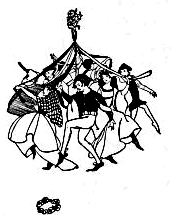
Once upon a time every village had its annual setting up of the May-pole, which was consecrated to the Goddess of Flowers, and early on May morning the young people went out to "gather the May." The first thing was to select the May-pole. The landed gentry allowed the villagers the choice of a suitable tree on their domains. A tall, straight sapling having been selected, it was speedily cut down and dragged to the village green by oxen gayly decorated with flowers and bright colored ribbons. Following after came the youths and maidens with wreaths of flowers, which they twined around cottage doorways on their way to the green, where they were to choose from among their number a Lord and Lady of May.
After a bower was built for them and the May-pole set up, there were merry dances, the revellers donning mask and costume to represent Robin Hood, Friar Tuck, Maid Marian, Much the Miller's Son, Little John, Will Scarlet and all the other famous characters of merry Sherwood. Pantomime was also indulged in, for this was a simple age, when simple pleasures satisfied the country people. Into the ring would come a hobby-horse and a dragon, the former ambling and prancing about, while the latter hissed and shook his wings, to the great delight of the spectators. There were also morris-dancers, with bells attached to their knees and elbows, who danced and capered musically. After this came trials of skill in archery by Robin Hood and his fellows, and when all these amusements grew tiresome, the villagers thronged about the May-pole and spent the remainder of the day in dancing.
But these May-day observances were not confined only to the country. In London at one time tall poles were erected on May morning, and green arbors and branches decorated the streets. It was a great day for the milkmaids and chimney-sweeps, who paraded the streets in companies, begging a trifle from their customers.
The leader of the chimney-sweeps, called "Jack in the Green," was covered, with the exception of his legs, with green boughs, garlands and nosegays. He looked like a dancing bouquet, as he moved up and down the street. Many a penny the sweeps collected from the admiring bystanders. This was a custom up to about one hundred years ago, and will perhaps remind some of my little readers of the ragamuffins who parade the streets of New York on Thanksgiving Day, begging a penny from every passer-by.
Finally, many abuses arose in the observance of the day. In 1644 Parliament passed an act forbidding the erection of May-poles. Later, during the restoration of the gay Charles the Second, the May-poles came back and flourished for a long time. Gradually, however, as the ancient simplicity of manners departed from the lower orders of the people, who were its chief upholders, the May-day festival fell into disuse, and now there are neither May-poles nor morris-dancers nor Jacks in the Green.