Volume 1 — Tuesday May 29.
Reading edition
John Dickenson and Elbridge Gerry, the former from Delaware, the latter from Massts took their seats. The following rules were added, on the report of Mr Wythe from the Committee—
That no member be absent from the House, so as to interrupt the representation of the State, without leave.
That Committees do not sit whilst the House shall be or ought to be, sitting.
That no copy be taken of any entry on the journal during the sitting of the House without leave of the House.
That members only be permitted to inspect the journal.
That nothing spoken in the House be printed, or otherwise published or communicated without leave.
That a motion to reconsider a matter which has been determined by a majority, may be made, with leave unanimously given, on the same day on which the vote passed; but otherwise not without one day's previous notice: in which last case, if the House agree to the reconsideration, some future day shall be assigned for that purpose.
Mr C. Pinkney[28] moved that a Committee be appointed to superintend the Minutes.
Mr Govr Morris objected to it. The entry of the proceedings of the Convention belonged to the Secretary as their impartial officer. A committee might have an interest & bias in moulding the entry according to their opinions and wishes.
The motion was negatived, 5 noes, 4 ays.
He expressed his regret, that it should fall to him, rather than those, who were of longer standing in life and political experience, to open the great subject of their mission. But, as the convention had originated from Virginia, and his colleagues supposed that some proposition was expected from them, they had imposed this task on him.
He then commented on the difficulty of the crisis, and the necessity of preventing the fulfilment of the prophecies of the American downfal.
He observed that in revising the fœderal system we ought to inquire 1. into the properties, which such a government ought to possess, 2. the defects of the confederation, 3. the danger of our situation & 4. the remedy.
1. The Character of such a government ought to secure 1. against foreign invasion: 2. against dissensions between members of the Union, or seditions in particular States: 3. to procure to the several States various blessings, of which an isolated situation was incapable: 4. to be able to defend itself against encroachment: & 5. to be paramount to the state constitutions.
2. In speaking of the defects of the confederation he professed a high respect for its authors, and considered them as having done all that patriots could do, in the then infancy of the science, of constitutions, & of confederacies,—when the inefficiency of requisitions was unknown—no commercial discord had arisen among any States—no rebellion had appeared as in Massts—foreign debts had not become urgent—the havoc of paper money had not been foreseen—treaties had not been violated—and perhaps nothing better could be obtained from the jealousy of the states with regard to their sovereignty.
He then proceeded to enumerate the defects. 1. that the confederation produced no security against foreign invasion; congress not being permitted to prevent a war nor to support it by their own authority—Of this he cited many examples; most of which tended to shew, that they could not cause infractions of treaties or of the law of nations to be punished: that particular states might by their conduct provoke war without controul; and that neither militia nor draughts being fit for defence on such occasions, enlistments only could be successful, and these could not be executed without money.
2, that the fœderal government could not check the quarrels between states, nor a rebellion in any, not having constitutional power nor means to interpose according to the exigency.
3, that there were many advantages, which the U. S. might acquire, which were not attainable under the confederation—such as a productive impost—counteraction of the commercial regulations of other nations—pushing of commerce ad libitum,—&c &c.
4, that the fœderal government could not defend itself against encroachments from the states.
5, that it was not even paramount to the state constitutions, ratified as it was in many of the states.
3. He next reviewed the danger of our situation, appealed to the sense of the best friends of the U. S. the prospect of anarchy from the laxity of government every where; and to other considerations.
4. He then proceeded to the remedy; the basis of which he said must be the republican principle.
He proposed as conformable to his ideas the following resolutions, which he explained one by one.
1. Resolved that the articles of Confederation ought to be so corrected & enlarged as to accomplish the objects proposed by their institution; namely, "common defence, security of liberty, and general welfare."
2. Resd therefore that the rights of suffrage in the National Legislature ought to be proportioned to the Quotas of contribution, or to the number of free inhabitants, as the one or the other rule may seem best in different cases.
3. Resd that the National Legislature ought to consist of two branches.
4. Resd that the members of the first branch of the National Legislature ought to be elected by the people of the several States every —— for the term of ——; to be of the age of —— years at least, to receive liberal stipends by which they may be compensated for the devotion of their time to the public service; to be ineligible to any office established by a particular State, or under the authority of the United States, except those peculiarly belong to the functions of the first branch, during the term of service, and for the space of —— after its expiration; to be incapable of re-election for the space of —— after the expiration of their term of service, and to be subject to recall.
5. Resold that the members of the second branch of the National Legislature ought to be elected by those of the first, out of a proper number of persons nominated by the individual Legislatures, to be of the age of —— years at least; to hold their offices for a term sufficient to ensure their independency; to receive liberal stipends, by which they may be compensated for the devotion of their time to the public service; and to be ineligible to any office established by a particular State, or under the authority of the United States, except those peculiarly belonging to the functions of the second branch, during the term of service; and for the space of —— after the expiration thereof.
6. Resolved that each branch ought to possess the right of originating Acts; that the National Legislature ought to be empowered to enjoy the Legislative Rights vested in Congress by the Confederation & moreover to legislate in all cases to which the separate States are incompetent, or in which the harmony of the United States may be interrupted by the exercise of individual Legislation; to negative all laws passed by the several States contravening in the opinion of the National Legislature the articles of Union; and to call forth the force of the Union agst any member of the Union failing to fulfil its duty under the articles thereof.
7. Resd that a National Executive be instituted; to be chosen by the National Legislature for the term of —— years, to receive punctually at stated times, a fixed compensation for the services rendered, in which no increase or diminution shall be made so as to affect the Magistracy, existing at the time of increase or diminution, and to be ineligible a second time; and that besides a general authority to execute the national laws, it ought to enjoy the Executive rights vested in Congress by the Confederation.
8. Resd that the Executive and a convenient number of the National Judiciary, ought to compose a Council of revision with authority to examine every act of the National Legislature before it shall operate, & every act of a particular Legislature before a Negative thereon shall be final; and that the dissent of the said Council shall amount to a rejection, unless the Act of the National Legislature be again passed, or that of a particular Legislature be again negatived by —— of the members of each branch.
9. Resd that a National Judiciary be established to consist of one or more supreme tribunals, and of inferior tribunals to be chosen by the National Legislature, to hold their offices during good behaviour; and to receive punctually at stated times fixed compensation for their services, in which no increase or diminution shall be made so as to affect the persons actually in office at the time of such increase or diminution. That the jurisdiction of the inferior tribunals shall be to hear & determine in the first instance, and of the supreme tribunal to hear and determine in the dernier resort, all Piracies & felonies on the high seas, captures from an enemy: cases in which foreigners or Citizens of other States applying to such jurisdictions may be interested, or which respect the collection of the National revenues; impeachments of any national officers, and questions which may involve the national peace and harmony.
10. Resolvd that provision ought to be made for the admission of States lawfully arising within the limits of the United States, whether from a voluntary junction of Government & Territory or otherwise, with the consent of a number of voices in the National Legislature less than the whole.
11. Resd that a Republican Government & the territory of each State, except in the instance of a voluntary junction of Government & territory, ought to be guarantied by the United States to each State.
12. Resd that provision ought to be made for the continuance of Congress and their authorities and privileges, until a given day after the reform of the articles of Union shall be adopted, and for the completion of all their engagements.
13. Resd that provision ought to be made for the amendment of the Articles of Union whensoever it shall seem necessary, and that the assent of the National Legislature ought not to be required thereto.
14. Resd that the Legislative Executive & Judiciary powers within the several States ought to be bound by oath to support the articles of Union.
15. Resd that the amendments which shall be offered to the Confederation, by the Convention ought at a proper time, or times, after the approbation of Congress to be submitted to an assembly or assemblies of Representatives, recommended by the several Legislatures to be expressly chosen by the people to consider & decide thereon.
He concluded with an exhortation, not to suffer the present opportunity of establishing general peace, harmony, happiness and liberty in the U. S. to pass away unimproved.[31]
It was then Resolved—That the House will tomorrow resolve itself into a Committee of the Whole House to consider of the state of the American Union—and that the propositions moved by Mr Randolph be referred to the said Committee.
Mr Charles Pinkney laid before the House the draft of a federal Government which he had prepared, to be agreed upon between the free and independent States of America.[32]—Mr P. plan ordered that the same be referred to the Committee of the Whole appointed to consider the state of the American Union.[33]
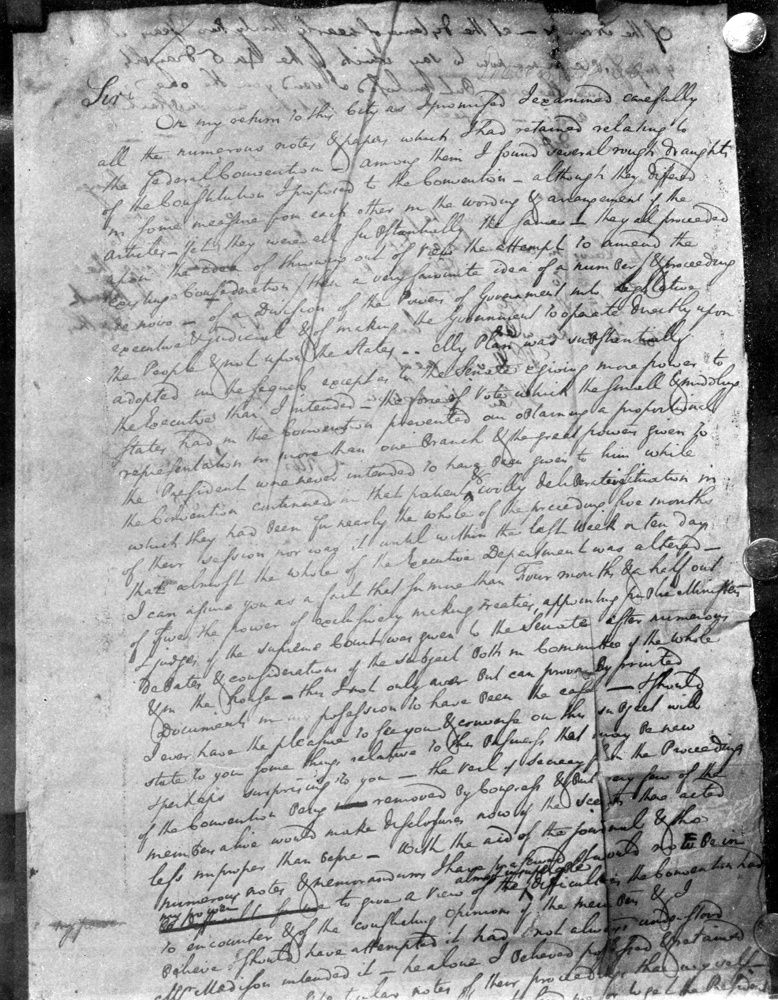
CHARLES PINCKNEY'S LETTER.
(Reduced.)
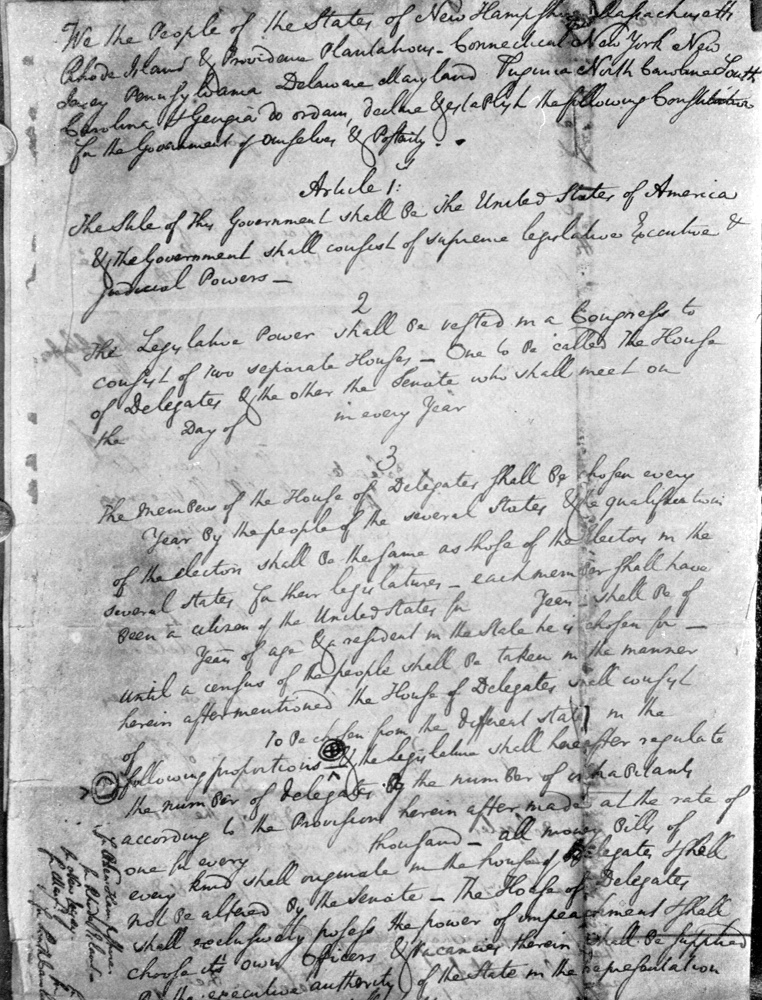
THE PINCKNEY DRAFT.
(Reduced.)
We the People of the States of New Hampshire Massachusetts Rhode Island & Providence Plantations Connecticut New York New Jersey Pennsylvania Delaware Maryland Virginia North Carolina South Carolina & Georgia do ordain, declare & establish the following Constitution for the government of ourselves & Posterity.
Article 1:
The Style of this Government shall be The United States of America & the Government shall consist of supreme legislative Executive & judicial Powers.
2
The Legislative Power shall be vested in a Congress to consist of two separate Houses—one to be called the House of Delegates & the other the Senate who shall meet on the —— —— Day of —— in every year.
3
The members of the House of Delegates shall be chosen every —— year by the people of the several States & the qualification of the electors shall be the same as those of the electors in the several States for their legislatures—each member shall have been a citizen of the United States for —— years; and shall be of —— years of age & a resident in the State he is chosen for.——Until a census of the people shall be taken in the manner herein after mentioned the House of Delegates shall consist of —— to be chosen from the different States in the following proportions: for New Hampshire, ——; for Massachusetts, —— for Rhode Island, —— for Connecticut, —— for New York, —— for New Jersey, —— for Pennsylvania, —— for Delaware, —— for Maryld, —— for Virginia, —— for North Carolina, —— for South Carolina, —— for Georgia, —— & the Legislature shall hereafter regulate the number of delegates by the number of inhabitants according to the Provisions herein after made, at the rate of one for every —— thousand.—All money bills of every kind shall originate in the house of Delegates & shall not be altered by the Senate. The House of Delegates shall exclusively possess the power of impeachment & shall choose it's own officers & vacancies therein shall be supplied by the executive authority of the State in the representation from which they shall happen.
4
The Senate shall be elected & chosen by the House of Delegates which House immediately after their meeting shall choose by ballot —— Senators from among the Citizens & residents of New Hampshire —— from among those of Massachusetts —— from among those of Rhode Island —— from among those of Connecticut —— from among those of New York —— from among those of New Jersey —— from among those of Pennsylvania —— from among those of Delaware —— from among those of Maryland —— from among those of Virginia —— from among those of North Carolina —— from among those of South Carolina & —— from among those of Georgia ——
The Senators chosen from New Hampshire Massachusetts Rhode Island & Connecticut shall form one class—those from New York New Jersey Pennsylvania & Delaware one class—& those from Maryland Virginia North Carolina South Carolina & Georgia one class.
The House of Delegates shall number these Classes one two & three & fix the times of their service by Lot—the first class shall serve for —— years—the second for —— years & the third for —— years—as their times of service expire the House of Delegates shall fill them up by elections for —— years & they shall fill all vacancies that arise from death or resignation for the time of service remaining of the members so dying or resigning.
Each Senator shall be —— years of age at least—shall have been a Citizen of the United States 4 years before his election & shall be a resident of the State he is chosen from. The Senate shall choose its own Officers.
5
Each State shall prescribe the time & manner of holding elections by the People for the house of Delegates & the House of Delegates shall be the judges of the elections returns & Qualifications of their members.
In each house a Majority shall constitute a Quorum to do business—Freedom of Speech & Debate in the legislature shall not be impeached or Questioned in any place out of it & the Members of both Houses shall in all cases except for Treason Felony or Breach of the Peace be free from arrest during their attendance at Congress & in going to & returning from it—Both Houses shall keep journals of their Proceedings & publish them except on secret occasions & the yeas & nays may be entered thereon at the desire of one —— of the members present. Neither house without the consent of the other shall adjourn for more than —— days nor to any Place but where they are sitting.
The members of each house shall not be eligible to or capable of holding any office under the Union during the time for which they have been respectively elected nor the members of the Senate for one year after.
The members of each house shall be paid for their services by the States which they represent.
Every bill which shall have passed the Legislature shall be presented to the President of the United States for his revision—if he approves it he shall sign it—but if he does not approve it he shall return it with his objections to the house it originated in which house if two thirds of the members present, notwithstanding the President's objections agree to pass it, shall send it to the other house with the President's objections, where if two thirds of the members present also agree to pass it, the same shall become a law—& all bills sent to the President & not returned by him within —— days shall be laws unless the Legislature by their adjournment prevent their return in which case they shall not be laws.
6th
The Legislature of the United States shall have the power to lay & collect Taxes Duties Imposts & excises
To regulate Commerce with all nations & among the several States.
To borrow money & emit bills of Credit
To establish Post offices.
To raise armies
To build & equip Fleets
To pass laws for arming organizing & disciplining the Militia of the United States
To subdue a rebellion in any State on application of its legislature
To coin money & regulate the Value of all coins & fix the Standard of Weights & measures
To provide such Dock Yards & arsenals & erect such fortifications as may be necessary for the United States & to exercise exclusive Jurisdiction therein
To appoint a Treasurer by ballot
To constitute Tribunals inferior to the Supreme Court
To establish Post & military Roads
To establish & provide for a national University at the Seat of the Government of the United States
To establish uniform rules of Naturalization
To provide for the establishment of a Seat of Government for the United States not exceeding —— miles square in which they shall have exclusive jurisdiction
To make rules concerning Captures from an Enemy
To declare the law & Punishment of piracies & felonies at sea & of counterfeiting Coin & of all offences against the Laws of Nations
To call forth the aid of the Militia to execute the laws of the Union enforce treaties suppress insurrections and repel invasions
And to make all laws for carrying the foregoing powers into execution.
The Legislature of the United States shall have the Power to declare the Punishment of Treason which shall consist only in levying War against the United States or any of them or in adhering to their Enemies. No person shall be convicted of Treason but by the testimony of two witnesses.
The proportion of direct taxation shall be regulated by the whole number of inhabitants of every description which number shall within —— years after the first meeting of the Legislature & within the term of every —— year after be taken in the manner to be prescribed by the Legislature
No Tax shall be laid on articles exported from the States—nor capitation tax but in proportion to the Census before directed
All Laws regulating Commerce shall require the assent of two thirds of the members present in each house—The United States shall not grant any title of Nobility—The Legislature of the United States shall pass no Law on the subject of Religion, nor touching or abridging the Liberty of the Press nor shall the privilege of the writ of Habeas Corpus ever be suspended except in case of Rebellion or Invasion.
All acts made by the Legislature of the United States pursuant to this Constitution & all Treaties made under the authority of the United States shall be the supreme Law of the land & all Judges shall be bound to consider them as such in their decisions.
7
The Senate shall have the sole & exclusive power to declare War & to make treaties & to appoint Ambassadors & other Ministers to foreign nations & Judges of the Supreme Court.
They shall have the exclusive power to regulate the manner of deciding all disputes & controversies now subsisting or which may arise between the States respecting Jurisdiction or Territory.
8
The Executive Power of the United States shall be vested in a President of the United States of America which shall be his style & his title shall be His Excellency. He shall be elected for —— years & shall be reeligible.
He shall from time to time give information to the Legislature of the state of the Union & recommend to their consideration the measures he may think necessary—he shall take care that the laws of the United States be duly executed: he shall commission all the officers of the United States & except as to Ambassadors other ministers and Judges of the Supreme Court he shall nominate & with the consent of the Senate appoint all other officers of the United States. He shall receive public Ministers from foreign nations & may correspond with the Executives of the different States. He shall have power to grant pardons & reprieves except in impeachments—He shall be Commander in chief of the army & navy of the United States & of the Militia of the several States & shall receive a compensation which shall not be increased or diminished during his continuance in office. At entering on the Duties of his office he shall take an oath faithfully to execute the duties of a President of the United States.—He shall be removed from his office on impeachment by the house of Delegates & Conviction in the Supreme Court of Treason bribery or Corruption—In case of his removal death resignation or disability the President of the Senate shall exercise the duties of his office until another President be chosen—& in case of the death of the President of the Senate the Speaker of the House of Delegates shall do so.
9
The Legislature of the United States shall have the Power and it shall be their duty to establish such Courts of Law Equity & Admiralty as shall be necessary—The Judges of the Courts shall hold their offices during good behaviour & receive a compensation, which shall not be increased or diminished during their continuance in office—One of these Courts shall be termed the Supreme Court whose jurisdiction shall extend to all cases arising under the laws of the United States or affecting ambassadors other public Ministers & Consuls—to the trial of impeachment of officers of the United States—to all cases of Admiralty & maritime jurisdiction—In cases of impeachment affecting ambassadors and other public Ministers this Jurisdiction shall be original & in all other cases appellate——
All criminal offences (except in cases of impeachment) shall be tried in the State where they shall be committed—the trials shall be open & public & shall be by Jury.
10
Immediately after the first census of the people of the United States the House of Delegates shall apportion the Senate by electing for each State out of the citizens resident therein one Senator for every —— members each State shall have in the House of Delegates—Each State shall be entitled to have at least one member in the Senate.
11
No State shall grant letters of marque & reprisal or enter into treaty or alliance or confederation nor grant any title of nobility nor without the Consent of the Legislature of the United States lay any impost on imports—nor keep troops or Ships of War in time of peace—nor enter into compacts with other States or foreign powers or emit bills of Credit or make any thing but Gold Silver or Copper a tender in payment of debts nor engage in War except for self defence when actually invaded or the danger of invasion be so great as not to admit of a delay until the Government of the United States can be informed thereof—& to render these prohibitions effectual the Legislature of the United States shall have the power to revise the laws of the several States that may be supposed to infringe the Powers exclusively delegated by this Constitution to Congress & to negative & annul such as do.
12
The Citizens of each State shall be entitled to all privileges & immunities of Citizens in the several States—Any person charged with Crimes in any State fleeing from justice to another shall on demand of the Executive of the State from which he fled be delivered up & removed to the State having jurisdiction of the offence.
13
Full faith shall be given in each State to the acts of the Legislature & to the records & judicial Proceedings of the Courts & magistrates of every State.
14
The Legislature shall have power to admit new States into the Union on the same terms with the original States provided two thirds of the members present in both Houses agree.
15
On the application of the legislature of a State the United States shall protect it against domestic insurrection.
16
If two thirds of the Legislatures of the States apply for the same the Legislature of the United States shall call a Convention for the purpose of amending the Constitution—or should Congress, with the Consent of two thirds of each house, propose to the States amendments to the same—the agreement of two thirds of the Legislatures of the States shall be sufficient to make the said amendments parts of the Constitution.
The Ratification of the conventions of —— States shall be sufficient for organizing this Constitution.[34]
Adjourned.