IN MEMORIAM.
Reading edition
John H. Dillingham.
John H. Dillingham, whose death occurred in Third Month, 1910, joined the Prison Society in the Fifth Month of the year 1882. He was elected a member of the Acting Committee a few months after joining the Society, which position he held until he was called to another and higher field of usefulness in the world beyond.
Our brother was always much interested in the humanitarian labors of the Society, and was a valuable visitor at the Eastern Penitentiary until, owing to his many other duties, he was obliged to discontinue that service.
As an evidence of his interest in and desire to help the objects of our care, it may be stated that a short time before his death he said it was his intention to resume his visits to them, but the Lord, “whose he was and whom he served,” willed otherwise, and the service will have to be performed by others. His genial disposition, loving nature and conspicuous goodness endeared him to all who knew him.
David Sulzberger.
David Sulzberger, a member of the Pennsylvania Prison Society, and a member of the Acting Committee since 1903, was born in the Duchy of Baden, in 1838, and died in March, 1910, at the home of his sister in this city.
Reared by pious parents of the Jewish faith, and following the teachings of Jehovah, as manifested to one who sought earnestly to know the Divine Will, he devoted much of his life and means to practical philanthropy. It has been said by a member of his own denomination that his crowning achievement was his splendid service to the cause of humanity in visiting the Jewish and other prisoners confined in the penal institutions located in this city. He brought to them the consolation of religion whenever they were amenable to its influence, the moral strength that emanated from a firm yet a kindly nature, the instruction that would give them a new start in the battle of life. Scarcely a week passed for many years without his visits to these prisoners, and at no time was he too busy to give his thought and attention to anything that would help the prisoners with whom he came in contact. Sometimes his kindness was abused, but that did not deter him from the work. He was possessed of the saving grace of a keen sense of humor that enabled him to take disappointments of that kind philosophically, as a part of the day’s work, and furthermore he was not hunting excuses to justify him in stopping. He was simply seeking to lend a helping hand in a field from which all but the stoutest of hearts are apt to be repelled.
He was a Hebrew of the patriarchal type, and to him Judaism was not merely a creed but a system of life, and with scrupulous fidelity he observed the lofty precepts of that religion which render it a sacred obligation on the part of its devotees to help struggling humanity by their presence, by their sympathy, by their means, in all the incidents of human life from the cradle to the grave.
In an eminent degree he possessed the courage of his convictions, and never for one moment shrunk from what might be supposed to be a disagreeable duty, or from lifting up his voice in high places in a protest against what he considered wrongs which should be remedied.
His counsels will be greatly missed, and his loss seems irreparable, but we have the assurance that he had fought a good fight, that his lifework was accomplished, and we are thankful that we have known him as a friend, and that we have had the example of his strong devotion to duty.
Mary S. Whelen.
The passing away, on February 15, of Miss Mary S. Whelen came as a distinct shock to her many friends and to the class of Philadelphians interested in the welfare of the Commonwealth and of the Municipality in one of its most vital issues.
Although the part Miss Whelen played so effectively, owing to her modesty, is known to but few, it deserves some mention in order that others, inspired by the same motives, may carry on the work to which she fearlessly and generously devoted many years. She was intensely interested in the welfare of prisoners convicted of crime, and as an active member of the Board of the Pennsylvania Prison Society, visited our prisons weekly, going into the cells, teaching many ignorant women to read and write. Her ear was ever open to explanations, and her kindly intuition made it possible for her to discern the motive which actuated a crime, and her advice and consolation often brought repentance and the possibility of better things. When the sentence expired, a woman having no home or place to which to go, was taken from prison, personally, by Miss Whelen to a destination where she might begin a new life; and letters from these once degraded creatures show in many instances reformation and warm expressions of gratitude. She was a member of the Committee on Police Matrons, and to this most beneficent service she gave practical and efficient aid. All her generous, charitable deeds have been accomplished so quietly and unostentatiously that it recalls the beautiful admonition, “Let not thy right had know what thy left hand doeth.”
Robert Parker Nicholson.
Robert P. Nicholson, whose death occurred in July, 1911, as the result of an accident, had been a member of the Society for a few years, but had served on the Acting Committee for only a few months. His deep interest in the work gave promise of much service on behalf of our cause. His genial disposition had endeared him to a host of friends by whom he is sadly missed.
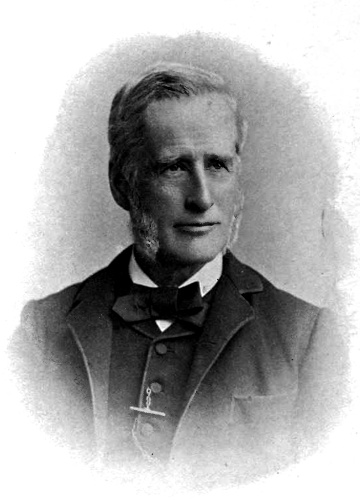
John J. Lytle, 1823-1911.
John J. Lytle.
“Thou shalt come to thy grave in a full age, like as a shock of corn cometh in in his season.”
Such was the passing of our beloved friend, John J. Lytle, whose death occurred on the 14th of Eighth Month, 1911, at his residence in Moorestown, N. J.
He was born at Alexandria, Va., in 1823, and had almost completed his eighty-eighth year. In his infancy his widowed mother brought her family to Philadelphia, and for the remainder of his life his residence was in or near that city. After he attained his majority he was a merchant for twenty-five years at the corner of Seventh and Spring Garden Streets.
Early in his business career he became deeply interested in personal visitations to the inmates of the Eastern Penitentiary. With the exception of Joshua L. Baily, President of the Society, his membership in the Pennsylvania Prison Society covered a period longer than that of any living member, both having been elected members in 1851. For nearly sixty years he was a member of the Acting Committee, and his official positions date from the beginning of his membership on the Acting Committee to the time of his death. Early in 1852 he was appointed Secretary of the Acting Committee, and in 1860 he was elected Secretary of the Society. This office he held till 1909, when, on account of the infirmities of age, he was released from the active duties of this position and appointed Honorary Secretary. From 1886 to 1908 he gave up almost his entire time and energies to work on behalf of prisoners. The Eastern Penitentiary was the scene of his greatest efforts. Almost daily did he visit this large institution, becoming personally acquainted with the thirteen hundred or more inmates and ministering untiringly to their physical and spiritual needs. He speaks of his great privilege and “pleasure to stand by the prisoner’s side, to grasp his hand, to put new life into his heart, to endeavor to restore confidence in himself.” While he believed in all changes in penal methods which are directed to the reformation of the prisoners, and in industrial and scholastic training, he was firmly convinced that the only sure basis of reformation was the life-giving, renewing power of the gospel of Christ. To this end he labored in season and out of season. He never forgot the spiritual interests of those whom he befriended. In his report for 1906 he says: “We must talk to the man in the cell as a man, a friend and brother.... That lives redeemed await the work of those who enter the prison cell with the message of Christ is well proven. Many a one has said to me—I believe in sincerity, ‘The best thing that ever happened to me in my life was my sentence to the penitentiary. Here I have found my Saviour, whom I knew not before.’” This theme is dwelt on in all the eighteen reports which he made after assuming the duties of General Secretary in 1886. To illustrate his faithfulness in the performance of duty, in a report made in his eighty-first year, he states that he had made during the year, four hundred and fifty visits to the Penitentiary (oftener than daily), and had conversed with the inmates, either in the cells or at the cell doors, about forty-five hundred times. “It is now fourteen years since my whole time has been given up to this work, and my interest in it grows from year to year.... I find there is an open door for me to talk to them of their spiritual needs....”
He was a delegate, in 1886, to the American Prison Association, and for twenty years thereafter he was usually in attendance at the sessions of that body, taking an active part in the proceedings and serving on its leading committees.
When the State Legislature, in 1895, discontinued the appropriation of $3,000 per annum for the equipment and support of prisoners discharged from the Eastern Penitentiary, John J. Lytle solicited private contributions to continue this aid, and so successful were his efforts that no prisoner in need in all these years has been dismissed from that institution without practical help and sympathetic attention. The task of making these collections and of attending to every minute detail of their distribution involved unremitting labor, which he ceased not until bodily infirmity in his eighty-fifth year compelled him to take a much-needed rest. From the autumn of 1908 till the time of his death he was mostly confined to his home and vicinity, but was able to maintain quite a large correspondence and to enjoy the visits of his friends. His genial, kindly disposition had endeared him to a large circle of acquaintances, who deeply appreciated the privilege of his intimacy. His interest in the cause of the prisoners never flagged. The summons came while sitting at his writing table by the side of his dear wife, who had been his faithful companion for more than sixty-two years. A stroke of paralysis, then a few days of unconsciousness and all was over.
He was a birth-right member of the Society of Friends. In 1849 he was married to Anna Reeve, and he is survived by the widow, one son and four daughters.