ARE THERE TRACES OF GLACIAL MAN IN THE TRENTON GRAVELS?
Reading edition
In a paper published in Science, Nov. 25. 1892, I undertook to study the evidence relating to paleolithic man in the eastern United States from a new point of view,—that furnished by certain recently acquired knowledge of the contents of quarries and shops where modern aboriginal flaked implements were made. It was shown that all rudely flaked forms could be sufficiently accounted for without the necessity of assuming a very rude state of culture, and that any people, paleolithic or neolithic, would in roughing out blades—the principal product of the flaking process—produce precisely these forms and in great numbers as refuse. It further appeared that the finding of these objects in sporadic cases in glacial gravels or in any formation whatsoever, could not be considered as proving or tending to establish the existence of a particular grade of stone-age culture for the region in which the formation occurs, since they may as readily pertain to a neolithic as to a paleolithic status. It was conclusively shown that no worked stone that can with reasonable safety be called an implement has been reported from the gravels, and that it is therefore clearly useless, not to say unscientific, to go on enlarging upon the evidence of an American paleolithic period and multiplying theoretic details of its culture.
I now propose to review briefly the question of the age of our so-called paleolithic implements, the questions of the grade of a given feature of culture and of the age or chronologic place of that culture being very properly treated separately, as they depend for their support upon distinct classes of evidence. During the past summer, 1892, certain important items of new evidence have been discovered bearing upon the question of the occurrence or non-occurrence of rudely flaked stones or of any artificial objects whatsoever in the normal gravels of the Delaware Valley, and it therefore becomes necessary to examine somewhat critically such of the published evidence as seems to be seriously affected by these recent observations.
It may be stated in beginning that no one disputes the glacial age of the Trenton gravels. The question to be discussed is simply this,—is the evidence satisfactory that works of art have been found in these gravels? Nothing else need be asked or answered. I do not take up this subject because I love controversy; disputation is really most distasteful to me. It happens that under the Bureau of Ethnology of the Smithsonian Institution I have been assigned to the work of making a survey of the archeology of the Atlantic coast region in which large areas, especially in states south of Mason and Dixon's line, remained almost untouched by investigators, and two years have been consumed mainly in these southern areas. But there are questions that refuse to be confined to definite geographic limits, and evidence secured in one section is sometimes found to bear so directly and forcibly upon problems pertaining primarily to other sections that the student of these problems must perforce become a free lance, and unhesitatingly enter any province promising results of value, howsoever fully occupied it may be by other investigators. One of the most interesting and important questions growing out of the study of American archeology has, as we have seen, arisen in the Delaware Valley, and the turn taken by some of my work in the south and west is such that I cannot pass this question by without consideration. The necessity of taking up the subject of glacial man became more and more apparent as the years passed on, and people continued to say to me, "You must go to Trenton; we are not satisfied with the present status of the question there; the evidence arrayed in favor of the theory of a paleolithic gravel man needs critical examination."
The difficulty of taking up and re-examining evidence, of which the record only remains, is, however, very great, since in most cases the evidence rests upon or consists of field observations, and these cannot be recalled or repeated, and there is absolutely no means of testing directly the value of what is recorded. One may seek either to verify or to discredit the promulgated theories, but years of search may fail to produce a single new item of evidence bearing decisively upon the subject. It is possible that at one period numerous finds of implements should be reported from certain portions of the gravels, and that afterwards the whole remaining body of these formations should be worked over and searched without securing a trace of art; yet this latter evidence, being negative, need not necessarily be considered sufficient to overturn the original positive evidence if that happens to be of a high class. There is not the least doubt, however, that positive evidence may be so impaired by various defects and inconsistencies, that, unsupported by renewed and well verified observations, it will finally yield to the negative forces; and if the theories of a gravel man in the eastern United States, howsoever fortified by accumulated observations, are not really properly supported in every way, they are bound in time to fall to the ground. All I can reasonably hope to do now is to have the evidence relating to glacial man placed on trial, and so fully examined and cross-examined that those who accept gravel man need not longer do so blindly without knowing that there are two sides to the question, and those who do not accept him may know something of the reasons for the belief that is in them.
The evidence employed to prove the presence of a race of men in the Delaware Valley in glacial times is confined almost wholly to the alleged discovery of rude implements in the glacial gravels. Practically all the evidence has been collected by Dr. C. C. Abbott, and upon his skill as an observer, his faithfulness as a recorder, his correctness of judgment and his integrity of character, the whole matter stands. Many visitors, men of high repute in archeology and geology, have visited the site, but the observations made on such occasions appear not to have been of a nature to be of great value in evidence, the finds being doubtful works of art or not having properly established relationships with the gravels in place. In the discussion of gravel man in eastern America a wide range of objects and phenomena has been considered, but the real evidence, upon which the theory of an ancient race and a peculiar culture must depend, is furnished by a hundred pieces—more or less—of rudely flaked stones said to have come from the gravels in place. And now what can be said with reference to this series of flaked stones further than that they are reported by the collector to have been found in the gravels at definite stated depths? I have elsewhere shown that they are not demonstrably implements in any case, that they are identical in every respect with the quarry-shop rejects of the American Indian, that they do not closely resemble any one of the well established types of European paleolithic implements, and that they are not a sufficient index of a particular stage of culture. I shall now present such reasons as there may be for the belief, held by many, that they were not really found in the undisturbed glacial gravels.
It is generally understood that the earliest reported gravel finds of importance were made on the banks of Assanpink creek within the city limits of Trenton, where the gravels to a thickness of twenty feet or more were exposed in a railway cutting. Later the river bluff near the lower end of the city, where the gravels were exposed to a depth of from twenty-five to forty feet, yielded large numbers. These two sites, so far as I can learn, furnished at least three-fourths of the finds in place. Other specimens were found singly in slight natural exposures, and in excavations for cellars, sewers, etc., at various points within the city limits.
The river bluff was for a considerable period the favorite hunting ground of the searchers for rudely flaked stones, and many specimens were collected. The gravels were exposed in a steep, nearly straight bank, several hundred yards in length, the base of which was washed by the river. There can be no question that Dr. Abbott and others have found shaped objects of various classes upon and in the face of this river bluff, and the visitor to-day, although the bluff is now buried almost completely under city refuse, will hardly fail to find some rudely flaked form in the deeper gullies or upon the narrow river bank or beach at the base. Dr. Abbott explicitly states[1] that he obtained certain of these specimens from the gravel outcrops, and that they were not in talus formations, but in undisturbed deposits. How then is it possible to do otherwise than accept these statements as satisfactory and final?
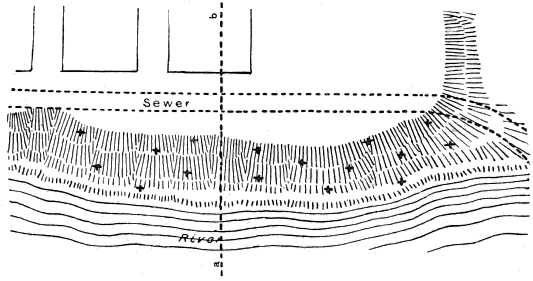
Fig. 1. Sketch map of the Trenton bluff, showing the relation of the sewer trench to the "implement" yielding slope.... a-b section line, Fig. 2.
Very recently, however, fortunate circumstances have brought the evidence furnished by this site again within our reach, thus enabling us to re-open the discussion under favorable conditions. What I had for some time desired to do in this case was, what I had already done at Piny Branch, D. C., and at Little Falls, Minn., to open a trench into the face of the bluff, and thus secure evidence for or against the theory of a gravel man. This measure was, however, rendered impracticable by the occupation of the bluff margin by a city street; but it happened last summer that the city authorities, desiring to improve the sanitary condition of the city, decided to open a great sewer through this very bluff to get a lower outlet to the river. A trench twelve feet wide and some thirty feet deep, the full depth of the exposed gravels, was carried along the bluff just inside of its margin, opening out into the river at the point where the bluff turns toward the north-east. It was a trenching more complete and more satisfactory than any of which I had ever dreamed. At no point for the entire length of the bluff did the excavation depart more than forty feet from the line of the terrace face—from the upper margin of the slope upon which such plentiful evidence of a supposed gravel man had been obtained. The accompanying map and section, Figs. 1 and 2, will indicate the location of the trench, and show the exact relations of the natural and artificial exposures of the gravels.
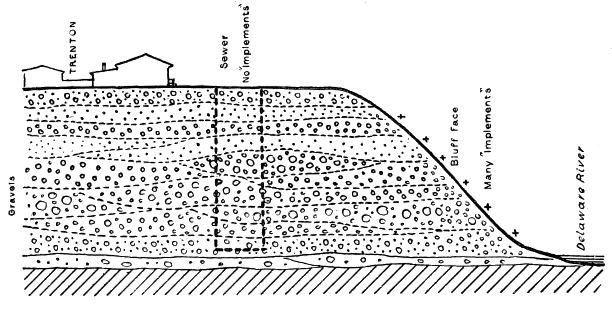
Fig. 2. Sections made by the river and by the sewer, the former yielding many "implements," the latter yielding none.
I made several visits to the place, descended frequently into the great cut and examined the gravels and their contents with the utmost care, but without securing a trace of art. Recognizing the vital importance of utilizing to the fullest extent this opportunity of testing the art-bearing nature of the gravels at this point, I resolved to undertake a systematic study of the subject. Summoning my assistant, Mr. William Dinwiddie, from his field of operations in the South, I had him spend upwards of a month at the great trench, faithfully watching the gravels as they were exposed. Mr. Dinwiddie had worked three years under my personal direction, and had helped open upwards of twenty trenches through similar gravel deposits, and was therefore well qualified for the work. Prof. W. J. McGee, Prof. R. D. Salisbury, Dr. Stewart Culin and Dr. Abbott also visited the place one or more times each. Relics of art were found upon the surface and in such portions of the talus as happened to be exposed, but nothing whatever was found in the gravels in place, and the search was closed when it became fully apparent that the case was hopeless.
It may be claimed that the conditions under which gravels are exposed in trenching as it progresses, are not as favorable for the collection of enclosed relics as where exposed by natural processes of weathering. This is true in a certain measure, as specimens may be obscured by the damp clinging sand which forms the matrix of the gravels. This, however, would interfere but little with the discovery of large flaked stones, such as we were led to expect in this place, and this slight disadvantage in detecting shaped pieces in fresh exposures is more than over-balanced by the treachery of weathered surfaces which often give to intrusive objects the appearance of original inclusion. The opportunity for studying the gravels in all their phases of bedding, composition and contents, was really excellent, and no one could watch the constantly renewed exposures hour after hour for a month without forming a most decided notion as to the implement bearing qualities of the formation. Not the trace of a flaked stone, or of a flake or artificial fragment of any kind was found, and we closed the work with the firm conviction that the gravels exposed by this trench were absolutely barren of art. But Dr. Abbott claims to have found numerous implements in the bluff face a few feet away and in the same gravels. If this is true, the conditions of glacial occupation of this site must have been indeed remarkable. It is implied that during the whole period occupied by the melting of the ice sheet within the drainage of the Delaware valley the hypothetical rude race lived on a particular line or zone afterwards exposed by the river to the depth of 30 feet, leaving his strange "tools" there by the hundreds, while another line or zone, not more than forty feet away at most, exposed to the same depth by an artificial trench, was so avoided by him that it does not furnish the least memento of his presence. One vertical slice of the gravels twelve feet thick does not yield even a broken stone, while another slice not probably one-half as thick, cut obliquely through the gravels near by, has furnished subject-matter for numerous books and substantiation for a brace of theories. That no natural line of demarcation between the two section lines is possible, is shown by the fact that the formations are continuous, and that the deposits indicate a constant shifting of lines and areas of accumulation; thus it was impossible for any race to dwell continuously upon any spot, line or plane. This is well shown in the section, Fig. 3, which gives the relations of the art-producing section of Dr. Abbott to the non-art-producing section of the sewer. The gravels were laid down entirely irrespective of subsequent cutting, natural or artificial; yet we are expected to believe that a so-called gravel man could have resorted for a thousand years to the space a, leaving his half shaped or incipient tools at all stages of the gravel building from base to top, failing entirely to visit a neighboring space b, or to leave there a single flake to reward the most faithful search. It is much easier to believe that one man should err than that a guileless race should thus conspire with a heartless nature to accomplish such extraordinary results. The easier explanation of the whole matter is that the objects found by Dr. Abbott were not really in the gravels, but that they are Indian shop-refuse settled into the old talus deposits of the bluff, and that his eager eyes, blinded by a prevailing belief in a paleolithic man for all the world alike, failed to observe with their wonted keenness and power.
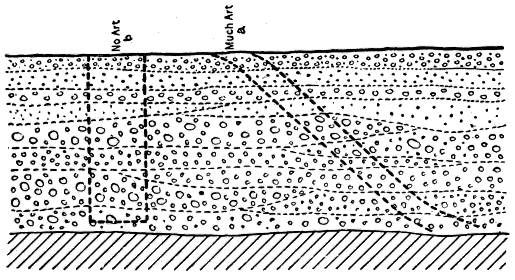
Fig. 3. a, Reputed "implement" producing zone of the river front. b, Barren zone of sewer.
But this case does not stand alone. The first discoveries of supposed gravel implements are said to have been made when the Pennsylvania Railway opened a road bed through the creek terrace on the site of the present station. At first numerous specimens of rudely flaked stones were reported, and the locality became widely known to archeologists, but the implement bearing portions of the gravels—and this is a most significant fact—were limited in extent, and the deposit was soon completely removed, the horizontal extension containing nothing. At present there are excellent exposures of the full thickness of the gravels at this point, but the most diligent search is vain, the only result of days of examination being a deep conviction that these gravels are and always were wholly barren of art.
It thus appears that here as well as upon the river front, the works of art were confined to local deposits, limited horizontally but not vertically, and a strong presumption is created that the finds were confined to redistributed gravels settled upon the terrace face in the form of talus. Dr. Abbott states that "at that point where I gathered the majority of specimens there is a want of stratification."[2] It is well known that such rearranged deposits are often difficult to distinguish from the original gravels. In trenching an implement producing terrace at Washington—where the conditions were probably quite similar to those at the Trenton railroad station—I passed through eighty feet of redistributed talus gravels before encountering the gravels in place, and so deceptively were portions of these deposits re-set that experts in gravel phenomena were unable to decide whether they were or were not portions of the original formation (cretaceous). The question was finally settled by the discovery of artificially shaped stones in and beneath the deposits.
Again, an implement bearing deposit of gravel was recently discovered by the late Miss F. E. Babbitt at Little Falls, Minnesota, and sufficient (a very little) digging was done to satisfy the discoverer, and all paleolithic archeologists as well, that the objects were really imbedded in the glacial gravels. In the summer of 1892 I visited the place and carried a trench twenty feet horizontally into the terrace face on the "implement bed" level before encountering the gravels in place. The talus deposits were several feet thick, and were of such a nature that their true character could not be determined without careful and extensive trenching. The whole talus deposit was here well stocked with Indian quartz quarry-shop rejects, which were as usual of paleolithic types, and it was but natural that Miss Babbitt's conclusions, although based as they necessarily were upon inexpert observations, backed by such well known "types" of "implements" should be unhesitatingly accepted by believers.
The occurrence of these telling examples of the deceptive appearance of re-set gravels would seem to justify and emphasize the conviction created by a critical examination of the two leading so-called paleolithic sites at Trenton, that Dr. Abbott, notwithstanding his asseverations to the contrary, has been deceived. Very strong support, it seems to me, is given to this conclusion by the recently published opinion of the late Dr. H. Carvill Lewis, a glacialist familiar with the Trenton region, and with the work of Dr. Abbott at the period of his paleolithic castle building. Dr. Lewis is reported to have maintained before an open meeting of the Academy of Science in Philadelphia "that what Dr. Abbott believed to be undisturbed layers (of gravel) were those of an ancient talus."[3] This remark may refer to both the main sites—the one at the railroad station and the other at the river front—or possibly only to the former. I have also heard it stated that that eminent scholar, Dr. Leidy, who must have had ample opportunities of forming correct opinions upon the subject, held pretty much the same views of Dr. Abbott's finds.
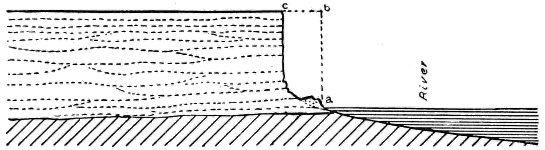
Fig. 4. A freshly formed gravel bluff.
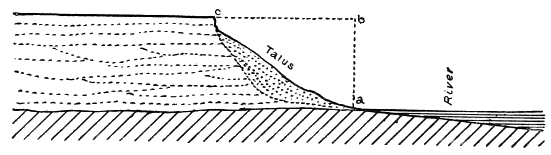
Fig. 5. Early stage of talus formation.
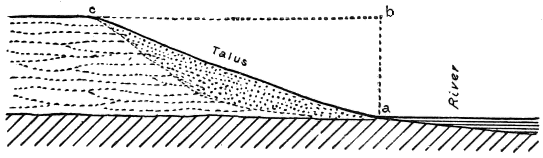
Fig. 6. An ancient talus.
To make the above criticism entirely clear, a few words of explanation of talus phenomena may be added. As a river cuts its channel deeper and deeper into deposits of gravel a section is gradually exposed, but the gravels break down readily under atmospheric influences and the exposed face does not retain a high angle. The upper part crumbles and descends toward the base, there to rest against the slope or to be carried away by the stream. A supposititious case will be convenient for illustration. A gravel terrace twenty feet in height is encroached upon by the river at high water and undermined, and the face breaks down vertically, leaving an exposure as illustrated in Fig. 4. In a very short time the upper portions become loosened and fall below, giving a steep slope as seen in Fig. 5. The process goes on with gradually decreasing rapidity, and if the river does not again encroach seriously, a practically stable slope is reached, as shown in Fig. 6. Such a talus may be hundreds or even thousands of years old, but there is rarely any means of determining its exact age. If the gravels are homogeneous in character, the talus will simulate their normal condition so completely that the distinction cannot be made out in ordinary gullies or by unsystematic digging. If the gravels contain varied strata the talus will be composite, and will be more readily distinguished from at least portions of the material in place.
Now it is important to observe what may be the possible art contents of such a talus as that shown in Fig. 6. It may contain all objects of art originally included in that portion of the gravels represented by a, b, c, together with all articles that happened to be upon the surface b, c, beside such objects as may have accumulated from dwelling or shop work upon its own surface, after the slope became sufficiently reduced to be occupied for these purposes. A talus is therefore liable to contain, and in the utmost confusion, relics of all periods of occupation, supposing always that there were such periods, from the beginning of the formation of the gravel deposits down to the present moment. As a rule such a talus, if art-containing, will have a large percentage of shop and quarry-shop refuse, for the reason that the exposed gravels, and the banks and beds of rivers cutting them, furnish, as a rule, a good deal of the raw material utilized by workers in stone, and the shops in which the work was done are usually located upon the slopes and outer margins of the terraces. Although there is the possibility of very considerable age for these talus deposits, it is unlikely that any of them date back as far as the close of the glacial epoch or at all near it, for rivers change back and forth constantly, undermining first one bank and then the other, so that a very large percentage of our talus deposits have been formed well within the historic period.
At Trenton the constantly exposed gravel banks afforded considerable argillite in bowlders, fragments and heavy masses, as well as some other flakable stones of inferior quality little used, and it is inevitable that the Indian who dwelt upon the shores of the river should have sought the workable pieces along the bluff, leaving the refuse everywhere; and it is a necessary consequence that the terrace margin, the bluff face, and the talus deposits, places little fitted for habitation, should for long distances contain no trace of any art shapes save such as pertain to manufacture. Thus are fully and satisfactorily accounted for all the turtle backs and other rude forms that our paleolith hunters have been so assiduously gathering. Nothing can be more fully apparent than that no other race than the Indian in his historic character and condition need be conjured up to reasonably account for every phase and every article of the recovered art. Mistaken interpretations of the nature of shop rejects, and the common association of these objects with redistributed gravels, are probably accountable for the many misconceptions that have arisen. Talus deposits form exceedingly treacherous records for the would-be chronologist. They are the reef upon which more than one paleolithic adventurer has been wrecked.
Relics of art attributed to gravel man have been collected, so far as I can gather from museum labels and from incidental references in various publications, from a number of sites aside from the two already referred to. These are scattered over the city, and the finds were made mostly in exposures of the gravels that remained visible for a short time only, as in street and cellar excavations and well pits. These reported finds can never be brought within the range of re-examination, and the searcher after unimpeachable testimony must content himself with placing them in the doubtful column on general principles. Urban districts are so subject to disturbance through cutting down of hills, filling in of depressions, grading of streets, digging of foundations, cellars, sewers, wells and graves that no man can, from a limited exposure such as those producing the reported tools necessarily were, speak with certainty of the undisturbed nature of the deposits penetrated. It is doubtful if any one is justified in publishing such observations at all without serious query. Such testimony is liable to fall of its own inherent weakness, being absolutely valueless if unsupported by collateral evidence of real weight. It can only be made permanently available to science by the discovery of something unusual or unique with which to couple it, something decidedly un-Indian in character or type, as for example the two skulls now in the Peabody Museum. These objects and the antler knife-handle exhibited with them may be alluded to as the only finds so far made at Trenton, having of themselves the least potentiality as proof and these skulls and this knife-handle must yet be subjected to the rigid examination made necessary by the importance of the conclusions to be based upon them.
Something may now be said concerning the art remains upon which this discussion hinges, and upon which conclusions of the greatest importance to anthropology are supposed to depend. Let us pass over all that has been said with regard to their manner of occurrence and association with the gravels and ask them simply what story they tell of themselves. Does this story, so far as we are able clearly to read it, speak of a great antiquity and a peculiar culture, or does it hint rather at vital weaknesses in the position taken by the advocates of these ideas? We shall see. The history of the utilization of rudely flaked stones in the attempt to establish a gravel man in America has never been written, but as read between the lines of paleolithic literature, it runs about as follows: The theory of a very rude and ancient people, having a unique culture and certain peculiar art limitations, was developed in Europe many years ago in a manner well known and often rehearsed. This people was associated with the ice age in Europe, and this epoch, with its moraines and till and sedimented gravels, was found to have been repeated in America. It was the most natural thing possible that these discoveries should carry with them the suggestion that man may have existed here as in Europe during that epoch, and that his culture was of closely corresponding grade. These were legitimate inferences and warranted the instituting of careful researches, but it was a dangerous suggestion to put into the minds of enthusiastic novices with fertile brains and ready pens. The idea was hardly transplanted to American soil before finds began to be made. The so-called "types" of European paleoliths suggested the lines upon which finds here should be made, and everything in the way of flaked stones connected directly or indirectly with the glacial gravels which had not yet been fully credited to and absorbed by the inconvenient Indian, was seized upon as representing the ancient time and its hypothetic people and culture. In the early days of the investigation the various rude forms of flaked stones, resulting from failures in manufacture, had not been studied, and were shrouded in convenient mystery, and they thus became the foundation of the new archeologic dynasty in America, the dynasty of the turtle-back. Dr. Abbott states in his first work[4] that these rude "implements" are not especially characteristic of any one locality, but seem to be scattered uniformly over the state. Specimens of every type, he says, are "found upon the surface, and are plowed up every spring and autumn; but this in no way militates against the opinion that these ruder forms are far older than the well-chipped jasper and beautifully-polished porphyry stone-work."[5] At that stage of the investigation it was not at all necessary that a specimen should come from the gravels in place or from any given depth, since the "type" was supposed to be easily recognized and was a sufficient means of settling the question of age.
Rude "implements" were called for and they were found. The only requirements were that they should not be of well-known Indian types, that they should be rude and have some sort of resemblance to what were known as paleolithic implements abroad. Since most of these so-called gravel implements of Europe are also doubtless the rejects of manufacture resemblances were readily found. The early attempts to utilize these rejects in support of the theory, and make them masquerade creditably as "implements" with specialized features and self-evident adaptation to definite ice-age uses, now appear decidedly amusing. Gradually, however, the lines have been drawn upon this early license, and it is to-day well understood by all careful students, that since the rude forms are so often repeated in modern neolithic refuse, the only reliable test of a gravel "implement" is its occurrence in the gravels in place. That a particular "implement," said to have been obtained from the gravels, is of "paleolithic type," does not in the least strengthen its claims to being a bona fide gravel implement; nor does its easy assignment to a "type" give any additional value to the collector's claim that the gravels said to contain it are implement bearing. The very names, "rude implement," "paleolithic implement," etc., carry with them a certain amount of mysterious suggestion; one thinks of unique, significant shapes and of strange, archaic uses. At their mere mention, the great ice sheet looms up with startling realism, and the reindeer and the mighty mammoth appear upon the scene. The reader of our paleolithic literature is led to feel that these antiquated objects carry volumes of history in their worn and weather-beaten faces, but this is all the figment of fertile brains. These objects have without exception the appearance of the most commonplace every-day rejects of manufacture without specialization and without hidden meaning. They tell of themselves no story whatsoever, save that of the oft-repeated failure of the aboriginal blade maker in his struggle with refractory stones. This will be shown with greater clearness farther on.
But the scheme does not end with the repetition of a European state of affairs. Our gravel archeologists have not been content to adopt that feature of the foreign scheme which utterly destroys the paleolithic race before a higher culture is brought upon the scene. It was thought to improve upon the borrowed plan by allowing for a gradual development upward from the paleolithic stage, represented exclusively by a class of meaningless bits of flaked stone, through a period less rude, characterized by productions so far advanced as to be assigned to a definite use. These latter productions consist mainly of rather large and often rude blades, sometimes plain, but generally notched or modified at the broader end as if to be set in a handle, or attached to a spear or arrow shaft. These were assigned to post-glacial times in such a way as to bridge or partly bridge the great space between the glacial epoch and the present. They were separated arbitrarily from the body of the collections of the region, and referred to as probably the work of an Eskimo race. This arrangement produced a pleasing symmetry and completeness, and brought the history of man down to the beginning of the Indian epoch, which is represented by all of those forms of art with which the red man is historically associated.
Three principal periods are thus thought to be represented by the finds at Trenton; and in the arrangement of the collections these grand divisions are illustrated by three great groups of relics, which are looked upon by the founders of the scheme as an epitome of native American art and culture. By others this grouping is looked upon as purely empirical, as an arbitrary separation of the normal art remains of the historic Indian, not suggested by anything in the nature or condition of the objects, nor in the manner of their discovery.
The "Eskimo" feature of the scheme requires a more detailed examination than can be given it here. It may be stated, however, that the separation of the so-called Eskimo spear points, or whatever they may be, from the great body of associated articles of flaked stone, appears to be a highly arbitrary proceeding. That they were extensively made by the Indians is proved by the occurrence of refuse resulting from their manufacture on modern shop sites, and that they were used by the Indian, is equally apparent from their common occurrence on modern dwelling sites. The exceptionally large size of the argellite points is readily accounted for by the nature of the material. It was the only stone of the region well adapted to the manufacture of long blades or projectile points. Jasper, quartz and flint have such minute cleavage that, save in rare cases, small implements only could be made from them. Their peculiar manner of occurrence, described at so much length by Dr. Abbott,[6] has been given undue consideration and weight. The phenomena observed may all be accounted for as a result of the vicissitudes of aboriginal life and occupation within the last few hundred years as fully and satisfactorily as by jumping thousands of years backward into the unknown.
Whatsoever real support there may be for the "Eskimo" theory, either in the published or the unpublished evidence, it is apparent that under the present system of solitary and inexpert research, the scientific world will gain little that it can utilize without distrust and danger. Whatsoever may be the final outcome—which outcome is bound to be the truth—it is clear that there is little in the present evidence to warrant the separation of a "paleolithic" and an "Eskimo" period of art from that of the Indian.
That the art remains of the Trenton region are essentially a unit, having no natural separation into time, culture or stock groups, is easily susceptible of demonstration. I have already presented strong reasons for concluding that all the finds upon the Trenton sites are from the surface or from recent deposits, and that all may reasonably be assigned to the Indian. A find has recently been made which furnishes full and decisive evidence upon this point. At Point Pleasant, on the Delaware, some twenty-five miles above Trenton, there are outcrops of argillite, and here have been discovered recently the shop sites upon which this stone was worked. There are two features of these shops to which the closest attention must be given. The first is that they are manifestly modern; they are situated on the present flood plain of the Delaware, and but a few feet above average water level, the glacial terrace here being some forty or fifty feet in height. These shops, therefore, represent the most modern phases of aboriginal industry, and may have been occupied at the coming of William Penn. The second point is that every type of flaked argillite found in the Trenton region, associated with the gravels or otherwise, is found on this site. It was to a certain extent a quarry site, for the great masses of argillite brought down by the floods were here broken up and removed from the river banks or bed. It was a shop site, for here the articles, mainly blades, were roughed out, and it was also a dwelling place—a village site—where all the specialized forms of flaked stones made from the blades were prepared for use. Here are found great numbers of the rude failures, duplicating every feature of the mysterious "paleolith" with which our museums are stocked, and exhibiting the same masterly quitting at just the point "where no further shaping was possible."[7] Here we see the same boldly manipulated "cutting edge," the "flat bottom" and "high peak," and the same mysteriously weathered and disintegrated surfaces, so skillfully made, by a nice balancing of accidents,[8] to tell the story of chronologic sequence in deposition.
Beside the failures, we have here, as on other quarry shop sites, the evidence of more advanced work, the wide, thick, defective blades, and many of the long, thin blades broken at or near the finishing point. Here, too, just back of the roughing-out shops, are the dwelling sites from which many specialized forms are obtained. The "Eskimo" type is fully represented as well as the ordinary spear point, the arrow point, and the perforator of our Indian. There is not a type of flaked argillite known in the Delaware valley that may not be duplicated here on this modern Indian site, and this has been known by local archeologists for years. Why so little has been said about the matter is thus explained. Dr. Abbott, in 1890, discovering this site, and finding "typical paleolithic implements" (the ordinary ruder forms of rejects) among the refuse, was so entirely at a loss to explain the occurrence that he felt compelled to again "take up the examination of the gravel deposits of the valley of the Delaware" with the hope of "finally solving the problem."[9] The true conditions would have been at once apparent to any one not utterly blinded by the prevailing misconceptions.
The entire simplicity of the archeologic conditions in the Delaware valley may be further illustrated. Had William Penn paused in his arduous traffic with the tawny Delawares, and glanced out with far-sighted eyes from beneath the pendant branches of the great elm at Shackamaxon, he might have beheld an uncouth savage laboriously fabricating rude ice age tools, making the clumsy turtle-back, shaping the mysterious paleolith, thus taking that first and most interesting theoretical step in human art and history. Had he looked again a few moments later he might have beheld the same tawny individual deeply absorbed in the task of trimming a long rude spear point of "Eskimo" type from the refractory argillite. If he had again paused when another handful of baubles had been judiciously exchanged, he would have seen the familiar redskin carefully finishing his arrow points and fitting them to their shafts preparatory to a hunting and fishing cruise on the placid Delaware. Thus in a brief space of time Penn might have gleaned the story of the ages—the history of the turtle-back, the long spear point and their allies—as in a single sheaf. But the opportunity was wasted, and the heaps of flinty refuse left upon the river bank by the workmen were the only record left of the nature of the work of that day. Two hundred years of aboriginal misfortune and Quaker inattention and neglect have resulted in so mixing up the simple evidence of a day's work, that it has taken twenty-five years to collect the scattered fragments, to sift, separate and classify them, and to assign them to theoretic places in a scheme of culture evolution that spans ten thousand years.
Yet is there really nothing in it all, in the theories, the observations, the collections and the books? Do I speak too positively in condemnation of the results of years of earnest investigation? Perhaps so, but the voluminous testimony is so overloaded with inaccuracies, the relics of unscientific method and misleading hypotheses, that every item must be sharply questioned; and the conclusions reached so far overstep the limits warranted by the evidence, that heroic measures alone can be effectual in determining their exact value. If, as many believe, vital errors have been embodied in the evidence presented by the advocates of the theory, it is impossible to state the case too strongly. Error once fully absorbed into the literature of science has many advantages over the tardy truth; it is strongly fortified and must be attacked and exposed without fear or favor. Truth involved with it cannot permanently suffer. If the twin theories of a gravel and a paleolithic man in eastern America are to be assailed as unsound or as not properly supported, it should be done now while the originators and upholders are alive and alert to sustain their positions or to yield to the advances of truth. I do not wish to wrongly characterize or to unduly minimize the evidence brought to bear in favor of these theories. I do intend, however, to assist the world so far as possible in securing an exact estimate of all that has been said and done, and all that is to be done.
In a previous article I have examined the evidence relating to paleolithic art in the eastern United States, and have indicated its utter inadequacy and unreliability. In this paper the testimony relating to the occurrence of gravel art, in the locality most fully relied upon by advocates of the theory, has been partially reviewed and subjected to the strong light of recent observations. It is found that the whole fabric, so imposing in books and museums, shrinks away surprisingly as it is approached. The evidence furnished by the bluff face and by the railway cutting, the two leading sites, is fatally weakened by the practical demonstration of the fact that the gravels proper are at these points barren of art remains. In endeavoring to naturalize an immigrant hypothesis, our gravel searchers, unacquainted with the true nature of the objects collected and discussed, and little skilled in the observation of the phenomena by means of which all questions of age must be determined, have undoubtedly made grievous mistakes and have thus misled an expectant and credulous public.
The articles themselves, the so-called gravel finds, when closely studied are found to tell their own story much more fully and accurately than it has heretofore been read by students of archeology. This story is that the art of the Delaware valley is to all intents and purposes a unit, that there is nothing unique or especially primitive or ancient and nothing un-Indian in it all. All forms are found on demonstrably recent sites of manufacture. The rude forms assigned by some to glacial times are all apparently "wasters" of Indian manufacture. The large blades of "Eskimo" type are only the larger blades, knives and spear points of the Indian, separated arbitrarily from the body of the art-remains to subserve the ends of a theory, certain obscure phenomena of occurrence having been found to give color to the proceeding. To place any part of this art, rude or elaborate, permanently in any other than the ordinary Indian category will take stronger proofs than have yet been developed in the region itself.
The question asked in the beginning, "Are there traces of glacial man in the Trenton gravels?" if not answered decisively in the negative, stands little chance, considering present evidence, of being answered in the affirmative. In view of the fact that numerous observations of apparent value have been made in other sections, there is yet sufficient reason for letting the query stand, and we may continue to cherish the hope that possibly by renewed effort and improved methods of investigation, something may yet be found in the Trenton gravels clearly demonstrative of the fascinating belief in a great antiquity for the human race in America.
The evidence upon which paleolithic man in America depends is so intangible that, unsupported by supposed analogies with European conditions and phenomena, and by the suggestions of an ideal scheme of culture progress, it would vanish in thin air; and if the theory of a glacial man can summon to its aid no better testimony than that furnished by the examples examined in this paper, the whole scheme, so elaborately mounted and so confidently proclaimed, is in imminent danger of early collapse.
W. H. Holmes.