Chapter XVI · HOW THE KOREANS LIVE
Reading edition
If the peninsula of Korea were moved to the western hemisphere it would stretch from Massachusetts to North Carolina. So of course there are differences in its climate. But on the whole it is very cold in winter and very hot in summer. Sometimes there are heavy rains and often severe droughts. Once, toward the end of July, when we were still living over the hills from Seoul, the rains were so heavy that all the lower part of the capital, along the Han River, was flooded, and we could get to town or to the railroad only by wading, sometimes up to our knees, in mud and water.
In a great many ways the Koreans are a sort of halfway people between the Japanese and the Chinese. This is especially true of their homes, which are not well adapted to the climate. The Chinese have chairs, but Koreans squat on the floor like the Japanese. Their wooden floors are raised above the ground, again like the Japanese, but they are covered with a kind of heavy varnished brown paper, instead of the thick straw mats of Japan. At one end is the kitchen, with a very crude mud-brick stove and oven, and in place of a chimney a flue carries the heat and smoke under the house and out at the other end. This device, 195which is used also in the north of China, warms the floor, and as the Koreans sleep on the floor, like the Japanese, it keeps them warmer than if they used the little charcoal-burning hibachi of the Japanese. Foreigners, however, sometimes wake up on a Korean floor dreaming that they are on top of a stove. In summer this scheme is not at all good. Of course it is just as necessary to cook in summer as in winter, and the flue from the kitchen keeps right on heating the floor-bed and the house when they are already too warm without it. Perhaps that is why we saw so many Koreans sleeping out on their porches, or sitting up talking at all hours of the night. Whatever the reason, Koreans are regular nighthawks.
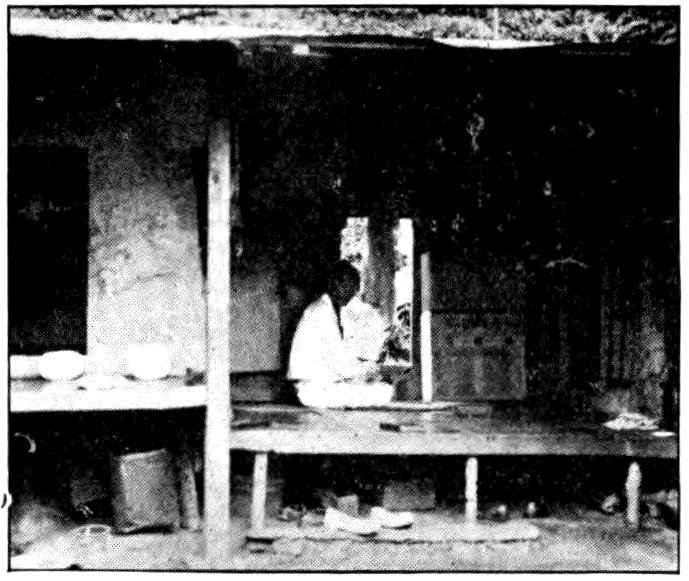
The interior of a Korean house. The floor, raised above the ground, is covered with heavy paper. Koreans take off their shoes in the house, as do Japanese.
196
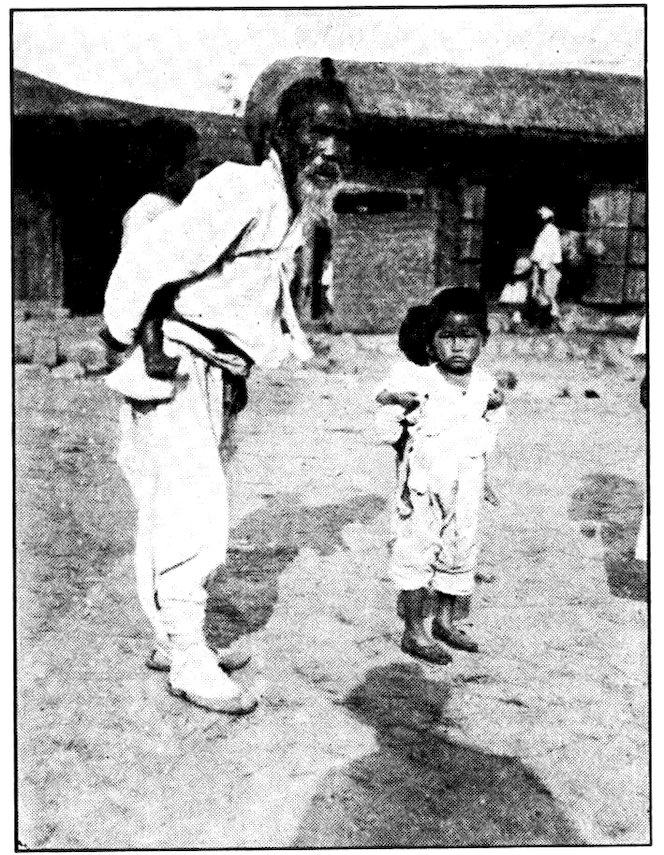
If grandfather and grandson are too old or too young to work in the fields, they can at least be baby-carriages.
Korean babies, like those of Japan and China, are not put into cribs or cradles but are tied to the back of mother, grandfather, or a small brother or sister. So they learn to sleep under any conditions, even while the mother is going about her work in the rice field or house or hurrying along the road. Naturally, when they grow up they can sleep anywhere, at any time. They do not have to have a soft bed and a dark, quiet room with everything just right, as most Americans do. Korean mothers do not send their children to bed with the chickens. They do not seem to care when the youngsters go to sleep, or when they get up. We 197often saw children suddenly lie down on the floor under everyone’s feet and go soundly to sleep, and almost as often we heard them talking in the middle of the night. It may be, too, that the curious old Korean custom of making the men stay home after the city gates were closed at nightfall and allowing only the women to go out after that gave the Koreans the habit of gossiping so much when other people would be sleeping.
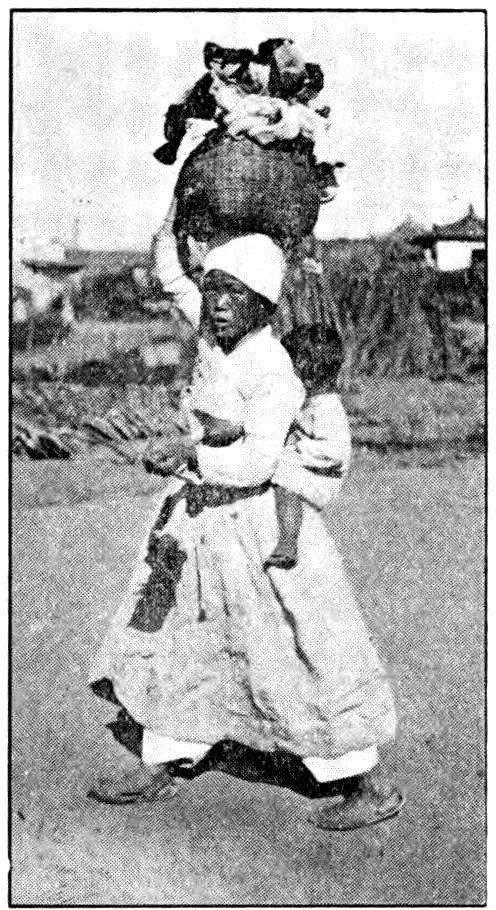
A Korean washerwoman takes her son along to the stream where she will beat out her clothes on the rocks. Carrying burdens on the back or on the head is easy for Koreans.
Some Contrasts
The houses of the Koreans are small, one-story cabins of from three to five rooms. They are generally half as wide as they are long, with no doors or windows in the back wall. The better-class houses have sliding walls, as in Japan, so that the whole house can quickly be made into one room, or the whole front of it can be opened when the weather is fine. But the dwellings are more solidly built than those of the Japanese, stones and mud, or mud bricks, often being used in construction. More wooden than paper walls are used. When he enters his house the Korean steps out of his 198shoes, or rather his slippers. These slippers turn up at the toe in a way that makes one think of a Venetian gondola. For rainy weather and mud the Koreans have, in place of the Japanese geta, boat-shaped wooden shoes, much like a Hollander’s. The carver, in making these, leaves on the bottom two stilts several inches high to lift the wearer above the mud.
For all their white garments, the Koreans are not so clean as the Japanese, though they are cleaner than the Chinese. As they have no bathrooms in their houses, or even in their public inns, the daily bath of the Japanese still seems very strange to them. In olden times they were careful to bathe on a certain day every year, because it was part of a religious ceremony, and I am afraid there are some who even now do not take baths at other times.
Korean Food
Just as the children of Korea sleep anywhere, and at any time, so they eat anything and everything. Mother never seems to worry about the smallest infant getting the colic. Babies not old enough to walk munch cucumbers or turnips or anything else they get their hands on. Foreigners often do not enjoy Korean food. First of all there is rice, boiled soft but eaten almost dry, as in Japan and China. Like his neighbors the Korean eats with chopsticks, but he uses a flat spoon for his rice. His various vegetables are not very different from our own, but he prepares them in styles we might not like. Fish, cooked in several 199queer ways, is eaten by everyone who can afford it, and the mass of Koreans probably eat more meat than the Japanese do.
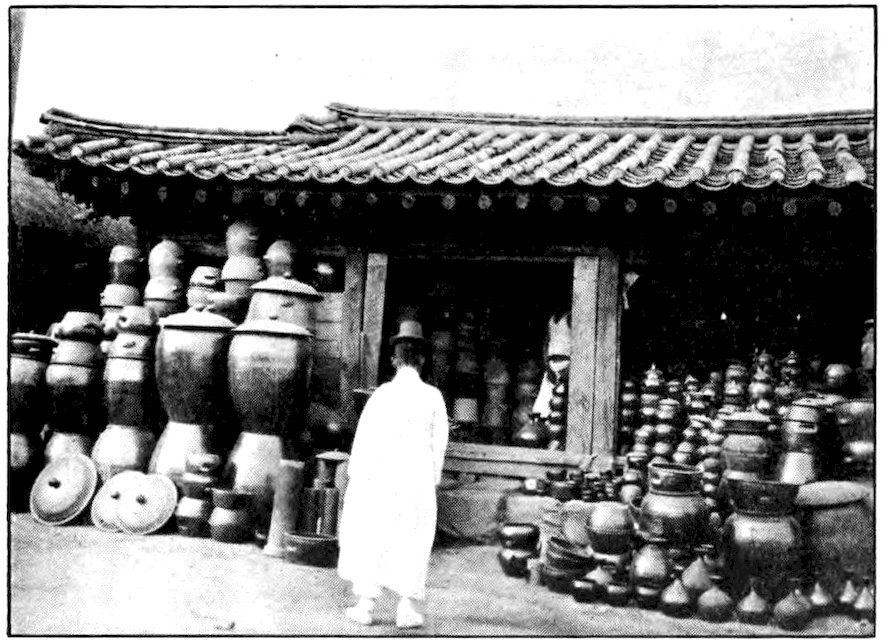
A jar store in Seoul. The Koreans use a great many brown earthenware jars of all sizes, especially for preserving their kimchee, a kind of Korean sauerkraut, made of turnips, cabbages, and other vegetables. This is put up every fall and eaten with great relish during the winter.
Brittle sheets of seaweed cooked in oil, black lettuce, pickled vegetables, hot red peppers, and some other things that do not even have a name in our language are found on the Korean table—or, more exactly, floor—along with such familiar vegetables as celery and green onions. Koreans hardly use sugar at all. In place of salt they are very fond of chang, a sauce made from pressed and fermented soya beans. Most Koreans dip every chopstickful of food in a bowl of this on the way to the mouth. Unlike both the Japanese 200and the Chinese, they do not often drink tea, but they like plain water or water in which barley or millet has been cooked. Some of them are rather too fond of sool, an intoxicating drink made of rice. It corresponds to the sake of Japan and the chiuh of China.
Interesting Street Scenes
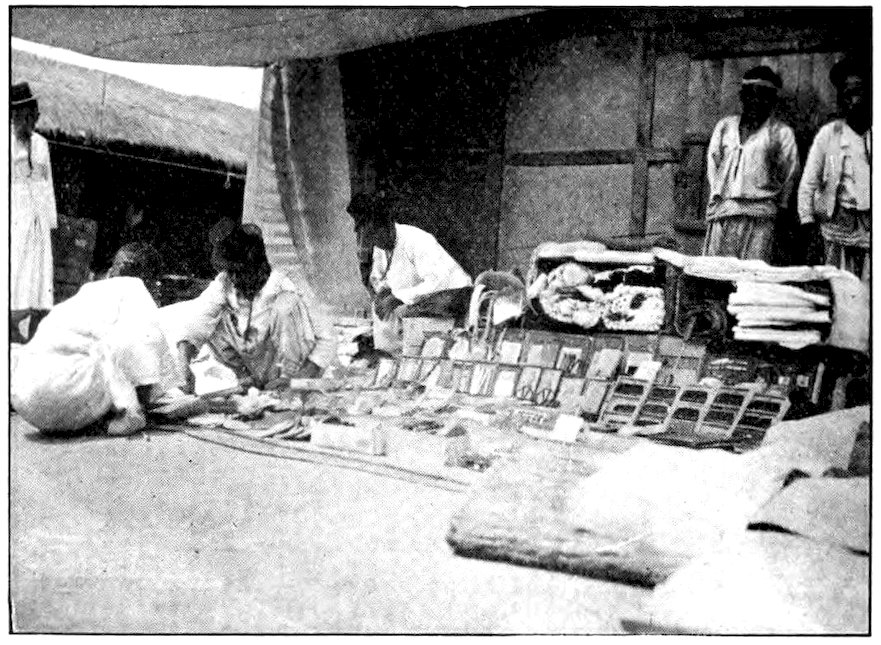
Market day in a town of interior Korea brings out strange displays of all sorts of new and second-hand wares.
It is always interesting to wander along the streets of Seoul, or the other large cities of Korea. Not only are there always many strangely dressed people constantly passing in rickshaws or on foot, but all the queer things they wear and eat and use are displayed in the long rows of shops. As in most of the Orient, the shops have no front walls, at least during the day 201and evening, when they are open for business. The stroller can see, and handle too, if he likes, the wooden mud-shoes and horsehair hats, the tiny chests of drawers bound in brass, the great brown jars for pickling vegetables, and the thousand and one other queer Korean things that are offered for sale. If it is one of the old-fashioned shops that are still most common, the shopkeeper and his clerks will probably be squatting on the varnished-paper floor, just as they would in their homes. But nowadays there are also many quite modern Japanese stores.
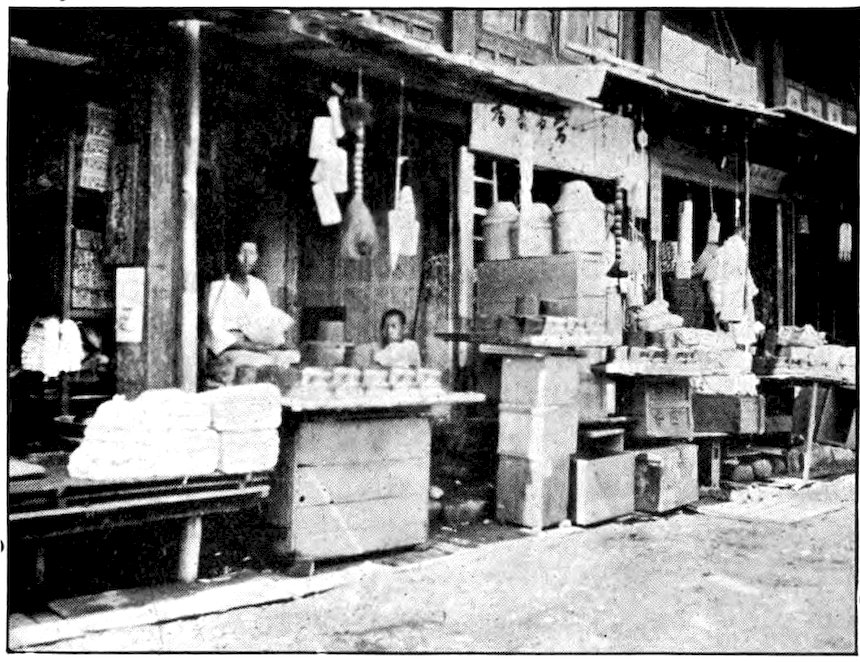
This is a shop and factory of Korean “plug” hats, such as nearly all the married men in the peninsula still wear. The horsehair from which these strange transparent hats are made is kept in rolls until it is needed.
The Koreans, like the Ainu, are larger than the Japanese who have conquered them, but they are a 202more simple and childlike people. Until the Japanese put a stop to it, their favorite game was throwing stones. Two gangs or two villages would line up against each other, much like American boys in a snowball battle, and throw stones until one side or the other was driven off. The women picked up stones and piled them in heaps where the men could reach them, and often these battles became so savage that men were not only seriously hurt but sometimes killed. You might think that with all this practice for generations, perhaps centuries, the Koreans would make good baseball players. Possibly they will some day, but at present they are not nearly so clever at it as the Japanese.
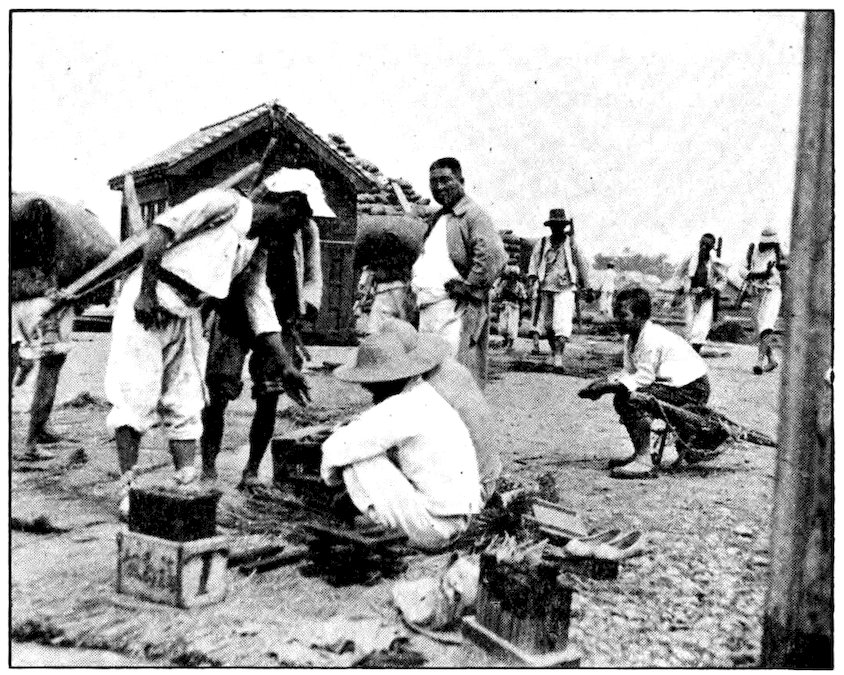
Korean coolies carrying grain to a ship in one of the most important harbors of the country keep track of their loads by getting a little bamboo stick as a tally on each trip.
203In his readiness to make and laugh at jokes, the Korean is more like the Chinese than the Japanese, although you cannot make him laugh as easily or as heartily as you can the hard-working people of China. But one little story will show that he is born with a sense of humor. An American missionary stepped off the train in Seoul and, having an appointment somewhere soon, looked at his watch. It was a large, old-fashioned watch which had been given to the missionary by his grandfather years before. Near by was a Korean boy with a jicky on his back. Immediately the boy backed up to the missionary and with a very solemn face asked him if he did not want the watch carried!
The Korean girls who entertain dinner parties by singing and dancing are called keesang, but they are not so well trained as the Japanese geisha, and the custom seems to be rather dying out. Now there are the movies, a Y. M. C. A. building (given by an American), and other modern attractions to draw the young men of Seoul away from the keesang entertainments. Another class that is disappearing are the old women whom we would call sorceresses, since they pretend to drive sickness out of children and evil spirits out of insane people—by dancing and shrieking and waving swords and spears and other weapons about them. The building of modern hospitals by the Japanese and by American and British missionaries has brought medical care to take the place of sorcery.
204
Koreans as Christians
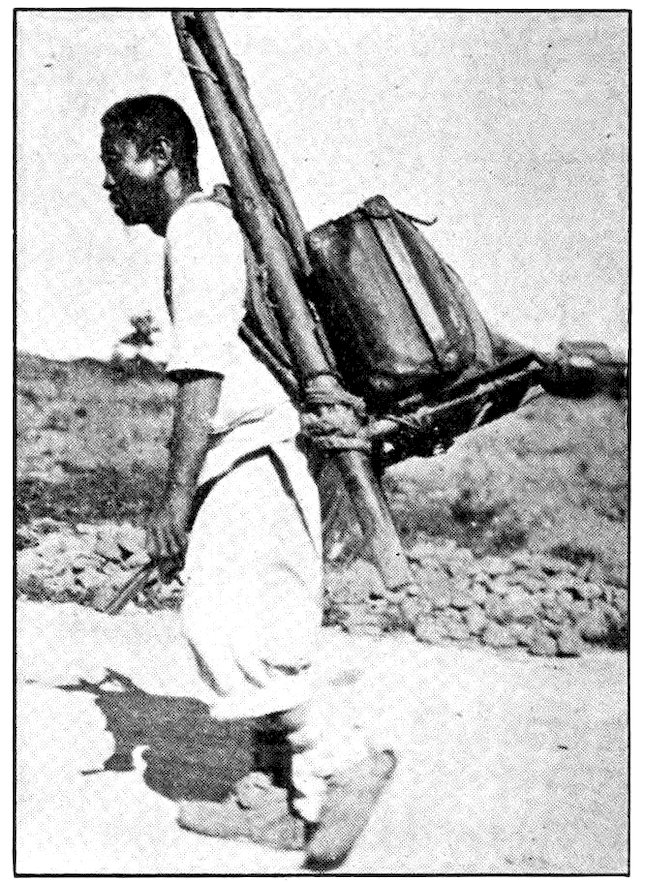
The Korean coolie fastens a jicky, something like an artist’s easel, on his back, to carry loads. This one is armed with a fan to ward off sunstroke.
There are now many Christian churches in Korea and thousands go to them every Sunday as regularly as people do in the United States. Some think the Koreans are converted to Christianity more easily than the Japanese or the Chinese because they are sad and troubled at their country’s loss of independence. Others say the Koreans are easily led by kindness, and still others, especially the missionaries, claim that Christianity appeals to them as the true faith as soon as they learn about it.
205
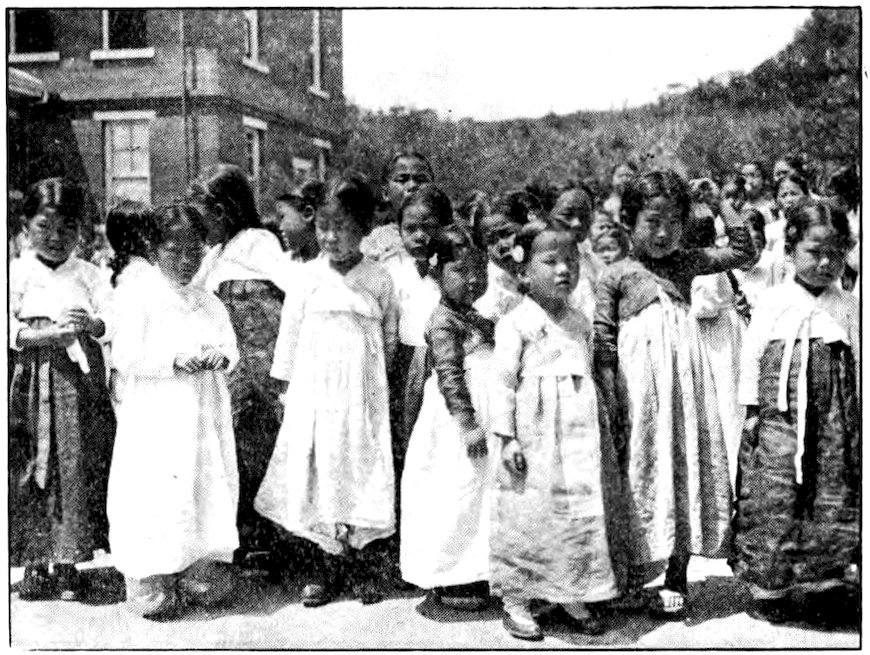
Korean girls leaving church. The American and British missionaries have had much success in Korea, and great numbers of the people go to church every Sunday, in their snow-white garments. Little girls may have garments of green, red, and other gay colors.
A Korean church service is very interesting, even if you cannot understand the language in which the foreign missionary or the native pastor in his snow-white garments is speaking. There are no chairs or other seats. Everyone sits on the floor. Behind the pulpit or along the walls beside it there may be one or two wooden benches, but these are for the few foreigners in the congregation. The Korean men keep their hats on, for it is nowhere the custom in Asia to uncover the head indoors. They do look odd in those bonnet-like little hats of theirs and their white garments, as they squat, gazing up very solemnly 206at the preacher. They alone are solemn. Hungry babies cry and squirm until they are fed, and small boys and girls play and whisper and even run about over the legs of the audience. This is not because they are naughty, but because the Koreans have had so many centuries of wandering through temples and saying their own prayers to the gods, that they do not know how to act in the way we think appropriate to a church. Besides, any child could be excused for becoming tired of squatting on the floor to listen to a long sermon, perhaps by a foreigner with a dreadful accent. But the Koreans are anxious to do as the missionaries wish. They have women in their churches whose business it is to run after scampering boys and girls and make them squat down again and behave themselves.
207