Lucy Fitch Perkins (continued 2)
Reading edition
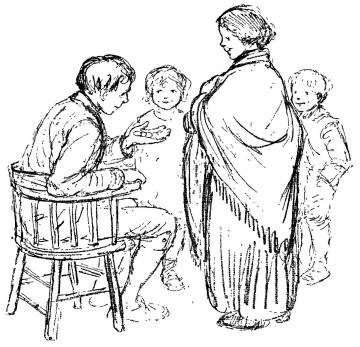
The Father and Mother looked at each other. “Now, what are they at all,” said Mrs McQueen, “but the best children in the width of the world? Wasn’t I after telling you that we’d make it out somehow? And to think of her being a thoroughbred like that, and we never knowing it at all.” She meant the pig!
But Mr McQueen never said a word. He just gave Larry and Eileen a great hug. Then Mr McQueen went over all the errands with his wife, and last of all he brought out the shawl. “There, old woman,” he said, “is a fairing for you!”
“The Saints be praised for this day!” cried Mrs McQueen. “The rent paid, and me with a fine new shawl the equal of any in the parish.”
It was a happy family that went to bed in the little farmhouse that night. Only Mrs McQueen didn’t sleep well. She got up a number of times in the night to be sure there were no Tinkers prowling about. “For one can’t be too careful with so much money in the house,” she said to herself.
Chapter Fourteen.
Sunday.
The next Sunday all the McQueen family went to Mass and Mrs McQueen wore her new shawl. The chapel was quite a distance away, and as they walked and all the neighbours walked, too, they had a pleasant time talking together along the way.
Dennis and the Twins walked together, and Larry and Eileen told Dennis all about the Fair, and about selling the pig to the Lady Kathleen, and “Begorra,” said Dennis, “but that little pig was after bringing you all the luck in the world, wasn’t she?” All the other boys and girls wanted to hear about it. Most of them had never been to a Fair. So Eileen and Larry talked all the way to church, and that was two miles and a half of talk, the shortest way you could go.
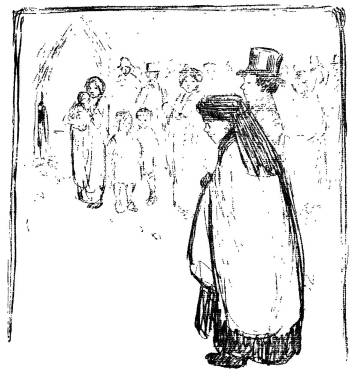
Just as they neared the church, what should they see but Grannie Malone, coming in grandeur, riding on a jaunting-car! Beside her was a big man with a tall hat on his head.
“’Tis her son Michael, back from the States!” cried the Twins. “He said in a letter he was coming.”
They ran as fast as they could to reach the church door in time to see them go in. Everybody else stopped, too, they were so surprised, and everybody said to everybody else, “Well, for dear’s sake, if that’s not Michael Malone come back to see his old Mother!”
And then they whispered among themselves, “Look at the grand clothes on him, and the scarf pin the bigness of a ha’penny piece, and the hat! Sure, America must be the rich place entirely.”
And when Michael got out of the cart and helped out his old Mother, there were many hands held out for him to shake, and many old neighbours for him to greet.
“This is a proud day for you, Grannie Malone,” said Mrs McQueen.
“It is,” said Grannie, “and a sad day, too, for he’s after taking me back to America, and ’tis likely I’ll never set my two eyes on old Ireland again, when once the width of the sea comes between us.”
She wiped her eyes as she spoke. Then the bell rang to call the people into the chapel. It was little the congregation heard of the service that day, for however much they tried they couldn’t help looking at the back of Michael’s head and at Grannie’s bonnet.
And afterward, when all the people were outside the church door, Grannie Malone said to different old friends of Michael, “Come along to my house this afternoon, and listen to Himself telling about the States!”
That afternoon when the McQueens had finished their noon meal, the whole family walked up the road to Grannie’s house. There were a good many people there before them. Grannie’s little house was full to the door. Michael stood by the fireplace, and as the McQueens came in he was saying, “It’s the truth I’m telling you! There are over forty States in the Union, and many of them bigger than the whole of Ireland itself! There are places in it where you could travel as far as from Dublin to Belfast without ever seeing a town at all; just fields without stones or trees lying there begging for the plough, and sorrow a person to give it them!”
“Will you listen to that now?” said Grannie.
“And more than that, if you’ll believe me,” Michael went on, “there do be places in America where they give away land, let alone buying it! Just by going and living on it for a time and doing a little work on it, you can get one hundred and sixty acres of land, for your own, mind you!”
“The Saints preserve us, but that might be like Heaven itself, if I may make bold to say so,” said Mrs Maguire.
“You may well say that, Mrs Maguire,” Michael answered, “for there, when a man has bent his back, and put in sweat and labour to enrich the land, it is not for some one else he does it, but for himself and his children. Of course, the land that is given away is far from big cities, and it’s queer and lonely sometimes on the distant farms, for they do not live in villages, as we do, but each farmhouse is by itself on its own land, and no neighbours handy. So for myself, I stayed in the big city.”
“You seem to have prospered, Michael,” said Mr McQueen.
“I have so,” Michael answered. “There are jobs in plenty for the willing hands. Sure, no Irishman would give up at all when there’s always something new to try. And there’s always somebody from the old sod there to help you if the luck turns on you. Do you remember Patrick Doran, now? He lived forninst the blacksmith shop years ago. Well, Patrick is a great man. He’s a man of fortune, and a good friend to myself. One year when times were hard, and work not so plenty, I lost my job, and didn’t Patrick help me to another the very next week? Not long after that Patrick ran for Alderman, and myself and many another like me, worked hard for to get him elected, and since then I’ve been in politics myself. First Patrick got me a job on the police force, and then I was Captain, and since then, by one change and another, if I do say it, I’m an Alderman myself!”
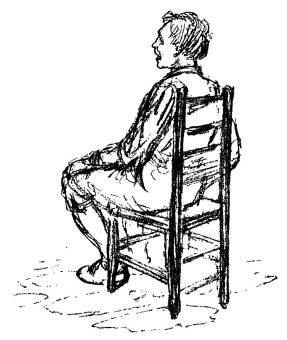
“It’s wonderful, sure,” Mr Maguire said, when Michael had finished, “but I’m not wishful for to change. Sure, old Ireland is good enough for me, and I’d not be missing the larks singing in the spring in the green fields of Erin, and the smell of the peat on the hearth in winter. It’s queer and lonesome I’d be without these things, and that’s the truth.”
He threw his head back and began to sing. Everybody joined in and sang, too. This is the song they sang:—
“Old Ireland you’re my jewel sure, My heart’s delight and glory, Till Time shall pass his empty glass Your name shall live in story. “And this shall be the song for me, The first my heart was learning, When first my tongue its accents flung, Old Ireland, you’re my darling! “From Dublin Bay to Cork’s Sweet Cove, Old Ireland, you’re my darling My darling, my darling, From Dublin Bay to Cork’s Sweet Cove; Old Ireland, you’re my darling.”
Chapter Fifteen.
Mr McQueen makes up his Mind.
Michael sang with the others. And when the song was ended, he said, “’Tis a true word, Mr Maguire, that there’s no place like old Ireland; and you’ll not find an Irishman anywhere in America that wouldn’t put the man down that said a word against her. But what with the landlords taking every shilling you can scrape together and charging you higher rent whenever you make a bit of an improvement on your farm, there’s no chance at all to get on in the world. And with the children, God bless them, coming along by sixes and dozens, and little for them to do at home, and no place to put them when they grow up, sure, it’s well to go where they’ve a better chance.
“Look at the schools now! If you could see the school that my Patrick goes to, you’d never rest at all until your children had the same! Sure, the schoolhouses are like palaces over there, and as for learning, the children pick it up as a hen does corn!”
“And are there no faults with America, whatever?” Mr McQueen said to Michael.
“There do be faults with her,” Michael answered, “and I’ll never be the man to say otherwise. There’s plenty of things to be said about America that would leave you thinking ’tis a long way this side of Heaven. But whatever it is that’s wrong, ’tis the people themselves that make it so, and by the same token it is themselves that can cure the trouble when they’re so minded. It’s not like having your troubles put down on you by the people that’s above you, and that you can’t reach at all for to be correcting them! All I say is there’s a better chance over there for yourself and the children.”
The Twins and Dennis and the other young people were getting tired of sitting still by this time, and when Michael stopped talking about America they jumped up. The children ran outdoors and played tag around Grannie’s house, and the older people stayed inside.
By and by Grannie came to the door and called them. “Come in, every one of you,” she cried, “and have a fine bit of cake with currants in it! Sure, Michael brought the currants and all the things for to make it yesterday, thinking maybe there’d be neighbours in. And maybe ’tis the last bit of cake I’ll be making for you at all, for ’tis but two weeks now until we start across the water.” She wiped her eyes on her apron.
Mr McQueen was very quiet as he walked home with Mrs McQueen and the Twins. And that evening, after the children were in bed, he sat for a long time silent, with his pipe in his mouth. His pipe went out and he did not notice it. By and by he said to Mrs McQueen, “I’ve made up my mind—”
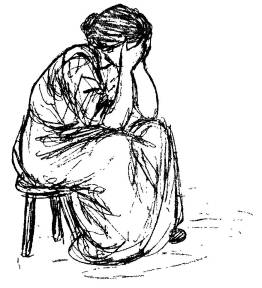
“The Lord save us! To what?” said Mrs McQueen.
“To go to America,” said Mr McQueen.
Mrs McQueen hid her face in her hands and rocked back and forth and cried. “To be leaving the place I was born, and where my father and mother were born before me, and all the neighbours, and this old house that’s been home since ever I married you—’twill break the heart in my body,” she said.
“I like that part of it no better than yourself,” said Mr McQueen, “but when I think of the years to come, and Larry and Eileen growing up to work as hard as we have worked without getting much at all, and think of the better chance altogether they’ll have over there, sure, I can’t be thinking of the pain, but only of the hope there is in it for them.”
“I’ve seen this coming ever since the children told us about Grannie Malone’s letter,” said Mrs McQueen. “’Tis Michael has put this in your head.”
“’Tis not Michael alone,” said Mr McQueen; “’tis also other things. To-morrow I pay Conroy the rent money. And it will take all that the pig brought and all I’ve been able to rake and scrape myself, and nothing left over at all. And there’s but ourselves and the Twins, and the year has not been a bad one. We have had the pig, which we wouldn’t be having another year. And what would it be like if there were more of us to feed, and no more pigs to be found in the bog like manna from Heaven, to be helping us out?”
“Sure, if it’s for the children,” sobbed Mrs McQueen, “I’d go anywhere in the world, and that you know well.”
“I do know it,” said Mr McQueen. “And since we’re going at all, let it be soon. We’ll go with Grannie and Michael.”
“In two weeks’ time?” cried Mrs McQueen.
“We will so,” said Mr McQueen. “I’ve no debts behind me, and we can sell the cows and hens, and take with us whatever we need from the house. Michael Malone will lend me the money and find me a job when we get there. The likes of this chance will never befall us again, and faith, we’ll take it.”
“Did he tell you so?” asked Mrs McQueen.
“He did, indeed.”
“Well, then, I’ve no other word to say, and if it must be done, the sooner the better,” said Mrs McQueen.
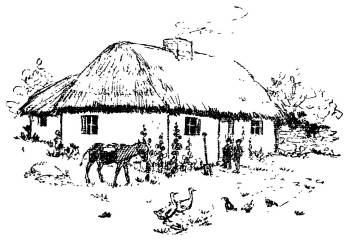
That night she lay awake a long time. She was planning just what they should take with them to their new home, and trying to think what the new home would be like.
Chapter Sixteen.
Mr McQueen pays the Rent.
The next morning Mr McQueen went to Mr Conroy and paid the rent. Then he said, “This is the last rent I’ll be paying you, Mr Conroy!”
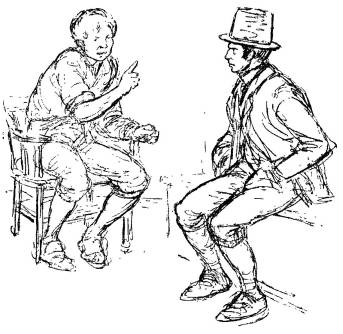
Mr Conroy was surprised. “What do you mean by that?” he said.
“I mean that I’m going to leave old Ireland,” said Mr McQueen.
“Well, now!” cried Mr Conroy. “To think of a sensible man like yourself leaving a good farm to go off, dear knows where! And you not knowing what you’ll do when you get there as like as any way! I thought you had better sense, McQueen.”
“It’s because of my better sense that I’m going,” said Mr McQueen. “Faith, do you think I’d be showing the judgment of an old goat to stay where every penny I can get out of the land I have to pay back in rent? I’m going to America where there’ll be a chance for myself.”
“I thought Michael Malone would be sowing the seeds of discontent in this parish, with his silk hats and his grand talk,” said Mr Conroy angrily, “but I didn’t think you were the fish to be caught with fine words!”
“If the seeds of discontent have been sown in this parish, Terence Conroy,” said Mr McQueen, “’tis you and the likes of you that have ploughed and harrowed the ground ready for them! Do you think we’re wishful to be leaving our old homes and all our friends? But ’tis you that makes it too hard entirely for people to stay. And I can tell you that if you keep on with others as you have with me, raising the rent when any work is done to improve the farm, you’ll be left in time with no tenants at all. And then where will you be yourself, Terence Conroy?”
Mr Conroy’s face was red with anger, but he said, “While I’m not needing you to teach me my duty, I will say this, McQueen. You’re a good farmer, and I hate to see you do a foolish thing for yourself. If you’ll stay on the farm, I’ll not raise the rent on you.”
“You’re too late, altogether,” said Mr McQueen; “and as you said yourself I’m not the fish to be caught with fine words. I know better than to believe you. I’ll be sailing from Queenstown in two weeks’ time.”
And with that he stalked out of the room and slammed the door, leaving Mr Conroy in a very bad state of mind.
All that Larry and Eileen could remember of the next two weeks was a queer jumble of tears and good-byes, of good wishes and blessings, and strange, strange feelings they had never had before. Their Mother went about with a white face and red eyes, and their Father was very silent as he packed the few household belongings they were to take with them to their new home.
At last the great day came. The McQueens got up very early that morning, ate their potatoes and drank their tea from a few cracked and broken dishes which were to be left behind. Then, when they had tidied up the hearth and put on their wraps ready to go, Mrs McQueen brought some water to quench the fire on the hearth. She might almost have quenched it with her tears. And as she poured the water upon the ashes she crooned this little song (see Note 1) sadly to herself:—
“Vein of my heart, from the lone mountain The smoke of the turf will die. And the stream that sang to the young children Run down alone from the sky— On the doorstone, grass - and the Cloud lying Where they lie In the old country.”
Mr McQueen and the Twins stood still with their bundles in their hands until she had finished and risen from her knees, then they went quietly out the door, all four together, and closed it after them.
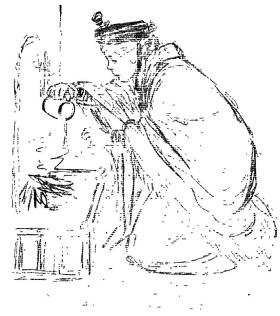
Mrs McQueen stooped to gather a little bunch of shamrock leaves which grew by the doorstone, and then the McQueen family was quite, quite ready for the long journey.
Mr Maguire had bought Colleen and the cows, and he was to have the few hens that were left for taking the McQueen family to the train.
Larry and Eileen saw him coming up the road, “Here comes Mr Maguire with the cart!” they cried, “and Dennis is driving the jaunting-car with Michael and Grannie on it.”
They soon reached the little group by the roadside, and then the luggage was loaded into the cart. Mrs McQueen got up with Grannie on one side of the jaunting-car and Eileen sat between them. Michael and Mr McQueen were on the other side with Larry. The small bags and bundles were put in the well of the jaunting-car.
“Get up!” cried Dennis, and off they started. Mrs McQueen looked back at the old house, and cried into her new shawl. Grannie was crying, too. But Michael said, “Wait until you see your new home, and sure, you’ll be crying to think you weren’t in it before!” And that cheered them up again, and soon a turn in the road hid the old house from their sight forever.
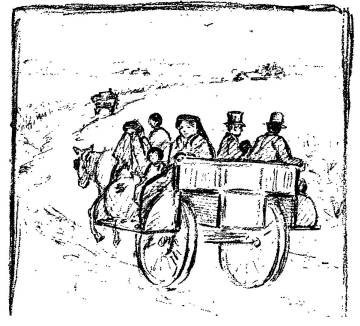
The luggage was heavy, and Colleen was slow. So it took several hours to reach the railroad. It took longer, too, because all the people in the village ran out of their houses to say good-bye. When they passed the schoolhouse, the Master gave the children leave to say good-bye to the Twins. He even came out to the road himself and shook hands with everybody.
But for all that, when the train came rattling into the station, there they all were on the platform in a row ready to get on board. When it stopped, the guard jumped down and opened the door of a compartment. He put Grannie in first, then Mrs McQueen and the Twins. They were dreadfully afraid the train would start before Mr McQueen and Michael and all the luggage were on board.
It was the first time Grannie had ever seen a train, or the Twins either. But at last they were all in, and the guard locked the door. Larry and Eileen looked out of the window and waved their hands to Mr Maguire and Dennis. The engine whistled, the wheels began to turn, and above the noise the Twins heard Dennis call out to them, “Sure, I’ll be coming along to America myself some day.”
“We’ll be watching for you,” Eileen called back.
Then they passed the station, and were soon racing along over the open fields at what seemed to poor Grannie a fearful rate of speed.
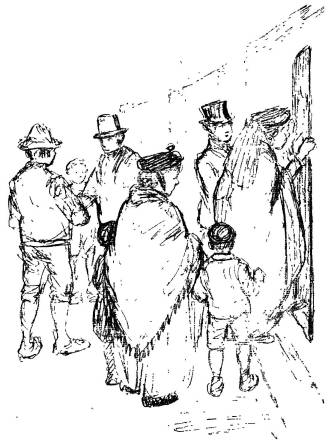
“Murder! murder!” she screamed. “Is it for this I left my cabin? To be broken in bits on the track like a piece of old crockery! Wirra, wirra, why did I ever let myself be persuaded at all? Ochanee, but it is Himself has the soothering tongue in his mouth to coax his old Mother away for to destroy her entirely!”
Michael laughed and patted her arm, and “Whist now,” he said, “sure, I’d never bring you where harm would come to you, and that you know well. Look out of the window, for ’tis the last you’ll be seeing of old Ireland.”
Grannie dried her eyes, but still she clung to Michael’s arm, and when the train went around a curve she crossed herself and told her beads as fast as she could.
The Twins were not frightened. They were busy seeing things. And besides, Larry had Grannie’s piece of coal in his pocket. From the window they caught glimpses of distant blue hills, and of lakes still more blue. They passed by many a brown bog, and many a green field with farmers and farmers’ wives working in them. The hillsides were blue with blossoming flax, and once they passed a field all spread with white linen bleaching in the sun.
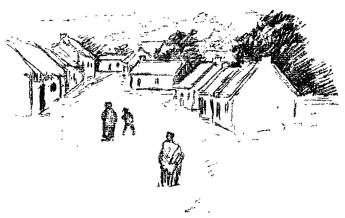
They flew by little towns with queer names, like Ballygrady and Ballylough, and once when they were quite near Cork they saw the towers of Blarney Castle.
At last the train rattled into a great station. There was so much noise from puffing engines and rumbling trucks and shouting men, that the Twins could only take hold of their Mother’s hands and keep close behind their Father as he followed Michael, with Grannie clinging to him, to another train. Then there were more flying fields, and a city and more fields still, until they reached Queenstown.
The next thing they knew they were walking across a gangplank and on to a boat. The Twins had never seen anything larger than a rowboat before, and this one looked very big to them, though it was only a lighter. This lighter was to carry luggage and passengers from the dock to the great steamer lying outside the harbour in the deep water of the main channel.
When they were all safely on board the lighter, and Michael had counted their bundles to be sure they had not lost anything, the Twins and their Father and Mother, with Michael and Grannie, stood by the deck rail and looked back at the dock. It was crowded with people running to and fro. There were groups of other emigrants like themselves, surrounded by great piles of luggage—waiting for the next lighter, for one boat would not carry all who wanted to go.
There were many good-byes being said and many tears falling, and in the midst of all the noise and confusion the sailors were loading tons of barrels and bags and boxes and trunks on board the ship.
There was no friend to see them off, but when they saw people crying all about them, the Twins cried a little, too, for sympathy, and even Mr McQueen’s eyes were red along the rims.
At last the gangplanks were drawn in, and the cables thrown off. The screws began to churn the green water into white foam, and the boat moved slowly out of the harbour.
The Twins and their Father and Mother, with Grannie and Michael, stood by the rail for a long time, and watched the crowd on the pier until it grew smaller and smaller, and at last disappeared entirely from sight around a bend in the Channel.
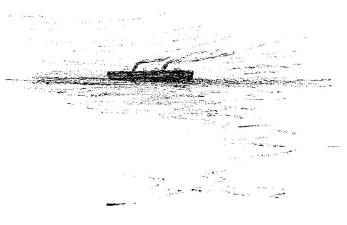
They stood there until the lighter reached the great ship that was waiting to take them across the water to a new world.
And when at last they were safely on board, and the lighters had gone back empty into the harbour, they stood on the wide deck of the ship, with their faces turned toward Ireland, until all they could see of it in the gathering dusk was a strip of dark blue against the eastern sky, with little lights in cottage windows twinkling from it like tiny stars.
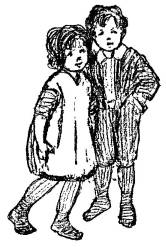
Then they turned their faces toward the bright western sky.
Note 1. Copyright of this poem by Herbert Trench, held by John Lane.
Chapter Seventeen.
Twenty Years After.
In the middle of one of the busiest crossings in Chicago, there stands a big man in a blue uniform. His eyes are blue, and there are wrinkles in the corners of them, the marks of many smiles.
On his head is a blue cap, and under the edge of the cap you catch a glimpse of dark hair. There are bands of gold braid on his sleeve, and on his breast is a large silver star.
He is King of the Crossing. When he blows his whistle, all the street-cars and automobiles and carriages—even if it were the carriage of the Mayor himself—stop stock-still. Then he waves his white-gloved hands and the stream of people pours across the street.
If there is a very small boy among them, the King of the Crossing sometimes lays a big hand on his shoulder and goes with him to the curb. And he has been known to carry a small girl across on his shoulder and set her safely down on the other side.
When the people are all across, he goes back to the middle of the street once more, and blows twice on his little whistle.
Then all the wheels that have been standing as still as if they had gone to sleep suddenly wake up, and go rolling down the street, while those that have just been turning stop and wait while the big man helps more people over the crossing the other way.
All day long the King of the Crossing stands there, blowing his whistle, waving his white-gloved hands, and turning the stream of people up first one street, then the other.
Everybody minds him. If everybody didn’t, they might get run over and wake up in a hospital. Oh, he must be minded, the King of the Crossing, or nobody would be safe!
When the long day is over, he looks up the street and sees another big man coming. This man wears a blue uniform, too, and a silver star, and when the hands on the big clock at the corner point to five, he steps into the place of the King of the Crossing and reigns in his stead.
Then the King jumps on to the platform of a passing street-car, and by and by, when it has gone several miles, he jumps off again, and walks up the street to a little house that’s as neat as neat can be.
It stands back from the street in a little green yard. The house is painted white, and the front door is green. But he doesn’t go to the front door. He goes round by the sidewalk to the kitchen door, and there he doesn’t even knock.
He opens the door and walks right in. Through the open door comes the smell of something good cooking, and he sees a plump woman with blue eyes that have smile wrinkles in the corners, just like his own, and crinkly dark hair, just like his own, too, bending over the stove. She is just tasting the something that smells so good, with a spoon.
When she sees the big man in the door she tastes so quickly that she burns her tongue! But she can use it just the same even if it is burned.
She runs to the big man and says, “And is that yourself, now, Larry darling? Sure, I’m that glad to see you, I’ve scalded myself with the soup!”
The big man has just time to say, “Sure, Eileen, you were always a great one for burning yourself. Do you remember that day at Grannie Malone’s”—when out into the kitchen tumble a little Larry and a little Eileen, and a Baby. They have heard his voice, and they fall upon the King of the Crossing as if he weren’t a King at all—but just a plain ordinary Uncle.
They take off his cap and rumple his hair. They get into his pockets and find some peppermints there. And the Baby even tries to get the silver star off his breast to put into her mouth.
“Look at that now,” cries Uncle Larry. “Get along with you! Is it trying to take me off the Force, you are? Sure, that star was never intended by the City for you to cut your teeth on.”
“She’ll poison herself with the things she’s always after putting in her mouth,” cries the Mother. She seizes the Baby and sets her in a safe corner by herself, gives her a spoon and says, “There now—you can be cutting your teeth on that.”
And when the children have quite worn Uncle Larry out, he sits upon the floor, where they have him by this time, and runs his fingers through his hair, which is standing straight up, and says to the Mother, “Sure, Eileen, when you and I were children on the old sod, we were never such spalpeens as the likes of these! They have me destroyed entirely, and me the biggest policeman on the Force! Is it American they are, or Irish, I want to know?”
“It’s Irish-American we are,” shouts little Larry.
“And with the heft of both countries in your fists,” groans big Larry.
And then the Mother, who has been laying the table, meanwhile, interferes. “Come off of your poor Uncle,” she says, “and be eating your soup, like gentlemen and ladies. It’s getting cold on you waiting for you to finish your antics. Your poor Uncle Larry won’t come near you at all, and you all the time punishing him like that.”
And then the Baby, still sucking her spoon, is lifted into her high chair. A chair is placed for Uncle Larry, and they all eat their soup around the kitchen table, just as the very last rays of the summer sun make long streaks of light across the kitchen floor.
“Where’s Dennis?” says Uncle Larry, while the children are quiet for a moment.
“Oh, it’s Himself is so late that I feed the children and put them to bed before he gets home at all,” says the Mother. “It’s little he sees of them except of a Sunday.”
“It’s likely he’ll live the longer for that,” says Uncle Larry. He looks reproachfully at the children and rubs his head.
And then—“Mother, tell us, what kind of a boy was Uncle Larry when you and he were Twins and lived in Ireland,” says little Eileen.
“The best in the width of the world,” says her Mother promptly. “Weren’t you, Larry? Speak up and tell them now.”
And Uncle Larry laughs and says, “Sure, I was too good entirely! It wouldn’t be modest to tell you the truth about myself.”
“Tell us about Mother, then,” says little Eileen. “Was she the best in the width of the world, too?”
“Sure, I’ll never be telling tales on my only twin sister,” says Uncle Larry, “beyond telling you that there was many another in green old Ireland just like her, whatever kind she was. But I can’t stay here wearing out my tongue! Look out the window! The chickens have gone to roost, and the sun is down. So get along with you to your beds.”
When he had gone, and the children were in bed, and the house quiet, the Mother sat down by the light in the kitchen with a basket of mending beside her.
And while she darned and mended and waited for Himself to come home, she remembered and remembered about when she was little Eileen, herself, and the King of the Crossing was just her twin brother Larry.
And this book is what she remembered.
The End.
Appendix.
Suggestions to Teachers.
Like the author’s earlier books—“The Dutch Twins” and “The Japanese Twins”—this reader aims to foster a kindly feeling and a deserved respect for a country whose children have come to form a numerous portion of our own population.
To arouse the children’s interest and thus to make the reading of this story most valuable as a school exercise, it is suggested that at the outset the children be allowed to look at the pictures in the book in order to get acquainted with “Larry” and “Eileen” and with the scenes illustrating their home life and surroundings.
During the reading, point out Ireland on a map of the world or on a globe, and tell the children something about the unique character of the country, thus connecting this supplementary reading material with the work in geography.
The text is so simply written that any fourth or fifth grade child can read it without much preparation. In the fourth grade it may be well to have the children read it first in a study period in order to work out the pronunciation of the more difficult words. In the fifth grade the children can usually read it at sight, without the preparatory study. Give little attention to the expressions in dialect. Let the children read them naturally and they will enhance the dramatic effect of the story. The possibilities in the story for dramatisation and for language and constructive work will be immediately apparent.
In connection with the reading of the book, teachers should read or tell to the children stories of Irish life and from Irish folk-lore; for example, “The Story of the Little Rid Hin,” “The Dagda’s Harp,” and “The Tailor and the Three Beasts,” in Sara Cone Bryant’s Stories to Tell to Children; and “Billy Beg and his Bull,” in the same author’s How to Tell Stories to Children. Material which may readily be adapted to this use will be found in Johnston and Spencer’s Ireland’s Story. Let the children bring to class postcards and other pictures of scenes in Ireland.
The unique illustrations in “The Irish Twins” should be much used, both in the reading of the story and in other ways. Children will enjoy sketching some of them; their simple treatment makes them especially useful for this purpose.
The book is printed on paper which will take water colour well, and where books are individually owned some of the sketches could be used for colouring in flat washes. They also afford suggestions for action sketching by the children.
An excellent oral language exercise would be for the children, after they have read the story, to take turns telling the story from the illustrations; and a good composition exercise would be for each child to select the illustration that he would like to write upon, make a sketch of it, and write the story in his own words.
These are only a few of the many ways that will occur to resourceful teachers for making the book a valuable as well as an enjoyable exercise in reading.
| Chapter 1 | | Chapter 2 | | Chapter 3 | | Chapter 4 | | Chapter 5 | | Chapter 6 | | Chapter 7 | | Chapter 8 | | Chapter 9 | | Chapter 10 | | Chapter 11 | | Chapter 12 | | Chapter 13 | | Chapter 14 | | Chapter 15 | | Chapter 16 | | Chapter 17 | | Appendix |