THE IRISH REBELLION of 1916 (continued 2)
Reading edition
"Well?" he questioned.
"We are friends of Captain Mellowes and heard he was staying here, so we stopped to see him," I said. "Is he in?"
"Come in till I take a look at you," he answered. After looking at us, "Come in here," he said, leading us to a room. "I'll go find him for you."
After a few minutes Captain Mellowes came into the room. He seemed surprised to see us, and was about to enter into a conversation with us when Barney said, "I've an important message to give you. Where's your room?"
"Come upstairs," said Captain Mellowes, rising at once.
They went upstairs. I could hear them moving about the room, and once in a while I heard something fall on the floor as if they were throwing different parts of their clothing to each other. After a few minutes' silence, I heard footsteps on the stairs and went out to the hall to be ready. Both came down the stairs, Captain Mellowes went forward and opened the door while I was saying "good-by" to Barney, who was remaining behind in the Captain's place. Barney left the house the following day; he took a train at the local station which ran to Crewe, and from there he made connections that brought him back to Ireland the day after the Captain's arrival.
Once outside the house, Captain Mellowes and myself wasted no time in getting to the car. I asked the man had we kept him long and he said we had been only half an hour. He started the car and away we went again. After three hours' ride we stopped at Stafford Station.
"Can you not go as far as Crewe?" I asked.
"No, Miss," he replied. "Crewe is altogether out of my direction."
"Very well," I said. "We'll leave here." We then left the car, gave the man his fee and entered the station. I took tickets for Crewe and found that we had only twenty minutes to wait. We arrived at Crewe about one a.m. and at one-thirty were in the train for Carlisle.
When we were near Carlisle the conductor came to collect the tickets; I asked him if Carlisle was the last stop.
"No," he said. "From there we go on to Glasgow without stopping."
"Oh," I said, "I didn't know that this train went to Glasgow. That's where we want to go. You had better make us out Excess Fare checks and we'll go on." He made them out, I paid them and he went out through the carriages. During this time Captain Mellowes was lying in the corner as if asleep.
In my list of "safe addresses" was one in Glasgow. When we arrived there next morning we made our way to that address, and there we stayed all day. During the day we managed to procure a clerical suit for Captain Mellowes, complete even to the breviary and umbrella. At eleven we took the train to Ardrossan; from there we could get a boat to Belfast. We had decided before leaving the house that we would travel as if we did not know each other. My accent was no longer needed, as a strong Irish accent was quite the thing for priests' clothing; but we were to keep each other in sight all the time.
That Captain Mellowes really looked the part was proved in the train. The porter lifted his cap to him, took his suitcase, and deferentially placed him in the seat next to me. There Captain Mellowes sat, his chin resting on his hands, which were supported by the umbrella, as if lost in holy meditations. Almost at the last moment, half-a-dozen North of Ireland cattle dealers tumbled into the carriage, shouting, laughing, and swearing. The porter had locked the door and the train had started before they realized what company they were in. A sudden silence fell on them all, they straightened themselves up, lifted their hats in salute to the priest, while questioning each other with their eyes. Then one lifted his cap again and turned to the rest as if to say, "I'm used to the company of priests," and addressed Captain Mellowes.
"Are you crossing to-night, Father?" he asked.
"I am," said Captain Mellowes.
"I hope we'll have a good night, Father."
"I hope so."
"I hear they caught a submarine up the Bangor Lough this morning; but I don't think there's any danger. Do you, Father?"
"I don't think so," said Captain Mellowes.
One dealer broke in then demanding to know that if there was no danger, why could they not insure the cattle they wanted to send across. Then each dealer tried to give his opinion at the same time. They became so excited, each one trying to get an audience at the same time, that they forgot all about the priest, and gave back word for word to each other. With raised voices they cursed and swore, stamped their feet, pounded the floor with their sticks, struck their hands, till one jumped from his seat in a rage and his gaze fell on the priest. The priest was still resting his chin on his hands, taking no more notice of them than if they were miles away. His very abstraction was a rebuke to them. The one who had jumped up said humbly, "I'm afraid we've disturbed you, Father." Captain Mellowes came to himself with a start.
"No, no, not at all," he said hurriedly. "I wasn't thinking of you at all." But the men looked as if they had offended beyond hope of pardon and kept silent till we reached the boat.
Early next morning I went up on deck. We were steaming up the river, I could see the city in the distance. Nearer to me were the famous Belfast shipyards, all alive with the clangor of hammering. As we approached I could see the swarms of men, poised on derricks and cranes, hard at work on the skeletons of ships. Just before we docked Captain Mellowes came on deck and walked over to the rail where I was standing. There was some byplay of surprised recognition between us for the benefit of those standing around. I asked him to come to the house for breakfast, and told him that he could not get a train to Dublin before ten o'clock. It was then seven o'clock and the gangplank was being put in place. I told Captain Mellowes that I was well known on the docks since the dock strike, and that it would be wiser for him to follow me instead of coming with me; that he would probably pass the Harbor Constables and policemen better alone, because, as they knew me, they would be likely to give my companion a scrutinizing glance and he would be better without that.
There were two Harbor Constables and two policemen at the end of the gangplank; they were on the watch for deserters from the Army and Navy. When I walked down the gangplank I saw that they recognized me and was glad that I had told Captain Mellowes to follow. I went in to the shed and on towards the exit. Midway I paused, dropped my suitcase as if to ease my arm, and glanced back to see if Captain Mellowes was following. He was just at the end of the gangplank; the four constables were saluting him and he was gravely saluting them.
I passed out into the street and walked slowly ahead to allow Captain Mellowes to catch up on me. In a short while we were walking together. It was too early to get a tram, and it would attract too much attention if a car drove up to our door, so we walked the distance. Falls Road, in Belfast, is called the Nationalist district, and my home was near the head of that road. When we got to that part of it where policemen were more plentiful and I was better known, I told Captain Mellowes to walk on ahead. I was glad I had done so, for I derived a great deal of amusement from the number of salutes Captain Mellowes had to return. Men and boys were on their way to work and they all saluted him. Every policeman on the road saluted Captain Mellowes; not one of them dreaming that the capture of the young priest they were so courteous to, would probably realize for him the dreams of Sergeantship every young policeman indulges in.
It was with a sigh of relief that I ushered Captain Mellowes into our house. The door was open and we entered without rapping. My mother thought we were the painters—she was expecting them that morning—and came out to remonstrate with us for not knocking. She was astounded for a moment, to see us in the hall, then she threw her arms around us both and literally dragged us both into the room where breakfast was on the table. She then called up the stairs to my sisters and told them we were home. On the instant there was a clatter and scamper, and pell-mell down the stairs charged my young sisters, some partially dressed and some in their nightgowns; bursting into the room they flung themselves on Captain Mellowes, hugging and kissing him as if he were a long lost brother returned. They hung about him asking him questions, interrupting each other. They poured forth so many questions that he could not answer them much less eat his breakfast. Mother noticed that his breakfast was growing cold and turning to the youngsters said in a voice that tried to be severe, "Children. I'm surprised at you—look at your clothes." Then there was another rush to the door and a scamper on the stairs as they raced up to dress. Never were they dressed so quickly before, for in less time than it takes to tell they were down again; crowding around the table each giving the other in excitable voice the story of how Captain Mellowes managed to return; but none of them bothering to ask Captain Mellowes or myself how it really happened.
Now that Captain Mellowes was in Belfast the next thing to be done was to get him to Dublin. He could not go by train for there were detectives at all the stations. There have always been detectives at railway stations in Ireland, whose sole business is to watch and to report the arrival and departure of the important members of the Separatist Party (the revolutionary body). This method keeps the local authorities informed as to the whereabouts of "such and such a person." On this account I sought a friend who owned an automobile. It so happened that he was going to Dublin that very evening and he agreed to take Captain Mellowes with him.
When I arrived home again I saw a woman in the parlor, who looked up at me through her veil, in the most mournful way; certainly the most forlorn person I had seen in a long while. But as I went nearer I recognized the clothes. My young sisters had decked Captain Mellowes out in our clothes to see if they were skillful at disguising. They were—but the clerical clothes were better.
I told Captain Mellowes of the arrangements I had made—we were to walk into the country along the Lisburn Road for about two miles, and there meet the motor-car. When it was time we started out. We were a party of four, Captain Mellowes and another young man, who was at that time hiding from the police in our house, my sister Agna, and myself. We walked along the country road and arrived at the appointed place too soon. The car was a little late; every car that came along would lift our hearts up and when it whizzed by would leave us little more nervously excited. It came in the end, however, and stopped for a minute while Captain Mellowes was being bundled on to the car, then sped away leaving us in the dark country road.
I arrived home about one-thirty and went to bed, tired out and fully resolved to stay there for the next day. But, alas! the news had got about and after school hours some of my friends called to hear my version, and compelled me to get up. The day or so following I took part in a Volunteer play called "Ireland First" in order to give the impression that I had been in Belfast and rehearsing with the company. On Saturday my mother received a letter from my father; the only reference he made to the job he had given me was, "Tell Nora I am proud of her."
VII
After that I was kept busy with the Ambulance class, and in preparing field dressings and bandages. There were about fifty girls working under my instructions and the work was beginning to be piled up. One squad was cutting up the material, another wrapping it up in waterproof material, others pasting on the directions, others sewing the completed bundle up in cotton bags which permitted them to be sewn into the men's coats. We were kept busy. When one of the officers came to the room to order the field dressings for his men, he voiced the opinion of all when he said, "Well, this looks like business. As soon as I stepped inside the door I felt that something important was going on. I suppose you all feel that way?" We did, and worked all the harder for it.
Some time before this my father had asked me if I would be in Dublin with him during the fight, but I had said, No, I would rather stay with the Northern division; that I thought I had better stay with the girls with whom I had been working. A younger sister had also decided to join the Northern detachment. My mother and the rest of the family were going to Dublin so as to be near my father. We were leaving the house just as it stood, to avoid suspicion, taking nothing from it but the trunks containing clothes. These could easily be taken without causing undue suspicion as it is quite a usual thing for families to go away for the Easter holidays. Between helping to pack up the trunks at home and the field dressings outside I managed to secure six hours' sleep during the latter part of Holy Week. My mother left Belfast on Good Friday, my sister and I the following day.
The instructions given the First Aid corps were: To meet at the Great Northern Station with full equipment and two days' rations. When we met the station was crowded with holiday-goers. There were three different queues circled around the station. We divided ourselves amongst them so that our party would not be large enough to attract attention. I found myself behind a party of soldiers going home on furlough. I could not help wondering if their furlough would be cut short, and if I might meet them again under different circumstances.
After I had taken the tickets I went to the trains to see if it were possible to get a carriage to ourselves. As the party had been split in two, one part to come on a later train, we could just fill a carriage. There was so much traffic that the railroad company had pulled out from many hiding places all the cars they could find. The line of cars presented a very curious picture as it stood waiting for the signal to start. There were the very latest corridor carriages, carriages quite new-looking, carriages old, carriages very old, and carriages so very old that they were an absolute temptation to us. These last were of that old type that has no wall between the carriages; the back of the seat is the only dividing wall. We picked out one and entered, took our seats, stowed away our haversacks, water-bottles, and hospital supplies under the seats and on the racks over our heads. Then we sat in pleasant anticipation to see who would enter the other carriage. One of the girls had put her head out of the window, and suddenly she gave a whoop and waved her arms. We hauled her in angrily, demanding to know what she meant by attracting attention in such a manner—didn't she know that the fewer that saw us the better? "But," she said when she got a chance, "I saw the Young Ireland Pipers coming up the platform looking for a carriage, and I thought it would be great to have them in the next carriage. They would pass the time for us by playing the pipes." (The Young Ireland Pipers were attached to the Volunteers.)
By this time the Pipers had come to the door of the carriage next to us and were getting in. They were both surprised and pleased when they saw the girls. They knew then that they could play all the rebel songs they desired, and say all the revolutionary things they could think of. That was one good thing about the Republican forces in our part of the country—every one knew every one else; and so it was elsewhere I am told. I doubt if ever pipers were so dressed going to battle. Slung from one shoulder was a haversack, crossing it was a bandolier filled with cartridges, a belt held the haversack in its place on one side, and from the other a bayonet was suspended. Strapped to the backs were rolled tar sheets, and under their arms they held the bagpipes with their green, white, and orange streamers flying over their shoulders. They were most warlike musicians. But more significant than all were the eager eyes shining out from under their caps. One young chap leaned over the wall and said to me, "My God! Isn't it great? We worked and worked without hope and now——" One of the boys had been tuning up the pipes and as the train began to move we swung out of the station to the tune of:
"Soldiers are we, whose lives are pledged to Ireland, Some have come from the land beyond the wave, Sworn to be free, no more our ancient sireland Shall shelter the despot or the slave. To-night we man the Bearna Baoighail[*] In Erin's cause come woe or weal, 'Mid cannon's roar or rifle's peal We'll chant a soldier's song."
Tyrone was our destination and we arrived there before dark. We were met by a local committee and taken to a hotel. After we had something to eat, we went over to the drill hall. There I had the first wound to attend to—one of the men had accidentally shot himself while cleaning his revolver. There was quite a crowd around me while I was dressing the wound. When I had finished, the men said that they hoped I would be detailed with their company, as they would feel much safer. I said that I didn't want to dress wounds till I had a chance to make some: at this they laughed and promised me that I would get all the chance I wanted. I then asked them when they would mobilize. "To-morrow morning," they replied. "We are waiting for the Belfast Division to arrive. We start on our maneuvers at 12 o'clock. We will all be together then."
We were still talking of our hopes when some one came into the hall and said that he had a message for Miss Connolly. "Here I am," I said. "What do you want?"
NORA CONNOLLY
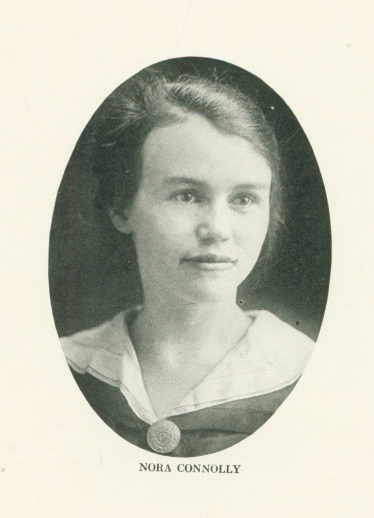
"Come outside, Miss Connolly," said he. "I have a message for you." I followed the man outside. The message he gave me was to the effect that the Commandant in the North had sent him to say that there would be no fighting in the North; that he had received a demobilizing order, but that he thought there would be fighting in Dublin. We could decide whether we would go back to Belfast or on to Dublin. He left the matter entirely in our own hands. I left the messenger and went back to the hall to call the girls together. I asked them to come with me to the hotel. I then told them the text of the message I had received and asked them to decide whether they would return to Belfast or go to Dublin. I said that I was going to Dublin and they decided to go with me. One of the girls suggested that we say the Rosary for the men who were about to fight. We knelt down and said it. We then began to get our things together again. I inquired about the trains to Dublin and was told that there would be no train till midnight. It was almost 10 o'clock then and we were some miles away from a station. I asked one of the men where I could get a car to take us to the station. They protested against our leaving, but I said that we had our work to do, and must get to Dublin as soon as possible. After some talk he sent one of the men to get two cars for us. We waited most impatiently till they came, then piling on to them as best we could we left the town and went towards the station.
While we were waiting for the train we saw the second contingent arriving from Belfast. The men had their equipment with them and swung out of the station in a truly martial way. I knew from their joyous faces and their remarks that they had not received the news we had, and I pictured to myself the change there would be when they did.
Our train left Tyrone at twelve-thirty, and arrived in Dublin at five-fifteen. We went directly to Liberty Hall for I knew my father would be there. Ever since the attempted raid on Liberty Hall, he had stayed there every night under an armed guard. He had determined that he would not be arrested before the day arrived.
As we approached to the building we saw an armed sentry keeping watch through a window; we went up the steps and knocked on the door. A sentry came to the door and asked our business. I said I was Mr. Connolly's daughter and that the girls were ambulance workers from the North. He did not know me, so he called to some one else to decide for him. The man he called to was the officer of the guard who knew me. As we went inside the door and up the stairs I asked him if he thought I could see my father. He told me that my father had not been able to go to bed until three o'clock. I said I thought it best to see my father at once. He then escorted me to the corridor in which my father's room was and told me the number. I walked along the corridor till I found the room and knocked on the door.
"Who is there?" called my father.
"Nora," I answered.
"What are you doing here? I thought you were with the North men."
"Let me in, father," I said. "I am afraid there is something wrong."
He opened the door and I entered the room. It was rather a small room, square and slightly furnished. There were but two chairs, a table, a cupboard and an army cot. My father was lying on the cot and looking at me in surprise. I went over to him and knelt down beside the cot to tell him why I was there.
"What does it mean, father? Are we not going to fight?" I asked him when I had finished.
"Not fight!" he said in amazement. "Nora, if we don't fight now, we are disgraced forever; and all we'll have left to hope and pray; for will be, that an earthquake may come and swallow Ireland up."
"Then why were we told last night that there would be no fighting in the North?"
"We received word last night that there could not be got fifty men to leave Belfast."
"That is not true!" I cried. "Why, there were fifty men on the train with us leaving Belfast; and before we left Tyrone there were two hundred. I saw them myself. They are there now with all their equipment, eager and happy and boisterous with delight."
"That is a different story from what we were told," said my father.
"Mine is the true one," I returned. "But don't accept my word for it. Call in the other girls and question them."
"Ask them to come in."
I went out to the girls and said that my father would like to see them. They came in; they all knew my father but he did not know them all, so I told him all their names.
"Tell me, girls," said my father, "how many men you saw in Tyrone before you left, Belfast men particularly."
Their story was practically the same as mine. When he had heard them all, my father asked one of them to call in the guard who was on duty in the corridor. When the guard had entered the room, or rather stood at the door, my father said to him, "Call the officer of the guard."
Shortly afterwards the officer of the guard knocked on the door. I opened the door and he came inside, saluted and said, "Yes, sir?"
"Send in five men who know the city thoroughly," said my father.
"Yes, sir," said the officer as he saluted again.
"Now," said my father turning to us again. "I am going to send you to each of the other Commandants. You tell them just what you have told me. And after you tell them all, ask them to come here as quickly as they can."
The five Citizen Army men came to the room shortly after that, and each of the girls was given different addresses to go to. It fell to my lot to go to Sean MacDermott. I had as my guide a man who looked as little an Irishman as he well might be. He was short and stout yet very light on his feet; he wore bright blue overalls, short black leggings, and his face was burnt a dark brown. He wore a wide black felt hat and from under it I saw hanging from his ears, big, round gold ear-rings. He looked as I fancied a Neapolitan fisherman would look like.
The leaders slept no two nights in the same place. Only themselves knew where each other was sleeping. This was for safety. I was taken to a place beyond Parnell Square, about twenty minutes walk from the Hall. When we arrived there we had to knock the people up; and it was some time before we received any answer. They were very suspicious of us when I said who it was I wanted. The woman, who opened the door, consulted with some one inside the house, before she decided to let me in. The guide having done his duty in bringing me there and seeing that I was about to enter the house, went back to Liberty Hall to report.
The woman then asked me who I was, what did I want, wouldn't any one else do, and a score of other questions. She went away after she had received my answers. In a few minutes a young man came down to interview me also. I told him that I was Mr. Connolly's daughter and that Sean MacDermott knew me, and that I had a message for him from my father. He was still reluctant to let me see Sean and said that Sean had hardly had time to go to sleep. I said that I knew that but that I had been traveling all night from the North, and had wakened my father over an hour ago who had had even less sleep than Sean.
After that he went away and came back to say that I could see Sean MacDermott. I went upstairs and found him in bed. He was looking very pale and tired. He listened to me, while I told him all I had to tell, without saying a word till I had finished. He then asked me if the others knew this. I told him that there were other girls seeing the other leaders at the same time. He remained silent for a while and then said, "I am very glad you came. Tell your father that I'll be at the Hall as soon as I can." I then returned to Liberty Hall. It was then about seven o'clock and we decided to go to Mass at Marlborough Cathedral around the corner.
VIII
When we returned from Mass my father had risen, and dressed in his uniform was going about the room singing to himself:
"We've got another savior now, That savior is the sword."
I began to prepare breakfast for my father and the rest of us. But it was some time before we sat down to our breakfast, as one by one the leaders dropped into the room, and as none of them had waited to have breakfast before coming they had to be served. I remember giving breakfast to a young officer who had come up on the night mail from Limerick, for final instructions. I gave Tom Clarke his last Easter breakfast. It seemed fitting he should have as table companion Sean MacDermott—they were always such close friends. Before they had finished Joseph Plunkett, his throat heavily swathed in bandages, for he had shortly gone under an operation, arrived; and following him closely came Thomas MacDonagh. Michael Mallin and my father had their breakfast together. They were all in uniform, except Tom Clarke and Sean MacDermott. Pearse did not have his breakfast at Liberty Hall; he arrived somewhat later than the others and had already eaten. While they were all standing around and talking, one of the girls came in and said, "Mr. Connolly, look, the Independent says, 'No maneuvers to-day.' What does that mean? Is it a trick?"
"What is that?" said my father, taking the paper from her. "Maneuvers" was the name under which our men were being mobilized. If the Independent, which had the largest circulation of any Sunday paper throughout the country, printed such a bit of news it would disorganize our forces to a great extent. Yet, there it was:
Owing to the critical situation all Volunteer parades and maneuvers are canceled.
By order Eoin MacNeill.
"What does this mean?" asked my father, turning to Pearse.
"Let me see it," said Pearse. "I know nothing whatsoever about this," he said when he had read it. After that there was some low-voiced conversation among the leaders; and then the Council room. They remained there till after one o'clock.
We then ate our long delayed breakfasts and then went to another part of the Hall to see more stirring sights. On our way out of the corridor we had to pass the Council room. It was guarded by an armed sentry who stood at the door forbidding all to pass. He stopped us and would not allow us to pass until one of the officers coming out of the room saw our plight and told him who we were. When we came to the corner of the corridor we were again stopped by a sentry, but he knew me and we went on out to the front of the building.
Here, all was excitement, guards at the top and the bottom of the stairs, men and boys, women and girls running up and down; Citizen Army men arriving by the dozen armed with all their equipment, poured steadily into the great front hall.
We remained about the Hall as we had been told to stay within call in case we were needed as messengers to the North. We remained in the vicinity until well on in the afternoon. It was not until the Citizen Army started out on a march that we were freed. I have never been able to understand how it was that the authorities did not become aware that something untoward was afoot. There were two dozen policemen detailed to attend the Citizen Army march and they hung around Beresford Place waiting for the march to begin. Surely they should have been able to sense the difference in the feeling of the crowds that were thronged around Liberty Hall all the day. There was no disguising by the people that they expected a different ending to this march than to all the other marches. Else why the haversacks filled with food, the bandoliers filled with ammunition, and the supply wagons piled high with supplies? The men and women were under military orders. They were no longer a volunteer organization, they were a nation's army. Their fathers and, mothers, their wives and children, their sisters and brothers, and their sweethearts knew that from that day forth their lives were no longer their own, but belonged to Ireland. And while they openly exulted in this thought and brought parting gifts to their loved ones, the police saw nothing.
Before they went on their march my father called me to him and told me to bring the girls to Surrey House, the home of the Countess de Markievicz, so that they would have a rest before reporting at Liberty Hall the following morning. They badly needed rest as they had had no sleep the night before. Our orders were to report at Liberty Hall the next morning at eight o'clock.
The next morning when we reached Liberty Hall we were told that we were to be given a message to take back North with us. The message was to be written and signed by Padraic Pearse; therefore we had to wait until he came. While we were waiting Thomas MacDonagh came into the room. He was in uniform. He greeted us in his gay, kindly way and pretended to jeer at us for leaving the city.
"Here we are," he said, "on the brink of a revolution and all you are thinking of is to get out of the city before we begin."
LIBERTY HALL After the outbreak of the European War
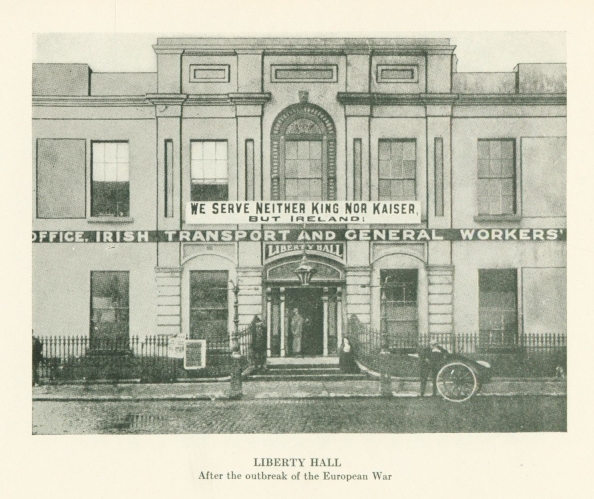
While he was talking my father came into the room carrying a large poster. He unrolled it and spread it out on the table saying, "Come here, girls, and read this carefully. It would be too dangerous to allow you to carry it with you, but read it carefully and tell the men in the North of what you have read." We all gathered around the table and read The Proclamation of the Irish Republic. I think that we had the honor of being amongst the first to see the proclamation.
Pearse came in while we were discussing our intended journey. He was in uniform; his military overcoat making him look taller and broader than ever. My father told him that we were waiting for the message. He went to the Council room to write it and we followed him. While we were waiting my father gave me some advice as to what we should do when we arrived in the North. Then Pearse called to us and we went to him. He handed me an envelope and said, "May God bless you all and the brave men of the North." He said it so solemnly and so earnestly that I felt as if I had been at Benediction. I then said "Good-by" to my father and left the Hall to take the nine o'clock train to the North.
IX
We knew that the men were to rise at twelve o'clock and as that hour drew nigh we watched and listened anxiously to hear or see if the news had reached the North before us. At twelve o'clock we left the train at Portadown. There was a large body of men belonging to an Orange Band parading up and down the platform beating their drums. They were going to some meeting in Derry. The noise was terrific but we bore it gladly for it told more than words that our men in Dublin had been able to carry out their plans without any untoward accident. We changed into the other train and finished our journey in a less anxious frame of mind. But there was disappointment awaiting us at Tyrone; when we arrived there the men had already received the demobilizing order of MacNeill and had obeyed it. The Belfast contingent was already in Belfast and the country divisions had not had time to mobilize before the order from MacNeill had arrived. When I found this out I sent messengers to the various bodies advising them of what was going on in Dublin. The principal dispatch was the one given us by Pearse and that one was sent off in care of my sister, other girls going to other places. There was nothing for the rest of us to do but to await the return of the messengers.
At eight o'clock that night a boy came from Belfast who said that he had been sent to advise us to return to Belfast and asked us to go back with him. I asked the officer of the local Volunteer Corps if they intended to go on with the fight now that the men in Dublin were out, or if they intended to obey MacNeill's order. He replied that they were in honor bound to assist the Dublin men. I said that being the case I would remain with them and that we would attach ourselves to their body as they had no First Aid Corps.
About an hour later the local organizer came to the hotel and asked for me. I went out to him; he said that it would be better if we were in a less conspicuous place—would we go to some place out in the country? It was nearer to the meeting place. We agreed to go and started out about ten o'clock.
It was a night of pitch darkness, a heavy rain was pouring steadily. After a ten minutes' walk we were out on a country road where the darkness seemed to grow thicker with every step. We could see nothing but trusting to our guides soughed up and down in the mud. For twenty minutes we walked on, then we were told to turn to the right. We could see nothing that showed a turning, still we turned and found that we were in a narrower road than before. It was even muddier than the road we had left but it was shorter. At the end we were stopped by a door of what appeared to be a barn. One of the men rapped on it and it was opened to us. We stepped inside and when our eyes were used to the light again, saw a number of men with their rifles. The hall was filled with standing men, a place was cleared around the hearth upon which was blazing the biggest turf fire I had ever seen. On a bench near the fire were a half dozen women; they had brought food to the men and were now waiting to take the girls home with them. After a short wait we started out again, still following blindly where we were led. At length we came to a crossroads and there the party divided. I, along with some other girls, was taken to a large farmhouse where the folk were waiting up for us. We went into a large kitchen and sat around a big turf fire. There was porridge, in a pot hanging over the fire from a long hook, for those who liked it; and the kettle was boiling for those who preferred tea. We had a long talk around the fire. The old man told us of his experiences when he was a Fenian and drew comparisons between that time and this. Our time was nothing like his—so he told us.
In the morning we rose early; we expected to have word from Belfast every minute telling us to get on the march. But no word came that day. As the hours passed my anxiety became unbearable. I had had no word from anybody since I had come there. The men and the boys could not work for fear the word would come when they were in the fields and might be delayed if they were not on hand. And all the day long they were riding up and down the roads on the watch for the messenger who would give them the orders to rise. The second day passed, still the word never came. The men and boys came to us every hour to report all they knew. And on Wednesday at noon a man burst into the farmhouse crying, "Pack up in the name of God, the word has come!" With what joy we packed up. How quickly the water bottles were filled and the haversacks stuffed with food. Butter, eggs, bread, and milk were thrust upon us. We could not take enough to satisfy the good people. The place was full of bustle and excitement, and then—the order was rescinded; it was a false alarm.
That disappointment ended my patience. I determined to go after my sister, who had not returned since she had left me to deliver the dispatch written by Pearse; and when we were together again we would both start for Dublin. I told the girls that I did not think that there would be any need of us in the North, that the men in command were waiting too long. That being the case it would be better for them to go home to Belfast and Agna and I would go to Dublin. They did not want to go from me, but I said I was speaking to them as their officer and they should obey. After a good deal of explaining they agreed to go home the next day.
I found that if I wanted to go to the town where my sister had gone, I would need to go by car. So a car was hired for me the next day. Just before the hour set for them to leave, a brother of one of the girls came to see what had happened to them. They all went home together. The car for myself came a little later and in it I piled as many of the Ambulance supplies as I could. There was only room for myself in the back, most of the room being taken up with the bundles. We started on our journey about six o'clock.
The town to which my sister had taken the dispatch was called Gortin; but later I had heard that she was at Carrickmore, since when I had not had any news of her. Before my mother had left Belfast she had entrusted Agna to my care, therefore I felt that I could not return without her. While on my way to Carrickmore to see if she was still there I had to pass through a village whose streets were thronged with soldiers. As we went out of the village and on into the country we met at least half a dozen motor trucks filled with soldiers. There were more marching behind, so many in fact that I asked the driver if there was a training camp near here.
"No," he said. "There is not. I'm afraid those fellows spell trouble." Conscious that the soldiers were looking sharply at myself and the bundles, I felt more than relieved when the car spun on out of their sight.
X
It was about eight o'clock when we reached the farm at Carrickmore. Fortunately the man to whom my sister had carried the dispatch was there. As I was telling him who I was and why I had come, his sister broke on me and exclaimed sharply:
"My God! Why did you come here?"
"Why," I asked in surprise.
"Did you not meet the soldiers on your way here?" she asked.
"Indeed, I did. I saw lots of them. What are they doing here?" I asked, turning to her brother.
"They raided this place this afternoon," he said, "and have only left here three-quarters of an hour ago."
"Raided the place!" I cried. "But, of course, they found nothing."
"They did, though," he said. "They found three thousand rounds of ammunition."
"Three thousand rounds!" I cried amazed and angry. "Where did you have it hidden?"
"In the turf stack," he replied.
"In the turf stack! Good God! What made you put it there? Doesn't every one who isn't a fool know that that would be one of the first places they would look for it. Three thousand rounds of ammunition in a turf stack! Couldn't you have hidden it some place else? Couldn't you have divided it? Couldn't you have——" and I broke off almost crying with anger and dismay.
"I know, Miss Connolly, you can't say or think anything more of the loss than I do. But I haven't been able to look after things this past week. I'm in hiding, chasing from pillar to post trying to find out what is to be done."
"And what are you going to do?" I asked. "This is Thursday and the men have been fighting in Dublin since Monday noon. What are you going to do? Think of the numbers of men and boys, women and girls who are at this minute in Dublin offering up their lives while the men of the North are doing nothing. It's a shame! It's a disgrace!"
"What could we have done? The men were all dispersed when I received the last dispatch. It's a different thing to mobilize men in the country from what it is in the city. There are a dozen or so here; six miles off there is a score; ten miles off there are some more, and so it goes all over the country. What were we to do?"
"Weren't you in a terrible hurry to obey MacNeill's order? Why were the men chased home on Sunday night and Monday morning? They were all gone when we arrived at Coalisland on Monday at one o'clock. Why were you in such a hurry to demobilize the men when their Easter holidays lasted till Tuesday? Did you not want them to fight? Were you afraid that another order would come rescinding MacNeill's?" The questions poured from me breathlessly; I was emptying my mind of all the riddles and puzzles that had been tormenting it.
"Say what you like, Miss Connolly, what can I say?" And he spread his hands in a helpless gesture.
"It's a shame," I commenced again. "Why did you not tell the men and give them the option of going on to Dublin? Why were the girls so honored? Why, the North can never lift up its head again. The men in Dublin preparing to lay down their lives while the North men were being chased home by their commanders. It's awful!"
"Miss Connolly, can't you believe that I feel it as much as you do? Think what it means to me that the men in Dublin are being killed while we are here doing nothing."
"The men in Dublin are fighting for Ireland. In a short while you may be fighting up here—and why? Because the Ulster Division is already quartered in Dungannon and Coalisland, and are trying to provoke a party riot by parading the streets in numbers, crying 'To Hell with the Pope.' There are bunches of them sitting on the doorsteps of Catholic houses singing 'Dolly's Brae' (the worst of all their songs). And if they go beyond bounds and those Catholics lose their temper, it will be in the power of England to say that while one part of the country was in rebellion, another part was occupied in religious fights. If you had issued another mobilization order when you received the dispatch from Pearse, that could never happen. Why didn't you issue that order?"
"We were waiting, Miss Connolly——"
"You were waiting. What for?" I broke in. "And now you have waited too long. There has been a flying column sent from Belfast, some two hundred strong, and it has taken up such positions that you are prevented from coming together. Dungannon, Coalisland, and all around there is completely cut off from this part. There is nothing now for the North men to do but sit tight and pray to God that the Dublin men will free their country for them. My God! A manly part! Where is my sister? I want to get her and go on to Dublin. I would be ashamed to stay here while the people in Dublin are fighting."
"She took a dispatch to Clogher and is still there."
"Is Clogher far from here? Can I get there, to-night?" I asked him.
"No, you cannot get there to-night; it is too far away. It is over the mountains. Stay here the night and you can set out in the morning. Stay here as long as you like, make this place your home, and don't be too hard on the North. We acted as we thought best, and perhaps we are sorry for it now. It is MacNeill's order that must be blamed. Good night, Miss Connolly."
"Are you going out? Do you not stop here?" I asked as I saw him gathering up his raincoat and cap. He straightened up his tall figure.
"No," he replied. "I have not slept here since Monday. I am determined that I shall not be arrested without doing something worth while. Good night again, and remember that this is your home for as long as you wish to stay."
"Good night," I answered as he left the room. Then it seemed that all the hopelessness of the world descended on me as I thought that here was another day gone, and I had not been able to accomplish anything.
I left the room in a few minutes and entered the kitchen. One side of the large farm kitchen was taken up by a fireplace. A large pot that was suspended over a huge turf fire the light of which reached across the room and danced and glistened upon the dishes that were standing on the top rack of the dresser. It was a sparsely furnished kitchen, for besides the dresser I could see only a table placed under the window, some farm implements on the other side of the room, and some benches. Except for the blazing of the fire there was no light, and while the ceiling was a roof of ruddy light, the rest of the kitchen was kept in semi-darkness by the farm laborers, who were sitting round the fire. The first thing I did was to arrange and make tidy my bundles of bandages which had been carried into the kitchen by the driver of the car. As I straightened up, my glance fell upon one of the men sitting by the fire, whom to my surprise I recognized as Lieutenant Hoskins of the Belfast Volunteers.
"Why, Rory," I exclaimed. "What are you doing here?"
"What are you doing here?" he asked. "I thought you were in Dublin. Didn't you go there Saturday night?"
"I did," I answered. "But I came North with a dispatch on Monday. I intend to go to Dublin to-morrow. But you didn't say what you are doing here."
"There was more chance of something happening here—we could do nothing in Belfast."
"There will be nothing happening here," I said. "That's why I am going to Dublin."
"Perhaps I'll try and make my way there to-morrow."
"I'd advise you to," I said as I left the kitchen. I was shown to my room and lost no time in getting to bed.
When my sister was leaving with the dispatch, I took her haversack from her so that she would not attract any unnecessary attention. That I might look like an ordinary traveler I put her haversack along with mine in a suitcase, and that suitcase had been carried to my room. The events of the night proved that it was a lucky thing for me that it had been brought to the bedroom. As I looked at it I wondered if a suitcase had ever before been packed in a like manner.
I could not have been asleep fifteen minutes when I was awakened by a tremendous rapping. In a few seconds the girl came to my room.
"Miss Connolly," she said. "What will we do? They are here again." I instantly thought of my revolver and cartridges which I had carried with me.
"Listen," I said. "Put on my coat and go down and open the door before they get angry."
"Why should I put on your coat?" she asked.
"Because I have something in it that I do not wish them to see. Put it on," I said, "and hurry down to the door."
When she had the coat on she went to one of the windows and opened it. She put her head out and asked who was there. While she was parleying with the soldiers I remembered that I had one hundred rounds of ammunition in one of the haversacks wrapped up in some clothing. I jumped out of bed and opened the suitcase. I had to rummage because I dare not make a light. I pulled article after article out of one of the haversacks in hot haste, but it was not there.
I turned to the other one and began searching it. I had just felt it when I heard a step on the stairs. Grasping it in my hand I sprung back into the bed. I had only arranged myself and was lying down when a light was flashed in my face.
The light was so strong that I could only lie there and blink my eyes. In a few minutes the light was removed from my face and flashed about the room, enabling me to see that it was held by a District Inspector of Police, and that he was accompanied by a military officer and some of the Royal Irish Constabulary. The D.I. switched the light back on my face suddenly and asked:
"Are you only waking up?"
"Just now," I answered.
"Don't be afraid," he said. "We heard that some more stuff came to this house to-day and we have come for it."
"It's not the most reassuring thing in the world to have soldiers and police come into your room at this time of night," I returned.
"What is your name?" he asked. I told him. I did not give a false one, as I did not know whether he had asked the girl downstairs my name or not.
"Where are you from?" was his next question.
"Belfast," I replied.
"Is that your suitcase?" he asked, pointing to it.
"Yes," I said.
"Look in it," he said to the officer.
"There is nothing there but my personal property," I said.
"All the same we must look," the D.I. said to me, as he went down to his knees beside the officer.
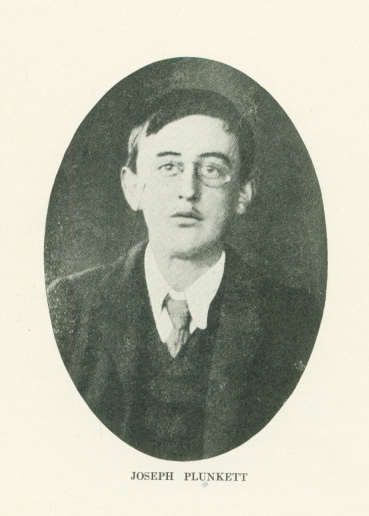
JOSEPH PLUNKETT
They gave it a rather cursory examination. Then they opened the wardrobe and looked into it, glanced into the drawers of the bureau. My heart almost stopped beating when they came near the bed. What should I do if they told me to rise? But they only looked under it, and passed out into the sitting room adjoining my bedroom. After they had examined the room they went downstairs again. I could hardly believe my luck. I was silently congratulating myself when I heard their heavy steps on the stairs again.
They came into the room again. The D.I. said, as he poured the rays of his lamp on my face, "We have found something downstairs which made us come up here to look again." I did not say anything in reply, only lay there and wondered to myself if they had found the revolver on the girl and if she had told them to whom it belonged. The military man was down on his knees at my suitcase once more.
"Did you say that there was nothing here but your personal property?" asked the D.I. as he knelt down beside him.
And then began the second search of my suitcase. Very carefully he lifted out each article and examined it. The stockings were turned inside out as a woman turns them when looking for holes. The reason for such an act I do not know, save that they might have thought that I had a dispatch concealed in them. The very fact that I knew that there was nothing incriminating in the suitcase made me lie back in the bed unconcernedly. Suddenly the officer said, "Ah!" and passed something to the District Inspector. As they were between me and the suitcase I could not see what it was. The District Inspector turned his head over his shoulder and asked again, "Did you say that there was nothing here but your own personal property?"
"I did," I replied.
"Well, what do you call this?" he asked, holding up two bundles wrapped in blue paper. "Do you call these personal property?"
"Yes, they are," I said, seeking hurriedly in my mind for an explanation. The parcel he was holding up for me to see held two dozen roller bandages. "They're mine," I said with sudden inspiration, "I got them cheap at a sale."
The answer evidently tickled the two men, for they laughed and one said to the other, "Just like a woman." They next came upon a box of tea, sugar, and milk tablets. The District Inspector asked as he held it up, "Are you going to start a commissariat department with these?"
"No," I answered. "They are no good."
Having completely overhauled my suitcase they next directed their attention to the bureau drawers. Every piece of paper in the drawers, letters, bills, etc., were read, and even the pages of books were turned over to make sure that nothing escaped them. They looked under the bed again and then passed out to the sitting room, where they remained but a few minutes. Shortly afterwards they went downstairs and then I heard them going out through the door.
Hardly were they out of the house when the girl came running to my room. "Get up, Miss Connolly," she said. "Get up and go. They'll come back and arrest you. Get up."
"Nonsense," I said. "If they intended to arrest me they would have done it now and not wait till they came back. You're excited, but there is no danger."
"You've just got to go, Miss Connolly," she said. "You can't stay here."
"That's all very well," I said. "But don't you know that I am a stranger round these
XI
I was down in the kitchen before six o'clock. The girl had put some bread and butter on the table, a cup of tea and an egg. My heart was so full I could not eat but I managed to drink the tea. I then turned to the place where I had stacked my bundles of bandages the night before. They were gone, even the knapsack that held my few days' rations.
"Where are all my things gone to?" I asked.
"The soldiers took them away last night."
"When?" I asked. "How did they come to see them?"
"After they came down from your room the first time," she replied. "They asked me who owned those bundles. I said the girl upstairs. Then they examined them, called in the soldiers and told them to take those bundles."
"Did they take the haversack with my rations?"
"They took everything. And they asked me the name of the girl upstairs. And I said I didn't know; that you came last night and asked for a night's lodging, and that I never turned any one away from the door."
"You told them that!" I cried. "Did you want to make them suspect me? Do you usually give your guest room to women tramps? In the name of Heaven, how could you be so foolish?"
"Well," she said. "I wasn't going to let on that I knew you."
"What will I do?" I said. "Now they will be on the watch for me. I can't go to Clogher by train. I'll have to walk. How far is it?"
"It's not five miles," she answered. "You can walk it easily. About two miles from it you will come to a place called Ballygawley, and there you can get a tram that will take you to Clogher."
"Five miles," I said. "I'll get there easily before noon. Which way do I go?"
Before she answered a woman came in with a message from the girl's brother. She looked at me suspiciously till she was told who I was. I told her that I was going to walk to Clogher to get my sister who was there, and that after that we would make our way to Dublin.
"To Clogher!" she said and looked at me in astonishment.
"Yes," I said. "Does your road go near Ballygawley? If so, I'll go with you and you can point it out to me."
"Yes," she answered. "But——"
But I was already on my way to get the suitcase and did not wait to listen to her objections. As I came down again I heard the girl say:
"—that's what I'd like to know."
"Well," I said. "What I'd like to know is who the girls were who brought the message to Dublin from Tyrone. There were two, I know; one was redhaired but it was the other delivered the message by word of mouth. I'd like to know who she is."
"I brought the message," said the girl who belonged to the house.
"You brought the message," I said and stared at her. "YOU—did you know that it was a wrong one? Don't you know that you reported a false state of affairs? How could you?"
"Well enough," she answered. "You've ruined this farm with your capers. The men are unsettled, my two brothers are in hiding, and not a thing being done on the farm."
"Farm," I repeated and turned to the visitor. I saw her blush for her acquaintance with the woman who had no soul but for a farm.
"Come," said the visitor to me. "I'll show you the road." And without another word we left. We went silently on our way. We crossed fields which brought us out on to a road, along which we walked for about ten minutes till we came to a branching of it. "We'll go up here," said my guide. I saw that it was a kind of boreen leading up to a very small farm cottage. As soon as we entered the woman turned to me and said, "We're not all like that"—not saying who or what she meant. Then again she said, "It's our shame and disgrace that our men are not helping the men in Dublin." A young man had risen from his seat when we entered. She next spoke to him and gave him a message. "It's for him," she said, nodding her head in the direction we had come from.
As she pointed to me she said to the young man, "She's going to walk to Clogher."
"To Clogher," he repeated. "It's a long walk."
"I've the day before me," I answered.
"Well, I've got my message to deliver or I'd go part of the way with you. It wouldn't be so long or lonely if you had company."
"Thank you," I said. "But I'll get along all right."
"Can I do anything for you before you start?" asked the woman when he was gone.
"Yes," I said. "You can give me a drink of water."
"Water!" she exclaimed. "Water! Indeed you'll get no water from me! You'll just take a long drink of milk. You'll need some nourishment to bring you over the long walk that's before you." With that she handed me a huge bowl of milk. She stood by me till I finished it, then she asked me if I had anything with me to eat in case I got hungry on the way.
"No," I replied. "The D.I. and his men took away the bag containing my rations."
"Well," she said, "you've got to have something." She commenced to butter some biscuits.
"Don't bother," I said to her. "I'll get along all right without that. I'll be in Clogher about twelve."
"O, you will," she said. "Well, just take these in case you don't. And I don't think you will."
I took the biscuits, then lifted up my suitcase and started to leave the house. "Wait a minute," she cried. She went into a room and returned with a Holy Water bottle. She sprinkled me with it and said, "May God bless and look after you, and bring you safely to your journey's end."
She then pointed out the road to me and I began my walk to Clogher. The road lay between low, flat-lying lands for the better part of two miles. There was neither hedge nor ditch dividing the fields from the road; nor were there any trees for shade. It was a most lonely road; I walked on for hours and never met a soul. The sun was roasting hot that day, and I was heavily laden. Besides the suitcase containing the two kits which I was carrying, I was wearing a tweed skirt and a raincoat over my uniform. As I walked, the fields on one side of the road changed and in their place were bogs. An intolerable thirst grew upon me and there was nothing with which to slake it.
Gradually the road became a mountain road. Had I not been so tired, what with the weight of the suitcases and the clothes I was wearing and the broiling sun, I could have admired the quiet, shadeless road that stretched along for miles trimming the skirt of the mountains. The mountains sloped away so gently from the road as to seem no more than hills. Patches of olive green and brown edged with a brighter green rose one above the other, each one more pleasing. Here and there the trimming was the golden furze or whin bushes; and on towards the top patches of purple and blue told of the presence of wild hyacinths. And above all was the pure blue and white of the sky. Below, the mountains, on the left of the road stretched the bog as far as I could see, brown, brown, browner, and finally black. Here and there, standing cut sharply against the dark background, danced the ceanawan—the bogrose—disputing for place with the ever-present furze. Yet all I could think of was that I must walk for miles on that lonely country road, with never a tree for shade and never a house to get a drink in.
I knew by the height of the sun that it was nearly twelve o'clock, yet I had not come to Ballygawley. In terror I thought for an instant that I had taken the wrong road, and then I remembered that the woman had told me that there was only the one road until I came to Sixmilecross.
At a distance from me and walking towards me I saw an old man. I tried to hurry towards him but could not. With every step the suitcase was growing heavier and my hands were becoming so sore that to hold the handle was absolute pain. And my thirst was growing. I could not understand how it was that I had not met with running water, it is usually so plentiful in Ireland. Finally my thirst grew so clamorous that I knelt down by the bog, lifted some of the brackish, stagnant bog-water in my hands and drank it. Immediately I began to think, "What if I contract some illness from drinking that water—what if I get fever——" And I had visions of being taken ill by the roadside with no one to look after me. Rut the old man was very near me now, and as we came abreast I asked him, "Am I near Ballygawley?"
"Ballygawley," he replied. "Daughter dear, you are six weary long miles from Ballygawley."
"Six miles!" I thought in despair. "How had the girl made such a mistake?"
I stumbled on till I was completely worn out and not able to go more than a few yards at a time. And then, while I sat by the roadside feeling that I could not rise again, I saw two girls coming towards me on bicycles. When they were nearer I thought that I recognized a voice. And I was right, for one of the cyclists was my sister. I struggled up from the ditch and staggered out on to the road in dread that they might pass me. Agna jumped from her bicycle and let it fall to the ground as she saw me swaying. She helped me back to the ditch. All I could say to her at first was, "I'm thirsty, so thirsty." She peeled an orange and gave it to me. I knew that I was babbling all the time, but neither of us could remember what I had been saying when we tried to think of it afterwards. I did not know that I had been crying till Agna said, "Don't cry, Nora. Here, let me wipe your eyes." Then I saw where the tears had splashed down on my raincoat and felt that my cheeks were wet. I suppose I was weeping from sheer physical exhaustion.
"Weren't we lucky to come this road, Teasie? This is my sister Nora," said my sister to the girl who accompanied her. "We were going to take the lower road," she said, turning to me, "but we were told that although this was the longer it was the easier for cycling. And now, I'm glad we took the longer one, for if we hadn't we would never have met you."
"Where were you going?" I asked.
She told me.
"Why," I cried, "that is the place I have left."
"Is that so?" said Agna. "Then we needn't go. You can tell us the news. We wanted to find out what happened during the raid yesterday."
As I sat there on the ditch I told them all that had happened from the capture of the three thousand rounds of ammunition to my own expediences. When I finished Agna took the suitcase and balanced it on her bicycle and said:
"We may as well go back now."
"I'll cycle on in to Ballygawley," said Teasie, "and find out when there will be a train this afternoon. You can come on after me."
"How far are we from Ballygawley?" I asked.
"About two miles," she answered.
"Never mind," said Agna, when she saw my expression at that news. "We will go so slowly that you'll never notice it."
The three of us went slowly along the road, Agna and Teasie taking turns at carrying the suitcase. At a turn in the road Teasie mounted her bicycle and rode off. After we had walked a long distance I said:
"Agna, I can't walk any further. I'll have to sit down."
I sat for quite a while till Agna said, "Try again, Nora. Keep at it as long as you can. When we get to Ballygawley you'll not have any more walking to do."
"Wait a while," I answered.
While we were sitting Teasie returned.
"You'll be in plenty of time," she said.
I stood up and we started off again. When we arrived at the outskirts of Ballygawley Teasie said, "I called in at a house I knew, and they are making tea for us. You'll be refreshed after it."
It was into a shop we went and in a room back of it a table was laid, and tea was ready for us. I drank the tea thirstily but was too tired to eat, although various things were pressed on me. When tea was over Teasie said to Agna:
"We'll go on our bicycles and meet Nora at the station of Augher. That," she said, turning to me, "is the station before Clogher. I think it would be better to get off there than in the station at Clogher. Every one would see you and they would be making all the guesses in the world as to who you are. The police would see you, too, as you would have to go past the police station. If you get off at Augher you can cross the fields to our place without any one seeing you. That's all right, isn't it?"
"Yes," I said.
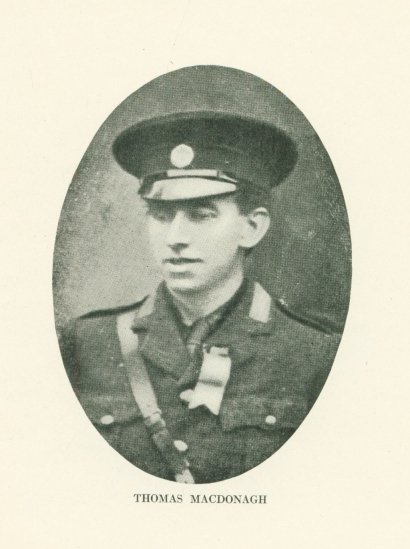
THOMAS MACDONAGH
They rode away. A young lad took my suitcase to the station for me and waited till the train came. The train was only the size of a trolley but had the dignified title of the Clogher Valley Railway. I sat in the corner and closed my eyes. I opened them at every stop to see if there was any sight of the girls. But it was not till the conductor called out, "Next stop Augher," that I had any glimpse of them. Over the hedge that divided the rails from the road I saw Agna's black curly head bobbing up and down and caught a smile from under Teasie's big-brimmed hat. They were peddling for all they were worth in an attempt not to be too far behind the train in arriving at Augher.
I waited at the station for about ten minutes before they came. They jumped off their bicycles; and we commenced to walk along the side of the rails. About fifteen minutes after we crossed over into a field. It was a stiff piece of work for the girls to push their bicycles through the fields and lift them over hedges. When we had gone through four fields we commenced to climb a hill. Near the top of the hill we clambered over another hedge and crossed one more field before we arrived at the farm which was Teasie's home. Teasie's father and mother had made it a home for Agna since she arrived at the town; and to me they also extended a very kindly welcome.
"She has walked all the way from Carrickmore," said Teasie to her mother. "We met her two miles outside of Ballygawley."
"Did you walk all that distance?" asked Mrs. Walsh.
"Yes," I answered. "I don't see how it took me so long to walk it, I'm usually a good walker."
"When did you start?" she asked me.
"Before eight," I answered.
"I think you did very well to walk it in one day," she returned. "Agna and Teasie were going to cycle there and stay over night because it was such a long ride."
"I was told that it wasn't five miles," I said.
"Five miles!" cried the mother. "It's fifteen if it's one, and a bad road at that. You'll want to rest after it. Take her into a bedroom, girls, and let her lie down."
The girls brought me to a bedroom and gave me cool water to bathe my face and hands and feet. Then they ordered me to go to bed. But although I went to bed I did not sleep.
I had been lying there for about two hours when Agna peeped in to see if I was awake.
"Come in," I said.
"Nora, what are we going to do?" was her first question.
"I am going to Dublin as soon as we can and you, of course, are going with me."
"I had my mind made up to try and get there to-morrow when we came back, but I am glad you are here, for now we can be together and won't have to worry about one another." She was speaking in her usual breathless fashion. "I'm afraid we can't go to-night," she said. "Did you hear that there is fighting in Ardee?"
"No," I answered. "I did not hear that; but if there is, we'll go there. It's on our way to Dublin. The men who are fighting will probably make their way to Dublin. If we can catch up with them we will be safer and more sure of getting there. Find out if there is a train to-night."
She went out and returned in a few minutes.
"No," she said. "There is no train to-night, but there is one leaving at five minutes to six in the morning."
"Well," I said. "I suppose we'll have to wait for that."
We caught the five minutes to six train in the morning. It brought us to a junction where we took tickets for Dundalk.
"You're going to a dangerous place," said the ticket agent.
"We won't mind that," we replied.
When we arrived at Dundalk the station was full of soldiers and constabulary. We hurried along out of the station so as not to attract attention. Agna went back and asked a porter if she could get a train to Dublin. The porter told her that the only train going there was a military one, and that the line was in the hands of the military. "There's no telling when there will be a train," he said.
It was then about one o'clock. "Come along," I said to Agna. "We will look for a restaurant and decide what we will do while we are eating." We walked down the street looking for a restaurant. At the foot of the street we saw one, a very small place. Just at the restaurant the street curved, and around the curve we saw that a barricade had been erected by the police authorities. Luckily we did not have to pass it to get to the restaurant. When we had entered and had given our order to the proprietress, she said that it would take some time—would we mind waiting? We assured her that we would not mind waiting and went into the parlor to talk over our situation.
The first decision arrived at was, that as we did not know the name of the villages and towns on the road to Dublin and could not hire a car to take us to any of them, it would be necessary for us to walk. Our next decision was that we would have to abandon our suitcase as it would be likely to attract attention. In order to carry out the second I told Agna that she must go out to buy some brown paper and string. Also, that while she was doing so she must find out if we would have to pass the barricade to get to the Dublin road. The reason why I sent Agna on this business, and did not go myself, was that Agna was so childish looking that no one would suspect her of trying to get to Dublin. Then again I knew that I could trust her to find any information necessary to us; she had been a girl scout and had learned the habit of observation. Also, her accent was more strongly Northern than mine.
With a parting adjuration from me not to be too long lest I become anxious, Agna went out on her errand. As she reached the door the proprietress came out of a room and said, "Are you going out, little girl?"
"Yes," said Agna, "I am going out to get a paper."
"Will you do a message for me while you are out?"
"Certainly," said Agna, "What is it?"
"Do you know the town?" asked the woman.
"No," said Agna, "I haven't been in it this long time." (She had never been in it before.)
"Well," said the woman. "I had better come to the door and show you the place I want you to go to." She did so and gave Agna a message to the butcher's. Agna was glad to do the message because if she were stopped now and asked where she was going to, she could give a definite answer. She left the door and walked towards the barricade. The policeman on duty there did not stop her as she walked through. The barricade was formed simply of country carts drawn across the roadway, leaving room for only one vehicle to pass through, and it was at this space that the policeman stood. As I sat by the window, I saw the policeman stop and examine cyclists, automobilists, and all other vehicles that were passing through. The barricade was on the road running from Dublin to Belfast.
Within twenty minutes Agna returned. She came into the parlor and gave me a bundle of brown paper and string, and then went out to deliver up her other message. She came back quickly and began to tell me the result of her observations. The best thing was that we were on the right side of the barricade and we should not have to pass it when we started out. But her next bit of information was not so pleasant; it was that according to the automobile signs there were fifty-six miles to Dublin. Still, nothing daunted, we began to transfer our kits from the suitcase to the brown paper. When we had finished we had two tidy-looking bundles much more convenient to carry than the suitcase.
While we were eating our dinner the question arose as to what we should do with the suitcase. We settled it by asking the proprietress to take care of it till we came back from Carlingford. She was quite willing to oblige us, she said, as Agna had been so obliging to her. I then paid the bill and we left the restaurant. I felt rather badly at leaving the suitcase behind me, as it had accompanied me for some ten thousand miles of my travels; it was like abandoning an old friend.
XII
It was about two-thirty on Saturday when we started to walk from Dundalk to Dublin, and when it began to grow dark we were still walking. While we were discussing the problem of where to spend the night, we came upon a barricade. We were in a quandary. What were we to do? We slowed up in our walking but that was no use; we were bound to pass it eventually—or be detained. We had not the slightest idea as to what we should do. We did not know the name of the next village, so we could not say that we were going there. We did not even know the name of the village we were in! What should we do? If we were stopped and searched—I had my revolver and ammunition and Agna wore her uniform under her coat and skirt—enough evidence to have us arrested. However, we put on a brave face and stepped forward bravely towards the barricade. About six yards from it we encountered two strong wires which were stretched across the entire width of the road, one reaching to the chin and the other to the knees. To give the impression that we had passed that way before and that we knew all about the wires, we ducked our heads under the high wire and put our legs over the lower one, then continued our walk to the barricade.
It was in charge of a corporal's guard. As we came abreast the soldiers, evidently thinking that we were country girls doing our Saturday's marketing, made some remark, in a broad Belfast accent, about carrying our bundles for us. In an accent broader than theirs, Agna gave them some flippant answer at which they roared with laughter; and while they were laughing we passed on. Further on we came to the village proper. Not until we saw the sign over the Post Office—"Dunleer P.O."—did we know the name of the village through which we were passing.
As we walked it grew darker. "What will we do—where will we spend the night?" I said to Agna. "There are no hotels about here, and if there were we could not go to them as we would have to register. If we ask at the cottages for a night's lodging they may become suspicious. If we walk all night we may meet military or police patrols, and that would mean that we would be sent to Armagh Jail instead of going to Dublin. What will we do?"
"O, pick out a nice field and spend the night there," said Agna airily.
"It looks as if that is just what we'll have to do," I said ruefully. "Come on and pick one before it gets too dark."
We heard a dog barking further down the road—that was the only sign of life. We judged that it was about nine o'clock and that every one was in bed. There was a path that turned to the right off the road which we took and walked along for about one hundred yards. Then we clambered over the hedge and into the field. It looked as if we had chosen a good place for we found ourselves in a sort of dell covered with grass and heather. We searched and found, as we thought, the softest place. Everything around us was so still that we felt compelled to talk in whispers. We could feel the darkness descending on us as Ave sat there, forgetting our weariness in the novelty of the situation.
We had been silent for a long time when Agna said, "To-morrow will be Sunday."
"Yes," I said. "We'll look queer carrying bundles through the villages on a Sunday."
"So we will," said Agna. "Look," she said suddenly. "Why couldn't we put on everything we can. It will make us fatter but it will make the bundles a respectable size. And we'll be warmer to-night," she added.
Her last remark decided me. I had been growing colder every minute I sat there and any suggestion to relieve me was welcome.
"All right," I said. "Let's start and put them on."
We opened the bundles and were very busy for some time. When we had finished there was twice the amount of clothing on than we had when we begun. We looked at each other, feeling bulky.
"I hope my coat will go on me," said Agna as she began to put it on. "There now, I've got everything on me except my towels, and brush and comb. Oh, and my putties."
"You can put them in your coat pocket," I said.
"I've got safety pins, roller bandages, my handkerchiefs and my purse in them so there's no room there."
"Put them in your raincoat pocket." She did so and stood up to inspect herself.
"O Lordy," she exclaimed. "I'm an imitation umbrella." Then she turned her attention to me.
"How did you get on?" she asked.
"Like you," I replied. "Only I've a pair of stockings left."
"Put them on you?" she said. "What's the use of getting boots two sizes too big for you, if you can't wear two pairs of stockings when you want to?"
I had forgotten that I could not get my size when I was buying my marching boots, and was compelled to take a pair two sizes too large. I put the stockings on.
"I never felt so big and heavy in my life before," I remarked.
"You'll be used to it by morning," she said consolingly. "Lie down and go to sleep."
"Sleep—" I commenced when she interrupted me to ask, "Nora, do you think there are any earwigs here? They might get into our ears when we are asleep."
"Earwigs," I repeated. "I don't know. But there's bound to be other insects and they would just as easily get into our ears as earwigs."
"What will we do?" she asked anxiously, for she was tired and wanted to sleep. I looked about and saw the towels.
"Put them around our heads," I said, pointing to them. So we each took a towel and pinned it around our heads to keep out wandering insects while we slept. But we need not have worried about what might happen to us while we slept, for we did not sleep that night.
As we lay there we could see the stars come out one by one, yet we could not sleep. The quietness of the place kept us listening expectantly for we knew not what. A heavy mist began to cover the field and wrapped itself about us till our clothes were dampened through and through. For the first time, I think, we were physically aware of the number of bones in our bodies, for each one seemed to be dancing to a tune of its own. Our teeth were chattering so that we could not speak. In an effort to keep ourselves warm we lay close together with our arms round each other. But our efforts were of no use; we could not sleep nor could we keep ourselves warm. We gave the struggle up and huddling close to the ditch we sat and waited for the dawn.
After an infinity of time the dawn came. Far off at the furthermost edge of the field we saw a streak of gray. As we watched it gradually widening we heard a cock crow in the distance. Under the descending light the fields seemed a glistening sea and our tweed skirts as if sprinkled with diamonds. The birds began to awaken and to chirrup in the hedges. For all we could see or hear, the birds and ourselves were the only stirring, living beings.
We sat on waiting for time to pass. As we did not have a watch with us we gauged the time by the sky. The distance between us and Drogheda we knew to be less than eight miles; and there was a possibility that we might get a train from Drogheda to some of the local stations. But as we were not sure we decided to recommence our walk, so that we would be all the earlier on our way to Dublin. With this thought in our minds we rose stiffly and plodded down the path to the main road. We really did not feel tired. As a matter of fact, we were anxious to have as many adventures and experiences as possible to tell our father when we reached Dublin. We pictured ourselves sitting on his knees, as we had often done before, telling him everything, watching for the ever-ready twinkle in his eye, and saw him give the quick throwback of his head, when we came to the more laughable parts of our story. It was this picture that helped us over the hard parts of our journey. As we went along the road to Drogheda our conversation consisted mainly of—"Wait till we tell Papa this—" or, "What will Papa say to that—" and, "Won't he laugh when we tell him—," so we whiled away the time, fixing firmly in our minds the most amusing parts of our journey.
It was not until we were within two miles of Drogheda that we met with any one on the road. The first person we saw was a cyclist, next we saw a man and woman going to milk the cows. And then as we went further along the road we saw many more people wending their way to town. At last, we came to Drogheda. It was practically deserted—a few milk-carts and a couple of policemen were all that we met as we proceeded into town. Then a church bell began to ring. We followed the sound and soon had joined a crowd that was hurrying to church. We were in time for seven o'clock Mass.
After Mass we wandered about a little hoping to find a place where we could get something to eat, also to find the road to Dublin. On account of it being Sunday and so early in the morning there was no place open. Although hungry we were not as much annoyed at the result of our search for food as contented when we came upon the road to Dublin. As we walked on I saw the railway station. A thought struck me, perhaps we can get a train now. I turned to Agna and said, "Go up to the station and ask if there will be a train to Skerries to-day."
In about fifteen minutes she returned and said there would be no trains running but the military trains. Then once again we started on our tramp.
Agna complained of hunger, and I was none the less hungry. We had not eaten since one-thirty the day before. "Would it be any use, do you think," I asked, turning to Agna, "to call at some of the cottages and ask them to make some tea for us?"
"It might be worth trying, anyway," she replied.
"Well," I said. "I'll wait till it gets a little later then I'll go to some of the cottages and ask."
It was after nine o'clock when I first ventured to a cottage. A woman opened the door to my knock, she had a bonnet on and was draping a shawl about her shoulders.
"We have been walking since early morning," I said, "and want to know if you will make us a cup of tea."
"I would," she replied, "only I've barely time to get to Mass. I'm sorry, but I can't miss Mass. I've to walk to Drogheda."
"No," I said. "It wouldn't do to miss Mass."
She came to the gate and bade me a cordial good-by. I tried two or three cottages after that, but from them all I had the same story—they were all going to Mass, so we had to go without our breakfast.
Just outside Drogheda we saw a milestone bearing the legend "Dublin 25 miles." And from then on the only excitement of our journey was to see who would be the first to spy a milestone. When we saw a milestone marked "Dublin 18 miles" we were exhilarated—Dublin seemed only a few steps away.
Sunday was, if any thing, warmer than the preceding day, and our double outfit made us dreadfully uncomfortable. I knew that it was not the heat or the long walk, or the two pairs of stockings that was responsible for the burning pain in my feet. My feet were burning me as never before. Agna had great faith in liniment. She likes to take it with her when she goes for a long walk; she says it takes the pain and stiffness from her muscles. When we were making our preparations the night before she had "linimented" herself as she calls the operation. I had had no pain or tiredness, but the soles of my feet were sore, and Agna, in her unfailing faith in the bottle, had "linimented" them, overruling whatever objections I had. And now, I was suffering torments—the liniment was burning its way into my flesh, made tender by the two pairs of stockings, heavy boots, and long march. At last, I could stand it no longer, so I said to Agna, "I must get my boots and stockings off—I'll have to get some relief or I'll go mad."