1915 LOOS AND THE FIRST AUTUMN (continued 2)
Reading edition
Christmas Eve was officially celebrated by good works; for the Battalion, its gas still intact, was warned to finish relief by eight o’clock, because, for the rest of the night, our guns would bombard German communication-trenches and back-areas so as to interfere as much as possible with their Christmas dinner issues. The 1st Coldstream filed in, and they filed out back to their various billets and posts at Pont du Hem, La Flinque Farm, and the rest. Christmas Day, their first at the front, and in the line, was officially washed out and treated as the 25th of December, dinners and festivities being held over till they should be comfortably settled in reserve. Some attempts at “fraternisation” seem to have been begun between the front-line trenches in the early morning, but our impersonal and impartial guns shelled every moving figure visible, besides plastering cross-roads and traffic lines at the back. Lieut.-Colonel McCalmont, Lord Desmond FitzGerald, and Captain Antrobus rode over from the 1st Battalion for lunch, and in the afternoon Lord Cavan spoke to the officers of his approaching departure from the Guards Division to command the Fourteenth Corps; of his regrets at the change, and of his undisguised hopes that the Guards Division might be attached to his new command. “He finished by telling us that we were following in the steps of our great 1st Battalion, which, as he has told the King and Sir Francis Lloyd, was as fine a battalion as ever trod.” Then there was a decorated and becandled Christmas tree brought out from England by Captain Alexander, which appeared at dinner, and, later, was planted out in the garden at the back of the mess that all might admire. Likewise, No. 1 Company received a gift of a gramophone, a concertina, and mouth-organs from Miss Laurette Taylor. The Irish take naturally to mouth-organs. The gramophone was put under strict control at once.
On boxing day, the whole 2nd Guards Brigade were relieved by the 1st Brigade, and went back out of reach of the shells to Merville via La Gorgue, passing on the road several companies of the 1st Battalion on their way to relieve the 1st Scots Guards. (“When the like of that happens, and leave is given for to take notice of each other, ye may say that the two battalions cheer. But ’tis more in the nature of a running roar, ye’ll understand, when we Micks meet up.”)
Merville billets were thoroughly good, and the officers’ mess ran to a hard-worked but quite audible piano. Best of all, the fields around were too wet for anything like drill.
The postponed Christmas dinners for the men were given, two companies at a time, on the 28th and 29th, whereby Lieutenant Moore, then Acting Quartermaster, distinguished himself by promptitude, resource, and organisation, remembered to his honour far beyond mere military decorations. At the eleventh hour, owing to the breweries in the back-area being flooded, there was a shortage of beer that should wash down the beef and the pounds of solidest plum-pudding. “As it would have been obviously preferable to have had beer and no dinners to dinners and no beer, Lieutenant Moore galloped off to Estaires pursued by a waggon, while the Second in Command having discovered that some of the Eleventh Corps (it is always sound to stand well with the corps you hope to join) also wanted beer, promised to get it for them if supplied with a lorry, obtained same and bumped off to Hazebrouck. Lieutenant Moore succeeded in getting 500 litres in Estaires and got back in time.” So all was well.
Festivities began a little before two, and lasted till eight. They sat at tables and ate off plates which they had not done since leaving England. Food and drink are after all the only vital matters in war.
The year closed with an interesting lecture on the principles of war, delivered at La Gorgue, which dealt with the “futility of ever surrendering the initiative,” and instanced some French operations round Hartmannsweillerkopf on the Alsace front, when a German general, heavily attacked, launched a counter-attack elsewhere along the line, forcing his enemy to return to their original position after heavy loss. Another example from the German gas-attack on St. Julien, when the English confined themselves to desperately attacking the captured section, whereby they only lost more men instead of counter-attacking farther down the ridge. This led to the conclusion that “to sit passively on the defensive with no idea of attacking was so fatuous as not to be worth considering as an operation of war.” At present, said the lecturer, we were on the defensive, but purely to gain time until we had the men and materials ready for a great offensive. Meantime the correct action was to “wear down the enemy in every way.” Whence the conclusion that the attitude of the Guards Division for the past seven weeks had been eminently proper; since our guns had bombarded “all the time,” and had cut the German wire in many places, so that the enemy never knew when he would be attacked. Further, our troops had thrice entered his trenches, besides twice making every preparation to do so (when, finding he was ready, we “very rightly abandoned the enterprise”). Not once, it was shown, had the enemy even attempted to enter our trenches. In fact, he was reduced “to a state of pulp and blotting-paper.” The lecture ended with the news that our motor-buses and lateral railways could concentrate one army corps on any part of the British front in twenty-four hours, and two corps in forty-eight. Also that the Supreme Command had decided it was useless to break through anywhere on a narrower front than twenty kilometres.
And on this good hearing the year ’15 ended for the 2nd Battalion of the Irish Guards; the War, owing to the lack of men and material which should have been trained and prepared beforehand, having just two years, ten months, and eleven days more to run.
click here for larger image.
Emery Walker Ltd. del. et sc.
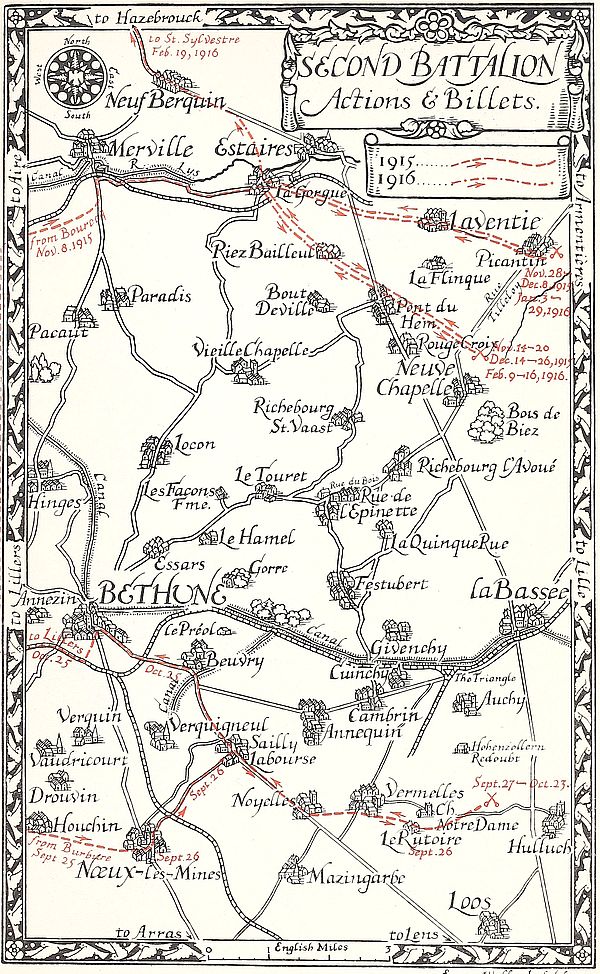
SECOND BATTALION Actions & Billets.
PRINTED IN GREAT BRITAIN BY EMERY WALKER LTD., LONDON