1915 LA BASSÉE TO LAVENTIE
Reading edition
They were not disappointed. New Year’s Day was marked by the flooding out of a section of forward trenches, and by experiments with a trench-mortar, from which 2nd Lieutenant Keating and some Garrison gunners threw three bombs at an enemy digging-party a couple of hundred yards away. This is the first reference to our use of trench-mortars in the young campaign. The enemy retaliated next day by bombing from their real trench-mortars, at a distance of seven hundred yards, the small farm-house where Battalion Headquarters lay. The bombs could be seen “coming at a very steep angle, but the house was only once hit.” Daylight showed the work of the Irish trench-mortar to have been so good—it had blown a gap in the German trench—that they continued it and inflicted and observed much damage.
They were relieved on the 3rd January by the King’s Royal Rifles and got to billets near Vieille Chapelle late that night. A London Gazette announced that the Distinguished Conduct Medal had been awarded No. 2535 Sergeant C. Harradine; No. 1664 Corporal C. Moran; No. 4015 Private W. Moore (since killed in action); No. 2853 Lance-Corporal W. Delaney. Also “the new decoration called the Military Cross” had been awarded to Lieutenant the Hon. H. W. Gough.
The Battalion, as a whole, had its reward for the past ten days when the Brigadier expressed his approval of the work of the Guards Brigade “and especially that of the Irish Guards.”
Cleaning and refit, classes in bomb-throwing (both by hand and from rifles) under the Engineers and an elementary machine-gun class under 2nd Lieutenant Straker, filled in the week; but the most appreciated boon at Vieille Chapelle was some huge tubs in which the men could be boiled clean. Father Gwynne held service in the roofless shell-wrecked church, long since wiped out.
They took over trenches from the Worcesters on the 8th with a cold knowledge of what awaited them; for the Diary notes, the day before: “Another wet day, which will probably completely fill trenches on the left of the new line with water.” But it did not fill them more than two feet deep, though the whole line was afloat, and in the communication-trenches seven men got stuck in the mud; one of them was not extricated for six hours. The relief took six and a half hours in pouring rain, with one man killed and two wounded. The front line of the Guards Brigade was held by the 3rd Coldstream on the right, the 2nd Coldstream in support; one Company of the 2nd Grenadiers in the centre, and the rest of the Battalion in support; the Irish Guards on the left, the Herts Territorials in support. The Grenadiers relieved their front company every twenty-four hours, the others every forty-eight. This meant that Battalion C.O.’s had to spend most of their time in the front line studying what was, in effect, the navigation of canals.
On the 9th January, for example, the water averaged three feet in the trenches and, as that average rose, it was decided to leave a few strong posts in comparatively dry positions and withdraw the others along the Rue du Bois into the destroyed village of Richebourg L’Avoué. Luckily, the enemy, not two hundred yards away, had his own troubles to attend to and, despite his lavish flares and musketry-fire, our men were extricated, bodily in some instances, with but 3 killed and 2 wounded.
On the 10th January the Herts Regiment relieved them, and the whole Battalion billeted at Richebourg St. Vaast. Casualties from small-arm fire had been increasing owing to the sodden state of the parapets; but the Battalion retaliated a little from one “telescopic-sighted rifle” sent up by Lieutenant the Earl of Kingston, with which Drill-Sergeant Bracken “certainly” accounted for 3 killed and 4 wounded of the enemy. The Diary, mercifully blind to the dreadful years to come, thinks, “There should be many of these rifles used as long as the army is sitting in trenches.” Many of them were so used: this, the father of them all, now hangs in the Regimental Mess.
Then trench-feet and rheumatism developed, and in forty-eight hours fifty men had to be sent to hospital for one form or other of these complaints.
A draft of a hundred fresh men arrived between the 11th and 12th of January with six officers: Captain P. S. Long-Innes, 2nd Lieutenants F. F. Graham, J. R. Ralli, R. B. H. Kemp, D. W. Gunston (Derek) and J. T. Robyns. Economy in officers and men was not yet possible; for when an officer was not in the front line he had more than all he could do to look after what comforts were obtainable for the men. Yet concessions were made to human weakness; for when the Battalion returned to its trenches on the 12th an order was received and, to some extent, obeyed that “men were not to stand in the water for more than twelve hours at a time.” This called for continuous reliefs of the platoons, as it took a man most of his rest in billets to scrape himself moderately clean. To save the labour of portage through the mud, each man was given two days’ supplies when he went into the trenches, plus some dry tea and a couple of tins of maconochie to heat up over the braziers. The idea worked satisfactorily; for the days of the merciless air-patrols had yet to come; and the braziers flared naked to heaven while the Irish “drummed up,” which is to say, stewed their tea or rations on them.
The hopeless work of improving positions in soil no stiffer than porridge was resumed, and the “telescopic-sighted rifle,” in the hands of Sergeant-Major Kirk and Drill-Sergeant Bracken, who were later congratulated by the G.O.C. Second Division, continued its discreet and guarded labours among the enemy. Only 1 man was killed and 1 wounded on the 13th January, and the night of that easy day passed off quietly, “the enemy occupying himself chiefly with singing songs or playing on mouth-organs.” Here and elsewhere he was given to spasms of music for no ascertainable reason, which the Irish, who do not naturally burst into song, rather resented. Between morceaux he sent up many coloured flares, while our working-parties silently completed and christened by the name of “Gibraltar” a post to command a flooded gap in the oozy line.
They were relieved on the 15th January by the Highland Light Infantry of the 3rd Brigade (Lahore Division) which was taking over the line held by the 4th (Guards) Brigade. The Battalion went back to Brigade reserve billets at Locon.[5]
Their last week in the trenches had cost them 82 casualties including sick, but it is worth noting that, at this time, Captain McCarthy, the Medical Officer, by issuing mustard mixed with lard for the men to rub on their feet, had in three days got the better of the epidemic of “trench” or, as they were then called, “swollen” feet.
It was while in reserve that 2nd Lieut. Keating, Bombing Instructor and in charge of the trench-mortars, lost his life and 13 men were wounded owing to the premature explosion of an old-type fused bomb with which he was instructing a class. Second Lieutenant Keating was buried next day in the cemetery near Le Touret, where many Guardsmen were already laid, and his epitaph may worthily stand as it was written—“A very capable officer, always ready to undertake any task however difficult or dangerous.”
After a few days the Battalion went into Corps Reserve and spent a week in being “smartened up” behind the line with steady drill, rifle exercises, route-marching and kit inspection, on rainy days, lest life in the caked filth of the trenches should lead any one to forget the standard of the Brigade of Guards which under no circumstance allows any excuse.
Their work was interrupted by another “Kaiser-battle,” obediently planned to celebrate the All Highest’s birthday. It began on the 25th January with a demonstration along the whole flat front from Festubert to Vermelles. Béthune was also shelled from an armoured train run out of La Bassée, and a heavy attack was launched by Prussian infantry on a salient of our line, held by the 1st Infantry Brigade, where it joined the French line among the tangle of railway tracks and brick-fields near Cuinchy. Owing to the mud, the salient was lightly manned by half a battalion of the Scots Guards and half a battalion of the Coldstream. Their trenches were wiped out by the artillery attack and their line fell back, perhaps half a mile, to a partially prepared position among the brick-fields and railway lines between the Aire-La Bassée Canal and the La Bassée-Béthune road. Here fighting continued with reinforcements and counter-attacks knee-deep in mud till the enemy were checked and a none too stable defence made good between a mess of German communication-trenches and a keep or redoubt held by the British among the huge brick-stacks by the railway. So far as the Battalion was concerned, this phase of the affair seems to have led to no more than two or three days’ standing-to in readiness to support with the rest of the Brigade, and taking what odd shells fell to their share.
No institutions are more self-centred than a battalion in the face of war. “Steady drill,” and company kit inspections were carried on in the lulls of the waiting, and their main preoccupation was how much water might be expected in the new trenches when their turn came to occupy them. The Germans were devoting some of their heavy artillery to shelling the lock of the Aire-La Bassée Canal at Pont Fixe, between Givenchy and Cuinchy, in the hope of bursting it and flooding the country. They spent more than a hundred eight-inch howitzer shells on that endeavour in one day, and later—long after the lock had been thoroughly protected with sandbags—used to give it stated doses of shell at regular intervals. Similarly, they would bombard one special spot on the line near Béthune because once in ’14 an armoured train of ours had fired thence at them.
The Battalion had just been reinforced by a draft of 107 men and 4 officers—Captain Eric Greer, Lieutenant Blacker-Douglass, 2nd Lieutenant R. G. C. Yerburgh, and 2nd Lieutenant S. G. Tallents. They were under orders to move up towards the fighting among the brick-fields which had opened on the 25th, and had not ceased since. Unofficial reports described the trenches they were to take over as “not very wet but otherwise damnable,” and on the 30th January the Battalion definitely moved from Locon, with the 2nd Coldstream, via Béthune to Cuinchy. Here the Coldstream took over from the 2nd Brigade the whole line of a thousand yards of trench occupied by them; the Irish furnishing supports. The rest of the Brigade, that is to say, the Herts Territorials, the Grenadiers, and the 3rd Coldstream were at Annequin, Beuvry, and Béthune.
The companies were disposed between the La Bassée-Béthune road and the railway, beside the Aire-La Bassée Canal. The centre of their line consisted of a collection of huge dull plum-coloured brick-stacks, mottled with black, which might have been originally thirty feet high. Five of these were held by our people and the others by the enemy—the whole connected and interlocked by saps and communication-trenches new and old, without key or finality. Neither side could live in comfort at such close quarters until they had strengthened their lines either by local attacks, bombing raids or systematised artillery work. “The whole position,” an officer remarks professionally, “is most interesting and requires careful handling and a considerable amount of ingenuity.”
Click on the map for larger image
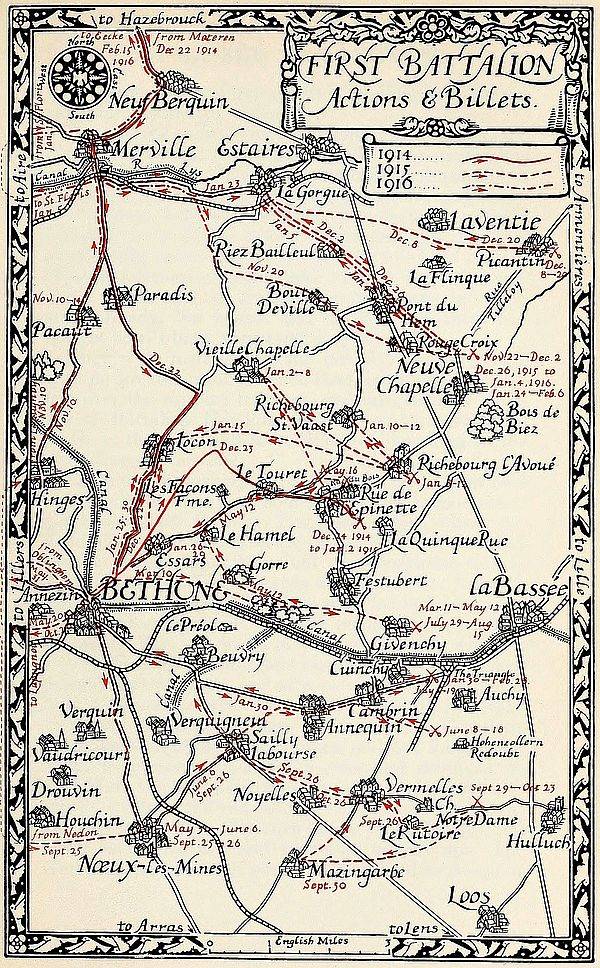
Emery Walker Ltd. del. et sc.
FIRST BATTALION
Actions & Billets.
PRINTED IN GREAT BRITAIN BY EMERY WALKER LTD., LONDON
Except for railway embankments and culverts, the country about was so flat that a bullet once started had no reason to stop. The men were billeted in solid-built Flemish houses with bullet-proof partitions, and therefore, unless noticeably shelled, were inclined to walk about in front of the houses in the daylight, till they were sternly set to work to clean their billets of months of accumulations of refuse and to bury neglected carcases. War and all connected with it was infinitely stale already, but houses and the ruins of them had not yet been wholly wiped out in that sector.
They were installed by the last day of the month with no greater inconvenience than drifts of stray bullets over the support trenches, and unsystematic shelling of Battalion Headquarters two or three hundred yards in the rear, and some desultory bombing in the complicated front line.
Early in the morning of the 1st February a post held by the Coldstream in a hollow near the embankment, just west of the Railway Triangle—a spot unholy beyond most, even in this sector—was bombed and rushed by the enemy through an old communication-trench. No. 4 Company Irish Guards was ordered to help the Coldstream’s attack. The men were led by Lieutenant Blacker-Douglass who had but rejoined on the 25th January. He was knocked over by a bomb within a few yards of the German barricade to the trench, picked himself up and went on, only to be shot through the head a moment later. Lieutenant Lee of the same Company was shot through the heart; the Company Commander, Captain Long-Innes, and 2nd Lieutenant Blom were wounded, and the command devolved on C.Q.M.S. Carton, who, in spite of a verbal order to retire “which he did not believe,” held on till the morning in the trench under such cover of shell-holes and hasty barricades as could be found or put up. The Germans were too well posted to be moved by bomb or rifle, so, when daylight showed the situation, our big guns were called upon to shell for ten minutes, with shrapnel, the hollow where they lay. The spectacle was sickening, but the results were satisfactory. Then a second attack of some fifty Coldstream and thirty Irish Guards of No. 1 Company under Lieutenants Graham and Innes went forward, hung for a moment on the fringe of their own shrapnel—for barrages were new things—and swept up the trench. It was here that Lance-Corporal O’Leary, Lieutenant Innes’s orderly, won his V.C. He rushed up along the railway embankment above the trenches, shot down 5 Germans behind their first barricade in the trench, then 3 more trying to work a machine-gun at the next barricade fifty yards farther along the trench, and took a couple of prisoners. Eye-witnesses report that he did his work quite leisurely and wandered out into the open, visible for any distance around, intent upon killing another German to whom he had taken a dislike. Meantime, Graham, badly wounded in the head, and Innes, together with some Coldstream, had worked their way into the post and found it deserted. Our guns and our attack had accounted for about 30 dead, but had left 32 wounded and unwounded prisoners, all of whom, with one exception, wept aloud. The hollow was full of mixed dead—Coldstream, Irish, and German.
The men who remained of No. 4 Company did not settle down to the work of consolidating their position till they had found Blacker-Douglass’s body. At least a couple of his company had been wounded in the first attack while trying to bring it away. Lee’s body was recovered not far off.
A quarter of an hour after the post had fallen, the Engineers were up with unlimited sand-bags and helped the men who worked as they ate among the piled horrors around them, while everything was made ready for the expected German counter-attack. It did not come. Not only had the post been abandoned, but also a couple of trenches running out of it to the southward. These were duly barricaded in case the enemy were minded to work back along them at dusk. But for the rest of the day they preferred to shell; killing 2 and wounding 5 men of the two companies which were relieved by a company of the 3rd Coldstream and one of the 3rd Grenadiers. Our men returned to billets “very tired and hungry, but very pleased with themselves.” That day’s work had cost us 2 officers and 8 men killed; 3 officers and 24 men wounded, and 2 men missing. In return, two machine-guns, 8 whole and 24 wounded prisoners had been taken, the post recovered and, perhaps, sixty yards of additional trench with it. Such was the price paid in those years for maintaining even a foothold against the massed pressure of the enemy. It is distinctly noted in the Diary that two complete machine-guns were added to the defence of the post after it had been recaptured. Machine-guns were then valuable articles of barter, for when the French who were their neighbours wished to borrow one such article “for moral and material support,” a Brigadier-General’s permission had to be obtained.
This experience had shown it was better for each battalion in the line to provide its own supports, and they reorganized on the 2nd February on this basis; the 2nd and 3rd Coldstream Guards taking over the left half of the line up to within fifty yards of the Keep, while for their right, to the main La Bassée road, the 2nd Grenadiers and the Irish Guards were responsible—each with two companies in the fire trench and two in support, and all on forty-eight hours’ relief.
The enemy continued to shell the captured position, killing 2 and wounding 9 men that day, but no counter-attack developed and a few days later it was decided to straighten out the front then held by the 4th (Guards) Brigade. The fighting on the 25th had left it running irregularly through the big brick-yard, before mentioned. Of the dozen or more solid stacks of brick, four or five connected by a parapet of loose bricks and known as the Keep, were in our hands. The other eight, irregularly spaced, made a most awkward wedge into our line. They were backed by a labyrinth of German trench-work, and, being shell-proof, supports could be massed behind them in perfect safety. The nearest were within bombing distance of the Keep, and, in those days, the Germans had more and better bombs than we. On every account, then, the wedge had to be cleared, the stacks and their connecting trenches overrun and the line advanced a hundred and fifty yards or so to get a better field of fire. As a preliminary, a small but necessary piece of German trench on the flanks of the Keep was captured by the Irish on the 5th February with a loss of but 2 killed and none wounded.
At 2 P. M. on the 6th of February the stacks were heavily bombarded for a quarter of an hour—a large allowance. Even “Mother,” a neighbouring 9.2, probably of naval extraction, took part in it, and some French artillery ringed the approaches on the German side with screens of black melenite fumes, while No. 2 Company from the front trenches swept the German parapet facing them with five minutes of that old “rapid fire” which the Germans in the Salient and elsewhere had so often mistaken for machine-gun work. Then two assaulting parties of thirty men each from Nos. 3 and 1 Companies, under 2nd Lieutenant T. Musgrave and J. Ralli, opened the attack on five of the eight stacks. The other three were fairly dealt with on the same lines by the 3rd Coldstream. As there was no wire left on the trench before our stacks, our party got there almost at once, but Musgrave, ahead of his men, was shot by a group of five Germans who showed fight behind a few fatal unbroken strands in the rear. They were all killed a moment later when the men came up. Then the supporting parties under Lieutenant Innes were slipped, together with the Engineers under Major Fowkes, R.E., and the combined attack swept on through the brick-stacks, in and out of the trenches and around and behind them, where the Germans were shot and bayoneted as found, till—fighting, digging, cursing and sand-bagging—our men had hacked their way some seventy yards beyond their objective and dug in under a shelf of raw ground about three feet high, probably the lip of an old clay-pit. Our guns had lifted and were choking off all attempts at possible counter-attacks, but the German supports seem to have evaporated in the direction of La Bassée. There was a ridge in front of the captured position whence a few bullets were still dropping, but the back of the defence had been broken and, as firing diminished, first one and then two out of every three men were set digging in and filling sand-bags. The fortunes of the little campaign had gone smoothly, and when it was necessary, in the rough and tumble of the trench-work, to bring up reinforcements or more shovels and ammunition for the digging-parties, the indefatigable and brotherly Herts Territorials were drawn upon. The Coldstream had carried their share of the front and lay in line on our left, and at dusk, while the Engineers were putting up more wire, under rifle-fire at 150 yards’ range, the position was secure.
Our casualties, thanks to the bombardment and the swiftness of the attack, were only 1 officer and 6 men killed and 25 wounded. Father Gwynne, the Chaplain, was severely wounded by a piece of shrapnel while watching the attack “from an observation-post,” which, as the Father understood it, meant as far forward as possible, in order that he might be ready to give comfort to the dying. The Coldstream gathered in twenty-eight prisoners, the Irish none, but among their spoils is entered “one Iron Cross” won rather picturesquely. At the opening of the rush the Germans made a close-range bombing-raid on one of the corners of the Keep and at last pitched a bomb on to the top of a sand-bag redoubt. This so annoyed one of our bomb-throwers, a giant of the name of Hennigan, of No. 1 Company, that he picked up a trench-mortar bomb (no trinket) which lay convenient, cut down the fuse for short range and threw it at a spot where he had caught a glimpse of a German officer. The bomb burst almost before it reached the ground, and must have made a direct hit; for nothing upon the officer was recognisable later save the Iron Cross, which in due time went to the Regimental Orderly Room. Hennigan was awarded the D.C.M.; for his bomb also blew in and blocked up the communication-trench through which the bombers came—a matter which he regarded as a side-issue compared to his “splendid bowlin’.”
The companies were relieved in the evening by a company of Grenadiers, and as they wandered back through the new-taken trenches in the winter dusk, lost their way among all manner of horrors. One officer wrote: “I fell over and became involved in a kind of wrestling-match with a shapeless Thing that turned out to be a dead man without a head ... and so back to Beuvry, very tired and sad for the death of Tommy” (Musgrave).
There were other casualties that moved laughter under the ribs of death. A man reported after the action that his teeth were “all broke on him.” His Company Officer naturally expressed sympathy but some surprise at not seeing a bullet-hole through both cheeks. “I took them out and put them in my pocket for the charge, Sorr, and they all broke on me,” was the reply. “Well, go to the doctor and see if he can get you a new set.” “I’ve been to him, Sorr, and it’s little sympathy I got. He just gave me a pill and chased me away, Sorr.”
A weird attempt was made at daybreak on the 7th February by a forlorn hope of some fifty Germans to charge the newly installed line at a point where the Coldstream and 2nd Grenadiers joined. They dashed out across the ground from behind a stack, the officer waving his sword, and were all killed or wounded on or close up to our wire. Men said there seemed no meaning or reason in the affair, unless it was a suicide-party of Germans who had run from the attack of the day before and had been ordered thus to die. One of their wounded lay out all day, and when the Irish were taking over the relief on the 8th some Germans shouted loudly from their trenches and one stood up and pointed to the wounded man. Said the Grenadiers who were being relieved: “Come and get him!” A couple of German stretcher-bearers came out and bore their comrade away, not thirty yards from our trench, while our men held their fire.
In the same relief it fell to the Irish to examine the body of a single German who had crept up and of a sudden peered into our front-line trench, where a Grenadier promptly shot him. He dropped on the edge of the parapet and lay “like a man praying.” Since he had no rifle, it was assumed he was a bomber; but after dark they found he was wholly unarmed. At almost the same hour of the previous night another German came to precisely the same end in the same posture on the right flank of the line. Whether these two were deserters or scouts who would pretend to be deserters, if captured, was never settled. The trenches were full of such mysteries. Strange trades, too, were driven there. A man, now gone to Valhalla, for he was utterly brave, did not approve of letting dead Germans lie unvisited before the lines. He would mark the body down in the course of his day’s work, thrust a stick in the parados to give him his direction, and at night, or preferably when the morning fog lay heavy on the landscape, would slip across to his quarry and return with his pockets filled with loot. Many officers had seen C——’s stick at the back of the trench. Some living may like to learn now why it was there.[6]
A draft of one hundred men, making good the week’s losses, came in on the 8th February under Captain G. E. Young, Lieutenants T. Allen and C. Pease, and 2nd Lieutenant V. W. D. Fox. Among them were many wounded who had returned. They fell to at once on the strengthening and cleaning up of the new line which lay less than a hundred yards from the enemy. It supported the French line where that joined on to ours, and the officers would visit together through a tunnel under the roadway. Of this forlorn part of the world there is a tale that stands best as it was written by one of the officers of the Battalion: “And while we were barricading with sand-bags where the old trench joined the road, a dead Coldstream lying against a tree watched us with dull unobservant eyes.... While we were trudging along the pavé, mortally weary (after relief), said the Sergeant to me: ‘Did you hear what happened last night? You saw that dead man by the tree, Sir? Well, the covering-party they lay all round him. One of them tapped him on the shoulder an’ asked him if he were asleep. And presently, the C.S.M. that came down with the relief, he whispered to the Corporal, “How many men have ye got out, Corporal?” “Five, Sir,” says the Corporal. “I can see six meself,” says the C.S.M. “Five belong to me,” says the Corporal. “Count ’em, lad,” says the C.S.M. “Five came out with me,” says the Corporal, “and the sixth, faith, ’tis cold he is with watching us every night this six weeks.”’”
For a while the days and nights were peaceful, as peace was counted round the brick-stacks. The unspeakably foul German trenches were supplemented with new ones, communication-trenches multiplied and marked with proper sign-boards, and such historic main-arteries as the “Old Kent Road” trench paved with bricks from the stacks. By night the front line sat and shivered round braziers in the freezing dark while bits of new-made trench fell around them, and listening-posts at the head of old saps and barricaded alleys reported imaginary night-attacks. When they worked on a captured trench they were like as not to find it bottomed, or worse still, revetted, with an enemy corpse, which the sliding mud would deliver hideously into the arms of the party. On such occasions the sensitive would be sick, while the more hardened warmed and ate their food unperturbed amid all the offal. But there were compensations.
On the 11th February, for example, it is noted that the men had baked meat and suet pudding “for the first time since the war began”; on the 13th not one man was even wounded through the whole day and night; while on the 15th more than half the Battalion had hot baths “for the first time since January.” The diaries record these facts as of equal importance with a small advance by the French on their right, who captured a trench but fell into a nest of angry machine-guns and had to retire. The Battalion’s share in the work was but to assist in keeping the enemy’s heads down; in return for which the Germans shelled them an hour, killing 1 and wounding 5. Our men persisted in under-cutting the sides of the trench to make dug-outs, in the belief that unsupported caves of earth were safe against high explosives. Timbers and framing, indeed material of any kind, were still scarce, and doors and boards from wrecked houses were used in erecting parapets. Sand-bags were made out of old petticoats and pyjamas, and the farmers’ fences supplied an indifferent sort of wire. Sand-bags, wires, and stakes did not arrive at the front in appreciable quantities till the spring of 1915, and telephones about the same date. There was no abundance of any of these things till late in 1915; for the country had not made any preparation for war till war began, and the price of this was the lives of men.
The simplicity of our battery-work is shown by the joyous statement that “we now have a Gunner officer to live with us in our headquarters in the trenches and a telephone to the battery so that fire can be brought to bear quickly on any part of our front as necessity arises.” At times there would be an error in the signals, whereby the Battalion coming up from billets to the trenches through the dark would be urged to make haste because their section was being attacked, and after a breathless arrival would find the artillery busied on some small affair away on a flank.
Characteristically enough, the Germans when bombarded, as they were with effect by the French, would retaliate by shelling our lines. The shells worried the Irish less than the fact that three of their officers—Major the Earl of Rosse, Lieutenant Rankin, and 2nd Lieutenant D. Parsons, who arrived at 2 A. M. with a draft from home, were found to be temporarily attached to the Scots Guards. At that time the Battalion was 25 officers and 900 men strong, and the wastage from snipers and shells, both in the trench and while relieving, was not more than six daily.
There were reports that the enemy was now mining under the brick-stacks, so a mining company was formed, and an officer experimented successfully in firing rifle-grenades point-blank from the rifle, instead of parabolically which allowed the enemy time to see them descending. This was for the benefit of a few persistent snipers seventy yards away who were effectively moved and their dug-out set ablaze by the new form of attack.
Towards the end of the month our men had finished their trench-cleanings and brickings-up, had buried all dead that could be got at, and word went round that, if the situation on the 25th February could be considered “healthy” the Prince of Wales would visit them. The Germans, perhaps on information received (for the back-areas were thronged with spies), chose that day to be very active with a small gun, and as a fresh trench linking up with the French on the La Bassée road had been made and was visible against some new-fallen snow, they shelled that too. For this reason the Prince was not taken quite up to the front line, at which “he was rather annoyed.” The precaution was reasonable enough. A few minutes after he had left a sector judged “comparatively safe” 2nd Lieutenant T. Allen was killed by a shell pitching on the parapet there. Three privates were also killed and 4 wounded by shell or bomb on that “healthy” day. The same gun which had been giving trouble during the Prince’s visit was thought to be located by flash somewhere on the north side of the La Bassée road and siege-howitzers kept it subdued till the evening of the 25th, when, with the usual German scrupulosity, it began to shell the main road, by which reliefs came, at ten-minute intervals for three hours, but with no casualties as far as the Irish were concerned. One shell, duly noted, arrived near Brigade Headquarters and a battery of ours was asked to abate the nuisance. It is curious that only a few hours later the Germans were shelling a French battery not far from Béthune with ten-inch stuff which, if expended on the main road, would have disorganised our reliefs very completely. This was on the eve of going into Corps Reserve at Béthune, where the Battalion took over the Collège de Jeunes Filles from the Worcesters, the best billets since the war began, but, alas! furnished “with a large square where drill can take place.”
The month’s losses had been 4 officers and 34 men killed, 5 officers and 85 men wounded, or 128 men in all.
At Béthune they enjoyed nine days’ rest, with “steady drill and route-marches,” concerts in the local theatre, inter-regimental boxing with the 2nd Grenadiers, and a Divisional football competition for a cup presented by the Bishop of Khartum. Here they defeated the 6th Field Ambulance and lost by two goals to nil to the Oxford and Bucks L.I. Major Trefusis, C.O., Captain Mylne and 2nd Lieutenant H. Marion-Crawford went home for a week’s leave—for that wonderful experience of “first leave” was now available—while Major the Earl of Rosse, who had been recovered from the Scots Guards, took over command.
Neuve Chapelle
By the 9th March every one had returned and with them a draft of a hundred men under Lieutenant C. Wynter, 2nd Lieutenant T. E. Nugent and 2nd Lieutenant Hon. W. S. P. Alexander, just in time to take their share in the operations before Neuve Chapelle.
This village, which lay four miles under the Aubers Ridge, at the entrance to the open country round Lille and Tourcoing, had been in German hands since Smith-Dorrien’s Corps were turned out of it on October 26th and 27th of the year before. Assuming that our troops could break through at that point, that no reinforcements could be brought up by the Germans over all their well-considered lines of communication, that the Aubers Ridge could be surrounded and held, that cavalry could follow up infantry armed with machine-guns across trenches and through country studded with fortified posts, it was considered, in some quarters, that an attack might be driven through even to Lille itself.
Our armies, penned for months in the trenches, had suffered heavy wastage, though they were being built up from behind with men, material and guns on a scale which, by all past standards, was enormous. The enemy, with infinitely larger resources, had meantime strengthened and restrengthened himself behind belt upon belt of barbed wire with uncounted machine-gun posts and an artillery of high explosives to which the world then held no equal. His hand was heavy, too, in offence, and the French armies to the eastward felt it as soon as the spring opened. To ease that pressure, to release our troops from the burden of mere wasteful waiting, and to break, as far as might be, the edge of the enemy at the outset of the ’15 campaign, were presumably objects of the battle only second to the somewhat ambitious project of entering Lille.
Neuve Chapelle proved in large what the men in the trenches had learned in little throughout the winter—that unless artillery utterly root out barbed-wire trenches, machine-gun posts, and fortified houses, no valour of attacking infantry can pierce a modern defensive line. More than three hundred guns—say 5 per cent. of the number that our armies had in the last years of the war—opened upon Neuve Chapelle and its defences at 7.30 on the morning of March 10 for half an hour “in a bombardment without parallel!” Where the fire fell it wiped out everything above the sodden, muddy ground, so utterly breaking the defence that for a while the attack of Rawlinson’s Fourth Army Corps went forward with hardly a check across shapeless overturned wreckage of men and things. Then, at one point after another, along the whole bare front, battalions found themselves hung up before, or trapped between, breadths of uncut wire that covered nests of machine-guns, and were withered up before any artillery could be warned to their help. This was the fate of the 6th Brigade, whose part in the work on that sector was to capture two lines of trenches in front of Givenchy. Three battalions of the 4th (Guards) Brigade—the 2nd Grenadiers, 1st Irish and 2nd Coldstream—were attached to it as Divisional Reserve, and the remaining two battalions of the brigade—the 3rd Coldstream Guards and the Herts Regiment under Colonel Matheson—as Corps Reserve.
The Battalion left billets near Béthune in the early dawn of the 10th March and moved to a wood just north of the Aire-La Bassée Canal, where it remained till midnight, when it went forward to take over some trenches held by the King’s Liverpool and South Staffords (6th Brigade) whose attack had failed. Our guns had only succeeded in blowing an inadequate hole or two in the enemy’s wire which at many places was reported as ten yards deep, and the assaulting battalions had, as usual, been halted there and cut down. The only consolation for the heavy losses in men and officers was the news that the attack farther north had gone well and that a thousand Germans had been captured.
A fresh attack was ordered on the morning of the 11th, but the bombardment was delayed by fog and did so little damage to the wire that by afternoon the idea was abandoned, and in the evening the 4th (Guards) Brigade took over the line that had been held by the 6th Brigade. They were filthy trenches; their parapets were not bullet-proof, and the houses behind them blown to pieces; Headquarters Mess lived in one cellar, the C.O. of the Battalion slept in another, and the communication-trenches were far too shallow. Part of our front had to be evacuated while our bombardment was going on as it was too close to the enemy for safe shelling. The failure of the 6th Brigade’s attack in this quarter reduced the next day’s operation to a holding affair of rifle and heavy-gun fire, delayed and hampered by the morning fog, and on the 13th March the Battalion went into billets at Le Préol. The battle round Neuve Chapelle itself, they were told, had yielded more prisoners; but heavy German reinforcements were being moved up.
Late that night a draft of eighty N.C.O.’s, and men arrived under Lieutenant J. S. N. FitzGerald, among them the first detachment of specially enlisted (late) R.I. Constabulary—large drilled men—who were to play so solid a part in the history and the glory of the Battalion. The strength of the Battalion at that moment was 1080 with some 26 officers—much greater than it had been at any time during the War. They were all turned into the endless work of cleaning out and draining foul trenches, and the dog’s life of holding them under regular and irregular bombardments.
It was safer to relieve by daylight rather than by night, as darkness brought bursts of sudden rifle and machine-gun fire, despatched at a venture from behind the five-deep line of German chevaux-de-frise not seventy yards away. Tempting openings, too, were left in the wire to invite attack, but the bait was not taken. Neuve Chapelle had been a failure except in so far as it had shown the enemy that winter had not dulled any of our arms, and it was recognized we must continue to sit still till men and material should accumulate behind us. The documents and diaries of those weeks admit this with the unshaken cheerfulness of the race. Yet, even so, the actual and potential strength of the enemy was not realised.
Very slowly, and always with the thought at the back of the mind that the deadlock might break at any moment, the Army set itself, battalion by battalion, to learn the war it was waging.
On the 15th of March 2nd Lieutenant H. Marion-Crawford was appointed Brigade Bombing Officer to the Guards Brigade with sixty men under him attached to the Irish Guards. The “jam-pot” grenade of 1914 was practically obsolete by now; the “stick” hand-grenade of the hair-brush type and the grenade fired from the rifle had succeeded it and were appearing on the front in appreciable quantities. The Mills bomb, which superseded all others both for hand and rifle, was not born till the autumn of 1915 and was not lavishly supplied till the opening of the next year.
On the 16th March, or five days after their share of the battle of Neuve Chapelle had ended, and they lay in the trenches, a moaning was heard in the darkness of No Man’s Land and a corporal sent out to report. He came back saying that he had got into a trench some thirty yards from the front line where he had seen a lighted candle and heard what he believed to be Germans talking. Another patrol was despatched and at last came back with a wounded man of the King’s Liverpools, who had been lying out since the 10th. He said he had been wounded in the assault, captured as he was trying to crawl back, stripped of boots, equipment and rations, but left with a blanket, and the enemy apparently visited him every night as they patrolled the trench. An attempt was made to capture that patrol, but in the darkness the trench was missed altogether.
The enemy celebrated the day before St. Patrick’s Day and the day itself, March 17, by several hours of brisk shelling of Givenchy, timed to catch the evening reliefs, but luckily without casualties. Queen Alexandra sent the Battalion their shamrock; telegrams wishing them good luck were duly received from Lord Kitchener, Colonel of the Battalion, Brigadier-General Nugent, and a letter from Sir Charles Monro commanding the First Army Corps. Father Gwynne held an open-air service in the early morning, and every man was given a hot bath at Béthune. More important still, every man who wanted it had free beer with his dinner, and in those days beer was beer indeed.
The end of the month was filled with constructive work and the linking up and strengthening of trenches, and the burial, where possible, of “the very old dead”—twenty-nine of them in one day—and always unrelaxing watch and ward against the enemy. At times he puzzled them, as when one evening he threw bombs just over his own parapet till it seemed that he must be busy blowing holes in his own deep wire. But it turned out at last to be some new pattern of bomb with which he was methodically experimenting. Later came a few aeroplanes, the first seen in some weeks. It may have been no more than a coincidence that the first planes came over on the day that the Prince of Wales was paying the Battalion another visit. But it was the continuous rifle-fire at night that accounted for most of the casualties in the trenches and during reliefs. Second Lieutenant T. Nugent was wounded in the back of the neck on the 24th by an unaimed bullet, and almost each day had its count of casualties.
The Battalion took life with philosophic calm. Food and rest are the paramount considerations of men in war. The former was certain and abundant; the latter scanty and broken. So the Commanding Officer made no comment when, one night going round the line, he found a man deeply asleep with his feet projecting into the fairway and, written on a paper on his chest, the legend:
Sleep is sweet; undisturbed it is divine, So lift up your feet and do not tread on mine.
A certain amount of change and interest was given by the appearance on the scene of the Post Office Territorials (8th City of London), commanded by Colonel J. Harvey, an ex-Irish Guardsman, and a platoon of that regiment was attached to the Battalion for instructional purposes. Later, three, and at last seven platoons, were placed at the disposal of the Irish Guards, whose C.O. “found them work to do.” They “made themselves quite useful” but “wanted more practice in digging”—an experience never begrudged them by the generous Irish.
Trench-work after Neuve Chapelle
Thanks to Neuve Chapelle, a breathing-space had been won during which Territorial troops were taking their place in the front line and such supplies as times afforded were coming up. The Diary records many visits of Colonels, Brigadiers, and Inspectors of the Territorial Forces to this section, which, when it had been brought up to the Guards’ standard, was considered a model for instruction. The month closed with bright moonlight and the mounting of two motor machine-guns, one south of Duck’s Bill and the other in Oxford Street, for protection against aeroplanes.
April opened with the death of 2nd Lieutenant J. M. Stewart, killed before dawn while looking over the parapet of the trench at Duck’s Bill, and buried at noon in the cemetery near “Windy Corner.” He was one of the best of the younger officers of these days and had proved himself on many occasions. The lull after Neuve Chapelle continued, the Battalion relieving the Grenadiers every other day at 6 P. M. with almost the regularity of a civilian department. When it was fine, aeroplanes, taking no notice of the anti-aircraft artillery, ranged over them in search of certain heavy naval guns that had been reaching into enemy back-areas.
There was very little bomb-dropping on infantry, and the monotony of rifle-fire and occasional hand-bombing was only broken when our artillery, with a few shells to spare, fired into the enemy’s second line near Couteleux, where the Germans, behind heavy wire, were singing and “making much noise.” The effort drew a return fire of high explosives and a shell wounded 8 and killed 1 man of No. 3 Company. Our gunners said that they had killed many more than nine Germans, but sporadic outbursts of this kind were not well seen in the front line, which has to abide the result. As one officer wrote: “I am all for determined bombardment but do not appreciate minor ones, though I quite see it makes the enemy use his ammunition.” The 2nd London Territorial Artillery registered their guns also, for the first time, on April 12, and a platoon of the 15th County of London with its machine-gun was attached to the Battalion for instruction.
It is no sort of discredit to the Territorials that at first they did not know what to expect in this war, and reading between the lines one sees how thoroughly and patiently the Regulars performed their extra duties of schoolmasters, guides, philosophers, and friends to battalions whose most extended training had never dreamed of an ordered existence, half underground, where all things but death were invisible, and even the transport and tendance of the wounded was a mystery of pain and confusion worked out among labyrinths of open drains.
Among the distinguished visitors to be shown the trenches was Lieut.-Colonel R. S. de Haviland of the Eton O.T.C.—a man of many friends in that company. The come-and-go of visitors cheered and interested the men in the front trenches, since their presence even for a little proved that, somewhere in the world, life continued on not inconceivable lines. They jested naturally enough at those who looked on for a day or two at their hardships and went away, but the hardships were lightened a little by the very jest. Even while the Commandant of the Eton O.T.C. was with them the Battalion was energetically devising means to drain out an unspeakable accumulation of stagnant water down hill from a mine near the Shrine under the White House barricade (the White House was scarcely more than a name even then) into some German trenches at the foot of the slope. This work necessitated clearing a ditch by the roadside in which were found four German corpses, “besides pieces of other human beings,” which were buried, and in due course the whole flood of abomination was decanted on the enemy. “As it was very horrible, I don’t suppose they will like it,” writes one of the officers chiefly concerned.
On the same day, April 16, while 2nd Lieutenant H. Marion-Crawford, who it will be remembered was Brigade Bombing Instructor, was schooling some men of the 3rd Coldstream with live grenades one exploded and killed him instantaneously. He had shown the greatest ability in organizing the bombing work and his loss at that time, where bombers were being more and more leaned upon, was very seriously felt. He was buried four hours after his death in the cemetery near Givenchy.
On the 17th the Battalion went back to the Collège des Jeunes Filles at Béthune for a four days’ rest while its place in the trenches was taken by a couple of Territorial Battalions—the Post Office Rifles and the 15th County of London. While it was route-marched, and instructed, and washed and steadily drilled, the battle for Hill 60 was being fought with mines and hand-grenades, hand-mortars, and the first gas-shells, a score of miles to the north, where it was made known to the Germans how, man for man, their fresh and fully-trained troops could not overcome ours. The demonstration cost some three thousand casualties on our side, and, it may be presumed, strengthened the enemy’s intention to use gas on a larger scale in the future. But no echo of the little affair interfered with the work at Givenchy. The question was how the new Territorial battalions would hold their trenches, and one sees in all the documents a justified pride in their teachings when the Battalion went up to the front again on the 22nd and found the Territorials were keen and had kept their trenches clean. For the Guards teach, not unsuccessfully, that unless a man is clean he cannot be the best sort of soldier.
On the night of the 22nd April the sector was held by the 15th County of London, the Irish Guards and the Post Office Rifles, the remainder of the Guards Brigade being in rest. To the normal strain of a watching front line in foul weather was added a fresh burden. A few days before, the enemy had blown a mine in an orchard about fifty yards short of our trenches. It did no damage at the time, but the R.E. Mining Officer, Lieutenant Barclay, in counter-mining towards the crater it had made, saw, through the wall of his mine, Germans engaged in turning the crater into an advanced-post. Trench-mortars were fired at once to discourage them. Then came reports of underground workings heard in other directions and, notably, close to the parapet of a trench near the White House. This was on the evening of the 24th. Hardly had orders been given to clear the White House trench, when the ground at the junction of Lieutenant Barclay’s countermine and the German crater went up and the Lieutenant was killed. At the same time an explosion occurred near the White House. Two privates of the Irish Guards (2845 J. Mansfield and 3975 M. Brine) volunteered to enter our mine and see what had happened. They recovered Lieutenant Barclay’s body at great risk from the asphyxiating gases, and both men were recommended for the D.C.M. The explosion near the White House was, after inspection, put down as the work of a heavy shell, not a mine; but listening parties reported more underground noises and another section of trench was evacuated accordingly. To prevent the Germans consolidating themselves further in the crater which connected with Lieutenant Barclay’s mine, our 4.5 howitzers bombarded it on the 25th, and it was decided to blow our end of the mine as soon as possible to prevent the enemy working up it. This was difficult, for the galleries were full of foul gas—whether leaking from some adjacent coal-pit or laid on by the enemy was uncertain. The R.E. officer who went down to lay the charges was asphyxiated and several of his men were injured.
Not till the 29th of April were the difficulties overcome; by which time the enemy had driven a fresh shaft into it. After the explosion, a field-battery (17th R.F.A.) and the 47th Howitzer Battery fired a salvo at the German trenches. “There was a little rifle-fire, but soon all was quiet.” Mining, like aerial and bombing work, was still in its infancy, and the information supplied by the Intelligence was said to be belated and inadequate.
An interesting point is the unshaken serenity with which the men took the new developments. They were far too annoyed at being shifted about and losing their rest to consider too curiously the underlying causes of evil. They left the 3rd Coldstream to deal with the situation and went into billets in Le Préol, and the next day (April 26) into Béthune for their hot baths. A draft of 3 officers (Captain T. M. D. Bailie and 2nd Lieutenants A. W. L. Paget and R. S. G. Paget) with 136 N.C.O.’s and men reached them on the 27th, when there was just time to give them a hot meal and send them at once to the trenches in the bright moonlight under “a certain amount of rifle-fire and intermittent shelling from small guns which did not do much damage.” An enemy field-gun, long known as an unlocated pest, spent the morning busily enfilading the trenches, in spite of the assurances of our artillery that they had found and knocked it out several times. Appeal was made to an R.A. Brigadier who, after examining the ground, left the Battalion under the impression that “it was likely a gun would be brought up early to-morrow.” Nothing more is heard of the hope: but guns were scarce at that time.
There were other preoccupations for those in command. The second battle of Ypres, that month’s miracle of naked endurance against the long-planned and coldly thought-out horror of gas, had begun near Langemarck with the choking-out of the French and Canadian troops, and had continued day after day with the sacrifice of battalions and brigades, Regulars and Territorials swallowed up in the low grey-yellow gas banks that threatened Ypres from Langemarck to Hill 60, or beaten to pulp by heavy explosives and the remnant riddled anew by machine-guns. Once again England was making good with her best flesh and blood for the material and the training she had deliberately refused to provide while yet peace held. The men who came out of that furnace alive say that no after experience of all the War approached it for sheer concentrated, as well as prolonged, terror, confusion, and a growing sense of hopelessness among growing agonies. If a world, at that time unbroken to German methods, stood aghast at the limited revelations allowed by the press censorship reports, those who had seen a man, or worse, a child, dying from gas may conceive with what emotions men exposed to the new torment regarded it, what kind of reports leaked out from clearing-stations and hospitals, and what work therefore was laid upon officers to maintain an even and unaffected temper in the battalions in waiting. The records, of course, do not mention these details, nor, indeed, do they record when gas-protectors (for masks, helmets, and boxes were not evolved till much later) were first issued to the troops on the Givenchy sector. But private letters of the 25th April, at the time the German mine in the orchard occupied their attention, remark, “we have all been issued out with an antidote to the latest German villainy ... i.e. of asphyxiating gases.... What they will end by doing one can hardly imagine. The only thing is to be prepared for anything.”
The first “masks” were little more than mufflers or strips of cloth dipped in lime water. A weather-cock was rigged up near Headquarters dug-outs, and when the wind blew from the Germans these were got ready. False alarms of gas, due to strange stenches given off by various explosives, or the appearance of a mist over the German line, were not uncommon, and on each occasion, it appeared that the C.O. had to turn out, sniff, and personally pass judgment on the case. The men had their instructions what to do in case of emergency, concluding with the simple order, perhaps the result of experience at Ypres, “in event of the first line being overcome, the second immediately charge through the gas and occupy the front-line trenches.”
But to return to the routine:
The casualties for the month of April were 2 officers and 8 men killed and 1 officer and 42 men wounded. The strength of the Battalion stood at 28 officers and 1133 men, higher than it had ever been before.
The following is the distribution of officers and N.C.O.’s at that time, a little less than three weeks before the battle of Festubert.
Headquarters
Major the Hon. J. F. Trefusis Commanding Officer.
Major the Earl of Rosse Second in Command.
Capt. Lord Desmond FitzGerald Adjutant.
Lieut. P. H. Antrobus Transport Officer.
Lieut. L. S. Straker Machine-gun Officer.
Capt. A. H. L. M’Carthy Medical Officer.
Lieut. H. Hickie Quartermaster.
The Rev. John Gwynne (S.J.) Chaplain.
No. 1 Company
Capt. J. N. Guthrie. 2nd Lieut. Hon. W. S. P. Alexander.
Lieut. R. G. C. Yerburgh. No. 2535 C.S.M. Harradine.
2nd Lieut. V. W. D. Fox. No. 3726 C.Q.M.S. P. M’Goldrick.
No. 2 Company
Capt. E. G. Mylne. 2nd Lieut. S. G. Tallents.
Lieut. Sir G. Burke, Bart. No. 3949 C.S.M. D. Moyles.
2nd Lieut. R. B. H. Kemp. No. 2703 C.Q.M.S. J. G. Lowry.
No. 3 Company
Major P. L. Reid. 2nd Lieut. C. de Persse (attached 7th Dragoon Guards).
2nd Lieut. J. R. Ralli. No. 2112 C.S.M. H. M’Veigh.
2nd Lieut. C. Pease. No. 3972 C.Q.M.S. R. Grady.
2nd Lieut. E. W. Campbell.
No. 4. Company
Capt. G. E. S. Young. 2nd Lieut. D. C. Parsons.
Lieut. J. S. N. FitzGerald. No. 2384 C.S.M. T. Curry.
Lieut. C. D. Wynter. No. 3132 C.Q.M.S. H. Carton.
The first ten days of May passed quietly. Mines, for the moment, gave no further anxiety, bombing and bombardments were light, reliefs were happily effected, and but 1 man was killed and 1 wounded. Two officers, Lieutenant H. A. Boyse and 2nd Lieutenant R. H. W. Heard, joined on the 2nd.
The Battle of Festubert
It was judged expedient while the second battle of Ypres was in full heat that the Germans should, if possible, be kept from sending any help to their front near Arras, in Artois, which at the time was under strong pressure from the French thrusting towards Lens. To this end, our First Army was ordered to attack the German Seventh Corps over the flat ground between Laventie and Richebourg on a front of some ten miles. The affair opened very early on the morning of the 9th May with a bombardment, imposing in itself by the standards of the day, but, as before, insufficient to break the wire or crush enough of the machine-gun nests. The Germans seem to have had full information of its coming, and dealt with it severely. The whole attack from north to south—Indian, Scottish, Territorials, and the rest—was caught and broken as it rolled against the well-wired German trenches.
The Battalion, whose part, then, was to maintain the right of our Army where it joined the French, heard the French guns open on the night of the 8th May, and by dawn the English gun-fire was in full swing to the north—one continuous roar broken by the deep grunt of our howitzer-shells bursting; for these were so few that we could pick them up by ear. The Guards had no concern with these matters till the trouble should thicken. Their business was to stand ready for any counter-attack and keep up bursts of rapid fire at intervals while they waited for what little news came to hand. It was uniformly bad, except that the French in the south seemed to be making some headway, and so far as aeroplanes and artillery observers could make out, there was no concentration of troops immediately in front of them. The Germans were too busy with the immediate English front to extend their commitments to the southward, and the next two days were, for the Battalion in their trenches, the quietest that they had known for some time. Then came orders to hand over to the 1st Scots Guards and rejoin the Second Division near Le Touret in readiness to carry on the attack which had broken down on the 9th. They bivouacked in the open, and the weather turned cold and wet, but the men, relieved from the trenches and assured of a change of work, sat it out “singing songs and playing games in the wet!” They had been forbidden to light fires, lest they should accidentally use the local farmers’ tobacco-drying poles or hedge-stuff. And while they waited under their mackintosh sheets the armies waited on the weather. A fresh attack was to be launched from Richebourg by the Rue du Bois, and southward as far as Festubert, but, this time, by night not by day, and after longer artillery preparation. The 5th and 6th Brigades were to open it, with the 4th (Guards) Brigade in support. It began at 11.30 on the 15th, when, at huge cost, something like half a mile in breadth and a quarter of a mile in depth of trenches was screwed out of the Germans by the morning of Sunday the 16th. The Battalion was moved from bivouac in the dawn of that day to support the 5th Brigade which had not gone so far forward as the 6th, and spent the day in trenches at Rue du Bois under incessant mixed artillery fire, which killed 1 man and wounded an officer and 28 men—the whole without being able to inflict any damage on the enemy. Indeed, the survivors of the battle here agreed that they saw no German dead other than some corpses left over from previous attacks. They returned to bivouac in wet and mist, and on the afternoon of the 17th were, with the 2nd Grenadiers, ordered to occupy the line then held by the 21st Brigade, and to push forward and dig in near a farm (Cour l’Avoine) bristling with machine-guns across a stretch of dead flat, muddy ground, pitted with water-logged shell-holes. The left was to keep touch with the 6th Brigade and the right with the Grenadiers, the whole line facing north-east from Quinque Rue.
They extended in the dusk. The left flanking company, No. 4, found no sign of the 6th Brigade, but received a message from the 5th King’s Battalion that their brigade orders were that the right of that battalion should get into touch with the Irish but would not be up till late; so one machine-gun was sent to strengthen that company’s flank. No. 2 Company, on the right flank, had reached its objective and dug itself in under bursts of raking machine-gun and rifle-fire directed against the dykes and bridges, which unfortunately wounded both Captain Mylne and Lieutenant Kemp, and the company command devolved on 2nd Lieutenant S. G. Tallents. The left flank, meantime, was in the air without tools or sandbags, but luckily the night was wet and it was allowed to dig itself in unmolested. The casualties for the day were only 2 officers wounded, 3 men killed, and 5 wounded.
The 18th dawned in wreaths of driving rain and mist that wrapped the flats. The preliminary bombardment of farm Cour l’Avoine was postponed for lack of good light, and in that lull a Brigadier whose men had already attacked the farm unsuccessfully came across the trenches to the Battalion and gave his experiences and recommendations. The weather made one low cluster of devastated buildings seen across the levels look remarkably like any other; and it seems pure luck that the attack, as originally intended, was not launched against the wrong objective. From noon on, the enemy began to shell the Battalion severely in its shallow trenches, and there were forty casualties while they lay awaiting orders. The attack began at 4.30 P. M. Cour l’Avoine was then so bombarded by heavy shell-fire that, as usual, it seemed that nothing in or around it could live. But as soon as the attacking companies rose and showed over the ground-line, the hail of machine-gun fire re-opened, and for the next three hours, the Irish suffered in the open and among the shell-holes, beaten down, as the other battalions had been before them, round the piled wreckage of Cour l’Avoine farm. In one trench, abandoned by the enemy, they fell into a neat German trap. Its parapet facing towards the British was bullet-proof enough, but the parados, though proof against the casual splinters of our shrapnel, which had no back-blast, had been pared thin enough to pass all bullets. Consequently, when the trench was occupied, accurately ranged machine-guns opened on the parados, and riddled the men to such an extent that one company had to get out and take refuge behind what had been the parapet. The greatest distance gained in all was about three hundred yards, and this with their left flank still in the air and protected by the one machine-gun which Lieutenant Straker, the unflinching enthusiast of the weapon, had brought into a communication-trench. At last they dug in where they were; the next brigade on the left linked up to the one machine-gun communication-trench, and with their old friends the Herts Battalion and the East Anglian Field Company, with whom they had tested mines together, they began to consolidate. The C.O. writes: “I tried to find out what officers I had left. Out of twenty-eight there were twelve, but four of these had been left behind with the transport a day or two before.” Of the eight who had come through the affair on their feet, only two were absolutely untouched. Here is the list: Captain J. N. Guthrie and 2nd Lieutenant V. W. D. Fox, killed by shell-fire, while leading their company—No. 1—to reinforce the line; 11 officers were wounded, Major the Earl of Rosse very severely in the head by a piece of shell; Major Reid, concussion from the explosion of a shell; Captain G. E. S. Young, hand; Lieutenant H. T. A. H. Boyse, head; 2nd Lieutenant S. G. Tallents, thigh; 2nd Lieutenant J. R. Ralli, stomach; 2nd Lieutenant E. W. Campbell, head; 2nd Lieutenant Hon. W. S. P. Alexander, neck; 2nd Lieutenant R. S. G. Paget, arm; 2nd Lieutenant J. K. Greer, leg and hand; 2nd Lieutenant C. de Persse, head. Twenty-two men were killed, 284 wounded, and 86 missing. The Battalion came through it all, defeated, held down at long range, but equable in temper and morale.
Small wonder that in the cheerless dawn of the 19th their Brigadier came and “made some complimentary remarks to the men who were standing about.”
The four officers who had been left behind were then ordered up to fill the gaps, and in that dawn the company commands stood: No. 1, Lieut. R. G. C. Yerburgh; 2nd Lieut. R. H. W. Heard. No. 2, Lieut. Sir Gerald Burke; 2nd Lieut. A. W. L. Paget. No. 3, Capt. T. M. D. Bailie. No. 4, Lieut. J. S. N. FitzGerald; Lieut. C. D. Wynter.
Almost at once shelling opened again, and Lieutenants Burke and Paget were wounded and 10 men killed or wounded by three high explosives bursting right over the line. It was sheer luck that, though shelled at intervals for the rest of the day, there were very few further casualties, and the Battalion returned “in small parties” to their bivouacs near Le Touret, where a hot meal, great-coats and a rum-ration awaited them. They were wet, tired, chilled, and caked with dirt, and cheerful; but next day, when they paraded before going into rest while they waited for reinforcements, there was hardly a speck of mud to be seen on them. Rest-billets at Lapugnoy, some seven or eight miles back, were out of range but not out of hearing of the guns, in a valley between delightful beech-woods carpeted with blue-bells. Here they lay off and rejoiced in the novel sight of unscathed trees and actual hills.
From Festubert to Loos
On the 24th May General Horne came to inspect and complimented them. His compliments are nowhere recorded, but it was remarked with satisfaction at his parade that the men “stood very steady and moved their arms well considering that they have not had much practice in steady drill lately.” They had merely practised unbroken discipline among the dead and the dying in a hopeless fight.
A draft of 126 men, under Lieutenant A. F. Gordon, arrived, and Lieutenant R. Rankin, who had been attached to the 1st Scots Guards since February, joined them at Lapugnoy, and the Rev. S. Knapp, R.C. Chaplain from the 25th Brigade, took temporary charge of spiritual affairs while their own Father Gwynne, who never spared himself, was trying electric treatment in Paris for lumbago, induced, as every one knew, by unsparing exposure.
On the 25th May they moved from Lapugnoy via Chocques to Oblinghem, some five miles to the north-east, a village of many and varied smells, close to an aerodrome where they lay at a moment’s notice, which meant that no one could take off his boots. A new type of gas-mask was issued here, and the men drilled in the use of it. Captain A. H. L. McCarthy, the medical officer who had been with them since October 25, accidentally broke his arm, and his duties were taken over by Lieutenant L. W. Bain, R.A.M.C.
On the 28th May a draft of 214 N.C.O.’s, and men under Lieutenant L. R. Hargreaves, 2nd Lieutenants N. F. Durant and L. C. Whitefoord, arrived, and the next day (29th) twelve more officers came in from England: Major G. H. C. Madden; Captain V. C. J. Blake; Captain M. V. Gore-Langton; 2nd Lieutenant J. T. Robyns; 2nd Lieutenant K. E. Dormer; 2nd Lieutenant Hon. H. B. O’Brien; 2nd Lieutenant R. J. P. Rodakowski; 2nd Lieutenant K. W. Hogg; 2nd Lieutenant J. Grayling-Major; 2nd Lieutenant F. H. Witts; 2nd Lieutenant W. B. Stevens; 2nd Lieutenant P. H. J. Close; bringing the Battalion up to 28 officers and 958 other ranks.
Headquarters and Companies then stood as follows:
Headquarters
Major the Hon. J. F. Trefusis Commanding Officer.
Major G. H. Madden Second in Command.
Capt. Lord Desmond FitzGerald Adjutant.
Lieut. P. H. Antrobus Transport Officer.
2nd Lieut. L. S. Straker Machine-gun Officer.
The Rev. S. Knapp Chaplain.
Lieut. L. W. Bain Medical Officer.
Lieut. H. Hickie Quartermaster.
No. 1 Company
Capt. M. V. Gore-Langton. 2nd Lieut. R. H. W. Heard.
Lieut. R. C. G. Yerburgh. 2nd Lieut. J. Grayling-Major.
2nd Lieut. F. H. Witts.
No. 2 Company
Capt. T. W. D. Bailie. 2nd Lieut. K. E. Dormer.
Lieut. R. Rankin. 2nd Lieut. L. C. Whitefoord.
2nd Lieut. W. B. Stevens. 2nd Lieut. Hon. H. B. O’Brien.
No. 3 Company
Capt. V. C. J. Blake. 2nd Lieut. N. F. Durant.
Lieut. C. D. Wynter. 2nd Lieut. K. W. Hogg.
2nd Lieut. J. T. Robyns.
No. 4 Company
Lieut. J. S. N. FitzGerald. 2nd Lieut. P. H. J. Close.
Lieut. L. R. Hargreaves. 2nd Lieut. R. J. P. Rodakowski.
2nd Lieut. A. F. L. Gordon.
There is no hint of the desperate hard work of the 2nd, reserve, Battalion at Warley, which made possible the supply at such short notice of so many officers of such quality. These inner workings of a regiment are known only to those who have borne the burden.
On the 31st May the 4th (Guards) Brigade was shifted from Oblinghem to billets near the most unpleasing village of Nœux-les-Mines, farther south than they had ever been before, as Divisional Reserve to a couple of brigades of the 2nd Division in trenches recently taken over from the French. The Brigade moved off in two columns, through Béthune down the main road to Arras, where they were seen by the Germans and shelled both en route and as they were billeting, but, as chance chose, without accident. The billets were good, though, like most in the early days, they needed cleansing, and a rumour went about that the trenches to which the Battalion was assigned were peculiarly foul, in very bad shape and would probably need re-making throughout.
Bombing classes with a new and an “absolutely safe” bomb (Mills), the routine of company drills and exercise, sports and an Eton dinner on the 4th June, filled the warm, peaceful days till it left Nœux-les-Mines for Sailly-Labourse. This was not the sector they had expected, but one farther to the north and nearer Cuinchy. Their trenches were an unsatisfactory line with insufficient traverses, not too many dug-outs, and inadequate parapets facing fields of fast-growing corn, which marked the German front two hundred yards away. They were reached from Cambrin through a mile and a half of communication-trenches, up which every drop of water had to be carried in tins. A recent draft of fifty had increased the Battalion to over a thousand men, and, apparently by way of breaking in the new hands, it was suggested that the Battalion should dig a complete new line of trenches. They compromised, however, by improving the existing one, which they shared with the 2nd Grenadiers, changing over on the 12th June to a stretch of fifteen hundred yards, held by the 2nd Coldstream. This necessitated three companies instead of two in the front line and the fourth in support.
The enemy here confined themselves to shelling timed to catch reliefs, but rarely heavy enough to interfere with working-parties digging or wiring in the tough chalk. On one occasion a selection of coloured lights, red, green, and white, had been sent up for the battalions to test. They chose a night when the enemy was experimenting on a collection of lights of his own, but soon discovered that rocket-lights were inadvisable, as their fiery tails gave away positions and drew fire. This disadvantage might have been found out in England by the makers instead of at 1 A. M. by a wearied Commanding Officer, whose duty was to link up and strengthen his trenches, keep an eye on the baffling breadths of corn in front of him, send reconnoitring parties out on all possible occasions, procure wire and Engineers to set it up, and at the same time keep all men and material in readiness for any possible attack that might develop on the heels of the bombardments that came and went like the summer thunder-storms along the tense line.
Sometimes they watched our own shells bursting in the German trenches opposite Givenchy, where the Battalion had stayed so long; sometimes they heard unexplained French fire to the southward. Next day would bring its rumours of gains won and lost, or warnings to stand-to for expected counter-attacks that turned out to be no more than the rumble of German transport, heard at night, moving no one knew whither. When our stinted artillery felt along the enemy’s trenches in front of them—for the high corn made No Man’s Land blind and patrol-work difficult—the German replies were generally liberal and not long delayed.
On the 17th June one such outburst of ours loosed an hour’s heavy shelling, during which Staff-Captain the Hon. E. W. Brabazon (Coldstream), on his rounds to look at a machine-gun position under the Battalion Machine-gun Officer, Lieutenant Straker, was killed by a shell that fell on the top of the dug-out. Lieutenant Straker, who was sitting in the doorway, had his foot so pinned in the fallen timber that it took an hour to extricate him. Captain Brabazon, in the dug-out itself, was crushed by a beam. He was buried at Cambrin next morning at nine o’clock, while the Battalion was repairing the damage done to the blown-in trenches and the French were fighting again in the south.
The brotherly Herts Battalion had been doing all the work of digging in their rear for some time past, and on the 20th the Battalion took over their fatigue-work and their billets at Annequin and Cambrin, while the Herts went to the front line. It was hot work in that weather to extend and deepen unending communication-trenches that cut off all the air. The Prince of Wales looked in on them at Annequin and watched the German guns searching for a heavy battery which had gone elsewhere. The movements of the Heir to the Crown, even as guardedly recorded in this Diary, not to mention others, and the unofficial stories of his appearance, alone, on a bicycle or afoot in places of the most “unhealthy” character, must have been a cause of considerable anxiety to those in charge of him. He spent his birthday (June 23) visiting along the line, which happened to be quiet after a bombardment of Annequin the day before. The place drew much fire at that time, as one of our batteries lay in front of it, and a high coal dump, used as an observation-post, just behind it. The Battalion was still on fatigues, and, in spite of many rumours and alerts, had suffered very little. Indeed, the total casualties of June were but 2 men killed and an officer and 22 men wounded. Meantime, the new drafts were learning their work.
The really serious blow they took was the departure at the month’s end of Lord Cavan, their Brigadier, to command the Fiftieth Division. They had known and loved him as a man who understood their difficulties, who bore his share, and more, of their hardships, and whose sympathy, unsparing devotion and, above all, abounding cheery common-sense, had carried them at every turn so far through the campaign.
He bid them farewell at Béthune on the 28th, where they were in rest-billets, in these words:
I have come to say good-bye to you, as I have to go away and take command of the Fiftieth Division. I wish to thank the Irish Guards for all they have done since they have been under my command. Before the war they had had no opportunity of proving themselves worthy to take their place in the Brigade of Guards. But during the course of this war they have always conducted themselves worthy of taking their place with the other illustrious Regiments of the Brigade of Guards—and more so. It is part of all of you young officers, who have taken the place of those who have fallen, to keep up the reputation of the Battalion, and you have a difficult task, as its reputation is very high. I need hardly say how much I feel leaving the 4th (Guards) Brigade, and I would rather remain its Brigadier than be a Field-Marshal elsewhere.
General Feilding, whom you all know, is coming to take my place, and I could not leave you in better hands. I wish you all luck.
His special farewell order ran:
28th June 1915.
On leaving the Brigade to take Command of a Division it would not be seemly to recall the various actions since 18th September in which it has been my privilege and my delight to command you, but I may say this—whether in action, in trenches, or in billets, no unit of the 4th (Guards) Brigade has ever disappointed me, nor has any Battalion ever fallen short of that great standard set us by our predecessors.
We welcomed the 1st Herts Territorials at Ypres, and most worthily have they borne their part with the rest of us.
To you all I convey the gratitude of a very full heart, and I wish you Good-bye and God Speed.
(Sd.) Cavan, Brigadier-General Commanding 4th (Guards) Brigade.
And for recognition of their work in the trenches for the past three weeks, the following was sent from the G.O.C. Second Division to the Officer commanding the Irish Guards:
The Brigadier-General has received the following letter from the G.O.C. Second Division, and he would like C.O.’s to arrange that all the men hear it, so that they may realise how fully their splendid efforts are appreciated both by General Horne and himself:
“Since the 4th (Guards) Brigade went into ‘Z’ Section on June 6, it has really done splendid work. In addition to opening up and deepening the communication-trenches and the construction of several different minor works in rear, you have dug and wired a new line across a front of at least 2000 yards. The 4th (Guards) Brigade and the 11th Company R.E. have done great work on many previous occasions, but I think that this last achievement surpasses them all.”
26th June 1915.
The C.O. directs that the above is read to all platoons, and not more than one platoon at a time.
(Sd.) Desmond FitzGerald, Captain Adjutant, 1st Battalion Irish Guards.
26th June 1915.
It was the Brigadier’s reference to their having proved themselves worthy to take place with the other regiments of the Brigade of Guards, “and more so,” that delighted them most; for the Battalion felt that it had won its spurs in every field. Yet, for all that, the Diary which, under the well-worn official phrases, represents the soul of the regiment and knows how that soul is made and tempered, emphasizes the fact that at Béthune there are some “quite good parade-grounds, where a good deal of steady drill will be carried out” and plenty of country for route-marching, where the men could learn how to bear themselves without “budging” beneath the casual shells that dropped miles behind the line.
So they “rested” at Béthune and gave a concert in the theatre, to which they invited many inhabitants of the town who, being new to the manners and customs of the Irish, “could not understand much,” but a French officer sang the “Marseillaise” with great effect, and at dinner afterwards, when the Prince of Wales was among the guests, there were not only red and white roses on the table, but, according to one account, “silver spoons and forks,” provided by the owner of the house. If Béthune did not yet comprehend the songs of these wild outlanders, it had full confidence in them.
Cuinchy
The first week of July saw them returned to their own old trenches at Cuinchy—the fifty times fought-over line that ran from the La Bassée Canal to within a hundred yards of the La Bassée-Béthune road. A couple of companies of the Herts, one on each side of the La Bassée road, lay on their right, and right of those again, the 2nd Coldstream. They boasted as many as six machine-guns in position belonging to the Battalion, and three to the 2nd Grenadiers, their relief. The trenches had not improved by use since February. There were mine-craters directly in front of them, their opposing edges occupied by our men and the enemy; the breastworks were old bursten sandbags; fire-steps had broken down, dug-outs were inadequate against the large-size trench-mortar bombs that the Germans were using, and generally the condition and repair of things was heart-breaking to the new-comers and their Brigadier, who spent most of his time, night and day, in the front line.
Annequin, where two of the companies were billeted, had become more than ever a shell-trap full of English batteries for which the Germans were constantly searching; and, since experts told them that we now had got the upper hand of the enemy at mining, the cynical expected that, at any moment, some really big mine would go up beneath them. As an interlude, the companies in billets were employed in making dug-outs without any material; which trifling task they somehow accomplished. The big shells and the bombing from the trench-mortars forced them to deepen all dug-outs to ten or twelve feet. These were shored with bricks and topped with rails as material became more plentiful.
On the 17th July Captain A. H. L. McCarthy, R.A.M.C., who had broken his arm at Lapugnoy six weeks before, returned to duty and was made welcome. His sick-leave, which he seems to have filled with beseeching letters to the C.O., had been darkened by a prospect of being detached from the Battalion and sent to the Dardanelles. Father Gwynne, also, came back from his two months’ rheumatism cure, relieving Father Knapp. He was not quite restored and so was forbidden by the C.O., to show himself in the front line for at least ten days. It is to be hoped that he obeyed, but in a battalion where the call for the priest goes out with, or before, the call for stretcher-bearers, neither shepherds nor flock are long separated under any circumstances. They tell the tale of one of their priests who, utterly wearied, dropped for an hour’s sleep in a trench that was being deepened under fire. He was roused by a respectful whisper from the working-party: “We’ve dug to your head an’ your feet, Father, an’ now, if you’ll get up, we’ll dig out under the length of ye.”
The Brigade’s system of forty-eight hours’ reliefs enabled them to do more in a given time than battalions who went in for four days at a stretch, as a man could carry two days’ rations on him without drawing on the fatigue-parties, and the knowledge he would be relieved at the end of the time kept his edge. A Brigadier of experience could tell any section of the line held by the Brigade as far as he could see it, simply from the demeanour of the working-parties. This state of things was only maintained by unbroken discipline and the gospel that if one man can keep himself comparatively clean in all that dirt and confusion every one else can. It behoved the Battalion, also, to make and leave a good name among the French upon whom they were quartered, as well as with the enemy over against them. They were at that time, as for long afterwards, almost unmixed Irish, and for that reason, the relations between officers and men were unlike anything that existed elsewhere, even in nominally pure Irish battalions. If there be any mystery in the training of war that specially distinguishes the Brigade of Guards from their fellows it is that the officers lie under discipline more exacting than that of the rank and file; and that even more than in any other branch of the service they are responsible for the comfort of their men. Forced together as they were in the stark intimacy of the trenches, that at any moment may test any soul to the uttermost; revealed to each other, every other day at least, in the long and wearisome march to billets, where the companies and platoons move slowly and sideways through the communication-trenches, gambling against death—if the German heavies are busy—at each step of the road, officers and men came to a mutual comprehension and affection—which in no way prevented the most direct and drastic criticism or penalties—as impossible to describe as it would be to omit, since it was the background against which their lives ran from day to day. The Celt’s national poise and manner, his gift of courtesy and sympathy, and above all the curious and communicable humour of his outlook in those days made it possible for him and his officers to consort together upon terms perhaps debarred to other races. When the men practised “crime” they were thorough and inventive in the act and unequalled in the defence as the records of some court-martials testify. But the same spirit that prompted the large and imaginative sin and its unexpected excuse or justification (as, for example, that three sinners detected in removing a large cask of beer were but exercising their muscles in “rowling it a piece along the pavé”) bred a crop of forceful regimental characters. Many, very many of these, have perished and left no record save the echo of amazing or quaint sayings passed from mouth to mouth through the long years; or a blurred record of some desperately heroic deed, light-heartedly conceived and cunningly carried through to its triumphant end and dismissed with a jest. The unpredictable incidence of death or wounds was a mystery that gave the Irish full rein for sombre speculation. Half an hour’s furious bombardment, with trenches blowing in by lengths at a time, would end in no more than extra fatigues for the disgusted working-parties that had to repair damage. On another day of still peace, one sudden light shell might mangle every man in a bay, and smear the duckboards with blood and horrors. A night-patrol, pinned down by a German flare, where they sprawled in the corn, and machine-gunned till their listening comrades gave up all hope, would tumble back at last into their own trenches unscathed, while far back in some sheltered corner the skied bullet, falling from a mile and a half away, would send a man to his account so silently that, till the body slid off the estaminet bench, his neighbours never guessed. The ironies and extravagances of Fate were so many, so absurd, and so terrible, that after a while human nature ceased to take conscious account of them or clutched at the smallest trifles that could change a mind’s current. The surest anodyne and one that a prudent commanding officer took care to provide was that all hands should have plenty to do. To repair a breach or to cut a fire-step was not enough. There was a standard in these matters to be lived up to, which was insisted upon through all the days of trench-warfare. None knew how long the deadlock would last or when the enemy, wearied of mining, bombs, and heavy artillery, might attempt a break-through. When the first line was cleaned and consolidated and finished with what was deemed then ample dug-out accommodation, supporting parties behind it had to be brought up to a like level; and so on.
The enemy at that time, on that line, interfered very little. They rigged a searchlight on one of the brick-stacks in their possession one evening, but took it down after our guns had protested. Occasionally they shelled Béthune, while trying to hit an observation-balloon near the town; and sometimes they bombed with trench-mortars. There were, however, days on end when nothing could stir them up, or when a few authoritative warnings from our guns would cut short a demonstration almost as it began. They were bombed for some hours to keep them out of the craters and to cover our men at work. In this work No. 4906 Private Henry won the D.C.M. in continuing to throw bombs though twice wounded (the Irish are gifted at hurling things) till he was at last ordered off the field. The enemy replied with everything except rifle-fire and in the darkness of a rainy night “his machine-guns caused some annoyance,” till, after our artillery had failed to find them, the Battalion trench-mortars silenced them and allowed us to finish digging the new trenches and sap. The whole affair lasted four hours and was carried out by No. 1 Company, under Captain M. V. Gore-Langton, at the cost of 1 man killed, 1 officer, Lieutenant the Hon. H. A. V. Harmsworth, slightly wounded, and 7 men wounded.
On the 3rd August Lieutenant H. F. Law was sent out with a patrol to examine yet another mine-crater close to the two which the Battalion had occupied on its first night. He threw bombs into it, found it empty, and the companies began at once to dig up to it from two points and make it all their own. The enemy “interfered” with the working-parties for a while but was bombed off. At daybreak he retaliated with a methodical bombardment along the line of seven-inch minenwerfers—one every three minutes—for an hour and a half. These could be seen dropping perpendicularly ere they exploded but they did no great damage, and the rest of the day was peaceful till a sudden thunderstorm made everything and everybody abominably dirty. (Additional fatigues are always more resented than any additional risks of death.)
When they came up again on the 6th August they found that an enemy mine in the orchard had exploded, wounding several of the Grenadiers whom they were relieving, and done damage to some of our own work. While they were making good, the Mining Company overheard Germans at work in a gallery a few feet from one of ours. The men were withdrawn at once from the forward line till dawn, when our mine was sprung “to anticipate enemy action.” It might have injured some of the enemy’s work, but it certainly disorganized several of our own sap-heads which had to be re-dug.
Into the variegated activities of that morning dropped a staff officer of the First Army Corps anxious to get the C.O.’s notes and instructions on mining for new troops who might later have to hold that line “in accordance with the manner taught by experience.” Captain J. H. T. Priestman of the Lincolnshires, a Sandhurst instructor, arrived with him and was attached to the sector for a few days “to see how things were carried on.” As he was being taken round the trenches by the C.O. and the Adjutant, next morning, a private, on sentry with a bomber, tried to throw a bomb on his own account, but, says the Diary, “not knowing how to, he blew himself up and wounded the bomber.” By breakfast time the enemy were shelling the line in enfilade from the direction of Auchy and two men were blown to pieces. A couple of hours later the bombardment was repeated with, from first to last, 6 killed and 9 wounded. The instructor was but one of many whose unregarded duty was to study at first hand every device of the enemy in action and to lecture upon it at the training-centres in England a few days later.
The Battalion relieved the Grenadiers once more on the 10th August, after another German mine had been exploded on the salient, and had carried away so much German wire that it seemed possible to effect an entry into their trenches across the new-made crater. A patrol under Lieutenant A. F. L. Gordon was therefore sent out at night but reported the slopes too steep to climb and, since another mine had gone up and destroyed four of our own sap-heads with it, the night was spent in repairing these under intermittent bomb-fire on both sides.