X THE PRICE THAT HAD TO BE PAID
Reading edition
Not until the City of New York actually was surrendered did the people of the Middle and Far West become startled into a really acute perception of the catastrophe that had fallen on the whole country.
Though they were fiery with patriotism and anger, and though they were giving not only lavishly but extravagantly of their wealth and men, they were free, unconquered and untouched. They had seen no invader. With a suddenly freshened realization of the hugeness of the country, they had attained the conviction that there was little danger that any foe possibly could reach them from the Atlantic.
They were willing to defend the East with all that they had. They were willing to toss to the air all their royal plans for the splendid future that was all but built. They were the real America, and they were willing to ruin themselves and die for America. But—the men of Chicago were a thousand miles from an enemy. Three thousand miles separated the men of the Pacific from the armed enemies in New England.
So their customary life and their business had continued. They continued to work and barter and plan. The loss of the industries of New England had made itself felt at once, but there was an enormous land left. Even the locking of all the Atlantic and Gulf ports with the attendant calamities could not wholly shatter their great web of trade.
Pacific Remains Open
Their commerce could go and enter through their own ports unimpeded, for happily in this crisis there was no danger threatening from across the Pacific.
Therefore, though the surrender of Boston had shaken them, it had not terrified them. The great inland country clung to the belief that the army would do something. During the enemy’s slow movement through Connecticut in the advance toward New York, the people of the West remained inspired by that hope, as men in past ages, stricken dumb by a darkened Heaven and a smoking mountain, still clung to the belief that a kindly miracle would interpose to save them, though the earth of their market places was trembling under their feet.
That spiritual self-defense with which men armor themselves against inevitable fates had not given way until the Administration announced the surrender of the City of New York and its two great forts, with the statement:
“The President assumes full responsibility. After a careful examination of the situation in person, he issued orders, as Commander-in-Chief of the armed forces of the United States, that the army in the field should offer no opposition.”
Then the West began to fear with a great fear that its Pacific coast was not safe, after all. It thought, appalled, that an enemy so formidable and successful, confronting opposition so futile, might succeed in breaking the defenses of the Panama Canal as easily as he had broken the defenses of the Atlantic.
Panama Canal Safe
But the Panama Canal was being held. The United States fleet, having failed to prevent the hostile landing on the New England coast, had turned at once to defend the one vital spot that it could protect even against superior numbers. That was the Caribbean entrance to the Canal.
It raced there under forced draught. It surprised and destroyed an inferior force of cruisers and battleships that the enemy had stationed there for blockade. Again it was mathematics. The foe, forced to assure himself against attack on his transports off the New England coast, had held all his powerful ships north of the American fleet. The weaker blockaders in the South, facing guns of superior range, ships of superior speed, and superior volume of gun-fire, went down to destruction without even the satisfaction of biting hard as they died.
Now the country that had been sick with humiliation because its navy would not fight, thanked Heaven that the fleet had kept itself intact: that instead of going down in glorious disaster, it had worked out a scientific problem coolly. The big navy, intact to its smallest torpedo boat, was lying fully potent under the strong defenses of Limon Harbor.
The guns of the fortifications protected the ships, and the ships protected the fortifications. Three thousand naval officers and sixty thousand sailors and marines, added to the land forces in the defenses, made a force of highly trained, completely efficient men.[149]
The Defenses Perfect
The defenses were perfect. This precious possession was one American possession at least that could be held to the last. Its guns were fully installed. It had ammunition. Its range finding systems and its systems of fire control were complete. Without the navy, it, too, would have been sorely weak in men and would have been open, like America’s continental defenses, to attack from the land. But with the naval forces, it was able to hold out.[150]
The navy was ready to throw men ashore to meet any attempt at landings along the coast. The navy’s torpedo boats and destroyers crept to sea in the night and guarded all weak places. The American submarines, with a safe harbor for a base, worked under ideal submarine conditions. When the hostile navy, freed from the task of protecting its army, at last appeared in force off the Isthmus, it dared not institute anything like a close blockade.
It dared not even venture in to bombard. There were 16-inch guns at Panama. It was an object lesson for the United States. Exactly thus, had there been an army to protect them, the Atlantic coast defenses could have defied any attempt from the sea to force a harbor.
Hostile Navy Powerless
The enemy navy, overwhelming as it was, could do nothing except to wait and watch. It cruised up and down, far out in the purple Caribbean. Its only trophies in the South were Porto Rico and the United States Naval station of Guantanamo in Cuba. It had taken the latter by the simple method of steaming in, for this “naval station” was only an unfortified harbor.[151]
The news of Panama’s safety was the first and only good news that had been given to the country since the declaration of war. The relief that it gave was so great that the people received almost with equanimity the news which followed—that word had come from spies of the arrival of more transports in Boston Harbor and Narragansett Bay, bringing forces estimated at figures varying from 50,000 to 100,000 more men.
Soon after this landing had been accomplished, cavalry and light artillery moved northward through Vermont. They seized and occupied in force Bellows Falls and the White River, Wells River and St. Johnsbury Junctions of the Vermont railroads. This cut the last communication of New England with the United States. It gave the invader absolute command of the St. Johnsbury and Lake Champlain Railroad, the Central Vermont, the Maine Central, the Boston and Maine and the Rutland branch railroads. Maine, New Hampshire and Vermont were in his power like the rest of New England. Blockaded from the sea, and cut off from railroad connection with the interior, they were subjugated even without the unfolding of forces that now began through their area.
Here, too, the invaders, despite their grown power, moved slowly, cautiously. They cut districts from each other, and occupied them one by one systematically, making united action by the population impossible even had it been feasible. By the simple method of disorganizing all the accustomed political and governmental affiliations, they turned to their purpose the ever-present lack of coherence between State governments and city governments, township authorities and County authorities. The machinery fell apart; and the enemy dealt with the bits as he chose.
The Conquest Complete
The few big cities of the three States could offer no resistance. Within a few days the conquest of all New England was complete. Not a word came out of it to the rest of the United States. The City of New York was equally sealed. Nothing was permitted to pass out of the gagged and fettered town. The messages that stormed at it were delivered to censors who did what they pleased with them, and passed practically none to the persons for whom they had been destined.
In this sealed city, for the first time in men’s memory, there were no crowds on the streets. Broadway from 59th Street to the Battery was almost naked of people by day and by night. Its electric signs were dark. Its hotels and theaters were all but dark.
Whenever, by chance, people found themselves in a given block in numbers sufficient to make a throng, there always was a hasty scattering, as if they feared to touch each other. As these little knots scattered, they cast swift glances of apprehension at the high roofs.
There had been an official notice on the front pages of all the New York newspapers on the morning after the occupation:
ALL ASSEMBLAGES OR GATHERINGS ON THE STREETS ARE STRICTLY FORBIDDEN By Order of the Military Government.[152]
There was no threat as to penalty for infraction. None was needed. The machine guns in all the towers and sky-scrapers were sufficient warning.
The shape of the island on which the Borough of Manhattan lay, with immensely long straight streets running north and south through its narrow width, made it a simple matter to isolate all sections in which there were populations who might become unruly. The crowded tenement districts of the East Side were cut off from those in the West. They were separated into units within themselves. Very soon, the soldiers moved around the city with the ease of careless visitors. Officers, mounted and in automobiles, went where they pleased. They paid apparently no attention to the people, and these, in turn, could not guess anything that the conquerors had in mind or what would be their next act in the next minute.
Surrounded by the Unknown
The city’s newspapers, like those of Boston and all New England, were controlled and edited by military censors. They were permitted to tell their readers nothing of importance. This utter ignorance in which the multitudes were kept, made them more helpless than did even the guns that watched them everywhere.
It was a city surrounded, perpetually confronted and oppressed by the unknown. The veil of secrecy and silence was lifted only when newspapers or placards printed some new proclamation in formal, legal verbiage.
The first one to be issued had proclaimed the occupation, and the institution of a Military Government. It had added that the existing civil authorities had been empowered and ordered to continue their administration with the sanction and participation of the Military Government, and that all civil and criminal laws remained in effect subject to changes demanded by military exigency.[153]
But immediately under this announcement was a paragraph headed:
LAWS SUSPENDED
On and after this date the following Classes of Laws are Suspended. (1) The Right to Bear Arms. (2) The Right of Suffrage. (3) The Right of Assemblage. (4) The Right to Publish Newspapers or Circulate Other Matter. (5) The Right to Quit Occupied Territory or Travel Freely in same.[154]
Another announcement that struck home after the people saw its real meaning under its smooth wording was:
“The municipal and other civil and criminal laws as administered by the civil authorities, are for the benefit and protection of the civilian population. Their continued enforcement is not for the protection or control of officers and soldiers of the Occupying Army, who are subject to the Rules of War, and amenable only to their own Military Government.”[155]
At first this announcement seemed to the citizens to be for their protection, but the sharper readers soon pointed out that it was only a skillful way of intimating that the soldiers were above all the laws that controlled the conquered population.
A Mysterious Flotilla
A few days after the surrender, people along the water-front noticed a great movement of vessels. The big Fall River Line and other Sound steamers moved down the Upper Bay in long procession, with some steamships seized at the wharves.
They were full of troops. Some of the vessels towed railroad floats with flat cars on which were lashed cannon so big that even from the shore the eye could perceive their unusual size. Other craft towed strings of small scows, and still others towed floating derricks.
The flotilla passed down the Upper Bay, but it did not go out through the Narrows. It disappeared in the narrow water-way of the Kill von Kull that winds between Staten Island and the mainland of New Jersey, and connects with the Lower Harbor through Raritan Bay.
The story of the mysterious flotilla spread quickly through a city whose lack of newspapers made its apprehensive curiosity only the more keen. Robbed of its news and bulletin service, the people, without any conscious plan, had organized a news service of their own. They had fallen back on the primitive method of circulating information from man to man.
New York’s “Bush Telegraph”
Within twenty-four hours of the suppression of the liberty of its press, the highly modern, highly artificial city had in operation the same form of news-transmission that has so often puzzled and even awed travelers in savage lands. Under the sky-scrapers the “bush telegraph” carried its messages with almost the same astonishing swiftness as in the jungle.
It was done by hasty whispers and by furtive conversation, for among the Orders and Regulations that were promulgated daily there was a little warning that severe punishment would be inflicted on any person who “spread false news, communicated the movement of land and sea forces, made noises or uttered outcries of a nature to disturb troops, or inspected, sketched, photographed or made descriptions of views on land or sea without authority.”[156]
There were enough ominous elasticity and inclusiveness in this Order to cover almost any exchange of words. Yet men, even though they were mortally afraid while they did it, could not resist the human impulse to transmit anything that they learned.
The news merely puzzled the great mass of the population. Accustomed all their lives to turn to their newspapers for knowledge about everything, they were quite helpless with their one means of enlightenment shut off.
To Open the Harbor
The Citizens’ Committee and the city officials, however, were able to guess pretty clearly what this movement of troops and heavy artillery meant. There was nothing in the lower harbor that possibly could demand such force except one place—the forts on Sandy Hook, the last remaining harbor defense that still was under the American flag. Solitary though it was, so long as it remained intact it forbade the entrance of New York Harbor to any hostile vessel.
There had been wonder before because the enemy commander had not demanded the surrender of the Sandy Hook defenses under threat of bombarding the city, as he had demanded and forced the surrender of Forts Hamilton and Wadsworth.
“Because Sandy Hook is not within the city, as the other two forts were,” was the solution at which the city’s lawyers arrived, after considering the rules governing military action. “The invader plainly is adhering carefully to all the accepted Rules of War. By doing so, he can, and does, hold us to account rigorously under the same Rules. This is profitable to him, for despite all their apparent stipulations in favor of a conquered territory, the Rules of War are made, after all, to facilitate war.”
It was impossible to warn the commander at Sandy Hook. Private service over the telephone and telegraph systems was suspended entirely. The fire alarm system was operated under the watchful control of soldiers. In Police Headquarters sat a Colonel of Cavalry whose countersign was necessary for every order issued by the Police Commissioner.
This was a stern officer, who held the police force in a hard, masterful hand. The men were accountable more than ever for strict enforcement of all laws, but they were subject also to summary control by every military officer. Even guards and posts of private soldiers had some authority over them.
There were many daily experiences and sights in their streets that served to make the people tractable, but few things were so powerful as the daily spectacle of their pugnacious police yielding sullen but complete obedience.
“It is unlawful to disobey orders given by our army.” This short regulation covered a great deal. It tied the police and the citizens hand and foot.[157]
“The big guns behind them made no despicable sentinels.”
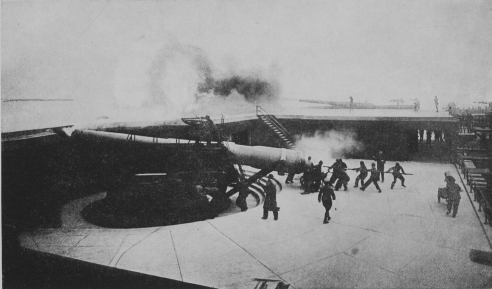
Taking of Sandy Hook
On Sandy Hook, fifteen miles down the harbor from the Battery, there were being demonstrated the inexorable mathematics of war that had been demonstrated at Narragansett, at Boston, at Forts Schuyler and Slocum in Westchester, and at Fort Totten in Long Island.
Fort Hancock on Sandy Hook, almost invulnerable to ship-attack from the sea, was being reduced from the land. The fort commander had disposed his men in the most formidable positions possible, and they made the narrow sandy neck of the Hook that led from the mainland to their fortifications a pass that no force, however contemptuous of death, would attack hastily. Barb wire and great sand mounds, rapid fire guns and big guns behind them, made them no despicable sentinels. But the Americans numbered companies where the enemy numbered battalions and regiments. The American mobile guns numbered pairs where the enemy’s artillery was counted by dozens.
The steel mass of fort that could protect harbor and city could not protect itself. The motley flotilla, emerging into Raritan Bay, landed its men on the New Jersey shore at Keyport inside of the lower harbor, and behind Sandy Hook. The defenses had not been devised or built to withstand attack from their own bay. The great rifled guns and the steel mortars were ponderous. They were mounted on complex engines, equally ponderous, whose bases were firmly anchored in concrete and steel. These mammoths were not things that could be swung around to all points of the compass. They were set in their solid beds for the one purpose of fighting things out at sea.
The Open Back of the Fort
The commander had succeeded, with desperate labor, by blasting away concrete emplacements and facings, in turning two of his big guns around to face the land and protect the open back of the fort. But the giant steel guns with their 1,000-pound projectiles that could fight 30,000-ton battleships, could not fight little two-legged men. They might, by chance of fortune, find and destroy one of the siege guns that were attacking them. But if they missed a gun and fell merely among soldiers, they would be scarcely more murderous than a little field gun that fires bursting charges or shrapnel.
The enemy did not try to rush the works. He had time and means and did not need to sacrifice men. To the heights of the Atlantic and Navesink Highlands, that ascend so strangely out of the sea and out of the flat-sea country there, he lifted guns of great caliber. He placed guns in cover behind every undulation. When he had placed all these weapons with scientific precision, they began to fire.
None of the mobile artillery installed for the defense of the fort against land attack could reach the invaders’ heavier artillery with any hope of effect. The men in the defenses, cowering under bomb-proofs and in pits, held out for a day and a night. They held out for another day. Then there was nothing left to defend. Dismounted and broken, their armament was destroyed. The survivors surrendered.
New York City did not know that the Sandy Hook defenses had fallen till three light enemy cruisers appeared in the upper bay and steamed through the East River to the Navy Yard. Then the city knew that its harbor was open.
Enemy Invades New Jersey
The army that took Sandy Hook did not return to New York. The flotilla took the troops and their light artillery aboard at the Atlantic Highlands, and steamed back through Raritan Bay, through the narrow sound behind Staten Island and into Newark Bay. Here other boats met it with cavalry and motor troops from Yonkers.
Troops landed at both sides of the entrance to the bay, taking Bayonne and Elizabethport, with their oil refineries and tanks, and their ship yards. Then the flotilla moved up the bay, and put great bodies of soldiers of all arms ashore at the great factory town of Newark. A big city, and a difficult city to control, it kept the commanders occupied for three days before they had made their footing good; but then it was an admirable and a vastly valuable base. From it the troops spread out and took Rutherford, Passaic, Hackensack, and Paterson.
It was rich commercial territory that complemented the value of possessing New York, for these factory cities were a part of the Metropolitan District counted with New York City in every National estimate of industrial wealth. This district contained almost thirty-two thousand factories. In wealth and productiveness, it was as choice a prize as New England.[158]
Army Ceases Operations
Having made good its hold on the new conquest across the Hudson River, the invading army ceased to expand. Even with the accretion that had been made to its forces, it had none to spare for further operations, for it now had under its charge 62,000 square miles of domain with more than thirty millions of people.
This was a Kingdom. The victor set himself to the task of organizing his government, which meant the task of turning it to profit.
From the beginning, he had taught the conquered people that an invading army lives on the country. Wherever his troops entered, the inhabitants were ordered to supply all that was needed by men and horses.
The occupying troops demanded lodgings and stable-room. They demanded accommodations for everything belonging to the army. They requisitioned fuel and straw. They called for teams, cars, motors, wagons, boats, and claimed the services of their owners. They occupied flour mills and bakeries. They took machinery, material, tools and equipment for repairing their munitions of war, bridges, and roads.[159]
In all the towns they seized parts of the hospitals and set them aside for the care of their men, impressing the hospital attendants into the service. For the use of their own medical service they forced the towns to contribute drugs and medicines.
They seized all appliances on land, on water or in the air that might serve for the transmission of news. Under the allegation that they were susceptible of use in war, they took all sorts of subjects of peaceful commerce or industry, from telegraph wire to houses.[160]
Putting on the Screws
Already they had subjected Boston to a levy of $50,000 a day for the maintenance of the troops. They laid on New York and the factory cities of New Jersey a joint levy of $100,000. They laid another impost for the same purpose on the big cities of New England of seventy-five thousand. This one levy alone amounted to 1 million, 575 thousand dollars a week; and it was only one of many.[161]
They confiscated outright all the cash, funds, realizable securities and notes belonging to the state, city and local governments. Every bank was warned under threat of condign punishment to deliver over everything that might be considered public property. In New York City they seized from a bank $100,000 that was deposited by a State Department to pay a draft; and they issued a warning that if the holder of the draft attempted to collect the amount or permitted it to pass from his possession, his house and lands would be confiscated.[162]
They declared themselves possessed as absolute owners by right of conquest of all public property besides cash. Thus in New York they asserted ownership of ninety-nine million dollars’ worth of suspension bridges and in Boston they took bridges to the value of ten and a quarter millions. They took the New York City armories valued at fifteen millions. They declared that they owned the subways valued at 100 millions.
All United States property, comprising fortifications everywhere in the conquered territory, navy yards, post offices, customs houses, lighthouses, treasury buildings, and court houses were listed in proclamations throughout the occupied country as good and legal prizes of war. The property so seized in the city of New York alone amounted to sixty-six millions.[163]
Working Furiously for Defense
The United States was working furiously for defense. In the steel country of Pennsylvania and the West, all the works were being altered to turn them into factories for shells, shrapnel, big guns and gun carriages. At Watervliet and Indian Head the capacity of the shops had been enlarged immensely and there was not a moment in the day or the night when there was a pause in the headlong labor. Powder was being made in the Middle West, in places safe from any possible attack by aeroplanes. The flying machine works of Hammondsport, and Buffalo, in New York, San Diego, and Overland Park, were turning out machines at the rate of one and sometimes two a month. Half a dozen other factories were being erected.[164]
A group of automobile factories had agreed to turn out 2-ton trucks at the rate of forty a day, and, indeed, already were producing thirty a day. One concern was working under a contract to produce enough automobiles every day to carry one regiment, each machine capable of making 100 miles an hour with four men and ten days’ rations of food and ammunition. Others had agreed between them to produce enough motors in every working day to carry five or six regiments.[165]
The Handicap of Unpreparedness
The efficient land was rising to the occasion with magnificent ability and temper. So far, those were justified who had said that America could meet a crisis with miraculous speed. But there were things that could not be met with speed—and these things were vital.
All the industrial efficiency on the land could not provide 35,000 trained and experienced officers: and that number was needed if the country was to put half a million volunteers into the field.
All the efficiency of men and engines could not correct, except by tedious, slow training, the defects in an army system that had made it impossible in peace times to concentrate 16,000 men and officers at the San Antonio border of Texas in less than three months after the order was issued.[166]
All the efficiency could not alter the fact that of the whole militia force of the United States, enrolled as “men armed with the rifle,” exclusive of the four divisions already with the army, there were only 24,000, or 38 per cent., who could shoot well enough to make them suitable for battle purposes.[167]
The capture of Massachusetts and Connecticut had cut off at one blow the source of 68 per cent. of all the ammunition and weapon works of the United States. The army, already short of cartridges, would have to remain short till all the complicated and minutely accurate machinery for making them could be built and established.[168]
There were only 425,000 rifles in reserve. The volunteers would have to drill without arms till factories could be put into operation.
What Had Been Lost
Seven militia mobilization camps were in the territory lost to the United States. One thousand acres of powder works in New Jersey were in the possession of the invaders.
The volunteers needed shirts, breeches, underwear. The four leading cities in the manufacture of cotton goods, the four that led in making woolen goods and the leaders in making clothing were cut off from the United States.
The volunteers needed shoes. More than all, they needed shoes. Shoes, shoes, and again shoes! Americans realized with heavy hearts how these unromantic things were making them helpless—what a blow it had been to their defense when the great Massachusetts factories of Lynn, Brockton, Haverhill, and Boston with their un-replaceable machinery had been taken. These cities and cities scattered through the rest of lost New England, had produced 57 per cent. of the boots and shoes for the United States.
The army was short, even under its old, economical estimates of more than 500 field artillery. To put the army of 300,000 volunteers into the field, it would need at least 1,500. In the days of peace it had been calculated that the shortage then existing could not be made good in less than two years. Now, with half a hundred factories toiling, with blackened Watervliet roaring and clanging as never a factory had labored before, guns were being turned out at a rate that promised to reach surprising dimensions when all the shops were fully at work.
Six Months of Helplessness
But at best there were six months during which nothing could be done except to prepare. During those six months, while the country poured forth its money prodigally to make up in wasteful speed what it had neglected during long years, the invader could sit in the conquered seaboard cities and suck them dry.
Nothing on earth could alter it. The volunteers had to learn everything. They had to learn to shoot, to survive slush and rain and cold, to dig trenches. They had to become hardened enough to march twenty and more miles a day with blankets, half a tent, frying pan, plate, knife, fork, water bottle, first aid kit, an emergency ration, an intrenching tool and bayonet, a heavy rifle and ninety heavy cartridges.
The militia regiments had to be raised from peace strength to war strength. That meant that into every company of 65 trained or partially trained men there would have to be an influx of 85 utterly untrained ones who would, of course, instantly destroy the original efficiency of the organization till they were trained up to it.[169]
“Six months at the very lowest possible estimate!” said the Secretary of War. “And it will be six months of such work as this country never did before in its history.”[170]
Six Months of Bleeding
“Six months with the North Atlantic Seaboard amputated,” said the President, “means six months of bleeding to death.”
Even without the mortal blow that was struck at the country’s commerce by the locking of its Atlantic and Gulf ports, this severance of New England and the metropolitan district of New York did, indeed, cause a huge, bleeding wound.
Of the seventy-five manufacturing cities of the United States whose manufactured product ranked highest in value and played the greatest part in the industrial wealth of the country, the invader possessed twenty-seven, or more than one-third.
Fifty-six thousand manufacturing establishments were in his control. Those of the New England States had produced 30 per cent. of the total wealth of the country in manufactures. When they were cut off, the blow struck every human being in the continent who needed their products, and every human being who depended directly or indirectly on the income from their purchases of raw material.
The United States had lost the source of 65 per cent. of its woolen manufactures in value, 48 per cent. of the cotton manufactures, 45 per cent. of the bronze and brass products.
All the amounts involved were enormous. The annual value of the raw material used by the conquered territory was beyond 2 billion dollars. The value of the completed products was 5 billions, 642 millions.[171]
An Incalculable Prize
The Nation, thus maimed, stared aghast at the value of the prize that had been wrested from it for lack of a little insurance. Its individuals had paid scrupulously each year for insurance against fire and crime and had scrutinized their policies with the utmost care. But they had permitted their chosen representatives in Legislatures and Congress to do as they chose about insuring against war, to spend money as they would or not at all, and to accept a worthless policy obtained at an extravagant price.
Now they faced a loss that, for the time at least, might well be called total. The value of Boston and the city of New York alone in taxable property was 9 billions and 880 millions. Five cities of Connecticut were worth 483 millions. Massachusetts had 22 cities exclusive of Boston whose value was 1 billion and 415 millions. Counting all New England, with New York and Boston, and leaving out the New Jersey conquest, the enemy’s loot was 15 billions and 386 millions, exclusive of the public city, State and Federal property that he had seized.[172]
What Can He Do With It?
“But what can he do with it?” the people of the rest of the United States began to ask each other presently.
Men had prophesied in the beginning that the conqueror with his guns turned on the great cities, would extort vast tribute under threat of leveling them. But there had swept through the land a spirit that would face anything rather than to purchase safety and ignoble peace. “Let him destroy the cities and all the land!” said America. “We will build the sea-board up again, better than before. We will recompense our fellow-citizens for every scrap that they lose. But we shall never pay blackmail!”
Had the invader entertained any such plan, this spirit that flamed unmistakably through the continent would have daunted him. But he had no such puerile design as to turn his wonderful prize into ashes. If his errand was one of brigandage and robbery, it was brigandage and robbery in the most scientific modern terms. It was brigandage that enlisted in its conception and prosecution the brains of a world’s financiers, the keen wit of a world’s merchants who wanted to win back the markets of the earth and the far-sighted policy of international diplomats.
For almost a month the conqueror did not show his hand. For almost a month the seaboard from the end of Maine to New Jersey remained sealed. Then, suddenly, he gave the United States his reply to the question: “What Can He Do With It?”
The Invader’s Reply
He opened the wires. He did not send out a word over them. The people of New England and New York did it. They sent out a flood of dispatches that were like a great cry for help. It was the invader’s reply, through them. The reply was “Starvation!”
“We need coal! We need iron and steel! We need cotton!” cried the people of New England. “We have used up all our raw materials. We cannot work any longer unless you ship to us.”
“We must re-open our banks!” said Boston and New York and the hundred other cities. “We are paralyzed without our exchanges and relations with the financial system of the country.”
“We need foodstuffs!” said they all.
The first quick decision of the country was one of wrathful refusal to furnish the supplies that the enemy might fatten himself. But the importunities from the conquered places grew. They went to all the land, west and north and south. They came at the White House like a storm.
“We are on the edge of panic! We have three millions of factory workers who will starve unless we can instantly reëstablish our industries and our finances!”
“It is intolerable!” said the President, his face white with anger. “It is simply a disguised form of blackmail. He means to make us finance him; for, of course, he will levy contributions on the country as soon as money begins to flow in.”
“He Has Us!”
“He has us!” said the Secretary of the Treasury. “As we were helpless against his cannon, so we are helpless against the new weapon that he has drawn—the starvation of our own people. All the messages that we have received prove that. He has shown them that their fate is wholly in our hands—that if we refuse to send them money and foodstuffs and raw material, they will have to blame us for the consequences.”
The President of the United States arose. “Gentlemen,” he said, “they are our own people. There is nothing else that we can do!”[173]
. . . . . . . .
That is the story of The Invasion of America. There was nothing else that we could do!
How the land labored heart-breakingly to put an army into the field; how the invader for eight long months held the conquered land, and under his efficient mastery made its soil produce prodigally, its manufactories pour forth their wealth in redoubled measure; how he laid tax after tax on the men whose necks were under his foot; how, toward the end, he gathered his transports in all the harbors; and how, when three American armies, each 500,000 strong, began to move toward the coast from three grand bases, he embarked all his men within one hundred and twenty hours and sailed away unscathed—these things were but inevitable consequences.
The United States of America never knew how much wealth the Conquestadore had squeezed from the conquered territory in requisitions, in fines, in license fees, in taxes on imports and exports, and in war levies. Statisticians figured for years afterward to discover from the wildly tangled accounts how much he had extorted. They figured and quarreled for a generation over the vast amounts that the United States had lost by losing the markets of the world; for when her ports were opened, she found that the markets were gone.
Men said that from first to last the invading army had taken a sum not short of four billions of dollars. But whatever the sum, it was as nothing to the wound that had struck America near the heart—a brave Nation, a greatly capable Nation, made to grovel for her life because, in a world of men, she had failed to prepare for what men might do.
THE END
FOOTNOTES:
Typographical error corrected by the etext transcriber:
one of the men in Wash-ton=> one of the men in Washington {pg 156}