THE INVASION OF 1910
Reading edition
WITH A FULL ACCOUNT OF THE SIEGE OF LONDON BY WILLIAM LE QUEUX NAVAL CHAPTERS BY H. W. WILSON INTRODUCTORY LETTER BY FIELD-MARSHAL EARL ROBERTS, K.G., K.P., ETC. Toronto THE MACMILLAN COMPANY OF CANADA, Limited 1906 All rights reserved
PREFACE
“I sometimes despair of the country ever becoming alive to the danger of the unpreparedness of our present position until too late to prevent some fatal catastrophe.”
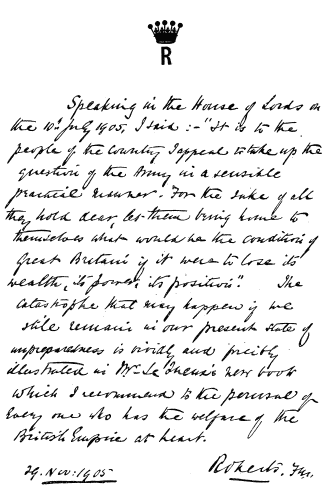
This was the keynote of a solemn warning made in the House of Lords on July 10th of the present year by Earl Roberts. His lordship, while drawing attention to our present inadequate forces, strongly urged that action should be taken in accordance with the recommendations of the Elgin Commission that “no military system could be considered satisfactory which did not contain powers of expansion outside the limit of the regular forces of the Crown.”
“The lessons of the late war appear to have been completely forgotten. The one prevailing idea seems to be,” said Earl Roberts, “to cut down our military expenditure without reference to our increased responsibilities and our largely augmented revenue. History tells us in the plainest terms that an Empire which cannot defend its own possessions must inevitably perish.” And with this view both Lord Milner and the Marquis of Lansdowne concurred. But surely this is not enough. If we are to retain our position as the first nation in the world we must be prepared to defend any raid made upon our shores.
The object of this book is to illustrate our utter unpreparedness for war, to show how, under certain conditions which may easily occur, England can be successfully invaded by Germany, and to present a picture of the ruin which must inevitably fall upon us on the evening of that not far-distant day.
Ever since Lord Roberts formulated his plans for the establishment of rifle-clubs I have been deeply interested in the movement; and after a conversation with that distinguished soldier the idea occurred to me to write a forecast, based upon all the available military and naval knowledge—which would bring home to the British public vividly and forcibly what really would occur were an enemy suddenly to appear in our midst. At the outset it was declared by the strategists I consulted to be impossible. No such book could ever be written, for, according to them, the mass of technical detail was far too great to digest and present in an intelligible manner to the public.
Lord Roberts, however, gave me encouragement. The skeleton scheme of the manner in which England could be invaded by Germany was submitted to a number of the highest authorities on strategy, whose names, however, I am not permitted to divulge, and after many consultations, much criticism, and considerable difference of opinion, the “general idea,” with amendment after amendment, was finally adopted.
That, however, was only a mere preliminary. Upon questions of tactics each tactician consulted held a different view, and each criticised adversely the other’s suggestions. With the invaluable assistance of my friend Mr. H. W. Wilson, we had decided upon the naval portion of the campaign; but when it came to the operations on land, I found a wide divergence of opinion everywhere.
One way alone remained open—namely, to take the facts exactly as they stood, add the additional strength of the opposing nations as they will be in 1910, and then draw logical conclusions. This, aided by experts, was done; and after many days of argument with the various authorities, we succeeded at last in getting them in accord as to the general practicability of an invasion.
Before putting pen to paper it was necessary to reconnoitre carefully the whole of England from the Thames to the Tyne. This I did by means of a motor-car, travelling 10,000 miles of all kinds of roads, and making a tour extending over four months. Each town, all the points of vantage, military positions, all the available landing-places on the coast, all railway connections, and telephone and telegraph communications, were carefully noted for future reference. With the assistance of certain well-known military experts, the battlefields were carefully gone over and the positions marked upon the Ordnance map. Thus, through four months we pushed on day by day collecting information and material, sometimes in the big cities, sometimes in the quietest and remotest hamlets, all of which was carefully tabulated for use.
Whatever critics may say, and however their opinions may differ, it can only be pointed out, first, that the “general idea” of the scheme is in accordance with the expressed and published opinions of the first strategists of to-day, and that, as far as the forecast of events is concerned, it has been written from a first-hand knowledge of the local colour of each of the scenes described. The enemy’s Proclamations reproduced are practically copies of those issued by the Germans during the war of 1870.
That the experts and myself will probably be condemned as alarmists and denounced for revealing information likely to be of assistance to an enemy goes without saying. Indeed, on March 15th last, an attempt was made in the House of Commons to suppress its publication altogether. Mr. R. C. Lehmann, who asked a question of the Prime Minister, declared that it was “calculated to prejudice our relations with the other Powers,” while Sir H. Campbell-Bannerman, in a subsequent letter apologising to me for condemning in the House a work he had not read, repeated that it was likely to “produce irritation abroad and might conceivably alarm the more ignorant public at home.”
Such a reflection, cast by the Prime Minister upon the British nation, is, to say the least, curious, yet it only confirms the truth that the Government are strenuously seeking to conceal from our people the appalling military weakness and the consequent danger to which the country is constantly open.
Mr. Haldane’s new scheme has a number of points about it which, at first sight, will perhaps commend themselves to the general public, and in some cases to a proportion of military men. Foremost among these are the provision made for training the Militia Artillery in the use of comparatively modern field-guns, and the institution of the County Associations for the administration of the Volunteers and the encouragement of the local military spirit. Could an ideal Association of this kind be evolved there is little doubt that it would be capable of doing an immense amount of good, since administration by a central staff, ignorant of the widely differing local conditions which affect the several Volunteer corps, has already militated against getting the best work possible out of their members. But under our twentieth-century social system, which has unfortunately displaced so many influential and respected county families—every one of which had military or naval members, relations or ancestors—by wealthy tradesmen, speculators, and the like, any efficient County Association will be very hard to create. Mr. Haldane’s scheme is a bold and masterly sketch, but he will find it very hard to fill in the details satisfactorily. Unfortunately, the losses the Army must sustain by the reduction of so many fine battalions are very real and tangible, while the promised gains in efficiency would appear to be somewhat shadowy and uncertain.
To be weak is to invite war; to be strong is to prevent it.
To arouse our country to a sense of its own lamentable insecurity is the object of this volume, and that other nations besides ourselves are interested in England’s grave peril is proved by the fact that it has already been published in the German, French, Spanish, Danish, Russian, Italian, and even Japanese languages.
William Le Queux.
London, July 26, 1906.
CONTENTS
BOOK I
CHAP. PAGE
I.The Surprise3
II.Effect in the City20
III.News of the Enemy30
IV.A Prophecy Fulfilled48
V.Our Fleet Taken Unawares60
VI.Fierce Cruiser Battle77
VII.Continuation of the Struggle at Sea94
VIII.Situation in the North108
IX.State of Siege Declared118
X.How the Enemy Dealt the Blow131
XI.Germans Landing at Hull and Goole154
XII.Desperate Fighting in Essex171
XIII.Defence at Last202
XIV.British Success at Royston221
XV.British Abandon Colchester235
XVI.Fierce Fighting at Chelmsford255
XVII.In the Enemy’s Hands266
XVIII.The Feeling in London279
BOOK II
I.The Lines of London287
II.Repulse of the Germans299
III.Battle of Epping310
IV.Bombardment of London326
V.The Rain of Death344
VI.Fall of London357
VII.Two Personal Narratives372
VIII.Germans Sacking the Banks393
IX.What was Happening at Sea413
X.Situation South of the Thames444
XI.Defences of South London456
XII.Daily Life of the Beleaguered466
XIII.Revolts in Shoreditch and Islington477
BOOK III
I.A Blow for Freedom495
II.Scenes at Waterloo Bridge511
III.Great British Victory520
IV.Massacre of Germans in London531
V.How the War Ended540
LIST OF MAPS AND PLANS
BOOK I
PAGE
Position of the IVth German Army Corps Twelve Hours after Landing at Weybourne, Norfolk57
Position of the Saxon Corps Twenty-four Hours after Landing in Essex148
Position of the German Forces Twenty-four Hours after Landing at Goole157
Germany’s Points of Embarkation167
Battle of Purleigh, 6th September193
Battle of Sheffield218
Positions of Opposing Forces, 8th September227
Battle of Royston, Sunday, 9th September232
Battle of Chelmsford. Position on the Evening of 11th September258
The Defence of Sheffield268
BOOK II
The Lines of London288
Battle of Harlow—First Phase296
Battle of Harlow—Final Phase307
German Attack on the Lines of London315
The Bombardment and Defences of London on 20th and 21st September337
London after the Bombardment365
Damage done in the City by the Bombardment369
Damage done in Westminster by the Bombardment384
Shetland Islands433
The Defences of South London on 26th September457
Scene of the Street Fighting in Shoreditch on 27th September478