WILLIAM ROSS WALLACE.
Reading edition
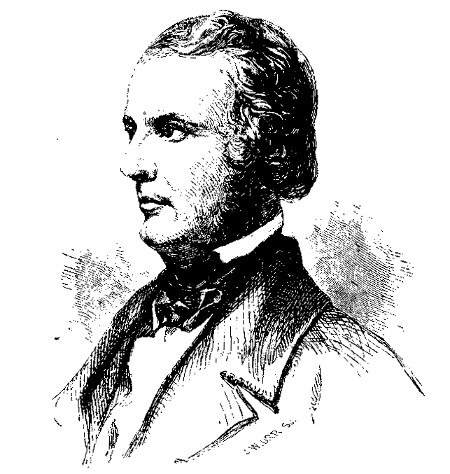
Of the large number of young men in this country who write verses, we scarcely know of one who has a more unquestionable right to the title of poet than William Ross Wallace, who has just published, in a very handsome volume, a collection of his writings, under the title of Meditations in America. Mr. Wallace has written other things which in their day have been sufficiently familiar to the public; in what we have to say of his capacities we shall confine ourselves to the pieces which he has himself here selected as the truest exponents of his genius, and without giving them indiscriminate praise shall hope to find in them evidences of peculiar and remarkable powers, combined with a spirit eminently susceptible to the influences of nature and of ideal and moral beauty.
Mr. Wallace is a western man, and was born in Lexington, Kentucky, in the year 1819. His father was a Presbyterian minister, of good family, and marked abilities, who died soon after, leaving the future poet to the care of a mother whose chief ambition in regard to him was that he should be so trained as to be capable of the most elevated positions in society. After the usual preparatory studies, he went first to the Bloomington College, and afterwards to the South Hanover College, in Indiana, and upon graduating at the latter institution studied the law in his native city. When about twenty-two years of age, having already acquired considerable reputation in literature, by various contributions to western and southern periodicals, he came to the Atlantic states, and with the exception of a few months passed in Philadelphia, and a year and a half in Europe, he has since resided in New-York, occupied in the practice of his profession and in the pursuits of literature. Of his numerous poetical compositions, this is the first collection, and the only volume, except Alban, a Romance, intended to illustrate the influence of certain prejudices of society and principles of law on individual character and destiny, which was published in 1848.
His works generally are distinguished for a sensuous richness of style, earnestness of temper, and much freedom of speculation. Throughout the Meditations in America we perceive that he is most at home in the serious and stately rhythms and solemn fancies of such pieces as the hymn "To a Wind Going Seaward," "The Mounds of America," "The Chant of a Soul," &c.; but he occasionally writes in livelier and less peculiar measures.
The late Mr. Poe in his Marginalia refers to the following as one of the finest things in American literature; it is certainly very characteristic.
THE CHANT OF A SOUL.
My youth has gone—the glory, the delight That gave new moons unto the night, And put in every wind a tone And presence that was not its own. I can no more create, What time the Autumn blows her solemn tromp, And goes with golden pomp Through our unmeasurable woods: I can no more create, sitting in youthful state Above the mighty floods, And peopling glen, and wave, and air, With shapes that are immortal. Then The earth and heaven were fair, While only less than gods seem'd all my fellow-men. Oh! the delight, the gladness, The sense yet love of madness, The glorious choral exultations, The far-off sounding of the banded nations, The wings of angels at melodious sweeps Upon the mountain's hazy steeps,— The very dead astir within their coffin'd deeps; The dreamy veil that wrapp'd the star and sod— A swathe of purple, gold, and amethyst; And, luminous behind the billowy mist, Something that look'd to my young eyes like God. Too late I learn I have not lived aright, And hence the loss of that delight Which put a moon into the moonless night I mingled in the human maze; I sought their horrid shrine; I knelt before the impure blaze; I made their idols mine. I lost mine early love—that love of balms Most musical with solemn psalms Sounding beneath the tall and graceful palms. Who lives aright? Answer me, all ye pyramids and piles That look like calmest power in your still might. Ye also do I ask, O continents and isles! Blind though with blood ye be, Your tongues, though torn with pain, I know are free. Then speak, all ancient masses! speak From patient obelisk to idle peak! There is a heaving of the plains, A trailing of a shroud, A clash of bolts and chains— A low, sad voice, that comes upon me like a cloud, "Oh, misery, oh, misery!"— Thou poor old Earth! no more, no more Shall I draw speech from thee, Nor dare thy crypts of legendary lore: Let silence learn no tongue; let night fold every shore. Yet I have something left—the will, That Mont Blanc of the soul, is towering still. And I can bear the pain, The storm, the old heroic chain; And with a smile Pluck wisdom from my torture, and give back A love to Fate from this my mountain-rack. I do believe the sad alone are wise; I do believe the wrong'd alone can know Why lives the world, why spread the burden'd skies, And so from torture into godship grow. Plainer and plainer beams this truth, the more I hear the slow, dull dripping of my gore; And now, arising from yon deep, 'Tis plain as a white statue on a tall, dark steep. Oh, suffering bards! oh spirits black With storm on many a mountain-rack Our early splendor's gone. Like stars into a cloud withdrawn— Like music laid asleep In dried-up fountains—like a stricken dawn Where sudden tempests sweep. I hear the bolts around us falling, And cloud to cloud forever calling: Yet WE must nor despair nor weep. Did WE this evil bring? Or from our fellows did the torture spring? Titans! forgive, forgive! Oh, know ye not 'tis victory but to live? Therefore I say, rejoice with harp and voice! I know not what our fate may be: I only know that he who hath a time Must also have eternity: One billow proves and gives a whole wide sea. On this I build my trust, And not on mountain-dust, Or murmuring woods, or starlit clime, Or ocean with melodious chime, Or sunset glories in the western sky: Enough, I am, and shall not choose to die. No matter what my future fate may be: To live is in itself a majesty! Oh! there I may again create Fair worlds as in my youthful state; Or Wo may build for me a fiery tomb Like Farinata's in the nether gloom: Even then I will not lose the name of man By idle moan or coward groan, But say, "It was so written in the mighty plan!"
The next poem is in a vein of lofty contemplation, and the rhetoric is eminently appropriate and well sustained. It is one of the most striking pieces in the book.
THE MOUNDS OF AMERICA.
Come to the mounds of death with me. They stretch From deep to deep, sad, venerable, vast, Graves of gone empires—gone without a sighn, Like clouds from heaven. They stretch'd from deep to deep Before the Roman smote his mailéd hand On the gold portals of the dreaming East; Before the Pleiad, in white trance of song, Beyond her choir of stars went wandering. The great old Trees, rank'd on these hills of death, Have melancholy hymns about all this; And when the moon walks her inheritance With slow, imperial pace, the Trees look up And chant in solemn cadence. Come and hear. "Oh patient Moon! go not behind a cloud, But listen to our words. We, too, are old, Though not so old as thou. The ancient towns, The cities throned far apart like queens, The shadowy domes, the realms majestical, Slept in thy younger beams. In every leaf We hold their dust, a king in every trunk. We, too, are very old: the wind that wails In our broad branches, from swart Ethiop come But now, wail'd in our branches long ago, Then come from darken'd Calvary. The Hills Lean'd ghastly at the tale that wan Wind told; The Streams crept shuddering through the tremulous dark; The Torrent of the North, from morn till eve, On his steep ledge hung pausing; and o'er all Such silence fell, we heard the conscious Rills Drip slowly in the caves of central Earth. So were the continents by His crownéd grief Together bound, before that Genoese Flamed on the dim Atlantic: so have we, Whose aspect faced the scene, unchallenged right Of language unto all, while memory holds. "O patient Moon! go not behind a cloud, But hear our words. We know that thou didst see The whole that we could utter—thou that wert A worship unto realms beyond the flood— But we are very lonesome on these mounds, And speech doth make the burden of sad thought Endurable; while these, the people new, That take our land, may haply learn from us What wonder went before them; for no word E'er came from thee, so beautiful, so lone. Throned in thy still domain, superbly calm And silent as a god. Here empires rose and died; Their very dust, beyond the Atlantic borne In the pale navies of the charter'd wind, Stains the white Alp. Here the proud city ranged Spire after spire, like star ranged after star Along the dim empyrean, till the air Went mad with splendor, and the dwellers cried, "Our walls have married Time!"—Gone are the marts, The insolent citadels, the fearful gates, The pictured domes that curved like starry skies; Gone are their very names! The royal Ghost Cannot discern the old imperial haunts, But goes about perplexéd like a mist Between a ruin and the awful stars. Nations are laid beneath our feet. The bard Who stood in Song's prevailing light, as stands The apocalyptic angel in the sun, And rained melodious fire on all the realms; The prophet pale, who shuddered in his gloom, As the white cataract shudders in its mist; The hero shattering an old kingdom down With one clear trumpet's will: the Boy, the Sage, Subject and Lord, the Beautiful, the Wise— Gone, gone to nothingness. The years glide on, The pitiless years! and all alike shall fail, State after State rear'd by the solemn sea, Or where the Hudson goes unchallenged past The ancient warder of the Palisades, Or where, rejoicing o'er the enormous cloud, Beam the blue Alleghanies—all shall fail: The Ages chant their dirges on the peaks; The palls are ready in the peopled vales; And nations fill one common sepulchre. Nor goes the Earth on her dark way alone. Each star in yonder vault doth hold the dead In its funereal deeps: Arcturus broods Over vast sepulchres that had grown old Before the earth was made: the universe Itself is but one mighty cemetery Rolling around its central, solemn sun. "O patient Moon! go not behind a cloud, But listen to our words. We, too, must die— And thou!—the vassal stars shall fail to hear Thy queenly voice over the azure fields Calling at sunset. They shall fade. The Earth Shall look and miss their sweet, familiar eyes, And, crouching, die beneath the feet of God. Then come the glories, then the nobler times, For which the Orbs travail'd in sorrow; then The mystery shall be clear, the burden gone; And surely men shall know why nations came Transfigured for the pangs; why not a spot Of this wide world but hath a tale of wo; Why all this glorious universe is Death's. "Go, Moon! and tell the stars, and tell the suns, Impatient of the wo, the strength of him Who doth consent to death; and tell the climes That meet thy mournful eyes, one after one, Through all the lapses of the lonesome night, The pathos of repose, the might of Death!" The voice is hush'd; the great old wood is still: The Moon, like one in meditation, walks Behind a cloud. We, too, have them for thought, While, as a sun, God takes the West of Time And smites the pyramid of Eternity. The shadow lengthens over many worlds Doom'd to the dark mausoleum and mound.
We do not remember any poem on Mahomet finer than the following:
EL AMIN.
Who is this that comes from Hara? not in kingly pomp and pride, But a great, free son of Nature, lion-souled and eagle-eyed! Who is this before whose presence idols tumble to the sod? While he cries out—"Allah Akbar! and there is no god but God!" Wandering in the solemn desert, he has wondered like a child Not as yet too proud to wonder, at the sun, and star, and wild. "Oh, thou moon! who made thy brightness? Stars! who hung you there on high? Answer! so my soul may worship: I must worship or die!" Then there fell the brooding silence that precedes the thunder's roll; And the old Arabian Whirlwind called another Arab soul. Who is this that comes from Hara? not in kingly pomp and pride, But a great, free son of Nature, lion-souled and eagle-eyed! He has stood and seen Mount Hara to the Awful Presence nod; He has heard from cloud and lightning—"Know there is no god but God!" Call ye this man an imposter? He was called "The Faithful," when, A boy, he wandered o'er the deserts, by the wild-eyed Arab men. He was always called "The Faithful." Truth he knew was Allah's breath; But the Lie went darkly gnashing through the corridors of Death. "He was fierce!" Yes! fierce at falsehood—fierce at hideous bits of wood, That the Koreish taught the people made the sun and solitude. But his heart was also gentle, and Affection's graceful palm, Waving in his tropic spirit, to the weary brought a balm. "Precepts?" "Have on each compassion:" "Lead the stranger to your door:" "In your dealings keep up justice:" "Give a tenth unto the poor." "Yet ambitious!" Yes! ambitious—while he heard the calm and sweet Aiden-voices sing—to trample troubled Hell beneath his feet. "Islam?" Yes! "Submit to Heaven!" "Prophet?" To the East thou art! What are prophets but the trumpets blown by God to stir the heart? And the great heart of the desert stirred unto that solemn strain, Rolling from the trump at Hara over Error's troubled main. And a hundred dusky millions honor still El Amin's rod— Daily chanting—"Allah Akbar! know there is no god but God!" Call him then no more "Impostor." Mecca is the Choral Gate Where, till Zion's noon shall take them, nations in her morning wait.
Mr. Wallace has published a few songs. They have not the stately movement of his other pieces, and the one which follows needs the application of the file; but it is, like the others, very spirited:
AVELINE.
——The sunny eyes of the maiden fair Give answer better than voice or pen That as he loves he is loved again.—C. C. Leeds.
Love me dearly, love me dearly with your heart and with your eyes; Whisper all your sweet emotions, as they gushing, blushing rise; Throw your soft white arms about me; Say you cannot live without me: Say, you are my Aveline; say, that you are only mine, That you cannot live without me, young and rosy Aveline! Love me dearly, dearly, dearly: speak you love-words silver-clearly, So I may not doubt thus early of your fondness, of your truth. Press, oh! press your throbbing bosom closely, warmly to my own: Fix your kindled eyes on mine—say you live for me alone, While I fix my eyes on thine, Lovely, trusting, artless, plighted; plighted, rosy Aveline! Love me dearly; love me dearly: radiant dawn upon my gloom: Ravish me with Beauty's bloom:— Tell me "Life has yet a glory: 'tis not all an idle story!" As a gladdened vale in noonlight; as a weary lake in moonlight, Let me in thy love recline: Show me life has yet a splendor in my tender Aveline. Love me dearly, dearly, dearly with your heart and with your eyes: Whisper all your sweet emotions as they gushing, blushing rise. Throw your soft white arms around me; say you lived not till you found me— Say it, say it, Aveline! whisper you are only mine; That you cannot live without me, as you throw your arms about me, That you cannot live without me, artless, rosy Aveline!
Our limits will not permit us to quote any of the remaining poems of this volume in full, and we conclude our extracts with a few passages penciled while in a hasty reading. In the piece entitled The Kings of Sorrow, the poet sings:
Was He not sad amid the grief and strife, the Lord of light and life, Whose torture made humanity divine, upon that woful hill of Palestine? Then is it not far better thus to be, thoughtful, and brave, and melancholy, Than given up to idle revelry, amid the unreligious brood of folly? For our sorrow is a worship, worship true, and pure, and calm, Sounding from the choir of duty like a high, heroic psalm, In its very darkness bearing to the bleeding heart a balm. Brothers, we must have no wailing: do we agonize alone? Look at all the pallid millions; hear a universal moan, From the mumbling, low-browed Bushman to a Lytton on his throne. Nor shall we have coward faltering: Brothers! we must be sublime By due labor at the forges blazing in the cave of Time; Knowing life was made for duty, and that only cowards prate Of a search for Happy Valley and the hard decrees of fate: Seeing through this night of mourning all the future as a star, And a joy at last appearing on the centuries afar, When the meaning of the sorrow, when the mystery shall be plain, When the Earth shall see her rivers roll through Paradise again. O! the vision gives to sorrow something white and purple-plumed: Even the hurricane of Evil comes a hurricane perfumed.
In the same:
... The Storm is silent while we speak; The awe-struck Cloud hath paused above the peak; The far Volcano statlier waves on high His smoking censer to the solemn sky; And see, the troubled Ocean folds his hands With a great patience on the yellow sands.
In Rest:
So rest! and Rest shall slay your many woes; Motion is god-like—god-like is repose, A mountain-stillness, of majestic might, Whose peaks are glorious with the quiet light Of suns when Day is at his solemn close. Nor deem that slumber must ignoble be. Jove labored lustily once in airy fields; And over the cloudy lea He planted many a budding shoot Whose liberal nature daily, nightly yields A store of starry fruit. His labor done, the weary god went back Up the long mountain track To his great house; there he did wile away With lightest thought a well-won holiday; For all the Powers crooned softly an old tune Wishing their Sire might sleep Through all the sultry noon And cold blue night; And very soon They heard the awful Thunderer breathing low and deep. And in the hush that dropped adown the spheres, And in the quiet of the awe-struck space, The worlds learned worship at the birth of years: They looked upon their Lord's calm, kingly face. And bade Religion come and kiss each starry place.
In the same:
See what a languid glory binds The long dim chambers of the darkling West, While far below yon azure river winds Like a blue vein on sleeping Beauty's breast.
In The Gods of Old:
Not realmless sit the ancient gods Upon their mountain-thrones In that old glorious Grecian Heaven Of regal zones. A languor o'er their stately forms May lie, And a sorrow on their wide white brows, King-dwellers of the sky! But theirs is still that large imperial throng Of starry thoughts and firm but quiet wills, That murmured past the blind old King of Song, When staring round him on the Thunderer's hills.
In the same:
... Still Love, sublime, shall wrap His awful eyebrows in Olympian shrouds. Or take along the Heaven's dark wilderness His thunder-chase behind the hunted clouds. And mortal eyes upturned shall behold Apollo's robe of gold Sweep through the long blue corridor of the sky That, kindling, speaks its Deity: And He, the Ruler of the Sunless Land Of restless ghosts, shall fitfully illume With smouldering fires, that stir in caverned eyes, Hell's mournful House of Gloom.
In the Hymn to a Wind, Going Seaward:
Move on! Move on, Wind of the wide wild West! Tell thou to all The Isles, tell thou to all the Continents The grandeur of my land! Speak of its vales Where Independence wears a pastoral wreath Amid the holy quiet of his flock; And of its mountains with their cloudy beards Tossed by the breath of centuries; and speak Of its tall cataracts that roll their bass Amid the choral of the midnight storms; And of its rivers lingering through the plains So long, that they seem made to measure time; And of its lakes that mock the haughty sea; And of its caves where banished gods might find Night large enough to hide their crownless heads; And of its sunsets broad and glorious there O'er Prairies spread like endless oceans on— And on—and on—over the far dim leagues Till vision shudders o'er immensity.
In the same:
——Troubled France Shall listen to thy calm deep voice, and learn That Freedom must be calm if she would fix Her mountain moveless in a heaving world.
In a Chant to the East:
Still! Oh still! Despite of passion, sin, and ill, Despite of all this weary world hath brought, An angel band from Zion's holy hill Walks gently through the open gate of Thought. Oh, still! Oh, still! Despite of passion, sin, and ill, One in red vesture comes in sorrow's time— One crowned with thorns from that far Orient clime, Who pitying looks on me And gently asks, "Poor man, what aileth thee?"
In the same:
The nations must forever turn to thee, Feeling thy lustrous presence from afar; And feed upon thy splendor as a sea Feeds on the shining shadow of a star.
In Wordsworth:
And many a brook shall murmur in my verse; And many an ocean join his cloudy bass; And many a mountain tower aloft, whereon The black storm crouches, with his deep-red eyes Glaring upon the valleys stretch'd below; And many a green wood rock the small, bright birds To musical sleep beneath the large, full moon; And many a star shall lift on high her cup Of luminous cold chrysolite, set in gold Chased subtilely over by angelic art; To catch the odorous dews which poets drink In their wide wanderings; and many a sun Shall press the pale lips of the timorous morn Couch'd in the bridal east: and over all Will brood the visible presence of the One To whom my life has been a solemn chant.
In the Last Words of Washington:
There is an awful stillness in the sky, When after wondrous deeds and light supreme, A star goes out in golden prophecy. There is an awful stillness in the world, When after wondrous deeds and light supreme, Sceptres refused and forehead crowned with truth, A Hero dies, with all the future clear Before him, and his voice made jubilant By coming glories, and his nation hushed, As though they heard the farewell of a god. A great man is to earth as God to Heaven.
In Greenwood Cemetery:
O, ye whose mouldering frames were brought and placed By pious hands within these flowery slopes And gentle hills, where are ye dwelling now? For man is more than element! The soul Lives in the body as the sunbeam lives In trees or flowers that were but clay without. Then where are ye, lost sunbeams of the mind? Are ye where great Orion towers and holds Eternity on his stupendous front? Or where pale Neptune in the distant space Shows us how far, in his creative mood, With pomp of silence and concentred brows, The Almighty walked? Or haply ye have gone Where other matter roundeth into shapes Of bright beatitude: Or do ye know Aught of dull space or time, and its dark load Of aching weariness?
Mr. Wallace is somewhat too much of a rhetorician, and he has a few defects of manner which, from this frequent repetition, he seems to regard as beauties. Peculiar phrases, of doubtful propriety, but which have a musical roll, occur in many of his poems, so that they become very prominent; this fault, however, belongs chiefly to his earlier pieces; the extracts we have given, we think will amply vindicate to the most critical judgments, the praise here awarded to him as a poet of singular and unusual powers, original, earnest, and in a remarkable degree national. It can scarcely be said of any of our bards that they have caught their inspiration more directly from observation and experience, or that their effusions, whatever the distinction they have in art, are more genuine in feeling.