Volume 4 / Book 6 — Ladies' Summer Fashions.
Reading edition
The strong and superb stuffs of winter are quite superseded by ball dresses, at the various watering places. The élégantes seek toilettes which, without being rich, are remarkable for lightness and tasteful patterns. We commend a white mousseline dress, with three flounces, simply hemmed; a long sash of ribbon of colored taffeta; natural flowers in the hair and on the front of the dress; a dress of colored taffeta, white or straw ground, or blue or pink ground; these stuffs are striped, or running and small patterns, or great branches with detached bouquets. Barèges are also much worn, with white ground sprinkled with little rose-buds; silk barège, with wreaths of flowers, are newer. The shape of the bodies of evening dresses has not undergone much change. Berthes are still worn, forming a point in front, only varying in the disposition of the ornaments, interspersed with small ribbons or lace and mousseline. Natural flowers will be worn for headdresses and bouquets. Walking dresses are much in vogue of barèges and mousseline, the body skirted, open in front, and lower down than in winter. We must mention a new dress, named Albanaise, made of barège. It is of several shades, but the most recherché are gris poussière, or dust gray. Five dull silk stripes begin from the bottom of the dress; then an intervening space and four other stripes; another space and, to finish, three more stripes ending right in the belt, always diminishing in size. We have also seen a jaconet dress, embroidered à l'Anglaise as an apron to the waist; the body embroidered at the edge flat, as well as in the skirts and sleeves; and three knots of blue taffeta fastened the bodice. For the country, dresses of Chinese nankeen and Persian jaconet are worn; and to protect from the sun, a kind of hood, of similar stuff. There are a great many black lace schales, embroidered muslins, printed barège, square or long, with cashmere patterns.
The scarf mantelet is also much in fashion, and the article which permits of the most frequent change; a point scarcely perceptible in the middle of the back makes it still more graceful. It is made in all shades, but the most comme-il-faut are black; it is more suitable, and sets off the freshness of the dress. It is trimmed with lace, fringe, or net, covered with small velvet dots. We have seen some quite covered with common embroidery; others embroidered with arabesques intermingled with braid and silk, and black jet.
For the seaside there are also worn many mantelets, which remind us of the winter by their shape; but the materials are somewhat lighter, chiefly of thin summer cloth, or felt of gray shades.
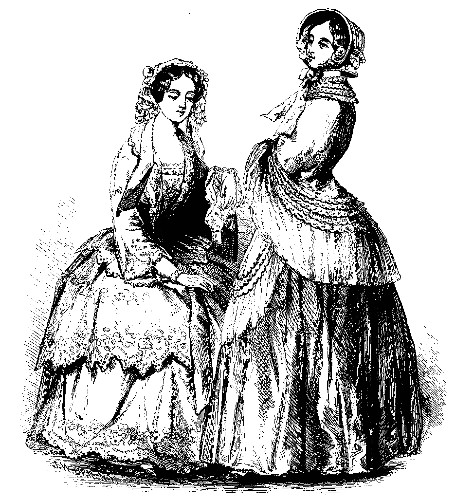
The Promenade Dress, on the preceding page, is of a rich plain chocolate-colored silk, made perfectly simple. Pardessus of a damson-colored brocaded silk, the lower part of which, as well as the large sleeves, being decorated with a magnificent double fringe, the under and deepest being of black, and the upper composed of long silk tassels, put at equal distances. Leghorn bonnet, trimmed with pink silk, cut the width of a broad ribbon, and pinked at the edge; the interior having a fulling of the pink silk encircling the face, with brides to match.
Coarse straw chapeaux, though principally intended for the country, are employed, though not much, for morning neglige, in town, and will be very much in request for the watering-places; they are of the capote form, in open-work, and lined with taffeta, of one of the colors of the ribbon that trims them. The ribbon is always plaided, and the most fashionable has a great variety of colors; the knots are large, and formed of several coques, divided in the middle by a torsade of ribbons; some are decorated with ribbons only, but small flowers and foliage may be employed to trim the interior of the brim. Fancy chapeaux are composed of bands of paille dentelle, alternating with rose-colored taffeta biais, &c. Rice straw is also employed a good deal for fancy chapeaux that are formed of more than one material.
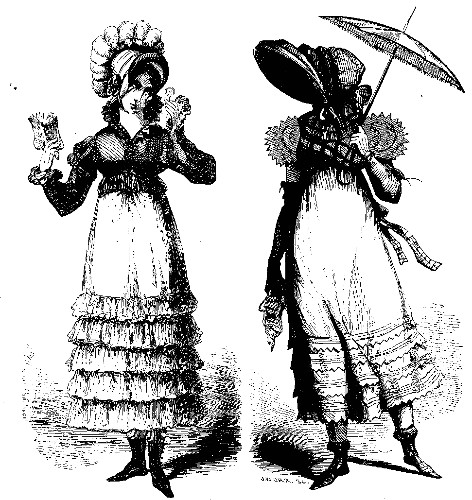
The following figures are copied from Parisian fashion plates for 1811. The shortness of the frocks should certainly satisfy the most extreme innovators of the present time.
LADIES' FASHIONS IN PARIS FORTY YEARS AGO.