WILLIAM HOGARTH.
Reading edition
The great comedian in pictorial art forms one of the subjects of Mrs. Hall's sketches, in the Pilgrimages to English Shrines, and we think her article upon visiting his tomb as interesting as any in this popular series:
Hogarth, the great painter-teacher of his age and country, was born in the parish of St. Bartholomew the Great, in London, on the 10th of November, 1697, and his trusty and sympathizing biographer, Allan Cunningham, says, "we have the authority of his own manuscripts for believing he was baptized on the 28th of the same month;" but the parish registers have been examined for confirmation with "fruitless solicitude." Cunningham gives December as the month of his birth; this is a mistake; so also is his notice of the painter's introduction of the Virago into his picture of the "Modern Midnight Conversation." No female figure appears in this subject. It is in the third plate of the "Rake's Progress" the woman alluded to is introduced. A small critic might here find a fit subject for vituperation, and loudly condemn Cunningham as a writer who was too idle to examine the works he was describing; pouncing on his minute errors, and forgetting the totality of his generous labors. Much of this spirit infests literature; and merges the kindly exposition of error into the bitterness of personal attack. The fallibility of human nature should teach us charity, and our own faults lead us to "more gently scan our brother man,"—a thing too often unthought of by those who are nothing if not critical, and as frequently nothing when they are. The painter was descended from a Westmoreland family. Sprung from an industrious race of self-helping yeomen, whose hardy toil brought them health and contentment, Hogarth had an early advantage, derived from his father's love of letters, which eventually drew him away from field and wood to the great London mart. Like thousands of others, he was unsuccessful. Fortunately, in this instance, his want of success in literature stimulated the strong mind of his son to seek occupation of more certain profit; and those who feel interest in the whereabouts of celebrated men, may think upon the days when William Hogarth wrought in silver, as the apprentice of Ellis Gamble, in Cranbourne Street, and speculate upon the change of circumstances, wrought by his own exertions, when, as a great painter, in after time, he occupied the house, now known as the Sabloniere Hotel, in Leicester Square.
Hogarth's character of mind, evidenced in his works and proved by his biography, is so perfectly honest, open, home-bred English, that we claim him with pride—as belonging exclusively to England. His originality is of English growth; his satire broad, bold, fair-play English. He was no screened assassin of character, either with pen or pencil; no journalist's hack to stab in secret—concealing his name, or assuming a forged one; no masked caricaturist, responsible to none. His philosophy was of the straightforward, clear-sighted English school; his theories—stern, simple, and unadorned—thoroughly English; his determination—proved in his love as well as in his hate—quite English; there is a firmness of purpose, a rough dignity, a John-Bull look in his broad intelligent face; the very fur round his cap must have been plain English rabbit-skin! No matter what "schools" were in fashion, Hogarth created and followed his own; no matter what was done, or said, or written, Hogarth maintained his opinion unflinchingly; he was not to be moved or removed from his resolve. His mind was vigorous and inflexible, and withal, keen and acute; and though the delicacy of his taste in this more refined age may be matter of question, there can be no doubt as to his integrity and uprightness of purpose—in his determination to denounce vice, and by that means cherish virtue.
Professor Leslie, in his eloquent and valuable Lectures on Painting, delivered in the spring of the present year to the students of the Royal Academy, has nobly vindicated Hogarth as an artist and a man, in words that all who heard will long remember. "Hogarth," he said, "it is true, is often gross; but it must be remembered that he painted in a less fastidious age than ours, and that his great object was to expose vice. Debauchery is always made by him detestable, never attractive." Charles Lamb, one of the best of his commentators, who has viewed his labors in a kindred spirit, speaking of one of his most elaborate and varied works, the "Election Entertainment," asks, "What is the result left on the mind? Is it an impression of the vileness and worthlessness of our species? Or is not the general feeling which remains after the individual faces have ceased to act sensibly on the mind, a kindly one in favor of the species?" Leslie speaks of his "high species of humor, pregnant with moral meanings," and no happier choice of phrase could characterize his many works. Lamb, with true discrimination, says: "All laughter is not of a dangerous or soul-hardening tendency. There is the petrifying sneer of a demon, which excludes and kills love, and there is the cordial laughter of a man, which implies and cherishes it."
Hogarth's works are before us all; and are lessons as much for to-day as they were for yesterday. We have no intention of scrutinizing their merits or defects; we write only of the influence of a class of art such as he brought courageously before the English public. Every one is acquainted with the "Rake's Progress," and can recall subject after subject, story after story, which he illustrated. Comparatively few can judge of him as a painter, but all can comprehend his moral essays—brave as true!
His fearlessness and earnestness are above all price; independent, in their high estate, of all praise. We would send "Marriage à la Mode" into general circulation during the London season, where the market for wives and husbands is presided over by interest rather than affection. The matrimonial mart was as bravely exposed by the great satirist, as the brutal and unmanly cock-fight, which at that period was permitted to take place at the Cock-pit Royal, on the south side of St. James's Park.
Society always needs such men as William Hogarth—true, stern men—to grapple with and overthrow the vices which spring up—the very weeds both of poverty and luxury,—the latter filled with the more bitter and subtle poison. Calling to mind the period, we the more honor the great artist's resolution; if the delicacy of our improved times is offended by what may seem deformity upon his canvas, we must remember that we do not shrink from Hogarth's coarseness, but from the coarseness he labored, by exposing, to expel. He painted what Smollett, and Fielding, and Richardson wrote far more offensively; but he surpassed the novelists both in truth and in intention. He painted without sympathizing with his subjects, whom he lashed with unsparing bitterness or humor. He never idealized a vice into a virtue—he never compromised a fact, much less a principle.
He has, indeed, written fearful sermons on his canvas; sermons which, however exaggerated they may seem to us in some of their painful details of human sin and human misery, are yet so real, that we never doubt that such things were, and are. No one can suspect Hogarth to have been tainted by the vices he exposed. In this he has the advantage of the novelists of his period: he gives vice no loophole of escape: it is there in its hideous aspect, each step distinctly marked, each character telling its own tale of warning, so that "he who runs may read."
Whoever desires to trace the life of this English artist—to note him in his apprenticeship—when he tamed as well as his rough nature would permit, his hand to the delicate graving so cherished by his master, Ellis Gamble; and when freed from his apprenticeship, he sought art through the stirring scenes of life, saying quaintly enough, that "copying other men's works resembled pouring wine out of one vessel into another; there was no increase of quantity, and the flavor of the vintage was liable to evaporate;"—whoever would study the great, as well as the small, peculiarities of the painter who converted his thumb-nail into a palette, and while transcribing characters and events both rapidly and faithfully, complained of his "constitutional idleness:"—whenever, we say, our readers feel desirous of revelling in the biography of so diligent, so observing, so faithful, so brave a spirit, we should send them to our old friend Allan Cunningham's most interesting history of the man. Honest Allan had much in common with our great national artist: though of different countries, they sprung from the same race—sturdy yeomen; they were alike lovers of independence, fighting for the best part of life manfully and faithfully enjoying the noble scorn of wrong, and battling for the right from the cradle to the grave. Self-educated—that is to say, educated by Nature, which gave and nourished his high intellect and independent soul—Allan could comprehend and appreciate the manly bearing and stern self-reliance of the painter, whose best resources were in himself; thus the biography of Hogarth is among the finest examples of its class which our language supplies. Allan's sympathies were with his subject; and his knowledge also came to his aid: for the poet was thoroughly imbued with a love of art.
Allan Cunningham was a better disciplinarian, and less prone to look for or care for enjoyment, than Hogarth; though we have many pleasant memories how he truly relished both music and conversation. But there was more sentiment in the Scottish poet than in the English painter; and the deep dark eyes of the Scot had more of fervor and less of sarcasm in their brightness. We repeat, Allan, of all writers, could thoroughly appreciate Hogarth; and his biography is written con amore. He says that "all who love the dramatic representations of actual life,—all who have hearts to be gladdened by humor,—all who are pleased with judicious and well-directed satire,—all who are charmed with the ludicrous looks of popular folly, and all who can be moved with the pathos of human suffering, are admirers of Hogarth." But to our thinking; Hogarth had a calling even more elevated than the Scottish poet has given him in this eloquent summing-up of his attributes; "he is one of our greatest teachers—a teacher to whom is due the highest possible honor; and the more we feel the importance of the teacher, the more we value those who teach well. In grappling with folly and in combating with crimes, he was compelled to reveal the nature of that he proposed to satirize; he was obliged to set up sin in its high place before he could crown it with infamy." The times were full of internal as well as foreign disturbance, and Hogarth's studio was no hermitage to exclude passing events or their promoters. He lived with the living, moving present,—his engravings being his pleasures; portraits, as they are now to many a high-hearted man of talent, his means of subsistence; heavy weights of mortality that fetter and clog the ascending spirit.
His controversies and encounters with the worthless Wilkes,—his defence of his own theories,—his determined dislike to the establishment of a Royal Academy—his various other controversies—rendered his exciting course very different from that of the lonely artists of the present day, who are but too fond of living in closed studios, "pouring," as Hogarth would have said,—"pouring wine from one vessel into another,"—pondering over tales and poems for inspiration, and transcribing the worn-out models of many seasons into attitudes of bounding and varied life! Is it not wonderful, as sad, that the artist will not feel his power, will not take his own place, assume his high standing as of old, and demand the duty of respect from the world by the just exercise of his glorious privilege! "Entertainment and information are not all the mind requires at the hand of an artist; we wish to be elevated by contemplating what is noble,—to be warmed, by the presence of the heroic,—and charmed and made happy by the light of purity and loveliness. We desire to share in the lofty movements of fine minds—to have communion with their image of what is godlike, and to take a part in the rapture of their love, and in the ecstasies of all their musings. This is the chief end of high poetry, of high painting, and high sculpture; and the man misunderstands the true spirit of those arts who seeks to deprive them of a portion of their divinity, and argues that entertainment and information constitute their highest aim." We have quoted this passage because it expresses our notions of the power of art more happily than we are able to express it; but we must add that the teaching as well as the poetic painter has much to complain of from society; it is impossible to mingle among the "higher classes" without being struck by their indifference to every phase of British art,—except portraiture. "Have you been to the Exhibition? Are there many nice miniatures? are the portraits good? Lady D.'s lace is perfect; Mrs. A.'s velvet is inimitable." Such observations strike the ear with painful discord, when the mind is filled with memories of those who are brave or independent enough to "look forward" with creative genius. There are many noble exceptions among our aristocracy; but with far too great a number art is a mere fashion.
HOGARTH'S HOUSE.
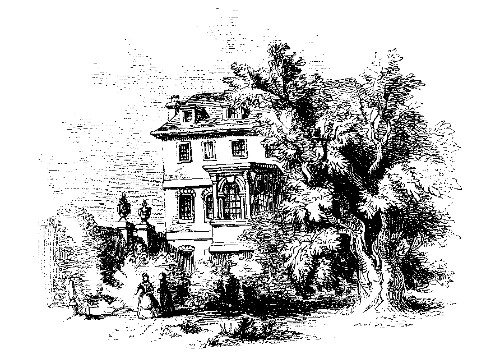
As a people, neither our eyes nor our ears are yet opened to its instructive and elevating faculty. We mistake the outlay of money for an expenditure of sympathy.
Hogarth's portraits were almost too faithful to please his sitters: he was too truthful to flatter, even on canvas; and the wonder is that he achieved any popularity in this fantastic branch of his art. Allan Cunningham has said of him, that he regarded neither the historian's page, nor the poet's song. He was contented with the occurrences of the passing day, with the folly or the sin of the hour; yet to the garb and fashion of the moment, he adds story and sentiment for all time. It is quite delicious to read the excuses Allan makes for the foibles of the man whose virtues had touched his own generous heart; he confesses with great naiveté that he looked coldly—"too coldly, perhaps"—on foreign art, and perhaps too fondly on his own productions; and then adds that, "where vanity soonest misleads the judgment he thought wisely; he contemplated his own works, not as things excellent in themselves, but as the rudiments of future excellence, and looked forward with the hope that some happier Hogarth would raise, on the foundation he had laid, a perfect and lasting superstructure."
We must humbly differ from the poet in this matter; we believe, if the characteristic cap were removed from that sturdy brow, we should find an admirable development of the organ of self-esteem. He thought as little of a future and "happier Hogarth," as he did of the old masters. He was Monarch of the Present—and he knew it!
The age we live in talks much about renovation, but it is not a conservative age; on the contrary, it would pull down Temple Bar, if it dared, to widen the passage from the Strand into Fleet Street; and it demolishes houses, shrines of noble memories, with a total absence of respect for what it ought to honor. We never hear of an old house without a feeling that it is either going to be destroyed or modernized; and this inevitably leads to a desire to visit it immediately. Having determined on a drive to Chiswick to make acquaintance with the dwelling of Hogarth, and look upon his tomb—we became restless until it was accomplished.
We had seen, by the courtesy of Mr. Allison, the piano-forte manufacturer in Dean Street, the residence of Sir James Thornhill, whose daughter Hogarth married: the proprietor bestows most praiseworthy care on the house, which was formerly one of considerable extent and importance. Mr. Allison says there can be little doubt that the grounds extended into Wardour Street. Once, while removing a chimney-piece in the drawing-room, a number of cards tumbled out—slips of playing-cards, with the names of some of the most distinguished persons of Hogarth's time written on the backs; the residences were also given, proving that the "gentry" then dwelt where now the poorer classes congregate. But the most interesting part of the house is the staircase, with its painted ceiling; the wall of the former is divided into three compartments, each representing a sort of ball-room back-ground, with groups of figures life-size, looking down from a balcony; they are well preserved, and one of the ladies is thought to be a very faithful portrait of Mrs. Hogarth. Hogarth must have spent some time in that house:—but we were resolved, despite the repute of its being old and ugly, to visit his dwelling-place at Chiswick; and though we made the pilgrimage by a longer route than was necessary, we did not regret skirting the beautiful plantations of the Duke of Devonshire, nor enjoying the fragrance of the green meadows, which never seem so green to us, as in the vale of the Thames. The house is a tall, narrow, abrupt-looking place, close to the roadside wall of its inclosed garden; numbers of cottage dwellings for the poor have sprung up around it, but in Hogarth's day it must have been very isolated: not leading to the water, as we had imagined, but having a dull and prison-like aspect; if, indeed, any place can have that aspect where trees grow, and grass is checkered by their ever-varying shadows. The house was occupied from 1814 to 1832 by Cary, the translator of Dante; and it would be worth a pilgrimage if considered only as the residence of this truly-excellent and highly-gifted clergyman.
ROOM IN HOGARTH'S HOUSE.
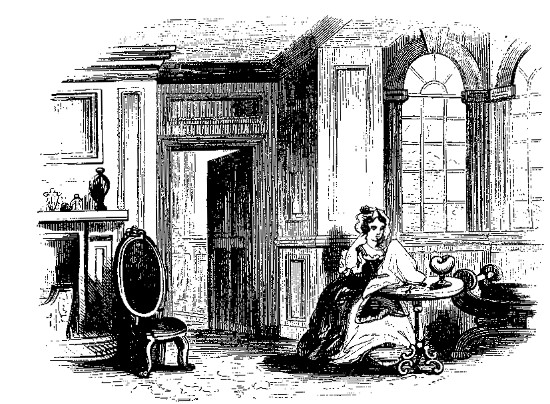
We have received from his son an interesting note relative to its features at the period when it came into his father's possession. "The house," he says, "stands in one corner of a high-walled garden of about three quarters of an acre, that part of the garden which faced the house was divided into long, narrow, formal flower-beds. Five large trees, whose ages bespoke their acquaintance with Hogarth, showed his love of the beautiful as well as the useful, a mulberry, walnut, apricot, double-blossomed cherry, and a hawthorn: the last of these was a great favorite with my father, from its beauty, and the attraction it was to the nightingale, which never failed to visit it in the spring: the gardeners were their mortal enemies, and alas, have at length prevailed. A few years ago, when I went to visit the old place, only one of the trees remained, (the mulberry seen in our sketch); in a nook at one side of the garden was a nut-walk, with a high wall and a row of filbert-trees that arched triumphantly over it; at one end of this walk was a stone slab, on which Hogarth used to play at nine-pins; at the other end were the two little tombstones to the memory of a bird and a dog." The house is as you see it here, the rooms with low ceilings and all sorts of odd shapes,—up and down, in and out,—yet withal pleasant and comfortable, and rendered more so by the gentle courtesy of their mistress and her kindly servant; the very dogs seemed to partake of the human nature of their protector, and attended us wherever we went, with more than ordinary civility. Hogarth might have been tempted to immortalize one of them for its extreme ugliness, and the waggish spirit with which it pulled at its companion's ears, who in vain attempted to tug at the bits of stumps that stuck out at either side of its tormentor's head. Mr. Fairholt was permitted to sketch the drawing room; the open door leads to the chamber from whence, it is said, Miss Thornhill eloped with Hogarth.
Mr. Cary, in the note to which we have already alluded, says, "there can hardly be a doubt that the house belonged to Sir James Thornhill, and that Hogarth inherited it from him. Mrs. Hogarth lived there after her husband's death, and left it by will to a lady from whose executor my father bought it in the year 1814. The room from which Miss Thornhill is said to have eloped is the inner room, on the first floor; this room was used by my father as his study. Over the dining-room fireplace was a spirited pencil sketch of five heads, and under them written 'five jolly fellows,' by Hogarth—during an absence the servants of a tenant carefully washed all out."
We can easily imagine how the union between Hogarth and his daughter, commenced after such a fashion, outraged not only the courtliness, but the higher and better feelings of Sir James Thornhill. Hogarth's innate consciousness of power may at that time have appeared to him vulgar effrontery; and it is not to be wondered at, that, until convinced of his talent, he refused him all assistance. There is something so false and wrong in the concealment that precedes an elopement, and the elopement of an only child from an aged father, that we marvel how any one can treat lightly the outraged feelings of a confiding parent. Earnest tender love so deeply rooted in a father's heart may pardon, but cannot reach forgetfulness as quickly as it is the custom of play-writers and novelists to tell us it may do.
Sir James Thornhill was greatly the fashion; he was the successor of Verrio, and the rival of La Guerre, in the decorations of our palaces and public buildings. His demands for the painting of Greenwich Hall were contested; and though La Fosse received two thousand pounds for his works at Montague House, besides other allowances, Sir James, despite his dignity as Member of Parliament for his native town of Weymouth, could obtain but forty shillings a square yard for painting the cupola of St. Paul's! Thus the patronage afforded "native talent" kept him poor; and though it must have been necessary (one of the cruel necessities induced by love of display in England), to have an establishment suited to his public position in London, nothing could be more unpretending than his ménage at Chiswick. Mrs. Hogarth, advised by her mother, skilfully managed to let her father see one of her husband's best productions under advantageous circumstances. Sir James acknowledged its merit at once, exclaiming, "Very well! very well! The man who can make works like this can maintain a wife without a portion;" and soon after became not only reconciled, but generous to the young people. Hogarth had tasted the bitterness of labor; he had even worked for booksellers, and painted portraits!—so that this summer brightness must have been full of enjoyment. He appreciated it thoroughly, and was ever the earnest admirer and the ready defender of Sir James Thornhill; thus the old knight secured a friend in his son; and it was pleasanter to think of the hours of reconciliation and happiness they might have passed within the walls of that inclosed garden, beneath the crumbling trellice, or the shadow of the old mulberry tree, than of the fortuneless artist wooing the confiding daughter from her home and her filial duties.
HOGARTH'S PAINTING-ROOM.
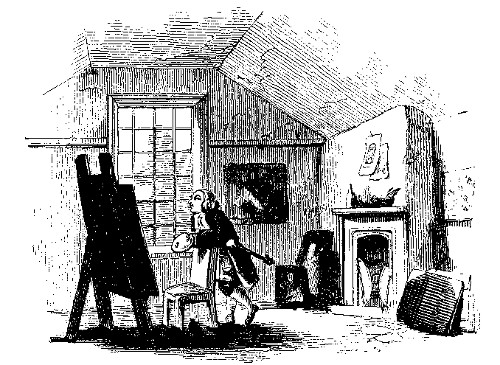
We were invited to inspect Hogarth's painting-room—a mere loft, of most limited dimensions, over the stable, which the imagination could easily furnish with the necessary easel, or still less cumbrous graver's implements. It is situated at the furthest part of the garden from the house; a small door in the garden-wall leads into a little inclosure, one side of which is occupied by the stable. The painting-room is over the stable, and is reached by a stair; it has but one window which looks towards the road. It must have been sufficiently commodious for Hogarth's purposes; but possesses not the conveniences of modern painting-rooms. The house at Chiswick could only have been a place for recreation and repose, where relaxation was cared for, and where sketches were prepared to ripen into publication.
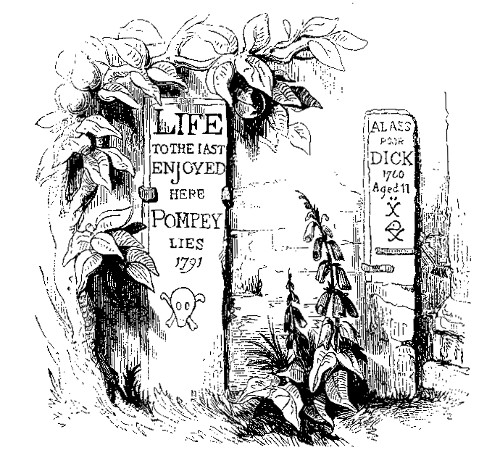
There are traditions about Chiswick of Hogarth having, while studying and taking notes, frequented a little inn by the roadside, and almost within sight of his dwelling. It has been modernized throughout—and supplies no subject for the pencil—yet it retains some indications, not without interest, of a remote date. The Painter must have been familiar with every class of character; and Chiswick was then enough of a country village to supply him amply with material. But, although a keen satirist, it is certain that he had as much tenderness for the lower orders of creation, as a young loving girl. In a corner of this quaint old garden, two tiny monuments are affixed to the wall, one chiselled perhaps by Hogarth's own hand, to the memory of his canary bird! The thinking character of the painter's mind is evidenced in this as in every thing he did—the engraving on the tomb suggesting reflection. Charles Lamb said of him truly, that the quantity of thought which he crowded into every picture, would alone "unvulgarize" every subject he might choose; and the refined Coleridge exclaims, "Hogarth! in whom the satirist never extinguished that love of beauty which belonged to him as a poet." There is something inexpressibly tender and touching in this memento of his affection for a little singing bird: the feeling must have been entirely his own, for he had no child to suggest the tribute to a feathered favorite. The tomb was afterwards accompanied with one to Mrs. Hogarth's dog. They are narrow, upright pieces of white stone laid against the brick-wall, but they are records of gentle and generous sympathies not to be overlooked. That Hogarth was more than on friendly terms with the canine race, the introduction of his own dog into his portrait clearly tells, and doubtless his bird often brought with its music visions of the country into the heat and dust of Leicester Square—soothing away much of his impatience. Men who have to fight the up-hill battle of life, must have energy and determination; and Hogarth was too out-spoken and self-confident not to have made many enemies. In after years his success (limited though it was, in a pecuniary point of view, for he died without leaving enough to support his widow respectably), produced its ordinary results—envy and enmity: and insults were heaped upon him. He was not tardy of reply, but Wilkes and Churchill were in strong health when nature was giving way with the great painter; an advantage they did not fail to use with their accustomed malignity. The profligate Churchill, turning the poet's nature into gall, infested the death-bed of Hogarth with unfeeling sarcasm, anticipating the grave, and exulting over a dying man.
TOMBS OF DOG AND BIRD.
Hogarth, warned by the autumn winds, and suffering from the restlessness of approaching dissolution, left Chiswick on the 25th of October, 1764, and returned to his residence in Leicester Square. He was cheerful—in full possession of his mental faculties, but lacked the vigor to exert them. The very next day, having received an agreeable letter from Doctor Franklin, he wrote a rough copy of his answer, but exhausted with the effort, retired to bed. Seized by a sudden sickness, he arose—rung the bell with alarming violence—and within two hours expired!
Of all the villages in the neighborhood of London, rising from the banks of the Thames, (and how numerous and beautiful they are!) few are so well known as that of Chiswick. The horticultural fêtes are anticipated with anxiety similar to that our grandmothers felt for the fêtes of Ranelagh; the toilettes of the ladies rival the flowers, and the only foe to the fascinating fair ones is the weather; but all which the crowd care about in Chiswick is confined to the "Duke's grounds" and the Society's Gardens. The Duke's beautiful little villa, erected by the last Earl of Burlington, is indeed a shrine worthy of deep homage; within its walls both Charles James Fox and George Canning breathed their last; and if, for a moment, we recall the times of Civil War, when each honest English heart fought bravely and openly for what was believed "the right," we may picture the struggle between Prince Rupert and the Earl of Essex, terminating with doubtful success, for eight hundred high born cavaliers were left dead on the plain that lies within sight of the gardens so richly perfumed by flowers, and echoing not to the searching trumpet or rolling drum, but to the gossamer music of Strauss and Jullien.
The Duke of Devonshire's grounds, containing about ninety acres, are filled with mementos, pleasant to the eye and suggestive to the imagination; but we must seek and find a more solemn scene, where the churchyard of Chiswick incloses the ashes of some whose names are written upon the pages of History. Though the church is, in a degree, surrounded by houses, there is much of the repose of "a country churchyard" about it; the Thames belts it with its silver girdle, and when we visited its sanctuary, the setting sun cast a mellow light upon the windows of the church, touching a headstone or an urn, while the shadows trembled on the undulating graves. Like all church-yards it is crowded, and however reverently we bent our footsteps, it was impossible to avoid treading on the soft grass of the humble grave, or the gray stone that marks the resting-place of one of "the better order."
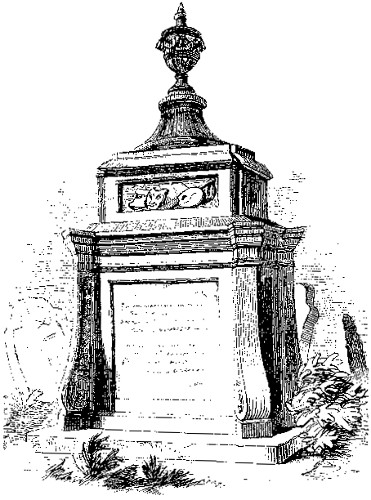
HOGARTH'S TOMB.
How like the world was that silent churchyard! High and low, rich and poor, mingled together, and yet avoiding to mingle. The dust of the imperious Duchess of Cleveland found here a grave; while here too, as if to contrast the pure with the impure, repose the ashes of Mary, daughter of Oliver Cromwell; Holland the actor, the friend of David Garrick, here cast aside his "motley." Can we wonder at the actor's love of applause?—posterity knows him not; present fame alone is his—the lark's song leaves no record in the air!—Lord Macartney, the famous ambassador to China, a country of which our knowledge was then almost as dim as that we have of the moon—the ambassador rests here, while a Chinese junk is absolutely moored in the very river that murmurs beside his grave! Surely the old place is worthy of a pilgrimage. Loutherbourg, the painter, found a resting-place in its churchyard. Ralph, the historian and political writer, whose histories and politics are now as little read as the Dunciad which held them up to ridicule, is buried here; and confined as is the space, it is rich in epitaphs,—three are from the pen of David Garrick, two from that of Arthur Murphy.
Hogarth's monument has been very faithfully copied by Mr. Fairholt.
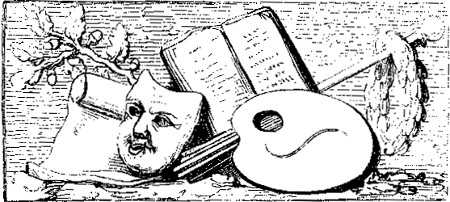
It is remarkable among the many plainer "stones" with which the churchyard is crowded, but is by no means distinguished for that artistic character—which it might have received as covering the remains of so great an artist. A small slab, in relief, takes from it, however, the charge of insipidity; it contains a comic mask, an oak branch, pencils and mahl-stick, a book and a scroll, and the palette, marked with the "line of beauty."
It has been remarked, that "while he faithfully followed nature through all her varieties, and exposed, with inimitable skill, the infinite follies and vices of the world, he was in himself an example of many virtues." And the following poetical tribute by David Garrick is inscribed on the tomb:
"Farewell! great painter of mankind, Who reached the noblest point of Art; Whose pictured morals charm the mind, And through the eye correct the heart If Genius fire thee, reader, stay; If Nature touch thee, drop a tear; If neither move thee, turn away, For Hogarth's honored dust lies here!"
Dr. Johnson also composed an epitaph, which Cunningham considers "more to the purpose, but still unworthy:"
"The hand of him here torpid lies, That drew the essential forms of grace; Here closed in death the attentive eyes That saw the manners in the face."
The tributes—in poetry and prose—are just, examine the works of this great painter-teacher as closely and suspiciously as we may, we can discover nothing that will induce a momentary doubt of his integrity of purpose in all he did; his shafts were aimed at Vice,—in no solitary instance was he ever guilty of arraigning or assailing Virtue. Compare him with the most famous of the Dutch masters, and he rises into glory; coarseness and vulgarity in them had no point out of which could come instruction. If they picture the issues of their own minds, they must have been gross and sensual; they ransacked the muck of life, and the grovelling in character, for themes that one should see only by compulsion. But Hogarth's subjects were never without a lesson, and, inasmuch as he resorted for them to the open volume of humanity, like those of the most immortal of our writers, his works are "not for an age but for all time."