Volume 4 / Book 8 — Gentlemen's and Ladies' Fashions for December.
Reading edition
In the fashionable world of this country we have at length the long-expected "hat of the future," from the ingenious artist Genin, who appears to be the only American who brings to the manufacture of hats an inventive faculty. It is likely that these hats will gradually take the place of the funnel and stove-pipe styles which have been so long in vogue. They are made of fine material, are light, pliable, durable, and have the more important merit of elegant and picturesque appearance. They are indifferently styled the Union Hat, and the Grandison Hat—the last name referring to the ideal of Queen Anne's days.
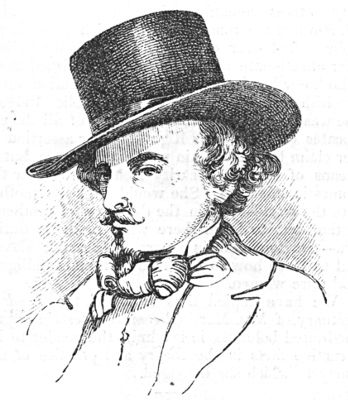
It is much doubted whether any of the changes made in gentlemen's costume in the last half century are improvements, and there are very few persons of taste who will approve the hat of the last few years more than that worn in the good old times of General Washington, when the three-cornered chapeau began to give place to such hats its are represented in our illustration.
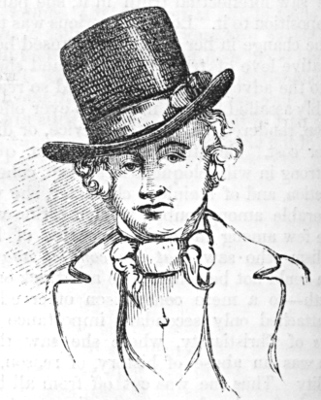
The next is somewhat more in vogue, at least for younger men, and for the opera and the theatre. It sets off a fine-looking face advantageously.
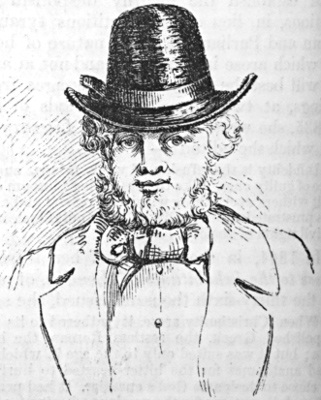
The last is better suited for travelling or hunting.
In Ladies' Fashions, there are some novelties, though comparatively few of a kind to attract a large degree of attention. We select for illustration in the first place—
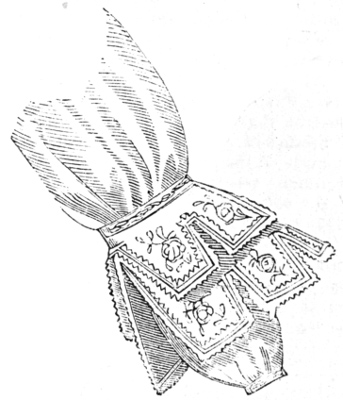
Close Under-sleeve.—This sleeve will be found to be of a very desirable form by ladies who object to the open sleeves, as it combines the elegant effect of the latter with the comfort of the close sleeve. It may be made either in muslin or net, and is cut as a bishop's sleeve, the fulness being confined on a band at the wrist. Two broad frills of lace or needlework are attached to the lower part of the sleeve. These frills are open in front of the arm.
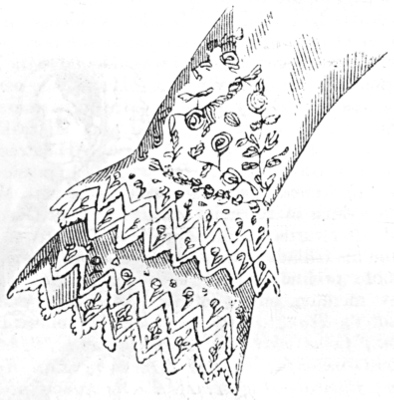
Under-sleeve of Lace.—This sleeve is intended to be worn for evening dress. The double row of vandyked lace forming the trimming should drop below the sleeve of the dress, under which the lace sleeve is to be worn.
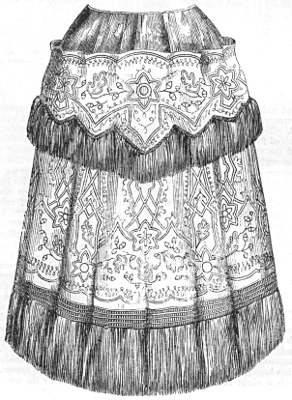
Among the most striking and beautiful articles in the way of Mantillas, is the Talma, represented in the following engraving. The capuche is formed on the model of those worn by the celebrated monks of St. Francis, and the tout ensemble is very graceful and beautiful. The entire design is very well exhibited in the illustration. The Talmas are made of velvet, silk, satin, and fine cloth. They have been introduced in New-York by Mr. Bulpin, of Broadway.
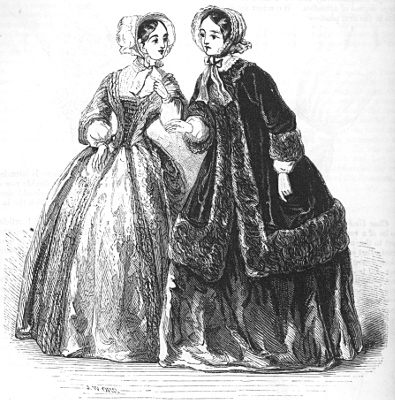
The jacket and waistcoat described in our last have a certain currency, but are not likely to be universally adopted. The above costumes, from the latest modes received from Paris, are in the main conservative, and the engraving is so distinctive that the figures scarcely need description.
Black now becomes indispensable in the toilettes of ladies of fashion; formerly it was exclusively reserved for days of mourning, A black dress does not interfere with the robes of varied colors, and the materials are rich and in good taste. Jet, in fringes or lace, is worn with all materials. Upon moire or satin, deep flounces of chantilly or ruches of lace, placed en tablier, are much worn; taffetas flounces are cut and stamped in patterns, or covered with narrow velvets imitating embroidery. For mantelets, and every species of outside garments, black will more generally perhaps than ever before prevail; and rich furs will have their old prominence for trimming, particularly for garments of velvet. Fine and heavy plushes are also being rather largely manufactured for such purposes.
There is scarcely any change perceptible in the shape of bonnets, most of the new ones being of the form which has been generally worn for some time; yet there is a slight modification of that shape in bonnets made expressly for the winter. The front is somewhat less wide and open, and the bavolet, being rather narrower, droops less at the back of the head. Of the various materials likely to be employed for bonnets during the coming winter, none will be more fashionable than velvet. Among the velvet bonnets we notice one of violet-colored velvet trimmed with bows of the same, intermingled with black lace and jet beads. The inside trimming consists of velvet pansies, of the natural color of the flowers, having yellow centres. With the flowers are combined a few loops of velvet ribbon of a rich yellow tint, matching the centre of the flowers. Another bonnet, composed of dark blue therry velvet, is trimmed with ribbon, striped with blue and orange. This bonnet is ornamented in the inside with white flowers.
A Russian winter riding habit is described as very simple but costly, having a bonnet or hat of sables or other furs, setting on the head very much like a chancellor's full wig, and secured by a richly gemmed bracelet under the chin. The close coat, and light and flowing mantle nearly concealing it, are of black or other dark-colored velvet. This will be in vogue probably only in the intensest severity of the cold season. Black cloth, embroidered, is used for the same purpose.
P. 636 corrected typo in Greek text.