Volume 2 — CHAPTER XVI.
Reading edition
The Trafalgar Campaign—Concluded.
Successive Modifications of Napoleon's Plan.—Narrative of Naval Movements.—Final Failure of Napoleon's Naval Combinations.—War with Austria, and Battle of Austerlitz.—Battle of Trafalgar.—Vital Change Imposed Upon Napoleon's Policy by the Result of the Naval Campaign.
THE Spanish declaration of war was followed by a new treaty of alliance with France, signed in Paris on the 5th of January, 1805, and confirmed on the 18th of the month at Madrid. Spain undertook to furnish, by March 21, to the common cause, at least twenty-five ships-of-the-line and eleven frigates; but the military direction of the whole allied effort was entrusted to Napoleon.
This accession of Spain could not become immediately operative, owing to the backward state of her armaments caused by the previous demands of Great Britain. The emperor therefore adhered for the time to his existing plans, formulated on the 27th and 29th of September. These proving abortive, he next framed, upon lines equal both in boldness and scope to those of the Marengo and Austerlitz campaigns, the immense combination which resulted in Trafalgar.
The events of the ten following months, therefore, have an interest wholly unique, as the development of the only great naval campaign ever planned by this foremost captain of modern times. From his opponents, also, upon whom was thrown the harder task of the defensive, was elicited an exhibition of insight, combination, promptitude, and decision, which showed them to be, on their own element, not unworthy to match with the great emperor. For Napoleon was at this disadvantage,—he could not fully realize the conditions of the sea. Accustomed by forethought and sheer will to trample obstacles under foot, remembering the midwinter passage of the Splugen made by Macdonald at his command, and the extraordinary impediments overcome by himself in crossing the Saint Bernard, he could not believe that the difficulties of the sea could not be vanquished by unskilled men handling the ponderous machines entrusted to them, when confronted by a skilful enemy. To quote an able French writer: "But one thing was wanting to the victor of Austerlitz,—le sentiment exact des difficultés de la marine." [159]
With steam, possibly, this inequality of skill might have been so reduced as to enable the generalship of Napoleon, having also the advantage of the initiative, to turn the scale. With sailing ships it was not so; and in following the story of Trafalgar it must be remembered that the naval superiority of Great Britain lay not in the number of her ships, but in the wisdom, energy, and tenacity of her admirals and seamen. At best her numbers were but equal to those arrayed against her. The real contest was between the naval combinations of Napoleon and the insight of British officers, avoiding or remedying the ex-centric movements he untiringly sought to impress upon their forces.
In December detailed instructions for executing the plan of September 29 were issued to Admirals Villeneuve and Missiessy. [160] The latter, after leaving Rochefort, was to steer between the Azores and Canaries, so as to avoid the British squadrons off the Biscay coast of Spain, go direct to Martinique, take the British islands Santa Lucia and Dominica, and upon Villeneuve's arrival place himself under his command. In pursuance of these orders Missiessy escaped from Rochefort on January 11. He was seen next day by a lookout vessel belonging to the blockading squadron; but the latter, for whatever reason, was off its post, and Missiessy reached Martinique safely on the 20th of February. On the 24th of that month six British ships-of-the-line, under Rear-Admiral Cochrane, sailed in pursuit from before Ferrol; where their place was taken by a detachment of equal force drawn from before Brest.
Villeneuve's orders were to go from Toulon direct to Cayenne, recapture the former Dutch colonies of Guiana, form a junction with Missiessy, re-enforce San Domingo, and start on his return for Europe not later than sixty days after reaching South America. With the combined squadrons he was to appear off Ferrol, release the French ships there blockaded, and bring the whole force, amounting to twenty of the line, to Rochefort. "The result of your cruise," wrote Napoleon to him, "will be to secure our colonies against any attack, and to retake the four Dutch colonies on the Continent, as well as such other British islands as may appear open to the force under your command." Six thousand troops were embarked on board his squadron for the operations on shore. Both he and Missiessy were expressly forbidden to land their crews for that purpose; a decision of the great emperor worthy to be remembered in these days.
Villeneuve was ready to sail early in January, but his first need was to elude the watchfulness of Nelson. The British admiral was known to move from point to point in his command, between the Maddalena Islands and Cape San Sebastian on the Spanish coast, while he kept before Toulon lookout ships always informed of his whereabouts. Villeneuve therefore thought indispensable to start with a breeze strong enough to carry him a hundred miles the first night. For a fortnight the wind hung at north-east and south-east—fair but very light; but on the 17th of January it shifted to north-west, with signs of an approaching gale. The next morning Villeneuve sent a division to drive off the enemy's lookouts; and when these disappeared the squadron sailed, numbering ten of the line and seven frigates. Nelson with eleven ships-of-the-line was at the moment at anchor in Maddalena Bay.
Following Napoleon's plan for deceiving the British admiral, the French squadron steered for the south end of Sardinia, as though bound eastward. During the night it was dogged by the enemy's frigates, which had retired no further than was necessary to avoid capture. At ten o'clock they were close by; and at two in the morning, satisfied as to the French course, they parted company and hastened to Nelson,—the wind then blowing a whole gale from the north-west. Twelve hours later they were seen from the flag-ship with the signal flying that the enemy was at sea, and in two hours more the British fleet was under way. Unable to beat out by the western entrance in the teeth of the storm, it ran in single column through the narrow eastern pass as night fell,—Nelson's ship leading, the others steering by the poop lanterns of the vessel next ahead. When clear of the port the fleet hauled up to the southward, and during the night, which was unsettled and squally, kept along the east coast of Sardinia. The frigate "Seahorse" was sent ahead to pass round the south end of the island and get touch again of the enemy.
During the night the wind changed to south-south-west, and blew heavily throughout the 21st. On the forenoon of the 22d the fleet, still struggling against a heavy southwesterly gale, was fifty miles east of the south end of Sardinia. There it was rejoined by the "Seahorse," which the day before had caught sight of a French frigate standing in toward Cagliari, but had not seen the main body. Not till the 26th did Nelson reach Cagliari, where to his relief he found the French had not been. Nothing even was known of their movements; but the same day the frigate "Phœbe" joined from the westward with news that a French eighty-gun ship, partially dismasted, had put in to Ajaccio. The British fleet then stretched across to Palermo, where it arrived on the 28th. Having now fairly covered the approaches from the westward to Sardinia, Sicily, and Naples, Nelson reasoned that one of two things must have happened: either the French, despite the southerly gale, had succeeded in going east between Sicily and Africa, or they had put back disabled. In the latter case he could not now overtake them; in the former, he must follow. [161] Accordingly, after sending scouts to scour the seas, and three frigates to resume the watch off Toulon, he shaped his course along the north side of Sicily, and on the 30th of January passed through the straits of Messina on his way to Egypt.
Villeneuve had in fact returned to Toulon. On the first night an eighty-four-gun ship and three frigates separated, and the former put in dismasted to Ajaccio, as Nelson had learned. The following day and in the night, when the wind shifted to south-west, three more ships-of-the-line were crippled. Forced to the eastward by the gale, and aware that two enemy's frigates had marked his course, the admiral feared that he should meet the British at a disadvantage and determined to retreat.
Thus prematurely ended the first movement in Napoleon's naval combination for the invasion of England. The Rochefort squadron had escaped only to become a big detachment, wholly out of reach of support or recall. The Toulon fleet, forced to await a heavy wind in order to effect the evasion by which alone the combination could be formed, was through the inexperience of its seamen crippled by the very advantage it had secured. In truth, however, had it gone on, it would almost infallibly have been driven by the south-west gale into the very spot, between Sardinia and Sicily, where Nelson went to seek it, and which was ransacked by his lookouts. [162] Neither Villeneuve nor Nelson doubted the result of such meeting. [163]
The other factor in this combination, the Brest fleet and army corps of twenty thousand men, had been held in readiness to act, dependent upon the successful evasion of the two others. "I calculate," Napoleon had said, "that the sailing of twenty ships from Rochefort and Toulon will force the enemy to send thirty in pursuit;" [164] a diversion that would very materially increase the chances for the Brest armament. For a moment he spoke of sending to India this powerful body, strongly re-enforced from the French and Spanish ships in Ferrol. [165] This was, however, but a passing thought, rejected by his sound military instinct as an ex-centric movement, disseminating his force and weakening the purposed attack upon the heart of the British power. Three months later, when he began to fear failure for the latter attempt, he recurred to the East India project in terms which show why he at first laid it aside. "In case, through any event whatsoever, our expedition have not full success, and I cannot compass the greatest of all ends, which will cause all the rest to fall, [166] I think we must calculate the operation in India for September." [167] India in truth was to the imagination of Napoleon what Egypt was to Nelson,—an object which colored all his ideas and constantly misled him. As was shrewdly said by an American citizen to the British government, in this very month of January, 1805, "The French in general believe that the fountains of British wealth are in India and China. They never appeared to me to understand that the most abundant source is in her agriculture, her manufactures, and the foreign demand." [168] This impression Napoleon fully shared, and it greatly affected his judgment during the coming campaign.
The return of Villeneuve and the delay necessary to repair his ships, concurring with the expected re-enforcements from Spain, wholly changed the details of Napoleon's plan. In essence it remained the same from first to last; but the large number of ships now soon to be at his command appealed powerfully to his love for great masses and wide combinations. Now, also, Villeneuve could not reach the West Indies before the sickly season.
The contemplated conquests in America, which had formed so important a part of the first plan, were therefore laid aside, and so was also the Irish expedition by Ganteaume's fleet. The concentration of naval forces in the West Indies or at some point exterior to France became now the great aim; and the sally of the various detachments, before intended to favor the crossing of the flotilla by a diversion, was now to be the direct means of covering it, by bringing them to the English Channel and before Boulogne. The operations were to begin in March; and urgent orders were sent to Spain to have the contingents in her several ports ready to move at a moment's notice.
The situations of the squadrons in March, when the great Trafalgar campaign opened, need to be stated. On the extreme right, in the Texel, were nine ships-of-the-line with a due proportion of lighter vessels; and some eighty transports lay ready to embark Marmont's army corps of twenty-five thousand men. [169] The Boulogne flotilla was assembled; the few detachments still absent being so near at hand that their junction could be confidently expected before the appearance of the covering fleet. The army, one hundred and thirty thousand strong, was by frequent practice able to embark in two hours. [170] Two tides were needed for all the boats to clear the ports; but as word of the fleet's approach would precede its arrival, they could haul out betimes and lie in the open sea, under the batteries, ready to start. In Brest, Ganteaume had twenty-one ships-of-the-line. The Rochefort squadron was now in the West Indies with Missiessy; but two more ships were ready in that port and one in Lorient. In Ferrol were five French and ten Spanish; of the latter it was expected that six or eight could sail in March. In Cadiz the treaty called for twelve or fifteen to be ready at the same time, but only six were then actually able to move. There was also in Cadiz one French ship. In Cartagena were six Spaniards, which, however, took no part in the campaign. At Toulon Villeneuve would have eleven ships. All these were ships-of-the-line. The total available at the opening of the campaign was therefore sixty-seven; but it will be observed that they were disseminated in detachments, and that the strategic problem was, first, to unite them in the face of an enemy that controlled the communications, and, next, to bring them to the strategic centre.
As in 1796, the declaration of Spain in 1805 added immensely to the anxieties of Great Britain. Lord Melville, who succeeded St. Vincent as First Lord in May, 1804, had at once contracted for several ships-of-the-line to be built in private yards; [171] but these were not yet ready. A somewhat singular expedient was then adopted to utilize worn-out vessels, twelve of which were in February, 1805, cased with two-inch oak plank, and with some additional bracing sent to sea. It is said some of these bore a part in the battle of Trafalgar. [172]
The disposition and strength of the British detachments varied with the movements of the enemy and with the increasing strength of their own navy. Lord Keith, in the Downs with eleven small ships-of-the-line, watched the Texel and the Straits of Dover. The Channel fleet under Cornwallis held Brest under lock and key, with a force varying from eleven, when the year began, to twenty or twenty-four in the following April. This was the centre of the great British naval line. Off Rochefort no squadron was kept after Missiessy's escape. In March that event had simply transferred to the West Indies five French and six British ships. Off Ferrol eight ships were watching the combined fifteen in the port. In October, when the Spanish war was threatening, a division of six was sent to blockade Cadiz. Nelson's command, which had before extended to Cape Finisterre, was now confined to Gibraltar as its western limit, and the Cadiz portion assigned to Sir John Orde,—a step particularly invidious to Nelson, depriving him of the most lucrative part of his station, in favor of one who was not only his senior, with power to annoy him, but reputed to be his personal enemy. Nelson had within the Straits twelve of the line, several of which, however, were in bad condition; and one, kept permanently at Naples for political reasons, was useless to him. Two others were on their way to join, but did not arrive before the campaign opened. It may be added that there were in India from eight to ten ships-of-the-line, and in the West Indies four, which Cochrane's arrival would raise to ten. [173]
On the 2d of March Napoleon issued specific orders for the campaign to Villeneuve and Ganteaume. The latter, who was to command-in-chief after the junction, was directed to sail at the first moment possible with his twenty-one ships, carrying besides their crews thirty-six hundred troops. He was to go first to Ferrol, destroy or drive off the blockading squadron, and be joined by the French and Spanish ships there ready; thence by the shortest route to Martinique, where he was to be met by Villeneuve and, it was hoped, by Missiessy also. If Villeneuve did not at once appear, he was to be awaited at least thirty days. When united, the whole force, amounting to over forty of the line, would, to avoid detection, steer for the Channel by an unusual route and proceed direct to Boulogne, where the emperor expected it between June 10 and July 10. If by Villeneuve's not coming, or other cause, Ganteaume found himself with less than twenty-five ships, he was to go to Ferrol; where it would be the emperor's care to assemble a re-enforcement. He might, however, even with so small a number, move straight on Boulogne if he thought advisable. [174]
Villeneuve's orders were to sail at the earliest date for Cadiz, where he was not to enter but be joined outside by the ships then ready. From Cadiz he was to go to Martinique, and there wait forty days for Ganteaume. If the latter did not then appear he was to call at San Domingo, land some troops and thence go to the Bay of Santiago in the Canary Islands, [175] where he would cruise twenty days. This provided a second rendezvous where Ganteaume could join, if unexpectedly delayed in Brest. The emperor, like all French rulers, did not wish to risk his fleet in battle with nearly equal forces. Whatever the result, his combinations would suffer. "I prefer," said he, "the rendezvous at Martinique to any other; but I also prefer Santiago to a junction before Brest, by raising the blockade, in order to avoid fighting of any kind." [176] When Ganteaume, at a most critical instant, only six days before Villeneuve got away, reported that he was ready,—that there were but fifteen British ships in the offing and success was sure,—Napoleon replied: "A naval victory now would lead to nothing. Have but one aim,—to fulfil your mission. Sail without fighting." [177] So to the old delusion of ulterior objects was sacrificed the one chance for compassing the junction essential to success. By April 1 the British fleet off Brest was increased to twenty-one sail.
Meanwhile Nelson had returned from his fruitless search at Alexandria, and on the 13th of March again appeared off Toulon. Thence he went to Cape San Sebastian, showing his ships off Barcelona to convince the enemy he was fixed on the coast of Spain; reasoning that if they thought him to the westward they would more readily start for Egypt, which he still believed to be their aim. He had by his communications with Alexandria learned the distracted state of that country since the destruction of the Mameluke power and its restoration to the Turks, and reported that the French could easily hold it, if they once effected a lodgment. [178] From Cape San Sebastian the fleet next went to the Gulf of Palmas, a convenient roadstead in the south of Sardinia, to fill with provisions from transports lately arrived. It anchored there on the 26th of March, but was again at sea when, at 8 A. M. of April 4, being then twenty miles west of the Gulf, a frigate brought word of the second sailing of the Toulon fleet. When last seen, in the evening of March 31, it was sixty miles south of Toulon, steering south with a north-west wind. One of the pair of lookouts was then sent to Nelson; and the other, losing sight of the enemy during the night, joined him a few hours after the first. The only clue she could give was that, having herself steered south-west with a wind from west-north-west, the enemy had probably kept on south or borne away to the eastward. Nelson, therefore, took the fleet midway between Sardinia and the African coast, scattering lookout ships along the line between these two points. [179] He was thus centrally placed to cover everything east of Sardinia, and with means of speedy information if the French attempted to pass, at any point, the line occupied by him.
Villeneuve had indeed headed as reported by the British frigates, swayed by Nelson's ruse in appearing off Barcelona. [180] Believing the enemy off Cape San Sebastian, he meant to go east of the Balearic Islands. The next day, April 1; a neutral ship informed him that it had seen the British fleet south of Sardinia. The wind fortunately hauling to the eastward, Villeneuve changed his course to pass north of the Balearics; and on the 6th of April, when Nelson was watching for him between Sardinia and Africa, he appeared off Cartagena. The Spanish division there declined to join him, having no instructions from its government; and the French fleet, continuing at once with a fresh easterly wind, passed Gibraltar on the 8th. On the 9th it reached Cadiz, driving away Orde's squadron. Following his orders strictly, Villeneuve anchored outside the port; and was there at once joined by the French seventy-four "l'Aigle," and six Spanish ships. During the night the combined force of eighteen of the line sailed for Martinique, where it anchored May 14, after a passage of thirty-four days. Some Spanish ships separated the day after sailing; but, having sealed instructions giving the rendezvous, they arrived only two days later than the main body.
This sortie of Villeneuve had so far been exceptionally happy. By a mere accident he had learned Nelson's position, while that admiral was misled by what seems to have been bad management on the part of his carefully placed lookouts. Nelson was not prone to blame subordinates, but he apparently felt he had not been well served in this case. Not till April 16, when Villeneuve was already six days on his way from Cadiz, did he learn from a passing ship that nine days before the French were seen off Cape de Gata, on the coast of Spain, steering westward with an east wind, evidently bound to the Atlantic. To this piece of great good luck Villeneuve's fortune added another. While he carried an east wind with him till clear of the Straits, Nelson, from the 4th of April to the 19th, had a succession of strong westerly gales. "We have been nine days coming two hundred miles," he wrote. "For a whole month we have had nothing like a Levanter except for the French fleet." [181] Not till May 6, after a resolute struggle of over three weeks against contrary fortune, did he anchor his fleet in Gibraltar Bay. Five days later he was on his way to the West Indies. But while the escape from Toulon showed the impossibility of securing every naval detachment of the enemy, the events elsewhere happening proved the extreme difficulty of so timing the evasions as to effect a great combination. While Villeneuve with eighteen ships was hastening to the West Indies, Missiessy, [182] with five others, having very imperfectly fulfilled his mission to annoy the enemy's islands, was speeding back to Rochefort, where orders at once to retrace his steps were waiting. At the same time Ganteaume with his twenty-one was hopelessly locked in Brest. Amid all the difficulties of their task, the British fleets, sticking close to the French arsenals, not only tempered their efficiency for war to the utmost toughness, but reaped also the advantages inseparable from interior positions.
The better to divert attention from his real designs, Napoleon took the time appointed for his squadrons' sailing to visit Italy. Leaving Paris April 1, and journeying leisurely, he was in Alessandria on the first of May and in Milan on the 10th. There he remained a month, and was on the 26th crowned king of the late Italian Republic. His stay in Italy was prolonged to July. It is probably to this carefully timed absence that we owe the full and invaluable record of his hopes and fears, of the naval combinations which chased each other through his tireless mind, of the calculations and surmises—true or false, but always ingenious—which are contained in his almost daily letters to the Minister of Marine.
Prominent among his preoccupations were the detention of Ganteaume,—who, "hermetically blockaded and thwarted by constant calms," [183] could not get away,—and the whereabouts of Nelson, who disappeared from his sight as entirely, and from his knowledge far more completely, than Villeneuve did from the British ken. "In God's name! hurry my Brest squadron away, that it may have time to join Villeneuve. Nelson has been again deceived and gone to Egypt. Villeneuve was out of sight on the 10th of April. Send him word that Nelson is seeking him in Egypt; I have sent the same news to Ganteaume by a courier. God grant, however, that he may not find him in Brest." [184] On the 15th of April Ganteaume did make an attempt. The British fleet had been driven off by a gale on the 11th, but reappeared on the 13th. On the afternoon of the 14th word was brought to Admiral Gardner, who had temporarily relieved Cornwallis, that the French were getting under way. The next day they came out; but the enemy now numbered twenty-four sail to their twenty-one, and after a demonstration they retired within the port.
As the advancing season gave less and less hope of the blockade relaxing, Napoleon formed a new combination. Two ships-of-the-line, now nearly ready at Rochefort, should sail under Rear-Admiral Magon, carrying modified instructions to Villeneuve. The latter was now commanded to wait thirty-five days after Magon's arrival, and then, if Ganteaume had not appeared, return direct to Ferrol, discarding the alternative rendezvous of Santiago. At Ferrol he would find fifteen French and Spanish ships, making with his own and Magon's a total of thirty-five. With these he was to appear before Brest, where Ganteaume would join him, and with the combined force of fifty-six of the line at once enter the Channel. Magon sailed with these orders early in May, and on June 4 reached Villeneuve just in time to insure the direction given by the latter to his fleet upon its return. To facilitate the junction at Brest very heavy batteries were thrown up, covering the anchorage outside the Goulet; and there, in May, Ganteaume took up his position, covered by one hundred and fifty guns on shore.
It will be recognized that the emperor's plan, while retaining its essential features, had now undergone a most important modification, due to the closeness of the British blockade of Brest. A combination of his squadrons still remained the key-stone of the fabric; but the tenacity with which the largest of his detachments was held in check had forced him to accept—what he had rejected as least advantageous—a concentration in the Bay of Biscay, the great hive where swarmed the British navy.
It became therefore more than ever desirable to divert as many as possible of the enemy's cruisers from those waters; an object which now continuously occupied Napoleon's mind and curiously tinged his calculations with the color of his hopes. In defiance of statistics, he thought the East Indies, as has before been said, the first of British interests. He sought therefore to raise alarms about India, and persisted in believing that every division sailing from England was bound there. "Cochrane," he writes on April 13, "was before Lisbon on March 4. He must first have gone to the Cape de Verde, thence to Madeira, and if he gets no information he will go to India. That is what any admiral of sense would do in his case." [185] On the 10th of May, when Cochrane had been over a month in the West Indies, he reiterates this opinion, and at the same time conjectures that five thousand troops which sailed from England on the 15th of April with most secret orders were gone to the Cape of Good Hope. "Fears of Villeneuve's meeting this expedition will force them to send more ships to India." [186] On the 31st of May he guesses that eight ships-of-the-line, which sailed ten days before under Collingwood, were bound to India, [187] and a week later repeats the surmise emphatically: "The responsibility of the ministers is so great they cannot but send him to the East Indies." [188] On the 9th of June he writes: "Everything leads me to believe the English sent fifteen ships to the East Indies, when they learned that Cochrane reached Barbadoes a fortnight after Missiessy sailed; and in that case it is quite possible Nelson has been sent to America." [189] This opinion is repeated on the 13th and 14th; and on the 28th, as the veil was about to fall from his eyes, he sums up the acute reasoning which, starting from a false premise, had so misled him: "It is difficult to believe that without any news the English have sent seventeen ships-of-the-line (i. e. Nelson and Collingwood combined) to the West Indies, when Nelson, joining his ten to Cochrane's six, and three at Jamaica, would have nineteen—superior to our squadron; while Collingwood going to the East Indies with eight and finding there nine, in all seventeen, also superior to us—it is difficult, I say, to believe that the enemy, with the chance of being everywhere superior, should blindly abandon the East Indies." [190]
Some French writers, [191] as well as some English, have disparaged the insight of Nelson, comparing him unfavorably with Napoleon, and basing their estimate largely upon his error in esteeming Egypt the aim of the French. In view of the foregoing extracts, and of other miscalculations made by the emperor during this remarkable campaign—which will appear farther on—it must be admitted that when in the dark, without good information, both were forced to inferences, more or less acute, but which, resting on no solid data, rose, as Nelson said, little above guesses. So also Collingwood has been credited with completely unravelling Napoleon's plan, and his penetration has been exalted above Nelson's because, after the latter's return from chasing Villeneuve to the West Indies, he wrote that the flight there was to take off the British naval force; overlooking his conjecture, two lines before, that (not England, but) "Ireland is the real mark and butt of all these operations." Rather might each adopt for himself Napoleon's own words, "I have so often in my life been mistaken that I no longer blush for it." [192] When his frigates lost sight of Villeneuve, on the night of March 31, Nelson went neither east nor west; he concentrated his force to cover what he thought the most likely objects of the enemy, and awaited information as to his movements. "I shall neither go to the eastward of Sicily nor to the westward of Sardinia until I know something positive." [193] It can be confidently said that under like conditions Napoleon would have done the same.
The fault of Napoleon's calculations was in over-estimating both the importance and the danger of India, and also in not allowing for the insight and information of the British government. He himself laid down, with his peculiarly sound judgment, the lines it ought to follow: "If I had been in the British Admiralty, I would have sent a light squadron to the East and West Indies, and formed a strong fleet of twenty of the line which I would not have dispatched until I knew Villeneuve's destination." [194] This was just what the Admiralty did. A light squadron was on its way to India, and eight ships were ordered to the West Indies under Collingwood; but that able officer, finding Nelson had started, contented himself with sending two to re-enforce him, and took up his own position with six before Cadiz, thus blocking the junction of the Cartagena ships. The strong body of twenty was kept before Brest, much to Napoleon's annoyance. "If England realizes the serious game she is playing, she ought to raise the blockade of Brest." [195] But here, as with regard to the Indian expeditions, Napoleon's thought was fathered by his wish. To weaken the Brest blockade, as he confessed a little later, was the great point for France. [196]
Nothing in fact is more noteworthy, nor more creditable, than the intelligence and steadiness with which the British naval authorities resisted Napoleon's efforts to lead them into ex-centric movements. This was partly due to an accurate judgment of the worth of the enemy's detached squadrons, partly to an intuitive sense of the supreme importance of the Biscay positions, and partly to information much more accurate than Napoleon imagined, or than he himself received in naval transactions. "Those boasted English," jeered he, when he thought them ignorant of Villeneuve's second sailing, "who claim to know of everything, who have agents everywhere, couriers booted and spurred everywhere, knew nothing of it." [197] Yet, by a singular coincidence, on the very day, April 25, that they were supposed thus deceived, the Admiralty were hurrying letters to Nelson and to the West Indies with the important tidings. "You reason," wrote he to Decrès, "as if the enemy were in the secret." [198] This is just what they were,—not as to all details, but as to the main features of his plans. While the emperor was wildly reckoning on imaginary squadrons hastening to India, and guessing where Nelson was, both the latter and his government knew where Villeneuve had gone, and the British admiral was already in the West Indies. About the beginning of May it was known in England not only that the Toulon fleet had sailed, but whither it was bound; [199] and about the first of June, despite the cautions about secrecy imposed by Bonaparte, the British were informed by a prisoner that "the combined fleet, of sixty sail-of-the-line, will fight our fleet (balayer la Manche), while the large frigates will come up channel to convoy the flotilla over. The troops are impatiently awaiting the appearance of the ships to set them free." [200]
The Admiralty therefore understood as well as did Napoleon that the crucial necessity in their dispositions was to prevent the combination of the enemy's squadrons, and that the chief scene of operations would be the Bay of Biscay and the approaches to the Channel. They contented themselves, consequently, with strengthening the force there, and keeping before Cadiz alone a detachment under Collingwood, lest a concentration in that port should compel them to weaken the Biscay squadrons. At the time Villeneuve sailed, an expedition of five thousand troops, whose destination was kept profoundly secret, was ready to start for the Mediterranean. This re-enforcement secured the naval bases of Gibraltar and Malta, and the Mediterranean otherwise was abandoned to frigates, supported by two or three ships-of-the-line. Herein also the practice of the Admiralty agreed with the precept of Napoleon. "The Mediterranean," wrote he on June 7 to his Minister of Marine, "is now nothing. I would rather see there two of Villeneuve's ships than forty;" and he added the pregnant counsel, which was exemplified by the British action, "It seems to me your purpose is not exclusive enough for a great operation. You must correct this fault, for that is the art of great successes and of great operations."
The secret expedition was met by Nelson just as he started for the West Indies. During his heavy beat down the Mediterranean he too, as carefully as Napoleon, had been studying the field on which he was to act; but while the one planned with all the freedom and certainty of an offensive, which, disposing of large means, moves upon a known object, the other, though in a restricted sphere, underwent the embarrassments of the defensive, ignorant where the blow was to fall. One clear light, however, shone step by step on his path,—wherever the French fleet was gone there should he go also.
The west wind which delayed his progress brought swiftly to him, on April 19, a vessel [201] from Gibraltar, with word that, two hours after Villeneuve passed the Straits, a frigate had started for England with the news, and that the French and Spaniards had sailed together from Cadiz. From this circumstance he reasoned, accurately, that the destination was the British Islands; [202] but he did not penetrate the deep design of a concentration in the West Indies. He therefore sent the frigate "Amazon" ahead of the fleet to Lisbon, to gather news and rejoin him off Cape St. Vincent; and by her he wrote the Admiralty, and also to the admirals off Brest and in Ireland, that he should take position fifty leagues west of the Scilly Islands, and thence steer slowly toward them. To any person who will plot this position on a map it will be apparent that, with winds prevailing from the westward, he would there be, as he said, equally well situated to reach Brest or Ireland; in short, in an excellent strategic position known to the authorities at home.
Stopping but four hours at Gibraltar on May 6, on the 9th he was off Cape St. Vincent, and there received news that the combined squadrons, to the number of eighteen of the line, had gone to the West Indies. His concern was great, for he fully understood the value of those islands. He had served there, knew them intimately, and had married there. Not a year before he had written, "If our islands should fall, England would be so clamorous for peace that we should humble ourselves." [203] Still, with all his anxiety, he kept his head. The convoy of troops was close at hand, he must provide for its safety. On the 11th of May it arrived, Nelson's fleet being then under way. To the two ships-of-the-line guarding it he added a third, the "Royal Sovereign," whose bad sailing delayed him; and to this circumstance it was owing that that ship, newly coppered, bore Collingwood's flag far in advance of either British column into the fire at Trafalgar. Three hours after the convoy's junction, at 7 P. M.of May 11, Nelson with ten ships was on his way to the West Indies, to seek eighteen which had thirty-one days' start.
On the 4th of June the British fleet, having gained eight days on the allies, anchored at Barbadoes, where it found Cochrane with two sail-of-the-line. The same day Magon with his two joined Villeneuve. In the three weeks the latter had now been in Martinique he had accomplished nothing but the capture of Diamond Rock, a small islet detached from the main island, which the British held and from which they annoyed the coasters. A frigate outstripping Magon had brought pressing orders to make conquests in the British possessions, during the thirty-five days of waiting for Ganteaume. In consequence, when Magon joined, the fleet was under way, standing north to clear the islands before making the stretch to the southward, and to windward, to reach Barbadoes; which Villeneuve had selected as his first point of attack.
On the 4th of June, therefore, the two hostile fleets were but a hundred miles apart, the distance separating Barbadoes from Martinique. Most singularly, at the very moment Villeneuve started north to return upon Barbadoes, false news, too plausible to be slighted, induced Nelson to go south. Positive information was sent by the officer commanding at Santa Lucia that the allies had been seen from there, May 29, steering south. Nelson anchored at Barbadoes at 5 P. M. June 4, embarked two thousand troops during the night, and at 10 A. M. next day made sail for the southward. On the 6th he passed Tobago, which was reported safe, and on the 7th anchored off Trinidad; where to the astonishment of every one nothing had been heard of the enemy. Cursing the news which had forced him to disregard his own judgment, when only a hundred miles of fair wind severed him from his prey, Nelson turned upon his tracks and steered for Martinique, tortured with fears for Jamaica and every exposed British possession.
On the 8th of June, when Nelson left Trinidad, the combined fleets were nearly four hundred miles from him, off the west side of Antigua. Here they captured fourteen merchant ships which had imprudently left port, and by them were informed that Nelson with fourteen ships (instead of ten) had reached Barbadoes. To these fourteen, Villeneuve, whose information was poor, added five as the force of Cochrane, making nineteen to his eighteen. Supposing therefore the enemy to be superior, not only in quality, which he conceded, but in numbers also, he decided, in view of so unexpected an event as the arrival on the scene of the greatest British admiral, to return at once to Europe. In this he doubtless met the wishes of Napoleon. "I think," said the latter, ere he knew the fact, "that the arrival of Nelson may lead Villeneuve to return to Europe;" [204] and he argued, still seeing things as he wished,—certainly not as a seaman would,—"When Nelson learns Villeneuve has left the Windward Islands, he will go to Jamaica," [205] a thousand miles to leeward. "So far from being infallible like the Pope," wrote Nelson at the same moment, "I believe my opinions to be very fallible, and therefore I may be mistaken that the enemy's fleet is gone to Europe; but I cannot bring myself to think otherwise." [206] Then, having given his reasons, he seems to dive into Napoleon's mind and read his thoughts. "The enemy will not give me credit for quitting the West Indies for this month to come." [207]
Villeneuve also doubtless hoped to shake off his pursuer by his sudden change of purpose. Transferring troops necessary to garrison the French islands to four frigates, he directed the latter to land them at Guadaloupe and rejoin him off the Azores,—a mistaken rendezvous, which materially lengthened his backward voyage. The combined fleet then made sail on the 9th of June to the northward, to reach the westerly winds that favor the passage to Europe.
Three days later Nelson also was off Antigua, and convinced himself that the allies were bound back to Europe. With the tireless energy that brooked no rest when once resolve was formed, the night was passed transferring the troops which but one week before he had embarked at Barbadoes. But not even a night's delay was allowed in sending news to Europe. At 8 P. M. he hurried off the brig "Curieux" with dispatches to the Admiralty, which the captain, Bettesworth, was to deliver in person; a momentous action, and one fraught with decisive consequences to the campaign, although somewhat marred by an overcautious admiral. On the 13th, at noon, the fleet itself, accompanied by one of Cochrane's two ships, the "Spartiate," sailed for the Straits of Gibraltar; but Nelson, uncertain as to the enemy's destination, also sent word to the officer commanding off Ferrol, [208] lest he might be taken unawares.
Although Villeneuve's decision to return was fortunate and characterized by the extraordinary good luck which upon the whole had so far attended him, it is evident that he ran the chance of crossing Ganteaume on the Atlantic, as he himself had been crossed by Missiessy. Napoleon had taken precautions to insure both his waiting long enough, and also his return in case Ganteaume could not get away by a certain time; but not having foreseen, nor until June 28 [209] even known, Nelson's pursuit of Villeneuve, he could not anticipate the course of the latter in such a contingency, nor combine with it the action of the Brest fleet.
Ganteaume, however, was not able to elude Lord Gardner, and on the 8th of May the emperor, having received in Italy the news of Magon's sailing, gave his final decision. If before midnight of May 20 an opportunity offered, the Brest fleet should start; but from daybreak of the 21st, had it every chance in the world, it should stand fast. A frigate was to be kept ready to sail the instant the latter condition took effect, carrying to Villeneuve orders for his action upon reaching Ferrol. This frigate did sail May 21, but of course did not find the admiral in the West Indies. Duplicate instructions were sent to Ferrol.
Villeneuve was by them informed that he would in Ferrol find ready for sea five French and nine Spanish ships, which, with those already under his orders, would make a force of thirty-four sail-of-the-line. In the roads off Rochefort would be five more. At Brest twenty-one ships were lying outside the Goulet, under the protection of one hundred and fifty cannon, ready to get under way at a moment's notice. The great point was to concentrate these three masses, or as much of them as possible, off Boulogne. Three courses were open to him. If the squadron at Ferrol could not leave the port when he appeared, on account of head winds, he should order it to join him at Rochefort and go there at once himself. Thence with forty ships he should proceed off Brest, join Ganteaume, and at once enter the Channel. If, however, the wind was fair for leaving Ferrol, that is, southerly, he would see in that a reason for hastening to Brest, without stopping for the Rochefort squadron; the more so as every delay would increase the British force before Brest. Thirdly, he might possibly, as he drew toward Ushant, find the winds so fair as to give the hope of getting to Boulogne with his thirty-five ships three or four days before the enemy's fleet at Brest could follow. If so, it was left to his discretion to embrace so favorable an opportunity. To these three courses Napoleon added a fourth as a possible alternative. After rallying the Ferrol ships he might pass north of the British Islands, join the Dutch squadron of the Texel with Marmont's corps there embarked, and with these appear off Boulogne. The emperor, however, looked upon this rather as a last resort. A great concentration in the Bay of Biscay was the one aim he now favored.
To facilitate this he busied himself much with the question of diverting the enemy from that great centre of his operations. This it was that made him so ready to believe that each squadron that sailed was gone to the East Indies. If so, it was well removed from the Bay of Biscay. For this he sought to get the Cartagena ships to Toulon or to Cadiz. "If we can draw six English ships before each port," he writes, "that will be a fine diversion for us; and if I can get the Cartagena ships in Toulon I will threaten Egypt in so many ways that they will be obliged to keep there an imposing force. They will believe Villeneuve gone to the East Indies in concerted operation with the Toulon squadron." [210] For this he purposes to send Missiessy to Cadiz. In Rochefort that admiral will occupy a British detachment, but on the spot where the emperor does not wish it; at Cadiz it will be remote from the scene. But later on he says, "Perhaps the enemy, who are now thoroughly frightened, will not be led away; in that case I shall have dispersed my force uselessly." [211] Therefore he concludes to keep him at Rochefort, where, if blockaded, he reduces the force either off Ferrol or off Brest. If not blockaded, he is to go to sea, take a wide sweep in the Atlantic, and appear off Ireland. The English will then doubtless detach ships to seek him; but he will again disappear and take position near Cape Finisterre, where he will be likely to meet Villeneuve returning. [212] Finally, for the same reason, toward the end of June he tries to create alarm about the Texel. Marmont is directed to make demonstrations and even to embark his troops, while part of the emperor's guard is moved to Utrecht. "This will lead the enemy to weaken his fleet before Brest, which is the great point." [213]
All these movements were sound and wise; but the emperor made the mistake of underestimating his enemy. "We have not to do," he said, "with a far-sighted, but with a very proud government. What we are doing is so simple that a government the least foresighted would not have made war. For an instant they have feared for London; soon they will be sending squadrons to the two Indies." [214]
The British government and the British Admiralty doubtless made blunders; but barring the one great mistake, for which the previous administration of St. Vincent was responsible, of allowing the material of the navy to fall below the necessities of the moment, the Trafalgar campaign was in its leading outlines well and adequately conceived, and in its execution, as event succeeded event, ably and even brilliantly directed. Adequate detachments were placed before each of the enemy's minor arsenals, while the fleet before Brest constituted the great central body upon which the several divisions might, and when necessity arose, actually did fall back. Sudden disaster, or being beaten in detail, thus became almost impossible. In the home ports was maintained a well-proportioned reserve, large enough to replace ships disabled or repairing, but not so large as seriously to weaken the force at sea. As a rule the Admiralty successfully shunned the ex-centric movements to which Napoleon would divert them, and clung steadfastly to that close watch which St. Vincent had perfected, and which unquestionably embodied the soundest strategic principles. Missiessy returned to Rochefort on the 26th of May and was promptly blocked by a body of five or six ships. As the force in Ferrol increased, by the preparation of ships for sea, the opposing squadron of six or seven was raised to ten, under Rear-Admiral Calder. Before Brest were from twenty to twenty-five, to whose command Admiral Cornwallis returned early in July, after a three months' sick leave. Collingwood with half a dozen was before Cadiz, where he effectually prevented a concentration, which, by its distance from the scene of action, would have seriously embarrassed the British navy. Such was the situation when Villeneuve and Nelson, in June and July, were re-crossing the Atlantic, heading, the one for Ferrol, the other for the Straits; and when the crisis, to which all the previous movements had been leading, was approaching its culmination.
When Nelson started back for Europe, although convinced the French were thither bound, he had no absolute certainty of the fact. [215] For his decision he relied upon his own judgment. In dispatching the "Curieux" the night before he himself sailed, he directed her captain to steer a certain course, by following which he believed he would fall in with the allied fleet. [216] Accordingly the "Curieux" did, on the 19th of June, sight the enemy in latitude 33° 12' north and longitude 58° west, nine hundred miles north-north-east from Antigua, standing north-north-west. The same day Nelson himself learned from an American schooner that a fleet of about twenty-two large ships of war had been seen by it on the 15th, three hundred and fifty miles south of the position in which Bettesworth saw it four days later.
Bettesworth fully understood the importance of the knowledge thus gained. The precise destination of the enemy did not certainly appear, but there could be no doubt that he was returning to Europe. With that intelligence, and the information concerning Nelson's purposes, it was urgent to reach England speedily. Carrying a press of sail, the "Curieux" anchored at Plymouth on the 7th of July. The captain posted at once to London, arriving the evening of the 8th, at eleven. The head of the Admiralty at that time was Lord Barham, an aged naval officer, who had been unexpectedly called to the office two months before, in consequence of the impeachment of Lord Melville, the successor to St. Vincent. It was fortunate for Great Britain that the direction of naval operations at so critical a moment was in the hands of a man, who, though over eighty and long a stranger to active service, understood intuitively, and without need of explanation, the various conditions of weather and service likely to affect the movements of the scattered detachments, British and hostile, upon whose rapid combinations so much now depended.
Barham having gone to bed, Bettesworth's dispatches were not given him till early next morning. As soon as he got them he exclaimed angrily at the loss of so many precious hours; and, without waiting to dress, at once dictated orders with which, by 9 A. M. of the 9th, Admiralty messengers were hurrying to Plymouth and Portsmouth. Cornwallis was directed to raise the blockade at Rochefort, sending the five ships composing it to Sir Robert Calder, then watching off Ferrol with ten; and the latter was ordered, with the fifteen ships thus united under his command, to cruise one hundred miles west of Cape Finisterre, to intercept Villeneuve and forestall his junction with the Ferrol squadron. With Nelson returning toward Cadiz, where he would find Collingwood, and with Cornwallis off Brest, this disposition completed the arrangements necessary to thwart the primary combinations of the emperor, unknown to, but shrewdly surmised by, his opponents. It realized for Ferrol that which Napoleon had indicated as the proper course for the British fleet off Brest, in case it received intelligence of Villeneuve's approach there,—to meet the enemy so far at sea as to prevent the squadron in port from joining in the intended battle. [217]
Fair winds favoring the quick, Cornwallis received his orders on the 11th; and on the 15th, eight days after the "Curieux" anchored in Plymouth, the Rochefort ships joined Calder. The latter proceeded at once to the post assigned him, where on the 19th he received through Lisbon the tidings of Villeneuve's return sent by Nelson from the West Indies. The same day Nelson himself, having outstripped the combined fleets, anchored in Gibraltar. On the 22d the sudden lifting of a dense fog revealed to each other the hostile squadrons of Calder and Villeneuve; the British fifteen sail-of-the-line, the allies twenty. The numbers of the latter were an unpleasant surprise to Calder, the "Curieux" having reported them as only seventeen. [218]
It is difficult to praise too highly the prompt and decisive step taken by Lord Barham, when so suddenly confronted with the dilemma of either raising the blockade of Rochefort and Ferrol, or permitting Villeneuve to proceed unmolested to his destination, whatever that might be. To act instantly and rightly in so distressing a perplexity—to be able to make so unhesitating a sacrifice of advantages long and rightly cherished, in order to strike at once one of the two converging detachments of an enemy—shows generalship of a high order. It may be compared to Bonaparte's famous abandonment of the siege of Mantua in 1796, to throw himself upon the Austrian armies descending from the Tyrol. In the hands of a more resolute or more capable admiral than Calder, the campaign would probably have been settled off Finisterre. Notice has been taken of Barham's good luck, in that the brilliant period of Trafalgar fell within his nine months' tenure of office; [219] but Great Britain might better be congratulated that so clear-headed a man held the reins at so critical a moment.
The length of Villeneuve's passage, which so happily concurred to assure the success of Barham's masterly move, was due not only to the inferior seamanship of the allies, but also to the mistaken rendezvous off the Azores, [220]—assigned by the French admiral when leaving the West Indies. The westerly gales, which prevail in the North Atlantic, blow during the summer from the south of west, west of the Azores, and from the north of west when east of them. A fleet bound for a European port north of the islands—as Ferrol is—should therefore so use the south-west winds as to cross their meridian well to the northward. Nelson himself sighted one of the group, though his destination was in a lower latitude. In consequence of his mistake, Villeneuve was by the north-west winds forced down on the coast of Portugal, where he met the north-easters prevalent at that season, against which he was struggling when encountered by Calder. This delay was therefore caused, not by bad luck, but by bad management.
Napoleon himself was entirely misled by Barham's measures, whose rapidity he himself could not have surpassed. He had left Turin on the 8th of July, and, travelling incessantly, reached Fontainebleau on the evening of the 11th. About the 20th he appears to have received the news brought ten days before by the "Curieux," and at the same time that of the Rochefort blockade being raised. [221] Not till the 27th did he learn that the British squadron off Ferrol had also disappeared, after being joined by the Rochefort ships. "The 'Curieux' only reached England on the 9th," he wrote to Decrès; "the Admiralty could not decide the movements of its squadrons in twenty-four hours, yet the Rochefort division disappeared on the 12th. On the 15th it joined that off Ferrol, and the same day, or at latest the next, these fourteen ships departed by orders given prior to the arrival of the 'Curieux.' What news had the English before the arrival of that brig? That the French were at Martinique; that Nelson had then but nine ships. What should they have done? I should not be surprised if they have sent another squadron to strengthen Nelson, ... and that it is these fourteen ships from before Ferrol they have sent to America." [222]
On the 2d of August the emperor set out for Boulogne, and there on the 8th received news of Villeneuve's action with Calder and of his subsequent entry into Ferrol. The fleets had fought on the afternoon of July 22, and two Spanish ships-of-the-line had been taken. Night-fall and fog parted the combatants; the obscurity being so great that the allies did not know their loss till next day. One of the British ships lost a foretopmast, and others suffered somewhat in their spars; but these mishaps, though pleaded in Calder's defence, do not seem to have been the chief reasons that deterred him from dogging the enemy till he had brought him again to action. He was preoccupied with the care of the prizes, a secondary matter, and with the thought of what would happen in case the Ferrol and Rochefort squadrons sailed. "I could not hope to succeed without receiving great damage; I had no friendly port to go to, and had the Ferrol and Rochefort squadrons come out, I must have fallen an easy prey. They might have gone to Ireland. Had I been defeated it is impossible to say what the consequences might have been." [223] In short, the British admiral had fallen into the error against which Napoleon used to caution his generals. He had "made to himself a picture," and allowed the impression produced by it to blind him to the fact (if indeed he ever saw it) that he had before him the largest and most important of the several detachments of the enemy, that it was imperatively necessary not to permit it to escape unharmed, and that at no future day could he be sure of bringing his own squadron into play with such decisive effect. The wisdom of engaging at any particular moment was a tactical question, to be determined by the circumstances at the time; but the duty of keeping touch with the enemy, so as to use promptly any opportunity offered, was a strategic question, the answer to which admits of no doubt whatever. On the evening of the 24th the wind was fair to carry him to the enemy, but he parted from them. During the night it blew fresh; and on the morning of the 25th, says a French authority, the fleet was without order, several vessels had lost sails, and others sustained injuries to their spars. [224] Calder, however, was not on hand.
It is related of Nelson that, on his return voyage from the West Indies, he used to say to his captains, speaking of the fleet which Calder allowed to escape, "If we meet them we shall find them not less than eighteen, I rather think twenty, sail-of-the-line, and therefore do not be surprised if I should not fall on them immediately; we won't part without a battle. I will let them alone till we approach the shores of Europe, or they give me an advantage too tempting to be resisted." [225] And again, after reaching England, he found on the 23d of August great anxiety prevailing about Calder, who with eighteen ships was then again cruising for Villeneuve, supposed to have been re-enforced to twenty-eight by the Ferrol squadron. "I am no conjuror," he wrote, "but this I ventured without any fear, that if Calder got fairly alongside their twenty-eight sail, by the time the enemy had beat our fleet soundly, they would do us no harm this year." [226] These two utterances of this consummate warrior sufficiently show how Calder should have viewed his opportunity in July.
Villeneuve had no more wish to renew the action than had Calder. Less even than that admiral could he rise to the height of risking a detachment in order to secure the success of a great design. In the eighteen ships left to him were over twelve hundred men so ill that it was necessary to put them ashore. Constrained by the winds, he put into Vigo on the 28th of July. Calder, on the other hand, having seen his prizes so far north as to insure their safety, returned off Cape Finisterre where he hoped to meet Nelson. Not finding him, he on the 29th resumed the blockade of Ferrol. On the 31st Villeneuve, leaving three of his worst vessels in Vigo, sailed for Ferrol with fifteen ships, of which two only were Spaniards. The fleet, having a strong south-west gale, kept close along shore to avoid meeting Calder; but the latter, having been blown off by the storm, was not in sight when Villeneuve reached the harbor's mouth. The allied ships were entering with a fair wind, when the French admiral received dispatches forbidding him to anchor in Ferrol. If, from injuries received in battle, or losses from any causes whatever, he was unable to carry out the plan of entering the Channel, the emperor preferred that, after rallying the Ferrol and Rochefort squadrons, he should go to Cadiz; but, the Brest fleet being ready and the other preparations complete, he hoped everything from the skill, zeal, and courage of Villeneuve. "Make us masters of the Straits of Dover," he implored, "be it but for four or five days." [227] Napoleon leaned on a broken reed. Forbidden to enter Ferrol, Villeneuve took his ships into the adjacent harbor of Coruña, [228] where he anchored August 1.
Thus was effected the junction which Calder had been expected to prevent. His absence on the particular day may have been unavoidable; but, if so, it does but emphasize his fault in losing sight of the allies on the 24th of July, when he had a fair wind. Twenty-nine French and Spanish ships were now concentrated at Ferrol. The popular outcry was so great that he felt compelled to ask an enquiry. The Admiralty having, by a movement both judiciously and promptly ordered, secured a meeting with the enemy's force so far from Ferrol as to deprive it of the support of the ships there, was justly incensed at the failure to reap the full advantage. It therefore ordered a court-martial. The trial was held the following December; and the admiral, while expressly cleared of either cowardice or disaffection, was adjudged not to have done his utmost to renew the engagement and to take or destroy every ship of the enemy. His conduct was pronounced highly censurable, and he was sentenced to be severely reprimanded.
This was after Trafalgar. The immediate result of the junction in Ferrol was the abandonment of the blockade there. On the 2d of August Calder sent five ships to resume the watch off Rochefort, whence the French squadron had meantime escaped. Not till August 9 did he know of Villeneuve's entrance into Ferrol. Having with him then but nine ships, he fell back upon the main body before Brest, which he joined on the 14th,—Cornwallis then having under him seventeen ships, which Calder's junction raised to twenty-six.
The next day, August 15, Nelson also joined the fleet. On the 25th of July, a week after reaching Gibraltar, he had received the "Curieux's" news. Obeying his constant rule to seek the French, he at once started north with the eleven ships which had accompanied him from the West Indies,—intending to go either to Ferrol, Brest, or Ireland, according to the tidings which might reach him on the way. After communicating with Cornwallis, he continued on to England with his own ship, the "Victory," and one other whose condition required immediate repairs. On the 18th he landed in Portsmouth, after an absence of over two years.
Cornwallis had now under his command a concentrated force of thirty-four or thirty-five sail-of-the-line, all admirably seasoned and disciplined. The allies had in Brest twenty-one, in Ferrol twenty-nine; two great bodies, neither of which, however, was equal in number, nor still less in quality, to his. Adrift somewhere on the sea were the five French ships from Rochefort. For more than five months these vessels, which sailed on the 17th of July, five days after the blockading ships had left to join Calder, ranged the seas without meeting an equal British division,—a circumstance which earned for them from the French the name of "the Invisible Squadron." But, while thus fortunately unseen by the enemy, Napoleon found it equally impossible to bring them within the scope of his combinations; [229] and it may be doubted whether commerce-destroying to the sum of two million dollars compensated for the loss of so important a military factor.
The ships in Cadiz being blocked by Collingwood, and those in Cartagena remaining always inert, the naval situation was now comparatively simple. Cornwallis was superior to either of the enemy's detachments, and he held an interior position. In case Villeneuve approached, it was scarcely possible that the two hostile squadrons, dependent upon the wind, which if fair for one would be foul to the other, could unite before he had effectually crushed one of them. It ought to be equally improbable, with proper lookouts, that Villeneuve could elude the British fleet and gain so far the start of it as to cover the Straits of Dover during the time required by Napoleon. In his concentrated force and his interior position Cornwallis controlled the issue,—barring of course those accidents which cannot be foreseen, and which at times derange the best-laid plans.
Such was the situation when, on August 17, Cornwallis was informed that Villeneuve had put to sea with, it was said, twenty-seven or twenty-eight ships-of-the-line. He at once detached toward Ferrol Sir Robert Calder with eighteen sail, keeping with himself sixteen. This division of his fleet, which is condemned by the simplest and most generally admitted principles of warfare, transferred to Villeneuve all the advantage of central position and superior force, and was stigmatized by Napoleon as a "glaring blunder." "What a chance," he wrote, upon hearing it when all was over, "has Villeneuve missed. He might, by coming upon Brest from a wide sweep to sea, have played hide and seek with Calder and fallen upon Cornwallis; or else, with his thirty ships have beaten Calder's twenty and gained a decided preponderance." [230] This censure of both admirals was just.
While the British squadrons were concentrating in the Bay of Biscay, and the happy insight and diligence of Nelson were bringing the Mediterranean ships to the critical centre of action, Napoleon, from the heights overlooking Boulogne, was eagerly awaiting news from Villeneuve, and at the same time anxiously watching the signs of the times on the Continent, where the sky was already dark with a gathering storm. The encroachments which led to the second war with Great Britain, in 1803, had excited no less distrust among the continental powers, who were indeed more immediately and disastrously affected by them; but none had then dared to move. The violation of German neutrality in 1804, by the seizure of the Duc d'Enghien on the soil of Baden, had caused a general indignation; which, on the part of Russia and Austria, was quickened into a desire to act by his execution, regarded by most as a judicial murder. Prussia shared the anger and fears of the other powers, but not enough to decide her vacillating government.
In this state of things the fall of the Addington ministry, and the consequent vigor imparted to the foreign policy of Great Britain by Pitt's second accession to power, led naturally to another coalition; the centre of which, as ever, was found in London. The czar having remonstrated vigorously, both with Napoleon and the German Diet, upon the seizure of the Duc d'Enghien, a bitter correspondence had followed, causing the rupture of diplomatic relations between France and Russia in August, 1804. For similar reasons, and at the same time, the French embassy to Sweden was recalled. Austria still temporized, though her actions excited Napoleon's suspicions.
Early in 1805 the czar sent special envoys to London, to treat concerning certain vast schemes for the reorganization of Europe in the interests of general peace. The particular object was not reached; but on the 11th of April a treaty between Great Britain and Russia was signed, the two agreeing to promote a league among the powers to stop further encroachments by Napoleon. Six weeks later the emperor was crowned King of Italy, and in June Genoa was annexed to France. This last act, contemplated by Napoleon for many years, [231] determined Austria's accession to the treaty. By her signature, given August 9, [232] the third coalition was formed. Sweden became a party to it at the same time, and Great Britain undertook to pay subsidies to all the members.
The preparations of Austria, ever deliberate, could not escape Napoleon's watchful eye. "All my news from Italy is warlike," he writes, "and indeed Austria no longer observes any concealment." [233] Yet, trusting to his enemy's slowness and his own readiness, he did not lose hope. The position was precisely analogous to those military situations in which he had so often snatched success from overwhelming numbers, by rapidly throwing himself on one enemy before the other could join. He might even yet deal his long cherished blow to Great Britain, under which, if successful, Austria also would at once succumb. On August 13, two days after learning of Villeneuve's entry into Coruña, he instructs Talleyrand to notify the emperor that the troops assembled in the Tyrol must be withdrawn to Bohemia, leaving him free to carry on his war with England undisturbed, or by November he will be in Vienna. [234] Urgent messages are the same day sent to Villeneuve to hasten and fulfil his mission, for time was pressing; threatened by Austria and Great Britain, a blow must speedily be struck. He is no longer ordered to refrain from fighting. On the contrary, if superior to the British, counting two Spanish ships equal to one French, he is to attack at all hazards. [235] "If with thirty ships my admirals fear to attack twenty-four British, we may as well give up all hope of a navy." [236]
On the 23d of August the emperor announces to Talleyrand his final and momentous decision: "My squadron sailed August 14 from Ferrol with thirty-four ships; [237] it had no enemy in sight. If it follows my instructions, joins the Brest squadron and enters the Channel, there is still time; I am master of England. If, on the contrary, my admirals hesitate, manœuvre badly, and do not fulfil their purpose, I have no other resource than to wait for winter to cross with the flotilla. That operation is risky; it would be more so if, pressed by time, political events should oblige me to postpone it to the month of April. Such being the case, I hasten to meet the most pressing danger: I raise my camp here, and by September 23 I shall have in Germany two hundred thousand men, and twenty-five thousand in Naples. I march upon Vienna, and do not lay down my arms until I have Naples and Venice, and have no more to fear from Austria. Austria will certainly thus be quieted during the winter." These words were a prophecy. The same day numerous orders, strictly preparatory as yet, were issued to the troops in Hanover, Holland, and Italy, and other provision made for the contemplated change of purpose. At the same time, still clinging to every hope of arresting Austria, and so being left free for the invasion of England, he sent Duroc to Berlin to offer Hanover to Prussia, upon condition that the latter should move troops toward Bohemia or at least make a clear declaration to Austria.
The issue was already decided. On the 13th of August, after three fruitless attempts, Villeneuve got to sea with his twenty-nine ships-of-the-line. The frigate "Didon" was sent to seek the Rochefort squadron and direct it also upon Brest. Yet the unfortunate admiral was even then hesitating whether he should go there with his vastly greater force, and the orders were likely seriously to endanger the smaller division. As he sailed, he penned these significant words to the Minister of Marine: "The enemy's forces, more concentrated than ever, leave me little other resource than to go to Cadiz." [238]
Shortly after he cleared the harbor the wind shifted to north-east, foul for his purpose. The fleet stood to the north-west; but the ships were badly handled and several received damage. On the morning of the 15th they were two hundred and fifty miles west-north-west from Cape Finisterre; the wind blowing a moderate gale, still from the north-east. Three ships of war were in sight,—two British, the third the frigate that had been sent to seek the Rochefort squadron, but which had been captured. A Danish merchantman reported that they were lookouts from a hostile body of twenty-five ships. The story had no foundation, for Cornwallis had not yet divided his fleet; but Villeneuve pictured to himself his inefficient command meeting a force with which it was wholly unable to cope. Losing sight of the great whole of which his own enterprise was but a part, though one of vital importance, his resolution finally broke down. That evening he ordered the fleet to bear up for Cadiz. On the 20th [239] it was sighted from the three ships commanded by Collingwood, who with a small division of varying strength had watched the port since the previous May. With steady judgment, that admiral in retiring kept just out of gunshot, determined, as he said, not to be driven into the Mediterranean without dragging the enemy too through the Straits. Villeneuve had little heart to pursue. That afternoon he anchored in Cadiz, where were then assembled thirty-five French and Spanish ships-of-the-line. Collingwood at once resumed his station outside. That night one ship-of-the-line joined him, and on the 22d Sir Richard Bickerton arrived with four from the Mediterranean. On the 30th Calder appeared, bringing with him the eighteen detached by Cornwallis. In compliance with his orders he had been before Ferrol, found the port empty, and, learning that Villeneuve had sailed for Cadiz, had hastened to re-enforce the blockade. With twenty-six ships-of-the-line Collingwood held the enemy securely checked, and remained in chief command until the 28th of September, when Nelson arrived from England.
Thus ended, and forever, Napoleon's profoundly conceived and laboriously prepared scheme for the invasion of England. If it be sought to fix a definite moment which marked the final failure of so vast a plan, that one may well be chosen when Villeneuve made signal to bear up for Cadiz. When, precisely, Napoleon learned the truth, does not appear. Decrès, the Minister of Marine, had however prepared him in some measure for Villeneuve's action; and, after a momentary outburst of rage against the unfortunate admiral, he at once issued in rapid succession the directions, by which, to use his own graphic expression, his legions were made to "pirouette," and the march toward the Rhine and Upper Danube was begun. "My decision is taken," he writes to Talleyrand, August 25; "my movement is begun. Three weeks hence I shall be in Germany with two hundred thousand men." During that and the two following days order after order issued from his headquarters; and on the 28th he wrote to Duroc that the army was in full movement. To conceal his change of purpose and to gain all-important time, by lulling the suspicions of Austria, he himself remained at Boulogne, with his eyes seemingly fixed seaward, until the 3d of September, when he went to Paris. On the 24th he left the capital for the army, on the 26th he was at Strasbourg, and on the 7th of October the French army, numbering near two hundred thousand, struck the Danube below Ulm; cutting off some eighty thousand Austrians there assembled under General Mack. On the 20th, the day before Trafalgar, Ulm capitulated; thirty thousand men laying down their arms. Thirty thousand more had been taken in the actions preceding this event. [240] On the 13th of November French troops entered Vienna, and on the 2d of December the battle of Austerlitz was won over the combined Russians and Austrians. On the 26th the emperor of Germany signed the Peace of Presburg. By it he relinquished Venice with all other possessions in Italy, and ceded the Tyrol to Bavaria, the ally of France.
Austria was thus quieted for three years, but the expedition against Great Britain was never resumed. In the course of the following year difficulties arose between Prussia and France, which led to war and the overthrow of the North German kingdom at Auerstadt and Jena. Yet another campaign was needed to bring Russia to peace in 1807. Meanwhile the Boulogne flotilla was rotting on the beach. In October, 1807, Decrès, by Napoleon's orders, made an inspection of the boats and the four ports. Of the twelve hundred of the former, specially built for the invasion, not over three hundred were fit to put to sea; of the nine hundred transports nearly all were past service. The circular port at Boulogne was covered two feet deep with sand; those of Vimereux and Ambleteuse, three feet. A very few years more would suffice to bury them. [241] In 1814 an English lady, visiting Boulogne after Napoleon's first abdication, noted in her journal that the mud walls of the encampment were still to be seen on the heights behind the town,—the crumbling record of a great failure.
The question will naturally here arise, What at any time were the chances of success? To a purely speculative question, involving so many elements and into which the conditions of sea war then introduced so many varying quantities, it would be folly to reply with a positive assertion. Certain determining factors may, however, be profitably noted. It is, for instance, evident that, if Villeneuve on leaving the West Indies had had with him the Ferrol squadron, and still more if he had been joined by Ganteaume, he could have steered at once for the Channel; and, by attending to well-known weather conditions, could have entered it with a favoring wind sure to last him to Boulogne. The difficulty of effecting such a combination in the West Indies, which was Napoleon's favorite project, was owing to the presence of British divisions before the hostile ports; and step by step this circumstance drove the emperor back on what he pronounced the worst alternative,—a concentration in front of Brest. As has been noticed, at the critical moment when this final concentration was to be attempted, the British, by a series of movements which resulted naturally from their strategic policy, were before that port in force superior to either of the French detachments seeking there to make their junction. Cornwallis's blunder in dividing that force cannot obscure the military lesson involved.
Nor can Calder's error, in suffering Villeneuve to escape him in July, detract from the equally significant and precisely similar lesson then illustrated. There also the British fleet was on hand to check an important junction—at a point so far from Ferrol as to be out of supporting distance by the division in the port—by virtue of an intelligent use of interior positions and interior lines.
To the strategic advantage conferred by these interior positions, for clinging to which credit is due above all to St. Vincent, is to be added the very superior character of the British personnel,—particularly of the officers; for the immense demand for seamen made it hard to maintain the quality of the crews. Continually cruising, not singly but in squadrons more or less numerous, the ships were ever on the drill ground,—nay, on the battle-field,—experiencing all the varying phases impressed upon it by the changes of the ocean. Thus practised and hardened into perfect machines, though inferior in numbers, they were continually superior in force and in mobility to their opponents.
Possessing, therefore, strategic advantage and superior force, the probabilities favored Great Britain. Nevertheless, there remained to Napoleon enough chances of success to forbid saying that his enterprise was hopeless. A seaman can scarcely deny that, despite the genius of Nelson and the tenacity of the British officers, it was possible that some favorable concurrence of circumstances might have brought forty or more French ships into the Channel, and given Napoleon the mastery of the Straits for the few days he asked. The very removal of the squadrons of observation from before Rochefort and Ferrol, in order to constitute the fleet with which Calder fought Villeneuve, though admirable as a display of generalship, shows that the British navy, so far as numbers were concerned, was not adequate to perfect security, and might, by some conceivable combination of circumstances, have been outwitted and overwhelmed at the decisive point.
The importance attached by the emperor to his project was not exaggerated. He might, or he might not, succeed; but, if he failed against Great Britain, he failed everywhere. This he, with the intuition of genius, felt; and to this the record of his after history now bears witness. To the strife of arms with the great Sea Power succeeded the strife of endurance. Amid all the pomp and circumstance of the war which for ten years to come desolated the Continent, amid all the tramping to and fro over Europe of the French armies and their auxiliary legions, there went on unceasingly that noiseless pressure upon the vitals of France, that compulsion, whose silence, when once noted, becomes to the observer the most striking and awful mark of the working of Sea Power. Under it the resources of the Continent wasted more and more with each succeeding year; and Napoleon, amid all the splendor of his imperial position, was ever needy. To this, and to the immense expenditures required to enforce the Continental System, are to be attributed most of those arbitrary acts which made him the hated of the peoples, for whose enfranchisement he did so much. Lack of revenue and lack of credit, such was the price paid by Napoleon for the Continental System, through which alone, after Trafalgar, he hoped to crush the Power of the Sea. It may be doubted whether, amid all his glory, he ever felt secure after the failure of the invasion of England. To borrow his own vigorous words, in the address to the nation issued before he joined the army, "To live without commerce, without shipping, without colonies, subjected to the unjust will of our enemies, is to live as Frenchmen should not." Yet so had France to live throughout his reign, by the will of the one enemy never conquered.
On the 14th of September, before quitting Paris, Napoleon sent Villeneuve orders to take the first favorable opportunity to leave Cadiz, to enter the Mediterranean, join the ships at Cartagena, and with this combined force move upon southern Italy. There, at any suitable point, he was to land the troops embarked in the fleet to re-enforce General St. Cyr, who already had instructions to be ready to attack Naples at a moment's notice. [242] The next day these orders were reiterated to Decrès, enforcing the importance to the general campaign of so powerful a diversion as the presence of this great fleet in the Mediterranean; but, as "Villeneuve's excessive pusillanimity will prevent him from undertaking this, you will send to replace him Admiral Rosily, who will bear letters directing Villeneuve to return to France and give an account of his conduct." [243] The emperor had already formulated his complaints against the admiral under seven distinct heads. [244] On the 15th of September, the same day the orders to relieve Villeneuve were issued, Nelson, having spent at home only twenty-five days, left England for the last time. On the 28th, when he joined the fleet off Cadiz, he found under his command twenty-nine ships-of-the-line, which successive arrivals raised to thirty-three by the day of the battle; but, water running short, it became necessary to send the ships, by divisions of six, to fill up at Gibraltar. To this cause was due that only twenty-seven British vessels were present in the action,—an unfortunate circumstance; for, as Nelson said, what the country wanted was not merely a splendid victory, but annihilation; "numbers only can annihilate." [245] The force under his command was thus disposed: the main body about fifty miles west-south-west of Cadiz, seven lookout frigates close in with the port, and between these extremes, two small detachments of ships-of-the-line,—the one twenty miles from the harbor, the other about thirty-five. "By this chain," he wrote, "I hope to have constant communication with the frigates."
Napoleon's commands to enter the Mediterranean reached Villeneuve on September 27. The following day, when Nelson was joining his fleet, the admiral acknowledged their receipt, and submissively reported his intention to obey as soon as the wind served. Before he could do so, accurate intelligence was received of the strength of Nelson's force, which the emperor had not known. Villeneuve assembled a council of war to consider the situation, and the general opinion was adverse to sailing; but the commander-in-chief, alleging the orders of Napoleon, announced his determination to follow them. To this all submitted. An event, then unforeseen by Villeneuve, precipitated his action.
Admiral Rosily's approach was known in Cadiz some time before he could arrive. It at first made little impression upon Villeneuve, who was not expecting to be superseded. On the 11th of October, however, along with the news that his successor had reached Madrid, there came to him a rumor of the truth. His honor took alarm. If not allowed to remain afloat, how remove the undeserved imputation of cowardice which he knew had by some been attached to his name. He at once wrote to Decrès that he would have been well content if permitted to continue with the fleet in a subordinate capacity; and closed with the words, "I will sail to-morrow, if circumstances favor."
The wind next day was fair, and the combined fleets began to weigh. On the 19th eight ships got clear of the harbor, and by ten A. M. Nelson, far at sea, knew by signal that the long-expected movement had begun. He at once made sail toward the Straits of Gibraltar to bar the entrance of the Mediterranean to the allies. On the 20th, all the latter, thirty-three ships-of-the-line accompanied by five frigates and two brigs, were at sea, steering with a south-west wind to the northward and westward to gain the offing needed before heading direct for the Straits. That morning Nelson, for whom the wind had been fair, was lying to off Cape Spartel to intercept the enemy; and learning from his frigates that they were north of him, he stood in that direction to meet them.
During the day the wind shifted to west, still fair for the British and allowing the allies, by going about, to head south. It was still very weak, so that the progress of the fleets was slow. During the night both manœuvred; the allies to gain, the British to retain, the position they wished. At daybreak of the 21st they were in presence, the French and Spaniards steering south in five columns; of which the two to windward, containing together twelve ships, constituted a detached squadron of observation under Admiral Gravina. The remaining twenty-one formed the main body, commanded by Villeneuve. Cape Trafalgar, from which the battle took its name, was on the south-eastern horizon, ten or twelve miles from the allies; and the British fleet was at the same distance from them to the westward.
Soon after daylight Villeneuve signalled to form line of battle on the starboard tack, on which they were then sailing, heading south. In performing this evolution Gravina with his twelve ships took post in the van of the allied fleet, his own flag-ship heading the column. It is disputed between the French and Spaniards whether this step was taken by Villeneuve's order, or of Gravina's own motion. In either case, these twelve, by abandoning their central and windward position, sacrificed to a great extent their power to re-enforce any threatened part of the order, and also unduly extended a line already too long. In the end, instead of being a reserve well in hand, they became the helpless victims of the British concentration.
At 8 A. M. Villeneuve saw that battle could not be shunned. Wishing to have Cadiz under his lee in case of disaster, he ordered the combined fleet to wear together. The signal was clumsily executed; but by ten all had gone round and were heading north in inverse order, Gravina's squadron in the rear. At eleven Villeneuve directed this squadron to keep well to windward, so as to be in position to succor the centre, upon which the enemy seemed about to make his chief attack; a judicious order, but rendered fruitless by the purpose of the British to concentrate on the rear itself. When this signal was made, Cadiz was twenty miles distant in the north-north-east, and the course of the allies was carrying them toward it.
Owing to the lightness of the wind Nelson would lose no time in manœuvring. He formed his fleet rapidly in two divisions, each in single column, the simplest and most flexible order of attack, and the one whose regularity is most easily preserved. The simple column, however, unflanked, sacrifices during the critical period of closing the support given by the rear ships to the leader, and draws upon the latter the concentrated fire of the enemy's line. Its use by Nelson on this occasion has been much criticised. It is therefore to be remarked that, although his orders, issued several days previous to the battle, are somewhat ambiguous on this point, their natural meaning seems to indicate the intention, if attacking from to windward, to draw up with his fleet in two columns parallel to the enemy and abreast his rear. Then the column nearest the enemy, the lee, keeping away together, would advance in line against the twelve rear ships; while the weather column, moving forward, would hold in check the remainder of the hostile fleet. In either event, whether attacking in column or in line, the essential feature of his plan was to overpower twelve of the enemy by sixteen British, while the remainder of his force covered this operation. The destruction of the rear was entrusted to the second in command; he himself with a smaller body took charge of the more uncertain duties of the containing force. "The second in command," wrote he in his memorable order, "will, after my instructions are made known to him, have the entire direction of his line."
The justification of Nelson's dispositions for battle at Trafalgar rests therefore primarily upon the sluggish breeze, which would so have delayed formations as to risk the loss of the opportunity. It must also be observed that, although a column of ships does not possess the sustained momentum of a column of men, whose depth and mass combine to drive it through the relatively thin resistance of a line, and so cut the latter in twain, the results nevertheless are closely analogous. The leaders in either case are sacrificed,—success is won over their prostrate forms; but the continued impact upon one part of the enemy's order is essentially a concentration, the issue of which, if long enough maintained, cannot be doubtful. Penetration, severance, and the enveloping of one of the parted fragments, must be the result. So, exactly, it was at Trafalgar. It must also be noted that the rear ships of either column, until they reached the hostile line, swept with their broadsides the sea over which enemy's ships from either flank might try to come to the support of the attacked centre. No such attempt was in fact made from either extremity of the combined fleet.
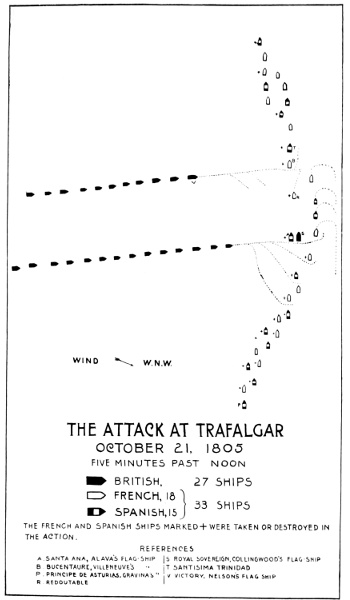
The Attack at Trafalgar. Click here for larger map
The two British columns were nearly a mile apart and advanced on parallel courses,—heading nearly east, but a little to the northward to allow for the gradual advance in that direction of the hostile fleet. The northern or left-hand column, commonly called the "weather line" because the wind came rather from that side, contained twelve ships, and was led by Nelson himself in the "Victory," a ship of one hundred guns. The "Royal Sovereign," of the same size and carrying Collingwood's flag, headed the right column, of fifteen ships.
To the British advance the allies opposed the traditional order of battle, a long single line, closehauled,—in this case heading north, with the wind from west-north-west. The distance from one flank to the other was nearly five miles. Owing partly to the lightness of the breeze, partly to the great number of ships, and partly to the inefficiency of many of the units of the fleet, the line was very imperfectly formed. Ships were not in their places, intervals were of irregular width, here vessels were not closed up, there two overlapped, one masking the other's fire. The general result was that, instead of a line, the allied order showed a curve of gradual sweep, convex toward the east. To the British approach from the west, therefore, it presented a disposition resembling a re-entrant angle; and Collingwood, noting with observant eye the advantage of this arrangement for a cross-fire, commented favorably upon it in his report of the battle. It was, however, the result of chance, not of intention,—due, not to the talent of the chief, but to the want of skill in his subordinates.
The commander-in-chief of the allies, Villeneuve, was in the "Bucentaure," an eighty-gun ship, the twelfth in order from the van of the line. Immediately ahead of him was the huge Spanish four-decker, the "Santisima Trinidad," a Goliath among ships, which had now come forth to her last battle. Sixth behind the "Bucentaure," and therefore eighteenth in the order, came a Spanish three-decker, the "Santa Ana," flying the flag of Vice-Admiral Alava. These two admirals marked the right and left of the allied centre, and upon them, therefore, the British leaders respectively directed their course,—Nelson upon the "Bucentaure," Collingwood upon the "Santa Ana."