The Industrial Canal and Inner Harbor of New Orleans (continued 2)
Reading edition
With the Industrial Canal open, sites available on long leases to business enterprise, and with our tax laws relating to the processes of industry and commerce revised and made more favorable, New Orleans will enter a period of expansion and development on a scale hardly yet dreamed of by her most far-visioned citizens, with enlarged profit and opportunity for all her people.
New taxable wealth will be created rapidly. New needs for taxable property will arise. The tax burden on all will be distributed more widely and when contrasted with the earning power of such property will become less and less of a burden.
This will be so because the water frontage through which the Canal is being created for the attraction of many enterprises which cannot locate on the river front, is all within the limits of the city of New Orleans.
With this Canal in operation, New Orleans will possess to the fullest degree the three great systems of port operation: Public ownership and operation of the river harbor facilities; public ownership of the land and private operation of facilities on the Industrial Canal; and private ownership of the land and private operation of the facilities on the new channel to the sea.
No other port in the country has the capacity for this trinity of port systems.
No other port possesses such a hinterland as is embraced within the Mississippi Valley, nor so extensive and so complete a system of easy-grade railroads and navigable waterways penetrating its hinterland.
No other port holds so strategic a position in the path of the new trade routes connecting the region of greatest productivity with the new markets of greatest promise in Latin-America and the Orient.
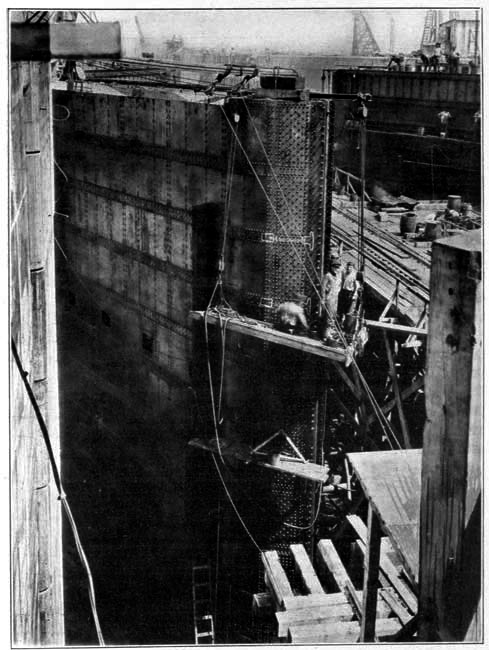
LOCK GATE There are Ten Like This
CONSTRUCTION COSTS AND CONTRACTORS.
Everything is relative. Looking at the total, some may think that the cost of the Industrial Canal is large. So it is—compared with the cost of an irrigation ditch through a 20-acre farm. But comparing the cost with the wealth it is invested to produce—has already begun to produce—it dwindles to a mere percentage. And a comparison of construction costs on the Industrial Canal with similar work done elsewhere during the same time is very much in favor of the former.
Witness the following figures shown in the books of the engineering department of the Dock Board:
Dredging, including the canal prism and the excavation of the sites of the bridge foundations, siphon and lock, averaged .2784 cents a cubic yard. The highest cost was in the lock section, from which 609,302 cubic yards were excavated at an average cost of .3796 cents a cubic yard. On the siphon and Florida Walk bridge section, including two other deep cuts, the 814,919 cubic yards excavated cost an average of .2607 cents a cubic yard. On the Louisville & Nashville bridge section, the 1,023,466 cubic yards excavated cost an average of .2363 cents a cubic yard. From there to the lake, 1,673,787 cubic yards, the average cost was .2411 cents. Dredging costs were below the original estimates when labor and supplies were 50 per cent cheaper.
The 90,000 cubic yards of concrete in the lock cost an average of $22.50 a cubic yard. This includes cost of material, mixing, building forms, pouring and stripping forms. Mixing and pouring, from the time the material was handled from the storehouse or pile, averaged $1.20 a cubic yard. It would be hard to find cheaper concrete on a work of similar magnitude anywhere, say the engineers.
On the siphon the concrete work cost more, because it was a subterranean job, with elaborate shaping. The price there was $35 a cubic yard, in place, including material and form work.
To drive the 17,000 bearing piles and 7,000 traveling piles on which the lock is floated, cost an average of 15 cents a running foot. This does not include the cost of the piling.
Construction steel cost .12 cents a pound, and erection around 4 cents. These were standard prices.
The lock gates, weighing 5,285,000 pounds, cost $845,600, in place. This does not include opening and closing machinery.
Three of the bascule bridges crossing the Canal, weighing 1,600,000 pounds each, cost $250,000 each, erected. The fourth bridge, near the lock, weighing 1,000,000 pounds, cost $200,000, erected. This is for superstructure only—it does not include the foundation.
The emergency dam bridge, weighing 350,373 pounds, and its 108,256 pounds of turning machinery, cost $96,728, in place. Hoisting machinery cost $40,000 more.
The eight girders of the emergency dam, weighing 90 tons each, at $240 a ton, cost $172,800.
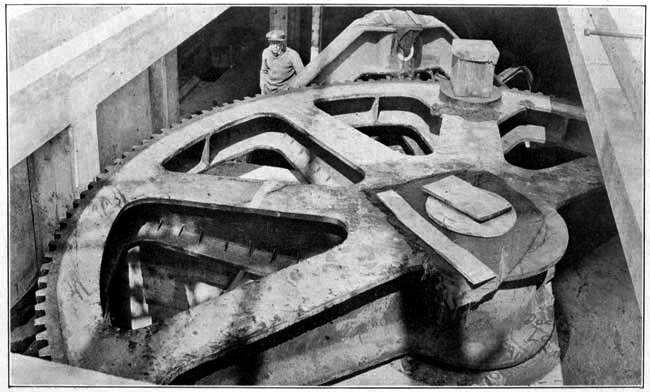
Machinery for working the ten lock gates, the eight filling gates, and the six capstans—twenty-four 52-horse power electric motors—cost $21,479, f.o.b. New Orleans.
The plant for unwatering the lock, consisting of one pump with a capacity of 15,000 gallons a minute, and two with a capacity of 250 gallons each, cost, erected, $11,000.
Total mechanical equipment used on the Industrial Canal weighs 14,500 tons. Its cost, including power-house, electrical connections, etc., is $1,516,000.
Plant and equipment for building the Canal, including locomotives, cranes, piledrivers, dredges, tools, etc., cost $781,232. Depreciation, up to February, 1921, is set at $266,874, leaving a balance of $514,358, carried as assets. Much of this has already been sold, and more will be disposed of.
Following are the firms that executed contracts on the Industrial Canal:
OUTSIDE NEW ORLEANS.
Lock gates and emergency dam girders: McClintic-Marshall Construction Company, Pittsburg, Pa.; designed by Goldmark & Harris Company, New York.
Filling gates: Coffin Valve Company, Indian Orchard, Mass.
Miscellaneous valve equipment: Ludlow Valve Company, Troy, N.Y.
Capstans: American Engineering Company, Philadelphia, Pa.
Mooring posts: Shipbuilding Products Company, New York, N.Y.
Miter gate moving machines: Fawcus Machine Works, Pittsburg, Pa.
Motors, control boards and miscellaneous electrical equipment: General Electric Company, Schenectady, N.Y.
Bridge crane and bascule bridges: Bethlehem Steel Corporation, Steelton, Pa. Former designed by Goldmark & Harris Company, New York, N.Y.; latter, by Strauss Bascule Bridge Company, Chicago, Ill.
Steel sheet piling: Lackawanna Steel Company, Buffalo, New York.
Hoists and cranes: Orton & Steinbrenner, Huntington, Ind.; American Hoist and Derrick Company, St. Paul, Minn.
Conveyor equipment: Webster Company, Tiffany, Ohio; Barker-Greene Company, Aurora, Ill.
Woodworking machinery: Fay & Egan Company, Cincinnati, Ohio.
Pipe: U.S. Cast Iron Pipe Company, Birmingham, Ala.
Lumber and piling: Hammond Lumber Company, Hammond, La.; Great Southern Lumber Company, Bogalusa, La.
Dredges: Bowers Southern Dredging Company, Galveston, Tex.; Atlantic, Gulf and Pacific Company, Mobile, Ala.
IN NEW ORLEANS.
Cinder and earth fill: Thomas M. Johnson.
Levee work: Hercules Construction Company; Hampton Reynolds.
Sand and gravel: Jahncke Service, Inc.; D. V. Johnston Company.
Cement: Atlas Portland Cement Company, the Michel Lumber and Brick Company being local agents.
Lumber and piling: Salmen Brick and Lumber Company; W. W. Carre Company, Ltd.
Coal: Kirkpatrick Coal Company; Tennessee Coal, Iron and R.R. Company.
Reinforcing steel and supplies: Tennessee Coal, Iron and R.R. Company; Ole K. Olsen.
Rail and track accessories: A. Marx & Sons.
Concrete mixers: Fairbanks Company.
Repairs and castings: Dibert, Bancroft & Ross; Joubert & Goslin Machinery and Foundry Company; Stern Foundry and Machinery Company.
OTHER PORT FACILITIES.
"New Orleans," says Dr. Roy S. MacElwee in his book on Port and Terminal Facilities, a subject on which he is considered an authority, "is the most advanced port in America in respect to scientific policy." The Shipping Board echoed the compliment in its report of its port and harbor facilities commission of April, 1919, when it said: "New Orleans ranks high among the ports of the United States for volume of business, and presents a very successful example of the public ownership and operation of port facilities. It is one of the best equipped and co-ordinated ports of the country."
New Orleans is the principal fresh water-ocean harbor in the United States. Landlocked and protected from storms, it is the safest harbor on the Gulf Coast. Almost unlimited is the number of vessels that can be accommodated at anchor. Alongside the wharves the water is from thirty to seventy feet deep. The government maintains a 33-foot channel at the mouth of the river.
The "port of New Orleans" takes in about 21 miles of this harbor on both sides of the river. This gives a river frontage of 41.4 miles, which is under the jurisdiction of the Dock Board, an agency of the state. The Board has, to date, improved seven miles of the east bank of the river with wharves, steel sheds, cotton warehouses, a grain elevator and a coal-handling plant of most modern type, together with other facilities for loading and unloading. Authority has been granted to issue $6,500,000 in bonds for increasing these facilities.
Wharves, elevators and warehouses built by railroads and industrial plants on both sides of the river bring up the total improved portion of the port to 45,000 linear feet, capable of berthing ninety vessels 500 feet long. These facilities are co-ordinated by the only municipally owned and operated belt railroad in the United States, which saves the shipper much money. More than sixty steamship lines connect the port with the world markets; the government barge line, a number of steamboat lines, and twelve railroad lines connect it with the producing and consuming sections of the United States.
BULL WHEEL Part of Operating Machinery for Lock Gates
Now nearing completion is the Public Coal Handling Plant. Built by the Dock Board to develop the business in cargo coal, it is costing more than $1,000,000.00, and will have a capacity of 25,000 tons. It is of the belt-conveyor type. The plant will be able to:
1. Unload coal from railway cars into a storage pile;
2. Unload coal from cars into steamers or barges;
3. Load coal from storage pile into steamers or barges;
4. Unload coal from barges into steamers and storage pile;
5. Load coal from barges or storage pile into cars.
At the 750-foot wharf the plant can take care of three ships at one time, with a maximum loading capacity of 800 to 1,000 tons an hour.
Other coaling facilities at the port are furnished by:
Illinois Central Railroad: Tipple with capacity of 300 tons an hour;
New Orleans Coal Company: Two tipples, capacity 150 and 350 tons an hour; floating collier to coal ships while freight is being taken aboard at the wharf, capacity 175 tons an hour; collier, capacity 150 tons an hour.
Alabama and New Orleans Transportation Company: Storage plant with loading towers on Lake Borgne canal, just below the city;
American Sugar Refining Company: Coal plant, capacity, 70 tons an hour, for receiving coal from barges and delivering it to boiler house;
Monongahela River Coal and Coke Company: Floating collier.
Fuel oil facilities for bunkering purposes are furnished by:
Gulf Refining Company: Storage capacity, 100,000 barrels; bunkering capacity, 800 barrels an hour;
Texas Oil Company: Storage capacity, 150,000 barrels; bunkering capacity, 1,500 barrels an hour;
Mexican Petroleum Corporation: Bunkering capacity, 1,500 barrels an hour;
Sinclair Refining Company: Storage capacity, 250,000 barrels; bunkering capacity, 2,500 barrels an hour;
Standard Oil Company: Storage capacity, 110,336 barrels; bunkering capacity, 1,000 barrels an hour.
In the Jahncke Dry Dock and Ship Repair Company, New Orleans has the largest ship repair plant south of Newport News. The plant is on the Mississippi river, adjacent to the Industrial Canal. It has a 1,500-foot wharf and three dry docks, of 6,000, 8,000 and 10,000 tons capacity, respectively. These can be joined for lifting the very large ships. It is equipped with the latest and most powerful machinery, and has been a strong factor in developing the port.
The Johnson Iron Works and Shipbuilding Company likewise has facilities for wood repairing, caulking, painting and scraping of vessels, as well as iron work. It has three docks: one 234 feet long, one 334 feet long, and a small one for lifting barges and small river tugs.
At the United States Naval Yard is a dock of 15,000 tons capacity. This is placed at the service of commercial vessels when private docks are not available.
The Public Cotton Warehouse and Public Grain Elevator are among the most modern facilities in the country.
Both plants are of reinforced concrete throughout, insuring a low insurance rate.
The cotton warehouse comprises five units, with a total storage capacity at one time of 320,000 bales, and an annual handling capacity of 2,000,000. High density presses compress this cotton to 34 pounds per cubic foot, saving the exporter 20 per cent on steamship freight rates. The insurance rate on storage cotton is 24 cents per $100 a year. Cotton is handled by Dock Board employees licensed by the New Orleans Cotton Exchange under rules and regulations laid down by the department of agriculture. Warehouse receipts may be discounted at the banks. Cotton can be handled cheaper here than at any other warehouse in the country.
Storage capacity of the Public Grain Elevator is 2,622,000 bushels. This is about 25 per cent of the grain elevator storage capacity of the port, but the Public Elevator handles 60 per cent of the business—proving its efficiency. Its unloading capacity is 60,000 bushels a day from barges or ships, and 200,000 bushels from cars. Loading capacity into ships is 100,000 bushels an hour—to one or four vessels, simultaneously. Fireproof and equipped with a modern dust-collecting system, this facility is considered one of the best in the country.
Other grain elevators at New Orleans are operated by:
Southern Railway: capacity, 375,000 bushels;
Illinois Central Railroad two elevators, capacity, 2,500,000 bushels;
Trans-Mississippi Terminal Railroad Company: two elevators, capacity, 1,350,000 bushels.
Wharves owned and controlled by the Dock Board measure 28,872 linear feet in length, with an area of 4,230,894 square feet. Twenty of these thirty-four wharves are covered with steel sheds.
Wharves operated by the railroads on both sides of the river increase the port facilities as follows:
Southern Railway: Two concrete and steel covered docks, one a two-story structure; one is 150 by 1,300 feet, with a floor space of 195,000 square feet; one is 150 by 1,680 feet on the lower floor, and 120 by 1,680 on the upper, with a combined area of 453,000 square feet floor space.
Illinois Central Railroad: covered wharf, 130-150 by 4,739 feet.
Morgan's Louisiana and Texas Railroad and Steamship Company: wharf space, 112,000 square feet; covered space, 117,200 square feet.
Trans-Mississippi Terminal Railroad Company: Wharf No. 1, three berths, 281,904 square feet; No. 2, one berth, 94,350 square feet; No. 3, one berth, 100,725 square feet—most of it covered; oil wharf, 15,000 square feet.
The New Orleans Army Supply Base has a two-story wharf 2,000 feet long by 140 feet wide. The lower floor of the wharf is leased by the Dock Board. Back of it are the three warehouses, each 140 by 600 feet, and six stories in height.
Seven industrial plants have loading and unloading facilities on the river. The Dock Board does not lease or part with the control of these, and controls the following charges: harbor fees, dockage, sheddage, wharfage, etc.
Open storage on river front contiguous to wharves totals 1,169,900 square feet. There is a great deal of potential open storage space away from the wharves and along railroad tracks, which could be reached by switches.
For the storage of coffee, alcohol, sisal, sugar and general commodities, private warehouses offer a floor space of 2,000,000 square feet.
Railroads serving New Orleans are: The Public Belt, Illinois Central, Yazoo & Mississippi Valley, Gulf Coast Lines, Louisiana Railway & Navigation Company, Louisville & Nashville, Louisiana Southern, Missouri-Pacific, Texas & Pacific, New Orleans & Lower Coast, Morgan's Louisiana & Texas Railroad and Steamship Company, (Southern Pacific) Southern Railway and New Orleans & Great Northern.
Storage track capacity of New Orleans for export traffic totals 15,156 cars. Track facilities alongside the wharves will accommodate 600 cars. New Orleans can handle, at the grain elevators and wharves, 3,000 cars a day.
Wharves are served exclusively by the Public Belt Railroad. The Industrial Canal will be similarly served. The Public Belt Railroad assumes the obligations of a common carrier, operating under appropriate traffic rules and regulations. The switching charge is $7.00 a car, regardless of the distance. On uncompressed cotton and linters, the charge is $4.50.
The government barge line connects New Orleans with the Warrior River section of Alabama and the Upper Mississippi Valley, including a great deal of inland territory to which river and rail differential rates apply, as far as St. Louis. It is operating a fleet of 2,000-ton steel covered barges and 1,800 horsepower towboats. There is a weekly service. Rates are 20 per cent cheaper than rail rates.
The port is supplied with some of the most modern freight handling machinery. Harbor dues and other expenses are low. The water supply, for drinking purposes and boilers, meets the strongest tests.
How advantageously situated is New Orleans will be seen from the following comparison of distances:
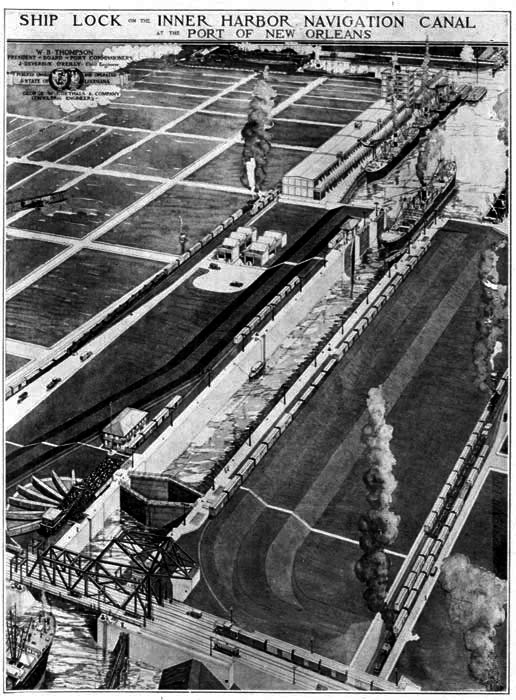
SHIP LOCK on the INNER HARBOR NAVIGATION CANAL at the PORT OF NEW ORLEANS THE LOCK COMPLETED
COMPARISON OF DISTANCES BY AND BETWEEN NEW ORLEANS AND NEW YORK AND PRINCIPAL CITIES.
(Distances in statute miles, furnished by War Department.)
New York New Orleans
Atlanta 846 498
Baltimore 188 1,184
Birmingham 1,043 348
Boston 235 1,607
Buffalo 442 1,275
Charleston 739 776
Chattanooga 846 498
Chicago 912 912
Cincinnati 781 836
Cleveland 584 1,092
Dallas 1,642 515
Denver 1,932 1,356
Detroit 693 1,100
Duluth 1,390 1,340
El Paso 2,310 1,195
Galveston 1,782 410
Indianapolis 827 888
Kansas City 1,335 867
Little Rock 1,290 487
Louisville 867 749
Memphis 1,156 396
Minneapolis 1,332 1,285
Mobile 1,231 141
Norfolk 347 1,093
Oklahoma City 1,643 856
Omaha 1,402 1,070
Pittsburgh 444 1,142
Philadelphia 91 1,281
Port Townsend 3,199 2,979
Portland, Oregon 3,204 2,746
Salt Lake City 2,442 1,928
San Antonio 1,943 571
San Francisco 3,191 2,482
Savannah 845 661
Seattle 3,151 2,931
St. Louis 1,058 701
Toledo 705 1,040
Washington, D.C. 228 1,144
COMPARISON OF DISTANCES BY WATER ROUTES BETWEEN NEW ORLEANS AND NEW YORK TO PRINCIPAL PORTS OF THE WORLD.
(Distances in nautical miles, supplied by Hydrographic Office, Navy Department; land routes in statute miles supplied by War Department.)
New York New Orleans
Antwerp 3,325 4,853
Bombay—
Via Suez 8,120 9,536
Via Cape of Good Hope 11,250 11,848
Buenos Ayres 5,868 6,318
Callao—
Via Panama 3,392 2,764
Via Tehauntepec 4,246 2,991
Cape Town 6,851 7,374
Colon (eastern end of Panama Canal) 1,981 1,380
Havana 1,227 597
Hong Kong—
Via Panama 11,431 10,830
[a] Via rail to San Francisco 9,277 8,568
Honolulu—
Via Panama 6,686 6,085
Via rail to San Francisco 5,288 4,579
Liverpool 3,053 4,553
London 3,233 4,507
Manila—
Via Panama 11,546 10,993
[a] Yokohama and San Francisco 9,480 8,771
[a] Yokohama and Port Townsend 9,192 8,972
Melbourne—
[a] Via San Francisco 10,231 9,522
Via Panama 10,028 9,424
Via Tehauntepec 9,852 8,604
Via Suez Canal 12,981 14,303
Mexico City—
By land and water 2,399 1,172
By land 2,898 1,526
New Orleans—
Land 1,372
Water 1,741
Nome, Alaska—
[a] Via San Francisco 5,896 5,187
[a] Via Port Townsend 5,555 5,335
Via Panama 8,010 7,410
Panama (western end Canal)—
Via Canal and Colon 2,028 1,427
Pernambuco, Brazil 3,696 3,969
Rio de Janeiro 4,778 5,218
San Juan, P.R. 1,428 1,539
Singapore—
Via Yokohama and Panama 13,104 12,503
Via Suez 10,170 11,560
San Francisco 3,191 2,482
Via Tehauntepec 4,415 3,191
Via Panama 5,305 4,704
Tehauntepec—
Eastern end of railroad 2,036 812
Valparaiso—
Via Panama 4,637 4,035
Yokohama—
Via Honolulu and Tehauntepec 9,243 7,995
Via Honolulu and Panama 10,093 9,492
Via Panama 9,869 9,268
[a] By land and water.
[b] By land.