Bertram Mitford (continued 4)
Reading edition
While comforting myself with this thought, something happened. There was a rustling in the grass, and a quick patter of feet. It was the darkest hour of the night, namely, that which precedes the dawn; but my eyes, well accustomed to the gloom, could distinguish the swift glide of fleeing shapes—indeed, a frightened, snarling yelp arose, as one of the shapes nearly came against me as I stood to listen. But they fled—those wild creatures of the night—after the manner of beasts who disperse when suddenly startled from their prey.
Then there came to my ears a low wail, as the moaning of a woman in fear, or in pain, perhaps both.
Chapter Eighteen.
The Refugees of the Ngome.
At first I liked it not, for strange tagati beings are about in the darkness—half-man, half-beast—who rend those that wander alone at night. But even of such I felt no fear then, wherefore I went straight to the spot whence the sound came; and, ready to use my spear if need be, called out to know who it was that spoke.
The answer came almost beneath my feet, and in the darkness I could make out a form lying there. I bent down and touched it. It was the form of a woman.
“Remain by me till dawn,” gasped a voice hoarse with pain and fear. “Those horrible beasts. They will rend me again. Oh, kill me, for I suffer agonies!”
“Who art thou?” I said, not liking this encounter.
“Nomshasa, the wife of Untúswa,” came the feeble answer.
Whau, Nkose! Then, indeed, did I well-nigh leap for amazement. For the name was that of one of my Swazi wives—that one who had mysteriously disappeared, and whom I had never expected to behold again. Bending over her, I strove, to raise her head; but as I moved her, though ever so gently, she shrieked.
“Ah—touch me not! I am torn in pieces. Those horrible beasts! Put me out of my pain. One blow at the back of the head will do it.”
Now the first streak of dawn had begun to lighten the earth, and by it I could see that what she said was so indeed. The hyenas which I had disturbed had indeed begun to devour her, and her body was hideously torn. But how had she come into that helpless plight? Then, by the fast increasing light, she knew me, and called me by name.
And I, Nkose, gazing at her, I was filled with horror. The whole of her scalp was one mass of blood, and it seemed as though her skull had been battered in. Her elbow joints were smashed and swollen; so too, were her wrists, and there were marks of frightful burns upon her body. The marvel was she was alive at all. I was full of pity for her, for she had been a handsome and pleasing girl, and during the short time since the King had given her to me to wife she had always done well by me.
Now, making a great effort, she told me her tale. During my absence against, the Amabuna she had been seized by order of Umhlela, and questioned as to my doings, but could tell nothing that would go against me in an accusation of witchcraft. She was kept a close prisoner in a hut until the return of Tambusa, when she had been put to the torture to force her to confess. They had burned her with fire, had broken her joints with heavy knob-sticks, and that not on one day, but on many; but she would say nothing, till at last, losing patience, Tambusa had ordered her to be thrown outside and knobkerried. But the slayers had done their work in bungling fashion, and so she had waited until night and dragged herself away in the darkness to die alone. Then, when faint and too weak to move, the hyenas had fallen upon her.
No, the King could not have known, for it was in order to condemn me before him that they had tortured her, she said. But when I asked why they should have selected her rather than the other two, then, Nkose, came in the old, old tale, the mischief that can be wrought by a woman’s tongue. That vision which Nomshasa had beheld while asleep at my side she could not keep to herself. She had chattered about it, and this coming to the ears of the two principal indunas who, in their jealous hatred, were watching my every movement, had put it into their minds to use her as a means of substantiating a charge of witchcraft against me, such a charge as Dingane himself would hardly venture to shield me from the penalty of. But the poor girl had been heavily punished indeed for giving way to the weakness of women—the wagging of too long a tongue; though in her constancy under the torments they heaped upon her she had shown no weakness at all, but rather the strength and bravery of the most valiant of warriors; and this I told her.
She was greatly pleased, and a drawn smile came over her face in the midst of her pain.
“I loved thee, Untúswa,” she said, “and I rejoiced when the King gave me, a captive girl who might have been made a slave, to wife to such a noted warrior as thou. And I think thou didst prefer me a little to the other two, but thou wert ever kind to me, and the torturers might have torn me into small pieces before I would have let fall one word to harm thee. And now I think I were better dead, for there might in time be others whom thou might prefer to me; yet for a little while I have been first.”
All this was said, not as I have told it to you, Nkose, but slowly and in gasps, and I, well, thinking of Lalusini, it seemed that her words were those of wisdom, for I had known experience of the jealousy of women. Yet I said:
“Thou wouldst ever have lived in great honour, Nomshasa, and have been counted great among my wives.”
“But not greatest—” she said, attempting to smile. “Yet hearken, Untúswa, and be warned. Return not to Nkunkundhlovu, for death awaits thee there. There is another great bull of the House of Senzangakona who would fain roar in this kraal. Mpande would welcome such a fighter as thee.”
The dawn had now spread, and soon the sun would come forth from behind the rim of the world. And now, in the full daylight, the terrible injuries that poor Nomshasa had received, both from the torturers and the teeth and claws of the beasts, looked so awful that every living moment must be to her a moment of intense agony. She could not live. She must have seen into my thoughts, for she said:
“It is time to give me rest, Untúswa. Yet return not to Dingane. They who were appointed to slay me jeered me beneath their blows, saying that before another sun or two set thy shade should join mine. Wherefore, flee. And now—Strike!”
I looked at her, and my heart was heavy with pity and wrath. Then I said:
“I will strike indeed, Nomshasa, for thy pain is too great. Yet let this lighten it. When the day of my power comes, be assured that the pangs of Tambusa and all who bore part in this matter shall be greater than thine. Now—art thou ready?”
“I am. No death could I have preferred to death at thy hand, Untúswa. Yet, hold my hand in thine unarmed one as the blow falls.”
I turned her gently over upon her side, but she groaned with the agony of it. Then with my left hand I held hers. For a moment I looked at her. Her eyes were closed, and something like a smile was upon her face. I raised my right arm aloft, then with one quick crashing blow brought the heavy knob-stick down. It fell, fair—just where the base of the skull joins the back of the neck. Her agony was over. No shudder even ran through her, so completely, so suddenly had death overtaken her.
Notwithstanding the warning of Nomshasa, I still took my way in the direction of Nkunkundhlovu, for I thought I might perhaps gather from those I should meet whether the danger threatening was very near or not; whereas by taking a contrary direction it might overtake me suddenly and unawares, as peril springs out upon one who is blind. Yet I proceeded with great caution, so that presently, seeing several men approach, armed with spears and shields, I dropped out of sight to let them pass.
But soon after them came another—a tall man and ringed. Him I surveyed a moment, and recognised Silwane. But, to my surprise, when I would have accosted him he turned away, as though not aware of my presence. This looked strange, but while I was pondering as to what it could mean, I heard Silwane begin to sing softly to himself. I listened as the words grew louder and louder, yet not so as they could have been heard from afar. And the words were strange, for he sang of a buffalo-bull for whom hunters lay in wait, whom their circle had well-nigh closed around; that the Ngome mountains were wild and broken, full of great forests and impenetrable hiding-places; and that there, and there only, had the hunted buffalo fled, that there, and there only, might he be safe. So he kept on singing. To any who heard, he might have been muttering an ordinary hunting-song, but to me, listening, ah! I saw his meaning. He had not really failed to observe me, but the last thing he desired was to do so in fact; and now he raised that song in urgent warning. Ah! he was a man, indeed, Nkose, was that same Silwane; a valiant fighter when we met in battle in opposite ranks; a true and faithful brother of the spear now that we had fought side by side.
So I saw through his warning and the advice it conveyed, yet before acting upon it I would take counsel with Lalusini. To this end I turned back, and travelling with great caution, at length I gained the strange earth cave where she dwelt.
She was surprised when she saw me, and somewhat disturbed. I told her all that had occurred—the death of poor Nomshasa and her warning; the meeting and warning of Silwane. But when I came to Nomshasa’s idea that I should join in the plots of Mpande she shook her head.
“That will not do, Untúswa. That will not further my plans at all. Au! It seems that our places are reversed,” she went on, with a laugh; “but it will not be always so. I know this people better than thou dost, and am in a better position to watch and wait, and, if need be, act. Now the only way by which Mpande can sit in the seat of Dingane is with the aid of the Amabuna, and we have no need of these white invaders. Here is my counsel, Untúswa. Flee hence to the Ngome forests beyond the Black Umfolosi, and lie hidden awhile. There dwell a number of men who have sought refuge, and who will welcome thee among them.”
“A wanderer again! Well, if it must be. But how is it that these people, if refugees, are allowed to dwell in the heart of the land unsought for?”
“Because the King does not really desire their death. They are made up of men who have been smelt out by the izanusi, and have managed to escape; others whom the King has doomed, not really meaning that they should be slain, or the izinduna have plotted to destroy, and who having been warned in time, fled; also the relatives of these men, dreading lest the doom should fall upon them also. Now these men are so numerous as almost to constitute a tribe in themselves; they are wild and fierce, but will welcome such another fighter. That is the only plan, Untúswa; thou must flee to the Bapongqolo. Did not even the warning of Silwane convey that? Was it not about a hunted buffalo who found safety in the Ngome forests?”
“That is so, Lalusini,” I answered. “Yet it seems that I have found thee after all this time of sorrow, only that we must lose sight of each other immediately.” And I looked at her sadly.
“Patience, Untúswa,” she said. “I am planning to make thee great, that thou and I together may rule the world. Say, are we not of the sort who are born to that end?” And, coming over to me, she placed both hands upon my shoulders, looking up into my face; nor had she to look up very much, for, tall as I was, she, for a woman, was of splendid stature.
“I think, indeed, we are well fitted to rule it,” I answered, with pride.
“Then go now, a wanderer once more, Untúswa, but only for a short while. Besides, it may be that I will find thee but, even among the fierce Bapongqolo, from time to time,” she added.
“Why, then, go I forth with joy,” I answered. “Farewell, Lalusini. Delay not to find me out.”
She gave me a few things which I might need, food, and a casting-spear or two, and a large new war-shield—I having come forth with but a small dancing shield—and thus once more fared I forth a wanderer, a fugitive from the parent nation, even as from its offshoot. Verily it seemed as though I were to find no rest.
Now the undertaking before me was, to a man of my experience and familiarity with peril, no very great one, for by using ordinary caution I could always travel unobserved. I avoided the kraals of men, moving mostly at night. Twice I saw in the distance bodies of armed warriors who might or might not have been in search of me; but these I easily eluded, though delayed thereby; and the third evening after parting with Lalusini I was well in among the wildest solitudes of the Ngome forest.
And they were solitudes, Nkose. The great slopes and spurs of the mountains were covered with dense forest surging up in seas of foliage against the immense rock walls of the Lebombo mountains. Below, chasms and deep ravines through which the mountain streams whimpered, half hidden beneath the decaying vegetation and rotting tree-trunks of ages. And of animal life, of bird life, of insect life—whau! the air was never still. By day the black chasms boomed with the hoarse bark of the dog-snouted baboons, and at night thundered from cliff to cliff the roar of the lion. Birds chattered and piped, and the buzz of insects hung ever upon the air, but of man and his habitations never a sign.
“Now,” thought I, “where are these people of whom Lalusini spoke? for these solitudes are not altogether to my mind. I like better not to dwell alone,” But still I wandered through unpeopled forests, seeing no sign of man, I grew uneasy. There was abundance of game, easily slain, too. Still I desired converse.
This, however, came my way at last, and in right startling manner did it come. I had turned the corner of a great rock, where the track I had been following opened into a grassy glade. Suddenly there sprang up right at my feet several men fully armed, who, with a loud shout, called on me to halt.
Chapter Nineteen.
The Vengeance of the Refugees.
“An impi sent by Dingane,” was my first thought, as I gassed upon the fierce countenances and the spears poised aloft with threatening flash.
“Who art thou—and whence?” said he who appeared to be the leader, a tall man and savage of mien.
“Rather, who are ye?” I answered, with another question, affronted by the insolent tone employed by the speaker.
“See these,” he answered swiftly. “Speak or die! You are one man, and these are several.”
“Yet I have fought with several before this day, O Unknown,” I retorted, with a swift movement, throwing up my shield in defence, at the same time backing towards the rock, so that they could not get round me. So I stood ready for a merry fight, for the leader alone would have taken up all my attention, so tall and strong was he—and there were others.
To my surprise they did not come on. The leader again spoke.
“Once more, who art thou? He who wanders in the retreat of the Bapongqolo must needs give an account of himself.”
“E-hé!” assented the others.
Then I lowered shield and weapons at once.
“I am Untúswa, the son of Ntelani. Perchance ye have heard of him, ye who are refugees.”
By the look which they exchanged I knew they had heard of me. Then the leader said:
“What seek you here, Untúswa, for in truth that is a name which is known?”
“I seek a refuge among the people who are in refuge,” I said.
“Why then, thou art welcome, Untúswa,” he replied. “I am Sifadu, the son of Kona, and I wielded a sharp spear in the ranks of the Imbele-bele, of which I was a captain. But Tola, that jackal-spawned cheat, did name my father at a witch-finding, and he, being old, died the death of the black ants; but I and the remainder of his house escaped—and here we are.”
“Tola will name no more, Sifadu,” I said. “The knob-sticks of the King’s slayers have put that form of pleasure beyond his reach.”
“He is dead, then! Haul I am glad, and yet not, for one day I had promised myself the delight of having him enticed here that he might die the death my father suffered through him. I would pay ten cows as the price of that pleasure—yes, willingly.” And the look on the face of Sifadu was such that it was perhaps as well for Tola in the long run that he had died the swift and painless death of the knobstick.
Thus we conversed, Sifadu and I, and as we journeyed I told him and the others a great deal of what had happened; of the invasion of the Amabuna, and how we had destroyed many of them. They had heard something of this, but I, who had taken part in it, was able to tell them everything. But what they especially wanted to know about was the rumour of plotting in favour of Mpande. Of this, however, I could not tell them much, because I knew but little myself.
The principal place of the Bapongqolo consisted not of one large kraal, but a number of small ones; and so scattered were these, and so carefully hidden, away in the dense forest which covered the slopes of a vast hollow or bowl, that it would be well-nigh impossible to strike them all at one blow; and to this end was such concealment planned. Impossible, too, would it have been for any considerable number of men to have penetrated the hollow without their advance having been long since known to the inhabitants, so dense and rock-strewn were the approaches; and, indeed, all such were under the observation of small outpost kraals, which served the purposes of pickets.
I gathered that these refugees were counted by hundreds. They were of all ages, from quite old men down to boys. Most of them, however, were middle-aged men in their prime; but whether the fact of being refugees kept them ever on the alert, all had a quick, ready, and fearless look, together with fine and well-knit frames, that stamped them as a warrior clan of no contemptible strength. And to Sifadu all seemed to look up as to a recognised chief.
Of this Sifadu I knew not quite what to make. He was friendly at first, but as time went by he seemed to look at me with jealous and suspicious eyes, as though he thought that a man of my standing and prowess would hardly be content with the position of one among many, wherein he was right, perhaps. Of one thing, however, I was certain. Did I or any other man desire the chieftainship of these outlaws Sifadu would first have to be dead.
For the present, however, I had no such thoughts. I was content to dwell quietly and unmolested, and await the turn events might take. So, as time went by, I seemed to have become as one of the Bapongqolo. Together we hunted the wild game of the forest—together we made descents in search of plunder into the Swazi country or the lands of the Amatonga, or levied tribute from the kraals lying beyond the outskirts of our own fastnesses; and so feared were we that none thought of resistance or retaliation.
“Of a truth, Untúswa, the day might come when Dingane himself would be glad to join us,” said Sifadu to me, as we were returning from one of these forays. “With our help, even we might save him his seat. Then should we not be among the highest of the nation? Then would there not be some who might groan aloud because the son of Kona had returned?”
Such a thought as this had been in my own mind, but I desired not to foster it in that of others, at least, not until I had determined upon my own plans; so to Sifadu I replied lightly on the matter, treating it as of no importance.
Lalusini had kept her word, and twice had arranged that we should meet and hold long converse together. But on the second of these occasions her news was great. The Amabuna had crossed the Tugela in great force, intending to march upon Nkunkundhlovu. There had been a tremendous battle, but the army of Dingane had defeated them and had driven them back; and but for their horses would have stamped them out entirely. Then the English at Tegwini had undertaken to interfere in this quarrel, and had crossed the Tugela with a large impi of Amakafula. These, however, got no further than the bank of the Tugela, for the King’s warriors made meat of that impi until the river ran red with their blood; and, in his wrath and disgust at this breach of faith on the part of the whites at Tegwini, Dingane sent an impi there to eat them up, too. Whau! and they would have been eaten up but that they took to the water—took refuge on a ship that was there—for these whites, Nkose, had no business to interfere in a quarrel which concerned them not. They were not of the blood of the Amabuna, and they had ever been treated as friends by the house of Senzangakona since the great Tshaka had allowed them the use of the lands on which they then dwelt. So they were rightly served.
Now all these tales of war and of great battles fired my blood, for I would fain have been in them; yet here I was, hiding away as a fugitive. But when I would have boldly returned, craving only that Dingane would allow me to wield a spear in the ranks of his troops, Lalusini dissuaded me. The hostility of Tambusa and Umhlela burned as hot against me as ever, and indeed I had fled not any too soon. She bade me wait. She herself was high in favour with the King by reason of the victories which had attended the Zulu arms, for she had foretold them.
Not without risk did I thus meet Lalusini. I could not reveal the real relationship between us, and the suspicions of the fierce Bapongqolo once fairly aroused, I might be slain suddenly and without warning, and no opportunity given me of explanation or self-defence. Indeed, after the first time, I thought I noticed a frost of suspiciousness in the converse of those people towards me as we sat around our fires at night. But the second time something so unlooked for happened that it gave them all something else to think about.
Lalusini had finished telling me all there was of news when, of a sudden, her manner became strange and suspicious.
“We are being watched, Untúswa,” she said quietly.
“Watched? Why then, it will be bad—ah, very bad—for the watcher.”
And hardly had the words escaped me than I darted from her side. I hurled myself through the thickness of the bush, but something was already crashing through it away from me. I made out the form of a man.
“Now, stop!” I cried—a casting assegai poised for a throw. “Stop! or I cleave thee to the heart.”
I was about to hurl the spear fair between the shoulders of the fleeing man—who was now not many paces in front—when he stopped suddenly. I went at him. He turned round and faced me, a glare of hate and fury in his eyes that seemed to scorch—to burn. And I—Whau! I stood as one suddenly turned to stone, the uplifted assegai powerless in my stiffened grasp. For the face was that of a ghost—the dreadful glare of hate and fury that paralysed me was upon the face of a ghost. I was gazing upon one whom I had seen slain, whom my own eyes had beheld clubbed to death by the King’s slayers—Tola, the chief of the witch doctors.
We stood for a moment thus, motionless, I gazing upon the horrible form of one I knew to be dead, as it stood there, shadowed in the gloom of the trees. Then, slowly raising an arm, the voice came, deep and hollow—
“Retire—or I put that upon thee which shall blast and wither thy heart and turn to water thy courage; which shall change the most valiant of fighting-men into the most cowardly of women.”
Awful as were the words, the effect upon me was not that intended. He had better have kept silence, for now I knew him to be alive, and I sprang upon him. He had a spear, and struck furiously at me with it; but I turned the blow, and then we closed. He fought and bit and kicked, and, powerful as I was, the lithe and slippery witch doctor for long defied my efforts to secure him, for I was anxious to take him alive. At last it seemed I should be obliged to kill him, when something was dropped over his head which, the next moment, was rolled round and round in a thick covering of stuff. It was Lalusini’s blanket. She had come to my aid just at the right time. We had no difficulty in securing him now, and with strips cut from his own skin cloak we bound his hands firmly behind him, and his feet. Then we removed the blanket.
“Greeting, Tola!” I said. “I thought thou wert dead; but I had forgotten, a great izanusi such as thou could not die, which is well, for not far off is one who longeth to welcome thee.”
“Have a care, Untúswa, have a care,” he snarled. “Dost thou not fear?”
“Why, no,” I answered. “The múti which protects me is greater than any which can be turned against me. But thou, what canst thou fear, O great izanusi who cannot die?”
I was but mocking him, Nkose, for now I saw through the plot. He had purposely been allowed to escape in the turmoil what time all the other izanusi had been slain; and I laughed at myself for my fears on first beholding him.
We left Tola lying there helpless; and, removing a little distance, we said out all we had to say. Then we took leave of each other.
“Use care, Untúswa, for it is that man’s life or thine,” said Lalusini, as we parted. “On no account let him escape.”
“Have no fear as to that, Lalusini,” I answered. “There is one who will take even better care of him than I could.”
When she had gone I unbound Tola’s ankles, and told him to walk. Now, seeing himself in my power, he began to talk fair. He promised to do all for me if I would but let him go—to rid me of my enemies, to make me the greatest man, next to the King. But I only mocked him.
“A live izanusi may do great things,” I said. “But a dead izanusi—whau!—of what use is he? And, Tola, I seem to remember that thou art dead—dead by order of the Great Great One. How then canst thou serve me?”
Then he began on another story. He could teach me things—could reveal mysteries which would render me all-powerful against every form of harm. But I only laughed at this, saying that he would soon have an opportunity of testing his powers in his own favour; and thus, ever with a watchful eye upon him, we travelled on together until we entered the hollow where were the kraals of the Bapongqolo.
“There are many here who will give thee warm greeting, chief of the izanusi,” I said. “Some even, upon whom thou hast looked before.”
Now people began to crowd around us, and, recognising my prisoner, shouts of hatred and threats were hurled at him. They would have torn him from me, but I restrained them.
“Go, call Sifadu,” I said. “I have brought him a long-desired guest.”
At the mention of Sifadu’s name the terror stamped upon the face of Tola was frightful to behold. We, standing around, enjoyed this, for scarcely a man there but had seen some relative haled to the place of doom at the bidding of this hyena; some indeed to writhe in torment for long before they died. Then Tola, foaming at the mouth, rolled on the ground in convulsions; but for this they cared nothing, as a mere witch-finding trick. They pricked him with their assegais until he came to again, roaring with laughter the while. And as he came to again, Sifadu appeared.
“Welcome, Tola,” he cried. “Welcome! We have long awaited thee. Ha, and a right warm welcome shall be thine, ah, ah! a right warm welcome.”
And thrusting his face close to that of the witch doctor he gnashed his teeth in a grin of such hardly-to-be-restrained fury that I thought he would have seized the other with his churning jaws like a beast.
“Welcome, Tola,” he went on. “A warm welcome to thee, in the name of all my house whom thou didst eat up. Whau! There were my two young wives. How nicely their tender limbs shrivelled and burned as they died the death of the hot stones as witches, smelt out by thee Tola—by thee, Tola—thou prince of smellers out!” and with the two repetitions he sliced off the witch doctor’s ears with the keen blade of his broad assegai. A frightful howl escaped the sufferer.
“Then there was my mother and another of my father’s wives; they were lashed to death with switches to make them confess—by thy orders. Tola. Haul Does this feel good—and this—and this?” And he lashed the prisoner’s naked body with a green hide thong until the air rang with screams.
“Then there was my father, Kona. He was eaten by black ants—at thy word, Tola—by black ants. It took nearly a day for him to die in that torment, raving and roaring as a madman. And now I think this shall be thine own end. Whau! The black ants—the good black ants—the fierce black ants—the hungry black ants. They shall be fed—they shall be fed.”
Now, Nkose, looking at Sifadu, I thought he came very near being a madman at that moment, so intense was his hate and fury, so difficult the restraint he put upon himself not to hack the vile witch doctor into pieces there and then with his own hand. He foamed at the month, he ground his teeth, his very eyeballs seemed about to roll from their sockets. But the face of Tola, ah! never did I see such terror upon that of any living man. The crowd, looking on, roared like lions, stifling Sifadu’s voice. They called to him the death of relatives—of fathers, of brothers, of wives, all of whose deaths lay at the doors of the izanusi. They wished that this one had a hundred lives that they might take a hundred days in killing him. There were several nests of black ants at no distance. Then somebody cried out that there was a particularly large one under a certain tree.
“Under a tree!” cried Sifadu. “Ha. I have an idea! Bring him along.”
They flung themselves upon Tola, whose wild howling was completely drowned by the ferocious yells of the crowd. But as they were dragging him roughly over the ground Sifadu interposed.
“Gahlé, brothers. Do not bruise him. The ants like their meat uninjured.”
Amid roars of delight the miserable wretch was dragged to the place of torment. Already some had knocked the top off the ants’ nest, and were stirring it with sticks to infuriate the insects. Right over the nest grew a long bough a little more than the height of a tall man from the ground. Now Sifadu’s idea took shape.
A wedge of wood was inserted between the victim’s teeth. This had the effect of holding his jaws wide open, nor by any effort could he dislodge the gag. Then his ankles being strongly bound together, he was hoisted up to the branch above, and left hanging by the feet, so that his head and gaping mouth just touched the broken top of the ant heap. Then as he writhed and twisted and howled in his agony—for the infuriated insects swarmed all over him—into his nostrils, mouth, severed ears, everywhere—the Bapongqolo crowded around gloating over his torments, and shouting into his ears the names of those whom he himself had doomed to a like torment. It was long indeed before he died, but though I have seen many a terrible form of death, never did I see any man suffer as did this one. And yet, Nkose, it was just that he should, for had not he himself been the means of dooming many innocent persons to that very death? Wherefore the revenge of the refugees was a meet and a just one.
Chapter Twenty.
The Bapongqolo Return.
Notwithstanding that I, and I alone, had brought to him his bitterest enemy to be dealt with, Sifadu’s manner towards me became, as time went on, more and more one of suspicion and distrust. He feared lest I should desire the chieftainship of this refugee clan; for by this time I was as completely one of themselves as he was, and he thought, perhaps rightly, that a man who had once commanded the fighting force of a great warrior nation was not likely to be content to remain for ever a mere nobody.
But this attitude taken up by Sifadu compelled me to do the very thing which he desired least, and that in self-defence. I laboured to create a following, and before I had been many moons among them I had attached fully half the outlaws to myself. Further, I knew that in the event of a quarrel between us I could count upon even more, for Sifadu was but indifferently liked. His bravery was beyond suspicion; indeed, it was through fear of his prowess that none disputed his supremacy. But he was of a quarrelsome disposition, fierce and terrible when roused, and had a sullen and gloomy mind; whereas I, for my part, have ever got on well among fighting-men, and as for gloomy thoughts, whau! they are the worst kind of múti, worse than useless indeed. True, I who once had been among the first of a great nation was now an outlaw and an exile from two great nations; but men’s fortunes change, and it might well be that in the near future my serpent would remember me, and my place be higher than ever—indeed I dared not think how high.
News at length reached us of another great battle. The Amabuna had again advanced upon Nkunkundhlovu, but before they could reach it a large impi sent by Dingane had reached them. Whau! that was a fight, said our informants. The Amabuna had drawn their waggons together, as their manner is, and the Amazulu strove for half a day to carry their camp with a rush. But it was of no use. The long guns shot hard and quick, and when the impi got almost within striking distance, and would have swarmed over the waggons, the Amabuna loaded their guns with several small bullets at a time, instead of only one, and our warriors went down in heaps. They could not stand against it, and this time a tale of defeat was brought back to the King.
Now the Amabuna, quick to take advantage of their success, pressed on immediately. But Dingane this time did not wait for them. He was warned that his brother, Mpande, was plotting against him, and he knew better than to be caught between the Amabuna on one side and his own rebellious people on the other. So he had decided to retire.
This was the news which reached us in our retreat, and whereas this would be the tract of country for which the King would make, it would be our retreat no longer. So we were forced to take a line.
Now, Sifadu’s plan was to hand over the whole band of refugees to Mpande, whose emissaries had been among us of late trying to win us over to the side of that prince. But my mind on the matter was different. I had no great opinion of Mpande, whereas Dingane was a real King—one to whom it was good to konza. My flight had been due to the hostility and intriguing of Tambusa, not to the displeasure of the King; and, now that the Great Great One was sore pressed by his enemies, I desired to wield a spear in defence of him. On this matter, too, Lalusini, whom I saw from time to time, was of the same mind as myself, though at that time she would not open her mind to me freely, bidding me, with a smile, to be still and wait.
Soon Sifadu, having his plans ready, called a council of the Bapongqolo to make known to the clan at large what he expected of it. The warriors came, several hundreds of them, in full war adornments, and fully armed, and Sifadu addressed them in a long speech. He recalled how it was that they came to be there, living the life of exiles and outcasts. He reminded them of their relatives slain, their houses stamped flat, their cattle seized to swell the herds of Dingane. The miserable cheat, Tola, whose bones lay broken and scattered around the nest of the black ants, in which they had put him to a just death, was only the mouthpiece of Dingane; the real oppressor was the King himself. Now, would they put themselves beneath the foot of such a King as that when they might obtain revenge for their wrongs, and at the same time lead a quiet life by doing konza to one who had promised them immunity and reward if they aided him now? But they must do this quickly for their own sakes, for their former oppressor with what remained of his army would be upon them in their retreat immediately.
Thus spoke Sifadu, but his words, and the words of others who argued in like manner, were not received as he intended. By more than half of those assembled they were received in silence. The old instinct of trained and disciplined warriors rendered these averse to turning against the King, especially so great a king as Dingane. Besides, it was by no means certain that even a combination of both forces against him would be attended with success. Then, too, they could not bring themselves to enter into alliance with the Amabuna.
Then I spoke. I pointed out that there were several hundreds of us—all good fighting-men—that if we all went in to offer our spears to the King, he, being pressed by enemies, would right gladly receive us. So should we all regain our place in the nation, and be outlaws no longer.
As I went on, the murmurs of assent which greeted my words grew into shouts. The people had long been tired of their runaway state, and here was a chance to set themselves right. They were also not a little tired of the rule of Sifadu.
This Sifadu saw, and leaping up, his countenance ablaze with fury, he came at me, his great spear aloft. So quickly was it done that I had barely time to throw up my shield. So powerful the blow that the blade pierced the tough bull-hide and stuck fast. Then Sifadu, following up his attack in swift fury, struck over my shield with his knob-stick. It was a terrible blow, and partly reached me. I felt half stunned, but infuriate with the pain. So, with a shout, I quit defence and went at Sifadu with a will.
A frightful commotion now arose. The friends of Sifadu would have rushed to his aid, but that they saw that those favourable to me were more numerous. These sprung to meet them, and all being fully armed it looked as though a bloody battle was about to be fought. But some cried aloud against interference, saying that the two of as should strive for the mastery, and to this counsel I added my voice. Sifadu, though, had no voice save to growl and grind his teeth like a maddened beast.
So we fought, we two—none hindering. Our shields flapped together, and for a moment we were immovable—pressing each other equally hard—each striving to run in under the guard of the other. Then the spear-blades—Sifadu having disentangled his—would flash and glance like threads of fire as we leaped and feinted—yet neither of us able to drive home either stroke or stab. A silence had fallen upon the onlookers now, and every head was bent eagerly forward. All this I could see, while never taking my gaze from my enemy.
At last my chance came. Pretending to stumble, I threw myself forward, and with one swift sweep of my assegai I sheared through Sifadu’s leg, gashing the thigh to the bone. He sank to the earth uttering a terrible howl. All the muscles were divided—from the principal blood-vessels red jets were spurting. Whau! He was in a sea of it. But even then, weakening each moment, he gathered strength to hurl his great knobstick at my face. I was prepared for this, however, and caught it on my shield; nor did I hurry to run in and finish him, knowing that while he could move a finger he would still gather himself together for one last desperate slash at me.
“Hamba-gahle, Sifadu,” I said—not mocking him. “This quarrel was not of my seeking, but the son of Ntelani never yet refused a fight.”
He made no reply, glaring at me in hate until very soon he sank down into unconsciousness and death. And all the warriors shouted in assent of my words, save some few—near friends of Sifadu; but for them I cared nothing. And presently some of the older among them came to me, and we talked. We agreed to carry out my plan of returning to the nation, and that at once.
“Whau, Untúswa! Thou hast commanded men from thy youth; it is fitting that thou shouldst be our leader now,” said one of them, after he had talked. “Say I not well, brothers?” turning to the rest.
“E-hé! Siyavuma!” (“We consent”) they cried as one man. Thus, Nkose, I became chief of the Bapongqolo, the tribe of the Wanderers; but, in truth, the honour might be brief, indeed, for it might please the King to make a quick end both of chief and tribe.
Now that we had thus decided, we sent out men to find out how things were going between Dingane and the enemy, and from their report we judged that the time had arrived to come in and lie beneath the foot of the Elephant. The Bapongqolo women were left in concealment in the recesses of the Ngome forests, while we, to the number of several hundreds, marched forth.
Before we crossed the White Umfolosi, I and other of the principal of the refugees climbed to the heights overlooking the Mahlabatini plain. It was somewhat early in the morning, but the brightness of the new day was dimmed—dimmed by a great cloud. Far away to the southward it rose, that cloud—thicker and thicker, higher and higher—a great dull pillar of smoke. Nkunkundhlovu was in flames.
Through the thickness of the smoke-cloud we could see the red leap of the fire. Then was amazement our master. Had the Amabuna gained a victory—so great a victory that they had been able to penetrate to the Great Place of the Elephant whose tread shaketh the world? Whau! it could not be. The marvel was too great.
But as we looked, lo! over the rise which lay back from the river came dense black masses—masses of men—of warriors—for in the morning sunlight we could see the glint of their spears. They moved in regular rank, marching in columns, in perfect order. In perfect order! There lay the whole situation. This was no defeat. The Great Great One, for reasons of his own, had fired Nkunkundhlovu before retreating.
Nearer they drew, those masses of warriors—on, on—rank upon rank of them. We saw them enter the river and cross, and for long it seemed that the flood of the river must be arrested in its run, so vast were the numbers that blackened it as they crossed. Our blood burned within us at the sight of this splendid array. We longed to be among them, bearing our part as men. We had had more than enough of skulking like hunted leopards.
“Ho, Siyonyoba!” I cried to the second leader of the refugees. “Form up our spears in rank, that we go down now and throw in our lot with these.”
Right down we went. The black might of our retreating nation was halting now, rolling up in waves; and there, on the very spot where we were finally repulsed by you English in the battle of Nodwengu, Nkose, when we thought to eat up your red square of soldiers, there did we wanderers, whose lives were forfeit, bring our lives in our hands to lay them at the feet of the King.
(The battle historically known to us as that of Ulundi is always termed by the Zulus the battle of Nodwengu, because fought nearest to the kraal of that name.)
I had sent on men in advance to announce our arrival, and now, as we drew near, the army opened on either side of us so as to leave us a broad road.
A dead silence lay upon the whole dense array. I gave one glance back at those I led—led, it might be, to their death. Truly, a more warrior-like band never desired to serve any King. Their fugitive life had hardened the Bapongqolo. Even the picked regiments of Dingane’s army could not surpass them for hardihood and uprightness of bearing; and though we were probably going to our death, my blood thrilled with pride that I was the elected leader of so splendid a band.
I gave a signal, and striking their shields in measure as they marched, the Bapongqolo raised a great song in praise of Dingane:
“There hovers aloft a bird, An eagle of war, In circles and swoop It floats above the world. The eye of that eagle Would burn up the world. But the world is allowed to live. So clement, so merciful, is that eagle who restrains his wrath. He retires but to swoop and strike again. Hau! The enemies of that war-eagle shall melt away like yonder smoke. A vulture who devours the flesh of men; So is that bird. Yonder is flesh that he shall presently eat. So great is he, He retires but to swoop and strike again.”
So our song thundered forth as we marched straight onward. I gave another signal. Immediately every shield and weapon fell to the ground with one crash, and advancing nearer weaponless, we bent low, a forest of heads, and from every tongue in one roar there ascended the “Bayéte.” For we were now in the presence of the King.
In stern silence Dingane sat gazing upon us. Then he, too, gave a signal. Immediately an armed regiment moved across our rear. Between us and the weapons we had thrown down stood a wall of armed men, and in this I read our sentence of death. We had risked our chance and had foiled. By my counsels, I had led these hundreds of brave men to their doom.
Chapter Twenty One.
The Embassy of Tambusa.
“What do I see? Untúswa, the wanderer? Untúswa, who fled from the north to konza to another King? Ha! Greeting, Untúswa, for it seems long since we have beheld thee.”
So spake Dingane, softly, flatteringly, even as Umzilikazi was wont to do what time the stake or the alligators were preparing for somebody, and I indeed felt dead already.
“And these,” went on the King, bending his stern gaze upon my following. “A warrior-like band indeed, and it seems a pity to slay such, yet must they all die.”
This he said almost to himself, else had the slayers been at work already. And I—the boldness of desperation came into me then.
“We are the King’s cattle,” I said. “We are here to place our lives beneath the foot of the Elephant. Yet, O Ruler of the World, there are some who should taste the goring of our horns. We are the King’s fighting-bulls. And, Great Great One, suffer us ere we die to spill once more the blood of the King’s enemies.”
“Yet, Untúswa, it sometimes happens that fighting-bulls, growing mad, turn and gore their owners. They had better have been slain first,” said Dingane, with dark suspicion in his tone.
Now I saw what was to be done, though I hardly knew what to say.
“I would ask the Great Great One wherefore these are here at all, but that they may drink the blood of the King’s enemies?” I urged, amazed at my own boldness. “Were they here for any other purpose, why then they were already dead, Father of the Wise. Au! they seek but to die in the ranks of those who fight. That is all, Calf of a Black Bull.”
And they on whose behalf I spoke uttered a great murmur of assent, together with words of bonga and the King’s titles.
Then I saw Dingane whisper to one who sat near him, and this one retired. Whau! that was a moment. We who sat there seemed already dead. Around crouched the two immense half circles of armed warriors, their shields lying on the ground before them—all in dead silence—and in his great chair made out of the carved trunk of a tree, the great white shield held aloft at the back of his head, the King sat, silent, stern, gloomy looking. His attitude was that of one who waited. Waited for what? For the carrying out of his order decreeing, our death?
Then some new event was astir. There stood before the King a woman. Now my followers dared to breathe again, and the sound went up from every chest like a sob of relief. And seeing who the woman was, my own relief became greater still, for she was my sorceress-wife.
“Hearken, Mahlula,” said the King. “See you these?”
“I see them, Great Great One,” she answered, sweeping a majestic glance over us. “They are those known as the Bapongqolo. They are here to lay their lives beneath the foot of the Elephant, and to crave the right to die fighting for him.”
“And how dost thou know that, my sister?” said Dingane suspiciously.
“It is easily known, Father of the Wise, and that not even by my múti,” she answered. “There are many among them known by name, and all have the look of forest-dwellers. And he at their head, look at him.”
“Ha! And is it for good or for ill that they are here?”
“For good, Ruler of the Great. For these are fine wielders of the spear. And they are many,” she answered.
“That is well,” said Dingane. “You wanderers, I give you your lives. You shall join these lion-cubs, and plenty of prey lies awaiting your teeth.”
For some moments, Nkose, the roar that went up from all men’s throats would seem about to split the world, for to the praises rolled forth from those who were thus spared was added the bonga of the whole army.
“Now talk we of Untúswa,” said the King, when this had quieted down. “There is that about him which I like not entirely. What of him, Mahlula?”
She looked at me long and earnestly, as though she had never seen me before, but in her sweet eyes I read hope and courage. Then she said:
“I think he is a born leader of warriors, Great Great One.”
“Ha! Now shalt thou have a chance of showing thy powers, Mahlula,” said the King. “Thou, Untúswa,” pointing at me with his assegai, “shalt also be put to the proof. I name these the Bapongqolo, and of this regiment I create thee induna, for I have not yet known the predictions of Mahlula to prove false. Retire now with thy men and form them up among those yonder.”
They who had custodied us now fell back, and as we all gathered up our weapons again we thundered forth the war-song of Dingane. Then, when we had formed up at the place pointed out to as, in truth it seemed that the army had received a most valuable addition in ourselves. Then dancing was ordered, and the slaughter of cattle, and there was much feasting.
Now during an earlier part of the war the Amabuna had sent messages to Dingane proposing peace, and to such the King had listened. Trouble was threatening at home, for Mpande, the brother of Dingane, was still plotting, and had by now collected a considerable following. Further, the Amabuna were increasing in strength, numbers having crossed the mountains to join them; moreover, several of the tribes who did konza to the royal House had forgotten their tribute, sheltering themselves behind the Amabuna. So Dingane had listened to the peace proposals of the Amabuna, and had agreed to pay nearly twenty thousand cattle, and to return the guns and horses taken at Nkunkundhlovu. For a space then there was peace. The Amabuna did not even want the cattle just then; they would rather we should herd them for the time being. So far good.
But one day there came news. Mpande had crossed the Tugela and had fled to the Amabuna, declaring that he feared for his life. Au! and long since he would have owned no life to fear for, had the King but listened to the counsels of Tambusa, who would have caused him to be slain. But it was too late now, and already Dingane had reason to repent him of his mercy, for now that Mpande had promised them to divide the nation the Amabuna, ignoring all former promises and arrangements, sent word to Dingane demanding from him double the number of cattle at first agreed upon, and without even awaiting his reply they prepared to advance upon Nkunkundhlovu.
Not for nothing had Mpande plotted. He had gained over to his cause Nongalaza, an induna of importance. Nongalaza was old, and suffered from swollen limbs; but he was a skilled and courageous commander, and he took with him to the side of Mpande and the Amabuna the strength of four full regiments.
Now Dingane sent an embassy to the leaders of the Amabuna, and the induna he chose as his “mouth” was Tambusa. He had better have chosen some other messenger—better for Tambusa, but not better for me, Nkose, for it was during Tambusa’s absence that I and the Bapongqolo arrived to place our lives in the hand of the King.
This, then, is what was happening at that time within the camp of the Amabuna, and the tale I have from the mouths of several among those who had fled with Mpande and who witnessed that which was now done.
Tambusa entered the camp of the Amabuna attended by Nkombazana, one of his own followers. He was received but coldly by the Amabuna. Why had they broken faith with the Great Great One who sits at Nkunkundhlovu? he asked. They had demanded twice the number of cattle at first agreed upon. They were preparing to invade the country, and had declared their intention of setting up Mpande as King, having deposed Dingane. Who were they who took to themselves the right to make and unmake Kings for the Zulu nation? asked Tambusa, proud and defiant. Dingane was King of the Zulu nation, and as King he would live and die.
“Ah! die perhaps, that is right,” said one of the Amabuna, with an evil laugh.
“A King of the Amazulu does not die of words nor of fear,” replied Tambusa, fiercely scornful. “Yet hearken to my message, even the ‘word’ of the Great Great One, whose mouth I am. Thus he speaks: ‘We made an agreement, have I not kept it? I have returned the guns and horses I promised; I have sent in part of the cattle I promised, I would have sent in all, but you preferred to leave the remainder with me for the present. Well, it is there, send and take it, or shall I send it in? Now you demand twice the number, and this I do not understand. Now you prepare to invade us in armed force, and threaten to make Mpande King in my place. This also I do not understand, and have sent my induna, Tambusa, as my “mouth” to say so. He is also my “ears,” and will listen to and bring back your words to me.’ Thus spoke the Great Great One by whose light we live.”
“Ha! The Great Great One by whose light we live!” jeered some of the Amabuna. “A Great Great murderer, who shall soon die.”
To this Tambusa made no reply. His head was proudly erect, on his face a sneer of hate and scorn such as he could hardly conceal. Then the chief of the Amabuna spoke:
“To you we have nothing to say. To your captain”—for so he designated the King—“we have nothing to say. When the time comes we shall act, and come it will, very soon.”
“We, too, know how to act,” answered Tambusa. “Hlalani gahle! I retire.”
He turned to leave—turned, to find a line of guns pointed full upon him at but a few paces distant.
“Halt—Kafir!”
The tone, the insult, the scowl on the shaggy faces which glared at him from under their wide-brimmed hats, roused all the savage fighting blood in Tambusa, and those who beheld him say that the great veins in his forehead swelled until they seemed about to burst with the pressure of his head-ring. “Kafir!” Thus these refuse whites dared to address the chief induna of the royal race of Zulu, second only in greatness to the King himself! But he was helpless, for, as a peace ambassador, he had of course been obliged to lay down his arms on entering the camp.
Now he turned to the leaders of the Amabuna, who were talking with their heads together.
“See you this?” he said, waving his hand towards the line of men who stood threatening him with their guns. “See you this? I, a peace messenger, am insulted and threatened. I, a peace messenger, am detained, when I would depart as I came. In truth, it is not good to trust to the good faith of the Amabuna.”
“In truth it is not good to trust to the good faith of the Amazulu,” answered the leader sternly. “Say, were not our people peace messengers—our people whose bones lie outside Nkunkundhlovu—who trusted in the good faith of that murderer, your chief?”
“Ha! But you? You are a holy people—a people of God, you told the King. We are only poor, ignorant black people,” said Tambusa, taunting them, in his scornful wrath.
“But there is a God of justice,” quickly replied the leader, “and He has delivered you into our hands to be dealt with as one of the chief murderers of our people. The others He will deliver to us in time. But enough of that. This is the matter now. The treacherous and cruel murder of our people at Nkunkundhlovu was counselled by you, Tambusa. By you it was planned and arranged, by your orders it was carried out. What have you to say?”
“That is not the matter about which I am here,” replied the induna. “If ye would have me answer on that matter, ye should have sent men to bring me here, if they could have done it. It is a matter as to which now I will say no word.”
“That is perhaps as well,” answered the leader, “for here we have enough to prove your guilt over and over again.” And with the words Tambusa saw the trap into which he had walked. Mpande had denounced him to the Amabuna—Mpande, whose death he had repeatedly counselled. He was as good as dead. Yet he only smiled, rearing his tall and stately form to its full height, and the smile was one of hatred and scorn and contempt. But so deeply did it sting those Amabuna that they broke forth into curses, and some of them, rising from their seats, shook their fists in his face, crowding around him, and fairly howling with rage, all talking at once as they heaped every abusive name upon him, the King and the whole Zulu race. But the smile of contempt and scorn only deepened on the face of Tambusa as he stood therein his great stature like some mighty tree, while they snarled and leaped around him like jackals. At last he who sat at the head of the council succeeded in quieting them.
“Then you have nothing to say—no reason to urge why the punishment of death should not be dealt out to you?” said this man, speaking solemnly. “There may be others, perhaps—others more guilty than yourself. If there is anything you can tell us—”
But here he stopped, for Tambusa had interrupted him by a loud, harsh laugh, so fierce that it sounded like a war-cry.
“Others? Anything I can tell you?” he repeated, with a very roar. “I, an induna of the right hand of the Great King, to give you information! Whau! ye must be madmen. Not to save a hundred lives would I give you information as to even the youngest boy just enrolled among those who bear shields. Do I fear death—I, Tambusa? Why, I stare it in the face every day. And I think, Ntshwai-ntshwai, when death has been the game some of you must have seen my face before.”
(Ntshwai-ntshwai. A nickname bestowed upon the Boers by the Zulus, being in fact an imitation of the swishing sound of their wide leather breeches as they moved.)
“He confesses!” cried those standing around. “Enough—enough. Let him be shot.”
The leader of the council, having obtained silence, spoke:
“On your own showing, Tambusa, you are guilty of counselling and planning the cruel and treacherous murder of our brothers at Nkunkundhlovu while they were at that place by the invitation of the King and Zulu nation. They were set upon and slain in cold blood while partaking of Zulu hospitality; and for your share in this unprovoked and abominable massacre this council adjudges you, Tambusa, to suffer death; and that, in execution of this sentence, you be taken outside the camp and forthwith shot.”
There was a deep silence as the leader ceased speaking. It was broken by the voice of Tambusa:
“I, too, have something to say.”
All started. Would this braggart, they thought, turn coward, and endeavour at the last moment to save his life? Ah, they little knew.
“Speak, then,” said the leader. “But let it be brief.”
“This boy,” said Tambusa, with a wave of the hand towards Nkombazana, who squatted a little distance off. “He has slain no Amabuna. Let him go home.”
No reply was made at first, and the Amabuna looked at each other. But Nkombazana, who had heard all, now sprang to his feet. He to go home, when his father and chief was to die here? No, no! Then, with flashing eyes, he began bellowing out the number of Amabuna he had slain. Why, he had helped to batter out the brains of that very party, and had ripped up white women with his own spear what time we rushed the waggon camp. If his chief was to die, he would die with him. A warrior must follow his chief everywhere.
Well, he obtained his wish. The leaders would have spared him at first, but when they heard him glorying in the slaughter of their countrymen—and countrywomen, too—they soon desisted in their attempts, and the Amabuna at large howled for his blood.
So Tambusa and his young follower were ordered to proceed in the midst of their armed guard to the outskirts of the camp to meet their death.
No further word did Tambusa speak, save one of commendation of the bravery shown by his follower. He strode forth in the midst of his guard, his head thrown back—his great stature and fearless countenance worthy of a Zulu of the noblest rank and birth. When they ordered him to halt he did so, and, facing round upon the line of levelled guns, stood proudly, with folded arms, his young follower standing equally fearless at his side. A line of flame shot forth, and a rolling crash. Tambusa and Nkombazana sunk quietly to the ground, pierced by many bullets, dying without a struggle.
Such, then, was the end of Tambusa, and although, Nkose, I had no liking for him nor he for me—indeed, had he lived he would ever have been my bitterest enemy—yet his end was that of a brave man, and in every way worthy of an induna of the Zulu nation who sat at the right hand of the King.
Chapter Twenty Two.
The Dividing of the Nation.
The time had been well chosen for the return of the Bapongqolo to the heart of the nation, for now the Amabuna were advancing upon us, and with them Nongalaza at the head of a strong army, made up of the rebel traitors whom he had induced to desert their true king. The killing of Tambusa while on a message of peace had infuriated Dingane. He ordered Nkunkundhlovu to be burnt, vowing to rebuild it no more until he had driven the rebels and their white friends from the land, and exacted a fearful vengeance for the slaughter of his faithful induna. So the izanusi were called up, and we were doctored for battle, and Lalusini, or Mahlula, as she was known here, together with her band of girls decked out in their richest dresses, stood forth and heartened the warriors by their songs of battle and victory; even as she had once heartened us to defeating, under the shadow of my white shield, these very warriors with whom I now fought, and a section of whom I was now leading. Yes, these hundreds of men, the Bapongqolo, were worth much to Dingane now.
The day had come at last, and the nation was divided. And now, with the one great struggle for the very life of the nation at our gates, Dingane showed himself, as he never had so shown himself before, as a noble and worthy warrior-king of a mighty warrior people.
It was the morning of the battle, that great struggle which should mean, to him and his, all or nothing. Ha! he was great, he was majestic, that warrior King, as he came forth to address his children—to hearten us for what lay before us. Not that we needed burning words of encouragement, for of all that dense array crouching there behind their shields, not one at that moment but longed for the gleam of the spears of Nongalaza to come into view.
Then the King stood forth arrayed in full war dress, his great form towering to the height of the waving ostrich plumes which rose above his head-ring—his head thrown back in royal pride as his eyes swept proudly over the dense ranks of those who adhered to him—and his words rolled like thunder upon the still air:
“My children, the day is upon us at last when the might of the People of the Heavens is to be put upon its sorest trial; the day which is to decide whether the name of Zulu is to blaze forth again in all its brightness, to strike terror once more upon the world, or to become a forgotten thing. For a space it has been hidden, but only that it might blaze forth again the more brightly. Yonder there come against us enemies. There are those who came among us with false words—calling themselves a holy people—and striving, with fair words, to wrest from us the lands which, bit by bit, we have added to the greatness of our nation—a people which knows not how to keep faith—a people which, in its greed, knows not how to observe its own agreements—a nation which slays ambassadors bearing a peace message. But worse. With that people, who comes? Who but they who would divide the nation—who, to do this, have not scrupled to place their neck beneath the foot of this other race—of these Amabuna, the scum and refuse of all white peoples—they of our own blood—they who have grown great under the shadow of the House of Senzangakona. These indeed are worse than dogs, for even a dog will not bite the hand that fattens him. Ha! and with them is one of the House of Senzangakona—yet not, for it cannot be that a real bough of that great and royal tree can have joined with the refuse of all the white races, to turn and destroy his father’s house. Some bastard must it be—changed at birth—some low, base bastard, foisted by fraud upon the House of Senzangakona. And he, he who would, by the favour of the Amabuna, call himself King, where is he? Not among those who come against us. He is not even a leader of men. See him skulk behind the guns of the Amabuna while my dog, Nongalaza, leads his army for him. His army! Hau! a pack of cur dogs whom the lion-cubs of Zulu shall disperse howling, for how shall so base and traitorous a band of runaways face and stand against the might of these?”
And as Dingane waved his hand over the assembled army a sound went up like the sullen roar of a sea-wave that curls and breaks. The King went on:
“My children! this is a time, not for talking, but for doing. I, your father, am here with you—I, your leader. Let the lion-cubs of Zulu fall on bravely under the eye of the lion. Lo! those who direct you are men to follow. Where is Umhlela? where is Silwane? where Nomapela and Untúswa?” And with each name a storm of applause rolled from the warriors. “Where they are, there follow. Lo! I see the enemy. Lo! there are they who come against us. In perfect order, rank upon rank, go now to meet them. Fall on and strike—and strike hard. Strike until not one of them is left. Go, my children! Go, lion-cubs of Zulu!”
Away in the distance a dust-cloud was advancing, and through it the sheen and flash of spears. With a great roar the whole army sprang to its feet and saluted the King, who stood, with head thrown back and outstretched arm, pointing with his spear towards the approaching host; and as the regiments formed up in columns and began their march, moving out over the plain like huge black serpents, the war-song of Dingane rolled forth like thunder upon the still and brooding air:
“Us’eziténi! Asiyikuza sababona.” (“Thou art in among the enemy. We shall never get a right of him.”)
Louder and louder it swelled, uttered in fierce, jerky roars, as the roars of ravening beasts who can no longer be restrained from their prey. Then the red mist was before all eyes. The host of Nongalaza was singing, too; but for that we had no ears, only eyes for the body of our foe. Our warriors now swung forward at a run, the ranks steadied and kept in line by the warning word of an induna, or a sub-captain. Otherwise none spoke.
Now they are before us. Their appearance is even as that of ourselves. They have the same shields, the same broad spears, the same discipline. But their courage? Ha! We have that—we, the chosen, we, the faithful. Now we are among them; there is the slap of shield meeting shield, the tramp of struggling feet, the soft tearing of spear ripping flesh. Ha! The red blood is flowing; warriors go down by hundreds—beaten to earth—ripped as they lie—as many of ours as of theirs. The savage, gargling groan of the dying, as they strive to drag themselves upward, and, spear in hand, die fighting still—the death-hiss of their slayers—the “I-ji!” that thrilling whistle that shakes the air—the laboured panting of those who strive—the shiver and clash of hard wood and the crunch of bone, as the heavy knob-sticks meet other hard wood, or perchance a skull—these are the sounds that turn the air itself verily warring. But neither side gives way—neither side yields a foot’s breadth—or, if so, it is but for a moment, to charge again in renewed fury.
Again and again this happens. No advantage can either side gain. Both strive with equal fury; both trained in valour and discipline under the same training. Whau! there will be none left to tell of this battle, so surely shall we make an end of each other.
Now I, with the Bapongqolo, being in command of the left “horn” of our army, am striving to surround that of the enemy, though his numbers are almost as great as our own, and in this I am partially succeeding. But what is the other “horn” doing? By this time we have gained some slightly rising ground, and now I can see. Ha! Can it be? Those on that side are fighting against us—fighting against their own brethren—fighting against their King. They have gone over to the side of Nongalaza.
But, so far from disheartening our people, this traitorous defection acts differently. Umhlela, watching and partly directing the battle from a little distance off, gives the word, and himself at the head of the force he has been holding in reserve, charges furiously upon these traitors, rolling them back upon the thick of Nongalaza’s force, and throwing the latter into confusion. Umhlela is a small man and old, but never was there a braver one. He is in the hottest of the battle, and they whom he leads follow like lions. The tossing of shields, and the tramp and pushing of striving feet, shakes both earth and air. Ha! Umhlela is down. A wounded warrior, supposed to be dead, has sprung to his feet, and with last stroke has cleft the brave induna through the heart. But the rallying cry on the dying lips: “On, children of Zulu! The Lion watches you,” thrills our people with renewed strength. Now we gain. The rebels are giving way. Now is the time. We press them harder and harder. Not hundreds now, but thousands lie slain, or writhing in death-throes. They are beginning to withdraw. The day is ours.
Is it? Ha! What is that shout, gathering in volume as it rolls along behind the rebel army—heartening those in front to face us more fiercely.
“They come, the Amabuna! The Amabuna are at hand!”
We who hear it can see Nongalaza riding on horseback along his rank—he and other of Mpande’s indunas—and with shout and gesture they point behind them, then wave their men on. And in the distance can be heard the rattle of the discharge of guns.
“They come, the Amabuna!”
That cry loses us the day. The younger regiments waver, fall into confusion, and flee. The men of the Imbele-bele—a splendid ringed regiment—stand their ground. So, too, do the Bapongqolo. Then we have work to do. One glance behind us, and we can see the land covered with fleeing fugitives; but the spot whence the King watched the battle is empty. We have saved the King.
Well, we are doomed. Thick and fast our warriors fall, being hugely outnumbered, and it wants but the coming of the Amabuna to make an end of us completely.
Now Nongalaza came riding along in my direction, where I, at the head of the Bapongqolo, stood at bay, and waved on his army, crying aloud that they should make an end of us, at all events. So seeing the rebel host—which now was stronger than we—sweeping up to surround us, I gave the word to retreat, and not too soon either, for we had to fight our way through the closing “horns.” But the land on that side was broken, and seamed with dongas; and Nongalaza’s people, tumbling over each other in their hurry and confusion, were less quick than we. Yet many were slain in that rout, and ere night fell the land seemed alive with pursuers and pursued. But I set my face in the direction of the Ngome forests, where my outlawry had been spent. There, I knew, were holes and retreats wherein not all the men of Nongalaza twice over would succeed in finding me.
And, as night fell, the dull red glow of burning kraals lit up the land, and from afar you could hear the exultant war-song—the song of victory. Yet not altogether, for the song of Mpande was the song of bondage too, in that he, a prince of the House of Senzangakona, had purchased his kingship dear; for he had purchased it at the price of doing konza to the Amabuna, in order to be allowed to hold it—in order to sit in the seat of Tshaka the Mighty, and of the warrior-king Dingane, who, however, might even yet be heard of again.
The slaughter on either side that day was immense, Nkose. Yet not by might or by bravery did Nongalaza win that victory. Oh, no! He won it by a trick. Had he not cried that the Amabuna were at hand, we should not have given way. But up till then we had gained no great advantage, and the approach of these people, who could gallop into our very midst and discharge their guns without harm to themselves, took all heart out of our warriors, already hard pressed by the forces of Nongalaza, nearly equal as these were to our own. So we fled, and lost the day. Yet we need not have, for the Amabuna were not really coming. But a good general will despise no method of snatching a victory, and Nongalaza was right.
Chapter Twenty Three.
A Hard Ordeal.
“Waken, Untúswa!”
The whisper was soft, so, too, was the touch, yet I sprang to my feet, grasping my spear. But at the same moment my grasp on it relaxed, for before me stood Lalusini.
Wearied with the hard fierce fighting of the day, I had crept into a secure hiding-place beneath a rock overhung with all manner of undergrowth, and had slept soundly. Yet my dreams had been full of warring and battle, and now my great assegai was clotted and foul with blood, and more than one deep gash on body or limb felt stiff and smarting.
But all thought of myself seemed at an end as I looked at Lalusini. There was a hard fierce look upon her face such as I had never seen there before, and in it I saw a strong likeness to Dingane.
“The time has come, Untúswa,” she said shortly. “Take thy spear, look well to its point, and follow me.”
“That I will gladly do, Lalusini,” I answered. “But, as we travel, tell me, what work is before me now?”
“One stroke of thy broad spear—the King’s Assegai—ha, ha! it is well named—it will be a royal weapon indeed! One stroke of thy broad spear and we shall be great together, great even as I have often predicted to thee. Come! Let us hasten.”
There was an eager fierceness in her tone and manner that kept me marvelling; however, I would see what her plan was.
She led the way—not speaking. We passed beneath spreading forest trees, where the thick undergrowth impeded our advance, and the silence of the shade was only broken by the call of birds. It seemed as though men’s feet had never trodden here; yet I knew the spot, for this was one of the very refuges I had at first thought of running for myself.
“There,” said Lalusini, in a quick, fierce whisper, pointing with her hand. “Strike hard and true. So shall we be great together.”
I went forward. In front was a low cliff, hanging over as though it had intended to form a cave, but was not quite sure of its own mind. Under the shelter thus formed, just screened from view in front by a dense growth of scrub lay the form of a man.
Cautiously I peered through the bushes, then put them aside. The form, which was turned away from me, did not stir. Noiselessly I stepped beside it, and then as I bent down to gaze into the face, I could hardly forbear a start. It was the face of Dingane—the face of the King.
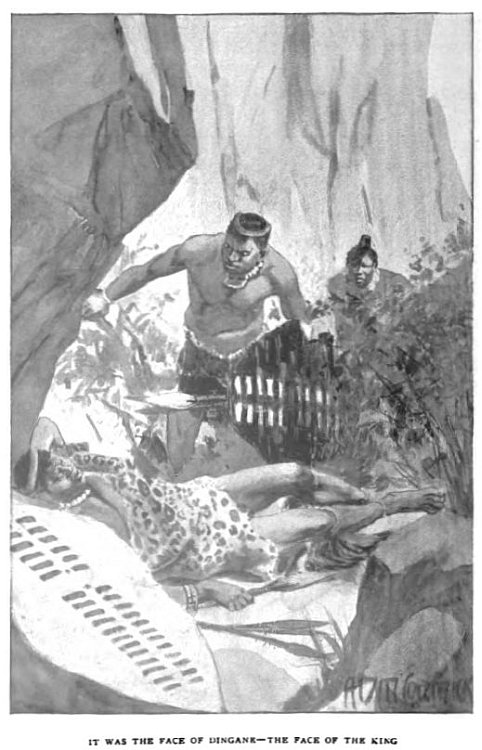
Yes; it was the Great Great One himself. He was sound asleep, his head pillowed on one hand, interposed between it and the rock. But how came he here, he who moved armed men in their countless might—he before whom the nations trembled and hid their heads—how came he here, in hiding and alone?
But was he alone? It seemed so, for I could descry no sign—no sound of the presence of men. And while I thus gazed, again that soft whisper breathed into my ear, “Strike, and strike hard! So shall we be great together!”
Strike! Nothing could have been easier. The large form lay there without movement, the heave of the breast, above the heart, turned towards me as though inviting the stroke. Yet, as I gazed, the noble majesty on the countenance of the sleeping King seemed to paralyse my arm. One blow, and Lalusini, by her sorcery, aided by my own warrior prowess, might set me upon Dingane’s seat. Yet, I could not do it.
Then I thought the sleeper stirred.
“He wakes,” I whispered, withdrawing again behind the bushes. Lalusini followed me.
“And art thou so weak, Untúswa?” she said. “Au! For this have I laboured, for this have I plotted and exercised my magic until it was nearly too much forme. Yet not all for greatness, but for revenge. The blood of Tshaka the Mighty flowed over the spear of Dingane; now shall the blood of Dingane flow over thy spear!”
Still I moved not, and she went on:
“The blood of that Mighty One from whom I am sprang, and who caused me to learn my magic that through it vengeance might fall, shall it not be avenged? The time has come for which I have waited and striven. Now go, and make an end of it, Untúswa, so shall we be great together; else canst thou be great alone—or small—with no help from me.”
Now I nerved myself. That which she seemed to threaten looked too terrible, for in truth, by her I was as one bewitched.
“Go, Untúswa. My múti is upon him. He will not waken too readily,” she whispered, in her sweetest of tones, gently pushing me towards the cave once more.
Again I parted the bushes and peered through; again I stood over the sleeping King. A great white shield lay almost beneath him, and two broad assegais had slid from his relaxed grasp. I raised my spear—No, I could not do it.
Had he been awake, and standing up, the deed would be an easy one at that moment; but alone, deserted, and asleep—no, I could not thus slay him.
And then I thought of the favour he had shown me, even to allowing me the chance of escaping to the Bapongqolo, what time Tambusa and Umhlela had striven to compass my death. I thought how he had spared me, spared the Bapongqolo, and had raised me to honour when all men trembled at his frown; and now that he lay here, a deserted fugitive, I could not turn against him. His life lay within my hand, yet I could not take it. No, not to win greatness for myself; not even to retain Lalusini’s love.
“Farewell, Untúswa!” came that soft whisper behind me. “Farewell; we may meet no more.”
She stepped swiftly through the belt of bushes. For a moment I stood stupidly gazing after her, then I followed. But she had disappeared. I called her, I searched for her. All in vain.
Then I went back to the sleeping King. Him I would save at all events. I had helped in saving him during the battle yesterday, by holding back the impi of Nongalaza; to-day I would save him entirely by myself. Even now Lalusini might have gone to find those who would carry out her bidding readily enough.
“Awaken, Great Great One!” I said, not too loud, lest others ears might be about. “Thy servant knows of a better sleeping-place than this.”
At first Dingane seemed to arouse himself but slowly. Then he sprang up, gripping his shield and spears.
“Who art thou?” he cried, darting upon me his lion-like glance. “Ha! Untúswa, is it? Another traitor perhaps. How sayest thou, Untúswa? All, all are traitors.”
“No traitor am I, Black Elephant,” I answered. “It is safer, however, for the lion of Zulu to make his lair elsewhere.”
In the glance which Dingane bent upon me was distrust, suspicion, contempt by turns, but no sign of fear.
“What, Untúswa, and art thou faithful to me—thou, the wanderer—thou who art not of us, while they whom my hand has fed have deserted me—have turned their spears against me? Whau! It cannot be.”
“Who am I to fill the ears of the Great Great One with words,” I answered. “Yet, my father—wanderer or no wanderer—I know of no man whom the Lion of Zulu may more safely trust.”
“What, then, are thy counsels, Untúswa?” said the King.
“This, Lion. Hard by is a place known to none, where thou canst sit still in safety until the army is collected again. It was badly routed in the more open plain, yet here in these fastnesses none will dare venture—not even the Amabuna—until the trumpeting of the Elephant shall scatter the traitors and rebels once more. Such is my counsel, Ruler of the Great.”
“I will even trust thee, Untúswa,” said the King. “And now let us go forth.”
I picked up my shield and weapons, which, of course, I had let fall, being in the royal presence, and we took our way thence, I walking in advance and spying carefully around to guard against possible surprise.
For long we thus travelled, and when night came we sat and feasted upon the meat of a young impala which I had killed by a lucky spear-cast; but we slept away from any fire, and in a place of secure concealment. On the morrow we kept on our way once more, and by noon came to the resting-place I had designed for the King. This was a group of caves, somewhat high up among the rocks of the Lebombo range. Beneath, the slope fell away, bushy, but not too thickly so as to prevent us from descrying the approach of friend or foe, while on either side so strewn with rocks and boulders was the base of the cliff that retreat would be easy in the event of pursuit.
“Whau, Untúswa!” said the King, with a laugh in his eyes. “When Tambusa would have broken a nest of wasps around thy kraal, thou wert turning thy wanderings to good account!”
“That is so, Great Great One,” I answered, recalling to mind the words of Sifadu—“The day might come when Dingane himself would be glad to join us.” And strange it was that my enforced flight from the hate of the principal indunas should be the means of providing the King with a place of refuge and concealment in the day of his downfall.
So we rested there for many days, Dingane and I. Yes, this dreaded one, before whom all men and all nations had trembled, now treated me as a friend, so entirely does adversity draw the greater and the lesser together. Yet never for a moment did I forget who it was that I thus foregathered with; never was there aught that was unbecoming in word or tone or action of mine towards the King—the real and true ruler of the great Zulu nation.
Often would the thought of Lalusini return to me, of her purposed revenge, which she intended to seize through me. This, then, was that for which she had plotted—this the means by which I was to become great. Had I in refusing it acted the part of a fool? No, that could not be, for, Nkose, although I spared not such as would injure me or could not keep faith, yet never did I lift hand against any who did well by me. Wherefore now I rejoiced that I had not slain the King—had not slain a sleeping and helpless man at the bidding of a woman, even though that woman were Lalusini.
Sometimes a gloom would settle upon the mind of Dingane. His sun had set, he would declare. The power of Zulu was a thing of the past, now that the nation was divided. But at such times I would say what I could to cheer him, telling him portions of my own story, which, in truth, had been wonderful. The army was scattered. Time was needed to collect it, and that time, I thought, had now arrived. I saw that everything was at hand that the Great One might need, and then I prepared to depart.
“I know not, Untúswa,” he said, as I took leave of him. “But for thy faithfulness these many days I might bethink me that soon thou shouldst return at the head of an impi to earn the reward promised by Mpande and the Amabuna to him who should deliver to them the real King—”
But I interrupted; somewhat unbecomingly, I admit:
“If that is thy thought, father, slay me as I stand,” and dropping my weapons I advanced a pace or two.
“Nay, nay, Untúswa,” he said, “that is what I might have thought, not what I thought,” replied the King gently. “Fare-thee-well, Untúswa, and may success be thine. Fare-thee-well, Untúswa, my servant—Untúswa, my friend.”
“Bayéte!” I cried, with right hand aloft. Then I started upon my errand, and more than ever did I rejoice that my spear had remained bright in the face of the entreaties of Lalusini.
Chapter Twenty Four.
The Stroke of Sopuza.
“Bayéte, Nkulu-nkulu! Father! we thy children have found thee at last! Lo! long have we wandered weeping, but now we are comforted. Come forth and show us the brightness of thy head-ring.”
Thus sang a great half circle of armed warriors, mustered on the slope beneath Dingane’s place of concealment.
Thus again and again they sang, but still Dingane did not appear.
For I had fulfilled my errand, Nkose, and this was the result—an array of warriors nearly as large as the original strength of the Amandebeli what time we followed Umzilikazi over the mountains. I had gone hither and thither, had turned night into day, had not spared myself, or feared danger. I had found out and rallied all the scattered bands which at heart had remained faithful to Dingane. I had drawn men from the kraals of Mpande himself, and from beneath the very shadow of the camps of the Amabuna. But one moon had died since I took leave of the King—I alone. Yet here I was, returning at the head of a splendid army—an army nearly as large as that with which Umzilikazi had founded a new nation. In truth, Dingane had not trusted me in vain.
Here were Silwane and Nomapela, and others of the old war-captains. Here was a remnant of the old Imbele-bele regiment—the Bapongqolo, too, my staunch refugees—and as much of the army as had survived the defeat by Nongalaza. All had in truth thought Dingane to be dead, but as I passed through their midst carrying word to the contrary, they had sprung to arms, and mustering swiftly and secretly, had returned to do konza to their rightful King. And here they were.
Now they redoubled their entreaties, singing louder and louder their songs of praise.
Sun of suns, come forth in thy brightness; We thy children sit in darkest night. If thou wilt not show us thy face. Lion of Zulu - thy cubs still have teeth, Teeth that are sharpened for war.
This time the King appeared. But before the great burst of sibonga which greeted his presence had died away he turned his back and retired, for by this means he chose to mark his displeasure over their seeming desertion.
Again and again they howled forth their songs of praise and entreaty. The King appeared again. This time he did not go back. He surveyed them a few moments in silence, then he called:
“Come hither, Untúswa.”
I disarmed, and crept up to where he stood.
“Sit here, Untúswa,” he said, pointing to the ground at his feet. “This is thy place. For the rest they can still remain at a distance.”
So I sat, Nkose, thinking how strange it was that I, who had begun my life as the son of an induna, should live to become the principal fighting chief of Umzilikazi’s army, and then come to earn the confidence of the Great Great One, the King of the mighty Zulu nation—should be bidden to sit near him while all others were kept at a distance—should live to become the most trusted councillor of two mighty Kings; for such I saw was the honour before me now.