Mrs. George de Horne Vaizey (continued 4)
Reading edition
Mary Rhodes shook her head.
“Not till his people know. It might come round to their ears, and that would make things more difficult still; but I am hoping it won’t be long. Now, Claire, I’ve told you, because you are such a kind understanding little soul, and it’s a comfort to talk things out; but I’ll kill you if you dare to breathe a word to another soul—Sophie Blake, or Mrs Willoughby, or even your mother when you write to her. You can never tell how these things are repeated, and Frank would never forgive me if it came out through me. Promise faithfully that you’ll never mention his name in connection with me.”
“Of course I will. What do you take me for? I shouldn’t dream of doing such a thing!”
“Of course, at the Willoughbys’, for instance, if anyone did mention his name—they might, quite well, for I should think they were in much the same set—there would be no harm in saying that you’d heard of him. I should rather like to hear what they said.”
Cecil’s face looked wistful as she spoke these last words, but the next moment her expression changed to one of pure amazement as the whirr of the cuckoo clock made itself heard, and the little brown bird hopped out of its niche, and sounded five clear notes.
“Gracious, what’s that? Where did that come from?”
“It was a Christmas present to me from abroad.”
Claire added the last words in the fond hope that they would save further criticism, and Cecil rose from her seat, and stood in front of the hanging clock examining it with critical eyes.
“It’s a good one. Most of them are so gimcrack. From abroad? One of your Belgian friends, I suppose? Does it make that awful row every hour? I can’t stand it here, you know, if it does.”
“Don’t trouble yourself. I’ll take it upstairs. I like the ‘awful row.’ I put it here because I thought it would be a pleasure to you as well as to myself. I’m sorry.”
“What a tantrum! Evidently the clock is a tender point. Better leave it here and stop the gong. It will keep you awake all night.”
“I won’t stop the gong! I—I like to be waked!” declared Claire obstinately. She lifted the clock from its nail, and stalked out of the room, head in air.
Cecil whistled softly between pursed lips.
Chapter Twelve.
An unpleasant tea-party.
In the inevitable fatigue which had marked Claire’s first experience of regular work, she had looked forward with joy to the coming of the holidays when she would be able to take her ease, and for a month on end laze through the hours at her own sweet will. A teacher scores above other workers in the length of holidays she enjoys. Several months in the year contrasts strongly with the fortnight or three weeks enjoyed by a female clerk or typist; in no other profession is so large a proportion of the year given to rest.
Claire had condemned the staff at Saint Cuthbert’s for want of appreciation of this privilege; but, before the four weeks of the Christmas holidays were over, her eyes were opened to the other side of the picture. Holidays were horribly expensive! Living “at home” meant an added bill for fire and light to add to the necessary expenses abroad; that the last items were necessary could hardly be denied, for a girl who had been shut up in a schoolroom through three months of term, naturally wished to amuse herself abroad during holiday time, and in London even the most carefully planned amusement has a habit of costing money.
Even that mild dissipation of shop-gazing, enjoyed by Sophie Blake, plus the additional excitement of choosing an imaginary present from every window, could only be enjoyed at the price of two Tube or omnibus fares. Boots wore out, too, and gloves grew shabby, and the January sales furnished a very fire of temptation. Claire had never before seen such bargains as confronted her down the length of Oxford and Regent Streets, and, though she might be firm as adamant on Monday or Tuesday, Wednesday was bound to bring about a weak moment which carried her over the threshold of a shop, and once inside, with sensational sacrifices dangling within reach, resistance melted like wax.
“Where do you suppose you are going to wear that concoction?” Mary Rhodes asked blightingly as Claire opened a cardboard box which had arrived by the morning delivery, and displayed a blue muslin dress inset with lace. “Lords, I suppose, or Ascot, or Ranelagh, or Hurlingham, or Henley... They come on in June and July, just as poor High School-mistresses are in the thick of cramming for the Matric. But no doubt you are the exception to the rule! ... You must think you are, at least, to have bought a frock like that!”
“Cecil, it was wickedly cheap—it was, indeed! It was one of a few summer dresses which were positively given away, and it’s made in the simple, picturesque style which I love, and which does not go out of date. I hadn’t the least intention of buying anything, until I saw it hanging there, at that price, and it looked at me so longingly, as if it wanted to come!”
“It’s well to be rich! It might have longed at me as much as it liked, I couldn’t have bought it, if it had been two-and-six! I need all my money for necessities,” Mary Rhodes said, sighing; and Claire felt a pang of reproach, for, since her return, Cecil had indeed seemed painfully short of loose cash. The debt still outstanding had been increased by various small borrowings, insignificant in themselves, yet important as showing how the wind blew. Claire wondered if perchance the poor soul had crippled herself by presenting her lover with a Christmas gift which was beyond her means.
The third week of the holidays arrived; in another week school would begin. Claire succumbed to temptation once more, purchased two good tickets for an afternoon concert at the Queen’s Hall, and invited Cecil to be her guest. Cecil hesitated, evidently torn between two attractions, asked permission to defer her answer until the next day, but finally decided to accept. From remarks dropped from time to time Claire had gathered that Major Carew was not fond of indoor entertainments, and somewhat disappointed his fiancée by his unwillingness to indulge her wishes in that respect. In this instance she had evidently balanced the concert against an afternoon in the Major’s society, and the concert had won. Claire found herself cordially in agreement.
When the afternoon arrived the two girls arrayed themselves in their best clothes, and set off in high spirits for their afternoon’s amusement. Their seats were in a good position, and the concert was one of the best of the season. All went as happily as it could possibly go, until the last strains of “God save the King” had been played, and the audience filed out of the hall on to the crowded pavement, and then, with a throb of disgust, Claire recognised the figure of a man who was standing directly beneath a lamp-post, his black eyes curiously scanning the passing stream—Major Carew! He had evidently been told of the girls’ destination, and had come with the express purpose of meeting them coming out. For the moment, however, they were unrecognised, and Claire gave a quick swerve to the right, hurrying out of the patch of light into the dimness beyond. The street was so full that, given a minute’s start, it would surely be easy to escape. She slid her hand through Cecil’s arm, drawing her forward.
“Come along! Come along! Let’s hurry to Fuller’s before all the tables are taken!”
“Fuller’s? Tea? How scrumptious! Just what I longed for. Listening to classical music is thirsty work!” Cecil replied, laughing. She was so lively, so natural and unconcerted that Claire absolved her on the moment from any arrangement as to a rendez-vous. In her anxiety to secure the longed-for cup of tea she broke into a half-run, but it was too late; the sharp black eyes had spied them out, the tall figure loomed by their side, the large face, with its florid colouring, smiled a broad smile of welcome.
“Hulloa, Mary! Thought it was you. I was just passing along. Good afternoon, Miss Gifford. It is Miss Gifford, isn’t it? Had a good concert, I hope—a pleasant afternoon?”
“Very good, thank you,” said Claire shortly.
Mary cried, “Oh, Frank! You! How did you come? I didn’t expect—” And the tone of her voice showed that the surprise was hardly more agreeable to her than to her companion. However welcome her lover might be on other occasions, it was obvious that she had not wished to see him at this particular moment.
“Well, well, we must move on; we mustn’t block up the pavement,” the Major said hastily. He took his place by the kerb, which placed him next to Claire, and bent over with an assiduous air. “You must let me escort you! Where were you bound for next?”
Claire hesitated. She wished with all her heart that she had not mentioned Fuller’s, so that she could reply that they were bound for the Tube. Oxford Circus was only a step away; in five minutes they could have been seated in the train; but Cecil had declared that she was longing for tea, so it would be ungracious to withdraw the invitation.
“We were going to Fuller’s.”
“Right!” The Major’s tone was complacent. “Good idea! How shall we go? Taxi? Tube? Which do you prefer?”
Claire stared at him in surprise.
“But it’s here! Quite close. We’re nearly there.”
He looked disconcerted, unnecessarily disconcerted, Claire thought; for it was surely no disgrace for a man to be ignorant of the locality of a confectioner’s shop! From the other side came Cecil’s voice, cool and constrained—
“If you were going anywhere, Frank, you needn’t stay with us. We can look after each other. We are accustomed to going about alone.”
“Please allow me the pleasure. There’s plenty of time. I should enjoy some tea immensely. Always take it when I get the chance!”
The block on the pavement made consecutive conversation impossible, and the three edged their way in and out in silence until Fuller’s was reached, and one of the last tables secured. The room looked very bright and dainty, the Christmas garlands still festooning the walls and framing the mirrors, the hanging lights covered by rose-coloured shades. The soft pink light was very kind to the complexions of the visitors, nevertheless Claire felt a guilty pang as she looked into the nearest mirror and beheld the reflection of herself and her friend as they sat side by side. As a rule, it was pure pleasure to realise her own fair looks; but for the moment they were of no importance, whereas poor dear Cecil had a lover to please, and there was no denying Cecil was not looking her best! Her expression was frowning and dissatisfied. She had taken off her veil in the hall and her hair was disarranged; compared with the fashionable groups round the other tables, she looked suddenly shabby and insignificant, her little attempts at decoration pitifully betraying the amateur hand.
“Oh, dear me, why won’t she smile? She looks quite pretty when she smiles. I’ll hold her before a mirror some day and show her the difference it makes. Ten years disappear in a flash! Now what in the world had I better be—agreeable and chatty, or cold and stand-off? I’ll do anything to please her, but it is hard lines having our afternoon spoiled, and being sulked at into the bargain. Cakes, please—lots of sweet, sugary cakes! Won’t that do, Cecil? We can have bread-and-butter at home!”
“Cecil! Cecil! Her name is Mary. Why do you call her Cecil?” cried the Major quickly, looking from one girl to another. Claire fancied there was a touch of suspicion in his voice, and wondered that he should show so much interest in a mere nickname.
“Because she is ‘Rhodes,’ of course.”
For a moment his stare showed no understanding, then, “Oh! that fellow!” he said slowly. “I see! It’s a pretty name anyway. Beats Mary to fits. Mary is so dull and prosaic. Too many of them about. One gets sick of the sound.”
“Is that intended for me by any chance?” asked Cecil in her most acid tones, whereupon the Major cried, “Oh! Put my foot in it that time, didn’t I?” and burst into a long guffaw of laughter, which brought on him the eyes of the surrounders.
Claire’s interest had already been aroused by a little party of two men and two women who were sitting at a table in the corner of the room, and who were, to her thinking, by far the most attractive personalities present. The men were tall, well set up, not especially handsome in any way, but possessing an unmistakable look of breeding. One of the women was old, the other young, and it would have been hard to say which was the more attractive of the two. They were quietly but very elegantly dressed, handsome furs being thrown back, to show pretty bodices of ninon and lace.
When Major Carew gave that loud unrestrained laugh, the four members of this attractive party turned to see whence the sound arose; but whereas three faces remained blankly indifferent, the fourth was in the moment transformed into an expression of the liveliest surprise. He stared, narrowing his eyes as if doubting that they were really seeing aright, twisted his head to get a fuller view, and, obtaining it, twisted back into his original position, his lips twitching with laughter. Then he spoke a few words, his companions leant forward to listen, and to two faces out of the three, the laughter spread on hearing what he had to say.
Only the elder of the two ladies retained her gravity. Her sweet glance rested on Claire’s face, and her brow contracted in distress. In the Major and Cecil she showed no interest, but Claire’s appearance evidently aroused curiosity and pity. “What is she doing in that galère?” The question was written on every line of the sweet high-bred face, and Claire read its significance and flinched with distaste.
“How they stare!” cried Mary Rhodes. “The man looked as if he knew you, Frank. Do you know who he is?”
“He’s a member of the Club. His name is Vavasour. We know each other by sight.” Major Carew’s florid colour had grown a shade deeper, he was evidently disconcerted by the encounter; but he made a strong effort to regain his composure, smiled at the two girls in turn, and cried lightly, “Envies me, I suppose, seeing me with two such charmers!”
“He didn’t look exactly envious!” Cecil said drily. She also had noticed that reflection in the mirror, and it had not helped to soothe her spirits. She felt an unreasoning anger against Claire for appearing more attractive than herself, but it did not occur to her that she was heightening the contrast by her own dour, ungracious manner. Altogether that tea-party was a difficult occasion, and as it proceeded, Claire’s spirits sank ever lower and lower. She had spent more than she had any right to afford on those two expensive tickets, hoping thereby to give pleasure, and now Cecil was in a bad temper, and would snap for days to come.—It was not a cheerful outlook, and for the second time a feeling of restiveness overtook her, a longing for a companion who would help the gaiety of life—such a companion as pretty, lively, happy-go-lucky Sophie Blake, for example. How refreshing it would be to live with Sophie! Just for a moment Claire dwelt wistfully on the possibility, then banished it with a loyal “She doesn’t need me, and Cecil does. She’s fond of me in her funny way. She must be, for she has confided in me already, more than in any of the others whom she’s known for years, and perhaps I may be able to help...”
The Major passed his cup for a second supply; a waitress brought a plate of hot cakes; the occupants of the corner table stood up, fastening furs and coats, and passed out of the door. With their going Major Carew regained his vivacity, chaffed the girls on their silence, recounted the latest funny stories, and to Claire’s relief addressed himself primarily to his fiancée, thus putting her in the place of honour.
Nevertheless Claire was conscious that from time to time keen glances were cast in her own direction. She had a feeling that no detail of her attire escaped scrutiny, that the black eyes noted one and all, wondered, and speculated, and appraised. She saw them dwell on the handsome fur stole and muff which Mrs Judge bequeathed to her daughter on sailing for India, on the old diamond ring and brooch which had been handed over to her on her twenty-first birthday; she had an instinctive feeling that she rose in the man’s estimation because of her air of prosperity. He made tentative efforts to arrange a further meeting. “Where do you go on Sundays, Miss Gifford? I say, we must arrange another tea like this. Lots of good tea places in town. We must sample them together. What do you say, Miss Gifford?”
Claire’s answers were politely evasive, and presently he began to grow restless, and finally pulled out his watch, and jumped to his feet.
“How time flies! I had no idea it was so late. I must run. So sorry to leave you like this.”
Mary Rhodes stared in surprise.
“Leave! Frank! But you said—I thought we were going—”
“Yes, I know, I know. I’m sorry, I thought I was free—but—a regimental engagement! Can’t get out of it. I’ll fix up another night. I’ll write.”
There was no doubt that he was genuinely disconcerted at the lateness of the hour, and his leave-taking was of the most hasty description, though he found time to give a lingering pressure to Claire’s hand; then he was gone, and the waitress came across the room and presented the bill.
Cecil flushed uncomfortably.
“I must pay this. Frank has forgotten. He rushed off in such a hurry.”
She pulled out her shabby purse, and Claire made no protest. In a similar position she herself would have wished to pay, but it was inconceivable that she should ever be in such a position. However hurried a man might be— She rubbed her hand on her knee with a little shudder of distaste. “Wretch! He would make love to me, too, if I would allow it! How can Cecil possibly care for such a man?”
And then she forgot Cecil’s feelings to ponder on a more perplexing problem.
Why had the man called Vavasour looked so amused, and why had the sweet-faced woman looked so distressed?
Chapter Thirteen.
A double invitation.
Janet Willoughby sent Claire a picture postcard, all white snow and strong shadow, and dazzling blue sky, and little black figures pirouetting on one leg with the other raised perilously in the rear. “This is me!” was written across the most agile of the number, while a scrawling line across the top ran, “Happy New Year! Returning on Tuesday. Hope to see you soon.” Tuesday was the day on which school re-opened; but Janet’s holiday was year long, not a short four weeks.
Cecil moaned loudly, but Claire was tired of aimless days, and welcomed the return to work. She determined to throw her whole heart into her task, and work as no junior French mistress had ever worked before; she determined never to lose patience, never to grow cross, never to indulge in a sarcastic word, always to be a model of tact and forbearance. She determined to wield such an ennobling influence over the girls in her form-room that they should take fire from her example, and go forth into the world perfect, high-souled women who should leaven the race. She determined also to be the life and soul of the staff-room—the general peace-maker, confidante, and consoler, beloved by one and all. She determined to seize tactfully upon every occasion of serving the Head, and acting as a buffer between her and disagreeables of every kind. She arranged a touching scene wherein Miss Farnborough, retiring from work and being asked by the Committee to name a worthy successor, pronounced unhesitatingly, “Claire Gifford; she is but young, but her wisdom and diplomacy are beyond all praise.” She saw herself Head of Saint Cuthbert’s, raised to the highest step of her scholastic ladder, but somehow the climax was not so exhilarating as the climb itself. To be head mistress was, no doubt, a fine achievement, but it left her cold.
Inside Saint Cuthbert’s all was life and bustle. Girls streaming along the corridors, in and out of every room; girls of all ages and sizes and shapes, but all to-day bearing an appearance of happiness and animation. Bright-coloured blouses shone forth in their first splendour; hair-ribbons stood out stiff and straight; many of the girls carried bunches of flowers to present to the special mistress for whom they cherished the fashionable “G.P.” (grand passion) so characteristic of school life.
Flora had a bunch of early daffodils for Claire. Another girl presented a pot of Roman hyacinths for the decoration of the form-room, a third a tiny bottle of scent; three separate donors supplied buttonholes of violets. The atmosphere was full of kindness and affection. Girls encountering each other would fall into each other’s arms with exclamations of ecstatic affection. “Oh, you precious lamb!”
“My angel child!”
“You dear, old, darling duck!” Claire heard a squat, ugly girl with spectacles and a turned-up nose addressed as “a princely pet” by an ardent adorer of fourteen. The mistresses came in for their own share of adulation—“Darling Miss Gifford, I do adore you!”
“Miss Gifford, darling, you are prettier than ever!”
“Oh, Miss Gifford, I was dying to see you!”
The morning flew past, and lunch-time brought the gathering of mistresses in staff-room. Mademoiselle’s greetings were politely detached, Fräulein was kindly and discursive, Sophie’s smile was as bright as ever, but she did not look well.
“Oh, I’m all right! It’s nothing. Only this horrid old pain!” she said cheerfully. Into her glass of water she dropped three tabloids of aspirin. Every one had been away for a longer or shorter time, visiting relatives and friends; they compared experiences; some had enjoyed themselves, some had not; but they all agreed that they were refreshed by the change.
“And where have you been?” asked the drawing mistress of Claire, and exclaimed in surprise at hearing that she had remained in town. “Dear me, I wish I had known! I’ve been back a fortnight. We might have done something together. Weren’t you dull?” asked the drawing mistress, staring with curious eyes.
“Very!” answered poor Claire, and for a moment struggled with a horrible inclination to cry.
After lunch Miss Bates took her cup of coffee to Claire’s side, and made an obvious attempt to be pleasant.
“I feel quite remorseful to think of your holidays. It’s astonishing how little we mistresses know of each other out of school hours. The first school I was in—a much smaller one by the sea,—we were so friendly and jolly, just like sisters, but in the big towns every one seems detached. It’s hard on the new-comers. I don’t know what I should have done if I hadn’t a brother’s house to go to on Sundays and holiday afternoons. Except through him, I haven’t made a single friend. At the other place people used to ask us out, and we had quite a good time; but in town people are engrossed in their own affairs. They haven’t time to go outside.”
“I wonder you ever left that school! What made you want to change?”
“Oh, well! London was a lure. Most people want to come to London, and I had my brother. Do tell me, another time, if you are not going away. It worries me to think of you being alone. How did you come to get this post, if you have no connections in town?”
“Miss Farnborough came to stay in Brussels, in the pension which my mother and I had made headquarters for some time. She offered me the post.”
Miss Bates stared with distended eyes. “How long had she known you?”
“About a fortnight, I think. I don’t remember exactly.”
“And you had never seen her before? She knew nothing about you?”
“She had never seen me before, but she did know something about me. Professionally speaking, she knew all there was to know.”
“That accounts for it,” said Miss Bates enigmatically. “I wondered— You are not a bit the usual type.”
“I hope that doesn’t mean that I can’t teach?”
Miss Bates laughed, and shrugged her thin shoulders. “Oh, no. I should say, personally, that you teach very well. That play was extraordinarily good. It absolutely sounded like French. Can’t think how you knocked the accent into them! English girls are so self-conscious; they are ashamed of letting themselves go. Mademoiselle thinks that your classes are too like play; but it doesn’t matter what she thinks, so long as—” she paused a moment, lowered her voice, and added impressively, “Keep on the right side of Miss Farnborough. You are all right so long as you are in her good books. Better be careful.”
“What do you mean?” Claire stared, puzzled and discomposed, decidedly on the offensive; but Miss Bates refused a definite answer.
“Nothing!” she said tersely. “Only—people who take sudden fancies, can take sudden dislikes, too. Ask no more questions, but don’t say I didn’t warn you, that’s all!”
She lifted her coffee-cup, and strolled away, leaving Claire to reflect impatiently, “More poison! It’s too bad. They won’t let one be happy!”
Before the end of the week school work settled into its old routine, and the days passed by with little to mark their progress. The English climate was at its worst, and three times out of four the journey to school was accomplished in rain or sleet. The motor-’buses were crammed with passengers, and manifested an unpleasant tendency to skid; pale-faced strap-holders crowded the carriages of the Tube; for days together the sky remained a leaden grey. It takes a Mark Tapley himself to keep smiling under such conditions. As Claire recalled the days when she and her mother had sat luxuriously under the trees in the gardens of Riviera hotels, listening to exhilarating bands, and admiring the outline of the Esterels against the cloudless blue of the sky, the drab London streets assumed a dreariness which was almost insupportable. Also, though she would not acknowledge it to herself, she was achingly disappointed, because something which she had sub-consciously been expecting did not come to pass. She had expected something to happen, but nothing happened; all through February the weeks dragged on, unrelieved by any episode except the weekly mail from India.
The little brown bird still industriously piped the hour; but his appearance no longer brought the same warm thrill of happiness. And then one morning came a note from Janet Willoughby.
“Dear Miss Gifford,—
“I should really like to call you ‘Claire,’ but I must wait to be asked! I have been meaning to write ever since we returned from Saint Moritz; but you know how it is in town, such a continual rush, that one can never get through half the things that ought to be done! We should all like to see you again. Mother has another ‘At Home’ on Thursday evening next, and would be glad to see you then, if you cared to come; but what I should like is to have you to myself! On Saturday next I could call for you, as I did at Christmas, and keep you for the whole day. Then we could talk as we couldn’t do at the ‘At Homes,’ which are really rather dull, duty occasions.
“Let me know which of these propositions suits you best. Looking forward to seeing you,—
“Your friend, (if you will have me!)
“Janet Willoughby.”
Claire had opened the letter, aglow with expectation; she laid it down feeling dazed and blank. For the moment only one fact stood out to the exclusion of every other, and that was that Janet did not wish her to be present at the “At Home.” Mrs Willoughby had sent the invitation, but Janet had supplemented it by another, which could not be refused. “I would rather have you to myself.” How was it possible to refuse an invitation couched in such terms? How could one answer with any show of civility, “I should prefer to come with the crowd?”
Claire carried the letter up to her cold bedroom, and sat down to do a little honest thinking.
“It’s very difficult to understand what one really wants! We deceive ourselves as much as we do other people... Why am I so hideously depressed? I liked going to the ‘At Home,’ I liked dressing up, and driving through the streets, and seeing the flowers and the dresses, and having the good supper; but, if that were all, I believe I’d prefer the whole day with Janet. I suppose, really, it’s Captain Fanshawe that’s at the bottom of it. I want to meet him, I thought I should meet him, and now it’s over. I shan’t be asked again when there’s a chance of his coming. Janet doesn’t want me. She’s not jealous, of course—that’s absurd—but she wants to keep him to herself, and she imagines somehow that I should interfere—”
Imagination pictured Janet staring with puzzled, uneasy eyes across the tables in the dining-room, of Janet drearily examining the piled-up presents in the boudoir, and then, like a flash of light, showed the picture of another face, now eager, animated, admiring, again grave and wistful. “Is your address still the Grand Hotel?—My address is still the Carlton Club.”
“Ah, well, well!” acknowledged Claire to her heart, “we did like each other. We did love being together, and he remembered me; he sent me the clock when he was away. But it’s all over now. That was our last chance, and it’s gone. He’ll go to the At Home, and Mrs Willoughby will tell him I was asked, but preferred to come when they were alone, and he’ll think it was because I wanted to avoid him, and—and, oh, goodness, goodness, goodness! how miserable I shall feel sitting here all Thursday evening, imagining all that is going on! Oh, mother, mother, your poor little girl is so lonesome! Why did you go so far away?”
Claire put her head down on the dressing-table, and shed a few tears, a weakness bitterly regretted, for like all weaknesses the consequences wrought fresh trouble. Now her eyelids were red, and she was obliged to hang shivering out of the window, until they had regained their natural colour, before she could face Cecil’s sharp eyes.
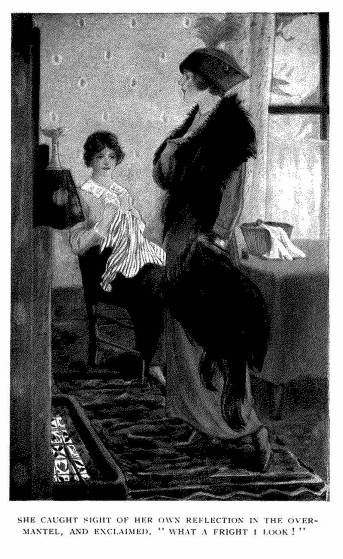
Janet arrived soon after eleven o’clock on Saturday morning, and was shown into the saffron parlour where Claire sat over her week’s mending. She wore a spring suit purchased in Paris, and a hat which was probably smart, but very certainly was unbecoming, slanting as it did at a violent angle over her plump, good-humoured face, and almost entirely blinding one eye. She caught sight of her own reflection in the overmantel and exclaimed, “What a fright I look!” as she seated herself by the table, and threw off her furs. “Don’t hurry, please. Let me stay and watch. What are you doing? Mending a blouse? How clever of you to be able to use your fingers as well as your brains! I never sew, except stupid fancy-work for bazaars. So this is your room! You told me about the walls. Can you imagine any one in cold blood choosing such a paper? But it looks cosy all the same. I do like little rooms with everything carefully in reach. They are ever so much nicer than big ones, aren’t they?”
“No.”
Janet pealed with laughter.
“That’s right, snub me! I deserve to be snubbed. Of course, I meant when you have big ones as well! Who is the pretty girl in the carved frame? Your mother! Do you mean it, really? What a ridiculous mamma! I’m afraid, Claire, I’m afraid she is even prettier than you!”
“Oh, she is; I know it. But I have more charm,” returned Claire demurely, whereat they laughed again—a peal of happy girlish laughter, which reached Lizzie’s ears as she polished the oilcloth in the hall, and roused an envious sigh.
“It’s well to be some folks!” thought poor Lizzie. “Motor-cars, and fine dresses, and nothing to do of a Saturday morning but sit still and laugh. I could laugh myself if I was in her shoes!”
Claire folded away her blouse, and took up a bundle of gloves.
“These are your gloves. They have been such a comfort to me. There’s a button missing somewhere. Tell me all about your holiday! Did you have a good time? Was it as nice as you expected?”
“Yes. No. It was a good time, but—do you think anything ever quite comes up to one’s expectation? I had looked forward to that month for the whole year, and had built so many fairy castles. You have stayed in Switzerland? You know how the scene changes when the sun sinks, how those beautiful alluring rose-coloured peaks become in a minute awesome and gloomy. Well, it was rather like that with me. I don’t mean that it was gloomy; that’s exaggerating, but it was prose, and I had pictured it poetry. Heigho! It’s a weary world.”
Claire’s glance was not entirely sympathetic.
“There are different kinds of prose. You will forgive my saying that your especial sort is an Edition de luxe.”
“I know! I know! You can’t be harder on me than I am on myself. My dear, I have a most sensible head. I’m about as practical and long-headed as any woman of forty. It’s my silly old heart which handicaps me. It won’t fall into line... Have you finished your mending? May I come upstairs and see your room while you dress?”
For just the fraction of a moment Claire hesitated. Janet saw the doubt, and attributed it to disinclination to exhibit a shabby room; but in reality Claire was proud of her attic, which a little ingenuity had made into a very charming abode. Turkey red curtains draped the window, a low basket-chair was covered in the same material, a red silk eiderdown covered the little bed. On the white walls were a profusion of photographs and prints, framed with a simple binding of leather around the glass. The toilet table showed an array of well-polished silver, while a second table was arranged for writing, and held a number of pretty accessories. A wide board had been placed over the narrow mantel, on which stood a few good pieces of china and antique silver. There was nothing gimcrack to be seen, no one-and-elevenpenny ornaments, no imitations of any kind; despite its sloping roof and its whitewashed walls, it was self-evidently a lady’s room, and Janet’s admiration was unfeigned.
“My dear, it’s a lamb! I love your touches of scarlet. Dear me, you’ve quite a view! I shall have sloping walls when I change my room. They are ever so picturesque. It’s a perfect duck, and everything looks so bright. They do keep it well!”
“I keep it well!” Claire corrected. “Lizzie ‘does’ it every morning, but it’s not a doing which satisfies me, so I put in a little manual labour every afternoon as a change from using my brain. I do all the polishing. You can’t expect lodging-house servants to clean silver and brass.”
“Can’t you? No; I suppose you can’t.” Janet’s voice of a sudden sounded flat and absent. There was a moment’s pause, then she added tentatively, “You have a cuckoo clock?”
Claire was thankful that her face was screened from view as she was in the process of tying on her veil. A muffled, “Yes,” was her only reply.
Janet stood in front of the clock, staring at it with curious eyes.
“It’s—it’s like—there were some just like this in a shop at Saint Moritz.”
“They are all much alike, don’t you think?”
“I suppose they are. Yes—in a way. Some are much better than others. This is one of the best—”
“Yes, it is. It keeps beautiful time. I had it in the sitting-room, but Miss Rhodes objected to the noise.”
“Was it in Saint Moritz that you bought it?”
“I didn’t buy it. It was a present.”
That finished the cross-questioning, since politeness forbade that Janet should go a step further and ask the name of the friend, which was what she was obviously longing to do. She stood a moment longer, staring blankly at the clock, then gave a little sigh, and moved on to examine the ornaments on the mantelpiece. Five minutes later the two girls descended the staircase, and drove away from the door.
The next few hours passed pleasantly enough, but Claire wondered if it were her own imagination which made her think that Janet’s manner was not quite so frank and bright as it had been before she had caught sight of the cuckoo clock. She never again said, “Claire”; but her brown eyes studied Claire’s face with a wistful scrutiny, and from time to time a sharp little sigh punctuated her sentences.
“But what could I tell her?” Claire asked unhappily of her sub-conscience. “I don’t know—I only think; and even if he did send it, it doesn’t necessarily affect his feelings towards her. He was going to see her in a few days; and she is rich and has everything she wants, while I am poor and alone. It was just kindness, nothing more.” But though her head was satisfied with such reasoning, her heart, like Janet’s, refused to fall into line.
At tea-time several callers arrived, foremost among them a tall man whom Claire at once recognised as the original of a portrait which stood opposite to that of Captain Fanshawe on the mantelpiece of Janet’s boudoir. This was “the kind man, the thoughtful man,” the man who remembered “little things,” and in truth he bore the mark of it in every line of his good-humoured face. Apart from his expression, his appearance was ordinary enough; but he was self-evidently a man to trust, and Claire found something pathetic in the wistful admiration which shone in his eyes as they followed Janet Willoughby about the room. To ordinary observers she was just a pleasant girl with no pretensions to beauty; to him she was obviously the most lovely of her sex. He had no attention to spare for Claire or the other ladies present; he was absorbed in watching Janet, waiting for opportunities to serve Janet, listening eagerly to Janet’s words. It is not often that an unengaged lover is so transparent in his devotion, but Malcolm Heward was supremely indifferent to the fact that he betrayed his feelings.
At ten o’clock Claire rose to take leave, and Mrs Willoughby made a request.
“I am going to ask you to do me a favour, dear. A friend is having a Sale of Work at her house for a charity in which we are both interested, and she has asked me to help. It is on a Saturday afternoon and evening, and I wondered if I might ask you to take part in the little concerts. Whistling is always popular, and you do it so charmingly. I would send the car for you, and take you home, of course, and be so very much indebted. You don’t mind my asking?”
“No, indeed; I should be delighted. Please let me help you whenever you can.”
In the bedroom upstairs Janet deliberately introduced Malcolm Heward’s name.
“That was the man I told you about at Christmas. He was one of the party at Saint Moritz. What did you think of him?”
“I liked him immensely. He looks all that you said he was. He has a fine face.”
“He wants to marry me.”
Claire laughed softly.
“That’s obvious! I never saw a man give himself away so openly.”
“Do you think I ought to accept him?”
“Oh, how can I say? It’s not for me to advise. I hope, whoever you marry, you’ll be very, very happy!”
Suddenly Janet came forward and laid her hands on Claire’s arm.
“Oh, Claire, I do like you! I do want to be friends, but sometimes I have the strangest thoughts.” Before Claire had time to answer, she had drawn back again, and was saying with a little apologetic laugh, “I am silly! Take no notice of what I say. Here’s your fur; here’s your muff. Are you quite sure you have all your possessions?”
Chapter Fourteen.
A Question of Money.
The next week was memorable to Claire as marking the beginning of serious anxiety with regard to Sophie. She had looked ill since the beginning of the term, and the bottle of aspirin tabloids had become quite an accustomed feature on the luncheon table; but when questioned she had always a smile and an easy excuse.
“What can you expect in this weather? No one but a fish could help aching in these floods. I’m perfectly all right!”
But one morning this week, meeting her on an upper landing, Claire discovered Sophie apparently dragging herself along with her hands, and punctuating each step with a gasp of pain. She stood still and stared, whereupon Sophie instantly straightened herself, and ascended the remaining steps in a normal manner.
“Sophie,” cried Claire sternly, “don’t pretend! I heard you; I saw you! My dear girl, is the rheumatism so bad?”
Sophie twisted her head this way and that, her lips pursed in warning.
“S–sh! Be careful! You never know who is about. I am rather stiff to-day. This raw fog has been the last straw. I shall be all right when we get through this month. I hate March! It finds out all the weak spots. Please, Claire, don’t take any notice. A Gym. mistress has no business to have rheumatism. It’s really very good for me to be obliged to keep going. It is always worse at the beginning of the day.”
Claire went away with a pain in her heart, and the pain grew steadily as she watched Sophie throughout the week. The pretty face was often drawn with pain, she rose and sat down with an obvious effort; and still the rain poured, and the dark fog enveloped the city, and Sophie struggled to and from her work in a thin blue serge suit which had already seen three winters’ wear.
One day the subject came up for discussion in the staff-room, and Claire was shocked and surprised at the attitude of the other teachers. They were sorry for Sophie, they sympathised, to a certain extent they were even anxious on her account, but the prevailing sentiment seemed to be that the kindest thing was to take no notice of her sufferings. No use pitying her; that would only make her more sorry for herself. No use suggesting cures; cures take time, not to speak of money. The Easter holidays would soon be here; perhaps she might try something then. In the meantime—tant pis! she must get along as best she could. There was simply no time to be ill.
“I’ve a churchyard cough myself,” declared the Arts mistress. “I stayed in bed all Saturday and Sunday, and it was really a little better, but it was as bad as ever after a day in this big draughty hole.”
“And I am racked with neuralgia,” chimed in Miss Bates. The subject of Sophie was lost in a general lamentation.
Friday evening came, and after the girls had departed Claire went in search of Sophie, hoping tactfully to be able to suggest remedial methods over the week-end. She peeped into several rooms before at last, in one of the smallest and most out-of-the-way, she caught sight of a figure crouched with buried head at the far end of the table. It was Sophie, and she was crying, and catching her breath in a weak exhausted fashion, pitiful to hear. Claire shut the door tightly, and put her arms round the shaking form.
“Miss Blake—Sophie! You poor, dear girl! You are tired out. You have been struggling all the week, but it’s Friday night, dear, remember that! You can go home and just tumble into bed. Don’t give way when you’ve been so brave.”
But for the moment Sophie’s bravery had deserted her.
“It’s raining! It’s raining! It always rains. I can’t face it. The pain’s all over me, and the omnibuses won’t stop! They expect you to jump in, and I can’t jump! I don’t know how to get home.”
“Well, I do!” Claire cried briskly. “There’s no difficulty about that. I’m sick of wet walks myself. I’ll whistle for a taxi, and we’ll drive home in state. I’ll take you home first, and then go on myself; or, if you like, I’ll come in with you and help you to bed.”
“P–please. Oh, yes, please, do come! I don’t want to be alone,” faltered Sophie weakly; but she wiped her eyes, and in characteristic fashion began to cheer up at the thought of the drive home.
There was a cheerful fire burning in Sophie’s sitting-room, and the table was laid for tea in quite an appetising fashion. The landlady came in at the sound of footsteps, and showed a sympathetic interest at the sight of Sophie’s tear-stained face.
“I told you you weren’t fit to go out!” she said sagely. “Now just sit yourself down before the fire, and I’ll take your things upstairs and bring you down a warm shawl. Then you shall have your teas. I’ll bring in a little table, so you can have it where you are.” She left the room, and Sophie looked after her with grateful eyes.
“That’s what I pay for!” she said eloquently. “She’s so kind! I love that woman for all her niceness to me. I told you I had no right to pay so much rent. I came in just for a few weeks until I could find something else, and I haven’t had the heart to move. I’ve been in such holes, and had such awful landladies. They seem divided into two big classes, kind and dirty, or clean and mad! When you get one who is kind and clean, you feel so grateful that you’d pay your last penny rather than move away. Oh, how lovely! how lovely! how lovely! It’s Friday night, and I can be ill comfortably all the time till Monday morning! Aren’t we jolly well-off to have our Saturdays to ourselves? How thankful the poor clerks and typists would be to be in our place!”
She was smiling again, enjoying the warmth of the fire, the ease of the cushioned chair. When Mrs Rogers entered she snoodled into the folds of a knitted shawl, and lay back placidly while the kind creature took off her wet shoes and stockings and replaced them by a long pair of fleecy woollen bed-socks, reaching knee high. The landlady knelt to her task, and Sophie laid a hand on the top of starched lace and magenta velvet, and cried, “Rise, Lady Susan Rogers! One of the truest ladies that ever breathed...”
“How you do talk!” said the landlady, but her eyes shone. As she expounded to her husband in the kitchen, “Miss Blake had such a way with her. When ladies were like that you didn’t care what you did, but there was them as treated you like Kaffirs.”
Tea was quite a cheerful and sociable little meal, during which no reference was made to Sophie’s ailments, but when the cups had been replaced on the central table, Claire seated herself and said with an air of decision—
“Now we’re going to have a disagreeable conversation! I don’t approve of the way you have been going on this last month, and it’s time it came to an end. You are ill, and it’s your business to take steps to get better!”
“Oh!”
“Yes; and you are going to take them, too!”
“What am I going to do?”
“You are going to see a specialist next week.”
“You surprise me!” Sophie smiled with exaggerated lightness. “What funny things one does hear!”
“Why shouldn’t you see a specialist? I defy you to give me one sensible reason?”
“I’ll do better than that. I’ll give you two.”
“So do, then! What are they?”
“Guineas!” said Sophie.
For a moment Claire stared blankly, then she laughed.
“Oh, I see! Yes. It is rather a haul. But it’s better to harden your heart once for all, and pay it down.”
“The two guineas is only the beginning.”
“The beginning of what?”
“Trouble!” said Sophie grimly. “Baths, at a guinea apiece. Massage, half-a-guinea a time. Medicine, liniments, change of air. My dear, it’s no use. What’s the use of paying two guineas to hear a man tell you to do a dozen things which are hopelessly impossible? It’s paying good money only to be aggravated and depressed. If it comes to that, I can prescribe for myself without paying a sou... Knock off all work for a year. Go to Egypt, or some perfectly dry climate, and build up your strength. Always get out of London for the winter months. Live in the fresh air, and avoid fatigue... How’s that? Doesn’t that strike you as admirable advice?”
She put her head on one side with a gallant attempt at a smile, but her lips twitched, and the flare of the incandescent light showed her face lined and drawn with pain. Claire was silent, her heart cramping with pain. The clock ticked on for several minutes, before she asked softly—
“Have you no savings, Sophie? No money to keep you if you did take a rest?”
“Not a sou. It’s all I can do to struggle along. I told you I had to help a young sister, and things run up so quickly, that it doesn’t seem possible to save. I suppose many people would say one ought to be able to do it on a hundred a year; that’s all I have left for myself! Hundreds of women manage on less, but as a rule they come from a different class, and can put up with a style of living which would be intolerable to us. I don’t complain of the pay. I don’t think it is bad as things go: it’s only when illness comes that one looks ahead and feels—frightened! Suppose I broke down now, suppose I broke down in ten years’ time! I should be over forty, and after working hard for twenty years I should be left without a penny piece; thrown on the scrap heap, as a worn-out thing that was no more use. But I might still live on, years upon years. Oh, dear! why did you make me think of it? It does no good; only gives one the hump. There is no Pension scheme, so I simply can’t afford to be ill. That’s the end of it.”
“Don’t you think if you went to Miss Farnborough, and explained to her—”
Sophie turned a flushed, protesting face.
“Never! Not for the world, and you mustn’t either. Promise me faithfully that you will never give so much as a hint. Miss Farnborough is a capital head, but her great consideration is for the pupils; we only count in so far as we are valuable to them. She’d be sorry for me, of course, and would give me quite a lot of advice, but she’d think at once, ‘If she’s rheumatic, she won’t be so capable as a Gym. mistress; I must get some one else!’ No, no, my dear, I must go on, I must fight it out. You’d be surprised to see how I can fight when Miss Farnborough comes on the scene!”
“Very well. You have had your say, now I’m going to have mine! If you go on as you have been doing the last month, growing stiffer week by week, you won’t be able to hide it! The other mistresses talk about it already. They were discussing you in staff-room last week. If you go on trusting to chance, you are simply courting disaster. Now I’ll tell you what I am going to do. I’m going to find out the address of a good specialist, and make an appointment for next Saturday morning. You shan’t have any trouble about it, and I’ll call in a taxi, and take you myself, and bring you safely back. And it will be the wisest and the cheapest two guineas you ever spent in your life. Now! What have you got to say to that?”
“Oh, I don’t know, I don’t know! You are very kind. I suppose I ought to be grateful. I suppose you are right. Oh, I’ll go, I suppose, I must go. Bother!” cried Sophie ungraciously, whereupon Claire hastily changed the conversation, and made no further reference to health during the rest of her visit.
Mrs Willoughby supplied the name of a specialist; the specialist granted an appointment for the following Saturday at noon, when the two girls duly appeared in his consulting-room; and Sophie underwent the usual examination, during which the great doctor’s face assumed a serious air. Finally he returned to the round-backed chair which stood against the desk, and faced his patient across the room. Sophie was looking flushed and pretty, she was wearing her best clothes, and she wore them with an air which might well delude a masculine eye into believing them much better than they really were. Claire had her usual smart, well-turned-out appearance. They seemed to the doctor’s eyes two prosperous members of Society.
“I fear,” he said gravely, “I fear that there is no doubt that your rheumatism is the sort most difficult to treat. It is a clear case of rheumatoid arthritis, but you are young, and the disease is in an early stage, so that we must hope for the best. In olden times it was supposed to be an incurable complaint, but of late years we have had occasional cures, quite remarkable cures, which have mitigated that decision. You must realise, however, that it is a difficult fight, and that you will need much patience and perseverance.”
“How soon do you think you can cure me?”
The doctor looked into Sophie’s face, and his eyes were pitiful.
“I wish I could say, but I fear that’s impossible. Different people are affected by different cures. You must go on experimenting until you find one that will suit your case; meanwhile there are certain definite instructions which you would do well to observe. In what part of London do you live?” He pursed-up his lips at the reply. “Clay! Heavy clay. The worst thing you could have. That must be altered at once. It is essential that you live on light, gravelly soil, and even then you should not be in England in winter. You should go abroad for four or five months.”
Sophie cast a lightning glance at her companion. “It’s impossible!” she said shortly. “I can’t move. I can’t go abroad. I am a High School-mistress. I am obliged to stay at my work. I am dependent on my salary. I knew it was stupid to come. I knew what you would say. I told my friend. It was her doing. She made me come—”
“I am very much indebted to your friend,” the doctor said genially. “She was quite right to insist that you should have advice, and now that I know the circumstances, I’ll try not to be unreasonable. I know how aggravating it must be to be ordered to do things which are clearly impossible; but you are young, and you are threatened with a disease which may cripple your life. I want to do all that is in my power to help you. Let’s talk it over quietly, and see what can be done.”
“I’m in school every day until half-past four, except on Saturdays, and I can’t afford to wait. I must get better, and I must be quick about it, or I shall lose my post. If I leave this school through rheumatism, it will go down in my testimonial, and I should never get another opening. I’m the Gym. mistress.”
“Poor girl!” said the doctor kindly. “Well,” he added, “I can say one thing for your encouragement; you could not help yourself more than by preserving your present attitude of mind. To determine to get better, and to get better quickly, is a very valuable aid to material means. And now I will tell you what I propose.”
He bent forward in his chair, talking earnestly and rapidly. There was no time to be lost, since the disease was apt to take sudden leaps forward; at this stage every day was of value; the enemy must be attacked before he had made good his hold. There was a new treatment which, within his own experience, had had excellent results. It was not a certainty; it was very far from a certainty, but it was a chance, and it had this merit, that a month or six weeks would prove its efficacy in any special case. If this failed, something else must be tried, but most cures were very long, very costly. He would propose in the first instance giving two injections a week; later on three or even four. There might be a certain amount of reaction.
“What do you mean by reaction?” Sophie asked.
“Fever, headache. Possibly sickness, but not lasting for more than twenty-four hours.”
Sophie set her lips.
“I have no time to be ill!”
The doctor looked at her with deliberate sternness.
“You will have all your life to be ill, if you do not take care now! I will do what I can to help you; we will arrange the times most convenient to you. You might come to me at first direct from school on Wednesdays and Saturdays. Later on the system will accustom itself, and you will probably feel no bad effects. I should like to undertake your case myself. My charge to you will be a quarter of my ordinary fee.”
“Thank you very much,” stammered Sophie, “but—”
Claire jumped up, and hastily interposed.
“Thank you so very much! We are most grateful, but it’s—it’s been rather a shock, and we have not had time to think. Will you allow us to write and tell you our decision?”
“Certainly. Certainly. But be quick about it. I am anxious to help, but every week’s delay will make the case more difficult. Try to arrange for Wednesday next.”
As he spoke he led the way towards the door. He had been all that was kind and considerate, but there were other patients waiting; all day long a procession of sufferers were filing into that room. He had no more time to give to Sophie Blake. The two girls went out into the street, got into a taxi and were driven swiftly away. Neither spoke. They drew up before the door of Sophie’s lodgings, entered the cosy sitting-room and sat down by the fire.
“Well!” Sophie’s face was flushed, her eyes were dry and feverishly bright. “I hope you are satisfied, my dear. I’ve been to a specialist to please you, and a most depressing entertainment it has been. Arthritis! That’s the thing people have who go about in Bath chairs, and have horrible twisted fingers. It was supposed to be incurable, but now they have ‘an occasional cure,’ so I must hope for the best! I do think doctors are the stupidest things! They have no tact. He could tell me that in one breath, and in the other that it was most important that I should have hope. Well! I have hope. I have faith, but it’s not because of his stupid injections. I believe in God, and God knows that I need my health, and that other people need it too. My little sister! What would happen to her if I crocked now? I don’t believe He will let me grow worse!”
“That’s all right, Sophie dear, but oughtn’t you to use the means? I don’t call it trusting in the right sense if you set yourself against the help that comes along. God doesn’t work miracles as He did in the old way; the world has progressed since those old times, and now He works through men. It is a miracle just the same, though it shows itself in a more natural fashion. Don’t you call it a miracle that a busy doctor should offer to treat you himself, at the hours most convenient to you, and to do it at a quarter of his usual fees?”
“His fee for to-day was two guineas. They always charge that, I suppose—these specialist people. A quarter of that would mean half-a-guinea a visit. Two half-guineas equal one guinea. Later on, three or four half-guineas a week would equal one-and-a-half to two guineas. Two guineas equal my whole income. Very kind, no doubt—very kind indeed. And just about as feasible as if he’d said a thousand pounds.”
Claire was busy calculating, her fingers playing upon her knee. Ten guineas ought to pay for the six weeks which would test the efficacy of the vaccine. Surely there could not be any serious difficulty about ten guineas?
“Wouldn’t your brother?”
Sophie shook her head.
“I wouldn’t ask him. He has four small children, and he does so much for Emily. More than he can afford. He works too hard, poor fellow. If it were a certainty, perhaps it might be managed somehow; but it’s only a chance, and six weeks won’t see the end.”
“But the end will be quicker if you begin at once. The doctor said that every day was of importance. Sophie, listen! I’ve got the money. I’ve got it lying in the bank. I’ll lend it to you. I’d love to lend it. If you’ll let me, I’ll send you a cheque to-night; that will pay for the first six weeks—”
Sophie stretched out her hand, and gave a momentary clasp to Claire’s fingers.
“You are a good soul! Fancy offering that to a stranger like me! It’s noble of you, my dear. Perfectly sweet! I’m awfully grateful, but it’s absolutely impossible that I could accept. When could I pay you back? I’ve never been able to save, but I have kept out of debt, and it would worry me to death to have ten pounds hanging round my neck. Besides, we shouldn’t be any further. At the end of the six weeks I should either be better, in which case he would certainly want me to go on; or worse, when I should have to try something else! You don’t propose that I should go on borrowing from you at the rate of one or two guineas a week?”
“I—I’m afraid I haven’t got it to give.”
“Very well, then—there you are! What’s the good of beginning at all?”
Claire put her hands over her face and thought with that intense and selfless thought which is as a prayer for help. The future seemed dark indeed, and the feeling of helplessness was hard to bear. Two lonely girls, with no one to help, and so much help that was needed! Here was indeed the time for prayer.
“Sophie, it’s horribly difficult; we can’t see ahead. We can only ‘do the next thing.’ It is your duty to take this cure now, and the way has opened for that. When we’ve come to the end of the six weeks, it may open again. You said you have trust in God. It’s no use talking generalities, if you are not prepared to put your faith into practice. The question for to-day is, Can you trust Him for the beginning of May?”
Sophie smiled.
“I like that! That’s a nice way of putting it. Yes, I can; but, Claire (I must call you Claire, you are such a dear!), I wish it didn’t mean borrowing other people’s money! It will be years before I can pay you back. It may be that I can never do it.”
“I would have said ‘give,’ but I was afraid it would hurt your pride. My stepfather gave me some money to buy jewellery for a wedding present, and as a pure matter of selfishness I’d get more pleasure out of helping you than out of a stupid brooch. And listen, Sophie, listen! I’m going to explain.—I chose to take up teaching because I wanted to be independent, and I knew my mother would be happier without me during the first years of her marriage; but she is devoted to me, and I know in time she will crave to have me back. She isn’t strong, and she finds the Indian climate trying, so very likely she may need my help. I shall never be sorry that I came to London, for work is a splendid experience, and I am glad to have it; but I have never the feeling that it is going to last. Mother comes first, and my stepfather is quite well-off, and can afford to keep me; so if I were needed, I should not feel that I was sacrificing my independence in letting him do it. So you see I am not quite in the same position as the other mistresses, and money is not of the same importance. If you were in my place, Sophie, would you hesitate to lend me a ten-pound note?”
“Guineas, please!” cried Sophie, laughing to hide her tears. “All right, my dear, all right! I give in. I lie down. You’ve beaten me. I’ve nothing more to say. I’ll take the horrid old injections, and pay for them with your money, and—and—I think I’ll go to bed now, please! I’ve had about as much as I can bear for one short day!”
“And I’ll go home and have a rest myself. I am to help at a bazaar this afternoon, and I don’t feel at all in my full beauty. Good-bye, Sophie. Cheer up! There’s a good time coming!”
“There’s a good time coming for you!” predicted Sophie confidently.
Chapter Fifteen.
“Lend me five pounds!”
The contrasts of life seemed painfully strong to Claire Gifford that Saturday afternoon as she seated herself in the luxurious car by Mrs Willoughby’s side, and thought of Sophie Blake obliged to borrow ten pounds to pay for a chance of health, and the contrast deepened during the next few hours, as she watched beautifully gowned women squandering money on useless trifles which decked the various “stalls.” Embroidered cushions, painted sachets, veil cases, shaving cases, night-dress cases, bridge bags, fan bags, handkerchief bags, work bags; bags of every size, of every shape, of every conceivable material; bead necklaces, mats—a wilderness of mats—a very pyramid of drawn-thread work. Claire found a seat near the principal stall, where she caught the remarks of the buyers as they turned away. ”...I detest painted satin! Can’t think why I bought that ridiculous sachet. It will have to go on to the next bazaar.”
”...That makes my twenty-third bag! Rather a sweet, though, isn’t he? It will go with my grey dress.”
“This is awful! I’m not getting on at all. I can’t decently spend less than five pounds. For goodness’ sake tell me what to buy!”
“Can’t think why people give bazaars! Such an upset in the house. For some charity, I believe—I forget what. She asked me to come...”
So on and so on; scores of women surging to and fro, swinging bags of gold and silver chain, buying baubles for which they had no use; occasionally—very occasionally, for love of the cause; often—very often because Lady — had sent a personal invitation, and Lady — was a useful friend, and gave such charming balls!
At the two concerts Claire had a pleasant success, which she enjoyed with all her heart. Her whistling performance seemed to act as a general introduction, for every listener seemed to be anxious to talk to her, and to ask an infinitude of questions. Was it difficult? How long did it take to learn? Was she nervous? Wasn’t it difficult not to laugh? How did she manage not to look a fright? Did she do it often? Did she mind? This last question usually led up to a tentative mention of some entertainment in which the speaker was interested, but after the first refusal Claire was on guard, and regretted that her time was filled up. She was eager to help Mrs Willoughby, but had no desire to be turned into an unpaid public performer!
Janet did not appear at the bazaar, so the drive home was once more a tête-à-tête, during which Mrs Willoughby questioned Claire as to the coming holidays, and expressed pleasure to hear that they were to be spent in Brussels. She was so kind and motherly in her manner that Claire was emboldened to bespeak her interest on Sophie’s behalf.
“I suppose,” she said tentatively, “you don’t know of any family going abroad to a dry climate—it must be a very dry climate—who would like to take a girl with them to—er—to be a sort of help! She’s a pretty girl, and very gay and amusing, and she’s had the highest possible training in health exercises. She would be splendid if there was a delicate child who needed physical development, and, of course, she is quite well educated all round. She could teach up to a certain point. She is the Gym. mistress in my school, and is very popular with the girls.”
“And why does she want to leave?”
“She’s not well. It’s rheumatism—a bad kind of rheumatism. It is just beginning, and the doctor says it ought to be tackled at once, and that to live on clay soil is the worst thing for her. If she stays at Saint Cuthbert’s she’s practically bound to live on clay. And he says she ought to get out of England for the next few winters. She has not a penny beyond her salary, but if she could find a post—”
“Well, why not?” Mrs Willoughby’s voice was full of a cheerful optimism. “I don’t know of anything at present, but I’ll make inquiries among my friends. There ought not to be any difficulty. So many people winter abroad; and there is quite a craze for these physical exercises. Oh, yes, my dear, I am sure I can help. Poor thing! poor girl! it’s so important to keep her health. I must find some one who will be considerate, and not work her too hard.”
She spoke as if the post were a settled thing; as if there were several posts from which to choose. Probably there were. Among her large circle of wealthy friends this popular and influential woman, given a little trouble, could almost certainly find a chance for Sophie Blake. Given a little trouble! That was the rub! Five out of six of the women who had thronged Lady —’s rooms that afternoon would have dismissed Sophie’s case with an easy sympathy, “Poor creature! Quite too sad, but really, you know, my dear, it’s a shocking mistake to recommend any one to a friend. If anything goes wrong, you get blamed yourself. Isn’t there a Home?” Mrs Willoughby was the exception to the rule; she helped in deed, as well as in word. Claire looked at the large plain face with a very passion of admiration.
“Oh, I wish all women were like you! I’m so glad you are rich. I hope you will go on growing richer and richer. You are the right person to have money, because you help, you want to help, you remember other women who are poor.”
“My dear,” said Mrs Willoughby softly, “I have been poor myself. My father lost his money, and for years we had a hard struggle. Then I married—for love, my dear, not money, but there was money, too,—more money than I could spend. It was an intoxicating experience, and I found it difficult not to be carried away. My dear husband had settled a large income on me, for my own use, so I determined, as a safeguard, to divide it in two, and use half for myself and half for gentlewomen like your friend, who need a helping hand. I have done that now for twenty-five years, but I give out of my abundance, my dear; it is easy for me to give money; I deserve no credit for that.”
“You give time, too, and sympathy, and kindness. It’s no use, Mrs Willoughby. I’ve put you on the topmost pinnacle in my mind, and nothing that you can say can pull you down. I think you are the best woman in London!”
“Dear, dear, you will turn my head! I’m not accustomed to such wholesale flattery,” cried Mrs Willoughby, laughing; then the car stopped, and Claire made her adieux, and sprang lightly to the ground.
The chauffeur had stopped before the wrong house, but he did not discover his mistake as Claire purposely stood still until he had turned the car and started to retrace his way westward. The evening was fine though chill, and the air was refreshing after the crowded heat of Lady —’s rooms. Claire had only the length of a block to walk, and she went slowly, drawing deep breaths to fill her tired lungs.
The afternoon had passed pleasantly enough, but it had left her feeling flat and depressed. She questioned herself as to the cause of her depression. Was she jealous of those other girls who lived lives of luxury and idleness? Honestly she was not. She was not in the position of a girl who had known nothing but poverty, and who therefore felt a girl’s natural longing for pretty rooms, pretty clothes, and a taste of gaiety and excitement. Claire had known all these things, and could know them again; neither was she in the position of a working girl who has no one to help in the day of adversity, for a comfortable home was open to her at any moment. No! she was not jealous: she probed still deeper, and acknowledged that she was disappointed! Last time that she had whistled in public—
Claire shook her head with an impatient toss. This was feeble. This was ridiculous. A man whom she had met twice! A man whose mother had refused an introduction. A man whom Janet—
“I must get to work, and prepare my lesson for Monday. Nothing like good work to drive away these sentimental follies!”
But Fate was not kind, for right before her eyes were a couple of lovers strolling onward, the man’s hand through the girl’s arm, his head bent low over hers. Claire winced at the sight, but the next moment her interest quickened in a somewhat painful fashion, as the man straightened himself suddenly, and swung apart with a gesture of offence. The lovers were quarrelling! Now the width of the pavement was between them; they strode onward, ostentatiously detached. Claire smiled to herself at the childishness of the display. One moment embracing in the open street, the next flaunting their differences so boldly that every passer-by must realise the position! Surely a grown man or woman ought to have more self-control. Then suddenly the light of a lamp shone on the pair, and she recognised the familiar figures of Mary Rhodes and Major Carew. He wore a long light overcoat. Cecil had evidently slipped out of the house to meet him, for she was attired in her sports coat and knitted cap. Poor Cecil! The interview seemed to be ending in anything but a pleasant fashion.
Claire lingered behind until the couple had passed her own doorway, let herself in with her latch-key, and hastened to settle down to work. When Cecil came in, she would not wish to be observed. Claire carried her books to the bureau, so as to have her back to the fire, but before she had been five minutes writing, she heard the click of the lock, and Cecil herself came into the room.
“Halloa! I saw the light go up. I thought it must be you.” She was silent for a couple of minutes, then spoke again in a sharp, summoning voice: “Claire!”
“Yes?”
Claire turned round, to behold Cecil standing at the end of the dining-table, her bare hands clasping its rim. She was so white that her lips looked of a startling redness; her eyes met Claire with a defiant hardness.
“I want you to lend me five pounds now!”
Claire’s anxiety was swallowed in a rising of irritation which brought an edge of coldness into her voice.
“Five pounds! What for? Cecil, I have never spoken of it, I have never worried you, but I’ve already paid—”
“I know! I know! I’ll pay you back. But I must have this to-night, and I’ve nowhere else to go. It’s important. I would lend it to you, Claire, if it were in my power.”
“Cecil, I hate to refuse, but really—I need my money! Just now I need it particularly. I can’t afford to go on lending. I’m dreadfully sorry, but—”
“Claire, please! I implore you, just this one time! I’ll pay you back... There’s my insurance policy—I can raise something on that. For pity’s sake, Claire, help me this time!”
Claire rose silently and went upstairs. It was not in her to refuse such a request while a five-pound note lay in her desk upstairs. She slipped the crackling paper into an envelope, and carried it down to the parlour. Cecil took it without a word, and went back into the night.
When she had gone, Claire gathered her papers together in a neat little heap, ranged them in a corner of the bureau, and seated herself on a stiff-backed chair at the end of the table. She looked as if she were mounted on a seat of justice, and the position suited her frame of mind. She felt angry and ill-used. Cecil had no right to borrow money from a fellow-worker! The money in the bank was dwindling rapidly; the ten guineas for Sophie would make another big hole. She did not grudge that—she was eager and ready to give it for so good a cause; but what was Cecil doing with these repeated loans? To judge from appearances, she was rather poorer than richer during the last few months, while bills for her new clothes came in again and again, and received no settlement. An obstinate look settled on Claire’s face. She determined to have this thing out.
In ten minutes’ time Cecil was back again, still white, still defiant, meeting Claire’s glance with a shrug, seating herself at the opposite end of the table with an air of callous indifference to what should come next.
“Well?”
“Well?”
“You look as if you had something to say!”
“I have. Cecil, what are you doing with all this money?”
“That’s my business, I suppose!”
“I don’t see it, when the money is mine! I think I have the right to ask?”
“I’ve told you I’ll pay you back!”
“That’s not the question. I want to know what you are doing now! You are not paying your bills.”
“I’ll sell out some shares to-morrow, and—”
“You shall do no such thing. I can wait, and I will wait, but I can’t go on lending; and if I did, it could do you no good. Where does the money go? It does you no good!”
“I am the best judge of that.”
“Cecil, are you lending money to that man?”
The words leapt out, as on occasion such words will leap, without thought or premeditation on the speaker’s part. She did not intend to speak them; if she had given herself one moment for reflection she dared not have spoken them; when their sound struck across the quiet room she was almost as much startled as Cecil herself; yet heart and brain approved their utterance; heart and brain pronounced that she had discovered the truth.
Cecil’s face was a deep glowing red.
“Really, Claire, you go too far! Why in the world should you think—”
“I saw you with him now in the street. I could see that you were quarrelling; you took no pains to hide it. You left him to come in to me, and went back again. It seems pretty obvious.”
“Well! and if I did?” Cecil had plainly decided that denial was useless. “I am responsible for the loan. What does it matter to you who uses it?”
But at that Claire’s anger vanished, and she shrank back with a cry of pain and shame.
“And he took it from you? Money! Took it from a girl he professes to love—who is working for herself! Oh, Cecil, how could he? How could you allow him? How can you go on caring for such a man?”
“Don’t get hysterical, Claire, please. There’s nothing so extraordinary in a man being hard up. It’s happened before now in the history of the world. Frank has a position to keep up, and his father—I’ve told you before how mean and difficult his father is, and it’s so important that Frank should keep on good terms just now.—He dare not worry him for money. When he is going to make me a rich woman some day, why should I refuse to lend him a few trifling pounds when he runs short? He’s in an expensive regiment; he belongs to an expensive Club; he is obliged to keep up with the other men. If I had twice as much I would lend it with pleasure.”
Claire opened her lips to say that at least no more borrowed money should be supplied for Major Carew, but the words were never spoken. Pity engulfed her, a passion of pity for the poor woman who a second time had fallen under the spell of an unscrupulous man. Cecil’s explanation had fallen on deaf ears, for Claire could accept no excuses for a man who borrowed from a woman to ensure comfort and luxury for himself. An officer in the King’s army! The thing seemed incredible; so incredible that, for the first time, a rising of suspicion mingled with her dislike. Mentally, she rehearsed the facts of Major Carew’s history as narrated by himself, and found herself doubting every one. The beautiful house in the country—did it really exist? The eccentric old father who refused to part with his gold—was he flesh and blood, or a fictitious figure invented as a convenient excuse? The fortune which was to enrich the future—was there such a fortune? Or, if there were, was Major Carew in truth the eldest son? Claire felt a devastating helplessness her life abroad had left her ignorant of many British institutions; she knew nothing of the books in which she might have traced the Carew history; she had nothing to guide her but her own feminine instinct, but if that instinct were right, what was to become of Mary Rhodes?
Her face looked so sad, so downcast, that Cecil’s conscience was pricked.
“Poor old Claire!” she said gently, “how I do worry you, to be sure! Never mind, my dear, I’ll make it up to you one day. You’ve been a brick to me, and I shan’t forget it. And I’ll go to my mother’s for the whole of the Easter holidays, and save up my pennies to pay you back. The poor old soul felt defrauded because I stayed only a week at Christmas, so she’ll be thankful to have me. You can go to Brussels with an easy mind, knowing that I’m out of temptation. That will be killing two birds with one stone. What do you say to having cocoa now, instead of waiting till nine o’clock? We’ve tired ourselves out with all this fuss?”
Chapter Sixteen.
The Meeting in Hyde Park.
It was the end of May. The weather was warm and sunny, the windows of the West End were gay with flowers; in the Park the great beds of rhododendrons blazed forth in a glow of beauty. It was the season, and a particularly gay and festive season at that. “Everybody” was in town, including a few million “nobodies.” There were clerks toiling by their thousands in the City, chained all day long to their desks; there were clerks’ wives at home in the suburbs, toiling all day too, and sometimes far into the night; there were typists, and shop assistants, and prosperous heads of households, who worked steadily for five and a half days a week, in order that their families might enjoy comfort and ease, condensing their own relaxation into short Saturday afternoons. And there were school-mistresses, too, who saw the sun through form-room windows, but felt its call all the same—the call of the whole glad spring—and grew restless, and nervous, and short in temper. It was not the leaders of society whom they envied; they read of Court balls, and garden parties, of preparations for Ascot and Henley with a serene detachment, just as they read with indifference in the fashion page of a daily newspaper that “Square watches are the vogue this season, and our élégantes are ordering several specimens of this dainty bauble to match the prevailing colours of their costumes,” the while they suffered real pangs at the sight of an “alarming sacrifice” at twenty-nine and six. The one was almost within their grasp; the other floated in the nebulous atmosphere of a different sphere.
In the staff-room at lunch-time the staff grew restless and critical. The hot joints no longer appealed to their appetites, the watery vegetables and heavy puddings became things abhorred. They thought of cool salads and compôtes on ice, and hated the sight of the greasy brown gravy. They blamed the cook, they blamed the Committee, they said repeatedly, “Nobody thinks of us!” and exchanged anecdotes illustrative of the dulness, the stupidity of their pupils. As for the Matric. candidates, they would all fail! There wasn’t a chance for a single one. The stupidest set of girls the school had ever possessed! Oh, certainly they would all fail!
“And then,” said Mary Rhodes bitterly, “we shall be blamed.”
The Arts mistress said with a sigh—
“Oh, wouldn’t it be heavenly to run away from it all, and have a week-end in the country! The gorse will be out, and the hawthorn still in blossom. What’s the very cheapest one could do it on for two days?”
Mademoiselle said—
“Absolutely, ma chère, there is no help for it. It is necessary that I have a distraction. I must buy a new hat.”
Sophie Blake said defiantly to herself—
“Crippled? Ridiculous! I refuse to be crippled. I want to run, and run, and run, and run, and dance, and sing, and jump about! I feel pent! I feel caged! And all that precious money squandered on injections...”
The six weeks’ course of treatment had been, from the doctor’s point of view, a complete success; from Sophie’s a big disappointment. She argued that she was still stiff, still in pain, that the improvement was but small; he pointed out that without the injections she would of a certainty have been worse, and since in arthritis even to remain stationary was a success, to have improved in the smallest degree in six weeks’ time might be regarded as a triumph. He prescribed a restful holiday during the Easter vacation, and a second course of treatment on her return. Sophie resigned herself to do without new clothes for the summer, and sold her most treasured possession, a diamond ring which had belonged to her mother, so that the second ten pounds was secure. But how was she to pay back the original loan?
Meanwhile Mrs Willoughby was inquiring among her friends for a suitable post, and had played the good fairy by arranging to send Sophie for the Easter holidays to a country cottage on the Surrey heights, which she ran as a health resort for gentlewomen. Here on a fine dry soil, the air scented with the fragrant breath of the pines, with nothing to do, and plenty of appetising food to eat, the Gym. mistress’s general health improved so rapidly that she came back to school with her thin cheeks quite filled out.
“Very satisfactory,” said the doctor. “Now I shall be able to get on to stronger doses!”
“What’s the good of getting better, only to be made worse?” cried Sophie in rebellion.
Cecil’s loan remained unpaid. She had spent her holidays with her mother as arranged, but her finances did not appear to have profited thereby. Dunning for bills became so incessant that the landlady spoke severely of the “credit of the house.” She went out constantly in the evening, and several times Claire heard Major Carew’s voice at the door, but he never came into the house, and there was no talk of an open engagement.
As for Claire herself, she had had a happy time in Brussels, staying with both English and Belgian friends and re-visiting all the old haunts. She thoroughly enjoyed the change, but could not honestly say that she wished the old life to return. If she came back with a heavy heart, it was neither poverty nor work which she feared, but rather the want of that atmosphere of love and kindliness which make the very essence of home. At the best of times Mary Rhodes was a difficult companion and far from affectionate in manner, but since the giving of that last loan, there had arisen a mental barrier which it seemed impossible to surmount. It had become difficult to keep up a conversation apart from school topics, and both girls found themselves dreading the evening’s tête-à-tête.
Claire felt like a caged bird beating against the bars. She wanted an outlet from the school life, and the call of the spring was insistent to one who until now had spent the summer in wandering about some of the loveliest scenes in Europe. She wearied of the everlasting streets, and discovered that by hurrying home after afternoon school, making a quick change of clothing, and catching a motor-’bus at the corner of the road, she could reach Hyde Park by half-past five, and spend a happy hour sitting on one of the green chairs, enjoying the beauty of the flowers, and watching the never-ending stream of pedestrians and vehicles. Sometimes she recognised Mrs Willoughby and Janet bowling past in their luxurious motor, but they never saw her, and she was not anxious that they should. What she wanted was to sit still and rest. Sometimes a smartly-dressed woman, obviously American, would seat herself on the next chair, and inquire as to the best chance of seeing the Queen, and the question being amiably answered, would proceed to unasked confidences. She thought England “sweet.” She had just come over to this side. She was staying till the fall. Who was the lady in the elegant blue auto? The London fashions were just too cute! When they parted, the fair American invariably said, “Pleased to have met you!” and looked as though she meant it into the bargain, and Claire whole-heartedly echoed the sentiment. She liked these women with their keen, child-like enthusiasm, their friendly, gracious ways. In contrast to them the ordinary Englishwoman seemed cold and aloof.
One brilliant afternoon when the Park was unusually bright and gay, Claire was seated near the Achilles statue, carelessly scanning the passers-by, when, with a sudden leap of the heart, she saw Erskine Fanshawe some twenty yards ahead, strolling towards her, accompanied by two ladies. He was talking to his companions with every appearance of enjoyment, and had no attention to spare for the rows of spectators on the massed green chairs. Claire felt the blood rush to her face in the shock of surprise and agitation. She had never contemplated the possibility of such a meeting, for Captain Fanshawe had not appeared the type of man who would care to take part in a fashionable parade, and the sudden appearance of the familiar face among the crowd made her heart leap with a force that was physically painful. Then, the excitement over, she realised with a second pang, almost as painful as the first, that in another minute he would have passed by, unseeing, unknowing, to disappear into space for probably months to come. At the thought rebellion arose in her heart. She felt a wild impulse to leave her seat and advance towards him; she longed with a sudden desperation of longing to meet his eyes, to see his smile, but pride held her back. She sat motionless watching with strained eyes.
One of Captain Fanshawe’s companions was old, the other young—a pretty, fashionably-dressed girl, who appeared abundantly content with her escort. All three were watching with amusement the movements of a stout elderly dame, who sauntered immediately ahead, leading by a leash a French poodle, fantastically shaved, and decorated with ribbon bows. The stout dame was evidently extravagantly devoted to her pet, and viewed with alarm the approach of a jaunty black and white terrier.
The terrier cocked his ears, and elevating his stump of a tail, yapped at the be-ribboned spaniel with all a terrier’s contempt, as he advanced to the attack. The stout dame screamed, dropped the leash, and hit at the terrier with the handle of her parasol. The poodle evidently considering flight the best policy, doubled and fled in the direction of the green chairs, to come violently to anchor against Claire’s knee. The crowd stared, the stout dame hurried forward. Claire, placing a soothing hand on the dog’s head, lifted a flushed, smiling face, and in so doing caught the lift of a hat, met for the moment the glance of startled eyes.
The stout lady was not at all grateful. She spoke as sharply as though Claire, and Claire alone, had been the cause of her pet’s upset. She strode majestically away, leaving Claire trembling, confused, living over again those short moments. She had seen him; he had seen her! He was alive and well, living within a few miles of herself, yet as far apart as in another continent. It was six months since they had last met. It might be six years before they met again. But he had seemed pleased to see her. Short as had been that passing glance, there was no mistaking its interest. He was surprised, but pleasure had overridden surprise. If he had been alone, he would have hurried forward with outstretched hand. In imagination she could see him coming, his grave face lightened with joy. Oh, if only, only he had been alone! But he was with friends; he had the air of being content and interested, and the girl was pretty, far prettier than Janet Willoughby.