Reception of immigrants in the Argentine Republic.
Reading edition
THE IMMIGRANT INSPECTION AND ITS REASON
Each ship that arrives in the country bringing immigrants, 2nd. and 3rd. class passengers, according to Law, is visited and inspected by a Commission comprising the Immigration Inspector, Board of Health doctor and Coast Guard officer, who examine the hygiene and healthiness of the ship, accommodation, provisioning during the voyage, supply of medicines, and as to whether a doctor or chemist is carried; if or no a greater number of passengers were carried than the accommodation allows; if the measurements of the deck, sparedeck and of the berths are in accordance with the Law; if there is sufficient ventilation, supply of firehose and cooking utensils, life belts and life boats; if there are passengers with contagious diseases; if passengers have been embarqued at ports where there is an epidemic; if any part of the cargo is inflamable or unhealthy, and, finally, receive any protest of the passengers of bad treatment and obtain from the Captain the documents he should deliver, showing cognoscence of the Immigration Law, and any incidents that have happened on the voyage. This is done in the interest of the immigrants.
RECEIVING THE IMMIGRANTS
The immigrants are carefully questioned and classified to find out their trades and means, note being taken of those who do not wish to come under the Immigration Law, their passports then being stamped «passenger only», as also are stamped «former resident» the passports of those who come under that heading.
Once the passports revised by the officials, those immigrants admited under the Law, are handed over to the receiving officials of the Immigrants Hotel who attend to them, placing them in trams, which take them to the Hotel. The baggage is taken on trucks to the same place by the Hotel porters.
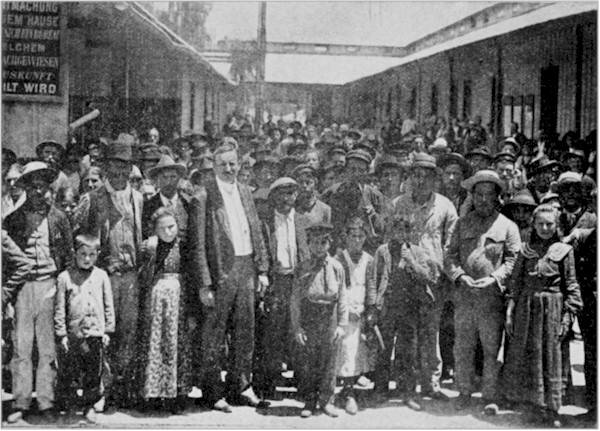
Immigrants Hotel in Buenos Aires Group of immigrants
FREE LODGING
Arriving at the Hotel, the names of the immigrants are entered in the Hotel register and they are given a lodging ticket valid for five days, which can be prolonged in case of sickness. The immigrants are comfortably lodged, the women and children in separate rooms to the men. The baggage is taken by the Hotel porters to a deposit where it is revised by the Custom House Officers, specially.
FREE BOARD
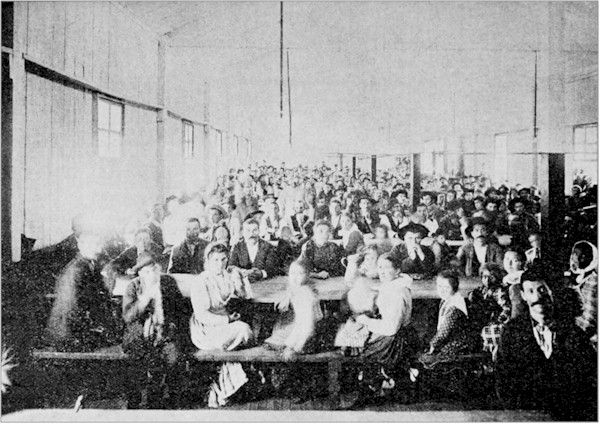
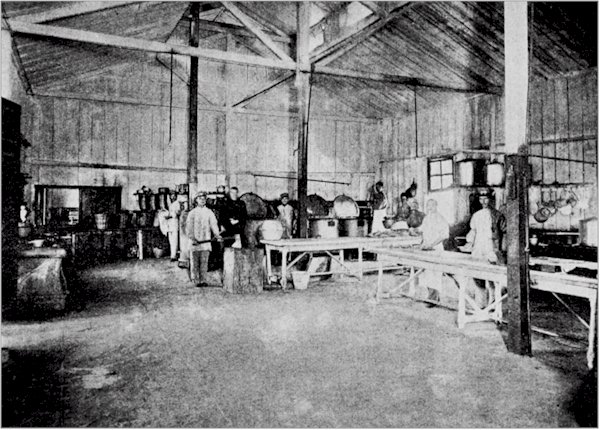
The rations given to the immigrants are of the best, and in the following proportions per day, per adult: meat 600 grams, bread 500 grams, potatoes, carrots or cabbage (alternately) 150; rice, maccaroni, or beans (alternately) 100; sugar 25 and coffee 10 grams; milk is given to the children. The food is cooked by steam and is served by the Hotel attendants in a large dining room.
MEDICAL ATTENDANCE
There is an Infirmary in the Hotel where patients are carefully attended; children as well as adults can be vaccinated. There is a staff of doctors, students, sicknurses, and a chemist’s fully equiped with medicines and disinfectants.
GOVERNMENT EMPLOYMENT OFFICE
On arrival, the immigrants are questioned as to what part of the country they wish to go, and are offered work by the Employment Office, in accordance with the inquiries for workmen received, full information of which, of wages paid and other conditions are carefully entered up in books kept for that purpose. If there are no enquiries for workmen in the particular trade of an immigrant looking for employment, this Office undertakes to find him work by either directing him to Works and Factories or by telegraphing enquiries to the Interior. Immigrants are warned, should they wish to go to any part of the country where there is no opening for one in their trade.
No persuasion is used to induce immigrants to go to any particular part of the country, it is left to them to decide.
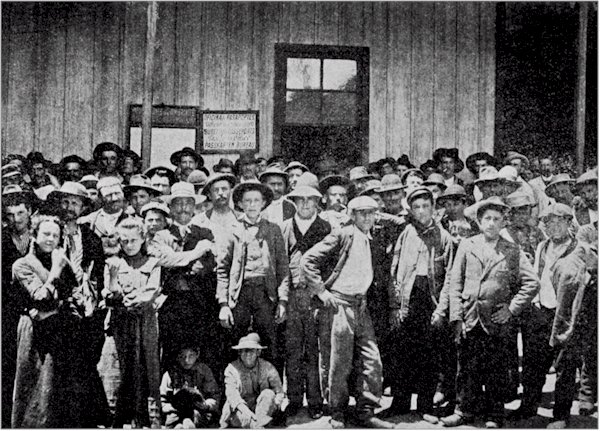
Immigrants Hotel in Buenos Aires Group of immigrants
FORWARDING AND RECEIVING FREE
The immigrants placed up country or who wish to join their relations, are taken care of by forwarding Agents who remit their luggage properly labeled, note down the immigrants so forwarded, provide them with tickets and see them on to the train or river steamers.
ARRIVING AT THE PROVINCES AND POINTS OF DESTINATION
The immigrants who go to the Provinces or National Territories to be settled, are met on arrival of the train by the Secretary of the Branch Office, boarded and lodged for ten days until they are settled or leave for some fixed destination. If they should have to change trains, they are looked after by this Official in the same way as in the Federal Capital, from the arrival of one train until the departure of the one in which they continue their journey.
POST AND TELEGRAPH OFFICE
For the better handing of the immigrants correspondence and in order that the Head Office and National Employment Office can transmit without delay, orders and instructions all over the Republic, there is a Post and Telegraph Office in the Immigration Hotel.
STATISTICAL RETURNS
The four following returns, summarize the Argentine Immigration movement from 1857 to 1903.
In those relating to the entry and nationality of immigrants, the information corresponding to the years running from 1857 to 1903 is given, and in those which refer to their trades and forwarding to the interior, the information has been taken corresponding to the last decade, this lapse of time being sufficiently demonstrative
Immigrants Hotel in Buenos Aires Part of the dining-hall
IMMIGRANTS PLACED AND FORWARDED TO THE INTERIOR OF THE COUNTRY BY THE NATIONAL LABOUR OFFICE DURING THE LAST DECADE FROM 1894 TO 1903.
Provinces and Territories 1894 1895 1896 1897 1898 1899 1900 1901 1902 1903 Total
Federal Capital 545 683 1.209 589 876 1.736 3.077 2.739 635 449 12.538
Buenos Aires 3.071 4.212 12.028 8.471 7.503 9.991 10.213 12.982 9.828 13.447 91.746
Entre Rios 2.345 2.129 814 1.190 1.184 1.575 1.456 1.151 677 317 12.838
Corrientes 101 115 114 455 293 194 117 225 118 46 1.778
Santa Fé 11.801 10.143 13.077 6.273 6.577 9.647 9.336 12.628 7.440 10.115 97.037
Córdoba 2.413 2.198 2.995 1.958 2.659 3.951 3.581 4.002 1.768 2.973 28.498
Tucumán 802 387 898 1.173 456 514 590 1.576 366 366 7.128
Santiago del Estero 76 51 291 149 165 141 99 132 82 73 1.259
Salta 19 36 47 237 345 224 94 76 31 61 1.170
JuJuy 18 10 104 38 17 69 41 273 72 216 858
Catamarca 11 29 19 16 8 14 14 35 10 5 161
La Rioja — 25 12 20 14 43 22 20 28 25 209
San Luis 46 91 183 207 95 129 129 159 124 76 1.239
Mendoza 566 665 1.973 2.569 1.365 1.695 2.183 4.160 1.521 757 17.454
San Juan 137 155 270 390 252 269 354 190 155 82 2.254
Chaco 34 6 20 105 112 21 24 41 27 12 402
Misiones 30 13 7 72 254 509 1.136 1.738 1.083 81 4.923
Tierra del Fuego — 16 54 41 19 8 9 17 7 17 188
Chubut 11 25 10 84 22 13 56 75 153 239 688
Santa Cruz 11 1 40 44 18 24 54 85 59 54 390
Formosa 47 5 13 116 50 16 20 35 25 1 328
Pampa Central 7 17 63 160 93 117 145 181 173 349 1.305
Río Negro 1 — 55 293 69 34 42 198 73 63 828
Neuquen — — 27 13 — 16 17 29 39 11 152
22.092 21.012 34.323 24.663 22.446 30.950 32.809 42.747 24.494 29.835 285.371
Immigrants Hotel in Buenos Aires Part of the kitchen
IMMIGRATION FROM COUNTRIES BEYOND THE SEA AND MONTEVIDEO 1857 to 1903.
Years Countries beyond the sea Montevideo Total
1857 4.951 4.951
1858 4.658 4.658
1859 4.735 4.735
1860 5.656 5.656
1861 6.301 6.301
1862 6.716 6.716
1863 10.408 10.408
1864 11.682 11.682
1865 11.767 11.767
1866 13.696 13.696
1867 13.225 3.821 17.046
1868 25.919 3.315 29.234
1869 28.958 8.976 37.934
1870 30.898 9.069 39.967
1871 14.626 6.307 20.933
1872 26.208 10.829 37.037
1873 48.382 27.950 76.332
1874 40.674 27.603 68.277
1875 18.532 23.534 42.066
1876 14.532 16.433 30.965
1877 14.675 21.650 36.325
1878 23.624 19.334 42.958
1879 32.717 22.438 55.155
1880 26.643 15.008 41.651
1881 31.431 16.053 47.484
1882 41.041 10.462 51.503
1883 52.472 10.771 63.243
1884 49.623 28.182 77.805
1885 80.618 28.104 108.722
1886 65.655 27.461 93.116
1887 98.898 21.944 120.842
1888 (a) 130.271 25.361 155.632
1889 (a) 218.744 42.165 260.909
1890 (a) 77.815 32.779 110.594
1891 28.266 23.831 52.097
1892 39.973 33.321 73.294
1893 52.067 32.353 84.420
1894 54.720 25.951 80.671
1895 61.226 19.762 80.988
1896 102.673 32.532 135.205
1897 72.978 32.165 105.143
1898 67.130 28.060 95.190
1899 84.442 26.641 111.083
1900 84.851 21.051 105.902
1901 90.127 35.824 125.951
1902 57.992 38.088 96.080
1903 75.227 37.444 112.671
2.158.423 846.572 3.004.995
(a)—With assisted passages.
General Total (including first class passengers) 3.685.430.
TRADES OF FOREIGN IMMIGRANTS, IN THE LAST TEN YEARS, FROM 1894 TO 1903.
Agriculturers 312.723 Workmen 118.223
Masons 8.500 Gardeners 923
Upper cutters 898 Brickmakers 262
Surveyors 16 Lithographers 37
Architects 12 Marble-cutters 59
Fitters 81 Sailors 7.739
Sawers 127 Engine drivers 445
Barbers 1.332 Mechanics 2.113
Coal-men 99 Milliners 6.051
Butchers 725 Millers 605
Carpenters 7.142 Musicians 796
Coppersmiths 439 Miners 1.272
Cooks (male, female) 9.265 Physicians 41
Confectioners 500 Furniture makers 92
Merchants 30.996 Bakers 2.382
Dressmakers 28.194 Stone cutters 1.208
Tanners 691 Painters 926
Coachmen 149 Laundresses 8.749
Calkers 54 Fishermen 112
Quarry-men 255 Teachers 12
Clerks 10.755 Watchmakers 372
Gilders 99 Tailors 4.985
Draftsmen 41 Without trade (children) 113.433
Joiners 604 Without trade (women) 8.111
Electricians 711 Servants (male, female) 28.450
Bookbinders 77 Hatters 501
Sculptors 43 Weavers (male, female) 6.546
Firemen 793 Typographers 481
Apothecaries 352 Coopers 316
Photographers 65 Turners 103
Cattle breeders 690 Dyers 62
Engravers 113 Harness makers 133
Glovers 76 Viner, winemakers 403
Smiths 3.546 Veterinaries 33
Tinsmiths 548 Plasterers 100
Printers 38 Shoemakers 6.094
Engineers 17 Other trades 8.430
751.366
Transcriber’s Note: To make the following table easier to read on the screen it has been transposed to show Years as column headings and Nationalities as row headings.
NATIONALITY OF IMMIGRANTS FROM COUNTRIES BEYOND THE SEA, EXCLUSIVELY, from 1857 to 1903.
Years 1857-59 1860-69 1870-79 1880-89 1890-99 1900 1901 1902 1903 Total
Italians 9.006 93.802 156.746 475.179 411.674 52.143 58.314 32.314 42.358 1.331.536
Spaniards 2.440 20.169 44.802 148.394 124.891 20.383 18.066 13.911 21.917 414.973
French 720 6.360 32.938 78.914 40.544 3.160 2.788 2.378 2.491 170.293
Austrians 226 819 3.469 16.479 8.681 2.024 2.742 2.135 1.378 37.953
English 359 3.603 9.265 15.692 4.691 421 439 405 560 35.435
Germans 178 1.212 3.522 12.958 9.204 760 836 1.029 1.000 30.699
Russians 3.837 15.665 2.119 2.086 1.753 1.429 26.889
Swiss 219 1.562 6.203 11.659 4.875 355 363 267 272 25.775
Belgians 68 519 628 15.096 2.654 117 117 148 174 19.521
Dutch 4.303 675 43 35 37 72 5.165
Portuguese 1.751 1.612 205 156 141 202 4.067
Danes 1.097 1.230 121 175 187 139 2.949
North Americans 1.094 794 89 151 132 93 2.353
Swedes 613 441 10 18 21 24 1.127
Others 1.128 6.282 7.295 8.330 13.659 2.901 3.841 3.134 3.118 49.688
14.344 134.328 264.868 795.396 641.290 84.851 90.127 57.992 75.227 2.158.423