Chapter XII · POINTS—THEIR RELATIVE IMPORTANCE, AND WHERE TO LOOK FOR THEIR DEVELOPMENT. (continued 2)
Reading edition
Before purchase, the hair on the inner side of the legs should be carefully examined. If a cicatrix or a bare spot is discovered near to the seat of cutting; if any paint or coloring matter can be detected upon the part; or if the hair does not lie perfectly smooth upon the place of injury,—have nothing to do with the animal. It is quite true that most fresh and nearly all young horses will cut—others strike only toward the end of a long journey; but it is also true that particular horses, however fresh or however tired they may be, never strike or cut. The quadruped which a gentleman desires, is one that does not contain evidences of a liability to accident or to disease. He wishes for a sound animal; and one disposed to strike certainly cannot, in the author’s opinion, be so esteemed. Every man wants a horse for service; but the creature which may at any moment receive a wound that shall incapacitate, assuredly cannot be esteemed a serviceable possession, in any meaning of the words.
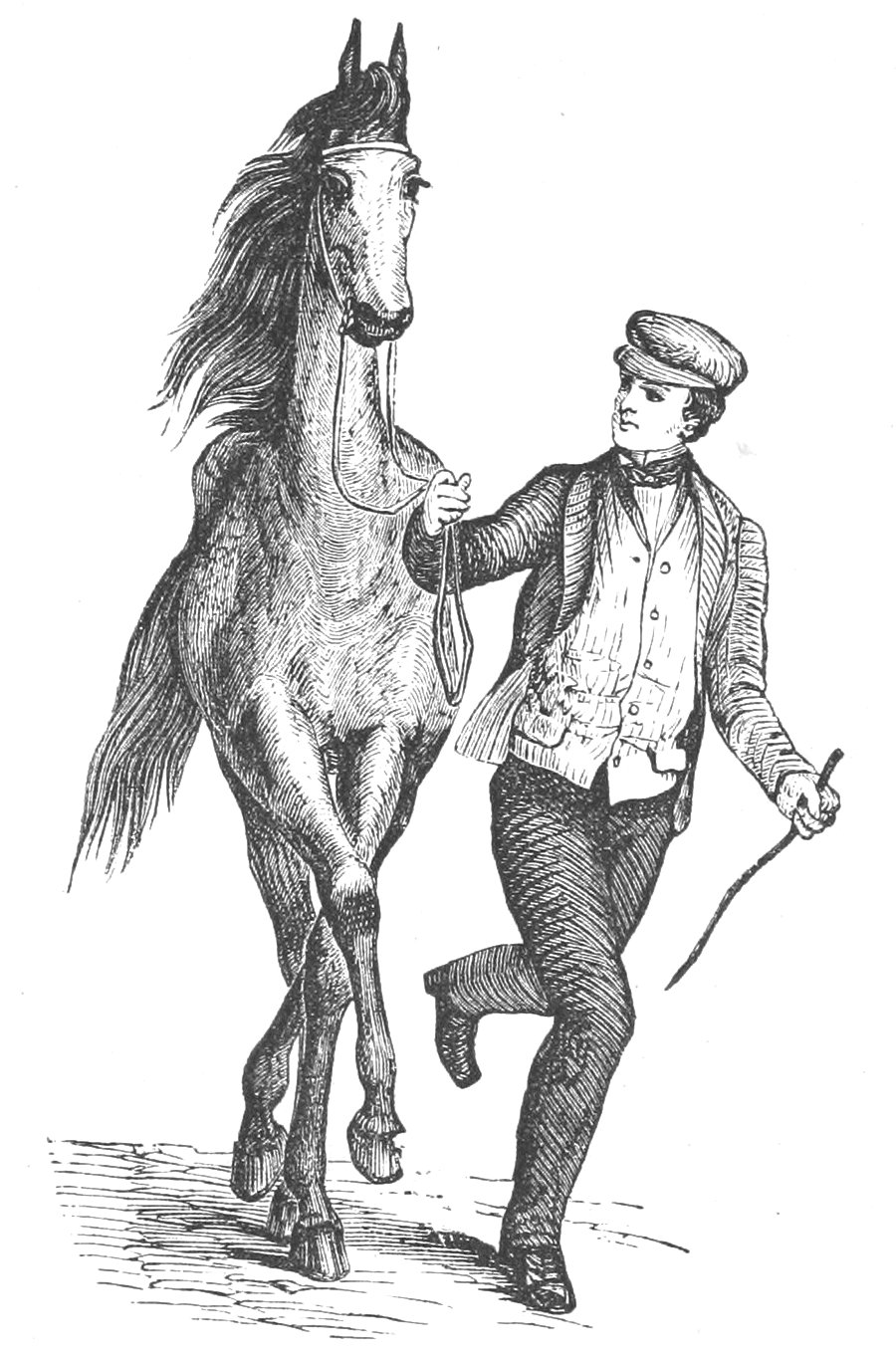
AN EXAGGERATED VIEW OF A WEAK ANIMAL, WITH DANGEROUS ACTION.
While examining the legs, the gentleman should also notice the shoes upon the different feet. If these are rusty, the fact demonstrates that the horse has been wearing wet swabs, and has been long stationary in the stable. The circumstance is suspicious. In horse dealing a justifiable suspicion is always acted upon as an established fact. If the shoes are of rude make and much worn, it looks badly; and though it is no recommendation, it justifies no inference. But if the shoes be thicker at one part than at another; if the horse, being a nag, should wear very high calkins; if the toe be shortened, or one side of the metal is obviously narrowed,—it denotes precautions against clicking and against overreaching: the first being a most audible annoyance, which may lead to the forcible tearing away a fore shoe; and the last causing a fearful, a terrible, and an incapacitating wound upon the heel of the foreleg. Also, should the toe of the hind shoe be ground down, while the heel exhibits no obvious wear, the fact demonstrates the existence of a spavin. Either clicking, overreaching, or spavin is legitimate cause for rejection.
The reader, from a perusal of the foregoing remarks, will comprehend a few of the difficulties which beset the purchaser of a horse; and these may warn him, in some measure, of the dangers that surround a person so engaged. The author is a veterinary surgeon, of some experience; but he would be very sorry to buy a steed for himself upon his unsupported opinion. He would always have the animal examined by a professional man ere the purchase was concluded. How greatly, therefore, must the general public stand in need of such protection! Especially when the known hazard of the transaction and the confusion necessarily accompanying a direct personal interest in the business help to confound the intellect and to overpower the judgment!
All persons complain of the roguery that is mixed up with horse dealing. The complaint is just; but it is not just that the public should vent it. It is the general abuse and the inhuman treatment to which animal life is subjected that renders such practices necessary. The cruelty and the roguery are associated as closely as cause and effect. Let the provocative be discarded, and its result, of course, must cease. But no man should blame the conduct which his own deeds have willfully generated. To hurt and to injure a patient and an obedient animal is a positive sin,—a violation of the trust confided by the Creator to the creature. To defraud, in a money transaction, is simply a crime,—an offense committed upon the laws by man established over man. Then, what right has he who violates one of the ordinizations of nature, to point at and to sigh over the person who merely breaks a human institution?
Christianity, if its benefits were exemplified in man’s actions toward the creatures living under his dominion, would immediately operate upon society. The horse, under better treatment, would of course not be liable to those injuries and accidents which roguery in the dealer merely endeavors to conceal. There would be no occasion for cheating when the creature exhibited no scar or defect which the seller was interested to hide or to deny. Thus one stain upon the present civilization would be abolished; for, notwithstanding the numerous assertions to the contrary, the author has yet to see the man who practiced dishonesty from a sheer love of iniquity.
The well-to-do may lament the immorality of the class below them; but if gentility would look less leniently upon itself, probably the exhibition of crime might be viewed as no more than the apex of a pyramid whose base is deeply planted in the frailties which are common to general society.