“Lions in Their Dens.”
Reading edition
J. L. TOOLE. By Raymond Blathwayt. Illustrations by Louis Gunnis. (Photographs by Messrs. Fradelle & Young, and Falk, of Sydney.)
mr. toole in "the steeplechase."
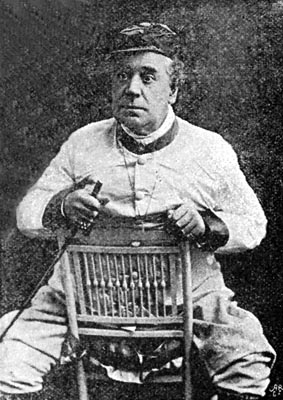
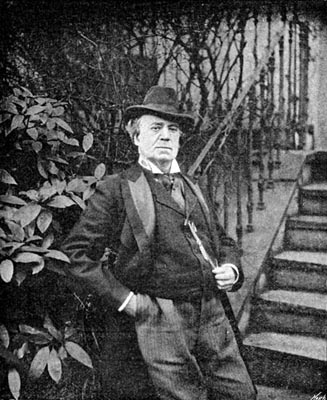
Every one who writes an article upon Mr. Toole begins by telling his readers how entirely lovable a man he is, and I do not know why I should differ from every one else, for, in this case at all events, what every one says is true. There are few actors, either in the past or present, who have so thoroughly succeeded in placing themselves upon a footing of the most friendly and cordial nature with their audience as Mr. John Lawrence Toole. And not only has he succeeded in establishing such relations between himself and his audience, but he has been to the full as successful in endowing the characters he has undertaken with those same lovable qualities which have endeared him both to the public and to his own private friends. Few actors so entirely breathe into their parts the very spirit of their nature and essence of their being as Mr. Toole breathes into his. With high and low, rich and old, young and poor alike, he is a never-failing favourite, and the moment his kindly face appears upon the stage, and the familiar voice once again awakens the memories of bygone years, a burst of affectionate applause breaks out in welcome of the dear old favourite of our English stage. No matter where a man has been; in the Great Republic over the water, or in the burning lands of India, or in the New World under our feet; when he returns, after years of absence, to the old country, and the familiar faces have passed away, and all things have become new, yet there is still one face that is the same, one voice in which there is still the old familiar ring, and to many such a wanderer old “Johnny Toole” becomes the one connecting line between the dear old past and the cold new present. And who does not know the aspect of the man himself—the short, sturdy figure, the slight limp in his walk, the kind, pleasant face with the mobile mouth and the eyeglass screwed in the smiling eye, and the hair, now sprinkled with grey, brushed back from the broad open forehead? The genial, pleasant manner, the entire ease of the man, and the utter absence of all that detestable putting on of “side” which is too often characteristic of the young actor of the present day, how all these things go towards the explanation of his universal popularity!
mr. toole's house.
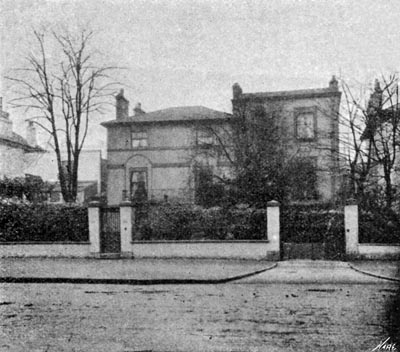
A great sorrow has overshadowed the latter years of his life, a sorrow from which he will never shake himself free, but which has only deepened the tenderness of the nature which is so characteristic of the man. I spent a morning with him very recently in his house at Maida Vale. As he entered the room and I asked him how he was, he replied, “Oh, well, I am pretty middling, thanks; an actor’s is such a hard life, you know,” he went on, confidentially, as he pushed me into a chair and took one himself upon the opposite side of the hearthrug. “I have just been reading a whole bundle of manuscript plays, and you never saw such rubbish in your life.
"i can't lay my hands on 'em."
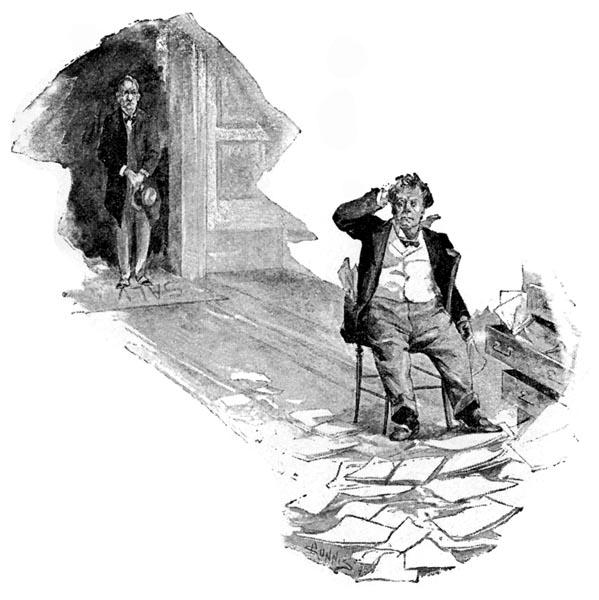
And then”—he went on, plaintively enough—“I lose the things, you know; put ’em into a drawer, or with a lot of other manuscripts and papers, and I can’t lay my hands on ’em when they are sent for, and then, oh, goodness! there’s the deuce and all to pay; for I can assure you that no mother thinks more of her first-born baby than a young author thinks of his first play, and if you are not of the same opinion he regards you as the biggest idiot in the world.” “Well, but,” I ventured to remark—“why on earth do you bother about the things?” “Oh, well,” said he—“you know I can’t help myself; you never can get away from them. For instance, I go out to a harmless evening party, and a country parson comes up to me, the most unlikely man in all the world, you’d think, and he’ll say to me, ‘My brother has just written a play, Mr. Toole; I wish you’d just cast your eye over it.’ And I can’t say No, Mr. Blathwayt, I can’t say No. Well, now you’re here,” he went on after a moment, “you’ll like to have a look round, won’t you? I’ve got lots of interesting things here. Come into what I call my study—although,” continued he, with a laugh, “I am afraid I don’t get through much study. I am too busy to write, you know,” he rambled on in a voice and manner that was amusingly reminiscent of “Walker London.” So into the study we went, encountering on our way a big Australian black bird, which was wandering about the house in an aimless and irresponsible fashion, crooning to itself memories of its Antipodean home. Before we entered the study, Mr. Toole drew my attention to a beautiful model of the picturesque old Maypole Inn in “Barnaby Rudge,” with a number of the characters in the novel wandering about in front of the house.
mr. toole and his "raven."
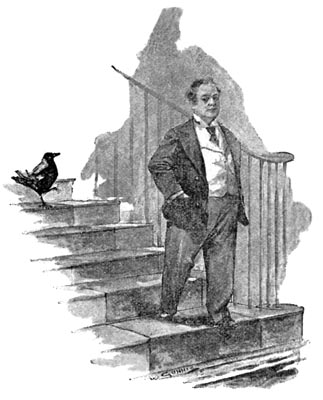
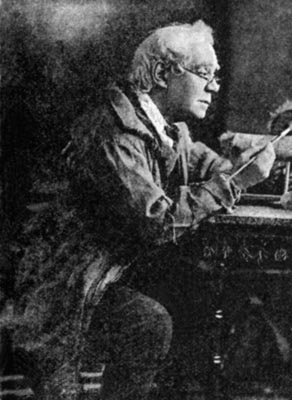
mr. j. l. toole.
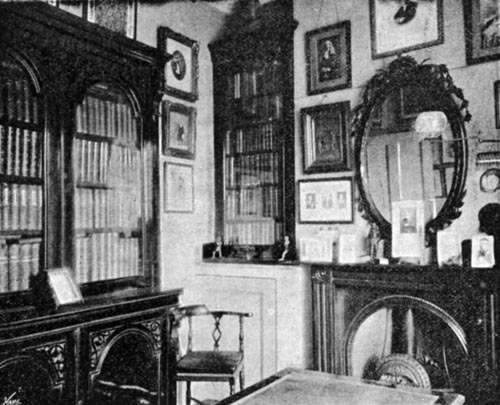
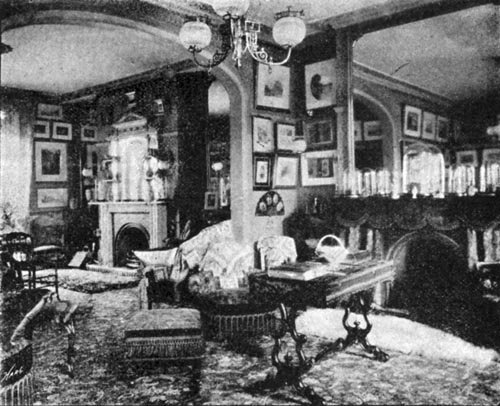
There was Barnaby Rudge himself, there was his supernaturally wicked old raven; old Joe Willet, the landlord, stood smoking in his shirt-sleeves, while pretty Dolly Varden herself was tripping down to town. “There,” said my host, “isn’t that clever? It stood for many years at the ‘Hen and Chickens’ in Birmingham, and Dickens used to admire it very much when he used to visit that town on his reading tours.” Two little Japanese figures, reposing upon the top of the case which contained this model, looked down upon Mr. Toole as he stood beneath them. He set their arms and heads moving, observing, as he did so, “Often, when I am studying a part, I set those little figures going, they do for the public applauding.” In the study itself, the walls were thickly hung with pictorial reminiscences—chiefly of the theatrical past. There were portraits of Macready in character, with his small, neat writing beneath; there was Charles Matthews in some character as a boy, and a portrait of old John Reeve, a celebrated comedian in his day; there was Mr. Toole as Paw Clawdian; there was Liston as Paul Pry; there were any amount of portraits of his dear old friend Henry Irving. I was much interested in an old theatrical bill of 1813 announcing Edmund Kean’s appearance as Hamlet. And then Mr. Toole brought in a large framed letter which hung up in the hall. It was a letter from Thackeray to Charles Matthews when he was lessee of Covent Garden Theatre, and it was written on the occasion of the Queen’s first state visit to Covent Garden after her marriage in 1840.
the hall.
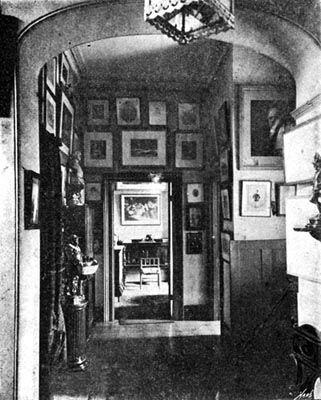
A pen and ink sketch by Thackeray adorned a large half of the page, in which he had represented Her Majesty with an enormous crown upon her head, and two or three queer sceptres in her hand, talking to the Prince Consort, who sat with her in the royal box, in the rear of which stood the members of the royal suite. In another corner of the hall there hung a letter, carefully framed, which bore the signature of “Nelson and Brontë,” and close beside it there was a clever pencil sketch by George Cruikshank, representing a London ’bus full of people of that period, and with the price, one shilling, marked up in large figures outside it—a curious glimpse of bygone days. In Mr. Toole’s dining room we found that clever lady artist, Folkard, who some time ago painted so faithful a likeness of old Mrs. Keeley, engaged in giving the finishing touches to an equally admirable portrait of my genial host himself.
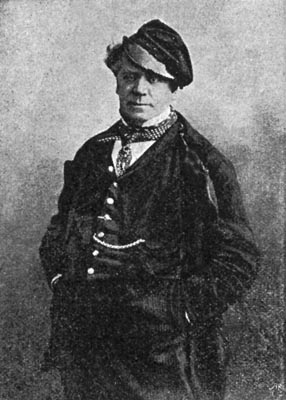
mr. toole in "artful cards."
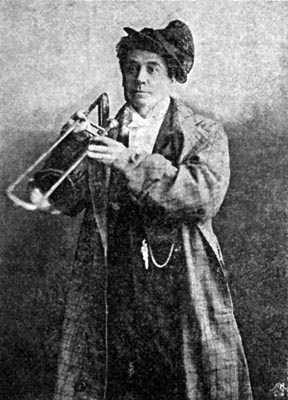
The dining room, no less than the other room, was crammed with “virtuous and bigoted articles.” There was some beautiful old china which had once belonged to Charles Dickens, and some handsome ivory elephants which Mr. Toole had brought with him from Columbo stood upon the sideboard. A very lovely oil painting by Keeley Halswelle, not in the least in his usual style, represented a far stretch of country, over the blue sky of which vast cumuli were massing themselves in snowy piles. There was a portrait, by Clint, of Stephen Kemble, who, like Mark Lemon, used to play Falstaff without padding. A painting of Joseph Jefferson, the celebrated American Rip Van Winkle, reminded me of a splendid picture of his which I always used to admire so much in the “Players’ Club” in New York, and I observed, as Mr. Toole pointed out a clever sketch by Mr. Weedon Grossmith, that it was curious to notice how many actors were also good painters. “Why, yes,” replied Toole with a quizzical smile, “I have painted a good many years myself.” “Oh, indeed,” said I—not immediately catching his meaning—“may I ask what you have painted?” “My face,” said he, with an amused chuckle of much enjoyment at having caught me.
mr. toole and his japanese audience.
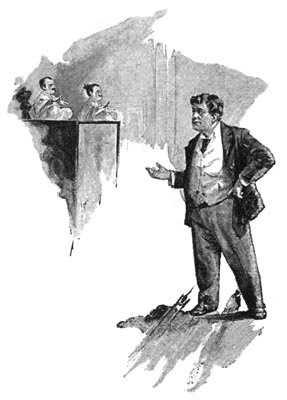
mr. toole in "off the line."
Mr. Toole then pointed out to me James Wallack, the father of the celebrated American actor, Lester Wallack, in his favourite character of The Brigand. “Ah!” said Mr. Toole, “that reminds me of an anecdote that’s told about James Wallack, and which ought to be a warning to actors never to make speeches from the stage. Wallack was playing The Brigand one night, and he was in the midst of his great dying scene, when an old gentleman, who was sitting in the stalls, got up and put on his hat, tied a scarf round his neck, and buttoned up his coat with great deliberation. Wallack got very irritated, and just as the old gentleman was going out, he called out to him, ‘The piece is not finished yet, sir.’ The old gentleman, who was not in the least disconcerted, replied, ‘Thank you, Mr. Wallack, I have seen quite enough.’”
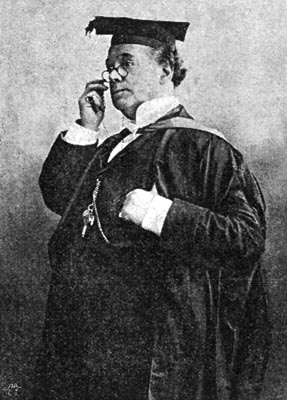
mr. toole as "the don."
When we returned to the drawing room, into which I had first been shown, having specially noted on my way through the hall Keeley Halswelle’s sketch of Mr. Toole as The Artful Dodger in 1854, and a few pages from Thackeray’s MSS. of “Philip” which hung upon the wall, Mr. Toole took out an enormous photographic album which contained the portraits of all the celebrities, big and little—and some of them were very big indeed, and some of them were very small—who had been present at a great banquet which was given in Mr. Toole’s honour before he left England for his Australian tour. Everyone was there—noblemen, journalists, and actors; legal luminaries and ecclesiastical dignitaries, people of social prominence and scientific fame; all the principal figures, indeed, that go to the making of this vast body politic. “I told a gentleman on board ship,” humorously remarked Mr. Toole, “that these were all the members of my company. I don’t know if he believed me or not.” Then came albums full of autographs, old playbills, portraits of celebrated actors long since crumbled into the dust, letters the writing of which was fast fading away, a characteristic letter from Charles Dickens acknowledging a beautiful paper knife which Toole had sent him.
One of the letters which Mr. Toole most prizes, and the prayer of which, with Mr. Hollingshead’s assistance, he was delighted to grant, is the following characteristic epistle:—
“Belle Vue Mansions, Brighton, August 6th, 1873.
“My dear Toole,—Were you ever in a mess? If you never were I can explain it to you, having been in several; indeed, I don’t mind confessing to you that I am in one now, and, strange to say, you are perhaps the only man who can get me out of it. You need not button up your pockets, it isn’t a pecuniary one. Only fancy! after thirty years’ practice and experience I have made a mistake in my dates, and for the first time in my life find myself engaged to two managers at the same time. Now, they say a man cannot serve two masters, but I can if they will come one after the other, only one at a time, one down, t’other come on; but to play at Bristol and the Gaiety on the same night (and keep it up for a week) I don’t see my way to accomplish. In a moment of enthusiasm I engaged to begin with Chute on September 29th, and I had scarcely done so when Hollingshead reminded me that I was booked to begin with him on that date, and that it could not be altered. Conceive my dismay. Chute holds fast—‘can’t be altered.’ So does Hollingshead—‘can’t be altered.’ Now, Toole—dear Toole, beloved Toole—can’t you stay a week longer at the Gaiety? Can’t you let me begin there on Monday, October 6th (as I thought I did), and get me out of my dilemma? Can’t you make this sacrifice to friendship, and put three or four hundred more into your pocket? Virtue is not its own reward, but an extra week of fine business is. Now, Toole—adored Tooley—the best of men—first of comedians—most amiable of your sex—burst into tears—throw your arms and sob out, ‘Do with me as thou wilt—play me another week—pay me another three hundred, and be happy.’ Breathless with anxiety, yet swelling with hope, I must await your answer. Pity the sorrows of a poor old man, and even telegraph ‘Yes,’ rather than keep me in suspense. What’s a week to an able-bodied low comedian? Child’s play! Why, you’ll be wanting to throw in morning performances as well to keep you from rusting. It really is a chance for you. Avail yourself of it and bless me, and I’ll bless you, and Hollingshead will bless us both, and Chute will bless us all.
“With my intermediate blessing, ever faithfully yours,
“C. J. Matthews.”
mr. toole as "ibsen."
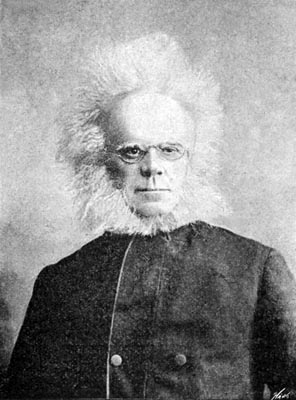
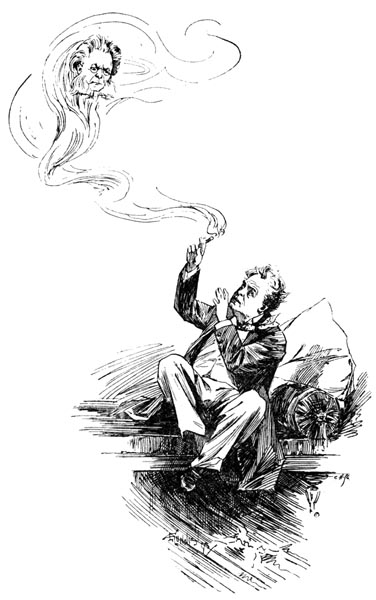
This letter Mr. Toole read to me, exactly mimicking the tone and manner of his old friend whom he still misses. I laughed heartily. “Well, now, Mr. Toole,” said I, as we settled down for a conversation on the art he loves so well and has served so faithfully, “has the public taste altered much since you first started in your theatrical career?” “No,” he replied, “upon my word I don’t think it has very much. My dear old friend Irving, however, has effected as great a change as any man, and his influence has always been for good.” “And what of the other Henry?” said I, “Hendrik Ibsen?” “Henry Gibson?” said Toole, looking up; “why, I never heard of him.” “No! Ibsen,” I explained, “Ibsen,” smiling as I mentally contrasted the great Norwegian physiologist and social Reformer, and the simple-minded, homely, old-fashioned Englishman whom we all love so well. “Oh! Ibsen, Ibsen,” said Mr. Toole, “I didn’t catch what you said; I thought you said Gibson, and I couldn’t think who on earth you meant. Well,” he said, “I don’t like his work myself. It’s so unwholesome, you know. It seems to me such a vitiated taste. They put it down to my ignorance; but if you ask me what I think,” he went on confidentially, “I should say there are very few who really care about him. He happens to be the fashion just at present. I played Ibsen in ‘Ibsen’s Ghost,’” he continued, “and they said it was a beautiful make-up. I don’t know what the old gentleman would have thought of it himself. Have you seen Irving’s Lear?” he suddenly remarked, after a moment of silence. “I can remember many Lears, but I have never seen anything like his. I have been tremendously moved by it; but it is far too great a strain for him.”
toole and ibsen.
Mr. Toole then drifted into eulogy of his almost life-long friend, upon whose generosity and the beauty of whose character he never wearies of expatiating. “And how do you think the comedy of to-day compares with that of past years, Mr. Toole?” said I. “Oh, well,” he replied; “I don’t think things have altered much. It is true that there was a great gap when Keeley, Buxton, Benjamin Webster, Sothern, and Charles Matthews all passed away within a few years of each other. But we’ve lots of good comedians now, to say nothing of the vast increase in the number of theatres, which, of course, gives far more opportunities to new men than was the case in my early days. For my own part, though I almost invariably play low comedy parts, yet, as a rule, I prefer pathos, I think.” And, as he spoke, Mr. Toole handed me a photograph which represented him in that very pathetic character Caleb Plummer in “Dot.” “There,” said he, “that’s one of my favourite characters, but people come to see me for fun, they don’t look much for pathos in me, except, perhaps, in the provinces. Ah! I like the provinces,” he continued. “I have many friends in them. The Scotch are a splendid people to play to, but then English people, by which I mean English and Scotch alike, are very clannish, and very tender to an old friend. I always feel when I appear upon the stage that I am in the presence of friends.
mr. toole as caleb plummer in "dot."
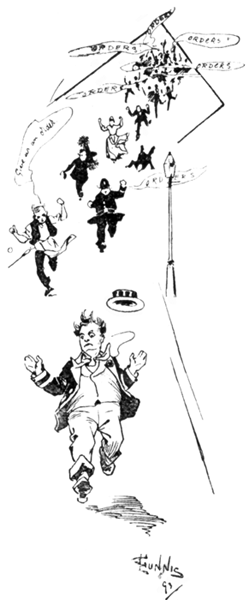
I don’t think that French actors are so much regarded as English actors. We feel the affection of our people so much. But, then, we go in and out as private friends amongst the people, more than the Frenchmen do. Their best actors go out to a party, and they act for money, just as they would in the theatre. I think that is very infra dig. myself. It seems to me that as soon as the curtain is down the actor’s work is over for the night, and when you go out to a man’s party you are his guest, but you cease to be so if you take his money. With singers, however, the case is quite different. Some say I am over fastidious, but, mind you,” went on Mr. Toole, very earnestly, “I think it would be very snobbish not to join in the fun that is going on as a friend, and help to make everything go pleasantly. As a rule, however, I consider that on this account the English actor’s social position is higher than that of a French actor. You ask me about criticism,” said Mr. Toole a little later, as we wandered on through different fields of thought, over our wine and cigars. “Well,” he continued, “it is very difficult to say whether it has improved or not during late years. In the old days, you know, we had some very good men; there was Oxenford, there was Bayle Bernard, there was Laman Blanchard, all very good men indeed. In the present day, Clement Scott is exceedingly clever, of course; but some of the young men are too much up in the clouds for me—they are very smart, I daresay, but I don’t know what they’re driving at, you know; all the same, I don’t think criticism has any more influence than it had of old, in some cases not so much.” And then, branching off on another line, Mr. Toole said—“Did you notice those remarks in the paper the other day about Fanny Kemble’s father, and how he came to grief as a theatrical manager? I smiled when I read them. I knew well enough how it was; it was that infamous ‘order’ system. Kemble actually gave 11,000 orders in one season. It’s altogether a rotten, bad system. Hundreds apply to me every week for orders who haven’t the slightest claim upon me, and especially wealthy people, who are invariably the greatest offenders in this respect, and yet, when they are refused orders, they at once book seats for the play.
the library.
Of course there are certain people who are thoroughly entitled to orders, and I am only too glad to give them in such cases, but I draw the line at giving them to any one who chooses to ask me. I can’t go into a restaurant and get a dinner for nothing—I wish I could; a tailor won’t make me a coat for nothing—why should I play to people for nothing? They cannot have any idea how much it costs to keep up a theatre, or perhaps they’d have a little more consideration for one. It’s a rotten, bad system, and it ought to be done away with.” Later on in the evening Mr. Toole and I drove down to the theatre together, and we resumed our conversation in his very interesting little dressing-room. I congratulated him on the long run which “Walker London” was having; “but don’t long runs tend to artificiality?” I asked.
it's a rotten system.
“No,” said Mr. Toole; “a new audience every evening saves you from that, to a great extent, especially with an earnest man. Earnestness is everything in an actor, but if you’re apathetic you’re lost. Still, I sometimes look at Paul Pry’s umbrella,” continued Mr. Toole, pointing to the quaint, queer, green old article that answered to that description, and which stood by itself in a corner of the room, “and wish I could play Paul Pry again, but I don’t see much chance of that at present. Why, it will soon be ‘Walker’s’ first birthday. I suppose they’ll want me to make a speech. And speech-making always bothers me, for I am very nervous.
mr. toole in his dressing room.
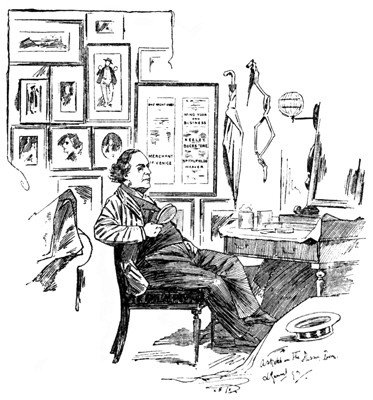
But I daresay I shall ‘gammon’ through somehow.” I observed, “Well, I must say you ‘gammon’ through very well, for I always think you are one of the easiest speakers of the day.” To which Mr. Toole replied, “Well, for my part, I think repose is everything. Quiet humour is always much more telling than noisy fun, and to feel your part deeply is far more than mere elocution.” “Do you think that the training that young people on the stage get, now-a-days, is as thorough as it was in your early days, Mr. Toole?” “Well,” he said, “I don’t think that young actors get so much practice as they did in the old days when Irving and I used to be for years together on a stock company in Edinburgh. He and I and Helen Faucit have played all the parts in Shakespeare together. But travelling companies have altered all that now-a-days. Still I think I must say that I’ve got a very fairly good répertoire for my people. Did you ever hear how I took to the stage?” he continued. “I used to be clerk in a wine merchant’s office, and I was also a member of the City Histrionic Club.
Well, one night I went to the Pavilion; one of the actors who used to give imitations of popular favourites didn’t turn up, and so I was persuaded by a man, who knew that I had been in the habit of giving imitations myself to our little club, to take his place. It was then that I first tasted the sweets of an actor’s life. It was then I resolved to quit the merchant’s desk for the stage. Do you see that playbill?” he continued, pointing up to an old time-stained paper which hung upon the wall.
the dining room.
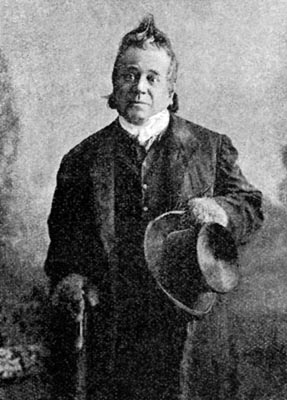
mr. toole as "rev. aminadab sleek."
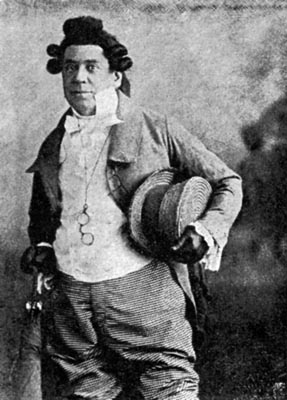
mr. toole as "paul pry."
“There,” said he, “that’s the first time my name ever appeared on a London playbill. I appeared on that occasion for ‘one night only’ at the Haymarket Theatre, where a benefit was being given for Mr. Fred Webster, in July, 1852.” I glanced round the little room, in which are gathered so many memories of the picturesque past, and in which so many of the best known men of the present day are so frequently to be found having a chat with “Dear Old Johnny Toole.” There was an amusing photograph of Toole up to his waist in a hot lake in New Zealand surrounded by a number of Maoris. There was a portrait of himself in his first part in “My Friend the Major.” Charles Matthews, in “My Awful Dad,” smiled across the room at Paul Bedford and Toole, who were standing within a picture frame together. There was a quaint old coloured print representing Grimaldi—for whom Mr. Toole has a great admiration, and whose snuff-box he regards as quite a treasure—in private life, and in his clown’s costume. But to enumerate further the interesting pictures that hang upon the walls of his little dressing-room would be to far exceed my allotted space. I happened on the following night to be delivering a lecture at the Playgoers’ Club on the Church and Stage, and before I left I asked Mr. Toole his opinion on the subject. “Why,” he said, “I think that the Church and the Stage have a great deal in common, and I think that they ought to be great friends, but I don’t see that we need reforming any more than any other branches of the community. For my own part, I have the greatest respect for the clergy, and a great many friends amongst them, and I always go to church when I can. I am very fond of going to Westminster Abbey. I like the music; it’s so solemn, you know—it always stirs me. I was very much amused at an incident which occurred to me the other day. I was playing in York, so on Sunday I went to the Minster as usual; on the following day, a man I knew came up to me and said, quite in good faith, ‘Why, I saw you in church yesterday, and you were behaving quite quietly!’ Just as though he had expected me to go in costume, and behave as though I were on the stage. But that is one of the ridiculous ideas that people get into their heads about actors. Still, I think, all that kind of thing is dying down now-a-days.”