MEMOIRS OF A FEMALE NIHILIST.
Reading edition
By Sophie Wassilieff. Illustrations by J. St. M. Fitz-Gerald.
I.
DEAR MESSIEURS,
You have asked me for a few reminiscences of the time when I took a more or less active part in the Revolutionary Movement in Russia—a sort of autobiographical sketch, to be published in English. As I never had the good fortune to render any really important service to my country, I have no right to draw public attention upon myself, and no wish to do so. But my experiences, of which I have told you a good deal by word of mouth, have been, save for sundry personal details, very like those of thousands of other young Russians, who, unwilling and unable to accept quietly the order of things that weighs so heavily upon their country, have devoted all their strength and all their faculties to the great struggle for freedom, which you of Western Europe call the Nihilistic Movement. In your opinion, it is just because of its simplicity and its likeness to many others, that the story of my life may possess some value; and perhaps you are right. At any rate, since to interest if but a small number of people in the lot of those who serve “the cause,” will be to serve the cause still further—and it is, for the rest, the cause of common humanity and justice—I herewith put at your disposition such of my souvenirs as I am at liberty to make public, at the same time reminding you of your promise to preserve my incognito intact.
And now for my facts:
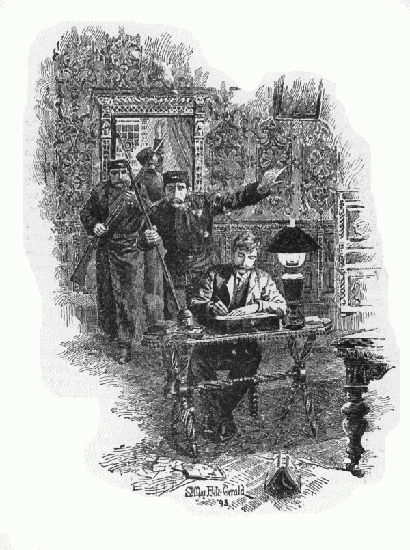
It was the year 188-. My brother had been arrested during the winter. At the beginning of the spring I went to X——, to the house of my uncle and aunt, to pass the summer, and to rest after the emotional strain I had been under. At least, such was the explanation of my leaving St. Petersburg which I gave to the police of that city, when I asked them for a passport for the interior of the Empire. As a matter of fact, I was anxious to see certain of my brother’s friends at X——, with the object of trying, with their assistance, to destroy the traces of his last visit there—traces which, if discovered by the police, might be extremely detrimental to Serge’s interests. On my arrival in the town—where, by the way, it was my habit to pass all my holidays—I found the Nihilist community, many of whose members were old friends of mine, in serious trouble. The police had just been making a terrible raid among them. Many had been arrested. The others, under strict surveillance, were daily expecting to be arrested in their turn.
“SERGE WAS ARRESTED.”
“TEACHING THEM TO READ AND WRITE.”
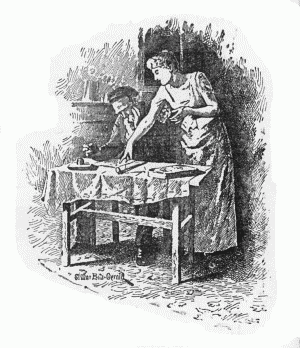
This circumstance, apart from the regret it caused me, had a considerable influence upon my relations with the local revolutionary organisation. The centre of this organisation was a group of young men and women, who, besides the revolutionary agitation that they were carrying on, were in correspondence with other groups of the same sort, for the purpose of exchanging books, helping comrades to escape from prison and fly the country, and so forth. X—— is a big town, chiefly given up to manufactures; and at the time of which I speak there was gathered around this central group a sort of duplex association, composed, on the one hand, of well-educated young folks, and, on the other, of working men. As a precautionary measure, the association as a whole was split up into a number of small circles, or clubs, that met separately, and knew nothing of one another. It was especially in these smaller clubs that the members of the central group carried on their propaganda, the aim of which was then, as it is to-day, to alter the present method of government, to rid the country of the despotism that bears so heavily upon it, and stops its development, and thus to make possible at once an improvement in the condition of the labouring classes, and a reconstruction of Russian society upon a more rational and a more humane basis. With the working people, however, the revolutionists were often forced to begin by teaching them to read and write. Outside of all these clubs, there were in the town a good many people who, while taking no direct part in the movement, sympathised with it, and did what they could to aid and abet it by gifts of money, and by providing refuge for such of the active members as were hiding from the police. With these very useful friends the revolutionists kept up more or less continuous relations.
The programme of the group at X—— needed for its accomplishment a large force of devoted and trustworthy workers; and the arrests that had been made just before my arrival had considerably thinned their ranks. This circumstance, as I have said, changed the nature of my own relations with the revolutionary organisation. Hitherto my visits to the town had been short, only to spend my school holidays in fact. Very young, moreover, I had never belonged to any of the clubs; and my friendships with their members had been purely personal. Now, however, I was older, and I had come to stop at X—— for several months. In the face of the gaps the late arrests had made in the little army of revolutionists, I felt that I must enlist. I offered my services, and they were accepted.
Towards the middle of the summer, my uncle and aunt went to Moroznoië, a little village near the town where their property lay. Leaving St. Petersburg before the end of the University year, I, a student of medicine, had been obliged to put off my examinations until the autumn. These examinations, or rather, my necessity to work and prepare for them, coupled with the presence of a fine public library at X——, gave me the pretext I needed to stay behind during the family villegiatura. After some opposition, and a good deal of talk about the superiority of country air, my uncle and aunt consented—the more easily, perhaps, because, after all, I was not to be alone; my Aunt Vera and two servants were to remain in the town house. Besides, my uncle and his wife were often coming back for a day or two at a time, and I promised to pass all my Sundays with them. This arrangement suited me perfectly. My Aunt Vera, my dead father’s sister, was the sweetest and gentlest of women, an invalid, with an infinite tenderness for Serge and myself, the orphans of her favourite brother. The servants also, an old nurse and a gardener, were entirely devoted to my family and to me. I was therefore free, mistress of the house, of my time, of myself. Divided between my studies, a few visits paid and received, and my weekly trip to Moroznoië, my life flowed peacefully, monotonously enough—on the surface.
“WE ARE BETRAYED!”
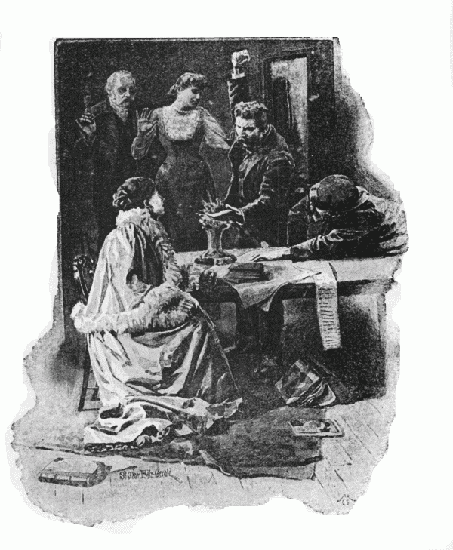
Down deep, alas! it was not the same. Our revolutionary group was being harried by the police, and their arrests and domiciliary visits were conducted with so much skill and certainty, we were forced to believe at last that we were betrayed by a traitor or a spy among our own numbers. Strictly watched by the police, who kept us “moving on,” avoided on that account by some of our friends, and knowing perfectly well that a single false step might bring ruin not only upon ourselves, but upon many others, we were obliged to be extremely cautious, and not to meet too often. A few furtive interviews now and again for the interchange of news, a few sparsely attended rendezvous for the purpose of keeping the threads of our organisation together, were pretty nearly all that we thought safe to permit ourselves. This mode of life—so tranquil to outward appearance, but in reality so full of anxiety for each and all; a life without a to-morrow, so that when we parted we did not know whether we should ever meet again, and it became our habit to say Adieu instead of Au revoir—lasted for me about five months. Melancholy enough, indeed, it had notwithstanding a charm of its own, a charm that sprang partly, perhaps, from the consciousness of dangers incurred for a noble object, and from the feeling of grave moral responsibility that we all had. A few episodes of that time are deeply fixed in my memory. A meeting we held one evening at twilight in a rich park near the town, a park that belonged to a high personage at the Imperial Court, whose son was one of us. There we met and whispered, and the murmur of the leaves overhead and the deepening shadows of the nightfall lent an intense colour of poetry to the situation. And then another meeting, in the poor little lodging of a factory-operative—a special meeting, called because our suspicions of treason within our own ranks had centred now upon a certain individual, a student, a college friend of my cousins, a constant visitor at our house. At this meeting a plan was adopted to test our suspect, and prove whether or not he was the guilty man. I, the next time he called, was to put him on a false scent; I was to tell him that a reunion of Nihilists would be held at a given place and a given time; and then we would await developments. I was also to draw him out, if possible, and make him convict himself from his own mouth. But this I could not do. I put him on the false scent; but I couldn’t draw him out. It is terrible to hold the life of a human being between your hands, even though that human being be the basest of cowards and traitors.
Well, at the time and place that I told him of, surely enough, the police turned up, and naturally they found nobody there. But during the two following nights twenty fresh arrests took place; and I was one of those arrested. My cousins’ friend, feeling himself discovered and menaced, had made haste to deliver us into the hands of our enemies!
“I WAITED A MOMENT TO TAKE BREATH.”
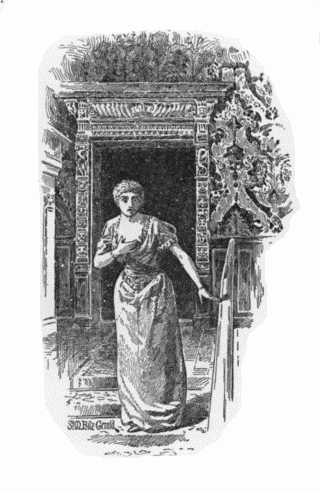
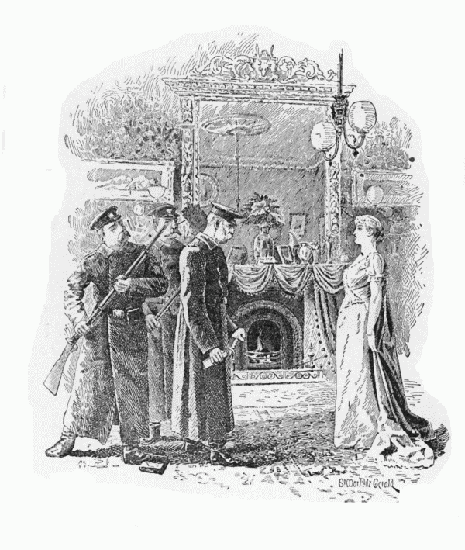
That evening I had come home rather late, and had then sat and chatted for a long while with aunt Vera, so that it was well towards midnight before I started to go to bed. Half-way upstairs, I was stopped by a noise; footsteps and stifled voices, mingled with the clang of spurs and sabres. I waited a moment, to take breath, which had failed me suddenly; then I went back downstairs. A violent pull at the bell, an imperative pull, sounded at the garden gate; and in a moment was followed by another at the door of the house. It woke the old nurse, and brought my aunt Vera from her room. Having been a little forewarned by me of the possibility of such a visit as this, she questioned me with a frightened glance. I answered “Yes,” by a sign of the head, and begged her under my breath to delay “them” as long as possible before letting “them” come in. The idea of being able to render me a service, perhaps the last, gave her strength and courage; and while slowly, very slowly, she moved towards the door, where the nocturnal visitors were getting impatient and trying to force the lock, I went into the dining-room. A moment later I heard her sweet trembling voice assuring Monsieur le Colonel de Gendarmerie that there was no one in the house; all the family were at Moroznoië; my uncle had been in town on Monday, but had left again on Tuesday, and wouldn’t return till the end of next week; and there was no one here but herself, the speaker, and a young lady visiting her. In this little respite, which I had arranged for myself without too well knowing why, I remained inert in the room, lighted feebly by a single candle, and tried to gather my thoughts together: they were slow enough to respond to my efforts. My first notion was that of flight, and, automatically, I opened a window. Close at hand, behind some shrubbery, I perceived the glitter of a gendarme’s uniform. There would surely be others in the garden and in the courtyard; and for the rest, fly—? How, and whither? I shut the window, and coming back to the middle of the room, I caught a glimpse of myself in the chimney-glass. I was very pale. Was I going to be a coward? This question, and that pale face in the mirror, awoke in me other thoughts, brought back to my memory other faces: that of my brother, who, a few months before, had gone so bravely from his home, to which he would never return, to the prison that he would perhaps never leave; those of friends lately arrested; those of so many, many noble men and women. Was I going to be a coward? So the examples set by these others turned my attention from myself, calmed me, gave me strength. I could hear the voice of Colonel P——, who, impatient of my aunt’s parleying, briefly bade her hold her tongue, and conduct him to the presence of her niece, Mademoiselle Sophie. That voice, rude and gross, had the effect of changing the moral depression which I had felt a moment ago into a sort of intense nervous excitement; and at the moment when the Colonel, followed by his men, appeared upon the threshold of the dining-room, honouring me with the very least respectful of bows, I, instead of saluting him in return, met him with a gaze as fixed and haughty as his own.
“MET HIM WITH A GAZE AS FIXED AND HAUGHTY AS HIS OWN.”
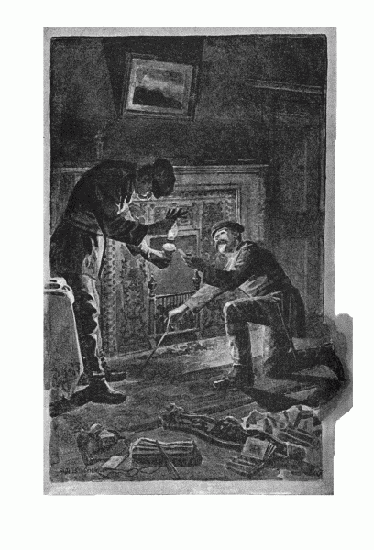
A minute later the Colonel was installed at the dinner-table, with the whole household arraigned before him, and everybody forbidden to leave the room. He asked my aunt Vera for the keys of the house, and the search began. The gendarmes scattered themselves through all the rooms, through the garden, the courtyard, the offices, and turned everything upside down, emptying wardrobes and cupboards, unmaking the beds, moving the articles of furniture to see that nothing was hidden behind them, and trying the screws to discover if there were any secret drawers. In my bedroom, which was of course the object of a very particular attention, a spy dressed in civilian’s costume got up on the tables and chairs, and tapped on the walls. Another drew the ashes, still hot, from the stove, and examined them by the light of a lamp, held by a big gendarme. From time to time these men would come back to the dining-room, bringing armfuls of books, and school papers belonging to my cousins, which they would deposit upon the table before Colonel P——. After looking them over, he would throw them aside with such manifest ill humour, that I, who by this time had myself completely under control, couldn’t let the occasion pass to condole with him on the sad nature of his trade. The whole search was a useless and odious farce, for I knew that there was nothing in the house of the kind they were looking for. Still I wasn’t sorry to let them prolong it, for that gave me more time to stay there at home, beside my aunt Vera, who, smaller and feebler and paler than ever, turned her dear eyes, full of fear and tenderness, upon my face, and kept stroking my hand with her two trembling ones.
“A LAMP HELD BY A BIG GENDARME.”
The search was nearly over, when a gendarme came in from the stable with a great parcel of books, done up in green cloth, which he laid before the Colonel. Opened, the parcel proved to contain not books only, but forbidden books—books by Herbert Spencer, by Mr. Ruskin, by Monsieur Renan! I was astonished at seeing them, and my first thought was that they belonged to my brother, who might have forgotten them there in the stable, or to my cousins, who, without being revolutionists, were interested in forbidden literature just because it was forbidden. So when the Colonel, having finished his inspection of them, asked me whom they belonged to, I answered quietly, “To me.” My aunt Vera, to whom I had always promised never to bring “forbidden” things into the house, looked at me sadly, reproachfully. Ah! my dear aunt, I lied in saying they were mine; but in my situation a few forbidden books couldn’t matter much; whereas for the others, for my innocent cousins—who knows what serious trouble they might have got them into?
The Colonel demanded, “Where do these books come from?”
“From the people who had them last.”
“Their names?”
“What, Colonel! You, the chief of the secret police of X——, you don’t know!”
This answer kindled a light of anger in his little Chinese eyes. For my part, I had spoken very slowly, looking steadily at him, and smiling as if it were a jest; but it wasn’t exactly a jest. While the Colonel had been questioning me, I had reflected. It was impossible that my cousins should have had books of this sort in their possession without speaking to me about them; and it was most unlikely that they could have belonged to Serge, who, always very careful, made it a strict rule never to bring anything of a compromising nature to our uncle’s house. But I had often heard that the political police, to create evidence against people whom they strongly suspected, but who were too prudent for their taste, and also to make their arrests appear less arbitrary in the eyes of the public, had a pleasant habit of bringing “forbidden” things with them to the houses where they made their perquisitions, for the sake of supplying what they might not be able to find. Was this what had happened now? Had I been caught in such a trap?
That was what I asked the Colonel in the form of a little jest.
“THROWS HERSELF AT THE COLONEL’S FEET.”
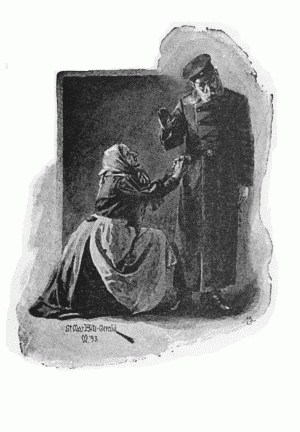
Did he understand? He answered with a piece of advice: that I should be less gay. For the rest, he was in a hurry; he looked at his watch; announced that all was over, and that I was under arrest; and called for witnesses to sign the procès-verbal. Our gardener ran out to find somebody. He came back with two people who had been attracted to our house by the lights and the noise. One was a cabman, the other was Dr. A——, a neighbour who had recently come to live at X——, and whom we knew only by sight. These men stared at me with surprise and curiosity. I scarcely saw them. The words “Under arrest” had completely upset my Aunt Vera, who, till then so calm, was now crying bitterly, covering me with kisses, and repeating, “My child! My child!” The old nurse also was crying, sobbing, and muttering to herself. Just when I feel that I myself am about to give way, and cry too—that which I am anxious, most anxious, not to do—she, the old nurse, throws herself at the Colonel’s feet, and begs grace for me, telling him that I am too young, too frail, to go to prison, that I have been coughing these many days, that I may die there! This makes the Colonel smile. For me, I tell the old nurse to get up. I scold her. Stupefied, trembling, she sinks to the floor in a corner of the room, and weeps for me as the Russian peasants weep for their dead, mingling with her sobs memories of our common past, praises of my good qualities, and so forth. All this, uttered in a low sing-song, is like a sort of funeral dirge.
I hear it still at the moment when the Colonel shuts me into a cab, with two gendarmes facing me, and another on the box beside the driver, to whom the order is given, “The fortress!”
Sophie Wassilieff.
(To be continued.)