Front matter
Reading edition
"A strange letter, from a strange hand, by a strange messenger; without date to it, name at it, and (I had almost said) sense in it. A letter which, even when it was opened, was still sealed, such the affected obscurity therein."
Fuller's Church History, x. 32.
LONDON: SIMPKIN, MARSHALL, HAMILTON, KENT & CO., LTD. 1916
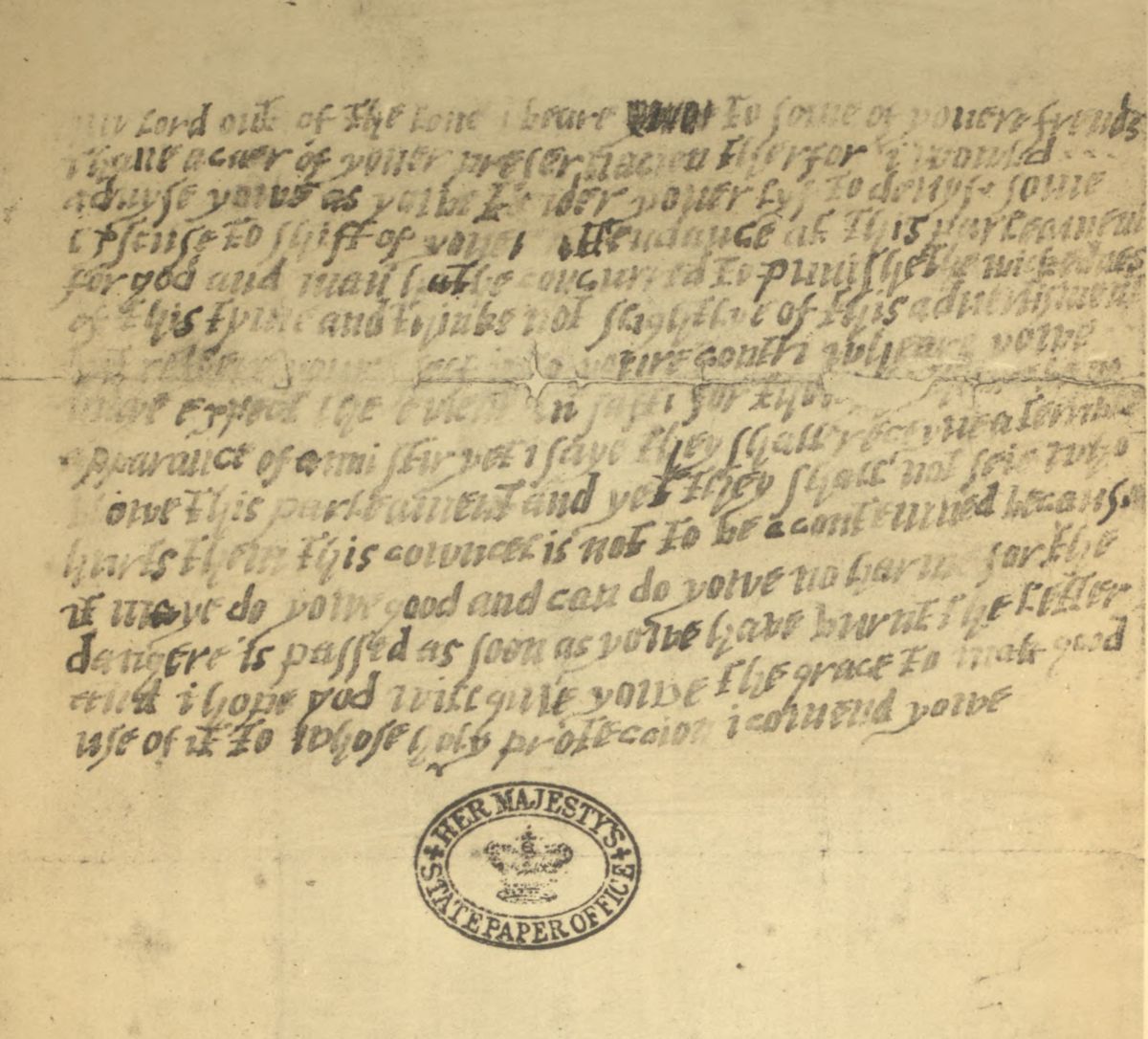
View larger image FACSIMILE No. 1. The anonymous letter as delivered to Lord Monteagle, October 26, 1605, warning him not to attend the opening of Parliament appointed for the Fifth of November. (From the original letter in the Museum of the Public Record Office.)
PREFACE
One of the great mysteries of English history is the anonymous letter to Lord Monteagle, warning him not to attend the opening of Parliament, appointed for the Fifth of November, 1605, which is popularly supposed to have led to the discovery of the Gunpowder Plot. The writer's identity was carefully concealed by the Government at the time; the intention being, as explained by Lord Salisbury, "to leave the further judgment indefinite" regarding it. The official statements are, therefore, as unsatisfactory as might be expected in a matter that, for State reasons, has not been straightforwardly related. The letter, however, remaining and in fair preservation, there was always the possibility of the handwriting being identified; and this, after the lapse of over three hundred years, is now accomplished.
CONTENTS
page
Prefacev
section
I.Historical Analysis1
II.The Official Story of the Letter5
III.Identification of the Handwriting9
IV.The Attorney-General's Opinion of Vavasour's Guilt19
V.Francis Tresham's Confidence when in the Tower24
VI.The Vavasours as Dependants of the Tresham Family25
LIST OF FACSIMILES
1. The anonymous letter as delivered to Lord Monteagle, October 26, 1605, warning him not to attend the opening of Parliament appointed for the Fifth of November (From the original letter in the Museum of the Public Record Office)Frontispiece 2. A page of the MS. entitled "A Treatise against Lying," etc., formerly belonging to Francis Tresham, of which the handwriting was attributed by his brother, William Tresham, to William Vavasour. Now in the Bodleian Library. (Laud MSS. 655, folio 44)[1] 3. William Vavasour's handwriting in the letter to the Earl of Salisbury, dictated and signed by Francis Tresham when dying in the Tower, December 22, 1605 ("State Papers, Domestic," James I., ccxvi. 211)[1]
Stated by Vavasour to have been written by Mrs. Tresham. On March 24, 1605-6, he confessed that he wrote it and signed a note to it to that effect.
4. William Vavasour's handwriting in his untrue statement, written in the presence of the Lieutenant of the Tower, that No. 3 was written by Mrs. Tresham. Dated March 23, 1605-6 ("State Papers, Domestic," James I., ccxvi. 207)[1]
***To avoid detection of his falsehood, he writes a hand quite different from his ordinary writing in Nos. 2 and 3, thus producing a hand which is in itself identical with his former disguised writing as seen in the anonymous letter (No. 1).
5. George Vavasour's handwriting on the last leaf, which he renewed for Francis Tresham, of the MS. entitled "A Treatise against Lying," etc. (Laud MSS. 655, folio 61)To face page 26