Chapter II · EASTERN BRANCH.
Reading edition
The Eastern Blacks, who have also been called Melanesians and Oceanian Negroes, inhabit the western part of Oceania and the south-east of Asia. Their complexion is very brown, sometimes increasing in darkness until it reaches intense black. Their hair is frizzled, crisp, flaky, and occasionally woolly. Their features are disagreeable, their figures of little regularity, and their extremities often lank. They live in tribes or small divisions, without forming themselves into nationalities.
We shall divide them into two groups, one, the Papuan Family, composed of peoples among whom the characteristics indicated above, are the most developed; the other, the Andaman Family, made up of tribes which more resemble the Brown Race, and probably result from a mixture of it with the Black one.
Papuan Family.
The Papuan Family seems to dwell only in small islands or on the coasts of larger ones. Two groups of peoples are observable in it, one, resembling the Malays, consists of the Papuans, who inhabit the New Guinea Archipelago, and the other, resembling the Tabuans, occupies the Fiji Islands, the New Hebrides, New Caledonia, and the Solomon range. We proceed to say a few words as to the manners and customs of these different sections of the Black Race.
Papuans.—A remarkable feature presented by the Papuans, is the enormous bulk of their half-woolly hair. Their skin is dark brown, their hair black, and their beard, which is scanty, is, as well as their eyebrows and eyes, of the same colour. Though they have rather flat noses, thick lips and broad cheekbones, their countenance is by no means unpleasant. The women are more ugly than the men, their withered figures, hanging breasts, and masculine features render them disagreeable to the sight, and even the young girls have a far from attractive look.
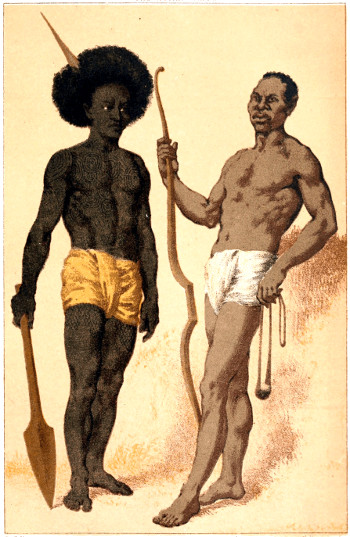
P. Sellier, p.t Imp. Dupuy, 22, R. des Petits Hôtels G. Regamey, lith.
PAPOUAN NEGRO OF NEW GUINEA
BLACK RACE
Lesson considered the Papuans fierce, inhospitable, crafty men, but the inhabitants of Havre de Doresy and generally of the northern part of this Oceanic region, as far as the Cape of Good Hope, seemed to him of great mildness and more disposed to fly from Europeans than to hurt them. He thinks, nevertheless, that the Negroes in the south of New Guinea, pushed back into that part of the island, and whom no intermixture has altered, have preserved their savage habits and rude independence. The state of perpetual hostility in which they live renders their character distrustful and suspicious. Never did Lesson visit a village, in a small boat manned by a fair number of men, that women, children, old men, and warriors did not take to flight in their large canoes, carrying off with them their movables and most precious effects. He adds, that by good treatment and plenty of presents, people may succeed in making way with them, may be able to lull their uneasiness and establish friendly relations. The coloured Plate accompanying this part of the work represents a native of the Papuan Islands.
Vitians.—The first accurate information about the Viti or Fiji Islands is due to Dumont d’Urville. Mr. Macdonald, an assistant-surgeon on board the English ship Herald, has published an account of his visit to Fiji, and from it we extract the following particulars.
Thakombau (fig. 234), the king, was a man of powerful and almost gigantic stature, with well-formed limbs of fine proportions. His appearance, which was further removed from the Negro type than that of other individuals of lower rank, sprung from the same stock, was agreeable and intelligent. His hair was carefully turned up, dressed in accordance with the stylish fashion of the country, and covered with a sort of brown gauze. His neck and broad chest were both uncovered, and his naked skin might be seen, of a clear black colour. Near him was his favourite wife, a rather large woman with smiling features, as well as his son and heir, a fine child of from eight to nine years old. His majesty was also surrounded at respectful distance by a crowd of courtiers, humbly cringing on their knees.
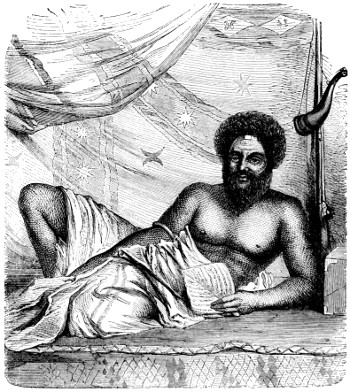
234.—THAKOMBAU, KING OF THE FIJI ISLAND.
In the course of his peregrinations, Mr. Macdonald was present at a repast, consisting of pork, ignames, and taro,[11] served in wooden dishes by women. Freshwater shell-fish of the cyprine kind completed the banquet. The broth was very savoury, but the meat insipid. During the conversation which followed, the traveller became convinced that gossip is a natural gift of the Fijians. Figs. 235 and 236 represent types of these people.
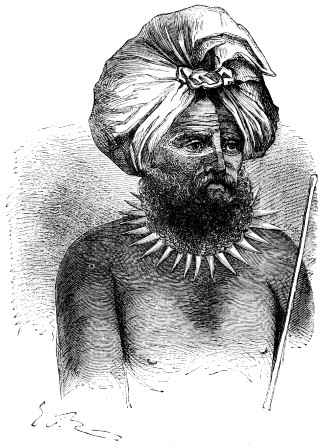
235.—NATIVE OF FIJI.
The Fijians are fond of assembling to hear the local news, or to narrate old legends. Respect for their chiefs is always preserved unalterable among this people, turbulent in their behaviour, depraved in their instincts, and familiar with murder, robbery, and lying. The homage paid to their chiefs makes itself manifest both by word and action; men lower their weapons, take the worst sides of the paths, and bow humbly as one of the privileged order passes by. One of the oddest forms taken by this obsequiousness is a custom in accordance with which every inferior who sees his chief trip and fall, allows himself to stumble in his turn, in order to attract towards himself the ridicule which such an accident might have the effect of drawing upon his superior.
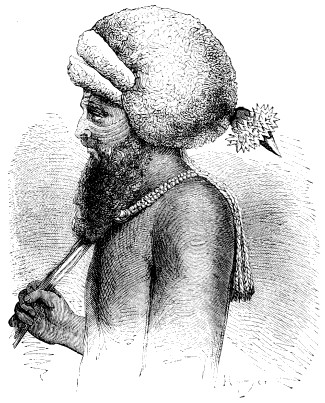
236.—NATIVE OF FIJI.
The different classes or castes into which the Fijian population is divided, are as follows: 1, sovereigns of several islands; 2, chiefs of single islands, or of districts; 3, village chiefs, and those of fisheries; 4, eminent warriors, but born in an inferior station, master carpenters, and heads of turtle-fisheries; 5, the common people; and 6, slaves taken in war.
The horrible custom of eating human flesh still exists in Fiji; the missionaries have succeeded in bringing about its disappearance in some parts of the island, but it remains in the interior districts, concealing itself, however, and no longer glorying in the number of victims devoured! Cannibalism does not owe its existence among the Fijians, as in most savage tribes, to a feeling of revenge pushed to the utmost limits; it arises there from an especial craving for human flesh. But as this choice dish is not sufficiently abundant to satisfy all appetites, the chiefs reserve it exclusively to themselves, and only by extraordinary favour do they give up a morsel of the esteemed delicacy to their inferiors.
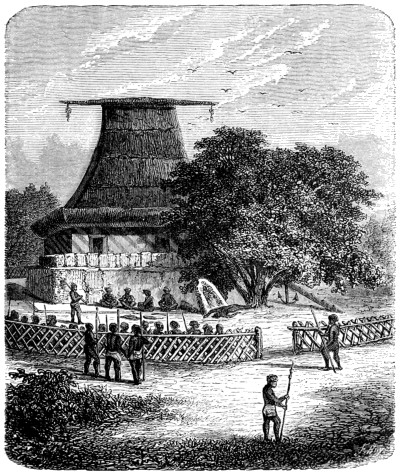
237.—A TEMPLE OF CANNIBALISM.
The engraving (fig. 237) is taken from a sketch made by the missionary Thomas Williams, of a sort of temple used on occasions of cannibalism in Fiji. The four persons squatted in front of the edifice are victims awaiting their doom, and whose bodies will afterwards serve for the feast of these man-eaters.
Mr. Macdonald discovered that the custom of immolating widows is still in full vigour in one of the districts of the island.
Dancing is the popular diversion of the Fiji Islands. The chant by which it is usually regulated is of monotonous rhythm, its words recalling either some actual circumstance or historical event. The dancers’ movements are slow at first, growing gradually animated, and being accompanied by gestures of the hands and inflections of the body. There is always a chief to direct the performers. A buffoon is sometimes brought into the ring whose grotesque contortions bring applause from the spectators.
Two bands, one of musicians, the other of dancers, take part in the regular dances of the solemnities at Fiji (fig. 238); the first usually numbers twenty, and the other from a hundred and fifty to two hundred, individuals. These latter are covered with their richest ornaments, carry clubs or spears, and execute a series of varied evolutions, marching, halting, and running. As the entertainment draws towards its close their motions increase in rapidity, their action acquires more liveliness and vehemence, while their feet are stamped heavily on the ground, until at last the dancers, quite out of breath, ejaculate a final “Wa-oo!” and the antics cease.
New-Caledonians.—The inhabitants of New Caledonia belong to the branch of Oceanian Negroes. This island, hidden in the Equinoctial Ocean, is a French possession, and has been marked out for the reception of those Communist insurgents and incendiaries arrested in Paris in June 1871, after the “seven days’ battle” who were sentenced to transportation by the courts-martial. We are indebted to MM. Victor de Rochas and J. Garnier for some valuable details concerning the population of the colony.
The aborigines of New Caledonia have a sooty-black skin; woolly, crisp hair and abundant beard, both black; a broad, flat nose deeply sunk between the orbits; the white of the eye bloodshot; large, turned-out lips; prominent jaws; a wide mouth; very even and perfectly white teeth; slightly projecting cheekbones; a high, narrow, and convex forehead; and the head flattened between the temples. Their average stature is at least as tall as that of the French, their limbs are well-proportioned, and their development of both chest and muscles is generally considerable.
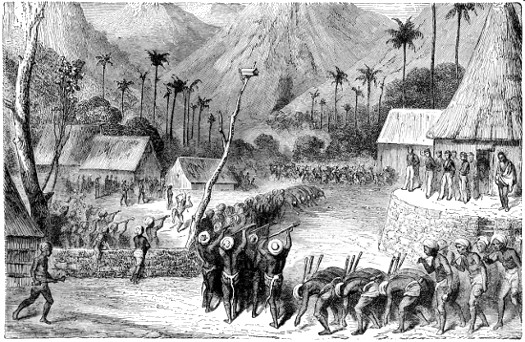
238.—A FIJIAN DANCE.
The men are not very ugly, many even showing a certain regularity of feature; and some tribes on the east coast are better favoured than the rest in this respect. Figs. 239 and 240 convey a fair idea of the male population.
The ugliness of the women is proverbial. With their shaven heads and the lobes of their ears horribly perforated or pinked, they present a revolting appearance, even when young in years. The rude toil and bad treatment to which they are subjected bring upon them premature old age. They suckle their children for a long period, for three years on the average, and sometimes for five or six.
Like all savages, the New-Caledonians possess an exquisitely keen sense of sight and hearing. They are active and capable of exerting considerable strength for a short effort, but have no lasting power. Their inability to support fatigue for any length of time doubtless arises from the nature of their nourishment. They swallow really nothing beyond sugary and feculent vegetable food, seldom eating meat, the true source of the sustainment and recuperation of strength. Their island supplies the New-Caledonians with no quadrupeds which they can capture for sustenance, and they possess no weapons suitable for killing birds.
The quantity of eatables these people can gorge at a single meal is wonderful, quite three times as much as an European would be equal to.
M. Garnier visited the village of Hienghène. Its chief came to meet the travellers and presented to them his eldest son, while numbers of naked warriors, with blackened chests, beards, and faces, stood round in a silent and motionless group. They might have been taken for bronze statues were it not for their dark and sparkling eyes which followed the smallest gesture of the visitors.
At a signal from the chief, several youths dashed forward and in a few seconds showered down from the cocoa-trees a hail of nuts, the pulp of which in the liquid state is the most agreeable drink imaginable for allaying thirst.
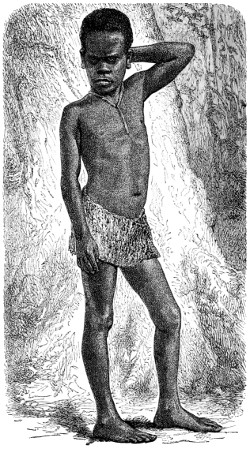
239.—YOUNG NATIVE OF NEW CALEDONIA.
The village of Hienghène is one of the most considerable in the island. Its dwellings are shaped like beehives, and are crowned with a rude statue surmounted by a quantity of shell-fish or sometimes by skulls of enemies slain in war.
These cabins have a single opening, very low and narrow. In the evening they are filled with smoke in order to banish the mosquitoes; the narrow aperture is then shut and the occupants lay themselves down to sleep on mats, whilst the smoke, by reason of its lightness, remains floating over their heads; but to sit upright without being half smothered by it is impossible.
Great numbers of aborigines dwell along the sea-coast. They came on board M. Garnier’s vessel in crowds, bringing provisions and shell-fish, and examining everything with the greatest attention.
The natives of this tribe are of a fine type. M. Garnier noticed among the visitors several men admirably built, and with a perfectly developed muscular system; but he nevertheless remarked as a general defect of the New Caledonians, that they have too thin legs in comparison with their bodies, and calves placed higher than in Europeans.
Whether from habit, or in consequence of anatomical formation, these people assume positions at every moment which would fatigue us terribly. They sit down on their heels for whole days, and when they climb up into a cocoa-tree, or rest themselves by the way, place themselves without any effort in postures that are really surprising.
The singular fancy which some of these tribes have for clay, has been already noticed, and M. Garnier convinced himself of the reality of the fact. The earth in question, is a silicate of magnesia, greenish in colour. It is ground by the teeth into a soft, fine dust, by no means disagreeable in taste. The habit of eating this clay, is, however, far from general; women only, in certain cases of illness, take a few pinches of it.
M. Garnier had an opportunity of being present at the pilou-pilou, a dancing festival which takes place on the occasion of the igname harvest. On a piece of high but level ground, overlooking a vast plain, were seated the chiefs and old men; the crowd were assembled below, and in front of them was piled a huge heap of ignames. Thirty or forty youngsters, selected from the handsomest of the tribe, advanced and each took a load, and then ascended the plateau in a body, all dashing at full speed to lay their burdens at the feet of the chiefs. Then, still running, they returned to the great mass of ignames to carry away a fresh cargo, and so on until the whole pile disappeared. They were pursued during this wild race by the yelling crowd, bounding around them with brandished weapons. Every European would have been interested in this strange spectacle; but a painter or a sculptor would have never grown weary of admiring the forms of the young performers: finer artistic models have seldom “posed” in any studio.
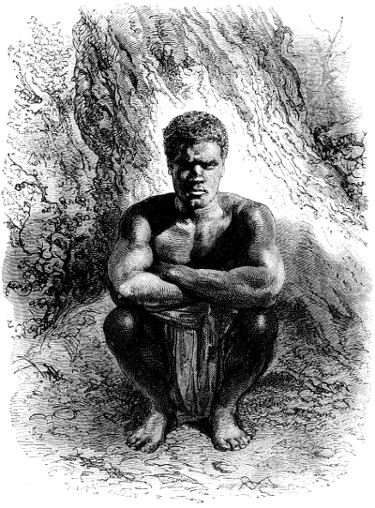
240.—NATIVE OF NEW CALEDONIA.
This fête was interrupted by a mock fight, during which the warriors, either in complete nudity or with gaudy cloths tied round their waists, whirled their weapons about as they kept bounding, yelling, and taunting their adversaries. The old withered men, whose hands could throw neither stone nor javelin, animated the courage of the young people and showered insults on their opponents.
We are unable to retrace in its entirety, the curious and graphic description which M. Gamier has given of this contest, but a scene of cannibalism at which he was present, is too dramatic to be passed over.
Near a large fire sat a dozen men, in whom the traveller recognized the chiefs he had seen in the morning, and pieces of smoking meat surrounded with ignames and taros were laid on broad banana leaves before them. The bodies of some unfortunate wretches killed during the day, supplied the materials for this ghastly banquet, and the hole in which their limbs had just been cooked was still there. A savage joy was pictured on the faces of these demons. Both hands grasped their horrid food. An old chief with a long white beard did not seem to enjoy so formidable an appetite as his comrades. Leaving aside the thigh-bone and the thick layer of flesh accompanying it which had been served him, he contented himself with nibbling a head. He had already removed all the meaty parts, the nose and cheeks, but the eyes remained. The old epicure took a bit of pointed stick and thrust it into both pupils, then shook the horrid skull until bit by bit he brought out the brain; but as this process was not quick enough, he put the back of the head into the flames, and the rest of the cerebral substance dropped out without difficulty!. . . .
Andaman Family.
We comprise in the Andaman Family those Eastern blacks who possess the characteristics of the Negro race strongly marked. These nations are as yet but little known. The inhabitants of New Guinea, the aborigines of the Andaman Isles, in the bay of Bengal, the blacks of the Malacca peninsula, those dwelling in some of the mountains of Indo-China, the natives of Tasmania, and, finally, the indigenous population of Australia are included in this group.
Among all these people the facial angle does not exceed 60 degrees; the mouth is very large, the nose broad and flat, the arms short, the legs lanky, and the complexion the colour of soot. The women are positively hideous.
The tribes which form these groups are, in general, numerous and subject to the arbitrary authority of a chief. Language is extremely limited among them; they possess neither government, laws, nor regularly established ceremonies, and some do not even know how to construct places of abode.
In order to convey to the reader an idea of the people composing the Andaman Family we shall give a glance at the inhabitants of the Andaman Isles and also at those of Australia.
Andamans.—The dwellings of the Andamans are of the most rudimentary kind, being hardly superior to the dens of wild beasts. Four posts covered with a roof of palm-leaves constitute these lairs, which are open to every wind, and “ornamented” with hogs’ bones, turtle shells, and large dried fish tied in bunches.
As for the inhabitants themselves, they are of an ebon black. They seldom exceed five feet in stature; their heads are broad and buried between their shoulders; and their hair is woolly, like that of the African blacks. The abdomen is protuberant in a great many cases, and their lower limbs lank. They go about in a state of complete nudity, merely taking care to cover the entire body with a layer of yellow ochre or clay, which protects it from the sting of insects. They paint their faces and sprinkle their hair with red ochre.
Their weapons are, however, manufactured with much cleverness. Their bows, which require a very strong pull, are made of a sort of iron-wood and gracefully shaped. Their arrows are tipped with fine points, some of them barbed, and they shoot them with much skill. They handle expertly their short paddles, marked with red ochre, and hollow their canoes with a rather rude implement formed of a hard and sharp stone fastened to a handle by means of a strong cord made from vegetable fibres.
The Andamans are ichthyophagists, for the seas which wash their islands abound in excellent fish and palatable mollusks. Soles, mullets, and oysters constitute the staple of their food, and when during tempestuous weather fish runs short, they eat the lizards, rats, and mice which swarm in the woods.
Though not cannibals, the Andamans are nevertheless a most savage race, who do not even exist in a state of tribedom, but who are merely gathered into gangs.
The bitterest contempt has been lavished on these rude inhabitants of the islands of Bengal, and people have been willing to consider them as brutes of the worst cruelty, and most extreme ugliness; but more recent observation, and the few facts which we have mentioned, show that this estimate should be somewhat mitigated.
Australian Blacks.—We have arrived at the black people who occupy part of Australia, and take advantage of some valuable information concerning them, found in M. H. de Castella’s “Souvenirs d’un Squatter Français en Australie,” and which was acquired by the author’s personal experience of these uncouth beings.
The wild state in which the aborigines of Australia exist is the result of the poverty of their country, which affords no other source of sustenance than animals. True, these abound there; kangaroos, squirrels, opossums, wild-cats, and birds of all kinds are so numerous, that the natives need, as it were, only stretch out their hands in order to take them. In this mild climate they can live without any shelter.
According to M. de Castella, the Negroes of Australia are not so ugly as they have been represented. Among the men whom he examined, some were tall and well made. Their slow, lounging gait, was not devoid of dignity, and the solemnity of their step reminded one of the strut of a tragedian on the stage.
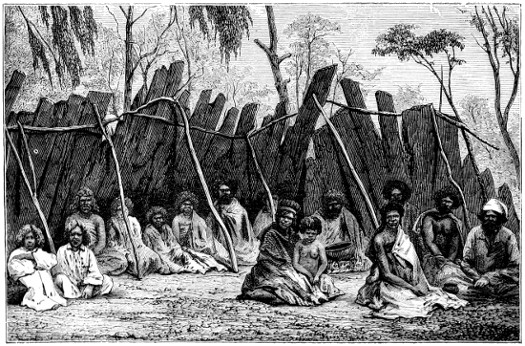
241.—ENCAMPMENT OF NATIVE AUSTRALIANS.
The Australian blacks recognize family ties. None of them have more than one wife, but they do not marry within their own particular tribe. They live encamped in bands, and now that they are reduced to small numbers, in entire tribes. They do not build permanent huts, but protect themselves in summer from the sun and hot winds merely by a heap of gum-tree branches, piled up against some sticks, thrust in the ground. When winter comes on, they strip from the trees large pieces of bark, eight or ten feet high, and as wide as the whole circumference of the trunk, forming with these fragments a screen, which they place at the side whence the rain is blowing, and alter if the wind happens to change. Squatted on the bare earth, in the opossum skin which serves the double purpose of bed and clothing, each of them is placed before a hearth of his own. Fig. 241 is an engraving taken from a photograph of Australian natives.
The Australian Negroes of the present day have guns, and employ little axes for chopping their wood and cutting bark, but it is not so long since the only weapons they possessed were made of hard wood, and their hatchets consisted of sharp stones fastened to the end of sticks, like the flint instruments used by men before the Deluge. There is in fact little or no difference between the people of the age of stone, and the Negroes of Australia, and consequently an acquaintance with the wild manners and customs of these races has been of great advantage to naturalists of our day in throwing light upon the history of primitive man.
M. H. de Castella was greatly struck by the agility of the Australian blacks in climbing gum-trees whose straight stems are often devoid of branches for twenty or thirty feet from their base, and are besides too thick to be clasped. When by perfect prodigies of acrobatism the native reached the wild cats and opossums’ nests, he seized the animals, and threw them to his wife.
This wife carried everything; her last-born in a reed basket hanging from her neck, the slaughtered game in one hand, and in the other a blazing gum branch, to light the fire when the family took up fresh quarters. The man walked in front, carrying nothing but his weapons; then came the wife, and after her, their children according to height.
A batch of Australian blacks is never, by any chance, to be met walking abreast, even when in great numbers, and if a whole tribe is crossing the plains, only a long black file is to be seen moving above the high grass.
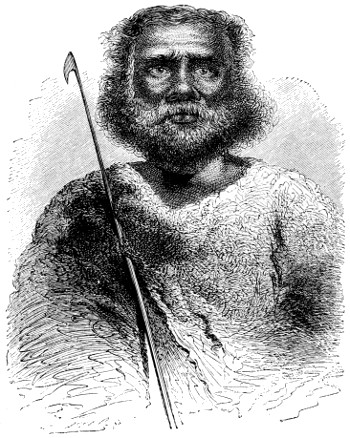
242.—NATIVE AUSTRALIAN.
M. de Castella was a spectator of the curious sight which eel-fishing affords among these natives. Holding a spear in each hand, with which to rake up the bottom, they wade through the water up to their waists, balancing and regulating their movements to the even measure of one of their chants. When an eel is transfixed by a stroke of one lance, they pierce it in another part of the body with the second, and then, holding the two points apart, throw the fish upon the ground, the quantity which they take in this manner being enormous. They dispense with saucepans and cooking utensils of all kinds in the preparation of their meals, simply placing the game or fish on bright coals covered over with a little ashes.
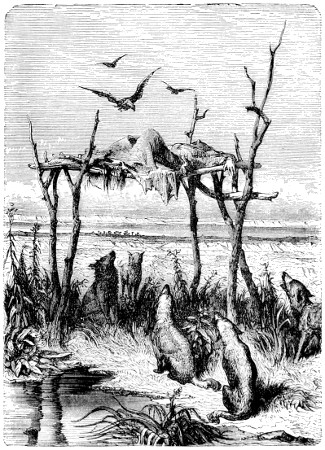
243.—AN AUSTRALIAN GRAVE.
Everyone has heard of the skill with which savages navigate their rivers in bark canoes, but the people of whom we are now speaking render themselves remarkable above all others by their adroitness in guiding their little crafts over the rapids. Only two persons can sit in their boats, while a spear supplies the place of an oar, and is used with astonishing dexterity.
No one acquainted with this kind of barbarous life will be surprised to hear that the blacks of Australia are diminishing at a wonderfully quick rate. Of the whole Varra tribe, formerly a numerous one, M. de Castella could find no more than seventeen individuals.
What most struck the author of an account of a journey from Sydney to Adelaide, which appeared in the “Tour du Monde,” in 1860, was the small number of aborigines which he met in a distance of more than two hundred and fifty miles. Sturt and Mitchell, in the middle of the present century, had visited tribes on the higher tributaries of the Murray river, which then consisted of several hundred persons, but M. de Castella found them only represented by scattered groups of seven or eight famished individuals. Fig. 242 portrays one of the types sketched by this gentleman.
Mitchell has given a description in his “Travels,” of the “groves of death”—those romantic burial-places of the Australians—but the writer in the “Tour du Monde” found them no longer in existence. The tombs of the natives at the present day are as wild and rude as themselves. In the bleak deserts of the land of the West four branches driven into the ground and crossed at the top by a couple more (fig. 243), support the mortal remains of the Australian aboriginal, whose only winding sheet is the skin of a kangaroo.