THE HUMAN FOOT.
Reading edition
THE Human Body is one of the most worthy objects of man’s study. It is the noblest as well as the crowning work of creation. In it material organization is carried to the greatest perfection. It surpasses, therefore, all other physical objects in exquisiteness of construction and in interest. How comes it, then, that most persons are so ignorant respecting it? Men, well informed in other matters, are usually altogether uninformed with regard to this. In every other branch of science we find amateur students pursuing the subject with zeal and success. Geology, Chemistry, Botany, Zoology, and even Comparative Anatomy have each their votaries; but Human Anatomy attracts no one. Why is this? Partly, I think, because opportunities for acquiring such information as is suitable and interesting are not so many as they ought to be.
It must be confessed, also, that we teachers of Anatomy are somewhat to blame. We are too prone, in our Lectures and Examinations, to dwell upon bare details, without enlivening those details with the many bright features of interest with which they are naturally invested; and we fail, therefore, to render it so attractive a science as it might be. The example of those able and animated teachers, John and Charles Bell, who laboured with some success to disperse the clouds that have ever overhung the horizon of anatomy, has been too much forgotten; and the flame which they kindled has almost died out under the chilling apathy of their successors. Truly glad should I be to see a change in this. I cannot but think that if the teachers of Anatomy took higher and more philosophical views of their science there would be no lack of interest on the part of the students. The interest so excited would soon spread beyond the limits of the profession; and there would thus be opened up to the public some of the products of that rich vein of knowledge and of that abundant material for thought which lie buried in the human frame.
I therefore willingly accede to your request for a Lecture upon some part of the anatomy of the human body, relying upon the intrinsic interest of the subject to make amends for my own deficiencies in expounding it; and I select the Human Foot, because a few of the more important points of its construction can be explained without much difficulty, because it affords a good illustration of some of the principles of animal mechanism, and because its form constitutes one of the great characteristics whereby man is distinguished from the lower animals. As an instrument of support and of locomotion it excels the foot of any other animal. It evinces its excellence by enabling man to stand upright in a way that no other animal can do; and so efficiently does the foot accomplish this and perform the task of carrying the body, that the hand is set at liberty to minister to the will. Thus is the foot instrumental in giving us an advantage over other animals, and in enabling us to provide the means of defence; and, thus, it aids us to carry out those wondrous works which are second only to the marvellous results of creative power.
We are accustomed to regard the hand as the great agent by which all this is attained, and we are apt to forget how much it is indebted to the foot. We do not reflect that, if the foot of man presented no distinguishing peculiarity, the hand, like the corresponding part in other animals, would be compelled to share with it the task of carrying the body, and could, therefore, not be devoted to the various offices which it is now free to perform. Little right has the hand to say to the foot, “I have no need of thee.”
The principle of “division of labour.”
In this concentration of locomotive power in the foot we have an illustration of what is called the “principle of division of labour,” a principle with which all civilized communities are familiar, and to which we are much indebted for the present advanced state of the arts and sciences; but which we may be said to have borrowed from the economy of nature. We find ever-increasing manifestations of it as we ascend in the animal series, from the lower and more simple to the higher and more complicated forms. Indeed, just as each step in civilization is attended with a further development of this principle, so is each division of the animal kingdom distinguished from those below it by the more distinct assignation of particular functions to particular organs, and by the consequent improvement of the mode in which the functions are performed. While, in proportion as the several organs acquire more distinct speciality in their work, so do they become, more and more, dependent upon one another, and, more and more, subjected to the control of central government, which is represented by the brain.
For instance, some of the lower animals, as the fresh-water Polyp, present nearly a uniform structure throughout their whole substance; and every part of them consequently performs the same function. There is not one organ for digestion, another for circulation, a third for respiration, and so on; but all these functions are performed by the same structure, and are performed, therefore, in a rude and imperfect manner. Any portion of the creature possesses all the requisites for its own nutrition, and is, so, independent of the remainder, and can live alone. Hence, the polyp may be divided into a number of pieces, each of which goes on living. Gradually, as we ascend from these lowly beings to the higher classes of animals, we find organs and functions more and more distinct from another; a Stomach is provided for the work of digestion, a Heart for circulation, Lungs for respiration. Each of these organs is essential to the existence of the others and of every part of the body; and they are all maintained in harmonious co-operation by the presiding influence of the nervous system.
Or, trace one of the functions in illustration of the same principle. Take the function of Locomotion, which has an especial relation to our present subject. In the Leech and the Worm the whole length of the body is occupied in the work, one part as much as another; and still, it is but a crawl. In the Fish the whole body is buoyed up by the water; it is flattened from side to side, and is all, from the head to the tail, concerned in the lateral stroke by which the animal is driven along; the side fins, which are the representatives of limbs, doing little beyond serving to guide and balance. In the other Vertebrates the work of locomotion is so far concentrated as to be assigned, almost entirely, to the limbs. All four limbs are in most of them devoted to it; while the bones and muscles of the trunk are only indirectly concerned in it. In Man, however, two limbs only are assigned to this important office. In him, therefore, the concentration of locomotive power, in other words the principle of division of labour, is carried out to the greatest extent—a disposition which affords one of the many proofs that the construction of his body combines with the faculties of his mind to place him at the head of the animal kingdom.
In making comparisons of different animals with one another, and in speaking of the relative perfection of their several organs, we must not forget that every organ of every animal is perfect as regards the purpose for which it was made. But some animals are said to occupy a higher position than others, or to be superior to others, because their mechanism is more complex, and they are, thereby, enabled to perform a greater variety of functions. And, in the animal kingdom, in proportion as each function rises into prominence, and becomes well and distinctly performed, so is a special organ assigned to it, and that organ becomes more and more highly elaborated.
You will not misunderstand me, then, when I say that concentration of function and perfection of structure usually go together. And, forasmuch as in the lower limbs of man there is a greater concentration of locomotive function than in any other part of any other animal, you will expect to find, in them, a greater perfection of locomotive mechanism—that is to say, a more complete combination of strength with variety, rapidity, and extent of movement—than is elsewhere to be met with.
This consideration will ensure attention while I give a brief account of the anatomy of man’s lower limb, more particularly of the foot.
Structure of the Lower Limbs.
The weight of the trunk is transmitted to the knee (see fig. 4, p. 15) by a single bone—the thigh-bone. This is the longest bone in the body, measuring, on the average, nearly eighteen inches. Above, it is jointed with the haunch-bone of the pelvis at the hip-joint. From the knee two bones descend to the ankle. Of these one is much the larger, and bears the chief of the weight. The other serves to give attachment to muscles, and to strengthen the ankle-joint. It runs down on the outer side of the ankle, forming there what is called the “outer ankle;” and a process of the larger bone runs down, in like manner, on the inner side, and forms the “inner ankle.” The front and inner side of the larger bone are close under the skin. This part is called the “shin,” being so named perhaps from the word “chine” or edge, because the leg presents an edge along the front, to facilitate its cleaving a way through the air, water, grass, or underwood. The shin itself is not particularly tender; but the skin is a good deal exposed here, and, as it lies so near the hard bone, it is easily injured; and, when “broken,” it is often difficult to heal.
In some very tall persons, and particularly in those who are so tall as to be called Giants, I have found the leg or shank bones, that is, the bones between the knee and the ankle, very long, disproportionately long to the rest of the skeleton. They are so in the skeleton of the Irish Giant, O’Byrne, which is preserved in the Museum of the College of Surgeons, in another Irish Giant in the Museum of Trinity College, Dublin, and in some other specimens which I have had an opportunity of measuring. In the name “Long Shanks” given to Edward I., the word “shanks” probably included the thigh as well as the leg, just as we are in the habit of applying the word “leg” to the whole of the lower limb.
Bones of the Foot.
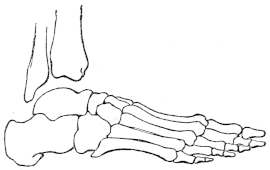
Fig.
1
.
There are 26 bones in the Foot. The hinder 7—called tarsal bones—are short and thick; they form the hinder part of the instep. In front of them lie 5 metatarsal bones, one passing, forwards, from the fore part of the tarsus to each toe. Behind, these are close together, and are connected with the tarsus. As they run forwards they diverge a little from one another; and their anterior ends rest upon the ground, and form the “balls” of the toes. They constitute the fore part of the instep. The remaining 14 bones are the toes. They are arranged in rows, like soldiers in a phalanx, three deep, and are hence called phalanges.
You observe that, although each of the other toes has 3 bones, the great toe has only 2. In this respect, therefore, it is an imperfect, or, rather, an incomplete member. The deficiency does not depend upon a want of length in the great toe; for this is usually as long as the second toe; in some persons it is a good deal longer; and it is always distinctly longer than the outer two toes. The reason for there being only two phalanges instead of three probably is because the great toe is required to be stronger than any of the others; and an additional bone would have tended to weaken it. I have, elsewhere1, given reasons for thinking that it is the middle phalanx which is absent in the great toe.
Fig. 2. Seal’s Foot.
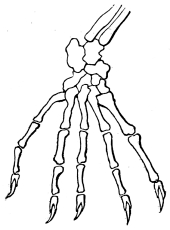
Fig. 3. Lizard’s Foot
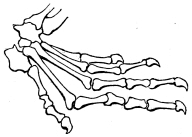
It is a curious and interesting fact, affording a remarkable illustration of the close adherence to a uniform plan which has been observed in the construction of the various animals, that, in no instance, does this toe contain more than two bones. Even in those creatures, as the Seal (fig. 2), in which it attains to greater length than any of the other sprawling digits, it contains the same number of bones as in man, its extraordinary length being attained by an elongation of the two bones, not by the addition of a third. And in those animals, as certain Lizards (fig. 3), where the number of bones in the other toes is increased to 4 or even 5, the number in the first, or inner, toe is still no more than two. The same rule applies to the fore limb; the number of bones in the inner digit, which, in man and monkeys, is called the “thumb,” is in no case more than two. In some animals, as will be mentioned again, there is only one bone in this digit, and in some the digit is wanting altogether; but in none does it contain more than two bones.
This reminds me of a still more remarkable instance of adherence to a particular number of bones. In the mammalian group of animals the neck, with only one or two exceptions, contains seven bones, neither more nor less. Whether it be the long neck of the Giraffe, or the short neck of the Mouse, the Bat, or the Porpoise, each consists, like the neck in Man, of seven bones. For what reason a particular number should be thus rigidly observed, it is not easy to say.
Of the seven tarsal bones the uppermost (fig. 1) is called the astragalus, from a supposed resemblance to a die. It is the middle bone of the instep. Above, it is jointed with the leg-bones; behind, it is connected with, and rests upon, the heel-bone, which is the largest bone in the foot. The bone which lies immediately in front of the astragalus, and supports it in this direction, is called the scaphoid, or boat-like, bone. In front of it are three wedge-bones, each of which is connected with one of the metatarsal bones of the inner three toes. On the outer side of the wedge-bones, connected with the metatarsals of the two small toes, and locked in between them and the heel-bone, is the cuboid bone.
I must confine my remarks chiefly to the human foot. Still the anatomy of man derives so much interest from being studied in connexion with that of the lower animals, and is so much more instructive when this is done, that I cannot forbear diverging, here and there, to make a few comparisons. Let me, for a moment, draw your attention to a similarity, in general construction, which exists between the lower limbs of man, and the hinder limbs of other animals. And the comparison may be extended to the fore limbs; for however diverse may be the appearance and the mode of action of the limbs in different animals, whether they be terminated by hands or by feet, whether they move upon the ground or ply in air or water, whether they be attached to the head, as are the front fins in many fishes, or, as is more common, be situated at the fore and hinder parts of the trunk, the same plan is traceable in all.
Great, indeed, is the variety of detail in nature. It is everywhere observable. No two things, however near their resemblance, are precisely alike. Yet, as I have before said, there is a remarkable adherence to unity of plan. One star differs from another star in glory, yet all appear fashioned in the same manner, and subject to the same laws. There are almost infinite varieties in the vertebrate kingdom. Each animal exhibits its own peculiarities; yet they are all formed in the same manner, and are developed upon one fundamental pattern, diverging from it in different ways according to the requirements of each. Again, though the several parts of the same animal differ from one another; yet in the skeleton the same bones which exist in one part may, as a general rule, be traced in other parts and in other animals. The bones which make up the pelvis in man are repeated in his shoulder, and, even, in his skull; and they may be recognised in the pelvis, in the shoulder, and in the skull, of all other vertebrate animals, with few exceptions. They undergo, it is true, great varieties in shape and size; but they can be shown to be the same, or, in the language of anatomists, to be “homologous.” It is highly interesting to the anatomist to trace the same bone through the different parts of the same animal, and through the various animals of the vertebrate series, and to observe the modifications which it undergoes in order to adapt it to the multiform mechanism of the several classes, to observe it sometimes dwindling, or even vanishing, and then, it may be, reappearing under some new conditions.
Fig. 4. Human Leg
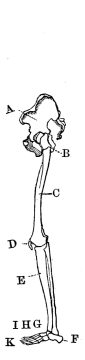
Fig. 5. Horse’s Leg
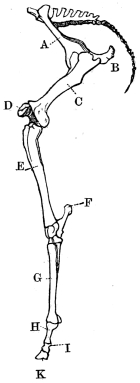
I must, however, resist the temptation to wander into this attractive field. It will suffice to take an illustration by a comparison of the bones of the human lower limb with those of the hind limb of the Horse. This may be easily done by the aid of these drawings (figs. 4> and 5) in which the two limbs are placed side by side, and the corresponding bones are marked with the same letters. Notwithstanding the many points of difference the same plan will be recognised in each. There is in each the thigh(C), the leg(E), and the foot, with the tarsal and metatarsal(G) bones, and the phalanges(H, I, K). But in the Horse two of the digits (the marginal ones, that is, the great toe and the little toe) are wanting, two are rudimentary, and the remaining one, which corresponds with the middle toe of man, in length, size, and strength, more than makes amends for the deficiency of the others. The lowermost bone, or terminal phalanx, of this huge toe, called the coffin-bone(K), is encased in the hoof, which corresponds with the human nail, and is the only part of the foot that rests upon the ground.
In Man the whole weight of the body has to be borne upon two feet; often it is balanced upon one. The foot is, consequently, spread out; and all the bones, from the heel to the tips of the toes, are made to form the basis of support upon the ground. The Horse, on the contrary, having no hands, but four feet, does not require so great breadth in each foot; and the opportunity is taken to narrow the foot, and to lengthen it so as to give fleetness. The end is attained by suppressing some of the toes, by elongating one far beyond the others, and enduing it with such strength as to enable it to carry the requisite weight upon the tip of the last phalanx. The heel(F) is raised high above the ground and becomes the “hock.” To speak of a horse kicking with his heels is, therefore, about as correct as to say, that he breaks his knees. His knee, as you perceive by the position of the “knee-cap”(D), is high up in the hind limb, near his body, quite out of harm’s way in a fall. The fact is, that he kicks with his toes; and, when he falls, he cuts the skin over the part in his fore limbs, which corresponds with the back of our wrists.
In the upper segment, or thigh, the difference between the two limbs is seen to be, to a certain extent, the reverse of what it is below. That is to say, whereas, in the Horse, the toe is elongated and thickened, so as greatly to exceed the corresponding part of the human limb; in Man the thigh-bone is elongated, so as to be double the length of that of the horse; the thigh-bone in man is also placed more vertically, nearly in the plane of gravity of the trunk. The horse’s thigh-bone slants forwards and outwards, which gives the muscles great power by causing them to run more at right angles between their points of attachment; and this arrangement increases the strength of the animal in drawing weights, and facilitates springing. A man cannot spring without first bending the limbs a little; whereas a horse, or a goat, can spring, at once, from the position in which it is standing.
To revert to the anatomy of the Human Foot.
The Arch of the Foot.
The seven tarsal and the five metatarsal bones—that is, the twelve bones of the instep—are arranged and jointed together so as to form an arch from the point of the heel to the balls of the toes. This is called the “plantar arch,” from the Latin word planta, the sole of the foot. The astragalus forms the summit, or key-bone, of the arch. It receives the weight from the leg, and transmits it, through the hinder pillar of the arch, to the heel, and, through the front pillar of the arch, to the balls of the toes.
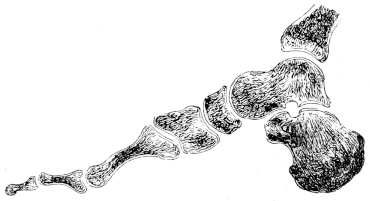
Fig.
6
.
The drawing represents a section, from behind forwards, of the lower end of the leg-bone, and of the bones lying along the inner side of the plantar arch. Behind it extends through the heel-bone, and in front through the great toe. It exhibits the arrangement of the fibres and plates in the interior of the bones, and shows that the greater number of them, in each bone, follow the direction of the two pillars of the arch; that is to say, they descend from the summit of the arch where it supports the leg-bone, backwards and downwards, to the heel, and, forwards and downwards, to the balls of the toes. Their arrangement is, therefore, such as to give resisting strength to the bones in the directions in which it is most required.
You may think that the arch of the foot would have been a much simpler structure, as well as stronger, if it had been composed of one bone instead of several. But it must be remembered that it would, then, have been liable to be cracked and broken by the sudden and violent manner in which, during running and jumping, the weight of the body is thrown upon it. Moreover, the several bones, where they touch one another, are covered with a tolerably thick layer of highly elastic gristle or cartilage (represented by the clear line left in the drawing along the contiguous edges of the bones); and this provision, together with the slight movements which take place between these bones, gives an elasticity to the foot and to the step, and serves to break the jars and shocks which are caused by the sudden contact of the foot with the ground.
This last is a very important point; and we find numerous contrivances in different parts of the body to protect the brain and other delicate organs from jars. So efficient are these contrivances, and so exact is the adaptation of the mechanism of the limbs and the trunk to the texture of the internal organs, that, while these are in a healthy state, we are able to run, to jump, and to leap from a considerable height, without inconvenience. But, if the organs be inflamed, or if the nervous system be over sensitive, as in common headache, the provisions, which are calculated for the normal state, are insufficient; ordinary movements are then painful, and to jump is intolerable.
The muscles play a very essential part in this work. First, they place the limbs in the most favourable position. Thus, when we alight upon the ground, from a height, we always contrive to do so with the knees and hips a little bent, so that the limbs readily yield at the joints, and act as springs to break the jar. Elderly persons commonly keep the limbs bent, even when walking quietly along. They do this because they need all the benefit which position will afford to make amends for the loss of elasticity consequent on the thinning and drying of the cartilages, and other changes that take place in the body with advancing years. Secondly, the muscles brace the limbs and joints in the position in which they have placed them. We experience the effect of the want of this salutary influence when we kick against an unseen object, or fall suddenly, or receive any blow or shock for which we are unprepared. How disagreeable, to say the least, it is to make the step for an additional stair when we have arrived at the top of a staircase, or, still worse, to meet with an unseen stair when we think that we have got to the bottom.
You perceive from the drawing (fig. 6) that there is a great difference between the two pillars of the plantar arch. The hinder pillar is comparatively short, and narrow, and descends suddenly, almost in a vertical direction, from the ankle, to the ground; and it is composed of only one bone—the heel-bone—which is jointed directly with the astragalus: whereas the fore pillar is longer and broader, is composed of several bones jointed together, and slopes much more gradually to the ground. There is, therefore, far less elasticity in the hinder part of the foot than in the fore part. Hence, when we descend from a height upon the ground, we always alight upon the balls of the toes, and thus gain the advantage which the several bones and joints afford in breaking the shock. If, after going up stairs this evening, you take the trouble to come down again, you will find that you alight upon each stair on the balls of the toes and experience no inconvenience, however quickly the descent is made. But, if you change the mode of proceeding, and descend upon the heels, the feeling will be by no means agreeable; and the various organs of the body, being disturbed from their accustomed repose, will raise such remonstrances against your infringement upon nature’s ways, that you will scarcely be able to continue the experiment. Proportionately more distressing is the sensation caused by jumping from a chair upon the heels. Indeed, this is not done altogether without risk; and the trial of it is scarcely to be recommended to persons who have attained to that sober period of life at which we are willing to concede that, in some things, nature is wiser than ourselves. Only a short time since I saw a gentleman, who, in jumping down some steps into a back yard, accidentally came upon his heels, and jarred one hip so severely that he was confined to his sofa for several days in consequence.
But, you may say, “in walking we do place the heel upon the ground first and experience no inconvenience.” True, because the force with which the foot descends in walking is very slight; and the weight is directed upon the heel, obliquely, in such a manner as to bring the toes very quickly to the ground, and really to throw nearly the whole force in that direction. Moreover, you may observe that when we walk, the weight of the body is partly sustained by the fore part of the one foot till the whole of the other foot is on the ground. I will, however, revert to the disposition of the feet in walking and running presently.
The arch of the foot has to bear great weight and at great disadvantage; and there is very little in the shape of the bones to maintain its integrity. Indeed, they all fall asunder when the other structures are removed, the key-bone dropping through of its own weight. And the same thing may be remarked throughout the skeleton. Wherever two or more bones move upon one another, their surfaces are so constructed that they do not hold together without some assistance from the soft parts. There are joints in the body which we call “hinge-joints,” and others which we call “ball-and-socket joints;” but in none of them is there such a holding and locking of one part in the other as you have in the hinge and the ball-and-socket of the mechanic. In every case the bones are held together, not by their own shape, but by ligaments and muscles. Consequently, any one of the bones may be dislocated from those next it without breakage; and when the muscles and ligaments are cut through, or have been destroyed by maceration, all the bones, between which any movement was possible during life, separate from one another.
Not only is this so, but in no instance are the movements of joints limited simply by the shape of the bones—that is to say, they are never brought to a stop by a part of one bone coming into contact with the edge of another. Such a contact would have caused a sudden check; and this would have been attended with more or less jar and with some danger of chipping and breaking the articular edges. The range of movement of a joint is always regulated by the ligaments or the muscles, not, directly, by the bones; and the restraint thus imposed upon the movements is brought to bear, not suddenly, but gradually; somewhat like the effect of the “break” upon a railway-train; while the cartilages between the bones may be compared with the “buffers” between the carriages.
It is chiefly by means of strong Ligaments, or sinewy bands, passing from bone to bone, that the shape of the plantar arch is maintained and the movements of the bones upon one another are regulated and limited. These ligaments are numerous; but I will mention only two.
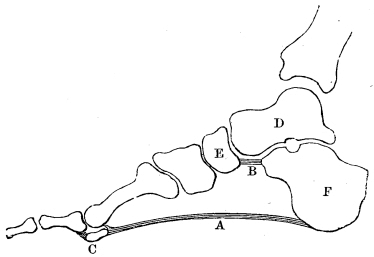
Fig.
7
.
One, the Plantar Ligament (A, fig. 7), of great strength, passes from the under surface of the heel-bone, near its extremity, forwards, to the ends of the metatarsal bones; in other words, it extends between the lowest points of the two pillars of the arch, girding, or holding, them in their places, and preventing their being thrust asunder when pressure is made upon the key-bone (D); just as the “tie-beam” of a roof resists the tendency to outward yielding of the sides when weight is laid upon the summit. The ligament, however, has an advantage which no tie-beam can ever possess; inasmuch as a quantity of muscular fibres are attached along the hinder part of its upper surface. These instantly respond to any demand that is made upon them, being thrown into contraction directly the foot touches the ground; and the force of their contraction is proportionate to the degree of pressure which is made upon the foot. Thus they add a living, self-acting, self-regulating power to the passive resistance of the ligament. In addition to its office of binding the bones in their places, the ligament serves the further purpose of protecting from pressure the tender structures—the blood-vessels, nerves and muscles—that lie above it, in the hollow of the foot, under the shelter of the plantar arch.
Another very strong ligament (B in the wood-cut) passes from the under and fore part of the heel-bone (F) to the under part of the scaphoid bone (E). It underlies and supports the round head of the astragalus, and has to bear a great deal of the weight which is transmitted to that bone from the leg. It does not derive the same assistance from a close connexion with muscular fibres as the ligament just described; but it possesses a quality, which that and most other ligaments do not have, viz. elasticity. This is very important, for it allows the head of the key-bone (D) to descend a little, when pressure is made upon it, and forces it up again when the pressure is removed, and so gives very material assistance to the other provisions for preventing jars and for giving ease and elasticity to the step.
A glance at the drawing will show you that here is a weak point in the foot. The head of the key-bone receives great weight from the leg, but is comparatively unsupported; and there is a considerable strain upon this part when the heel is being raised in walking. Moreover, a good deal of movement takes place between the key-bone (D) and the scaphoid bone (E), more than between any other two bones of the instep; and freedom in the range of movement is generally attended with some sacrifice of strength. The strong elastic ligament comes in therefore with peculiar advantage at this point; and it is underlaid, and additional support is afforded exactly when it is most required, by the tendon (b in fig. 12) of a strong muscle, the especial office of which is to assist in raising the heel and bending the instep, and which runs, from the back of the leg, behind the inner ankle, to the scaphoid bone.
Weak Ankle and Flat-foot.
In spite, however, of the thick elastic ligament and the strong tendon just mentioned, the joint between the astragalus or key-bone and the scaphoid bone still remains a weak point. The head of the key-bone, from being insufficiently supported or from being overweighted, is very apt to descend a little below its proper level; the consequence of which is that the plantar arch is lowered and the foot is flattened; and the more the foot is flattened the weaker it necessarily is, because the position of the bones then becomes less and less favourable for bearing weight, and an increasing strain is thus incurred by the ligaments and muscles. Hence the foot and ankle feel weak; and the weakness is especially felt when the person endeavours to raise the heel, so as to mount upon the balls of the toes, in walking. For the performance of that movement with ease and steadiness a well-formed plantar arch is essential; and the person, whose feet are defective in the manner we are considering, can never walk with a bold, firm step. The movement in him may be better described as a shuffling from one foot on to the other, than as a walk. To this I will recur again when I come to speak more of walking. The defect, when slight in degree, is commonly called “weak-ankle;” when more decided it is called “flat-foot,” because the sole is then nearly, or quite, flat. The head of the key-bone, under such circumstances, may even bulge downwards and inwards, and form a prominence on the inner side of the sole, so as to give more or less convexity to the line on the inner side of the foot, which should be concave.
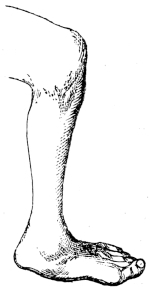
Fig.
8
. Flat-foot.
The representation of “flat-foot” here shown was drawn from the foot of a labouring man in this county. He said he believed the deformity was due to his having worn thick tight shoes when he was a growing boy. He is most likely right in his opinion; for tight or ill-fitting shoes, cramping the feet and preventing the proper growth of the bones and the free play of the muscles, are a common cause of this evil. This is so especially among the agricultural class, whose feet are, from an early period, enclosed in stiff unyielding leather cases that are enough to mar nature’s best efforts to construct a plantar arch.
The same drawing shows that flat-foot is not the only deformity for which “high-lows” are answerable. Besides the almost total want of calf, which is due to the wearer being obliged to hobble along, whole-footed, with short feeble steps, it will be seen that the great toe has not been allowed to assume its natural straight line, but has been squeezed athwart the other toes, so as to be almost at a right angle with the foot. No room at all is thus given for the second toe; it has been driven quite out of the field, and has been obliged to hide itself by bending down under the other toes. This is no uncommon state of things. Frequently it is attended with the formation of a painful bunion upon the prominent inner side of the ball of the great toe; and, in addition, there is sometimes a corn upon the first joint of the second toe, which is a source of so much inconvenience that I have known many sufferers glad to get relief by parting with the toe.
I wish I could hope that the days of high-lows are numbered, and could believe that in the next generation they will be ranged with the things of the past, and that our children may know these enemies to the form of the rustic foot, only as objects to be gazed upon with feelings of astonishment and pity, just as we regard the perukes and the stays of our ancestors. There are, however, some practical difficulties in the way of the fulfilment of this charitable wish.
There are two periods of life at which Flat-foot is most likely to be engendered. First, in infancy, if the child be put upon its feet too early, before the bones and ligaments are strong enough to bear the weight of the body. Therefore mothers should not indulge their anxiety to see their infants walk very early; the pride attendant on premature success is liable to be followed by regret at finding that the children never walk well. Parents and nurses should be content to let the children crawl and roll about upon the floor, and should not encourage them to stand upright, especially if they be rather heavy or weak children. Children are quite sure to acquire the faculty of walking as soon as they are well fit to exercise it.
The second period is at about fourteen. The body attains a considerable increase of weight at this time, in consequence of the quick growth that takes place. We often remark that lads and girls of this age shoot up apace; and their greater weight is not always attended with a proportionate acquisition of strength. They are apt to be rather weak and ungainly in their movements; and the weakness often shows itself in the foot, by a yielding of the plantar arch. Moreover, many boys and girls are, at this age, turned out into the world to earn a livelihood, and are obliged to be a good deal upon their feet, and perhaps, in addition, have to carry weights. Thus errand-boys, butchers’ and bakers’ boys, and young nursery-maids, are frequent sufferers in this way. The constrained positions in dancing, also, if enforced too much, or continued too long, so as to tire the feet, sometimes lead to the same result. On the other hand, moderate exercise of this kind is calculated to strengthen the foot and also the whole frame, and contributes much to improve the carriage.
This is not the place to enter into particulars of treatment. I will, therefore, merely remark that the common notion of supporting and strengthening the ankles by tight-laced boots is altogether a mistake, and must be ranked among the most influential of the causes which combine to spoil so many feet. It has its parallel in the idea of strengthening the waist by stays. The notion is, in both instances, fortified by the fact that those persons who have been accustomed to the pressure, either upon the ankle or the waist, feel a want of it when it is removed, and are uncomfortable without it. They forget, or are unconscious, that the feeling of the want has been engendered by the appliance, and that had they never resorted to the latter they would never have experienced the former; just as dram-drinking induces a recurrence to the stimulus by causing a sense of sinking when it is discontinued; and, for the same reason, the opium-eater can hardly exist without his drug.
The Movements of the Foot.
We come now to the Movements of the foot upon the leg; and rarely do we contemplate anything more calculated to excite our admiration. Consider their variety, the rapidity with which they take place, in order to effect the requisite succession of positions in walking and running, and to adapt the sole to the inequalities of the surface on which we tread; and remember the great weight which has to be sustained while these movements are going on: yet, how seldom is there a failure.
This combination of variety of movement with security is effected by the employment of three joints, each of which plays in a direction different from the others, while all act harmoniously together.
One of the three joints—strictly called the “ankle-joint”—is between the leg-bones and the foot-bones, that is, between the tibia and fibula, above, and the astragalus beneath. By means of it the foot may be bent or straightened upon the leg; in other words, the toes may be raised or depressed. In this movement the heel participates, being depressed when the toes are raised, and vice versâ. A second joint is between the astragalus and the heel-bone. It permits the foot to be rolled inwards or outwards upon an antero-posterior axis; so that the sole may be turned inwards, with its inner edge upwards, or may be turned down so as to be placed flat upon the ground. A third joint is between the first and second row of tarsal bones—that is, between the astragalus and the heel bone, behind, and the scaphoid and cuboid bones in front. It permits the degree of flexure of the tarsal or plantar arch to be increased or diminished.
Had the several movements which are requisite for easy walking all taken place in one joint, that joint must necessarily have been very insecure; indeed, it must have been a “ball-and-socket” joint, and we should have been poised upon our feet in the state of what is called “unstable equilibrium”—a state quite incompatible with security or strength, and which would have rendered the assistance of the upper limbs essential to either standing or walking.
An instance of a similar kind of mechanism to this of the joints between the foot and the leg is presented by the mode in which the head is secured upon the back-bone. We can nod the head upwards and downwards; we can turn it to either side in so free a manner that we are able to command with our eyes the whole circle in which we sit simply by the movements of the head; and we can incline the head to the right or to the left. Any of these movements may be made very quickly; and there is a separate joint or joints for each of them. Thus, the nodding movement takes place between the head and the first vertebra or uppermost bone of the spine; the turning of the head from side to side takes place between the first and second vertebræ, the head with the first vertebra rotating upon a pivot projected upwards from the second vertebra; and the inclination of the head from side to side takes place by movements of the second vertebra upon the third, of the third upon the fourth, and so on. The result is that, although the movements are thus varied, they are free as well as rapid. Yet the head is so well poised and so strongly fixed that the neck is able to bear it all day long without fatigue; and, as though the weight of the head, which is by no means inconsiderable, were not enough for the neck, we are in the habit of selecting this as the part upon which to carry burdens. One never feels so strongly impressed with the carrying capabilities of the neck and the ankle, as when following men and women in mountain districts toiling up and down the hills under great bundles of hay, baskets full of bitter beer, and various things intended to minister to the comfort and luxury of travellers and the inhabitants at the top. So effectual, indeed, are the provisions for security that, notwithstanding the freedom and variety of their movements, the joints of the foot with the leg, and of the head with the spine, are, in proportion to their size, the strongest in the body.
I have stated the movements that take place in the three joints of the foot with the leg in a simple manner, for the sake of avoiding confusion. In reality, however, they are not so simple, but very difficult to analyse and make out correctly. The difficulty is due, partly, to the close proximity of the joints to one another, which renders it no easy matter to distinguish the movements of one from those of the others, and, partly, to the fact that the movements in each joint are a little oblique.
In the latter respect the foot-joints resemble most of the others in the body; and it is this obliquity in the movements of the joints, added to the curves and twists in the shape of the bones, that constitutes one of the chief difficulties in investigating and clearly understanding the mechanism of the human frame. It has been said that “Nature abhors a vacuum:” it may with equal truth be said that she abhors a straight line. In the Human Skeleton, at any rate, all the bones are bent and twisted, some in two or three directions; and the surfaces by which any bone is jointed to the adjacent bones, are invariably oblique with regard to each other.
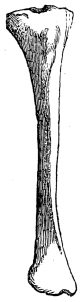
Fig.
9
.
Take, for instance, the tibia, or large bone of the leg, of which a front view and an inner side view are given in the drawings. The tibia is a column transmitting weight from the thigh to the foot; and in any machine of man’s construction a column fulfilling similar purposes would be made straight and of uniform diameter throughout. The bone, on the contrary, does not present the same thickness at any two parts of its length. It has a distinct bend, forwards, in nearly its whole length (fig. 10): there are lateral curves, alternating like those in the letter S, seen along its front (fig. 9): and the articular surface at the lower end is placed obliquely with regard to that at its upper end, in consequence of a twist in the shaft, in such a manner that when the hinder surface of the upper end of the bone rests upon a board, the lower end touches the board only by its outer corner (fig. 10). This disposition of the lower end, I may remark, assists to give the foot a slant outwards from the heel to the toe, so that when we stand, with the heels together, the great toes of the two feet diverge a little from one another.
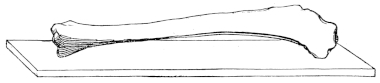
Fig.
10
.
Moreover, the surfaces by which the tibia is jointed with the thigh-bone at the knee are arranged with a varying degree of obliquity, so that the relation of the leg to the thigh varies somewhat in different positions of the limb. For instance, when we stand upright, the thigh slants inwards from the pelvis, and the leg descends in a vertical direction to the ground. While, however, the knee is being bent the leg is carried, not in a vertical plane, but a little obliquely, so that the lower part soon begins to slant outwards; and when the knee is fully bent the obliquity of the leg and that of the thigh correspond, and the leg is, as it were, folded up against the thigh. The heel is thus brought up, not to the middle line of the body, but to the hip, and we are enabled to sit with the hips upon the heels, as the Japanese are represented doing, or with one hip upon one heel—a position in which our riflemen are trained to take aim, and in which their predecessors with the arrow were wont to shoot, as is shown by the accompanying sketch of a bowman (fig. 11), taken from one of the Æginetan marbles in the Glyptothek at Munich.
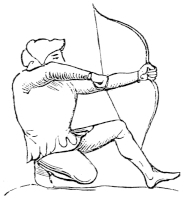
Fig.
11
.
A variety of purposes is attained by the curvilinear shape of the bones and the obliquity in the movements of the joints. Not the least of these is the appearance of elegance and ease which is given to the whole frame, both when it is at rest and when it is in motion. In order that you may fully appreciate this result, I would ask you, the next time you are in a gallery of antique statuary, to contrast the figures which the Egyptians have left us with those by the Greeks. In the former you will find that straight lines and right angles prevail: the figure sits, probably, bolt upright, with the elbows, hips, knees, and ankles bent at right angles: the fingers commonly run straight forwards; and a hand is often laid upon each knee, the limbs of the two sides being quite symmetrically placed. Such statues may be imposing; but they are stiff and unnatural. They represent positions which the body rarely assumes; and they, certainly, are far from pleasing. Very different is the Greek statuary. A correct representation of nature is the great difficulty and the highest consummation of art; and the Greeks evinced their greatness in art by a true appreciation and close imitation of natural form. The position of their figures is life-like; and, therefore, we love to contemplate them. The outline in them exhibits a graceful disposition of curves and obliques; and it is because the great sculptors of Greece were, in this and in other respects, so true to nature that their works have commanded the admiration, and served as models for the imitation, of all succeeding ages.
It is one of the master results of creation, and one of the peculiar marks of creative genius, that perfection and beauty are usually presented together. As truth is the soul of eloquence, so is perfection the soul of beauty. The works of nature are beautiful because there is so much excellence in them, such admirable adaptation to their purpose; and we find the works of man beautiful only so far as they are correct imitations of their great originals in nature, or show some approach to nature’s excellence. And man is the most beautiful object in nature because he is the most perfect, that is, because the purpose of his existence is the highest, and because his physique exhibits the most marvellous moulding to adapt it to its high purpose; because, in short, in him the material is wrought to such a point of refinement as to be the receptacle and minister of the immaterial.
The movements of the three joints between the foot and the leg take place in harmony. The following is the order observed. The raising of the heel is accompanied by a rolling of the foot inwards, and by an increased flexure of the plantar arch; and the raising of the toes is accompanied by a rolling of the foot outwards and a straightening of the sole.
The Muscles of the Leg and Foot.
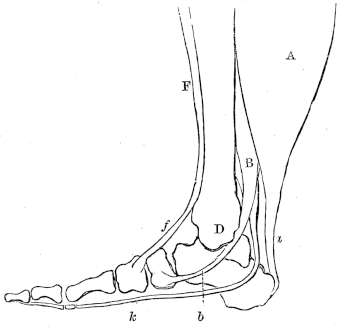
Fig.
12
.
The first series of the movements just described is effected, mainly, by three muscles. Of these one (A, fig. 12) raises the heel while the other two (B, fig. 12, and C, fig. 13) raise and support the ankle. The muscle which acts upon the heel is one of the largest and most powerful in the body; and well it may be, for in raising the heel it has to raise the whole weight of the body. Its fibres, accumulated at the middle and upper part of the leg, form the “calf;” below they taper into a thick tendon (a) connected with the hinder extremity of the heel-bone, and called the Tendo Achillis. The name, it need scarcely be said, refers to the tale of Thetis holding her son Achilles by this part when she dipped him in the river Styx. Her hand prevented the part from coming in contact with the water; and so it did not partake of the invulnerability which was conferred upon the rest of his body by the immersion. We read, accordingly, he was finally killed by a wound in the heel2.
The other two muscles (B and C) also descend from the leg and terminate in tendons (b and c) which pass, one on either side, behind the projections (D and E) which we call respectively the inner and outer ankle, to the inner and outer edges of the instep. They assist to raise the ankle, and support it so as to prevent its swerving from side to side; and they permit it to play to and fro upon them, like a pulley upon ropes running under it, in a safe and easy manner. The inner (b, fig. 12) of the two tendons passes, as before mentioned, beneath the head of the key-bone, and adds greatly to the strength of the arch. It is, moreover, the chief agent in effecting the two movements which are associated with the elevation of the heel, viz. the turning of the sole inward and the flexion of the foot.
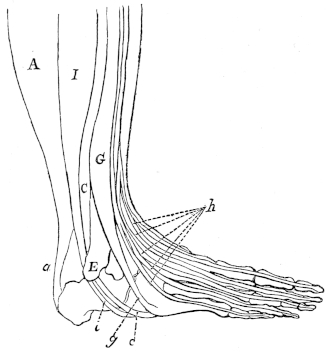
Fig.
13
.
The second series of movements—the raising the toes, the turning the sole downwards, and the straightening the foot—are effected by two muscles (F, fig. 12, and G, fig. 13), the tendons (f and g) of which pass, one in front of the inner ankle, and the other in front of the outer ankle, to the respective edges of the instep. These require much less power than their opponents; and the muscles on the front of the leg are, therefore, smaller and weaker than those behind.
A question of practical interest here suggests itself. How is the balance between these antagonistic muscles maintained, and the proper position of the foot preserved? If the muscles which cause the elevation of the heel and the other movements associated with it are so much stronger than those which produce the opposite series of movements, and if, as we know to be the case, muscles are always, even when a limb is at rest, contracting with a certain amount of force, why do not those of superior power gain and maintain the ascendancy, and hold the limb in the position to which they have a tendency to draw it? And why, in this instance, are not the feet kept with the heels raised and the soles inturned and bent? The reply is, that the ill consequence suggested is prevented, and a proper adjustment between the opponent sets of muscles, in this and other parts of the body, is effected through the medium of the nervous system. That system institutes friendly relations, and compels an orderly and harmonious action of the several muscles; and it does so by frequently exerting its influence upon them, keeping them in drill, as it were, and enforcing the habit of yielding in a kindly manner to one another.
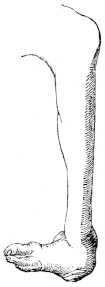
Fig.
14
.
Club-foot.
You have often observed, and perhaps wondered at, the almost incessant, semi-involuntary and, seemingly, meaningless movements of infants, especially the peculiar sprawlings out of their fingers and toes. Now these are for the purpose of keeping the different sets of muscles in practice and in order, till the will acquires a due control, when they gradually cease. They are going on before birth as well as afterwards; and when they are deficient, or when they take place irregularly, in consequence of an imperfection in the nervous system, the limbs are liable to become deformed. The feet, under these circumstances, are often drawn into the very position I have just mentioned; the sole is turned inwards and upwards, so as never to touch the ground; the heel and the toes are approximated; and the foot rests upon the ground on the outer side, or quite on the fore part, of the instep. Such a condition constitutes one of the most common forms of what is called “club foot.” Children are often born with one or both of their feet thus distorted. Happily, however, if they be submitted in time to the modern improved modes of treatment they may usually be set right. The accompanying woodcut gives a sketch of the foot of a young woman who had not the good fortune to be thus attended to.
The muscles compose the flesh or chief part of the bulk of a limb. The “calf” is almost entirely made up of the fibres of the “calf-muscle.” But at the ankle there are no muscles. As they descend the leg, all the muscular fibres disappear, and there are only tendons. These, though much thinner than the muscles, are very strong; and they are the cords or ropes by which the muscles pull upon distant parts. As they pass over the ankle they are strapped down close to the bones by means of stout sinewy cross-bands, which prevent their starting from their places when the muscular portions pull at them.
Two especial advantages result from this arrangement.
First, the lower part of the leg and the ankle are reduced in size. Thereby the resistance to the passage of the limb through the air is lessened; and when it is upon the ground, the leg is less in the way of the other foot which is swinging, to and fro, beside it. An elegance of shape is also thereby imparted. The “pretty ankle” owes much of its charm to the mode in which the tendons are disposed. How comparatively thick and clumsy would the ankle be if the tendons of the toes took the straight course represented by the line a in the drawing, instead of being bound down, as they are, to the curve of the ankle!
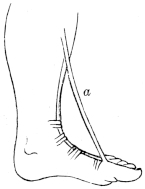
Fig.
15
.
Secondly, the obliquity with which the tendons run to their insertions is increased by this arrangement; and the velocity of the movements to which they minister is increased also. True, a loss of strength is involved in such a disposition, but the gain in velocity is of more importance. If (to refer again to the diagram, fig. 15) the tendon ran in a straight course from the front of the leg to the great toe, the angle at which it joined the toe would enable it to act with more strength; but the movements connected with it could not be so quick as they now are.
We find in the construction of the human frame many instances in which strength is sacrificed to rapidity of movement in this and other ways. Scarcely any conceivable amount of strength, for instance, would be an adequate compensation for a loss of that celerity of movement of the hand which enables us to strike a blow and drive a nail. No wonder, therefore, that strength is here sacrificed to obtain celerity. And the same principle holds good for other parts.
The length and direction of the heel affords a good illustration of the principle of which I am speaking. When the heel-bone runs out to a considerable distance, and nearly straight, behind the ankle, as it does in some of the lower animals and in the inferior races of mankind, it presents a better leverage to the calf-muscle, which is, then, enabled to raise the ankle with a less amount of effort; but there is proportionately less velocity. Accordingly, in the more perfectly formed foot, such as we find it in the higher races of mankind, the heel-bone, instead of running out backwards, descends very obliquely, almost vertically.
In this instance, the loss of strength, which is thus incurred for the purpose of acquiring celerity in movement, is usually compensated for by the greater development of the calf-muscle. Hence the high heel and the well-developed calf go together; and, like most of the other features of good bodily formation, they are, on the whole, best marked in the nations which are endued with the highest intelligence, and which are, in this way, physically, as well as mentally, qualified to occupy the foremost places in the human family. Thus, we may mark a relation between the heel and the brain; and, as the comparative anatomist is able by the inspection of a bone to trace out the skeleton to which it belonged, so might it be possible for the human anatomist, by observing minutely the peculiarities of the heel and the other features of the foot in any particular race of men, to form some estimate of the capacity and conformation of the skull, and thereby, of the amount of intelligence.
Contrast the foot and leg of the European (fig. 16), as represented in the drawing reduced from the Farnese Hercules, with those of the Negro (fig. 17), the drawing of which was taken from a native of Sierra Leone. In the former the leg is plump and the calf well developed; the foot is compact and well arched; the heel descends nearly vertically; and the inner ankle stands clearly out and is raised high above the ground. In the Negro the leg is thinner and the calf is not so well defined; the foot is long, flat, and sprawling; the heel is more horizontal; and the inner ankle does not show clearly, and almost touches the ground.
Fig. 16.
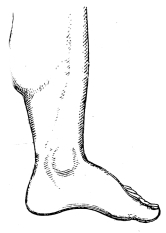
Fig. 17.
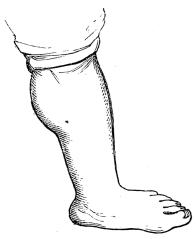
Fig. 18. European.
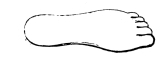
Fig. 19. Negro.
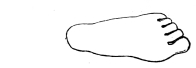
Contrast also the outline (fig. 19) of the foot of the same Negro with that (fig. 18) of an Englishman. Both were traced upon the ground, and reduced upon the same scale. The Negro was 5 ft. 2 in. in height; the Englishman was 6 ft.; both were of the same age: yet the Negro’s foot was considerably the larger. It was 11 inches long, 3 1/2 inches across the middle of the instep, and 10 1/2 inches round the balls of the toes. Whereas the Englishman’s foot was less than 10 1/2 inches long, was 2 1/2 inches across the middle of the instep, and 9 1/2 inches round the balls of the toes. Even in this simple outline how much less shapely is the African’s foot. Some allowance must be made for the fact that the Negro was more accustomed to go barefooted than the Englishman; and the pressure of the boot or shoe has, in some degree, the effect of giving compactness to the foot.
In the native Australian the leg is commonly still more lanky, there being less calf than in the African; and in the Monkey the heel is quite horizontal, the sole is flat, and the muscular fibres of the leg are continued low down, close to the ankle, instead of being concentrated higher up; so that the leg has nearly the same thickness from the knee to the foot, and there is no calf at all. Indeed, in the Gorilla (see fig. at page 91) the circumference of the leg increases towards the ankle. Thus, the calf may be regarded as the characteristic of Man; and a well-developed calf is a characteristic of the higher members of the human species. The pride, therefore, which is felt in a well-formed leg is not altogether a senseless folly, but finds some excuse in the fact that its foundation lies deep in the laws of physiology and ethnology. It must be confessed, that the fashion which, in the last century, dictated the knee-breeches, the silk stocking, and the shoe, evinced a truer appreciation of the dignity and beauty of the human figure than do the modern investments, which quite cover up the limbs, encumbering their movements and hiding the beauty of the leg and ankle.
In the addition of the high heel to the shoe we recognise an effort to improve upon the original, by exaggerating one of the peculiar features of the human foot; but it results in a failure, as is invariably the case with such strainings after a greater perfection than nature has given. It increases the apparent height of the person and of the arch of the instep; but it throws the weight too forward upon the toes, and detracts from the length and security of the step. Moreover, by causing disuse of the elevators of the heel, it interferes with the full growth of the calf.
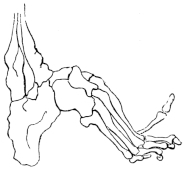
Fig.
20
. Chinese.
This is, however, a harmless piece of vanity in comparison with the monstrous efforts of the Chinese to mould the foot to their ideal by squeezing the heel and the toes together. They effect this to such a degree that (fig. 20) the heel-bone descends vertically from the ankle, the plantar arch is bent to an acute angle, and the foot is so crumpled up that all movement in it is effectually prevented, and the part is reduced almost to a mere stump. These observant and ingenious people have caught, it may be, the idea that compactness, elevation of instep, and sudden descent of heel are characteristics of the well-formed foot, and may urge that they are helping nature to perfection in the direction which she has herself indicated. But in their silly attempt at the preternatural, in this impious use, as it were, of fire stolen from heaven, they simply burn and cripple themselves, and render themselves ridiculous, and give to all other nations the much needed lesson that it is enough for man to follow as a humble imitator of his Maker’s works, and that his attempts to alter, or improve upon, any part of the wondrous design of creation will assuredly have the effect of spoiling and defacing it3.
It seems that the several races of mankind are usually rather proud of their peculiarities, and that each has an inclination to make much of, and artificially exaggerate, the points in which it differs from the others. Thus the Chinese are remarkable for the spareness of their hair and the smallness of their feet; so the men shave their heads, leaving only the pig-tail, and the women squeeze up their feet in the remorseless manner we have seen. The Singhalese, who are flat-footed, are said to consider it one of the requisites for a ‘belle’ that the soles of her feet should not have any hollow. The red Indians of America delight in staining and painting their skins of a lively red colour. The Columbian tribe of Indians increase the natural lowness of their forehead by flattening it out in infancy, and succeed in bringing about a deformation of the skull almost as remarkable in its way as is the effect of Chinese cramping upon the foot. These people also take pains to reduce the small quantity of hair upon their eyebrows, lips, and chin, by plucking it out.
Joints of the Metatarsus with the Tarsus.
Figs. 25.
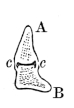
24.
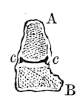
23.
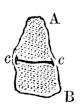
22.
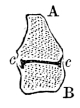
21.
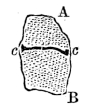
I will briefly draw your attention to one other point in the anatomy of the foot; and that is, the mode in which the “metatarsal” bones are jointed with the “tarsal.” If you take hold of the ends of the metatarsal bones—in other words the “balls”—of the great toe and of the two toes next to it, in your own foot, you will find that you can move them scarcely at all; they are firmly set upon the rest of the foot, almost as though they formed one piece with it. If you then try the end of the metatarsal bone of the fourth toe you will be able to move it a little upwards and downwards; and in the case of the little toe the movement is still more distinct. This difference depends upon the mode of construction of the joints of the metatarsal bones with the tarsal, which is easily understood by the aid of the accompanying drawings, representing sections, from above downwards, through these joints. In 21, 22, and 23, which are the tarso-metatarsal joints of the great toe and the two next it, the opposed surfaces of the bones between c, c, are quite flat, so that the only movement that can take place is a slight sliding of one bone upon the other, just enough to assist in breaking the jar, but not enough to interfere with the firm basis of support which these toes are required to afford to the plantar arch in consequence of the great stress of the weight in walking being borne upon this side of the foot. In No. 24, which is the joint of the ring toe, and still more in No. 25, which is the joint of the little toe, the end of the metatarsal bone (A) is rounded and is received into a corresponding concavity or cup in the tarsal bone (B). This allows a slight revolving of one bone upon the other to take place, and permits the movement which you discover when you grasp the balls of these two toes between your fingers. The outer part of the foot needs not to be so strong and firm as the inner part, because it does not lie so nearly in the plane of gravity during walking; and the provision just described, which permits some movement in the outer two metatarsals, enables the balls of the toes to adapt themselves to inequalities on the ground, and to share more equally, under various circumstances, the weight which is thrown upon them.
Standing and Stooping.
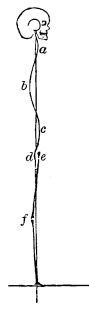
Figs. 26. Standing.
27. Bowing.
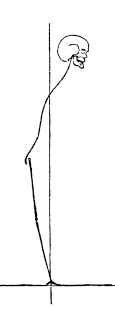
28. Stooping.
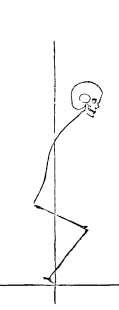
29. Squatting.
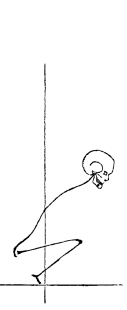
When we Stand straight upright (fig. 26) the centre of gravity of the head is directly over a point midway between the two ankles; and the plane of gravity, represented by the vertical line in the figure, descends, from the head, through the spine, pelvis, and lower limbs, to the key-bone of the instep. And you observe that, between the head and the ankle, the skeleton is not quite straight, but is arranged in six curves, which are, alternately, in front of and behind the line of gravity. Of these curves the upper three are in the spine. They are well marked; the uppermost (a) is in the neck and is directed forwards; the next (b) is in the back and is directed backwards; the third (c) is in the loins and is directed forwards. The fourth curve (d), less distinct than those above it, is in the pelvis and is directed backwards. The fifth and sixth curves are very slight; the fifth (e), directed forwards, is at the hip-joint; and the sixth, (f), directed backwards, is at the knee. The last two curves, though slight, are not unimportant; and they contribute very much to our comfort and to prevent fatigue when we are standing: they do so in the following way. The strong ligaments of the hip are placed towards the fore part of the joint, that is, in front of the line of gravity; and the strong ligaments of the knee are placed towards the back part of the joint, that is, behind the line of gravity. It follows that when these joints are fully extended they are “locked,” as it is termed, just as is a hinge when opened to a little beyond the straight line; and, by this means, the muscles are set at rest, and we are able to maintain the erect posture, for some time, steadily and without fatigue.
When standing upright in this way, at rest on both legs, or on one leg in the military position of “at ease,” and the muscles are off their guard, if a sudden and unexpected, though slight, pressure be made upon the ham, so as to bend the knee a little and throw the joint in front of the line of gravity, the man will drop, unless the muscles come quickly to the rescue—a tendency which has not escaped the observation of school-boys.
In Bending or Bowing (fig. 27) the head is carried forwards; and, to maintain the balance, the opposite pole of the trunk is carried backwards, so as to preserve the line of gravity still over the ankles.
In Stooping (fig. 28) or Squatting (fig. 29), as in picking up any thing from the ground, the lower limbs and the trunk are bent in a zigzag manner; the heels are raised; and the plane of gravity falls, in front of the ankles, over the balls of the toes. Now we recognise one of the advantages which accrues to man from the great length of his thigh. For the head and upper part of the trunk are advanced so far in front of the feet, that it would be impossible to maintain a balance at all, even upon the balls of the toes, and we should necessarily fall forwards, were it not that, owing to the length of the thigh, the lower part of the trunk is carried backwards to a plane behind the heels, and so serves to maintain the equilibrium.
Walking.
Figs. 30.
31. Walking.
32.
Figs. 33.

34. Walking.
35.

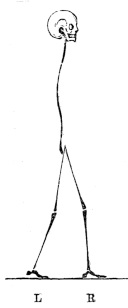
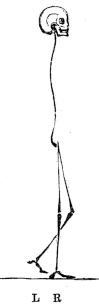
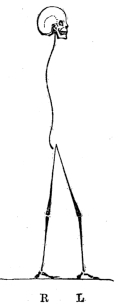
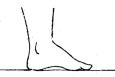
Let us next consider the part which the foot performs in Walking. To understand this it is necessary to consider its positions and movements in the several stages of a step. When first placed upon the ground the foot (R, fig. 30) is a little in advance of the body; and the heel comes first (fig. 33) into contact with the ground. The toes quickly follow; and the body, then, passes, vertically, over, the ankle and the key-bone of the instep. The foot (R, fig. 31 and fig. 34) now rests steadily upon the heel and the balls of the toes; the other foot (L) leaves the ground, so that the whole weight is borne by one foot; and the plantar arch of that foot expands a little, so as to cause slight lengthening of the foot, under the weight that is laid upon it. Much yielding of the arch is, however, prevented by the ligaments that brace the arch (fig. 7), and by the muscles that are disposed beneath it. Next, the heel (fig. 35) is raised by the action of the calf muscle, and the weight of the body is thrown forwards, over the balls of the toes, while the other foot (L, fig. 32) is carried onwards, and is placed upon the ground ready to receive the weight and commence its carrying work. When this has been done the foot is withdrawn from the ground; and, in the withdrawal, a final impulse onward is given, so as to throw the weight of the body fairly over to the other foot. The fore part of the foot is then raised, and the knee is bent a little. By these means the toes are kept clear of the ground, while the foot is swung forward, beside the other, so as to be ready again to rest upon the ground and bear the weight of the body.
In each complete step, therefore, there is a period during which the foot rests upon the ground, and a period in which it is swinging in the air. In walking the former period is considerably longer than the latter; and at the commencement, and at the end, of that period (figs. 30 and 32) the other foot is also upon the ground, so that it is only during the middle of the time (fig. 31) in which the foot rests upon the ground that it has to bear the whole weight of the body.
Running.
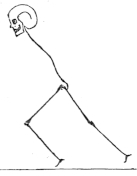
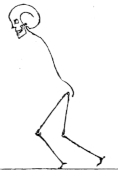
In Running the process is much the same as in walking. The chief difference is that, whereas in walking both feet are never off the ground at the same time, and both are upon the ground at the beginning and end of each step; in running both feet are never on the ground at the same time, and both are off the ground, and the body is flying unsupported through the air, at the beginning and end of each step (figs. 36 and 38). Thus, you may always distinguish running, though it be ever so slow, from walking, because, in the latter, the two feet are upon the ground at the same time; while, in the former, only one foot touches the ground at a time.
Figs. 36.
37. Running.
38.
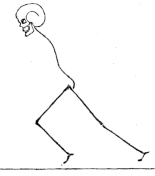
The period during which the body rests upon the ground in running is comparatively very short, being merely the time when one foot is set down in the middle of each step (fig. 37); and great force has, consequently, to be exerted to propel the body through the air during the whole remainder of the step. Hence the exertion of running is much greater than that of walking. In slow running the same parts of the foot are applied upon the ground as in walking, and in the same order; but in quick running the balls of the toes only touch the ground. The quicker we run the shorter, relatively to the rest of the step, is the time during which the foot rests upon the ground, and the greater, consequently, is the effort.
After the foot leaves the ground, in running, it is thrown up behind; and, at the same time, the fore part of the sole and the toes are turned a little obliquely inwards, so as to prevent their catching against adjacent objects. If the toes were turned out, when thrown up behind, it would present a very awkward appearance, and we should frequently be tripped up by their coming in contact with substances near which we pass. While the foot is being swung forwards the toes are gradually turned a little the other way. Thus, by the time they pass the other leg the toes have lost the inclination inwards, and are directed straight forwards; and when the foot has reached a point in advance of the other leg, and the sole is preparing to present itself to the ground, the toes are turned a little outwards. This turning of the foot inwards and outwards during its movement backwards and forwards, in each step, is a graceful movement, and may be compared to the “feathering” of an oar. It takes place, also, in walking, but is less marked than in running; and in many persons it can scarcely be discerned during walking.
The distinction between the paces of other animals resembles that between the walking and the running of man, and is equally definite. Take, for instance, the Walking, Trotting, and Galloping of the Horse. In Walking the fore and the hind limbs of the same side are moved together, or nearly together, but they do not leave the ground till the limbs of the opposite side are placed upon it; so that at one period all four limbs are upon the ground together. In Trotting the fore and the hind limbs of opposite sides move together; but, as in walking, neither of them are withdrawn from the ground till the opposite one has reached it4.
In Galloping, or Cantering, the horse springs or bounds with all four limbs at the same time; all the feet are thrown up nearly together; all are off the ground together; and all reach the ground again nearly at the same time ready for another spring. I say that the feet are all thrown up nearly, and not quite, together, because the fore and the hind limbs of one side take the precedence a little of the others, or “lead,” as it is called. The trained horse is taught to lead, habitually, with one, usually the right, side, because the motion is more steady when the horse is accustomed to gallop in one way than if he be allowed to vary it. Directly the horse begins to gallop, the rider knows, by the motion, whether he is leading with the proper leg. In some animals, as the Deer, the two fore and the two hind feet move together exactly in galloping. Anthony Trollope tells us that in Panama, Cuba, and other Spanish countries in the West, the horses are “taught to pace, that is, move with the two off legs together, and then with the two near legs. The motion is exceedingly gentle, and well fitted for those hot climates, in which the rougher work of trotting would be almost too much for the energies of debilitated mankind.” This pacing is probably only a quick walk.
When we walk the heels follow one another nearly in a straight line, as is shewn by “walking a chalk,” or more readily by walking along the line between the curb and the flagstone pavement; and the plane of gravity of the body corresponds with this line. There ought, therefore, to be no perceptible swerving of the trunk from side to side in walking. There should, also, be scarcely any rising or falling; inasmuch as there are provisions in the mode of bending the limbs (which I cannot here discuss) to prevent the body from being moved up and down during the step. The head and shoulders should be carried along nearly in a straight line. If it were otherwise, if they were moved in a zigzag or undulating manner, from right to left, or up and down, the space traversed in a given distance would be much increased, and there would be a proportionately greater expenditure of muscular force. By a beautiful combination of movements this is prevented, and a rectilinear course is maintained, while the weight of the body is transferred from foot to foot, in a succession of steps.
Only observe a good walker for a minute or two, and you will see how straight the head is carried along; and when your eye falls upon a person who “rolls in his walk” you perceive how ungainly are his movements, and you have an instinctive feeling that he is an awkward fellow. Whether you are disposed to make an exception in favour of the British tar, in consequence of his many other good qualities, I must leave you to judge. His peculiar gait on shore is probably due to his not being sufficiently practised in straight walking to counteract the effect of the lounging manner and general disregard for appearances which he acquires on board ship. Whatever the reason may be, though he has the better of us in a storm at sea, he certainly does not always appear to advantage on terra firma. Now that a general improvement in gait and step may be expected among landsmen, as a result of the volunteer movement, it becomes still more desirable that the sailor should participate in the good influences of the drill.
Although the heels follow one another in a line the toes diverge a little from the line, because the foot slants, as I have just said, somewhat outwards when it is placed upon the ground. It results from this position of the foot that the weight of the body descends upon it with a slight obliquity, inwards as well as forwards; and that is precisely the direction in which the foot is best prepared to receive weight. For, when the foot rests upon the ground in this position all the ligaments on the inner side (and they are very strong) as well as those beneath, are on the stretch; and the joints, with the exception of the ankle-joint, are as it were locked, so as to afford a secure, steady basis of support to the leg. When the weight of the body descends upon the foot in the direction mentioned a sprain rarely occurs. It is when the weight falls in the opposite direction, that is, more or less obliquely outwards, and throws the ankle out, that a sprain easily happens. Thus a slight inequality of the ground, or any other cause that tilts up the inner edge of the foot, is likely to lead to a sprain, especially when we are going down hill or down steps.
Here let me remark that a Sprain is the result of a stretching of some ligament, or other part, caused by an undue force being brought to bear upon it. The ligaments are very strong, and under ordinary circumstances are not very sensitive; and they are capable of offering great resistance to force applied in the direction in which they are calculated to meet it. But, if the force be applied in a direction in which they are not calculated to meet it, they are easily injured, and they become, then, very painful. The same is, also, likely to occur if the force be severe or sudden.
The muscles are a very great assistance to the ligaments, forasmuch as, by placing and retaining the joints in proper positions, they regulate the direction in which forces are brought to bear upon the ligaments. Moreover, by steadying or bracing the joints, they check or break the force and prevent its being suddenly imposed upon the ligaments. And the muscles, by virtue of their contractile property, have the capability of becoming tight in any position of the joint, which is an immense advantage; whereas a ligament having no contractility and, usually, no elasticity, is tight only in one position. The office of a ligament is to limit the movement of a joint in a particular direction; and, till the joint has assumed a certain position—till it is bent or straightened to a certain angle—the ligament does not come into play. During the bending or straightening of a limb the muscles regulate the movement, and bring it to a stop or check it before it has gone to its full extent; and, thus, the ligament is relieved from that sudden imposition of force which would result if it were required to check the movement of a joint in its full swing.
Accordingly, when the muscles are prepared and in proper action, that is, when they place the joint in a suitable position and duly support or brace it, a sprain very rarely occurs. It is when the muscles are unprepared, when we make a false step, or when the foot encounters an unexpected obstacle, and the weight falls suddenly upon the ligaments in an unfavourable direction, that a sprain occurs. A man jumps from a considerable height, or descends deep steps with a heavy weight upon his back, and no harm results; but he slips off the curb-stone, or treads unwarily upon a piece of orange-peel, or turns his foot hastily, to avoid some object on the ground, and sprains his ankle.
In order that they may do their work well, be alert, and maintain good guard, the muscles need to be kept in practice. A person unaccustomed to throw a ball is very liable to sprain his elbow with the sudden jerk which is required for that feat; or if a person takes to tumbling and jumping, without proper training, he will probably suffer for his temerity. Again, common experience tells us that a joint which has been sprained is, for a long time, liable to be sprained again. This is because the part remains tender as well as weak; and the muscles do not brace it steadily and firmly, or come nimbly to its aid when it is in danger.
In consequence of the foot, in walking, being placed upon the ground with the toes slanting a little outwards, the outer and hinder edge of the heel first touches the ground. Hence this part of the heel of the shoe is usually worn down before the remainder. The ball of the little toe next comes to the ground, and the balls of the other toes follow in quick succession; and it is from the great toe—that is, from the inner side of the foot—that the last impulse is given to propel the body, forwards, over the other foot. In order to give full effect to this final impulse an especial muscle, the “Long Fibular” muscle (I in fig. 13), is provided. The tendon (i) of this muscle passes, behind the outer ankle, beneath the sole of the foot, to the great toe. It has the effect of pressing the ball of the great toe upon the ground, while it raises the outer ankle, and so contributes to throw the weight, across, in the direction of the other foot.
Thus the foot revolves upon the ground, from the heel to the balls of the toes, and from the outer edge of the former to the inner edge of the latter; and during the revolution, which has been compared, though the comparison fails in many points, to the revolving of the segment of a wheel, the ankle is raised and advanced forwards.
On the complete and steady execution of this movement good walking chiefly depends, more particularly upon the full performance of the last stage of the process, viz. the rising fairly upon the balls of the toes and delivering the weight steadily over to the other foot. This is the most difficult part of the process, the whole weight of the body during its execution being borne upon the fore part of the foot, that is, upon the longer pillar of the plantar arch; forasmuch as the heel is being raised and the other foot is off the ground. For the good performance of this part of the process, all the features of the well-made foot are essential. There must be a high and firm plantar arch, a heel set at a proper angle, and a strong great toe running straight forwards. There must be also a fully developed calf to set the machinery well in motion.
If the plantar arch be low it cannot bear the strain attendant upon this movement; and the person, in consequence, shirks the full performance of it. He does that by turning the toes too much out; and, then, he contrives to roll over the inner side of the foot, instead of rising upon the balls of the toes; and so he gets along with short, shuffling, feeble steps. How many persons, owing to one cause or other, hobble in this way! Some turn the toes very much in, and rise over the ball of the little toe, instead of over the great toe. This is done with comparative ease, because the ball of the little toe is nearer to the ankle; but the step is, thereby, shortened, as well as rendered less firm and less graceful.
The revolving movement of the foot, or the bringing of its several parts into contact with the ground in succession, in a distinct manner, is peculiar to man. Many animals do not bear upon the heel at all; they only tread upon the toes, and are, therefore, called Digitigrade. Some, indeed, bear only upon the tips of the toes, as the Horse (fig. 5, p. 15). Others go upon the balls of the toes, as the Cat, the Hare, the Pig, and the Dog. Some animals bear upon the heels as well as the toes, and are called Plantigrade, as the Bear, the Badger, and the Monkey; but these all flop the sole upon the ground in its whole length at once. The foot in them is not sufficiently compact and strong to bear the weight of the body first upon one part then upon another; and they, consequently, walk in an ungainly manner, as compared with man.
Character evinced by manner of Walking.
Bear in mind that for the firm vigorous walk there is required, not only the well-formed limb, but also the manly and determined Will, acting in a decided and authoritative manner over the several members of the body, so that these are accustomed readily, and steadily, to obey its commands; just as the soldiers of a well-drilled regiment obey the directions of the superior officer in an orderly and efficient manner. And, as you may judge of the character of the officer by the discipline of his men, so may you form an estimate of a man by the movements of his limbs. You see a man walk along the street, and you instinctively form an opinion of him by the mode in which he carries himself and treads the ground. Be careful not to allow yourselves to be inflexibly biassed by these first impressions, as that amounts to prejudice. Nevertheless, experience tells us that they are not to be altogether despised. They originate in a perception of the working of the great laws by which body and mind are harmonized; and, if fairly estimated, they rarely deceive us.
We have little difficulty in recognising three chief classes among pedestrians. First, there are those who pay too much attention to the movements, who walk with a pompous strut, or a mincing gait, or affect some style or other. We are naturally very little inclined in favour of such persons; indeed, we have usually to make an effort not to be decidedly prejudiced against them. Secondly, there are those who pay too little attention to their movements, who do not seem to be sufficiently alive to the responsibility attaching to the possessors of so noble a structure as the human frame, and who do not give themselves the trouble to exert the powers of the glorious mechanism with which they are charged. They slouch, or dawdle, along in a listless lazy manner. Instinct tells us, and tells us rightly, to beware how we trust such persons with the conduct of our affairs, or with any office of responsibility. We feel that the lack of energy manifested in the guidance of their limbs is, too probably, a feature of character, which unfits them for the active duties of life; and we know that such men are not usually successful in their calling. Thirdly, there are those who shew, by the firmness and precision of their step, and by the regularity in the succession of the movements by which the step is made, that they are conscious of the dignity of their species, of the responsibility attendant on that dignity, and of the respect due to themselves. Such men we feel are likely to pursue their avocations energetically and methodically, as well as with punctuality.
Many points of character peep out in the way men walk. Our poet tells us that in one we may read
“rascal in the motions of his back And scoundrel in his supple sliding knee.”
Another has a halting, shuffling, undecided gait; while a third walks in a bold, determined, straight-forward, erect and independent manner. One has a cautious, parsimonious step, as if sparing of shoe-leather, or afraid to trust the ground; he has, however, probably, trusted the funds with considerable investments. Some walk with long, pretentious, measured strides; others make short, quick, insignificant steps. Some, again, are hurried, fussy, noisy; while others glide along in a quiet, shrinking, unpretending, it may be timid, manner.