Front matter (continued 3)
Reading edition
Jasper rode straight for Stonehanger in about as black a temper as a man can boast. He had no very definite ideas as to what he meant to do. Feeling violent, savage, and very much befooled, he just rode toward Stonehanger, letting the impulse of his jealousy urge him thither.
The track he chose came from the south over the common, leaving Bramble End lying half a mile to the south-east. Jasper passed the quarry where Tom Stook said that De Rothan had sometimes left his horse. Jasper peered into it, and found the quarry a mere pit full of broom and brambles, its entrance half choked by a big elder-tree. But there were trampled places here and there, and a rough path that led out on to the common.
Any one approaching Stonehanger from the south had all but the roof and chimneys of the house hidden from him by a heave of the ground. Then one came into full and sudden view of the place with its grey terrace and wind-blown trees. Such a passion as jealousy often provokes the opposites of a man's normal nature, and Benham developed a spirit of wariness and cunning. He dismounted as soon as he saw the chimneys of the house, found a spot amid the furze where he could fasten Devil Dick to the tough stem of a furze-bush, and went on foot.
The windows and terrace rose into view, with the wind-blown yews and thorns, and then the stretch of grassland immediately below the terrace. It was here that Jasper dodged down behind the furze like a stalker sighting a stag. The lines of his face grew hard and keen. He took off his hat, and, thrusting it into the furze, made a sort of loophole between the boughs through which he could watch Stonehanger unobserved.
A man was walking to and fro on the grassland below the terrace, flourishing a stick as though he were trying the suppleness of his wrist for sword-play. Sometimes he would pause and draw imaginary patterns on the ground with the point of the stick. Or he would stride as if measuring the ground, look about him critically, and scan the surrounding country. There appeared to be some purpose in this pacing to and fro. The man might have been an engineer surveying the ground for the throwing up of earthworks and the placing of guns.
The man was De Rothan. Jasper knew him by his height, by his black clothes, and his haughty, swaggering walk. Only De Rothan could have flourished a stick with such gusto.
Jasper looked grim.
"Hallo, so it's you, is it! Tom Stook was right. What the devil do you think you are doing marching about up there?"
He watched De Rothan jealously, thoughtfully.
"Measuring the ground? Trenches and redoubts? By George, that's it! Why did I never think of that before? Stonehanger would make one of the strongest positions for ten miles round. A landing party might seize it and hold on——. Hallo!"
He was all eyes for the moment, for another figure had appeared upon the terrace. Jasper could see only the head and shoulders behind the low wall. It was Nance Durrell, a white sun-bonnet covering her black hair.
He saw her come to the edge of the terrace and look over. The white strings of her sun-bonnet were over her shoulders. She rested her hands on the parapet and watched De Rothan pacing to and fro below.
Jasper became for the moment the most violent of cynics. A sense of his own ineptitude tormented him. He believed that he understood all that was happening up yonder.
De Rothan turned and caught sight of Nance. He gave her a magnificent bow, sweeping hat and stick with splendid expressiveness. As for Benham, the toe of his boot alone could have expressed his emotions.
"Coxcomb—dog of a spy!"
They were talking together up yonder, and Jasper could hear the faint sound of their voices. Nance appeared to lean forward over the parapet with an intimate friendliness that did not ease Jasper's jealousy.
De Rothan approached the steps. He mounted them, turned to the right and sat himself down on the parapet within a yard of Nance. He laid his hat beside him and tapped one of the coping stones with his stick. Nance did not edge away. She perched herself facing him. It was evident that they were talking together.
Jasper imagined all manner of intimate confidences passing between them. Confound De Rothan, he seemed on excellent terms with the girl! No doubt that was why the Frenchman had looked him over with such amused insolence when they had met.
Jasper knelt awhile behind the furze, gripping his coat collar with one hand, and staring hard at the green gorse. He was ready to believe that De Rothan was Nance's lover, and a passion of repulsion held him for the moment. The anger in his blood was a cold and ugly anger. A man feels the more bitter when he has reason to despise himself.
Then a thought struck him.
"Yes, by George! That's it! I'll make sure of the man. Tom Stook shall have a look at him."
He started up, and, keeping his body bent, made his way back toward his horse.
"I'll make sure that Monsieur de Rothan is Tom Stook's man. Then, by George! I'll call him to account."
XVII
In half an hour Jasper Benham was back in the turnip field on the Rush Heath land where Tom Stook was still wielding his hoe.
"Tom, can you trot four miles at a stretch?"
"Lord, sur, what for?"
Jasper told him as much as he could tell such a man as Tom Stook.
"I'd take you up behind me, but you're such a big fellow, Tom. Leave your hoe in the hedge, and hold on to my stirrup. I'll tell you more as we go along."
And so they set out for Stonehanger.
They went by way of Bramble End, Jasper leaving Devil Dick tethered in Stook's little cow-lodge. Rogue Tom had come by a pretty shrewd notion of what Jasper Benham expected of him. He took the lead as they made their way over the common.
"No nag in t' old quarry, sir?"
"No."
"T' crossways at Dudden's Oak, that be the spot, then, Master Jasper."
"Sure?"
"Mounseer has to cross t' ridge. Let him take what track he will, he'll come to t' crossways at Dudden's Oak, unless he goes by t' woods and ditches."
Jasper agreed. Stook was a fox who knew the country.
They skirted the upper part of the common, and took a farm track that led to the crossways at Dudden's Oak. The old tree, a huge shell with its boughs half dead, stood in the centre of a triangular piece of grass. There was a wood between two of the converging roads, and Jasper laid Tom Stook in ambush in this wood.
"You'll get your glimpse of the gentleman, Tom, if he comes this way."
"I'd be glad to get a sound o' t' furriner's voice."
"You'd know him by the voice?"
"I've heard him speak in t' dark. If I see him and sound him I'll know 'em all for t' same man."
Jasper leaned against the trunk of the old oak with his face toward the two ways that led south-east and south-west. De Rothan might come by either road. Nor had Jasper been there fifteen minutes before he saw a mounted man appear far down under the oak boughs on the Rookhurst track. It was De Rothan himself, jogging along at a comfortable trot, yet sitting very straight and stiff in the saddle, like some grand seigneur riding over his estate. Jasper waited for him on the green point of grass between the two roads. He had seen Tom Stook's brown face thrust itself momentarily between the hazel boughs like the face of a satyr. He was on the alert.
De Rothan recognised Jasper when he was within thirty yards of Dudden's Oak. A slight knitting of the brows betrayed his impatience. But he came on with all the fine and unembarrassed confidence of a grandee.
Jasper stood forward with a sweep of the hat.
"I must ask you to stop, sir."
De Rothan pulled up, and gave Jasper a stiff bow. He was high in the stirrups of his dignity, and ready to play the grand monarch.
"Good day to you, Meester Benham."
"Good day to you, Chevalier. Will you be so good as to tell me whence you come, and where you are going?"
De Rothan looked haughty.
"Indeed, sir, by what right do you ask these questions?"
"By a right that it is not yours to question. I am a King's officer and we have our orders. You will be so good as to answer me."
"I take it as a reflection on my honour."
"Take it as you please. We have to supervise the comings and goings, even of our guests."
"Meester Benham, do you suggest——?"
"I ask you to answer my question."
"Your way of asking it is insolent."
"I stand by my orders. We are neither of us here to question them."
De Rothan appeared to do some rapid thinking. Then he gave an irritable shrug of the shoulders.
"I suppose an exile has to suffer suspicion. If you would know it, sir, I have been riding to exercise myself and my horse. I rode from my house to Stonehanger Common; I ride back again to my house. Is that what you require?"
"I take your answer at its value, sir. You may pass on."
De Rothan looked at Jasper as though he were half-minded to ride him down. He appeared to swallow something. He was a man who preferred to make very sure of success before he struck.
"I am deeply beholden to you, Meester Benham, for your serene patronage. There are things that we do not forget."
"Remember them when you please, Chevalier."
"I choose my own time, Meester Benham. I do not chastise insolence until the occasion suits me."
Jasper gave him a vicious smile.
"Do not postpone it too long, sir. We do not live so very far apart. Good day to you."
De Rothan rode on.
Then Tom Stook's brown face appeared. It was one broad grin.
"T' same furriner—all over. I've seen him meet t' smuggling Frenchy—Jerome. That be him, Master Jasper."
"Well, he's a liar, Tom."
"Liar! All Frenchies be liars. Good for you, Master Jasper."
Jasper sent Tom Stook home with a silver crown in his pocket, and rode back alone to Rush Heath. He wanted to worry this matter out, to think out his plans for dealing with Durrell and De Rothan. Jasper had no desire to drag the whole neighbourhood into the adventure. In a way it was his own affair, and he meant to carry it on his own shoulders. His motives and emotions were jumbled together. The one outstanding fact was his determination to break De Rothan. He would outwit the man, corner him, fight him, if need be, and get up early one morning to see him hanged. It was a question of duty; and it was not. Jasper loved and hated. These things are sufficient without a man dragging in duty and religion, and trying to cover up the essential and elemental passions with sentimental affectations, and platitudes about patriotism.
Jasper had been away from Rush Heath since the morning. Jack Bumpstead was not to be found, and Jasper, going in to stable Devil Dick, found a strange nag in one of the stalls. Old Mrs. Ditch, the housekeeper, met him in the passage, her grey curls very much in order, and a ribbon in her cap.
"La, Master Jasper, Mr. Winter came two hours ago. I had dinner kept back awhile. There be some cold victuals laid out for you."
"What—Mr. Jeremy?"
Mrs. Ditch looked coy. Mr. Jeremy was a gentleman who forever caused a tender fluttering among all sorts and conditions of women.
Jasper made for the dining-room. In the Chippendale arm-chair by the window sat a shortish, thickset, hard-headed man in black, smoking a long pipe, and looking out on life with steel-black, whimsical eyes. He had one of those Roman heads, with harsh strong features, power in every line, and a cynical kindliness about the mouth.
"Why, Jeremy——!"
"Jeremy it is, lad. Come over and kiss me."
They laughed, and came together to grip hands with the impulsiveness of two men who have learned to love each other as men can.
"What are you doing down here?"
"Filling a chair and a bed."
"Good, by George! It's a year since we've seen you. Where's Squire Kit? Have you seen him?"
Jeremy settled the tobacco in the bowl of his pipe with the end of his little finger.
"Having a nap upstairs, Jasper. Curse me, lad, it's good to see you. Brown and lusty, eh, though you had a broken arm in the spring. What, Jack Bumpstead's no gossip. And how's that old blackguard, Goffin? I've brought him down a pound of snuff."
Jeremy Winter had been a gentleman of many adventures, and his picturesque career had culminated in the founding of a fencing school in a quiet street near St. James's. Jeremy and Jasper's mother had been cousins, and for twenty years Mr. Winter had descended at spasmodic intervals upon Rush Heath, never with much money in his pocket, but with plenty of audacity and cheerfulness in his eyes. He would have tales to tell of Canada, or the East Indies, or of service in the Austrian army, or of bronzed and ragged adventures in Spain. There was something lovable about the man. He was tough, capable, humorous, warm-hearted, a master of the small sword and the sabre, imperturbable and smiling in the face of odds.
Jasper sat himself down at the table with a resentful and freshly remembered hunger. Jeremy Winter's coming struck him as the most welcome of coincidences. One could tell things to Jeremy that a man would not tell to any other living creature.
They talked hard, touching on a dozen familiar memories, and filling in the gaps between the now and the then. Jeremy had made a success of his fencing school, but as he put it—"London's a sort of howling wilderness just now. Every blessed soul seems to have gone off somewhere into the country to help to drill bumpkins, and stand ready for the French. I shut up the school for a month. There were only a few raw youngsters to teach."
When Jasper had dined they strolled out into the garden with the elbow-to-elbow air of men well pleased to be together. Jeremy had taught Jasper to fence as a boy. He had taken some pride in the lad, for their temperaments were much alike. Jasper had much of the elder man's nerve and courage and imperturbable toughness.
"Well, lad, how's the sword-arm?"
"Out of practice. I have an idea, Jeremy, that you are the very man I want."
"What, getting ready for a quarrel—woman—and all that?"
"More than that. I'll tell you."
In the long walk Bob the gardener had thrown down half a dozen hazel fagots, for sticking the rows of sweet peas. Jeremy brought out a knife, chose two hazel boughs, sliced off the twigs and shaped them to the length of two foils.
"Let's try you, Jasper."
They stood in the grass walk and fenced together, the sunlight shining on the brown hazel stocks and on their intent faces. Jeremy Winter was extraordinarily quick and supple for a man of fifty. He had the wrist of a blacksmith and the cunning of a player on the spinet. Jasper was slow and out of practice. Jeremy touched him five times in as many minutes.
"Stiff. Is the business serious?"
They began to pace up and down the grass walk while Jasper told Jeremy Winter the truth about Stonehanger. Jeremy was a good listener, shrewd, attentive, and ready to compare new facts with the gleanings of a very varied experience. He was an easy man to confide in, because he was so full of a sage understanding. Jeremy had led a picturesque and rather dissipated life between the twenties and forties, and it is the man who has been a man who is of most use to his brother men.
"So you fell in love with the girl, lad. What! I'm old dog enough to know that! Heaven help me, it happened to me every month when I was a youngster. But I was only in love—once—you know; the great splash; and she left me to drown."
"That's all done with, Jeremy."
"Twenty years ago, sir."
"No, I mean my small incident. It was just an inclination; no more than that."
Jeremy regarded him with an affectionate twinkle.
"Just so—just so."
"I have got to pull this nest of spies to pieces. The girl mustn't blame me. I've got to do my duty."
"Duty! You be very careful of that word, Jasper. It's a fool's word. I don't trust men who talk about their duty. Why not send a file of soldiers in?"
Jasper stared at the chimneys of the house that rose against the stately gloom of the cedars.
"I have a mind to carry the thing through myself."
"Out of consideration for the lady!"
"No. This Frenchman and I have a score to settle."
Jeremy stroked a firm and shiny chin.
"Who is he? An émigré?"
"Pretends to be. He calls himself the Chevalier de Rothan."
"What?"
"De Rothan."
Jeremy said something under his breath.
"Tall, dark rogue, is he, with the airs of a grandee, drooping tip to his nose, wears black, and talks about St. Louis?"
"That's the man! Do you know him, Jeremy?"
Winter looked thoughtful.
"I've met him in London."
"Where?"
"At my school. He came in to fence; Jack Sidebotham brought him. He was all over my best men."
They paused, and looked each other in the eyes.
"Jasper, the fellow is one of the best swordsmen in the country. I had a turn with him."
He smiled a grim little smile.
"Vanity, that's his weak point, too much flourish. I had him pinked, but—"
Jasper threw up his chin.
"All right, Jeremy. I'd tackle him—curse him!—even if he were a better man than you."
"You wait a bit, my lad."
"You had better call me a coward!"
Jeremy laid a hand on Jasper's shoulder.
"Stop that. Do you think I don't love you, lad? Do you think I want to have you run through by a swaggering blackguard like De Rothan? He's a good shot, too, mind you. You wait a bit, till we have had a week with the foils."
As men they knew each other, and Jasper was touched.
"I'm a hot-headed fool, Jeremy. I'll do what you wish."
XVIII
Had Jasper Benham been able to see into Nance's heart he would have felt a man's pity for her, that richer tenderness that dissolves away the pettier and more selfish thoughts.
For Nance was very lonely, and perplexed amid her loneliness. Things had happened that had troubled her beyond measure. In the first place, she had overheard some talk that had passed between De Rothan and her father, a few, disjointed sentences, nothing more, and yet the words had caught her ear and set her musing upon their meaning. Moreover, De Rothan himself had become suddenly and ominously real. He had swaggered out of a vague and questionable past into an urgent and audacious present. He had kissed her hand, and he had tried to touch her with the touch of a lover.
A woman can judge a man by his eyes, and his way of looking. The Frenchman was infinitely courteous, but he had no reverence. His admiration was a complacent and self-confident emotion. It bent, half patronisingly, and touched what it admired, as though a woman's charm was a mere flower to be plucked and held to the nostrils.
De Rothan had made Nance's spirit creep. She had become suddenly afraid of him, and shy of being alone.
Queerly enough her loneliness and her craving for comradeship and sympathy found her thoughts turning toward Jasper Benham. It was a pure impulse and it surprised her new self-consciousness. There seemed something inevitable about it, something that claimed spontaneous justification. Nance found herself questioning the meaning of this impulse. If she distrusted one man and felt drawn toward the other, did not this spiritual phenomenon suggest some deep and instinctive truth? It contradicted the things that she had been told about Jasper. If he was a bad man why should she think of him now that she needed help?
It was in a mood of doubt and unrest that she idled round her terrace garden, looking at the faces of the pansies, pulling up weeds, and putting a stick here and there to a head-heavy flower. The sound of footsteps made her start self-consciously. A figure of Time came striding over the grass—old David Barfoot—scythe on shoulder, a brown straw hat shading his lean, tanned face.
Nance smiled at the old man, a smile of relief. There had been rain in the night, and the moist grass was ripe for scything. It would cling to the edge of the blade and make the work easier.
"I like the grass short, David."
He had a way of hearing Nance's words as he heard no one else's.
"I'll shave it close; trust me."
He carried the stone in a queer little leather case fastened to his belt at the back. Getting an edge was a great business. The stone rang along the blade of the scythe. Presently he began to mow with steady, purring strokes, and the swinging movement of his arms and shoulders was not without a kind of grace.
Nance sat herself on the terrace and watched him. There was something restful in the level, swinging rhythm.
David was not a talkative man, but he had his moments of illumined loquacity.
"Fine weather for the crops. They'll be making hay afore the end o' June. Maybe the French won't tarrify us at all."
Nance had the look of a contented listener. It was pure coincidence that sent David drifting toward matters that were vital to her needs. He began to talk about his relatives and their affairs, which were mostly of a sordid, poverty-stricken, and child-bearing order.
"Maybe you've heard speak of my sister, Sue Barton. Thirteen brats, and her man down with t' ague. Bad times, too. I don't say as the gentry can't be kind."
"Thirteen children, David!"
He stopped to sharpen his scythe.
"Pig's meal, they be glad to get it! Jim sick, and Sue expectin' as usual. It was lucky for Jim Barton as he had worked on and off for t' Benhams. They be good gentlefolk, t' Benhams, though t' old squire has the mouth of hell on him."
Nance said "Oh!"—a non-committal exclamation.
"Master Jasper, he be a good young gentleman."
"The Mr. Benham who was shot in the lane?"
"Sure. There be gentry and gentry. Some of 'em doan't care; some of 'em gives for what they gets. Master Jasper's a soft heart, but he be'unt no fool, neither. A tough gentleman when a man be a rogue and a beggar."
Nance had a moment's perplexity. Then she said:
"I have heard bad things about Mr. Benham, David."
She spoke softly, but David was watching her mouth. He picked up the words and answered them.
"Have ye now! Well, I've heard different. Be man, woman, or child sick down Rush Heath way, the young squire he be for knowing about it. Better than the parson, he be. Not pious-like; can do his cussing. Clean about t' wenches, too. Though I shouldn't be saying such a thing afore you, Miss Nance."
Nance reddened, not wholly because of David's words.
"You appear to know a great deal about Mr. Benham, David."
"Sure—we knows this and that in t' country. I likes a fine, upstanding gentleman. I wishes him good luck in the shoes of his father."
"Is it true that Mr. Benham is to marry his cousin, David?"
"She? You be meaning Miss Benham o' Beech Hill?"
"I don't know."
"Sure, Mr. Benham be'unt no fool! Marry she! 'Tain't no sense."
"Well, it isn't our business, is it, David?"
The old man grunted. He was thinking of things that it was not his business to utter.
But his words had had their effect on Nance. For days she had been striving against a growing sense of resentment. Doubt and mental suffering have some kinship to physical pain; they torment the mind until it breaks out into passionate rebellion. Nance left David to his scything and went straight into the house. She knew that her father was in his study, and her very doubts drove her to demand some answer to the questions that were troubling her heart. Durrell's secretiveness, De Rothan's mysterious presence about the place, the slandering of Jasper Benham, all these things combined to form a distorting glass that threw the reflections of life back at her with perplexing vagueness.
Nance climbed the stairs slowly, stiffening her courage against this colloquy with her father. The house seemed very still as she passed down the long brown gallery and knocked at her father's door.
"Yes?"
"May I come in, father?"
"Yes, come in."
He was wrapped in an old dressing-gown, and sitting at his table, books open before him, a quill in his hand. It might have been some austere Milton inditing polemics against the Church of Rome.
Durrell had the look of a preoccupied man who suffered interruption grudgingly.
"Well, what is it?"
She closed the door.
"I want to speak to you, father."
He frowned, and laid his pen in the trough of an open book.
"What is it? About the food—or the pots and pans?"
"No. It is about things that have been worrying me."
"Things—things? How loosely you express yourself!"
His impatience stiffened her courage.
"This Chevalier De Rothan—why does he come to the house?"
Durrell leaned back in his chair, pushing his feet out under the table.
"What has that to do with you, Nance?"
"I want to know why you have him to the house."
"Indeed!"
"I don't like him. I don't trust him. I have a kind of feeling that we are in his power."
Durrell looked at her with frowning intentness.
"Little fool!"
She flushed, sensitively.
"Father, I feel that things are happening here about which you have suffered me to know nothing. It is wrong to me, unfair——"
"Tssh! Don't let us have this nonsense, this tragedy queening."
"Can you swear that——"
"Nance, you are a fool. Am I to be catechised by a silly girl! Stuff and nonsense!"
"Then why does this man come here in the middle of the night? Why does he spend hours with you, here, in this room? Oh, I may know more than you think, father. One cannot help having ears and eyes."
"Girl—what do you mean?"
"I have a right to know——"
"Right? You talk to me about your rights!"
Durrell was a quick-tempered and a scornful man, but Nance had never seen him look so evil.
"Let me tell you, Nance, that I am not a man who thinks it necessary to explain things to a child."
"But you explained away Jasper Benham's character—to me."
He pushed his chair back violently, and rose.
"I told you some truths for your own good."
"Did the man De Rothan tell you these things?"
"Silence!"
"I have a right——"
"Silence, I say!"
Durrell's face had lost all scholarly repose and refinement. It was harsh, flushed, and threatening.
"Go to your room, girl. Never let me have more of this interference."
"I am not a child any longer. If you drive me to it, father, I shall rebel——"
He broke out in a way that amazed her, with a scolding fury that threw aside all self-control. Durrell was not capable of the blind, physical violence of the ordinary male, and his unreasoning wrath ran into a torrent of outrageous taunts and sarcasms. We are the creatures of savage littlenesses in our rages, those nerve-storms that rise out of nothing, and end in nothing.
Durrell's fury of words had a numbing effect upon the girl. She stood mute, staring, astonished by the unreasoning violence of the man who had given his life to accumulating wisdom out of books. Then she drew back toward the door, opened it, and escaped.
She went to her own room, realising in a numb way that her father had spoken words to her that could never be forgotten. The very violence of his anger had been an outrage, its arbitrariness an answer to her suspicions.
Then she heard De Rothan's voice on the terrace below. He was talking to David Barfoot, but David would never consent to understand him.
The voice sent a shiver of repulsion through Nance. She turned and locked the door.
"Mees Nance, Mees Nance, where is the sunlight?"
He was calling up at her window, and she hated him for not being another man.
Durrell's footsteps came down the gallery, and he joined De Rothan on the terrace. The Frenchman could have done with other company, but he was drawn sharply toward sterner issues.
Durrell took him into one of the dark paths through the shrubbery.
"The girl has begun to suspect us."
"What, sweet Nance?"
"She challenged me to a confession, as though I owe any confession to a child!"
"And you scolded her! You men of letters lose your tempers as badly as tipplers at an inn. Poor Nance; you scorched her with that infernal tongue of yours."
Durrell gave him a sneering look.
"You need not pity the girl. She seems to hate the very sound of your name."
"Come, come, that is promising."
"You had better hold away from her."
De Rothan laughed.
"Mr. Benham, too, suspects us. I have decided how to deal with that gentleman. But sweet Nance hates me! That is good news."
"What do you mean, sir?"
"Do you see your daughter, Durrell, as one of the beauties of Napoleon's court? It is not impossible, sir, not impossible. Where hate is, there love shall be gathered in."
XIX
Bob, the gardener, scything grass in the Rush Heath garden, saw Jasper and Mr. Jeremy Winter come out of the house while the dew still lay upon the grass. Jasper had a pair of foils under his arm. The two gentlemen stripped off their coats in the long walk, rolled up their shirt-sleeves and began to fence. They were at it for an hour or more in short, sharp bursts, Jeremy pulling the younger man up from time to time, and making him repeat some series of parries and passes. The clinking of the foils made a thin and constant tingle of sound, broken now and again by Jeremy's deep and imperturbable voice. There was no blood in the battle, but the great poppies in the borders were the colour of blood.
Jeremy was not ill-pleased with these practise bouts.
"You will soon have a quick point again. The man behind the sword's the thing. Nerve, and a devilish sharp eye."
"You will warrant me sound in a week, Jeremy?"
"Not far off, not far off. Don't forget the pistols, though. And look you, lad, the game is to play up to the vanity of a man like De Rothan. Fencing's a subtle art. 'Tain't all wrist and sinew. There's mind in it, personality, soul. It's a picking to bits of human nature. You don't fight a man's sword alone, but his grit, or his conceit, and his damned flourishes."
"You are a cunning master, Jeremy."
"Why, confound me, half life is acting. Act when you fight, lad. I could play a man like De Rothan the veriest clown's game, make him think me a bungler, and run him through before he had the sense to take me seriously. That's what fighting should be, brain as well as beef."
They went in to breakfast, a silent meal so far as Jasper was concerned. Jeremy Winter watched him with affectionate amusement. A man of fifty renews his youth in seeing a young man in love.
"I have it, Jeremy!"
"What, lad?"
"An idea."
It did not unfold itself, for there was a sudden violent hammering on the floor of the room above. Mr. Christopher Benham was using the heel of his shoe to attract attention.
"Hallo, the squire's awake."
"I'll go up and see what he wants. I say, Jeremy, not a word about this."
"Not a word. He'd curse me out of the country for egging you on to take risks."
"Besides, there's Rose. You remember Rose?"
Jeremy drew in his lips.
"Remember her, by gad! We always quarrelled, Rose and I. So he wants you to marry her?"
"I don't know. Rose can twist him round her finger. I don't want her meddling in my affairs."
"The less a woman knows the better."
Jasper spent the morning practising with his pistols in the little meadow by Ten Acre Wood. He chose the meadow because it was a mile or more from the house, and the oaks of the wood smothered the reports of the pistol. He did not wish the sound to come to Mr. Christopher's ears, for he was in an intensely irritable state, and very feeble. The most trivial thing would send him into a gouty rage, and his rages left him breathless and inarticulate.
After dinner Jasper ordered Jack Bumpstead to saddle Devil Dick. Jeremy Winter stood smoking a pipe in the porch, and watched him mount and ride out.
Jasper headed straight toward Stonehanger. His face had a set and very determined look. He was out on a grave business, and on his guard against sentiment and romance.
It was still and sultry, and there was a fog at sea. Grey haze covered the hills, and the long grass in the fields hardly so much as stirred. Stonehanger Common lay in the full, thundery glare of the afternoon sunlight. Warm, dry perfumes rose from it, and the gorse looked a dusty green. Jasper followed the lane, and, pushing Devil Dick through a gap in the hedge, approached Stonehanger from the western side. His plan of campaign promised to adapt itself to the identity of the person who chanced to meet the first attack.
As it happened, he came upon David Barfoot by the gate that led into the rough meadow where Jenny the cow was turned out to grass. The coincidence faced Jasper with two alternatives. He made a sign to David, and the old man came and stood by Devil Dick's right shoulder.
"Is Miss Nance at home?"
David watched Jasper's lips.
"She be out, Master Benham."
"And Mr. Durrell?"
"Would you be wanting to see him?"
David's sceptical sincerity stirred Jasper's inclinations. He discovered a very human desire to set eyes on Nance. Durrell! Barfoot was right. Anthony Durrell could go to the devil.
He was surprised to find David Barfoot so ready to help him.
"Do you know where she is?"
"She be gone down t' sea lane."
"Straight on?"
"Sure."
"I might meet her if I rode on down the lane." Barfoot grinned approvingly.
"I'm telling ye," he said.
The lane went winding down between furze-clad banks, a green way powdered with wild flowers. About half a mile from Stonehanger House the lane broadened out into a kind of grassy stream that meandered as it pleased. Jasper reined in on a piece of rising ground, and scanned the land ahead of him. Two furlongs to the south stood a group of may-trees. They were smothered in blossom, and their massed floweriness made them look like a great heap of white wool or of snow.
Jasper caught sight of a figure moving on the outskirts of these trees, a figure that loitered, and reached up to break off the flowering sprays. He had ridden to Stonehanger convinced that he could hold himself well in hand and that he could talk to Nance as dispassionately as he would have talked to his cowman's grandmother. But when he saw that figure down by the may-trees, Jasper knew why he hated De Rothan, and why he was trying to compromise with Nance.
He rode on, rather slowly, stiffening his upper lip as though he were in for a life-and-death tussle and not for a scene with a mere girl. Jasper had planned out what he would say, and how he would say it. He had stalked up and down the Rush Heath rose-walk, putting his emotions in order, and choosing his texts.
Something spoiled all that. It was his own sincerity, and the face and figure of the girl leaning through the foliage of a may-tree, and looking at him with widely opened eyes. This particular tree grew hollowed out on the inside, its lower branches lying like so many ledges with bands of shadow in between them. The long grass was all white and gold with buttercups and moon-faced daisies.
Jasper lifted his hat.
"David Barfoot told me I might find you down the lane."
His sudden appearing had thrown Nance's thoughts into confusion. She had been thinking about him, and he had startled the intimate inwardness of her thoughts. She was too conscious of their last meeting and the way she had rebuffed him.
She came out from amid the may boughs with a troubled shadowiness of the eyes. A sheaf of the white blossom lay in the hollow of her left arm. Perplexity is apt to simulate coldness and pride. She looked cold and white and upon the defensive.
The silence irked them both. They took refuge in vague superficialities.
"Fine trees, these. They looked like a pile of snow in the distance."
"Yes. I love the smell of may blossom."
"Scents carry one back to all sorts of memories."
"I know. I always like a bowl of wild flowers in my room."
"Are you going back to Stonehanger?"
She threw a quick and watchful look at him.
"Yes."
"Then I will turn back with you."
She seemed uneasy and perplexed. The half-scared look in her dark eyes touched him. What was she afraid of, and why did she glance at him in that queer, disturbing way? He began to relent, to lose himself in the world of her presence.
"You know that—my father——"
"I know that he does not want me at Stonehanger."
He dismounted, and set himself at her side.
"Then, if you know that——"
"Yes, but if you forbid a thing, it drives a man to do it. Besides——"
He found himself looking into her eyes, searching them with sudden impetuous passion. She glanced away, reddening, the bunch of may blossom crushed against her bosom. A thorn pricked her arm, but it was part of the pain of her perplexity.
She seemed to cast about for words.
"We lead such a lonely life, and father does not like strangers."
"Is that why you were so hard on me?"
"When?"
"Oh, you remember."
He was driving her into a corner, and it was impossible for him not to see her too palpable distress. It both troubled and angered him, pointing toward two possible explanations.
"You remember the night you rescued me out of the lane?"
"Yes."
"Well, you were very good to me—then. What made all this difference?"
"Father does not like strangers."
"But is that enough to make you treat a man as though——"
She broke in upon him, white and hurried.
"Mr. Benham, don't——"
"Nance, why won't you tell me the reason?"
"I can't."
"I'll take it well. It might help something pretty serious that I have to say to you."
She gave him a startled look, as though suspecting some other method of attack.
"You are so masterful!"
"No, no. You won't help me—whereas I have ridden over to help you."
"What do you mean?"
"Tell me what made you treat me as you did."
She lifted her chin, and showed him a clear and obstinate profile.
"No, I will not."
"You won't help me!"
"If you have come to strike bargains——"
"Nance, you drive a man into being angry."
"What right have you to be angry?"
"My own right."
"Who gave it you?"
"A man seizes it. Do you think I don't hold myself as good as that French fellow De Rothan?"
She paused, and looked at him half-warningly.
"You try to seize too much. The Chevalier de Rothan is my father's friend. I——"
"You——"
"I have nothing more to say."
"I have. It is what I came for. And it concerns your good friend De Rothan."
She flashed her eyes at him, mistaking his grim sarcasm. They were on the edge of a quarrel, and very near to those bitter words that rise to the lips of passion.
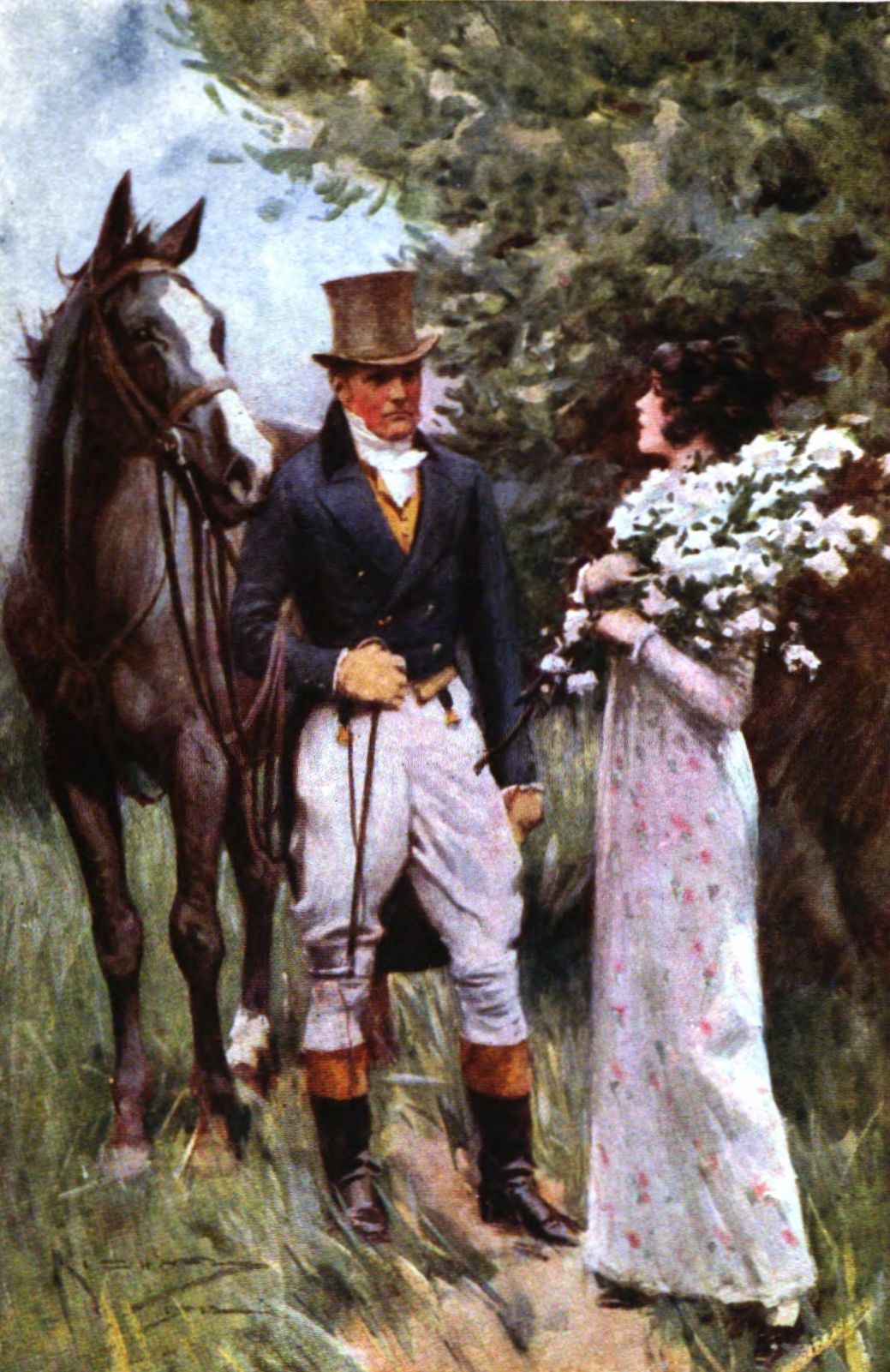
"I think that you and I are better apart."
"As you please. But I have not had my say—yet."
"Oh, you are unbearable!"
"One is not thanked for telling the truth. I came here to warn you that the whole business is discovered."
She swung round and faced him, holding up an impatient and restive head.
"Do all men talk behind each other's backs? What are you hinting at?"
Jasper looked at her stubbornly.
"How much do you know, Nance? By George, you look innocent enough!"
"What do you mean?"
"The Chevalier de Rothan is a French spy."
"Mr. Benham!"
"You have said that your father is his friend."
"Oh!"
"I will not use the word 'spy' when speaking of your father."
XX
Nothing could have more clearly proved Nance Durrell's innocence than the indignation that leapt up in her like a white flame out of a fire. It was the anger of youth, swift, generous, and impulsive.
"You call Anthony Durrell a spy!"
"I called De Rothan a spy."
"How do you know? How do you know?"
He was more busy with her face and gestures than with her words. It was a wonderful love-play to him, with its quick kindlings, its red, passionate lips, its eyes that flashed out melodramatic scorn. The very way she breathed, and held her head, was sheer revelation.
The sincerity of her anger challenged him.
"How dared you come to me with this tale?"
"Because it is true."
"How do you know?"
"I have seen and heard things."
"Well, then, you, too, are something of a spy."
"I could not help seeing and hearing what I did. I am not the only man who has suspected your father of French sympathies. As for De Rothan, we ought to have known him for a rogue. We English are such easy-going fools."
She walked on, head in air, eyes looking into the distance.
"I will not believe it."
"I am sorry."
"Oh, don't talk of sorrow!"
"Nance, do you think I came here to taunt and bully you?"
"Perhaps——"
"What the devil do you think I came for?"
She shrugged her shoulders.
"To be rough—and quarrelsome?"
She was falling a little from the serenity of her indignation. Her anger had been a thing of the moment, and now that it was passing she knew that she had suspected her father, and her own suspicions went out to clasp hands with Jasper's accusations.
She looked slantwise at him, and a glimpse of his clean-cut mouth and steady eyes made her think of a strength and courage that waited. Of a sudden she felt desperately helpless, and desperately lonely. Why were they at cross-purposes, and quarrelling like boy and girl? It would be better if she spoke out.
"Well, what are you going to do? You seem so sure about it all. I suppose you will denounce us?"
"You knew nothing about it, Nance."
"You think that?"
His eyes studied hers.
"You are not made to tell lies. Are you going to let me help you?"
"Am I to accept all this on your authority?"
He nodded with an air of grave and imperturbable magnanimity.
"I believe, Nance, that you knew nothing. But have you never been brought to wonder what your father's life was, and what the Frenchman De Rothan meant to him?"
She looked at the ground before her, intent and thoughtful.
"Things have happened that have troubled me."
"Your father is not a man to talk."
"No. There have been things that I could not understand. Oh, it is hard!"
"I know."
Jasper's eyes softened. He stroked Devil Dick's neck as the horse walked quietly beside him.
"Nance?"
"Well, what now?"
Her voice was forlorn, and a little impatient.
"I understand why your father did not want me at Stonehanger."
"Oh, but then——"
She caught herself up, and reddened.
"Go on."
"He gave me a reason."
"Tell it me."
"Won't you let me keep it to myself? I don't know that I believe it any longer."
Jasper had a flare of understanding.
"Oh—that! It was about my cousin, Rose Benham?"
"Yes and no."
"What, more than that?"
"Don't ask me any more."
She glanced at him half pleadingly, and his square jaw and strong, confident head showed up convincingly against a cloud of slander.
"I don't think I believe it. Don't ask me to say more."
He gave her a full, frank look.
"Have it so, Nance. I'm here in my own shoes, a free man, with nothing to hide under my coat. But I'll tell you one thing: I have a good, fierce grudge against De Rothan."
Her face expressed the searching of her thoughts.
"Because he is a spy? Or has he offended you?"
"Because I hate the man."
"Then you are not—not disinterested?"
He smiled grimly.
"Nance, I'm not."
She hid her eyes under black lashes, and her lips trembled perceptibly.
"But I must trust some one."
"Trust me."
"Yes, but——"
He bent toward her with intense earnestness.
"Nance—listen. I believe in my heart that your father is in very great danger. Spy he may not be; it is a low word and should not live near you. But he is a Revolutionist, a Jacobin, a sympathiser with the French. God knows what he hopes to get out of Napoleon! This fellow De Rothan is the danger. The country's mad and scared; they'd show no pity."
She was white and serious and a little frightened.
"Oh, I know—I know! But father——!"
"I know the kind of man he is, an enthusiast, ready to be martyred. There are people who suspect him, but I don't think a living soul knows as much of the affair as I do."
Nance's eyes were supplicating and eager.
"Yes—but can you help me?"
"We must rid Stonehanger of this fellow De Rothan."
"But how?"
"That will be my business."
"But it may be dangerous for you."
"Confound it, who cares! You've got to trust me, Nance, and by Heaven, I'll not fail you."
Her face and eyes warmed to him. His strength and confidence were giving her comfort.
"What strange creatures we are! A few minutes ago, I almost hated you, because you forced things on me; but now I feel that I must have your help."
"That is what I came to offer you. I have nothing to complain of."
They had been following the lane back to Stonehanger, when Nance, who seemed more restlessly alert than Jasper, saw a man on horseback appear between the furze-clad banks. He was a hundred yards away, but Nance knew him for De Rothan. She touched Jasper's arm.
"Look!"
"De Rothan?"
Her eyes met his with a new meaning. She was putting her trust in him, waiting to be guided by what he would say and do.
"Nance, pretend to be angry with me."
"Must I?"
"It was not so very difficult a little while ago."
She gave him a glimmering of the eyes.
"Must I be very proud?"
"Yes, freeze me for being too forward, or scorch me with scorn!"
A woman loves humour and some degree of subtlety in a man. Nance looked at De Rothan, and then turned to her dissembling.
"I wish you would not vex me with your attentions—I mean presence"—she blushed into a moment's laughter—"I very much resent it."
"If my company is displeasing to you——"
"It is—most displeasing."
"Well, then, why did you lead me on?"
"How dare you suggest such a thing."
"Do you mean to say that you have not encouraged me?"
"Your insolence is unbearable."
Jasper had raised his voice, and she echoed him with fine spirit. They made quite a pretty quarrel of it, Nance playing the part of beauty affronted, Jasper very much the rude and aggressive male. They hushed the affair, and smothered an intense desire to laugh. De Rothan was within a few yards of them. His saluting of Nance was a royal function; his glance at Benham a kingly threat.
"Mees Durrell, may I have the felicity to think that I am at your service?"
"O, Chevalier——"
"You go to the deuce," said Jasper under his breath.
De Rothan looked him over with cool scorn.
"Meester Benham, I think your presence here is unnecessary. I will conduct Mees Durrell back to Stonehanger."
"Please, if you will, Chevalier. This gentleman——"
"Mees Nance, I am full of understanding."
He bowed in the saddle to Jasper, and blessed him with a serene sneer.
"Meester Benham, I must ask you to relieve us of your presence."
Even though he was fooling the man, Jasper felt savage.
"What business is it of yours, sir?"
"I stand for courtesy—and chivalry, Meester Benham."
"Puss in Boots! I shall want a word with you, sir."
"I shall be at your service, when I have escorted Mees Durrell home."
"Good. In the lane?"
"Wherever you please."
Jasper caught Nance's eyes. She gave him a quick and secret smile as De Rothan dismounted to put himself at her side. They went off together up the lane, leaving Jasper standing beside Devil Dick. He watched them with curious and contradictory emotions, and a hatred of De Rothan that was not to be appeased by the thought that he had the man in a tight corner.
His eyes fixed themselves finally upon Nance, and he discovered infinite delight in watching her slim figure moving between the green banks of the lane. Everything about her was adorable, her anger, her perplexity, her slow drifting toward trust in him. That glint of mischief in her eyes! And how she had taken up the game with De Rothan! What a change in the course of an hour! He had ridden out in a puritanical mood and here he was ready to go down and kiss those two small feet.
Jasper smiled to himself and moved on up the lane. The gateway of Stonehanger appeared under the dark shade of the hollies and laurels. Nance was just passing through it, De Rothan standing hat in hand and holding the gate open. There was something infinitely offensive to Jasper in the bending of the man's figure toward Nance. He remembered how he had felt when he had seen them together on the terrace. Things had changed in a sense since then, but his grudge remained against the Frenchman.
De Rothan waited for him, a supercilious and flaunting figure that looked very tall in the shadow of the shrubs. He resembled a victorious captain waiting with arrogance for a beaten enemy to deliver up his sword. Jasper felt a stinging lust to smite burning in his right arm.
They met with frank enmity.
"You wish to speak to me, Meester Benham. I, too, have words to say. Let us lead our horses down the lane."
They walked on side by side, leading their horses by the bridles. De Rothan's nostrils were dilated, his eyes full of an angry glare. Jasper looked dogged.
"I must advise you to mend your manners, Meester Benham. I am a gentleman of France."
"Thanks, sir, thanks."
"In the future you will not thrust yourself upon Mees Durrell."
"Why not?"
"Because she does not desire it."
"Did she tell you so?"
"And because I forbid it."
"That hardly convinces me."
A common instinct made both men leave their horses standing and face each other in the lane. The days of the wearing of the small sword had passed. But men who are angry can quarrel without swords.
"So you have my orders, Meester Benham."
"I return them. On second thoughts I feel inclined to throw you and them into the nearest ditch."
"Sir!"
"Frenchmen can fight only with their cooking-spits."
In a flash De Rothan struck at Jasper's face with his open hand. The blow was caught, and the wrist seized with the grip of a man who was savagely angry. Jasper twisted De Rothan's arm, a schoolboy's trick, and De Rothan, with a snarl of pain, was driven to twist about so that his back was toward Jasper. The sinews cracked about the shoulder-joint, while Jasper tilted the Frenchman's hat over his nose.
"How does it please you, monsieur?"
"Dog!"
Jasper flung De Rothan's arm aside. The Frenchman swung round, and they were at each other like a couple of dogs. De Rothan was the taller man, but Benham was thickly built and very powerful about the loins and shoulders. Moreover, he had been the rough-and-tumble champion at a country school. He had De Rothan round the middle, and crumpled him backward as though he were a sheaf of corn.
The Frenchman beat a fist in Jasper's face, and for the moment Jasper crushed him in his arms for the grim joy of feeling the cracking of De Rothan's ribs. Then he half lifted and half hustled him to the side of the lane.
The ditch was not a deep one and it was dry, but that was no saving of De Rothan's dignity. He emerged, dusty and speckled with spittle-blight, a man furious with physical shame.
"I do not fight like a ploughboy. You shall hear from me."
He felt his wrenched shoulder, and recovered some of his haughtiness.
"You have strained my shoulder-joint."
"Rest it for a few days, or months."
"Your insolence may cost you dear."
"I shall be at your service whenever you choose to fight."
He gave De Rothan a steady stare, and then climbed into the saddle.
"The fat's in the fire," he thought, as he rode off down the lane, "but—God! it was good crushing that fellow's ribs."
De Rothan's face was a study in malignant cynicism as he brushed his clothes and picked up his hat.
"Very well, very well, Mr. Benham; to-morrow, or the next day, I shall kill you. There shall be no mistake about that."
XXI
Grimly elated, Jasper rode back to Rush Heath. The day had given him far more than he had dared to desire. He had thrashed his man and made a second conquest of Nance Durrell's confidence. His jealousy had dispersed like a thunder-cloud, leaving a clear and adventurous sky.
At Rush Heath he found Jeremy Winter and Cousin Rose in the thick of a quarrel. Rose had driven over from Beech Hill, ostensibly to sit at Squire Kit's bedside, and treat him to some of her frank and pious opinions.
"Uncle Christopher, you shall listen to good words. It fills me with pity, to hear an old man curse and blaspheme."
Mr. Benham had leaned against his pillows and glared at her with a man's disgust. She had talked on and on, and though he had shut his eyes and pretended to snore, she had not been turned from thrusting her piety upon him. It had ended in Squire Kit hammering the floor with the stick he kept on the bed, and Jeremy had arrived to rescue him.
"Jeremy, I say,—Jeremy——"
Winter had understood things at a glance. He had hooked up her arm, and walked her off by main force, and that was why they were quarrelling in the oak parlour.
"I wonder you don't keep away from here, Mr. Winter. You never do any good to Uncle Christopher and Jasper."
Jeremy was the imperturbable fencer whose laughing eyes and sage, sardonic mouth always filled Rose with anger. Her attacks amused him, and Rose Benham insisted upon being taken very seriously.
"So you think I have debased the whole household; Jasper, too, eh?"
"You have always been an irreligious man. You would have led poor father into all sorts of foolishness if we had not prevented it."
"Poor man!"
"I hate your flippancy."
"What a world it is! I have seen my share of it, and upon my soul there is nothing to touch English piety. And there is no one who knows so much about everything as a good back-country English gentlewoman. I suppose she has it all straight from the Almighty."
Rose sat very straight and stiff in her chair.
"That's right, Mr. Jeremy Winter, be blasphemous. At your age——"
"At my age, Miss Benham, you will be a very old woman. As it is, the women still fall in love with me."
"Oh, you wretched old reprobate."
Jeremy went off into huge yet quiet laughter, and it was in the midst of it that Jasper entered with the steady, gleaming eyes of a man who had desires to satisfy and enemies to grapple.
"Hallo!"
He had one glimpse of Rose's stiff and implacable face.
"What have you been doing, Jerry?"
"I? Nothing, sir, nothing. But Miss Benham will have it that I am a disgusting old reprobate and not fit to be in this house."
His smile exasperated Rose. It was so good-tempered, so sly, so unanswerable.
"You ought to know Jeremy Winter by this time, Rose."
"Thank you. I know a little, and that has always been too much."
"Oh, come now!"
She felt that he was on Winter's side, the man's side, and it angered her.
"You men are all alike. You love old ruffians who tipple and tell bad stories."
"Now, how on earth do you come at that, Miss Benham? Keyholes, eh?"
"Mr. Winter, should I listen to your voice through a keyhole!"
Both men laughed, and Rose stood up. She looked thinner and sharper-featured when she was angry.
"Jasper, tell your man to bring my horses round."
And she whirled away from Rush Heath in a dust cloud of indignation. The cat in her knew and feared the dog in Jeremy.
Jasper rejoined Winter in the parlour. Jeremy was lighting his pipe, and looking humorously down his nose.
"Are you going to marry your cousin?"
"What, marry Rose!"
"You be careful, young man; she'll ask you the question and have your immortal soul in her reticule before you can say 'gammon'."
"I don't think she will, Jerry."
"That's good. You seem most deucedly pleased with yourself. What is it?"
Jasper went to the wine-cupboard and brought out a decanter and two long-stemmed glasses.
"Drink her health, Jerry."
"Miss Benham's?"
"Don't be a tease. Her health, and God bless her. By George, I have had my money out of De Rothan."
"How?"
"I landed him in a ditch. Do you know what it feels like to crush a man's ribs in, Jerry? It's a gorgeous feeling. I gather there will be a fight."
Winter looked serious.
"You may have thrown him all right, lad, but——"
"I have looked him in the eyes, Jeremy, and I can match him. Besides, I am going through with it—for the sake of Nance Durrell."
"O you youngsters! I've done it myself, too. Run your chest up against a sword-point because a girl glimmers her eyes. Tell me about it."
And Jasper told him.
Jeremy sat for a while in thought.
"Why don't you pounce on the man? Have him arrested. It would save a lot of trouble."
"I want to keep Durrell out of it. You see, Jerry, if I work this through quietly, it will save no end of a mess."
"Will it?"
"Yes."
"You seem cocksure."
"Haven't I got my devil back these few days with the foils? And look you, Jerry, do you remember fighting when you were in love?"
"I do."
"Were you beaten?"
"No."
"It makes you grim, quick as lightning, cool as cold steel. That's how it works with me."
Jeremy nodded his head sagely.
"Well," said he, "we'll spend the next two days fighting each other. And you bang away with your pistols. How do they carry?"
"I can hit a card five times out of six at twenty paces."
"I've got twice the nerve since I've seen her to-day."
"Confound you, I used to be just the same."
In the cool of the evening these two spent an hour in fencing together on the lawn by the cedars. The great black shadows of the trees lay in dark capes and promontories upon the green sea of the grass. The standard roses were in bloom, and the scent of the clover pinks in the borders filled the air. Swallows glided in and out, threading their way among the cedars, and circling round the tall chimneys of the house.
Parson Goffin hobbled up the drive, and sat down on a bench to watch Jeremy Winter and Jasper fencing. He had watched them at swordplay years ago, and there was nothing new in it to awaken curiosity.
Goffin was in one of his growling moods. He had a sore tongue from too much smoking, and England was going to the dogs.
"They say that we may have Villeneuve in the Channel any day during the next month. They don't know where he is; they expect him to swoop out of the blue. Boney will get across, and we shall be licking his shoes."
"A pretty angel of hope you are, Goffin!"
"Sir, we have been drinking too much these fifty years. The Almighty may be sending something to sober us."
"He gave us the Hanoverians to help us to drink! You are down at the heel, parson. If you could prove to me that Nelson is at the bottom of the sea, I might be ready to howl with you."
"So he may be, sir, so he may be, for all we know."
"Jasper, send for a good stiff glass of rum; Mr. Goffin is feeling a little faint and vapourish this evening. Yes, that was the best tussle we've had. It took me all I knew to keep your point out."
Parson Goffin's gloom was in sympathy with the gloom that overshadowed England during those months of May, June, and July. At Boulogne Napoleon waited for the chance that should give him control of the narrow sea—even for three days. Off Rochefort, Ferrol, and Brest the ships of Calder and Cornwallis kept up their grim blockade, while out yonder upon the Atlantic, Fate, Villeneuve, and Nelson faltered on the edge of the unknown. Nelson and his fleet had sailed away into the west, and men asked themselves what news the Atlantic would disgorge. Would it be the thunder of the French guns in the Channel, the breaking out of the ships blockaded in Brest and Rochefort, the sweeping of the Dover Straits, the red horror of invasion?
At Stonehanger Nance sat on the terrace wall and looked out toward the sea. The sunlight played upon her face and in her eyes, and gave them a brown radiance. There was a warmth and graciousness about her, a sadness that found its recompense in the richness of her thoughts and musings.
Her spiritual attitude toward her father was one of astonishment and compassion. She could pity him, even though she could not understand his motives. De Rothan was the scapegoat upon whom she laid the guilt and the burden of her resentment, though how Anthony Durrell had been inveigled into such schemes she could not imagine. What quarrel had he with England? He was a morose man, a silent man, and perhaps in a vague way she felt that he had been disappointed. Nance's nature was the very opposite of her father's. She was direct, generous, less ready to feel aggrieved. The flaming discontent of the fanatic is incomprehensible to healthy, humour-loving, sanguine people. There are men who will backbite their own country out of sheer hereditary cussedness. They are against everything that is—and Anthony Durrell was such a man.
He came out upon the terrace while Nance was there, and walked up and down under the house with his hands behind his back. There was a restless uncouthness even in the way he moved, for Durrell was one of those men who had been a sop at school, and a greenhorn at college. He had thrown a ball like a girl, and his legs and arms were not made to work like the limbs of a virile male. Books, philosophy, and theorising had filled his circle of consciousness. His liver had grown sluggish with a sedentary life, and now he was nothing but a lean and embittered figure of denunciation and discontent, impatient, ineffectual, passionate, yet weak.
Nance felt a kind of pity for him as she watched him go to and fro. She could not help contrasting him with Jasper Benham. As for De Rothan, he was a sinister figure dogging the footsteps of this lean, white-haired, narrow-shouldered man.
She crossed over to her father.
"Would you like a walk on the common? It is cooler now."
He glanced at her as though he had only just discovered her presence.
"No, no; I'm busy, thinking."
"You can think while you walk, and I'll keep quiet."
"Thank you. I wish to be alone."
His strung forehead and irritable eyes repulsed her. Intuition warned Nance that it would be useless to attack him openly, even with the power of compassion. Some men are mad, even when they are sane. It is useless to argue with them. They have to be strait-jacketed by the common sense of the community and kept from doing themselves and other people harm.
XXII
Parson Goffin was still grumbling on the bench under one of the cedars when Jack Bumpstead appeared from the direction of the stables.
"Here be a man for to see you, Master Jasper."
"Who is it, Jack?"
"Thomas Stook o' Bramble End."
"Send him round. Wait, though, I'll come myself. Where did you leave him, Jack?"
"In the yard."
Jasper found Tom Stook sitting on the horse-block and tickling himself pensively with a straw. His brown face remained shy and stolid when he saw Jasper. He stood up, slouching his shoulders, the straw tucked away in one corner of his mouth.
"Well, Tom, what is it?"
Stook surveyed the yard, and scrutinised the kitchen windows with sneering suspiciousness.
"Them turmit-flies o' wenches; always poppin' about. Maybe, sir, you might like to see them signal lights at Stonehanger. I wouldn't be for promising, but I have my sense o' smell. They say that Mounseer Jerome be comin' ashore to-night."
"The smuggling rogue! How do you know, Tom?"
Stook grinned, and looked expressively at Jasper.
"Maybe a little bird dropped ut down t' chimney. Maybe there'll be kegs on t' beach. It be'unt no business o' mine, but you can see Stonehanger from my cottage."
"So these devils of smugglers play two games. They ought to sink Jerome and his boat. Tom, you've got some sense."
"Thank 'ee, sir."
"Get into the stable and saddle the new brown cob, not Devil Dick. And keep your mouth shut, see."
"I will—sure, Master Jasper."
Jasper went in by the back entry and made his way noiselessly upstairs. He took his pistols and a hanger, and rejoined Tom Stook in the stable. Jeremy and Parson Goffin were arguing together under the cedars, and Jasper left them at it, wishing to get away without being questioned. Coming out with Tom Stook and the cob he took the field path that turned aside under the orchard hedge.
The western horizon was a level band of yellow light, with blue-black hills below and a sky of lapis-lazuli above. The full moon was a great silver buckler on a field of blue. Big stars were beginning to glitter as Jasper and Tom Stook turned down by one of the high hedges with the long grass and weeds brushing their knees. The hedge hid them from Rush Heath, a hedge that smelt of honeysuckle, and trailed the pink sprays of the wild rose over the green of the hazel, thorn, and holly.
Twilight fell as they made their way toward Bramble End, and the world became a world of amethyst and of silver. The Stonehanger uplands were dim and vague in the distance. The colour had melted out of the western sky when they reached the rough track that led to Bramble End. Jasper had mounted the cob, and Tom Stook swung along ahead on his long and lumbering legs, a length of straw still dangling from one corner of his mouth.
Stook's cottage had the shape of a hay-rick. It was built of stone and thatched with heather. A tumble-down shed or lodge stood half hidden by three elder trees that grew close together in the hedge. All about the place lay a tangle of brambles, furze, blackthorn, and bracken.
"I'll put t' nag in t' lodge, Master Jasper."
"Right, Tom."
Jasper made his way to the back of the cottage. There was a piece of vegetable ground here shut in by a low hedge. A yew-tree grew close to the cottage, and a seat made of the rotting tail-board of a cart had been laid upon two logs. Away to the north rose Stonehanger Common, and in the twilight Jasper could distinguish the grey mass of Durrell's house.
He sat down under the yew-tree, and Tom Stook came round from the lodge.
"A good look-out, Master Jasper."
"No wonder you could see the lights, Tom. What time do they show them up yonder?"
"Must have been nigh on midnight when I've seen 'em afore."
"That means three hours' sentry work. Have you had your supper?"
"No, I ain't."
"You go in and get it. I'll keep a watch here. If it should come to a scuffle, Tom, are you ready to see it through?"
Stook scratched a meditative chin.
"Sure, Master Jasper, so long as it be'unt with Sussex folk."
"You don't mind beating a Frenchman?"
"They be nasty beasts with their knives and pistols."
"You can leave that part of it to me, Tom."
"Oh—I doan't say as I be afraid."
Jasper kept watch there in the dusk, with the light of the moon becoming more brilliant as night gave her the darkness that she needed. "Pee-weet, pee-weet" wailed a plover somewhere over the furze. From an oak wood in the valley came the "burring" of a night-jar. With steady patience Jasper kept his eyes on the place where Stonehanger house cut the sky-line. Once he saw the distant twinkle of a candle, coming from Nance's window, so far as he could judge. The furzelands were vague, black, and desolate under the moon, strange eerie wastes where anything might happen.
Jasper's thoughts dwelt upon Nance, though the reverie of a man in love is rather a visualising of the woman beloved than a meditation upon her mystery. The white face of the moon and the dusky elf-locks of the night were wholly feminine. Jasper imagined himself walking with Nance in the dark old shrubbery behind Stonehanger, looking into the dim dearness of her face, touching her hand, and uttering her name.
Tom Stook's clumsy figure drifted across these passionate imaginings. He was wiping his mouth on the back of his hand, and looking toward Stonehanger.
"What may you be after, sir?"
"I am out hunting, Tom, to catch a fox of a Frenchman. And look you here, I want you to keep your mouth shut about all this, the lights up yonder, and the comings and goings. It will be worth your while."
"Sure, Master Jasper, you be a gen'leman o' sense. It be'unt no business o' mine."
"There is some one who has to be protected. I want to lay a rogue by the heels without harming innocent people."
Stook brought out a short clay pipe, and a little leather bag in which he kept tobacco. He had to go indoors to get a light from the wood fire that he had lit to cook his supper. When he emerged, the bowl of his pipe glowing, he had one very characteristic remark to make.
"It be powerful cold f' June."
Jasper felt for his pocket flask. He knew that it was inward warmth that the man needed.
"One pull, Tom, and no more. We must keep our heads clear to-night."
Two hours passed, and the vague, moonlit slopes of the common began to suggest all manner of mysterious movements to Jasper's tired eyes. Stonehanger was a dim outline against the sky. He had begun to doubt whether anything was going to happen when a bright, yellow point flashed out suddenly in the north. It remained there for some ten seconds, and then disappeared as though a curtain had been jerked forward to cover it.
"You seed ut, sir!"
"Was that from Stonehanger, Tom?"
"Sure."
They waited awhile, and in due course the light flashed out a second time and died back into the night with equal suddenness.
"What do they mean by that?"
"Mounseer Jerome be about somewhere."
Jasper meditated.
"I tell you what, Tom, we will make our way up to Stonehanger."
"Better try t' owld quarry, sir."
"They meet there?"
"I reckon they do."
"Have you got a lantern?"
"Sure."
"Fetch it, and bring a thick stick with you."
They left the cottage, Jasper with his hanger and pistols, Tom Stook carrying a lantern, and a stout hollywood cudgel. Tom took the lead, pushing his way along a narrow, winding path half overgrown by straggling furze, their figures melting away into the blackness of the moor.
After twenty minutes of this rough going, Tom Stook stopped abruptly, and stood listening. Jasper paused close to him. There was no wind, and no stirring of the furze in the clear sheen of the moonlight.
"T' quarry be yonder, sir."
"Where?"
"Just down over t' bank."
They spoke in whispers, bending forward and looking across the moor.
"Can you hear anything, Tom?"
"Not me."
He put the lantern down, and scratched his chin.
"I reckon I'll go on, Master Jasper, and take a look into t' quarry."
He went down on all-fours, and Jasper saw his long, loosely knit body go crawling along the path like some big beast of prey. He disappeared with nothing more than a faint rustling of the furze, and Stonehanger Common seemed as still and as empty as a becalmed sea at midnight. Tom Stook was away twenty minutes. He came back, walking, his holly-stick over his shoulder.
"There be'unt no one—yet."
"Well, then, we had better take cover in the quarry."
They went on and clambered down through the furze into the mouth of the quarry. A rough trackway led into it, and Tom Stook seemed to know the place as well as he knew his own garden. There was some open ground in the centre, though dwarf-trees, brambles, and furze made a tangled mass along the walls. Stook chose a place near the entry, a kind of nest shut in by the wild undergrowth, and under the black shadow of the quarry wall. A gap between two furze bushes gave them a view of the open space, and of the trackway leading into the quarry.
"I'll have t' lantern ready, Master Jasper."
He took off his coat, produced a tinder-box, and, going down on his knees, proceeded to get a light.
"She's got a shade, sir, and I'll put her on under t' bush with m' coat to make it safe."
The lantern was lit and hidden away, and they were both growing stiff and rather tired of waiting when Tom Stook touched Jasper's shoulder.
"Did ye hear that?"
Through the stillness of the moonlit night a faint sound reached them, a sound as of some one brushing through the furze. It might, have been a strayed sheep, or even a rabbit scuttling among the dry stems of the furze, but for the distinctive scraping of feet over the rough ground. Jasper crept forward, and stood waiting in the gap between the two furze bushes. He had borrowed Stook's holly-cudgel, and was in the deep shadow, and not likely to be seen.
The footsteps came nearer and nearer, and paused outside the quarry. A deep and grumbling voice growled sulkily as though its owner were tired and out of temper. Then the man entered the quarry, passing close by the place where Jasper stood.
Benham saw him as a shortish, thick-set man with a great round head, and a slouching walk. It was just a glimpse, for Jasper made his leap, springing out from the black shadow into the moonlight. The man swung round with a quick snarl of surprise.
"Tonnerre!"
The holly-stick swung just before a pistol flashed, and the bullet thudded against the wall of the quarry. Jasper knocked the pistol out of the man's hand, gave him a tap on the skull, and then closed. So far as the tussle went, it was not a very serious affair. Youth was well served in handling this little round cask of a man. He was rolled over, and pinned flat on his back, while Jasper wrenched a second pistol and a knife out of his belt and threw them away into the undergrowth.
"Tom, bring your lantern. Quick, man, quick!"
XXIII
Tom Stook came running out with the lantern.
"Have ye got him, Master Jasper?"
"It looks rather like it, Tom—eh!"
The light fell upon a fat, swarthy, and sullen face that blinked its eyes at the lantern.
"Mounseer Jerome—sure!"
The man heaved, and swore savagely.
"Sacre bleu,—give off my chest!"
"Lie still."
Jasper was in no mood for wasting time, since he desired the business over and done with before De Rothan or Durrell should appear.
"Tom, take him by the wrists and hold his hands above his head. Quiet, will you, or I'll give you a crack with the stick."
Jerome glared and lay still, his arms extended above his head like the arms of a man upon the rack. Jasper unbuttoned the Frenchman's coat, and went through all his pockets. He found nothing there save a pipe, and a tobacco-box. Something lying under the man's shirt betrayed itself as Jasper passed his hand over Jerome's broad chest. As Jasper tore the shirt open the Frenchman's body squirmed like the body of a man who stiffens his muscles to resist.
"Hold on, Tom."
"Help, there,—help!"
"Lie quiet, or by George, I'll put a bullet through your head."
Jasper drew out a flat, leather pocket-book or case that was fastened by a string round Jerome's neck. Jasper snapped the string, and turned aside toward the lantern to examine the plunder. It contained several sheets of paper neatly folded and covered with what appeared to be a jumble of dots, lines, and letters. Jasper's brown face showed grim and intent by the light of the lantern.
"Cipher, to be sure! This is what I expected to find."
He put the sheets back into the leather case, and thrust it into the inner pocket of his coat. The sea-captain's eyes were watching him with evil interest, and he had the air of one who listened.
Jasper understood. Captain Jerome expected a rescue.
"Tom, I want to be rid of this gentleman, and I don't want the red-coats to get hold of him, either."
"Sir?"
"March him down to within a mile of the sea, and send him off with a blessing."
"I'll do't, Master Jasper."
"Monsieur Jerome, it is lucky for you that I am giving you this chance. Clear out, and let us hear no more of you. If ever I hear of you showing your face on this side of the Channel, I'll have you taken and shot as a spy. You understand?"
"I speak no English."
"Nonsense. You get off back to France, and pray to God to keep you from playing at carrying secret signals. Up with him, Tom. Here, put one of my pistols in your belt."
Tom Stook grinned, and swung the Frenchman to his feet. Jasper gave him a pistol and the hollywood cudgel.
"Bundle him off, Tom. I want him out of the way. I am staying on here to see what happens."
Stook took the sea-captain by the collar.
"Come along, you barrel o' sour beer. No shouting, mind ye, and no tricks. Come along."
Jasper heard them go blundering along down the path, Stook helping the Frenchman along with vigorous bumps of the bent knee. Jasper smiled to himself and picked up the lantern, and, returning to his lurking-place, he put out the light and sat down to wait.
It was De Rothan whom he expected, this insolent and sneering émigré, who dabbled his hands in midnight treacheries. Jasper did not doubt that the packet of cipher he had taken from the smuggling sea-captain Jerome would compromise not only De Rothan but Anthony Durrell and his daughter. Jasper's attitude was one of shrewd and patient restraint. A scheme that was defeated might be considered to be non-existent, and there would be no need to swoop upon the lesser dupes when the dominant spirit had been dealt with.
Something crackled into a clump of briers close to where Jasper lay in ambush. It was a stone flung from above as a signal to Jerome, who should have been waiting in the quarry. Jasper kept very still. He heard some one pushing through the furze and brushwood round the rough lip of the quarry. Footsteps came down toward the entrance. Then there was silence.
Jasper leaned forward and peered round one of the furze bushes. A man was standing in the trackway leading into the quarry, his face turned toward the sea. By his height and build, and by the arrogant throw-back of the head, Jasper knew him for De Rothan. He stood there like a figure carved in black basalt, motionless, watchful, full of a fine yet sinister suggestiveness.
Jasper watched him. How easy it would be to bring the man down, wing him, put an end to all his weavings of treachery. He did not doubt but that De Rothan was armed. They might make a fight of it there, but Jasper was not given to shooting in the dark. He wanted to prove the whole case against De Rothan, to convince himself and Nance of the man's double dealing.
Minutes passed, and De Rothan showed a growing impatience. He began to walk to and fro along the trackway, stopping from time to time to listen or stare out over the stretch of moonlit furze. It was evident that he had not heard the report of Jerome's pistol, and that he suspected nothing in the way of intervention. The smuggler had failed to appear; that was what made De Rothan restless.
For an hour the Frenchman walked up and down while Jasper lay behind the furze bushes and kept watch. Once De Rothan paused within three yards of him and stood listening, muttering angrily over the absence of Jerome.
His patience gave out at last. Jasper saw him walk to the entrance of the quarry, stare into the distance, and then turn, and clamber up the bank. Jasper held back till the sound of De Rothan's footsteps had died down into the night. Then he pushed Tom Stook's lantern under a bush, climbed out of the quarry, and, striking the path that led toward Stonehanger, followed it with some of the caution of an Indian working a trail.
Jasper neither heard nor saw anything of De Rothan till he came in sight of the chimneys of Stonehanger rising above the ridge of ground that hid the lower part of the house from view. Jasper paused here instinctively, and it was well that he did so. A black figure rose into view on the rising ground above and stood with the grey oval of its face turned toward the sea.
Then De Rothan disappeared. Jasper pushed on, topped the rising ground, and over the furze saw Stonehanger grey and glaring in the light of the full moon. Chimneys, parapet, window frames, even the individual stones in the walls were clear and distinct. The thorns and yews were bunches of black foliage rising above the grey line of the terrace wall.
Jasper could not help asking himself why Jerome had chosen such a night for landing, and how he had been able to avoid the patrols.
"Money and rum work wonders. These smugglers squeeze in everywhere."
He saw De Rothan mount the steps to the terrace and stand there looking at the windows of the house. Jasper seized his chance to slip forward and gain the shelter of some furze bushes that straggled close to the terrace wall.
He heard voices on the terrace. Anthony Durrell had been waiting for De Rothan, and but for his short sight he would have seen Jasper make his dash across the open grounds for the shelter of the furze bushes under the wall.
"Jerome has failed us. I waited more than an hour."
De Rothan glanced at Nance's window.
"Is madam asleep?"
"Yes. Speak softly, she mustn't know that you are here. Perhaps we mistook Jerome's light."
"No, I'm sure of that. Hallo—!"
The voices broke off abruptly like the voices of two plotters who hear the sound of stealthy footsteps coming toward them. Jasper had made his way to the terrace wall. He flattened himself against it, expecting to see a head appear over the edge of the parapet.
Then he heard some one calling, "Who's there?"
It was Nance's voice, and the moonlight seemed to quiver with it. She had thrown her lattice open and was leaning out, and scanning the terrace. Durrell had drawn De Rothan under the dense shadow cast by one of the yews.
They remained there motionless, till Nance disappeared for a moment from the window.
"Quick, round to the back of the house."
"This game of hide-and-seek is all nonsense, Durrell. You had much better let the girl know the truth."
"No, no, she's not to be trusted."
"My dear sir, I'll make her trustworthy. You do not know how to manage women."
They had crossed the terrace and passed down the passage that led to the offices and stables. Durrell was agitated and impatient, De Rothan a little scornful. He was tiring of Durrell's moods and eccentricities. If everything went well, the fanatic would have served his purpose in the course of the next few weeks. He would be thrown aside like a broken tool.
"Jerome won't come to-night. I'll be off; I left my nag round under the wall."
Durrell was full of vague fears.
"I hope nothing has happened."
"Bah! Jerome found the moon too bright. Besides, the news we expect is too important to be risked with a shrug of the shoulders. If Villeneuve can only get into the Channel and hold it for three days! Fate will spin the coin for us before long."
Meanwhile Jasper had crept cautiously along the front of the wall and reached the steps. He climbed them slowly, pausing when his head came on a level with the terrace. It was deserted. Grass, flower-beds, and stone-paved walk lay white in the light of the moon.
Jasper climbed the last steps, and stood looking up at Nance's window. A passionate exultation possessed him, and for the moment he was ready to take the maddest of risks. He wanted to see Nance, to speak with her, to feel that they were conspiring together against De Rothan and the French.
The chance was nearer to him than he imagined. There was the click of a key turning in a lock, and the garden door opened, showing an oblong shadow in the moonlit wall. Some one was standing there in the shadow, and Jasper, caught in the full moonlight, laid a hand upon the pistol in his belt.
The figure in the doorway moved out into the moonlight. It was Nance. She had slipped on an old gown, and a pair of shoes, and come down, shivering, to brave the truth.
"Nance!"
She hung back a moment, and then came gliding out across the grass, the moonlight making a silver mist of her loosened hair. Mouth and eyes were round shadows.
"You! Is it you?"
She was so close now that Jasper could see the moonlight in her eyes. The pupils were large and black, and swimming with a kind of fear.
"Was it you I heard?"
"No. De Rothan and your father."
"Where are they?"
"They have gone round to the back. I have something that I must tell you. And we may be seen here."
They stood looking into each other's eyes. The clatter of a horse's hoofs came from the lane, followed by the slamming of a door.
Nance started, and a shiver of excitement went through her.
"It is so light here, and we shall be heard—"
Jasper reached out, and caught her hand. She did not flinch or resist him.
"Quick! Down the steps."
They fled away, hand in hand, like a couple of children.
XXIV
They were on Stonehanger Common among the furze bushes with the moonlight shining down on them, and the silence of night over the land. The horizon was an horizon of silvery distances, woodland, sea, and hill. There was no wind moving, and the air was fresh and fragrant with dew.
Jasper still held Nance's hand. They had taken one of the grass paths that wound down over the common to the fields and woods. The moonlight was on their faces, and they said but little for the moment. They had passed suddenly into a new world, and were somewhat awed by its strangeness and its beauty.
There was an audacity, too, about the thing that thrilled them both. Youth called to youth. They looked at each other as though there were wonderful things to be discovered in each other's eyes.
"What have you to tell me?"
Jasper had taken off his hat, and was walking bareheaded beside her. At such a season every gesture has an exquisite significance. There is homage, passionate utterance, in every movement of the head and body.
"I have many things to tell you."
She caught the man's meaning and turned it back with a shy smile.
"I mean—about this man De Rothan."
"I am afraid that I have been playing the spy."
"You?"
"It was for good ends, and to help you and yours."
She looked at him anxiously.
"Have you found out anything more?"
"A little. Look at this."
He dropped her hand gently, and pulled out the leather case that he had taken from the sea-captain, Jerome.
"I robbed some one of this to-night—yes, fairly and squarely—down in the quarry. It was their go-between, their secret letter-carrier from France—a smuggling captain. These dispatches should be in De Rothan's hands. He came down to the quarry, but we had packed his man off with the fear of God in him."
Nance's head was very close to Jasper's shoulder as she bent to look at the papers.
"What are they?"
"Messages in cipher. One has to find out the code. But you see what all this means."
She did see it, and her face was white and serious in the moonlight.
"It means danger for us."
"Unless we smother it."
"But what will you do?"
He replaced the case in his pocket.
"It seems to me that I have two causes to serve, to put an end to this system of spying, and to save your father from ruining himself. There is only one thing to be done; deal with De Rothan."
"But how? If you have him arrested——"
"No, nothing so clumsy as that. I began the attack by quarrelling with him yesterday."
"After you left me?"
"Yes. I pitched him into the ditch."
Her eyes looked frightened, and there was a tremor about her mouth.
"What have you done! It means an affair of honour."
"Just so, Nance. That was why I did it. I expect to hear from him in a few hours."
She was distressed and perplexed.
"But how can I let you do this—risking your life for us!"
"I am doing it because I like it."
"No, it is for us. I can't let you. I'll go to father and make him give it up."
The sincerity of her distress touched him very deeply. He reached out and caught her hands.
"Nance, I'm no boy. I'm as good a man as De Rothan. I can't go back; my honour's in it. I've got to fight this man and beat him. Don't you see how it will mend everything?"
She would not meet his eyes.
"But you are sacrificing yourself——"
"No—no—no. Look at it in this way. I fight De Rothan; perhaps I kill him—perhaps I only wound him. If he comes out of it alive, I take him by the collar, tell him what I know, and give him twelve hours in which to leave the country. Go he shall. Then will come the time to appeal to your father's common sense."
His blunt confidence almost persuaded her.
"Oh, you are brave enough. But as to my father's common sense——"
Jasper laughed at her quaint despair.
"Well, I shall come to him and say, 'Mr. Durrell, I happen to have discovered about this French affair. I have some of your secret papers in my possession. Our friend the Chevalier de Rothan is dead, or has fled the country. The game is up. Swear to try no more plotting, and I will not breathe a word of what I know. Otherwise I shall have to hand you over to the authorities.'"
Her eyes flashed with approval.
"Ah, yes—that would be great. It might settle everything."
He drew her a little nearer to him.
"Not everything, Nance. But I am not here to ask for what I have not earned."
She did not look at him, but hung her head a little.
"You are being too good to us."
"That's no credit to me. I can't help it."
His frankness brought her eyes glimmering up amusedly to meet his, and it was then that she noticed that they had come within a hundred yards of the big oak wood that bounded the common on the south-east. The domes of the trees gleamed in the moonlight.
"Look! Do you see where we are?"
"By George, yes. I suppose we had better turn back."
"Please."
"But supposing they have locked us out?"
"I shall have to throw stones at father's window."
"Yes, but then——"
Her mouth wavered into mischievous curves.
"He will be told that I have been out in the moonlight looking for voices."
"That's it—that's it."
He looked at her with fine approval.
"Yes, show spirit, that's the thing. But supposing, for the sake of argument, that Mr. Anthony is asleep and won't be wakened?"
"There is the stable. I should not mind a bed of hay."
"And scold—before you are scolded in the morning. It is like getting in the first blow."