Chapter XXII · NAMES OF EXTERNAL PARTS OF THE HORSE.
Reading edition
I shall here of course omit to describe parts, such as the eyes, head and tail, for instance, which are known to everyone. The figures and letters employed in the following list, have reference to those on Fig. 147, except when Fig. 148 is mentioned.
The hoof (10) is the horny box which encloses the lower part of the leg. The front part of the hoof, near the ground surface, is called the toe; the side portions, the quarters; and the rear parts, the heels. The outer portion of the hoof is termed the wall, which is divided into a hard, fibrous outer covering, called the crust, and a soft inner layer of non-fibrous horn. The designations “wall” and “crust” are often used indiscriminately.
The frog is the triangular horny cushion which is in the centre of the ground surface of the hoof, and which, by its elasticity and strength, acts as a buffer in saving the structures inside the hoof from the injurious effects of concussion.
The cleft of the frog is the division in the middle line of the frog. In healthy feet, it consists of only a slight depression. In a disease, called “thrush,” of the sensitive part which secretes the frog, the cleft forms a deep, damp and foul-smelling fissure, and the frog becomes more or less shrivelled up. The frog similar to the skin of the palms of our hands, requires frequent pressure to make it thick and strong. The horn of the hoof is merely a modification of the cuticle (scarf skin).
The bars of the hoof are the portions of the wall of the hoof which are turned inwards at the heels, and run more or less parallel to the sides of the frog. The sole is that portion of the ground surface of the foot which is included between the wall, bars and frog.
The pastern (9) is the short column of bones (two in number) which lies between the fetlock and hoof.
The fetlock (8) is the prominent joint which is just above the hoof.
The cannon bone (7) is the bone that extends from the fetlock to the knee (6), which, in the horse, corresponds to our wrist.
The back tendons or back sinews (M) form the more or less round tendinous cord which is at the back of the leg, from the knee (or hock) to the fetlock. These tendons, which are two in number, usually appear in the form of one cord; but in horses which have a very fine skin and “clean legs,” we may see that one of them is placed behind the other. The term “clean legs” signifies that the limbs are not only sound, but are also free from any fulness, which would more or less obscure the contour of the bones, tendons and ligaments. Muscles are the lean of meat, and their ends are connected to bones by means of tendons, which consist of hard, fibrous and inelastic material. The ligaments of the limbs are composed of the same material (white connective tissue) as tendons, and serve to connect bones together, without the intervention of muscle. The horse has practically no muscles below his knees and hocks.
Fig. 147.—External parts of horse.
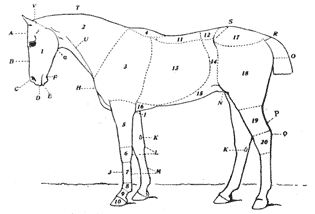
The suspensory ligament is the fibrous cord which lies between the cannon bone and the back tendons. The fact that it stands sharply out between these two structures, when viewed from the side, shows that it is in a sound condition, which is a most important point as regards usefulness; because injury to it, from accident or overwork, is a fruitful cause of lameness, especially in saddle horses that are employed in fast work.
The fore-arm (5) is the portion of the fore leg between the knee and the elbow.
The point of the elbow (I) is the bony projection which is at the top and back of the fore-arm.
The point of the shoulder (H) is the prominent bony angle which lies a little below the junction of the neck and shoulder, and consists of the outer portion of the upper end of the humerus.
The forehead (A) is the front part of the head which is above the eyes.
The nose (B) is a continuation of the forehead, and ends opposite the nostrils (C).
The muzzle is the lower end of the head, and includes the nostrils, upper and lower lips (D and E), and the bones and teeth covered by the lips.
The chin-groove (F) is the depression at the back of the lower jaw, and just above the fulness of the lower lip, which, in this case, assumes the appearance of a chin.
The angles of the lower jaw (G) are the bony angles between which the upper end of the wind-pipe lies.
The withers (4) are the bony ridge which is the forward end of the back.
The shoulders (3) are the bony and muscular portion of the body which is more or less included between a line drawn from the point of the shoulder (H) to the front end of the withers, and another line drawn from the point of the elbow (I) to the rear end of the withers. Anatomically speaking, the shoulders consist of the humerus (the bone which lies between the elbow and the point of the shoulder), shoulder blade, and the muscles which cover them.
The crest (T) is the upper part of the neck, extending from the withers to the ears.
The jugular groove (U) is the groove which is on each side of the neck, just above the wind-pipe. It marks the course of the jugular vein.
The poll (V) is the part on the top of the neck, immediately behind the ears.
The breast is the front portion of the body which we see between the fore legs and below a line connecting the points of both shoulders, when looking at the animal from the front. The chest is the cavity which is covered by the ribs, and which contains the lungs, heart, etc. Therefore, instead of saying that a horse which struck a fence without rising at it, “chested” it, we should, on the contrary, say that he “breasted” it. This confusion between the terms “breast” and “chest” is not unusual.
The brisket (16) is the part formed by the breastbone, and is the lower part of the chest.
The girth-place is that portion of the brisket which is just behind the fore legs, and which the girths pass under when the horse is saddled.
The back (4 and 11) is practically the withers and that portion of the upper part of the body which is covered by the saddle. Strictly speaking, it is that portion of the spine which is possessed of ribs. In common parlance, the term “back” is often applied to the upper part of the horse, from the withers to the highest point of the croup (Fig. 148, H). This measurement includes the loins (12) as well as the back. The bones (six vertebræ) of the loins have no ribs, and, consequently, the flanks on each side are soft to the touch, and have a tendency to “fall in” (become depressed), especially if the abdomen, which is underneath them, be insufficiently filled with food. The croup (17) is that part of the spine which is between the loins and tail. The hind legs are connected to the croup by means of the pelvis, which is firmly united to the croup by strong ligaments. The pelvis stands in the same relation to the hind legs as the shoulder blades do to the fore limbs, the chief difference between them being that the pelvis is a single bony structure composed of several bones, and the shoulder blades are separate bones. The front part of the pelvis is called the point of the hip (S).
The stifle (N) is the joint of the hind leg which is at the lower part of the flank. The thigh extends from the stifle to the hip joint.
The hock (20) is the large and freely movable joint which is immediately above the hind cannon-bone. The point of the hock (Q) is the bony projection at the back and top of the hock. The hamstring, or tendo Achillis (P), is the tendinous cord which runs up the back of the leg from the point of the hock. The gaskin (19) is the part of the leg immediately above the hock and bounded at the rear by the hamstring. The term, thigh, is usually applied to the part of the hind leg above the gaskin; but, correctly speaking, it is the part of the hind leg above the stifle.
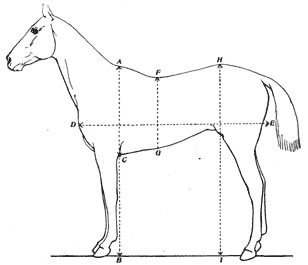
Fig. 148.—Measurements of horse.
The belly, or abdomen (15), is the underneath portion of the body of the horse which is not covered by bone.
The point of the buttock (O) is the rearmost point of the pelvis.
The dock (R) is the solid part of the tail.
The height of a horse (A B, Fig. 148) is the vertical distance of the highest point of his withers from the ground, when he is standing with his fore legs nearly vertical and with the points of his hocks in a vertical line with the points of his buttocks. I have qualified “vertical” by “nearly” when referring to the fore legs; for when the hind legs are placed as in Fig. 147, the weight of the head and neck, which are in front of the fore legs, would cause the animal to stand somewhat “over.” When a pony is being measured for polo or racing, his legs should be placed in the position I have described, although his head may be lowered until his crest is parallel with the ground.
The length of the body of a horse (D E, Fig. 148), may be assumed as the horizontal distance from the front of the chest to a line dropped vertically from the point of the buttock. This measurement is a somewhat arbitrary one, but it is probably the best for the purpose. French writers generally take the length of a horse as the distance from the point of the shoulder to the point of the buttock. As this is not a horizontal measurement, I prefer to it the one just given.
The depth of the chest at the withers (A C, Fig. 148) is the vertical distance from the top of the withers to the bottom of the chest. This measurement being taken for convenience sake is an arbitrary one, because the chest is lower between the fore legs than behind the elbow, which is the spot I have selected. Besides, the actual height of the withers above the roof of the chest, has no fixed relation to the depth of the chest.
Depth of the body (F G, Fig. 148). The best and most uniform point to take this is, I think, the lowest point of the back.
Height at the croup (H I, Fig. 148) is measured from the highest point of the hind quarters.