Front matter
Reading edition
Cover
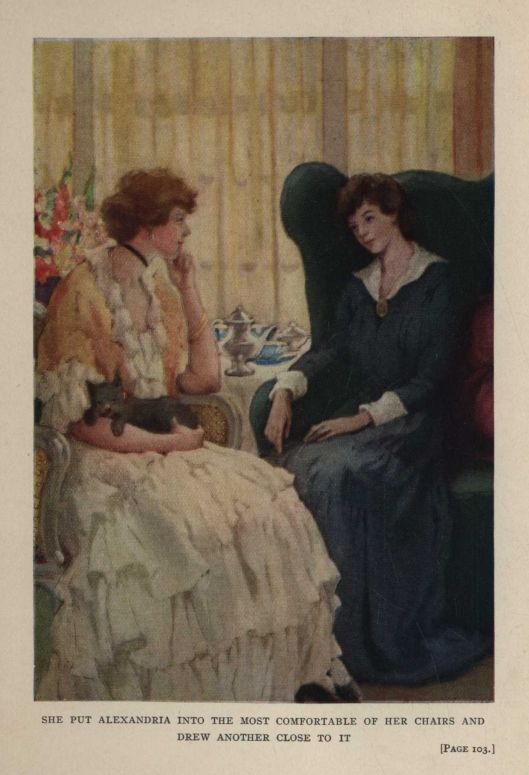
SHE PUT ALEXANDRIA INTO THE MOST COMFORTABLE OF HER CHAIRS AND DREW ANOTHER CLOSE TO IT. PAGE 103.
THE HONEY-POT
BY THE COUNTESS BARCYǸSKA
Author of "The Little Mother Who Sits at Home."
NEW YORK E. P. DUTTON & COMPANY 681 FIFTH AVENUE 1916
Copyright, 1916 BY E. P. DUTTON & COMPANY
FIRST IMPRESSION, FEBRUARY 1916 SECOND IMPRESSION, FEBRUARY 1916
I am a traveler in the great World-path; my garments are dirty and my feet are bleeding with thorns. Where should I achieve flower-beauty, the unsullied loveliness of a moment's life? The gift that I proudly bring you is the heart of a woman. Here have all pains and joys gathered, the hopes and fears and shames of a daughter of the dust; here love springs up struggling toward immortal life. Herein lies an imperfection which yet is noble and grand. If the flower service is finished, my master, accept this as your servant for the days to come.
—Rabindranath Tagore.
THE HONEY-POT
I
In her petticoat, barefooted, because the morning was sultry, Miss Maggy Delamere plied a well-worn hare's foot to her cheeks with the sure touch of an artist. Professionally speaking and adding a final "e" to the term, that is what she was—chorus-lady by courtesy, showgirl in the vernacular of the stage. On her small dressing-table were ranged a number of pots and bottles, unguents and creams. A battered make-up box containing remnants and ends of variously colored grease sticks flanked a looking-glass of inadequate size and small reflective power. A beam of sunlight striking across a corner of the table danced with minute particles of dust from a powder-puff.
The astonishing amount of vigor she put into the process of facial adornment, the prodigality with which she used pigments and washes, were characteristic of her temperament, all generosity and recklessness. Paint and powder were a habit with her, not an exigency. No girl of nineteen could have needed them less. Her complexion, well-nigh flawless, bloomed beneath the unnecessary veneer. Not even a cracked mirror could mitigate her good looks nor detract anything from her vivacious expression. It reflected a speaking face even when the lips were still.
She was taking unusual pains with her appearance this morning. A card stuck in the edge of the looking-glass provided the reason.
Memo. from A. Stannard, Dramatic Agent. PALL MALL THEATRE. Voice Trial, June 22nd, 10.45 a. m.
As everybody knows, the Pall Mall is the one London Theater of all others to which ladies of the chorus most aspire. In Maggy's case that aspiration was intensified by real want of an engagement. She had recently succumbed to an attack of that childish complaint, measles, and was more than usually hard-up. Her choice of garments was as limited as her means, yet twice she changed her mind about one or another of them before she was satisfied that she looked her best. Her efforts to that end finished with the tacking of several sheets of tissue paper to the inside of her skirt to give it the rustle of a silk lining. The rustle—deceptive and effective as stage thunder—convincingly accomplished, she felt ready to present herself before any stage-manager in existence.
If her mood was serene vanity had no part in it. Unlike the average chorus-girl she was quite free from conceit of any kind. She was too good-looking to be unaware of it, but she did not trade on her appearance further than professional principles strictly allowed. She asked no more of it than that it should bring her in from thirty shillings to two pounds a week for honest work behind the footlights. Commercialism with her ended there. She was all heart, but free from illusions. Her mother had been on the stage before her. Always on the stage herself since childhood, familiarized with its careless, hand-to-mouth existence, its trials and its exuberances, she had become worldly-wise at ten and a woman at fifteen. But the life did not demoralize her. The bad example of a mother's frailty and intemperance had been her safeguard. She had never lost her head or her heart. She did not rate herself very high, but she rated men lower. Apart from this she had no hidebound views about life or morality. Since her mother's unlovely death she had lived alone and kept her end up somehow. She had often been penniless, gone hungry and cold; but so did many of the people among whom she moved. So long as she was not quite penniless she never worried. Cigale-like she lived in the present. If she ever suffered from fits of depression it was when she realized that she was more than usually shabby and needy, a condition, however, which she preferred to put up with rather than descend to the acquisitive methods of other girls.
Through the rattle of the traffic in the street below she heard a church clock booming. Incidentally, she regarded churches less as places of worship than timepieces of magnitude, convenient when you do not possess a watch. She counted the strokes, ten of them, darted to the glass for a last survey of herself, gave a touch to her hat, another to her waistbelt, and pattered in her now stockinged feet to the top of the stairs.
"Shoes, please, Mrs. Bell!" she sang out. "You don't want me to be late, do you?"
"Coming this moment, Miss Delamere!" shouted an answering voice.
Mrs. Bell lumbered up the stairs with the shoes in her hand—high-heeled ones of the sort that only last a fortnight before losing shape.
"I just stopped to give them an extry polish," she panted.
Maggy took them from her and hurriedly put them on. While she buttoned them her landlady went on her knees and gave them a final rub up with her apron. She meant well.
"You'll have luck to-day," she said, regaining her feet and surveying her lodger with approval. "I should look out for the butcher's black cat on my way, if I was you. Back to dinner, dear?"
"I'll have a cut off whatever you've got, if I am," Maggy answered.
"Mine's hot Canterbury lamb and onion sauce."
"All right."
Maggy ran downstairs, slammed the hall door behind her and walked down the street into the main thoroughfare, looking for the green motor-bus that would take her within a stone's throw of the Pall Mall Theater. In a quarter of an hour she had reached that imposing edifice. Going in at the stage door she descended a flight of stone steps, traversed a long passage, and found herself upon the stage.
Gray daylight filtered down from the skylight above the flies, just enough for the business of the moment, no more. Across the unlit footlights was a gloomy void, pierced by an occasional gleam from an open door at the back of the pit or dress-circle, and relieved by the lighter hue of serried rows of dust-sheets hanging over the seats and balcony edges.
Close to the footlights was a table occupied by the stage-manager and one of his satellites. In the corner to their left an upright piano was set askew with the conductor of the orchestra seated at it. At the back of the stage, standing about in groups, some thirty girls and a few men were waiting to have their voices tried.
They chattered noisily. Most of them seemed to know one another. One or two called out a greeting to Maggy. Some were volubly discussing their professional experiences, telling of late engagements and prospective ones; the run of this piece, the closing down of that; incidents on tour and in pantomime; suppers at restaurants and the demerits of landladies. These topics ran into one another and overlapped. Others, with giggles, imparted risky anecdotes in undertones. Most of them appeared to be taking the situation with the calmness of habit. Nervousness showed in a few faces; anxiety in one or two. One pale-faced girl was in a condition of approaching maternity. In other surroundings she would have attracted attention, perhaps called up pathetic surprise that in the circumstances she should be attempting to obtain employment. But here very few were affected by pathos at sight of her, nor was she an object of much surprise.
After Maggy had exchanged a word or two with those whom she knew she took very little notice of the people about her. She stood apart, humming a tune, and every now and again her feet broke into a subdued dance step. But this state of abstraction did not last long. That she was a creature of impulse showed in an abrupt change from it to close attention of what was going on around her. Her fine eyes went alertly over those present and came to rest on a girl of about her own age whose quiet manner and dress of severe black singled her out from the rest. She was tall and slight, very much in the style of the women in Shepperson's drawings. Her small features and graceful figure gave her a distinguished appearance. She looked what she was, a lady, and a stranger to her surroundings. She held a roll of music and glanced nervously about her until she became aware of Maggy's smiling regard. It seemed to encourage her. She returned the smile and advanced.
"At which end will they begin?" she asked nervously, making it clear that she was an amateur.
"Anywhere," replied Maggy with friendly cheerfulness. "You're not a pro.?"
"No."
"I thought not. I shouldn't let on if I were you. Managers fight shy of beginners. First thing they'll ask you at the table is what experience you've had. Haven't you been on the stage at all before?"
"No, I've never appeared in public. I'm new to it all."
"Been looking for a shop—an engagement—long?"
"For five weeks. Ever since I came to London."
The girl in black could not hide the note of disappointment that came into her voice. Maggy gave her an encouraging tap on the arm.
"Five weeks!" she scoffed. "That's nothing. Lots of us are out for months. You'll know that if you ever hit real bad luck."
"I can't wait months."
"Hard up?" Maggy asked with quick understanding.
"I shall be soon."
"Same here. Tell me, where are you living? You're different to the crowd. I like you."
The girl in black hesitated and got a little red.
"I'm not living anywhere at present," she confessed. "I was in a boarding-house until to-day. I had to leave. I shall have to find rooms before night. Perhaps you wouldn't mind telling me where to look?"
They had moved away from those nearest them. Each felt attracted to the other without knowing why.
"Did they keep your box?"
"No. Why should they?"
"I thought you meant you couldn't pay."
"No, it wasn't that. But I can't go back. A man came into my room last night—one of the men staying there. I rang the bell and called the landlady. I don't understand why, but she blamed me and was very offensive. I didn't go to bed again. I sat up, waiting for the morning."
"The beast!"
The cheery look left Maggy's face, giving place to one of deep resentment. "The man, I mean," she said, "though I've no doubt the woman was just as bad. There are houses like that. Fancy you not knowing it. I should have ... Here, they're going to begin. Keep by me. I'll see you through."
The stage-manager rapped on the table.
"Silence, please! We'll commence now."
An immediate hush followed. The groups broke up, spreading across the stage, facing the footlights. Such indifference to the occasion as many of them had hitherto evinced was gone now. They were there to be engaged. Even the most self-assured became serious, made so by the competitive equation. Only twelve girls and three men were wanted to complete the ranks of the chorus, and here were nearly forty applicants for the vacancies.
"Come on, come on. Who's first? You with the boa," proceeded the stage-manager. "What's your song?"
The girl indicated handed her music to the pianist. He rattled off the prelude without the waste of a moment. The girl sang a few bars, and was interrupted by: "That'll do. Next!"
Nothing more was said or asked. The girl took her sheet of music, and effaced herself. With equal celerity the next dozen were disposed of. Not more than one out of four was called to the table for her or his name to be recorded. All the while the singing was going on the stage-manager kept up a running fire of remarks at the expense of the singer. Generally they were merely sarcastic; some were rude.
The girl in black kept close to Maggy who looked on unperturbed, now and then jerking out a subdued comment on the proceedings, partly to herself, partly for the information of her companion.
"Now it's Dickson, poor kid! Look at the state she's in. Silly of her to come. Powell won't let her open her mouth.... There you are! Off she goes. She's crying. The brute! He needn't have said it! ... That's Mortimer. She'll get taken on.... Knew it at once. Down goes her name—address 'Makehaste Mansions!' Don't they get through us quick? We're not human beings, only voices and figures. My turn!"
She walked confidently down to the table, ignoring the piano.
"Where's your song?" inquired the stage-manager.
"Won't you take my voice on trust, Mr. Powell?" was her jaunty reply. "It's like a bird's."
"Nightingale, I suppose?" he jeered.
"No, bird of Paradise. Aren't I good enough to look at?"
After a momentary hesitation, during which he appraised her face and figure, he said:
"Got a photo of yourself in fleshings?"
"Not here. Plenty at my agent's—Stannard's."
"All right. Name, please. Next."
The girl in black was next. Her heart beat uncomfortably fast as she moved down. Had she to pitch her voice to fill that gaping void across the footlights? She shrank from singing to these blasé-looking men who gave the impression of damning before they heard. Then she saw that Maggy was still standing by the table and nodding encouragingly to her. It gave her heart. She handed her song to the pianist and commenced to sing.
"Louder, please," said some one.
She sang louder and lost her nervousness. It was not so difficult to fill that huge auditorium, after all. So far, she was the only one of them that had been allowed to sing her song half through.
"Shouldn't mind hearing the rest of that another day," said the stage-manager, stopping her at last. "Not half bad, my dear. Name, please."
She gave her name, Alexandra Hersey.
"What have you been in?" came the query.
Before she could answer Maggy chimed in.
"She was with me on tour in 'The Camera Girl.' No. 2 Company."
"Address?"
Again Maggy came to the rescue.
"Put her down to mine. 109 Sidey Street. Then you'll remember us both—p'r'aps!"
She hooked her arm in Alexandra's and made for the wings. When they were in the passage facing the stage-door she said:
"I'll help you find rooms if you like. I've nothing to do. I say, you can sing!"
"If it hadn't been for you—"
"Oh, rats!"
"But it was awfully good of you," Alexandra maintained. "Is there a room in the house where you live?" she asked, actuated by a strong desire not to lose sight of her new acquaintance.
"There's room in my room, that's all. I pay ten shillings a week. My landlady charges fifteen for two in it. That would be seven-and-six each. But"—she made a wry face—"you wouldn't like it. It's slummy. There's a smell of fried fish and a beastly row half the night. Still, you can have a look at it if you like."
There was invitation in the tone.
"I'd like to come," said Alexandra.
"Right-O. Here's my motor car. The green one." She held up her hand to a 'bus driver. "My chauffeur doesn't like stopping, except for policemen."
She gave Alexandra a push up and sprang on the footboard after her. They climbed to the top, and were rattled and jerked in the direction of the King's Cross Road.
II
One Hundred and Nine Sidey Street was not an attractive apartment house, but it was cheap and respectable. Mrs. Bell, an "old pro" herself, by reason of having, in some distant past, earned twelve shillings a week as a "local girl" in pantomime, preferred the lesser lights of the stage for tenants. She knew their ways, their freedom from "side," their unexacting habits. When she could not secure them she took in "respectable young men." At the present juncture the young men predominated. Maggy Delamere was the sole representative of "the professional" in her house. She occupied the third-floor front, and owed three weeks' rent.
She threw open the door for Alexandra to enter. It was the sort of room that many a domestic servant would have considered inadequate. The only compensating feature about it on this hot June day was that it had two windows. Both stood open, and on the sill of each a pot of flowers, mignonette in the one, sweet peas in the other, helped to create an impression of freshness. This was strengthened by the paucity of its furniture and the chilly look which an unrelieved expanse of linoleum invariably gives. A single iron bedstead occupied one angle. A clean but faded nightdress case, trimmed with crochet work, lay on the pillow. This and the flowers in the windows were the only things that gave evidence of the room being occupied by a young girl.
Maggy made a comprehensive gesture with her hand.
"The chorus lady at home!" she declaimed humorously. "Living in the lap of luxury. There's her voluptuous couch, her Louis the what's-his-name chest of drawers, her exquisite bric-à-bric washstand and—My dear, be careful of the chair! It's a real antique, only three legs and a swinger! Sit on the bed, it's safer. Pretty little place, isn't it? We'll have lunch in a minute or two. Can you eat hot New Zealand mutton? I told the old woman I'd have a cut off her joint to-day. I'll just shout down to let her know there's two of us."
After her voice had echoed down the three flights and been duly answered, she came back and poured out water for her new friend to wash her hands in. Common yellow soap was all she could offer for this purpose. She was only able to afford the fancy variety and cheap perfumes when she was in an engagement. She took off her hat while Alexandra dried her hands and then, as they sat side by side on the bed, she suddenly blurted out:
"What the dickens makes you want to go in for the stage? Don't tell me if you'd rather not."
"There's no reason why I shouldn't," said Alexandra. "I've longed to ever since I was quite small."
"Goodness! And I've wanted to get off it ever since I can remember. Not that I ever had the chance. I don't know how to do anything useful. I suppose you got cracked about the stage, same as most girls, because you didn't know anything about it. You belong to a swell family, I suppose?"
"No," was the smiling reply; "only Anglo-Indians."
"What are they? Half-castes? You're fooling!"
"English people who live or have lived in India. My father was in the army."
"What, an officer?"
"Yes."
Maggy was impressed. She had once met a Sergeant-Major, and, superior being as she thought him, knew that his glory was reflected from the commissioned ranks.
"That's something to be proud of, anyway."
Alexandra's people had been in the Army and Civil Service for generations. It had not occurred to her to think of them unduly on this account. She said as much.
"Well," observed Maggy sententiously, "I should say your father and the rest of your relations must be either dead or dreaming to let you go on the stage."
"Nearly all my near relations are dead. I have an aunt and uncle—"
"What does he do?"
"He's a retired colonel. He—they wanted me to live with them." Alexandra gave the information with a touch of reluctance.
"Why didn't you?"
To give a stranger adequate and convincing reasons why one prefers not to live with uncongenial relations is not always easy. Alexandra put it briefly.
"We have nothing in common," she said.
"And what do you think you have in common with this life and the people you'll meet in it?" propounded Maggy. "If I were you I'd go back and say: 'Nunky old dear, I've changed my mind. I'll come and live with you and be your loving niece, amen.' Fancy! a retired colonel—Anglo-Indian—and you think twice about it!"
"Nothing would induce me to change my mind," said Alexandra with decision. "There are three girls, and they find it a tight fit without me. They're not rich.... When my mother died I had to do something. Besides, I'm really ambitious to get on."
Maggy snapped her fingers.
"Oh, ambition! Do you know what the ambition of every chorus girl is? It isn't to become a star-actress. That's clean beyond her. It's to find a man who'll take her away from a room like this and treat her decently."
Alexandra found it difficult to reconcile such a statement with one so beaming and joyous-looking as Maggy.
"But you—you don't think like that?" she rejoined.
"Sometimes I do. I've kept straight so far because I like being on my own. I hate men, with their nasty thoughts and their prowling ways. But I haven't met any that I liked. If I had, perhaps I shouldn't be here now. If we get taken on at the Pall Mall it'll be nothing but men, men, men. We shall get no peace."
"You paint everything in such somber colors. There must be light as well as shade."
"There's a lot of limelight, if that's what you mean; but the shade's all the darker for it. Oh, I can tell you the stage is a rotten place if you've got no money or no friends or no chap at the back of you. I'm not saying that for the sake of talking. It's good enough for any one like me. But when I see a blind man crossing the road I always wish I could make him see, and as I'm not God Almighty the only thing I can do is to give him a hand. That's how I feel about you. The traffic's dangerous enough when you've got eyes in your head, like I have. It's all traffic on the stage. I suppose you think you'll be able to look after yourself? Well, you wait and see. There'll be Mr. Johnnie at the stage-door asking you to hop into his landaulette because the road's slippery or some such nonsense. But what's the use of trying to convince anybody? I can see I shan't put you off the stage.... I'll help you to look for a room, unless—" Maggy's volubility checked for a moment. "—unless you'd like to chum with me. I'm just what you see. Nothing hidden up my sleeve; no drink and no boy."
She saw Alexandra wince at her plain language, and watched her anxiously. Hardly ever before had she sought the companionship of another girl, nor could she quite understand the motive that was making her do so now.
Her extreme candor certainly had a startling effect on Alexandra. She had never met any one so outspoken. But she put the right construction on Maggy's frankness, recognized it as a manifestation of genuineness and honesty, and succumbed to it as she had to the girl's fascinating vivacity. She was altogether drawn towards her. Again, Maggy stood to her as the personification of the new life she had elected to make her own.
Maggy was looking at her expectantly, looking and smiling. There was something very compelling in her smile.
"I'd like to chum," said Alexandra impulsively.
III
When Maggy spoke of the stage she generally meant the Pall Mall Theater. Just now it was in her thoughts more than any other, perhaps because she had met Alexandra there, but also because she was inclined to think that Alexandra and she had made a favorable impression on its stage-manager.
The Pall Mall, De Freyne, its lessee and manager, and the Pall Mall chorus are a trinity known the world over. Productions at the Pall Mall invariably enjoy success. Long runs prevail there. That was one of the reasons why Maggy looked forward to an engagement at that theater. Another was the pay, rather more than was obtainable elsewhere. In other respects it offered her no advantages and some drawbacks. She had, for instance no aspiration to become one of a chorus whose unrivaled attractions marked it out as a sort of human delicatessen for the consumption of epicurean males. On the other hand, De Freyne was indifferent to expense on the question of costume, and that had had considerable weight with Maggy. Like any other pretty girl she reveled in beautiful clothes, even though they should only be on loan to her for an hour or two out of the twenty-four. On tour the dresses were often effective enough at a distance, but either of inferior material or their pristine freshness considerably depreciated by having seen previous service in a London theater. That militated against the pleasure of wearing them. At the Pall Mall everything would be new and the best that money could buy.
That De Freyne's object in dressing his chorus regardless of cost was a licentious one, the desire to make his two-score of attractive-looking girls still more attractive in the eyes of the jeunesse dorée, who filled his stalls, was no deterrent to Maggy on her own account. She did think of it in regard to Alexandra. She wondered whether Alexandra would be affected by the demoralizing influence of those beautiful clothes which at the Pall Mall were fashioned to display a girl's physical charms to the very limit of decency. It ended in her being almost sorry that Alexandra's innocence and the callousness of an agent should have sent her to the voice trial.
How Alexandra was to make a good impression on the public by posturing in the chorus was not explained to her. It was the expression of an opinion which she could take or leave. In her innocence she made the common error of imagining that the public chooses its plays, its novels, its pictures, its music and its actors and actresses for itself. She did not stop to think that there might be gradations in that public or that the vast majority of it is deprived of selective taste by the interested parties who cater for it. Generalizing by the noise the public makes with its hands when it approves of anything, she argued that everything it applauds must be good. The noise is there right enough and the approval is genuine; but that has to be discounted by the fact that the public has nothing better to approve of. For the public—the crowd—is a led horse most of the time. It is enormously manageable. It does what it is told and goes where it is taken. Its taste has never been given a chance of becoming educated because of the fare that has been forced upon it. Its purveyors feed it as injuriously as an ignorant man will a horse. For the want of anything better the horse will eat what is given it. So with the public. Obviously the public never has anything to do with the choice of a play. Nobody has except the man who buys it and puts it on the stage.
Following the simile of the led horse and the proverb that, though you may take it to the water you cannot make it drink, the public likewise will once in a way evince the same sort of stubbornness. Then the play that failed to "go down" is unostentatiously withdrawn, or the pretender to histrionic laurels unable to obtain them will try his or her luck again in another piece with another's money behind it.
After all, it is but a question of credulity. Even Alexandra had to conform to it. She was advised to apply for a place in the chorus and she did so. With her necessarily vague ideas about the chorus she did not think of it as anything very dreadful. It did not offer so good a footing on the stage as she desired, that was all. She did not, for instance, believe all the disparaging things Maggy said about the stage. She appreciated that on the stage a girl might be unduly exposed to temptation, but in her austerity that was no reason for yielding to it. In her Arcadian purity she could not conceive of circumstances, however degrading, having any adverse effect on herself. Nor could she credit Maggy's insistent assertion that without money or influence an actress must remain in the depths. She believed, as inexperience always does, that talent is bound to be recognized sooner or later. The creed of the chorus girl, unspoken, unwritten, was yet hers to learn.
For ten days the two girls heard nothing from the Pall Mall Theater. It was possible, if not probable, that they might not hear at all. Meanwhile Maggy went about with Alexandra looking for an engagement in some other direction. It was a matter of urgency to both of them to get something to do. Maggy had been out of an engagement for two months. She was in Mrs. Bell's debt, and she owed money to a doctor. Alexandra was little better off. As the orphaned daughter of an officer she had a pension of £40 a year so long as she remained unmarried. But with the expense she had been put to in coming to town and in spite of the strictest economy it was not enough to live on.
She could not help being anxious about the future; more so than Maggy. Maggy, though she chafed at them, was accustomed to bad times: Alexandra had never struck them before. Hardly had she got over the illusion of imagining that a small part in a London theater was obtainable than she found herself in no request even for the chorus. It was terribly disappointing. They were forever haunting stage-doors and the crowded waiting rooms of theatrical agencies. For hours every day they wandered about the Strand and its environs.
But for the prospect of sheer want confronting them they would have been quite happy. The bond that united them was based on mutual respect as well as affection. Disappointment and privation only cemented it. In these days when the stale breakfast egg was a comestible to be shared, when anything better than canned food became a luxury, their friendship remained free from any of the pettinesses which generally characterize the intimacy of people living under conditions of hardship.
The stoicism of a family of soldiers supported Alexandra. She had the pride of race that refuses to surrender to misfortune. Her grit, astonishing in one so delicately reared, surprised Maggy. She began to look up to Alexandra as a being of a superior world in which the virtues, being Anglo-Indian, were of a particularly high order. She had a very nebulous conception of the meaning of the term.
Just as Alexandra found it absorbing to listen to Maggy's stage talk, even though it was humorously misogynistic, so nothing pleased Maggy so much as to listen to Alexandra's narration of life in an Indian military station. It sounded to her like a history of the high gods: a medley of color, warmth and ease, good living and brass bands. She loved to hear of parades and polo, of the troops of servants, the gymkhanas and dances, all the social amusements and advantages of the sahib caste. From habit, Alexandra would use native words when talking of these things, and Maggy's unaccustomed brain never quite differentiated between syce, hazari, maidan, ayah, chit, durzi, kitmagar, butti, tikka-gari and such-like terms in common use with Anglo-Indians. But they impressed her immensely.
The amount of talk they got through in these early days of their friendship was stupendous. It helped to relieve the harassing search after employment and its invariable ill-success.
One morning, three weeks after their first meeting, Maggy sprang out of bed to gather up two letters which their landlady had pushed under the door. On the flaps were inspiring words in red lettering.
"Pall Mall Theater! Hooroo! One for each of us!" she cried, and danced about in her nightdress.
Alexandra, behind an improvised screen formed of a shawl over the towel rail, was having her morning bath in a zinc tub of inadequate size.
"Open mine," she called. "I'm wet."
She waited anxiously. There came the sound of tearing paper and then Maggy's voice, raised excitedly:
"Pull that old shawl down, Lexie! If you don't practise on me you'll die of shyness and no clothes at the Pall Mall. We're engaged! Rehearsal Thursday. Eleven o'clock!"
IV
It was past one o'clock. For over two hours without a pause the chorus had been going through their "business" in the new play with the reiteration that exasperates the teacher and the taught. The girls had relapsed into sulkiness, the stage-manager's temper was ruffled. Even the pianist in the O.P. corner by the footlights felt the reaction. His hands rested on the keys without energy.
Powell, the stage-manager, faced the forty girls standing in a semi-circle, three-deep. The majority of them were dressed in the ultra-fashionable style of the moment, some very expensively, a few with taste. The exceptions were Maggy and Alexandra. He knew they were all tired and rebellious; but he was concerned only with their recalcitrant feet.
"Now then, girls. Once more."
The pianist's hands came down heavily on the opening chords of a dance movement.
"La-la-la—da-di-dum—point! Step it out. Don't mince!"
A tall girl, gorgeously arrayed, brought the dance to a stop by leaving her position in the front row.
"I'm not going to stick here all day," she announced defiantly. "I'm lunching with my boy, and he won't wait."
"Get back to your place, Miss Mortimer," snapped Powell.
"Not me. I'm going."
As she began to cross the stage on her way out a voice came from the depths of the auditorium:
"Miss Mortimer, we're not concerned with your private appointments. If they're to interfere with your work here you can look for another engagement somewhere else."
The show-girl glanced in the direction of the voice and shrugged.
"Mean you'll fire me, Mr. De Freyne? Well, I don't care. Pa's rich!"
She walked off jauntily, her high heels clicking on the boards, a costly plume streaming over her left ear. The lessee of the Pall Mall Theater said nothing. He was mildly amused. He stood in the dark at the back of the dress circle complacently regarding his theatrical seraglio. All the girls were pretty, or if not pretty, showy. Some had been selected for their figures, some for their faces, some for both. No duchess, not even a fashionable duchess, was arrayed like one of these. Solomon in all his glory might perhaps have competed with them, but not the lilies of the field. Presently De Freyne's gimlet eyes picked out Maggy and Alexandra. Their appearance disturbed his equanimity.
He watched them attentively for ten minutes or so, at the end of which period the tired stage-manager dismissed the chorus for the morning. De Freyne's authoritative voice again made itself heard.
"Miss Delamere and Miss Hersey. Step up to my room before you go, please. I want to speak to you."
The girls exchanged scared glances. A special interview with De Freyne was sufficiently unusual to fill them with dismay. He was not in the habit of detaining members of his chorus for the fun of the thing.
They groped their way along dim, soft-carpeted passages to the front of the house and entered the managerial office. De Freyne was blunt to a degree. He wasted no time.
"You two girls have got to make more of a show," he told them. "I can't have shabby dresses at the Pall Mall."
Alexandra was too taken aback by this curt rebuke to make any reply; but Maggy lost her temper.
"Meaning flash clothes and jewelry?" she bit out. "How do you expect us to do it on thirty-five shillings a week, Mr. De Freyne?"
"I'm not interested in your resources," was De Freyne's cold answer.
"You ought to be. You ought to get a pencil and slate and write down the cost of lodgings, food, boots, and all the rest of it, and figure out how little we've got left to buy clothes with—unless we don't care who buys them for us. We're not that sort—not yet."
"You must look smarter," reiterated De Freyne, showing no resentment at this tirade. "You silly creatures, don't you want to attract attention?"
"We'll attract attention on the night. Don't worry," said Maggy. She was afraid of De Freyne, but she did not let her voice show it.
"That's all very well, but you know the unwritten clause of my agreement with you all. The ladies of my chorus have got to be dressed decently off the stage as well as on.... Anyhow, there it is. Take it or leave it." He dismissed them with a nod.
Neither said anything until they had passed out of the stage-door and were in the street.
"That means new clothes," said Alexandra in a tone of deep depression.
"Or Dick Whittington!" Maggy rejoined dryly. "Turn and turn again—our dresses. I'll have a go at yours to-night, Lexie. Look, there's Mortimer and her boy."
A big car slid past them, ridiculously upholstered in white velvet. An effete-looking youth and the girl who had stated that her "pa" was rich lolled in the back seat.
Maggy's eyes followed them speculatively.
"Wonder if there's anything in it?" she remarked.
"In what?"
"In that sort of a good time. Flat, money, pet dog, car, week-ends at Brighton—enough to eat."
"I don't want to think about it."
"Neither do I. But I have lately. I'm wondering what on earth we're standing out for. No one thinks any the better of us for it. The girls all think us fools, and the men just grin and wait."
"Don't talk about it. Talking makes it all seem worse."
"One day I shall do more than talk. I shall walk off."
Alexandra said nothing. She knew Maggy's mood. Maggy was hungry, tired, and cross. Motives of economy impelled them towards their lodgings, where half a tin of sardines was waiting to be consumed. Neither had had anything to eat since early morning. And when they had lunched they would have to walk back to the theater for rehearsal again at three. Maggy suddenly halted before a Lyons' depot.
"Come on in, Lexie," she said. "We can't wait. We shan't be home till past two. And if we're late back we'll be fined."
"There's the tin of—" Alexandra began and stopped.
Maggy had pushed open the swing doors. The grateful smell of hot and well-made coffee and savory, nourishing food, cheapness notwithstanding, made her surrender to temptation. Deprivation has this effect. De Freyne, lunching expensively at the Savoy, recognizing here and there approved members of his chorus and their cavaliers, could not be expected to know anything of empty stomachs. Besides, it was their own fault if the girls did not know which side their bread was buttered.
They sat down at one of the marble-topped tables. A waitress came towards them.
"Two cups of coffee, rolls and butter—"
This was Alexandra's order.
"Coffee, rolls, and two steak-and-kidney puddings," augmented Maggy recklessly.
Unmoved, the attendant went off to execute the order.
Maggy met Alexandra's startled eyes. Her own were defiant.
"Don't tell me," she said. "It'll cost us nearly eighteenpence. I don't care. I'm going to pay, and if I don't go bust that way I shall do something worse. We're going to feed, dear!"
V
"Damn! She's turned off the gas!"
Maggy stopped machining. The small room was plunged in darkness. Alexandra groped for matches and lit the candles. It was not easy to work by the flickering light, but both girls went on with what they were doing. There was something grim about the task. One associates the alteration of frills and furbelows with some small pleasure to the adapter; but there was none here. Necessity impelled them, kept them out of their beds. They were heavy with sleep. The air of the room was close and unpleasant.
Maggy had all but finished turning Alexandra's coat and skirt. Alexandra had adapted two Indian shawls into an effective dress for Maggy. The work was too hastily done to bear inspection at close quarters or much strain by its wearer. They had been steadily at it for five hours.
It was Maggy who gave in first. She finished machining with a savage jerk, leaving the handle to revolve by itself.
"Let's go to bed," she said. "I'll get up half an hour earlier and finish that."
Alexandra went on. She was not going to be beaten for the sake of half an hour. Besides, she knew that Maggy in the cashmere shawl arrangement would please De Freyne. She, at any rate, would pass muster.
"I'm not so very tired now," she answered without looking up, "and I may be in the morning."
Maggy shook her hair down and slipped out of her clothes with the celerity that comes of practise between the acts. She did not even trouble to take the paint off her face. She got into bed and lay watching Alexandra working by the guttering candle-light. She did not talk. She was too utterly tired.
At last Alexandra's work was done. She hung up the dress and put away the needles and cotton. She had a strong inclination to get into bed without more ado than Maggy had shown; but habit was not to be denied. She knew she would not be able to rest properly unless she was clean and cool. She brushed her hair, washed her face and hands, brushed her teeth. A huge sigh from Maggy's bed made her turn.
"Am I keeping you awake?"
"No. I sighed because you're so different to me. I couldn't wash to-night. And I knew my hair'd be a mat in the morning and the pillow pink from my cheeks."
"I wish you didn't paint. There's no harm in girls doing it if they need it, but you spoil yourself."
"Force of habit. Mother made up my face from the time I was ten."
Alexandra in her nightdress knelt down at the side of her bed. Maggy never said prayers. To see Alexandra say them, she said, was the nearest she would ever get to such things. She had never been taught to pray when a child.
"Might as well drop Him a hint that we're at the end of our tether," she suggested presently.
When Alexandra rose from her knees Maggy was sitting up in bed watching her, her hands clasping her legs.
"And you mean to say that you believe somebody hears you!" she said wonderingly.
"Yes."
"And does what you ask?"
"Yes—in the end."
"Then He must be pretty deaf.... You look nice saying your prayers. If I were God I couldn't refuse you anything. P'raps He's a woman-hater. Women get the worst of it everywhere, I think. If we do wrong, we have to pay for it. If we don't do wrong, we have to pay just the same. We're made so that we're not fit to be working all the time. Oh, it's a hell of a world for women! I can stand anything when I feel it's fair and just. I can't see any justice where we're concerned. They have an inspector Johnnie to see that the scales in the grocery-shops are fair, but if a woman wants to make a bargain she's got to do it on the heavy side."
"The law courts are the scales."
"The law? Aren't the scales against us there too? If we want a divorce we've got to be knocked about as well as—other things. If we're deserted and ruined before we're married we can get so many shillings a week until the kid's in his teens. And if there's no kid or it dies, well, p'raps your God'll help us, but the law won't. It's all too hard to fight against, and one can't make head or tail of it. Look at the White Slave Traffic. They'll flog a man if they catch him at it, but they won't flog De Freyne and give him hard labor for the dirty work he's doing every day of his life, though everybody knows about it. Why, he's only a—what's it called?—procurer for the nobility and gentry and all the rich bounders. And we're not all in yet, but we shall be. My word, one hears a lot about the chorus-girl being on the make-haste and living you-know-how. One doesn't hear how she's driven into it, like cattle into a dirty pen. I'm done, Lexie. I shan't hold out long."
Alexandra blew out the remaining candle. In the darkness one could just make out the two narrow beds and the glimmer of the window.
"You mustn't give in, Maggy," came Alexandra's voice after a pause. "When one meets the man one cares about one doesn't want to come to him with nothing to give."
"Why not? There isn't a man in a hundred who comes to a woman with a clean slate. Why should they expect us to have nothing written on ours?"
"Because when a man marries nature makes him want a pure woman, not for his own sake but because of the children she will probably have. For myself, I know I would rather show a clean slate to the man I loved and who loved me in a decent way whatever his life had been, than let a man who was nothing to me write his name there first. That must be wrong because it's against nature."
"Is it? I don't know. You can argue better than I can. You don't lose your temper. Let's bring it down to ourselves and our difficulties. The stage is a honey-pot and we girls are the honey in it, and the men are the flies buzzing round. They won't leave us alone. They make it almost impossible for us to live a decent life. And if it's decent it isn't beautiful. You can't call it beautiful, Lexie. This room's the limit. Think of the food we eat. Generally beastly. And our clothes. Everything's ugly and makeshift, and yet we've only got to stretch out our little fingers—"
"More than our little fingers."
"Well, if you like. Anyway, what are we waiting for? There's no sense in it. It won't get us any forrader. Why don't you leave me alone? I'd almost made up my mind to give in when I met you. I should rather enjoy cutting a dash and having everything I want and going one better than the other girls who crow over us, and snapping my fingers at the management like Mortimer did to-day. If a man was going to marry me and give me a nice broad ring and a little home there'd be some reason for going on like this and keeping good; but men don't ask chorus-girls to marry them, as a rule—not by a long chalk! Oh, goodnight!"
She twisted on to her side, and the bedsprings groaned.
From neighboring churches clocks began striking twelve. The noises from the street subsided. Only an occasional footfall was heard or a cart rumbling past. Sometimes a shrill voice broke the stillness, sometimes a drunken song.
The girls slept.
At dawn a cool breeze moved the dingy window curtain. Maggy woke and peered through the gray light at Alexandra, sleeping.
She looked as though she were dead and at peace.
Maggy wondered if that was the better fate.
VI
De Freyne did not seem to notice the efforts of the two girls in obeying his instructions to smarten up their appearance: he said nothing. But for all that, the change did not escape him. Maggy, in the draped cashmere affair struck him as likely to appeal to a Jew or a gentleman from Manchester. He had a particular individual of each type in his mind, and awaited a propitious moment for exploiting her to one or the other. For the next few days the attention of the girls would have to be devoted to rehearsals, not men.
De Freyne's exploitation of his chorus naturally had it roots in commercialism and self-interest. The girls themselves very seldom thanked him for his introductions. They were astute enough to understand that the advantage was at least mutual. Not that De Freyne expected any thanks. It was a trite observation of his that theatrical people were the most ungrateful lot in the world. He himself was a shining illustration of the dictum, but that did not lessen its truth. He got his "turn" from his wealthy stage-door dilettanti. It might be a social one in the shape of admittance to elevated circles; a select club, a shooting party, a cruise on a big yacht. Sometimes it was an invitation by a young and indiscreet member of the peerage to his country house and a photograph in the illustrated papers to proclaim it. De Freyne was very partial to reading beneath the group: "From left to right: The Marquis of Perth, Lady Angela Coniston, Sir Francis Manningtree, Mr. De Freyne...." This was prestige dear to his heart. He toed the line successfully between Society and Bohemianism. Most of the rich rascals and all the rich fools of the world were at his service.
But what gave him most satisfaction was to be able to put an important City man under an obligation. It often resulted in special information concerning stocks and shares that brought him large profits. He would have sacrificed any girl's reputation for a one-fourth per cent. turn of the market, and frequently did so.
In this regard he mentally pigeon-holed Maggy. It would not be difficult to find her a partner in the dance to which he should set the Mephistophelean measure. Alexandra he looked at with a cold eye. He wasn't sure of her. He had nothing to say against her looks, but he had no use for prudish high-steppers. Quick of apprehension where girls were concerned, he put her down in that category. The chorus would bear thinning out a bit. As a matter of policy, De Freyne always engaged more girls than he wanted.
For another week rehearsals went on, growing more frequent and longer. The clever stage-manager goes nearer creating silk purses out of sows' ears than any human being. No one in the early days of rehearsal would associate the pouting, obtuse, wooden young woman with the airy fairy sylphs who ravish the eye on a first night; yet they are one and the same, trained by methods similar to those used in schooling performing animals, by coaxing, bullying and inexhaustible patience.
When the chorus were at last up to concert pitch and the principals letter-perfect, the dress rehearsal took place. Maggy was in the front row, looking big and beautiful in a Futurist creation of rose fleshings and black chiffon. The front row girls were very carefully chosen for opulence of figure. Alexandra had been relegated to the back. She was disappointing in tights, which means nothing more than that if a butcher did not approve her an artist might.
It was over at last, the long performance with its glitter, glare and gaiety. There was nothing in it, but all London would flock to see it because the music was catchy and the girls so pretty and the whole show so symbolical of the light side of life. For several days afterwards rehearsals were frequent. The usual "cuts" and alterations had to be made, the show licked into shape.
On one of these occasions Maggy received a message from De Freyne. He wanted to see her. Leaving Alexandra in the dressing room she went up to the managerial office. It was nearly one o'clock.
"I'm glad you took my advice," he said in a friendly tone. "You've been turning yourself out much better."
"Thanks," Maggy answered. "Is that all?"
"No. I'm going to put you in the way of dressing really well. A very decent chap wants to know you. You'll be lucky if he likes you."
"That's your opinion. Well, he can like me as much as he likes. But I'm straight."
De Freyne chewed the end of his mustache.
"You get these silly notions from the girl you live with," he said impatiently. "I'll mix advice with a bit of prophecy. If you don't try and make yourselves more agreeable you'll find you're in—"
"Queer Street?"
"It's equivalent—Garrick Street and Maiden Lane—out of a shop. It doesn't hurt you to be nice to a fellow, does it? He may ask you to lunch. Duchesses lunch."
"I'm not a duchess, and I'm particular who I lunch with."
At the end of her sentence the door opened and a man looked in. He had heard her, and was amused.
Maggy's look as she turned to acknowledge De Freyne's introduction was inimical. She knew perfectly well what that introduction portended. She must be hard. She had repulsed other men. She could take care of herself. But this man—what was his name—Woolf?—loomed tall and big over her, big as Fate, possessive. He exercised a spell: he appealed to her. She knew it in the first moment that she looked at him. She knew she would like to lunch with him, and that she would inwardly be disappointed if she had the strength of mind to refuse. When the invitation came she accepted it with cheeky reservation.
"All right, Mr. Woolf, so long as you don't think I'm Little Red Riding-hood and included in the menu."
The capitulation satisfied her conscience. Then she remembered Alexandra.
"I must go and tell my friend not to wait for me," she said.
"Miss Hersey?" supplied De Freyne. "You might also ask her to come in here in ten minutes, will you?"
"My car's outside," said Woolf. "You'll find me at the stage-door."
Maggy ran along to the dressing room where she had left Alexandra. The other girls had gone.
"Lexie, I'm going out to lunch," she began breathlessly. "I wish you were coming too. Do you mind? I shan't be long. I'll cut home as quickly as I can."
She could not hide her excitement. It showed in an added sparkle of the eyes, a catch in the voice. Alexandra wondered what else besides an invitation to lunch could have created this effect. It caused her vague uneasiness. But prospective enjoyment was so clearly written all over Maggy's face that she refrained from expressing it.
"Of course I don't mind," she said. "I hope you will enjoy yourself."
"You are a dear!" Maggy felt awkward. "You—you don't think it's wrong?"
"There's nothing wrong in going to lunch with anybody. Especially if he's—all right, and knows you are, too."
"He's nice, I think."
"I'm glad. But be careful, Maggy."
"Rather!"
Maggy moved to one of the mirrors and took up a powder-puff.
"You've got heaps on already," deprecated Alexandra.
"Have I?" She powdered over the rouge. "I do look rather like puff pastry—in layers, don't I? Well, I haven't time to take any of it off. Lexie, De Freyne wants to see you in a minute or two. I don't think it's anything important. He seems in a good temper. Ta-ta, dear."
She ran out and made for the stage-door where Woolf was waiting for her. His car, a big open one, was drawn up opposite it. Maggy wished the girls had not all gone. They had twitted her so often about her lack of a male escort. Now there was no one to see her get in.
"Where are we going?" she asked. "The Savoy?"
"Not this time," said Woolf. "My house is not far off."
"I'd prefer the Savoy," she persisted, although she had never actually been to that restaurant.
Woolf was the sort of man who invariably gets his own way with women. In addition to being characteristically obstinate he was indifferent to any opinion that clashed with his own. If it was one that suited him so much the better; if not, he ignored it. So long as he paid the piper he considered he had the right to call the tune. But before paying he scanned the bill carefully. He was not a gentleman. He met gentlemen sometimes, and was adaptive enough to be mistaken for one. He belonged to one or two nearly-good clubs. He was a man about town in the sense that he was to be seen wherever money could purchase an entrance.
"You'll be quite chaperoned at my place," he assured Maggy. "I've a man and his wife."
"I don't need a man and his wife to look after me," she retorted sharply.
He gave her an attentive stare. "Who does look after you?" His meaning was obvious.
"Myself, of course. Why don't we go to the Savoy?"
"How persistent you are. Do you want to know why, really? Promise you won't be offended?"
"If I am I'll hop out."
"Well ... when you let me buy you some pretty clothes I'll take you there."
He half expected she might "hop out," especially as the car had come to a standstill in a traffic block. She looked hot-tempered. But Maggy was too level-headed to be sensitive on the score of clothes.
"I suppose that king in the story wouldn't have been seen with his beggar maid at the Savoy until he'd dressed her out," she remarked ironically. "Well, you won't go there with me any time, anyway."
"Why not?"
"Because this young woman provides her own wardrobe."
"We shall see."
Woolf liked her spirit, otherwise her independence might have irritated him.
Arrived at his house he gave her in charge of his man's wife. Maggy disliked the woman on sight. There was something furtive about her. She gave the impression of being one who was used to waiting on ladies in a single man's house. Sly and secret amusement lurked in her eyes. She lingered, unostentatiously, while Maggy prinked herself in front of the glass. After a minute or two she turned, and intimated that she was ready.
"Wouldn't you like to take off your hat, miss?"
There was something unpleasantly insinuating in the smooth tones.
"No, thanks," said Maggy shortly.
"You've left your purse on the table, miss."
"Have I? There's nothing in it. It'll be quite safe."
The woman led the way downstairs and ushered her into a room half-library, half-drawing-room.
"Find everything you wanted?" inquired Woolf, coming forward to meet her.
"Yes, thanks. What a swanky bed-room! Silver hair-brushes and face powder and hairpins! Is it yours?"
"No, it's the visitors' room. I'm glad you like it."
"I didn't say I liked it. It looked as if you always had it ready for a lady. I don't like the look of your man's wife either."
Woolf laughed at the downright expression of opinion.
"She's all right," he said significantly. "She's as quiet as the grave and much deeper."
"She's no good."
"Who is! Are you?" He took her hand and tried to draw her to him. Maggy's form grew rigid.
"Hands off," she said coolly. "There's nothing doing here."
"Won't you let me kiss you?"
"No."
"Why not?"
"For the same reason that I keep my hat on, and you don't. One's out of respect for me and the other's respect for myself."
"You're a funny girl!" Woolf drew back and looked at her. "Why are you on the defensive?"
"Haven't I need to be?"
"Not with me, surely. I want to be friends with you."
"Friends!" She threw up her chin aggressively. "I've only got one in the world."
"And who is he?" Woolf asked with quick curiosity.
"She's a girl. I chum with her."
"Women can't be friends with each other," he asserted didactically. "Especially when they're of the same profession. A Hottentot woman and her civilized sister have only one occupation—the study and pursuit of man. You're like doctors, all at each other's throats. Some of you practise homeopathy, the others are allopaths. The first marry and take their husbands in small doses, the allopaths believe in quantity. Your friend would probably leave you to-morrow if she got a good enough chance."
"Talk about some one you know," Maggy responded.
The contentious conversation was interrupted by the entrance of Woolf's man announcing lunch. They went into the dining room. Maggy was hungry and did justice to an excellent meal. But she refused to drink anything stronger than lemon squash, and when Woolf pressed her for her reason for such abstinence she gave him none. She had seen her mother suffer from alcoholic excess. The smell of spirits always turned her sick.
When they were alone Woolf leant towards her.
"Now let's talk," he said. "What do you want me to do for you?"
"Nothing," replied Maggy shortly.
"Do you dislike me?"
She looked at him and away again.
"No. That doesn't mean you're fascinating. You're the sort of man who might get round a girl like me if I was fool enough to listen to you. Lexie—that's my chum—would tell you off at once."
"I should think she's a man-hater." Woolf was beginning to feel a distinct antipathy towards Maggy's friend.
"No, she isn't. Only men aren't much in our line. You can see prowling beasts without going to the Zoo."
Maggy's conversational trick of generalizing led away from the point Woolf wanted to press.
"You doubt me," he said. "You'd believe in me if I wanted to marry you—"
"Oh, cut it! You don't!" she interjected.
"Marriage is an institution for the protection of women who wear flannel petticoats. It doesn't follow that a girl can't trust a man because he offers her a lot more than most wives get."
"He offers her a lot more because he knows it won't last for long. I'm practical."
"If you were practical you'd listen to my offer."
"Oh, I'll listen."
"Well, I'd like to make you really comfortable. You ought to have a smart little place of your own, and dainty things, and money to spend."
"It's as old as the hills. I daresay I'm not the only girl you've made that proposition to. Try somebody else. I'm going now."
"You mean you won't think about it?"
Maggy was silent for a minute.
"Oh, I shall think about it right enough, don't you worry," she said in an odd voice. "I shall think about it when I'm hungry. I shall think about it when I'm tired. It's a long way from the theater to King's Cross Road. I shall think about it when I see the other girls sneering at me because I haven't got a boy. I shall think about it in the summer time when people go to the sea and take off their clothes, and I shall think of it in the winter when I'd like a few more on. You needn't think I don't know that you're tempting me." Her voice nearly broke.
"Then be friends," urged Woolf again. "What's to prevent you?"
"Lexie. Lexie would be cut up. Lexie has made me think more of myself since I've known her than I ever did before. If it wasn't for her do you think I'd traipse home night after night to that slummy little room that's dear at fifteen shillings a week? She's not used to the life, and if she can hold out against it I ought to be able to who've never known anything better. Well, thanks for a nice lunch. You've fed the hungry. That's one good mark for you."
Woolf led her back into the other room and shut the door.
"You'll kiss me before you go," he said imperiously.
He had her by the wrists. His strong grasp sent a thrill through her. Though she resisted she wished there were no harm in letting him kiss her, wished that his offer were not based on wrong-doing. It was not only because he could give her material things that she was tempted. She had stumbled across a man who made a direct call to her nature, and she knew it. De Freyne, callously unselective, could not have deliberately chosen an individual more likely to encompass Maggy's surrender. Woolf was not young: nearly forty. But he was so blatantly good-looking, so—so swaggering. Maggy knew he was selfish and probably a little unkind, possibly bad-tempered, that he would never care for a woman in the way that women crave to be cared for, tenderly, protectively. All the same, she knew that she would get too fond of him if she saw him often and that he would go to her head....
Even now she felt dizzy. Her habitual self-confidence deserted her. She experienced an overmastering desire to fling herself into his arms and cry and cry, to tell him how difficult everything was, and how she had tried.... But she knew perfectly well that he would not understand. He was a man who would never understand women's feelings because he did not think them worth understanding. As long as there were women in the world, plenty of pretty ones, their feelings did not matter. Flowers did not feel when one picked them, or if they did, well, that was what they were there for: to be picked.
"You don't want to kiss me against my will, do you?"
Maggy struggled free. As a matter of fact Woolf's grasp had relaxed. He was quite ready for the interview to end. He had a business appointment at three and did not want to be late for it. If Maggy had offered him her soul at three that afternoon, or what interested him far more, her substance, he would not have foregone his appointment. That was the man.
"Well, good-by," he said, without further persuasion. "You can go home in my car. I'll 'phone to the garage now."
Maggy went to get her purse and gloves. When she returned Woolf was no longer in the room. It was five minutes to three.
"The car is at the door, miss," the man told her. "Mr. Woolf had an appointment to keep. He asked me to say would you ring him up any time you wished to speak to him. This is his telephone number, miss." He handed her a card.
He helped her into the car and tucked the linen rug round her with just that touch of familiarity which the good servant avoids. Maggy knew perfectly well what he and his wife thought about her. Unused as she was to servants, good or bad, she was quick enough to appreciate that they took their tone from their employer and his habits.
She leant back in the car and gave herself up to the luxury of being driven in it. The celerity with which she was whirled from the affluence of Piccadilly and Regent Street to the grimy purlieus of the King's Cross Road had a disheartening effect upon her. When the chauffeur stopped at her door she was sure she saw disparagement in his face. He would return to his own place and tell Woolf's man and his wife to what sort of a lodging-house he had taken her, and they would make impertinent jokes at her expense. She despised herself for caring what the man thought or said. Alexandra wouldn't have cared a button. She would have scorned the man for scorning her.
She went upstairs slowly. The period of reaction had arrived. It depressed her. The lunch was over; the pleasant excitation Woolf's company had aroused had died down. She felt "flat."
To her surprise Alexandra was not in. She put the kettle on the gas-ring and took out their tea-cups from the cupboard where they were kept. She was rather glad she had got in before her friend. It would show how she cared about her, to have hurried home and made tea.... Good old Lexie!
At the sound of steps outside she called out:
"Hurry up, Lexie. Tea!"
It was Mrs. Bell, not Alexandra.
"I've brought the bill," she observed, depositing a half sheet of paper on the table. "I'd be glad to have it squared soon. You're still one-ten behind."
"We haven't got it yet."
"You'll pay me soon? I shall have to let the room if you don't. Letting's all I have to depend on, you know. By the way, I ought to have told you, it'll be seventeen and six a week now instead of fifteen. The rents of these houses have gone up."
"Since I drove here in a car," snapped Maggy. "We'll pay you and clear."
"No, don't do that, dearie. Can't you just give me a bit on account?"
Maggy opened her purse and held it upside down. She had given threepence to Woolf's woman, and the remaining threepence to the chauffeur. They had despised the coppers, naturally, and barely thanked her. They would not have thanked her at all but for the possibility that they might see her again under more affluent circumstances.
"Something'll happen soon," said the woman, thinking of the car. "I'll treat you kind because I've a kind 'eart."
She stood away from the door to let Alexandra, who had come up, pass into the room. Maggy looked up quickly. Something was wrong. She saw it at once.
"So I'll let it stand over," went on Mrs. Bell. "The bill," she explained to Alexandra. "It seems as it's not convenient for you to pay it yet. It's disappointing, but I suppose—"
"How much is it?" asked Alexandra in a dispirited voice.
"Two pounds—five altogether with last week's bill."
To Maggy's amazement Alexandra handed her the amount.
"Write the receipt and go, please," she said.
When they were alone Maggy stood still waiting for an explanation.
"Where did you get it?"
To add to her astonishment Alexandra began to cry brokenly. She had never seen her give way before.
"Lexie, darling, what is it?" Her voice was sharp with alarm.
Alexandra stopped crying as suddenly as she had begun.
"A fortnight's salary in lieu of notice," she said. "I think I've been walking ever since. The pavements were hot, and—my head."
Maggy said nothing more. With a world of sympathy in her touch she unpinned Alexandra's hat. Alexandra sat with her hands in her lap staring in front of her. Maggy knelt on the floor and gently drew off her friend's shoes, brought slippers and put them on, after which she poured out a cup of tea and silently put it before her.
This was dire news. Lexie would tell her more by and by. Maggy knew she couldn't talk now. She couldn't have said a word herself without breaking down. Tea would relieve the tension.
There came an irresolute knock at the door, and their landlady thrust in an arm and a plate.
"Shrimps was passing so I've bought you a pint for a relish, dears," came a conciliatory whine.
To save argument Maggy took them and shut the door again.
"W-what a mixture!" she gasped hysterically. "Temptation and tea, t-tears and—shrimps!"
VII
Alexandra began to tell about her sudden dismissal. De Freyne had been in a good temper and apparently had no grievance against her. Every one in the chorus knew there was always the chance of not being kept on for the run of the piece. He was the managerial autocrat of stageland and he did what he liked. A fortnight's notice or a fortnight's salary in lieu of notice discharged his obligations so far as his chorus was concerned.
Quite formally and with much the same stereotyped form of regret as an editor employs in rejecting a suitable contribution, he told Alexandra that he did not feel himself justified in retaining her services.
"Are you—dissatisfied with me?" she faltered, utterly taken aback.
"No, not exactly. You're a hard worker."
"Then—?"
"I simply find I don't need you. I'm sorry, but there it is."
"Is it—because I didn't get a new dress when you spoke to us? I couldn't afford to," she said simply.
De Freyne fidgeted with some papers on his desk.
"Oh, that's all finished and done with," he answered without looking at her.
"But I'd like to know where I've failed, please, Mr. De Freyne. It's very important that I should know. I shall have to find another engagement."
De Freyne gave her a searching look.
"You may get on all right elsewhere," he said. "I'll tell you the truth for once in a way. You're not the right type. Don't you see you're not the sort of material I've got to provide? Hang it all, it's my living. Do you think I surround myself with the belles of Houndsditch and the Lord knows where because I like it? The only kind of girl I've any use for is the one who, besides working in business hours, makes a show in smart places the rest of her time. Miss Mortimer was a good instance of what I mean until she got swelled head. You're a lady and you won't do. Forget you are one and you can stop on or come back again. I mean that."
She knew what he meant, and since she had no intention of modeling herself on Miss Mortimer she also did not attempt to argue the matter. De Freyne, for some unaccountable reason, tried to justify himself.
"I daresay you think me a sort of understudy to Apollyon, but if you'll look at things impartially I'm not as bad as all that. The girls I engage come to me knowing I can find them the best market. I give them far better chances than they can get anywhere else. You and your friend are—accidents. You have either got to clear or—conform. In the case of your friend, don't you think it's rather a shame to persuade her to buck up against things? She's not like you. It's not doing her a good turn. I've given her a chance to-day...."
He let the words sink in.
Alexandra left the theater, dismissed.
Her luck looked desperately bad. It was unlikely that she would get another engagement until the autumn, if then. It was a long time to wait. True, she might go and stay with her nearest relatives, the Anglo-Indian Colonel, his wife and daughters, but they lived in Devonshire. Once in Devonshire it was morally certain that she would have to remain there, dependent on people with whom she had nothing in common. Her purse would not allow her to make frequent journeys to London to find work.
She did not want to give up the stage without a struggle. It would be horribly humiliating to own herself beaten. She believed in her dramatic ability. She was not afraid of roughing it, but she had not seen the rocks ahead. When she turned over in her mind other ways of earning a living difficulties presented themselves. She could not do office work: she knew nothing of shorthand or typewriting. She might apply for the post of children's governess or companion, but would she be acceptable for either? There would be questions as to her previous experience. All she would be able to cite would be a fortnight's stage-work in the chorus, hardly the right qualification for a guardian of youth or companionship to a lady! She could picture the instinctive drawing-back of a prospective employer and the murmured "I'm afraid you won't do...."
No, she would have to go on as she had begun or drop by the way.
She walked the sun-blistered pavements, hardly noticing where she was going, trying to think what to do, where to go. The same old heart-rending round would begin again—Denton's, Blackmoore's, Hart's, the lesser known agencies, and "nothing for you to-day. Look in again, dear."
How she was going to live she simply did not know. A fortnight's salary! ... She could not guess how many hundreds of men and women of the same profession as herself were facing the same problem without even the fortnight's salary between them and destitution.
Then there was Maggy. Unless Maggy "conformed," she would be told to go too. De Freyne's words stuck in her mind: "Isn't it rather a shame to persuade her to buck up against things? It's not doing her a good turn." "Things," of course, was a euphemism for Fate. She had never meant to impose her own moral views on Maggy. She didn't want to spoil her material prospects. Maggy had shown again and again that it was only on her, Alexandra's, account that she had elected to make a stand. There was ever a hint of irresolution behind her apparent firmness. Alexandra was fairly sure that if Maggy found a man who would gain her affection and treat her well she would be ready to be convinced that there was no harm in an unlegalized union. That she had not succumbed in the past was no argument that she would remain unassailable in the future. Alexandra was perhaps standing in her light. In one sense she was protecting her, in the other she was taking the bread out of her mouth. She did not feel herself privileged to coerce the younger girl when she could not help her or even help herself. Maggy was not fiercely virginal. Once she had taken the initial step she would lose her sensitiveness. Nature would demand that she take it sooner or later. She was frail, because at heart she was so simple, so unhesitatingly unafraid to go where her instincts led her.
Alexandra made up her mind that she would not try to influence her. It was not fair. But she hoped she would not yield to temptation. Something in the thought of Maggy surrendering twisted her heartstrings. It made her feel so dreadfully sorry. It was as though she dimly foresaw that if Maggy snatched at the sham thing Joy, she would see it turn to sorrow, to dust and ashes....
She found herself before the door of their lodging. She had walked there mechanically with dragging steps. De Freyne had said that he had given Maggy a chance that afternoon. Alexandra recalled her happy, flushed face, the look of excitation in her eyes. Maggy had evidently liked the man, whoever he was. It was only three o'clock. She did not expect her back yet. She was probably still enjoying herself tremendously. Alexandra wondered how much Maggy cared for her after all, how soon before she would leave her to fight it out alone.
And she found Maggy in before her. Maggy had made tea, she had taken off Alexandra's hat and knelt down and drawn off her shoes....
Alexandra put down her cup and stretched out her hand across the table. Maggy took it and gave it a squeeze.
"There's a bit of poetry I learnt once," she said. "I say it whenever I feel the limit. It's a sort of psalm.
"All's well with the world, my friend,
And there isn't an ache that lasts;
All troubles will have an end,
And the rain and the bitter blasts.
There is sleep when the evil is done,
There's substance beneath the foam;
And the bully old yellow sun will shine
Till the cows come home!"
"Can't you see 'em in your mind's eye, Lexie dear, a string of them—brown ones with soft eyes—their heads moving from side to side, coming down the long lane just round the turning ... and the sun shining behind them through clouds.... Cheer up, ducky!"
VIII
Maggy said very little about Woolf. On certain topics there was a barrier of silence between the two girls, imposed by Alexandra. Maggy was disposed to be utterly unreserved, crude. Brought up in stage surroundings she had heard undiscussable things talked of openly all her life. Alexandra showed such distaste for laxity of speech that Maggy now refrained from touching on the subject of sex almost entirely. Had she been unreserved about Woolf, his conversation with her and her own attitude toward him, she would have had to show herself in a light that Alexandra would have disliked and certainly not understood.
Maggy was never quite sure in her mind whether Alexandra was very cold by nature or completely reserved. She, herself, belonged to the type of woman, not a rare one, who can discuss her marital relations with others with a frankness that no man would ever dream of employing when speaking of his wife to his most intimate friend. Alexandra, except under extraordinary stress, would be as secretive as a man. To discuss sexual emotions or indulge in speculation about them with another girl was a thing quite foreign to her. At school she had, in that sense, been a being apart, while the other girls whispered in corners. Instinctively she shrank from having her mind contaminated by second-hand knowledge of the most vital and delicate functions of nature.
Her upbringing had been different from Maggy's. Maggy's mind had been forced prematurely on the hot-bed of theatrical laxity. Alexandra's life, up till the last year, had been one of calm and sweet companionship with an adored mother. She had lived a healthy, normal existence, met men of her own class who would no more have dreamt of thinking irreverently of her than of their own mothers or sisters. She was aware that strong passions, illicit unions, and trouble and misery resulting from immorality, did exist in the world. She read of these things in newspapers and the books that were never kept from her; but these passions and unions and dissolving of unions seemed things that did not touch her class.
She came into active collision with them for the first time when she went on the stage. She could not shut her eyes to the condition of things there any more than she could shut her ears to the sordid language of the girls in their common dressing room. But it made her ashamed to be a woman, a being of the same sex. These girls thought of men only in one way. The men whom they spoke of as their "boys" or their "friends" were certainly not any coarser in mind than the girls themselves. They had no more reserves of speech than factory-hands. There were exceptions here and there, but being exceptions they were negligible as a power of reform.
Some girls attained their positions legitimately, she knew; but how few? One could count them on the fingers of one hand. Every one of them had had some one, a mother or a father to look after them, a father who waited at the stage-door every night, a comfortable home. They had been dressed well by their people. Though in the chorus, they had never known its strain and stress, for they had not been of it. Its hardships and temptations had, so to speak, been screened from them, and they had been curiously impervious to its language. Hence it was that their reputations had not suffered.
Even out of musical comedy how few illustrious names were unassociated with scandal. Alexandra had heard the true story of how one of England's most prominent actresses was selected for her first important part—that of a courtesan. An actress sufficiently convincing in the role could not be found, till at last the author of the play exclaimed in exasperation: "Well, if we can't get the actress, let's have the woman." The equivalent had been lauded by the Press and the public, and the author's fees had not appreciably diminished!
Alexandra knew now that her own chance of succeeding through hard work or any talent she might possess was about one in a thousand. She learnt of the many capable actors and actresses—some of them more than capable—who were touring the provinces year after year, and would wear out their souls and their lives touring the provinces. It was more than a hard struggle for the women: women were scarcely given a fighting chance.
Yet all she could do was to fight, fight all the time so as not to drop out; to make a bare living, not to lose sight of ambition's pinnacle while she was forced to dwell in the plains of penury. But as regards Maggy she would not influence her one way or the other. Maggy would have to decide for herself.
During the ensuing week they were less together than they had ever been. In the morning Maggy was at the theater while Alexandra went the round of the stage-doors to see if there was a chance of her being taken on. Very often they did not meet till after the show in the evening. For the first two nights Alexandra had gone to meet Maggy and had walked back with her; but now Maggy came home in Woolf's car. She said nothing about him. Alexandra asked no questions.
IX
"I've got something to show you," Woolf said. "Hop in."
Maggy got into the car. She had been lunching with Woolf at his house. He always sent her to Sidey Street in his car, but never went there with her. He hated slums and mean streets. He had been born and bred in them and had had enough of them.
"Coming too?" she asked.
"Yes. I'm going to take you to see something I've just fixed up. I want to know what you think of it. It's a flat."
"Oh."
He got in beside her and set the car going. Maggy had been holding him at arm's length all the afternoon. He was getting a little tired of the pursuit and intended it should end. He could not associate Maggy with protracted virtue. If she persisted in this pose—for he thought it was a pose—he would lose interest in her. He had told her as much at lunch.
"Oh, rubbish!" Maggy had responded, munching at a pear that only a rich man could afford to buy out of season. "Courting's a change for you."
"It's too much trouble. In business I work hard. I know what I want and I go on till I get it. With women I don't want hard work. Besides, unripe fruit is sour. It's best when it's ready to fall."
"Then you've come under the wrong tree," she said cheekily.
But she knew that the fruit was trembling on its stem—ripe.
"About this flat," she said, when they were on their way, "are you thinking of moving?"
"No."
Woolf turned and looked at her intently. She could not face the searching in his eyes; she blushed and was angry with herself.
"I don't see what you want my opinion for, anyway," she said, to cover her confusion.
"It's funny, but I do."
He said no more. Maggy's thoughts occupied her for the rest of the drive. She sat back in her seat, out of contact with Woolf. When he was close to her, or his clothing touched her, a breathless sensation assailed her, sapping her strength.
The flat he took her to see was a furnished one in Bloomsbury, small but attractive in her eyes. It contained a bedroom, a bathroom and a sitting room. Meals were obtainable at a reasonable price in a restaurant attached to the building. The rooms had every appearance of being lived in. There were flowers in sitting room and bedroom, magazines, a box of chocolates: on the bedroom dressing-table was a brand-new silver toilette set and brushes. Among the pictures on the walls, framed in black and gold, were several studies of female figures in the nude. The electric lights were rose-shaded.
Maggy was entranced with the place. She forgot her defensive attitude and showed frank pleasure in all she saw. She fingered the silver brushes lovingly, smelt the flowers, munched a chocolate.
The white-tiled bathroom with its plated fittings appealed to her strongly.
"Hot and cold!" she murmured. "Not in bits but all at once. Scrummy!"
"What are you talking about?" said Woolf, amused.
"In Sidey Street we have a foot-bath and wash in bits," she explained frankly. "I've dreamt of baths like this. I've never had one."
She turned on the taps with the fascination of a child, and watched the water run.
"So you like it all?"
"I should just think I did!"
She perched on the edge of the bath, swinging a foot.
"You've really taken it?"
"For three years."
"Who's coming to it?"
"It's for a good girl."
"You mean for a bad girl," she pouted.
"She'll be good—to me."
"Well, I hope she'll like it."
He took her two hands. "So do I, Maggy. She's said so, anyway."
"Meaning me?"
He nodded.
"You've taken it on the chance that I'll come?"
"It's got to be completely furnished. If it wasn't you it would probably be some one I didn't care about half so much. But it's going to be you, isn't it, Maggy?"
"For three years!" Her voice trembled. "And after? What happens when the agreement's run out? Has the girl got to be like the flat—taken on by some one else? There was a play, wasn't there, a few years ago, called 'Love and What Then?' It didn't last long."
She got up and went back into the sitting room. Woolf followed her.
"Won't you trust me and come?"
"If I came I should come without trusting you. I'm not the kind that tiles herself in. I suppose I should let things rip."
"Well, it's yours for the taking. Only you've got to decide—now."
And suddenly Maggy's defenses broke down. She felt the frail bulwarks of her unsheltered girlhood crumbling around her.
"It wouldn't be for the bathroom or the bedroom or what you'd give me," she said huskily.
"Wouldn't it?"
His arms were about her.
"No," she whispered. "It's you."
Woolf gave her a little Yale key.
"Here it is. Let yourself in when you want to take possession."
He had tea sent up from the restaurant and they had it together in the cosy sitting room. Maggy was very subdued. She would go back to Sidey Street only to pack the few personal possessions she treasured. She hoped, was almost sure, Alexandra would be out. She dared not face her just yet.
"I'll bring you back after the show to-night," Woolf reminded her when they parted. "Don't forget I've given you the key."
"I've given you more than a key," said Maggy.
X
"Lexie, I feel a beast, but I've got to go. You'll never understand. That's why I've said so little about him. Woolf, I mean. It isn't only what he can give me, though it does mean something too. I'm wrong somewhere, I suppose. I don't think about it like you do. And it's all right for girls like me. Perhaps it's the only thing. You'll never want to see me again. That's the one part that doesn't bear thinking about. I don't suppose you'll believe I care a hang for you now, but I do, even though it's too late to go on living with you if I wanted to. The other thing was stronger, that's all. I had a little Persian cat once. I used to let her out for exercise on a string because I was afraid of losing her. But she got out when I wasn't looking all the same and disappeared for three days. She couldn't help it, poor dear. It was just her nature. I expect I'm like that cat. I was bound to go on the tiles. You'll think that vulgar. I am vulgar all through. That's the difference between us.
"You've been the best chum in the world, dear. I can't thank you properly. I'm a rotter. I've left my cash on the dressing-table. I don't want it. Fred Woolf will be looking after me. Take it, do please. What's the use of starving when you needn't. Good-by, Lexie. You may not believe it, but I'm crying and I do care.
"MAGGY."
XI
Mrs. Bell came into the room with the supper tray. It was mostly tray. The supper consisted of two cups of cocoa, half a loaf of bread and an atom of butter. She gave her lodger an inquisitive glance as she spread the tablecloth. Alexandra had Maggy's letter in her hand, and her face was woefully sad.
"You need not lay for two," she said quietly. "Miss Delamere won't be here in future."
The bald statement was sufficient for Mrs. Bell. Ever since the day when Maggy had been brought to her door in a private car she had more or less been prepared for this dénouement. The association of chorus-girls and cars in her experience had but one meaning: a rise for the former in the plane of life with a concomitant and much-to-be-desired acceleration of the pace at which it may be lived.
"I'm glad she's found a friend," she observed cheerfully. "She's the sort that's made for a man to look at. Have you seen her chap yet, Miss Hersey?"
"I don't want to talk about Miss Delamere's affairs," winced Alexandra.
"You're upset, I can see. I'm not denying it's hard to see a friend carried off like that." Mrs. Bell Bell shook her head deprecatingly. "It's a trying place, the stage. I wouldn't go back to it myself, not if I was paid like a Pavlova. I'd rather toil and moil for Mr. Bell downstairs all the days of my life." And having thus asserted her claim to respectability, conjugal endurance and a taste for sour grapes, with admirable conciseness she felt she was privileged to ask another question: "Have you got a shop yet, dear?"
"No, it's the wrong time of year."
"You can't wait till the autumn?"
"No."
"Then what'll you do?"
"I'm not thinking of myself just now. It doesn't matter," said Alexandra wearily.
"I know. You're bothering your poor head about Miss Delamere. Don't you fret. She's got some one to look after her. That's better than looking after yourself. I daresay she's sleeping in a creep de sheeny nightdress to-night with real lace on her pillows."
"Don't talk like that!" Alexandra shuddered.
"Well, it's no good trying to walk clean on a muddy road. Drink your cocoa while it's hot, dearie. If you're on the stage you must go on like the angels in heaven, doing what Rome does, where there's very little marriage or giving in marriage." Mrs. Bell's metaphor was mixed, but her views were definite. "That's why I would rather see my own girl lying here at my feet dead and smiling in her coffin than in the profession. She's a respectable upper housemaid," she finished comfortably, as she closed the door behind her.
Alexandra tried to eat a little dry bread. The butter was rancid. She ended by giving up the attempt. Her throat ached. She leant her head on the table. It ached as much as her heart and throat did. Her whole body was permeated with the pain of unshed tears.