Part 1 — WHAT ILLUMINATING WAS. (continued 2)
Reading edition
As no one can doubt that the 14th century was the period during which illumination attained its highest perfection, not only in point of artistic spirit in design, but in the dexterous processes of execution as well, it has been considered that it might prove useful to the English student to supply him or her with as large a proportion as possible of illustration of that which we may really regard in matter of illuminating as our national style. Thus our plates in this manual, Nos. 7, 8, and 9, have been taken from a Latin Bible (B. M. Reg. 1, D. 1), exquisitely written on Uterine vellum, about the commencement of the 14th century, by an English scribe, whose autograph at the end of the holy text declares that
"Wills. devoniensis scripsit istum librum."
Well may the pious writer render thanks as he does, in a paragraph just preceding the colophon, "to God, to Jesus Christ, to the Blessed Virgin Mary, and to all Saints," on the completion of such a volume, in every respect a model of what illuminated writing may be. It is somewhat deficient in pictures, although in the prologue and in that part of the Psalms in which David prophesies concerning our Saviour, specimens of the artist's abilities on a more extended scale than usual may be met with. In these, as in the initials and borders, manual dexterity is pushed to perfection, and combined with that occasional feeling for beauty and constant appreciation of humour, which form leading characteristics of that English school of illumination, of which "William of Devon" must ever be ranked among the worthiest. The expression of the little heads, and of the hands and feet, which are unusually well drawn for the period, is invariably given with the pen, scarcely any attempt being made at shading with the brush. The high lights are touched on most delicately with pure white; and deep blue, and burnished gold grounds looking like solid metal, are universal throughout the volume.
Our plates, Technical Manual, Nos. 7, 8, 9, also from a Latin Bible in the Royal collection (No. 15, D 2), are of nearly the same period and style, but not quite so delicately wrought perhaps as the illuminations are which we meet with in Reg. 1, D 1. The former offer, however, the least exceptional aspect of English illumination of the Edwardian period—one in which vigorous but rather heavy colouring and firm but rather loaded outline dominate. In these specimens we at length see natural leafage of the vine, maple, &c., introduced, but scarcely yet allowed to throw itself about in Nature's wildly wilful way.
Historical Manual. Plate No VII.
XIIITH Century.
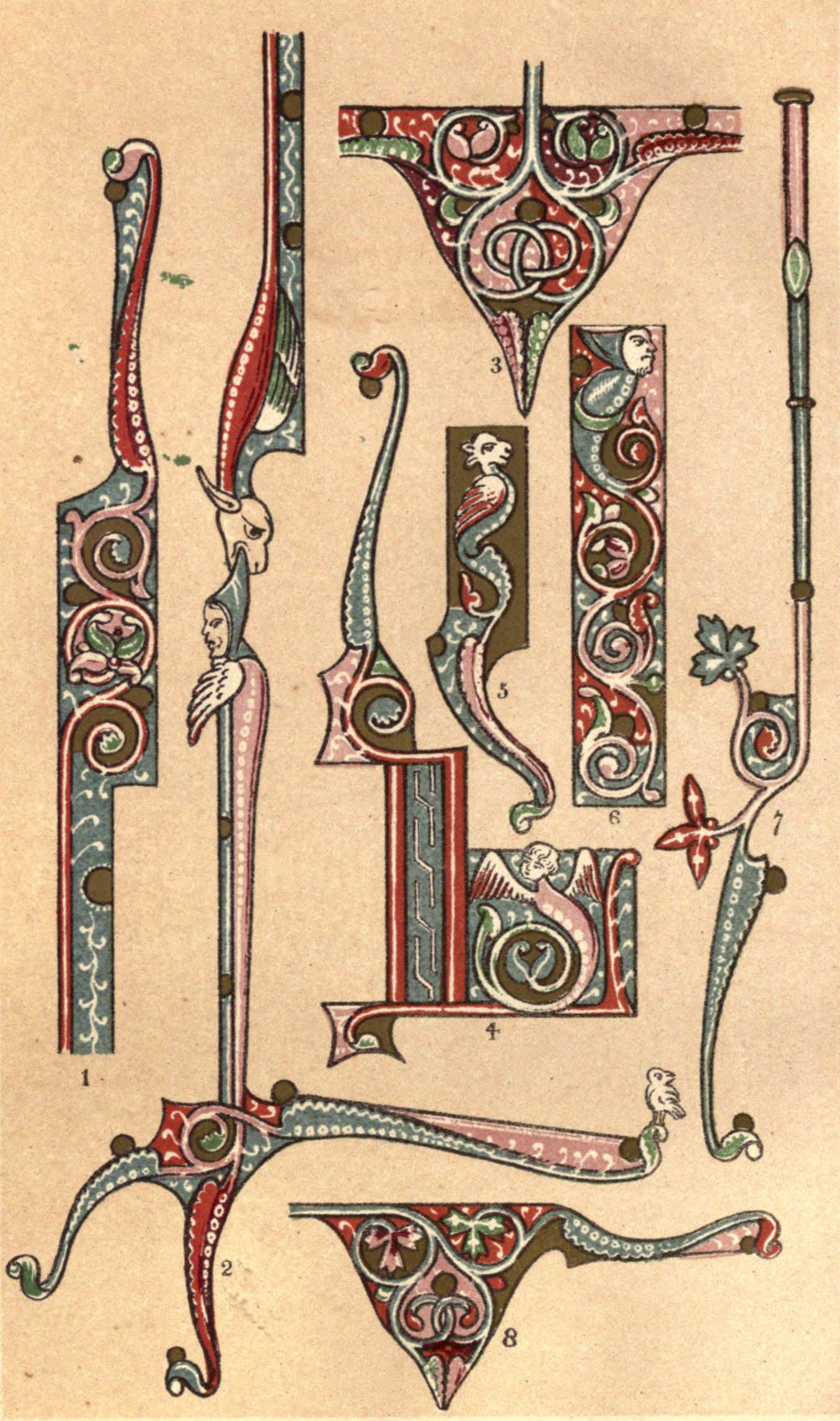
From British Museum, Reg I. D. I.
Historical Manual. Outline for coloring. Plate No VIII.
XIIITH Century.
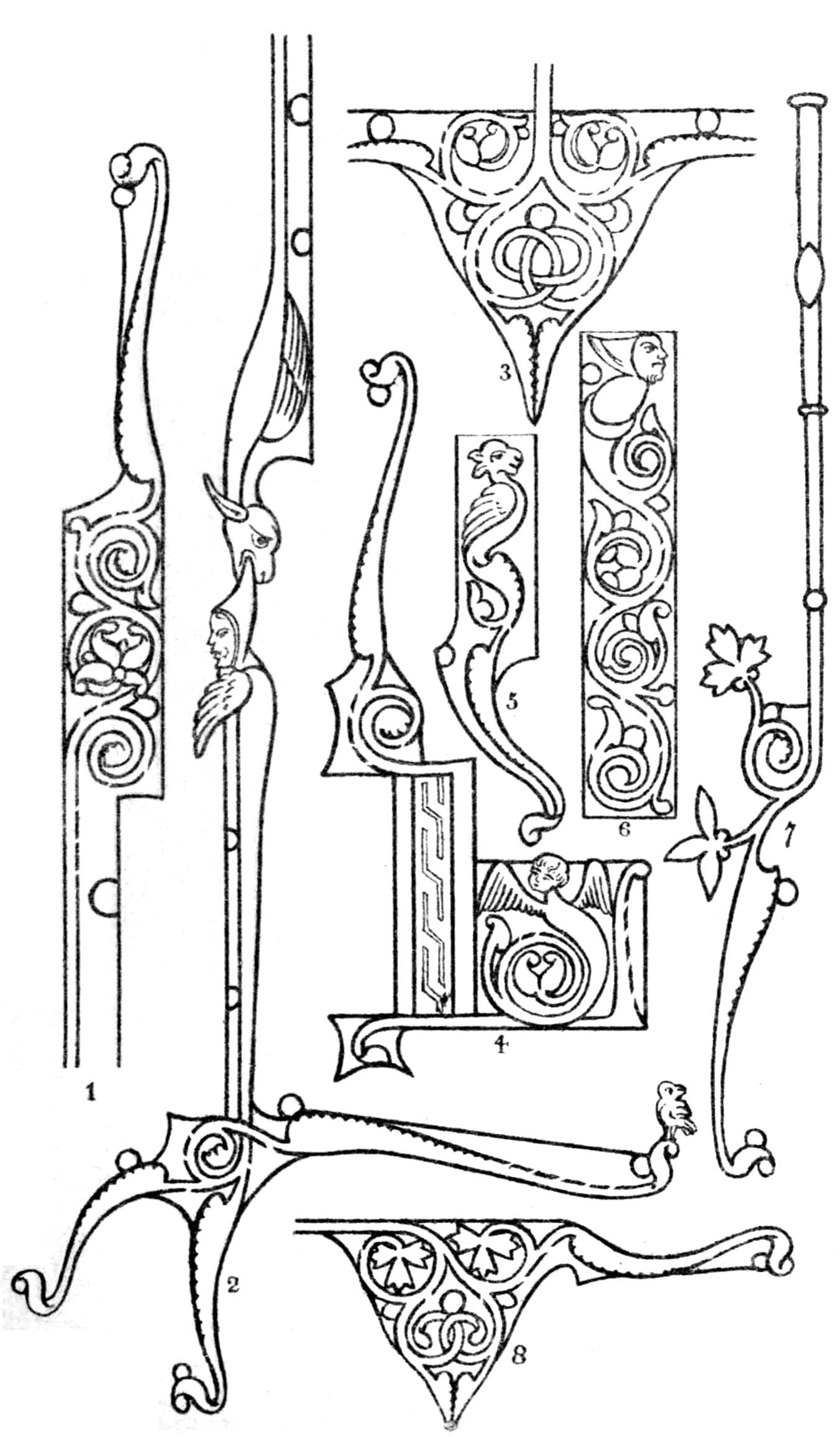
From British Museum, Reg I. D. I.
From the 12th century onwards, important illuminated manuscripts exist to the present day in such profusion as to deter me from individualizing in this necessarily brief essay. I shall rather dwell upon general characteristics of style, and upon the influence of the leading patrons of the art, in its palmiest days, in England, France, Germany, and the Netherlands. In these countries the infinite activity of the mendicant friars kept up a steady demand for manuscripts of all kinds: thus Richard de Bury, bishop of Durham, the greatest bibliophile of his age, and the tutor when prince, and friend while sovereign, of Edward III., relates, that in all his book-hunting travels: "Whenever we happened to turn aside to the towns and places where the aforesaid paupers had convents, we were not slack in visiting their chests and other repositories of books; for there, amidst the deepest poverty, we found the most exalted riches treasured up; there, in their satchels and baskets, we discovered not only the crumbs that fell from the masters table for the little dogs, but, indeed, the show-bread without leaven,—the bread of angels, containing in itself all that is delectable."
These mendicant friars were looked upon with great jealousy by the clergy, who attributed to them the decrease in the number of students in the universities. Fitz Ralph, archbishop of Armagh and chaplain to Richard de Bury, accuses them of doing "grete damage to learning:" curiously enough, his accusation, contained in an oration denouncing them, bears testimony to their love of books and to their industry in collecting them. "For these orders of beggers, for endeles wynnynges that thei geteth by beggyng of the foreside pryvyleges of schriftes and sepultures and othere, thei beth now so multiplyed in conventes and in persons. That many men tellith that in general studies unnethe, is it founde to sillynge a pfitable book of ye faculte of art, of dyvynyte, of lawe canon, of phisik, other of lawe civil, but all bookes beth y bougt of freres so that en ech convent of freres is a noble librarye and a grete, and so that ene sech frere that hath state in schole, siche as thei beth nowe, hath an hughe librarye. And also y sent of my sugettes to schole thre other foure persons, and hit is said me that some of them beth come home agen for thei myst nought find to selle ovn goode Bible; nother othere couenable books." Richard de Bury's example gave a stimulus to those who succeeded him, both at Durham and elsewhere.
As the styles of architecture varied in England and France,—agreeing in leading particulars, but each acquiring for itself a set of distinctive characteristics,—so did the art of illumination. In the purely Gothic work, such as prevailed from 1250 to 1400, extreme finesse in execution, tenderness of colour, gentleness of expression, piquancy of ornament, and elegance of composition, may be regarded as almost invariable attributes of French productions. In England, on the other hand, the style was not so harmonious but more vigorous, the colouring was fuller and deeper, the action of the figures more intense, the power of expression more concentrated, and reaching occasionally in its energy almost to caricature, the sense of humour always freely developed, and a more generally active sentiment of life impressed upon design, not only in figure subjects, but in ornament. In the latter, monkeys and other animals, dragons, and comic incidents, are very frequently intermingled with graceful foliage and heraldic embellishments. In fact it is to the credit of both countries that, with so much that is excellent in common, they should still have displayed such free and distinctive features as marked the works of each respectively. About the year 1400, in both countries the mechanical reproduction of the accredited types and leading incidents of Scripture and of Catholic faith began to be abandoned; and, mainly from the necessity of giving to the historical personages introduced in secular romances and chronicles individual force and vigour, an attention to portraiture and a transcription of characteristic traits of active life are freely developed.
Considering how few traces of the art of painting, as exhibited either in panel pictures or in mural embellishments, remain to attest the condition of the arts in England and France in the thirteenth, fourteenth, and fifteenth centuries, it is impossible for the student of Gothic art to overestimate the extreme interest which attaches to the chronological series of specimens of the painter's art which may be examined in the great metropolitan libraries of either country. It is very fortunate for our reputation that we are enabled, through so large a series of volumes as still exist, to trace such distinctive and national characteristics as enable us to assert, without fear of error, that so far as graphic dexterity is concerned, the English artificers were fully competent to execute all the artistic productions which have as yet been found upon our soil. That foreigners were freely employed there can be no doubt, but that the works which were executed by them could not have been executed by Englishmen, no one can with safety assert, who has traced with any considerable care the gradual development of English art through a series of English illuminated manuscripts.
That illumination was excessively popular in England during the 14th century among the leading families, is proved by the numbers of coats of arms emblazoned in many of the most remarkable English manuscripts. Thus in the Salisbury Lectionary, in the Douce, in Queen Mary's, and in the Braybrooke Psalters, appear the ancient coats of some of the best blood in the country. A most interesting contemporary illustration of the precise terms upon which these noble patrons employed the best illuminators of the day has been furnished me by a kind and learned antiquarian friend,[65] in the shape of an extract from the fabric rolls of "York Minster,"[66] of which the following is a translation:—
"August 26th, 1346.—There appeared Robert Brekeling, scribe, and swore that he would observe the contract made between him and Sir John Forbor, viz., that he the said Robert would write one Psalter with the Kalender for the work of the said Sir John for 5s. and 6d.; and in the same Psalter, in the same character, a Placebo and a Dirige, with a Hymnal and Collectary, for 4s. and 3d. And the said Robert will illuminate ('luminabit') all the Psalms with great gilded letters, laid in with colours; and all the large letters of the Hymnal and Collectary will he illuminate with gold and vermilion, except the great letters of double feasts, which shall be as the large gilt letters are in the Psalter. And all the letters at the commencement of the verses shall be illuminated with good azure and vermilion; and all the letters at the beginning of the Nocturns shall be great uncial (unciales) letters, containing V. lines, but the Beatus Vir and Dixit Dominus shall contain VI. or VII. lines; and for the aforesaid illumination and for colours he [John] will give 5s. 6d., and for gold he will give 18d., and 2s. for a cloak and fur trimming. Item one robe—one coverlet, one sheet, and one pillow."[67]
Under such contracts, and on much more extravagant terms, were no doubt produced the finest of those "specimens of English miniature painting" of the Edwardian period, which Dr. Waagen considers "excel those of all other nations of the time, with the exception of the Italian, and are not inferior even to these."[68]
There is probably no document in existence which better illustrates the nature, cost, and classification of illuminated and other manuscripts during the 14th and 15th centuries, than the catalogue of the library founded by William of Wykeham, himself one of the greatest English patrons of literature, at the College of St. Mary, near Winchester. This catalogue has been printed in extenso in the "Archæological Journal" (vol. xv. pp. 69 to 74), with notes by the Rev. W. H. Gunner. It is essentially a catalogue raisonné, divided into the following classes, which give a good idea of the staple commodities in mediæval and monastic libraries:—
Historical Manual. Plate No IX.
XIIITH Century.
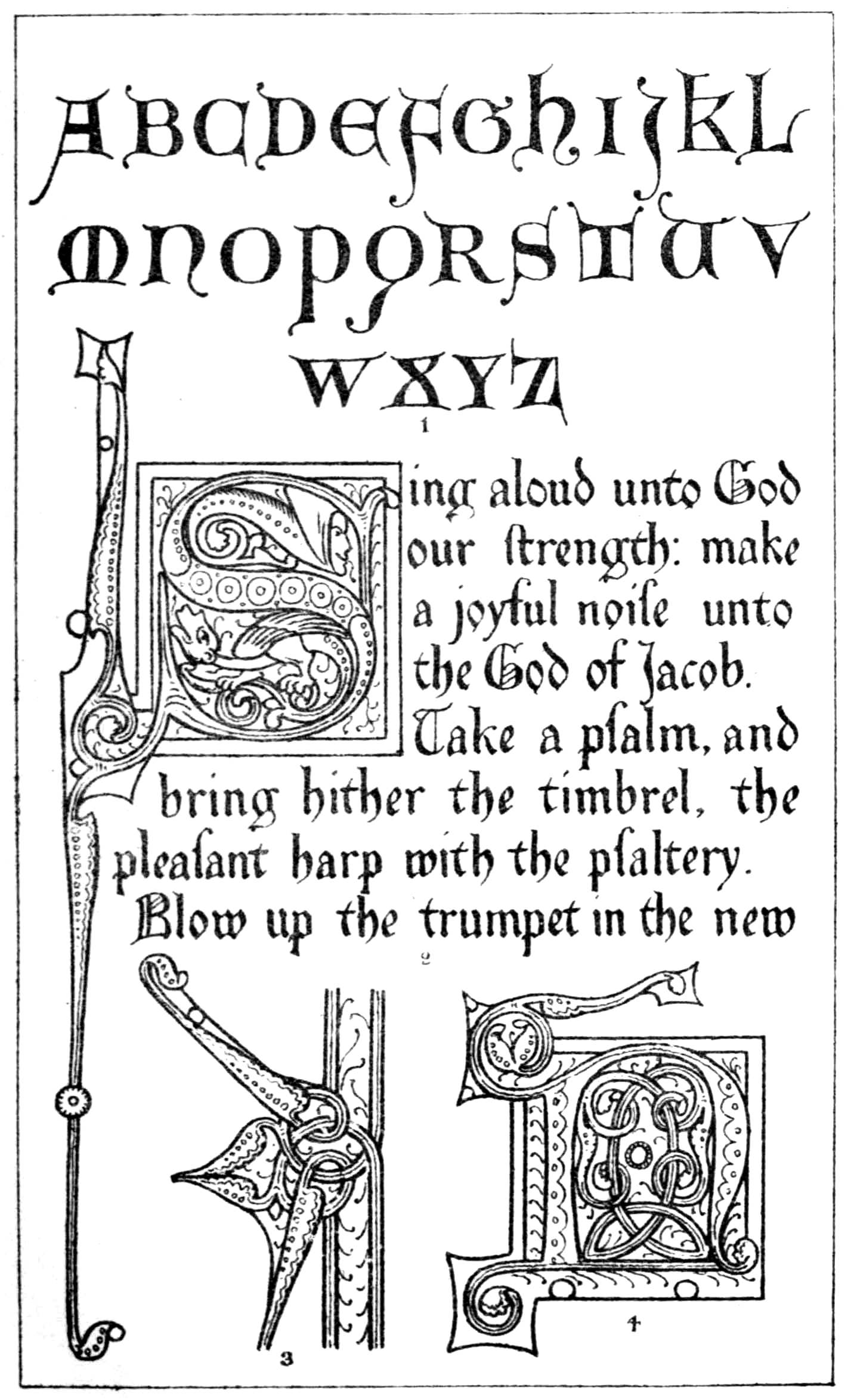
From British Museum, Reg I. D. I.
"Ordinalia, Antiphonaria, Portiphoria, Legendæ, Collectaria, Graduales, Manualia, Processionalia, Gradales, Pontificates et Epistolares, Libri Theologiæ, Doctores super Bibliam, Libri Sententiarum, Doctores super Sententias, Libri Historiales, Psalteria Glossata, Libri Augustini, Libri Gregorii, Libri Morales Diversorum Doctorum [to which in many libraries might, I fear, be added, Libri Immorales Diversorum Auctorum], Libri Chronici, Libri Philosophiæ [strange to say, a total blank in the Winchester Collection], Libri Juris Canonici, Decreta et Doctores super Decreta, Decretales, Libri Sexti cum Doctoribus, Clementinæ, Summæ et alii Tractatus Diversorum Doctorum Juris Canonici, Libri Juris Civilis, and Libri Grammaticales."
Most of the volumes in this library were donations from both laity and clergy, but mainly from the former. The price of every volume is given. The founder himself presented one Missal valued at £20, and John Yve, "formerly a fellow of this College, bequeathed a great Portiphoriam for laying before the senior fellow standing on the right hand of the upper stall," valued at an equal amount. The York contract, previously quoted, shows precisely how much illumination could be obtained for much less than one pound; and we may therefore form from it a tolerable idea of the magnificence of volumes upon the production of which such large sums were expended. The student will find this catalogue well repay his careful examination.
During the last half of the 14th century and the beginning of the 15th, the art of illumination received a great impulse in France, from the magnificent patronage bestowed upon it by Jean, Duc de Berri, brother of Charles V. Of his unique library, which excited the envy of all the princes of his time, and stimulated especially Philip the Bold, Duke of Burgundy, and the great Duke of Bedford, to enter into competition with him, many magnificent specimens still remain—such as his Psalter, his two Prayer-books, and his copy of the "Merveilles du Monde."[69]
French illumination attained perfection in these works, and in some few specimens of the more decidedly Renaissance period, such as the unsurpassed "Hours of Anne of Brittany," executed about the year 1500: all of these are models for the study of the illuminator of the 19th century, since in them gaiety and charm of ornament will be found united to a style of miniature-painting of real excellence in art. In the MSS. of the period of Jean de Berri, we meet with the perfection of that lace-like foliation known as the Ivy pattern—one that attained an extraordinary popularity in France, England, and the Netherlands.
In the illuminations of both France and England, during the 14th and first half of the 15th centuries, the application of raised and highly-burnished gold became a leading feature, and reached its highest pitch of perfection. When used, as it frequently was, as a ground for miniature subjects and ornaments, it was frequently diapered in the most brilliant and delicate manner. This diapered background gave way at length to an architectural, and, ultimately, under the influence of the Italian school and that of the Van Eycks, to a landscape one.
It may be well now to advert to those styles of illumination which, through the Flemings settled in this country, greatly affected English art; and which, through the House of Burgundy, equally powerfully wrought upon the French styles, not so much of ornament, as of miniature-painting. As M. Hippolyte Fortoul[70] justly remarks, "The powerful school established at Bruges by the Van Eycks, at the close of the 14th century, exercised an immense influence on all the schools of Europe, not excepting those of Italy;"—an influence which was, indeed, not altogether dissimilar from that brought to bear upon mannerism in Art by the Pre-Raffaelitism of the present day. The foundations of the Netherlandish school were sufficiently remote, but may be satisfactorily traced through existing miniatures and paintings. Herr Heinrich Otte, in his "Handbuch der Kirchlichen Kunst-Archäologie" (p. 187), gives a chronological list of the principal MSS. of Germanic production from the Carlovingian period to the commencement of the 13th century. Up to that period the Byzantine manner prevailed, mixed with a peculiar rudeness, such as may be recognised in the works of the great saint and bishop, Bernward of Hildesheim, whom Fiorillo and other writers look upon, with Willigis of Mainz, as the great animator of German art in the 11th century.[71] The conversion of this latter element into Gothic originality appears to have taken place during the 13th century, and a fine manuscript in the British Museum (B. R 2, b. 11), ascribed by Dr. Waagen to a period between 1240 and 1260, illustrates the transition.[72]
Historical Manual. Plate No X.
XVTH Century.
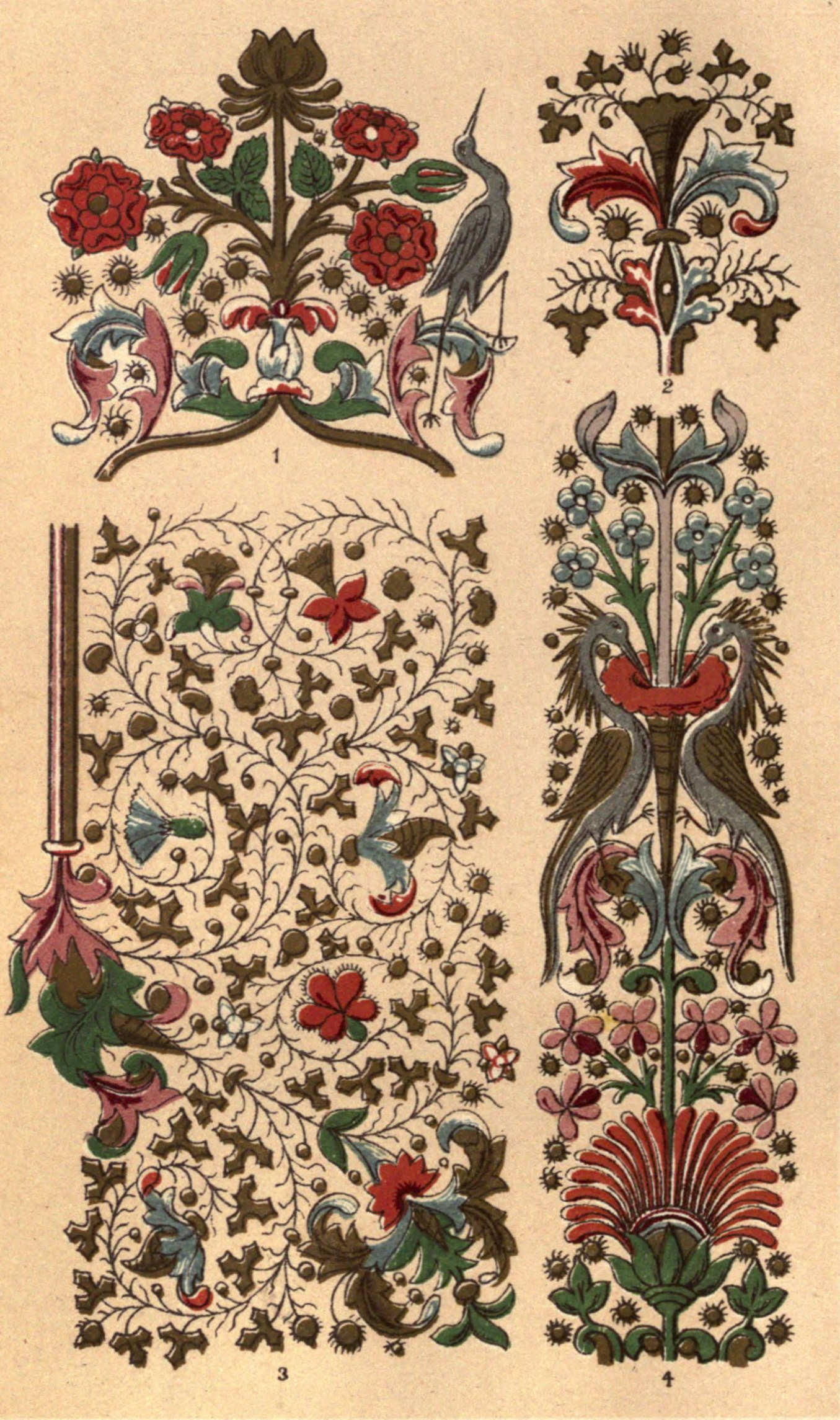
From the Bedford Missal, British Museum, Add. 18,850.
Historical Manual. Outline for coloring. Plate No XI.
XVTH Century.
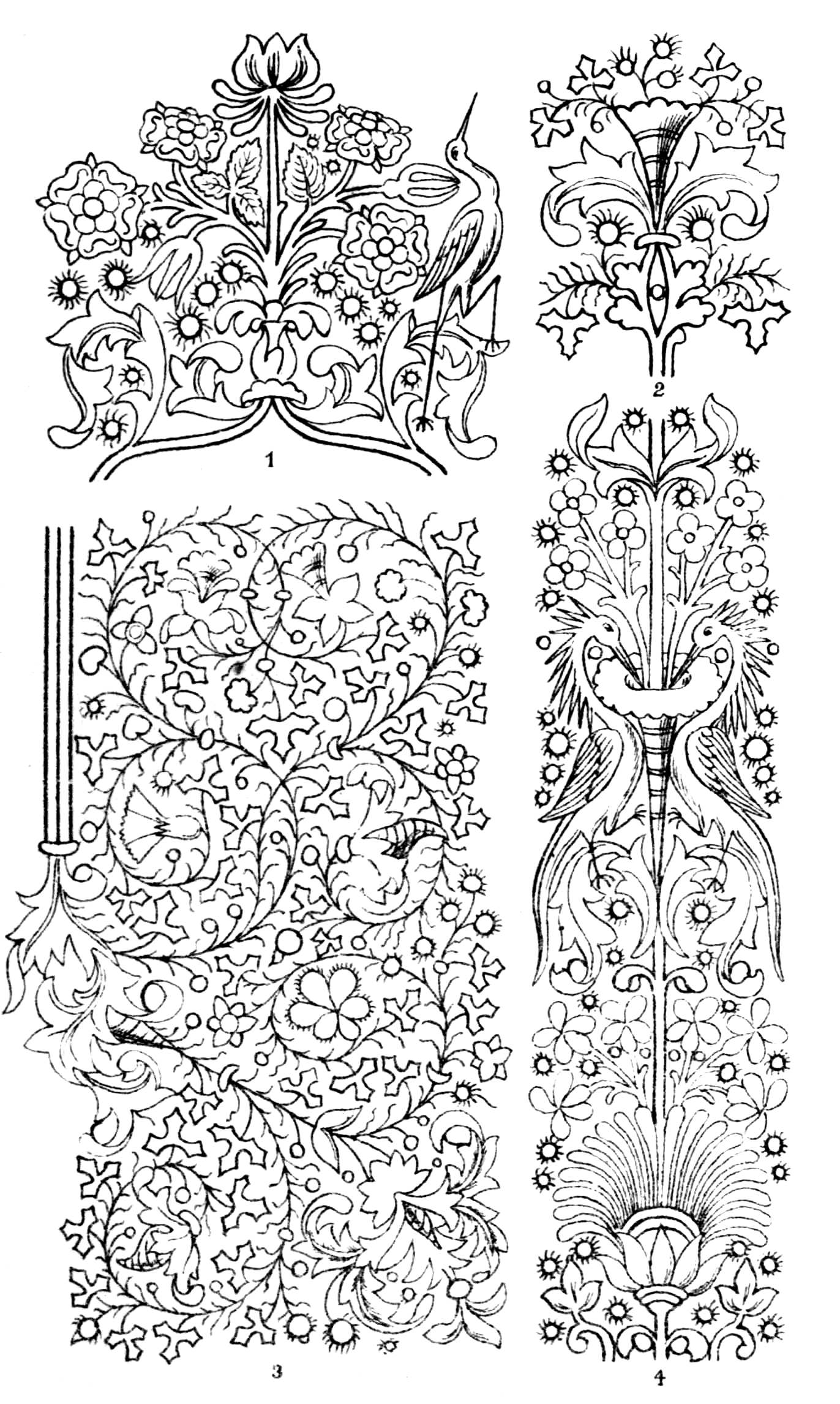
From the Bedford Missal, British Museum, Add. 18,850.
With the commencement of the 14th century appear the "Lay of the Minnesingers," one of the most peculiar of the Paris manuscripts, and others cited by Dr. Kugler, which carry on the evidence of progressive development until the power of expression obtained in painting by Meisters Wilhelm and Stephen of Cologne, is reflected in the contemporary miniatures.
Even did not the celebrated "Paris Breviary," and the British Museum "Bedford Missal," or, more correctly speaking, "Book of Hours," both executed in part by the three Van Eycks, Hubert, Jan, and Margaretha, for the great Regent of France, exist, the style of the panel-pictures painted by them would be quite sufficient to show that they must have been illuminators before they became world-renowned oil-painters. Through their conscientious study of nature, both in landscape and in portrait subjects, a complete change was wrought in the miniatures of all manuscripts produced after their influence had had time to penetrate into the scriptoria and ateliers of the contemporary artist-scribes. Had not the invention of printing rapidly supervened, there can be no doubt that even more extraordinary results than followed the general appreciation of their graces as illuminators would have been ensured.
It is not in publications such as this little manual that any attempts could be successfully made to reproduce the pictorial results achieved by such masters in such volumes; but an attempt may certainly be made to convey some idea both of the general character of the handwriting and of the ornamental adjuncts by which its effect, and that of the beautiful little pictures framed in by its brilliant playfulness, was so greatly heightened. In plates 10, 11, and 12 of this manual, Mr. Tymms has collected from the "Bedford Book of Hours" much that the student will find worthy of his careful attention. Well, indeed, may the enthusiastic Dr. Dibdin soar off into the most transcendental raptures over a volume which, tested even by the ignoble touchstone of a public sale in 1815, was not knocked down to its eager purchaser, the then Marquis of Blandford, for a less sum than £687. 15s. It has now happily found a final resting-place in the British Museum (ranking as "add. 18,850"), of which it must always remain as, probably, the greatest treasure, both from its historical association and its intrinsic excellence and beauty—containing, as it does, not less than fifty-nine whole-page miniatures, and about a thousand smaller ones, enriched throughout with gilded lace-work, and ornaments of the description of that shown in our plates, and commended to the student's diligent observation.
The later manuscripts of the German and Netherlandish schools of miniature-painting generally reflect the mixed cleverness and angularities of such masters as Rogier van der Weyde the elder, Lucas van Leyden, Martin Schongauer, &c.; where, however, the manner of Hemling prevailed, spiritual beauty and refinement followed.
Historical Manual. Plate No XII.
XVTH Century.
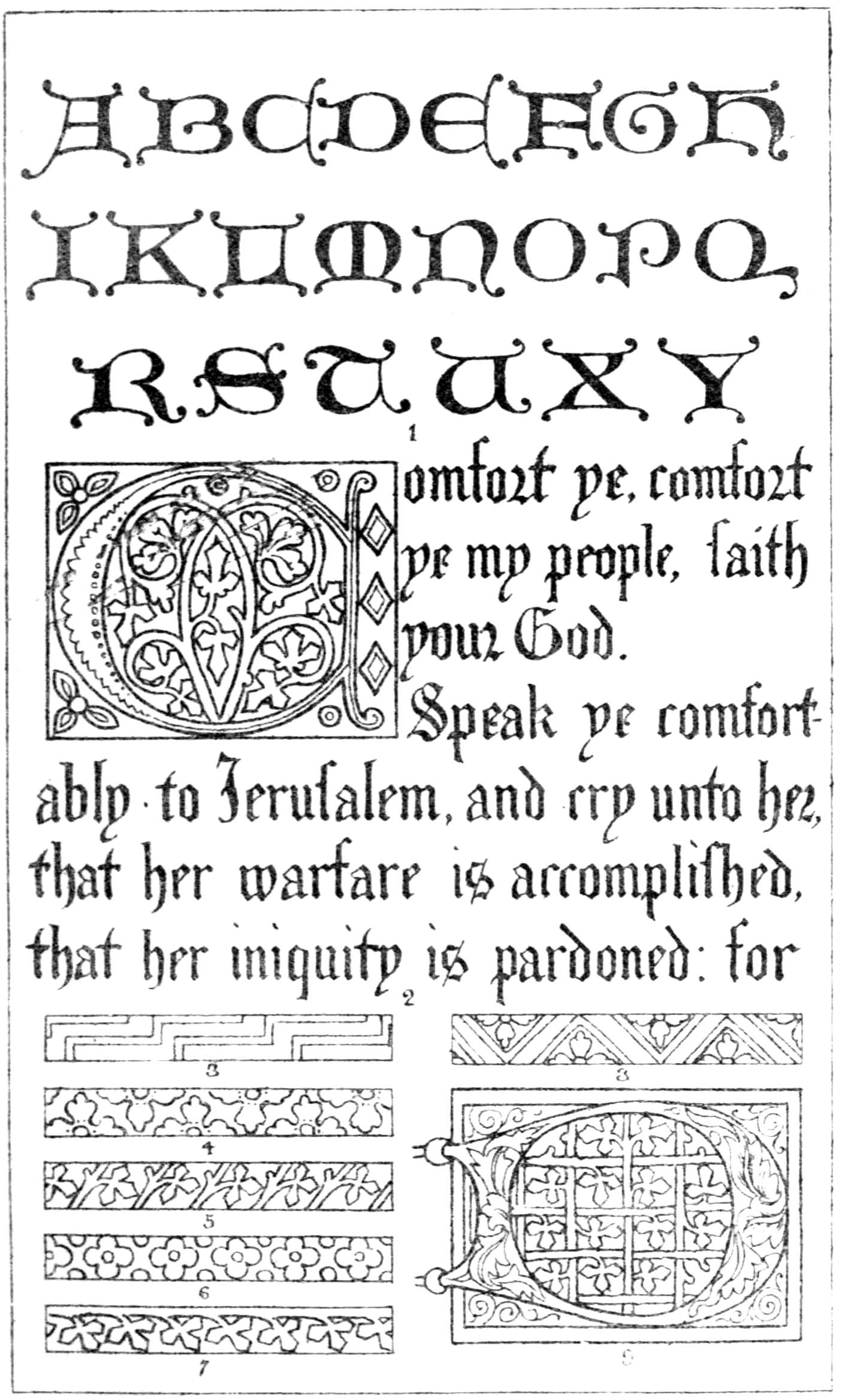
From the Bedford Missal, British Museum, Add. 18,850.
To dwell upon Spanish illuminated manuscripts would be comparatively profitless to the practical student; for all the peculiarities and excellencies they would appear to have at any time possessed, may be found more perfectly developed at first in French, subsequently in Netherlandish, and ultimately in Italian volumes.[73] In one most remarkable and indeed historical volume, the actual alliance of Spanish writing and initial illumination with Flemish subject-painting and Arabesque is clearly to be recognized. The result of the union is certainly most happy, for few more beautiful books exist than the exquisite missal which in a passage of golden letters and honied words Francesco de Roias offers to Isabella "the Catholic." This magnificent volume, from which our plates (Technical Manual) Nos. 10, 11, and 12, have been taken, was purchased by the authorities of the British Museum, in whose catalogue it figures as add. 18,851, of Messrs. W. and T. Boone in 1852. In this work the brush triumphs over the pen, its decorations are essentially pictorial, and many of them recall, if not the hand, at least the style, of Memling and Van Eyck. Unlike volumes of earlier periods in which the illustrations are generally the work of one hand throughout, in this elaborate volume, a division of labour obtains. In this, as in many others of about the same period, not only are the penman and the painter two individuals, but the latter especially becomes half a dozen. This was, no doubt to a great extent, occasioned by the almost universal substitution of lay for clerical illuminators in the latter part of the 15th century, and by the production at that date of illuminated books for dealers adopting the principles and practice of that system of economic production which ultimately permitted manufacture to almost universally supersede Art throughout Europe. It remains now only to sketch, with a brevity altogether out of proportion to the great interest of the subject, the progress of the art in Italy.
If the delineation of naïve and graceful romantic incident, combined with elegant foliated ornament, reached perfection in the illuminations of the French school; if blazoning on gilded grounds was carried to its most gorgeous pitch in Oriental and Byzantine manuscripts; if intricate interlacements and minute elaboration may be regarded as the special characteristics of Hiberno-Saxon scribes; and if a noble tone of solid colour, combined with great humour and intense energy of expression, marked England's best productions,—it may be safely asserted, that it was reserved for the Italians to introduce into the embellishment of manuscripts those higher qualities of art, their peculiar aptitude for which so long gave them a pre-eminence among contemporaneous schools.
I therefore proceed to trace the names and styles of some few of the most celebrated among their illuminators; premising by a reminder to the student of the miserably low pitch to which art had been reduced in Italy during the 12th century. Even the most enthusiastic and patriotic writers agree in the all but total dearth of native talent. Greeks were employed to reproduce Byzantine mannerisms in pictures and mosaics, and to a slight extent no doubt as scribes. Illumination was scarcely known or recognized as an indigenous art; for Dante, even writing after the commencement of the 14th century, speaks of it as "quell' arte, che Alluminar è chiamata a Parisi."[74]
Probably the earliest Italian manuscript showing signs of real art, is the "Ordo Officiorum Senensis Ecclesiæ," preserved in the library of the academy at Sienna, and illuminated with little subjects and friezes with animals, by a certain Oderico, a canon of the cathedral, in the year 1213.
The Padre della Valle[75] expressly cautions the student against confounding this Odericus with the Oderigi of Dante,[76] who died about the year 1300. The latter was unquestionably an artist of some merit, for Vasari[77] speaks of him as an "excellente miniatore," whose works for the Papal library, although "in gran parte consumati dal tempo," he had himself seen and admired. Some drawings by the hand of this "valente uomo," as he is styled, Vasari speaks of possessing in his own collection.
Baldinucci makes out Oderigi to have been of the Florentine school on no other grounds than because Vasari describes him as "molto amico di Giotto in Roma;" and because Dante appears to have known him well. Lanzi,[78] however, more correctly classes him with the Bolognese school, from his teaching Franco Bolognese at Bologna, and on the strength of the direct testimony of one of the earliest commentators on Dante—Benvenuto da Imola. This same Franco worked much for Benedict IX., and far surpassed his master.
Vasari especially commends the spirit with which he drew animals, and mentions a drawing in his own possession of a lion tearing a tree as of great merit. Thus Oderigi, the contemporary of Cimabue, and Franco, the pupil of Oderigi and contemporary of Giotto, appear to have been to the Art of Illumination what Cimabue and his pupil Giotto were to the Art of Painting,—the pupil in both cases infinitely excelling the master. To them succeeded, about the middle of the 14th century, a scarcely less celebrated pair—Don Jacopo Fiorentino, and Don Silvestro, both monks in the Camaldolese monastery, "degli Angeli," at Florence. The former, Baldinucci tells us, "improving, with infinite study, every moment not devoted to his monastic duties, acquired a style of writing greatly sought after for choral books." The latter, who was rather an artist than a scribe, enriched the productions of his friend with miniatures so beautiful, as to cause the books thus jointly produced to excite, at a later period, the special admiration of Lorenzo the Magnificent, and his son, the no less magnificent Leo X.[79] So proud were their brother-monks of the skill of Frati Jacopo and Silvestro, that after their death they preserved their two right hands as honoured relics.
About a century later, the leading illuminators were Bartolomeo and Gherardo,—the former abbot of San Clemente, at Arrezzo, and the latter a Florentine painter and "miniatore," whom Vasari confounds with Attavante, a painter, engraver, and mosaicist. Of all the Italian artists who adopted the style of the illuminators, if they did not themselves illuminate, the most celebrated certainly are Fra Angelico da Fiesole[80] and Gentile da Fabriano. The majority of the works of both are little else than magnified miniatures of the highest merit.
The school of Siennese illumination was scarcely less distinguished than that of Florence. M. Rio dwells with enthusiasm on the books of the Kaleffi and Leoni, still preserved in the Archivio delle Riformazioni, and especially on those decorated by Nicolo di Sozzo, in 1334. The greatest master of the school, Simone Memmi,[81] the intimate friend of Petrarch, was himself an illuminator of extraordinary excellence, as may be seen by the celebrated Virgil of the Ambrosian Library at Milan, which contains, amongst other beautiful miniatures by his hand, the fine portrait of Virgil, and a very remarkable allegorical figure of Poetry, quite equal in artistic merit to any of the artist's larger and better-known works in fresco or tempera.[82]
It is, however, in the library of the cathedral at Sienna, which retains many of the magnificent choir-books executed by Fra Benedetto da Matera, a Benedictine of Monte Cassino, and Fra Gabriele Mattei of Sienna, that the greatest triumphs of the school are still to be recognized. This series of volumes, although much reduced from its original extent by the abstractions made by Cardinal Burgos, who carried off a vast quantity to Spain, is still the finest belonging to any capitular establishment in Italy, and worthily represents the grandeur of Italian illumination in "cinque cento" days.
The series of similar volumes next in importance to those of Sienna, is attached to the choir of the church and monastic establishment of the Benedictines at Perugia, known as "San de' Casinensi." Of these, nothing more need be said than that they are worthy of the stalls of the same choir, the design of which is attributed to Raffaelle, and the execution to Stefano da Bergamo, and Fra Damiano, of the same town, the great "intarsiatore."
Formerly, as M. Rio observes,[83] "Ferrara could boast of possessing a series of miniatures, executed principally in the seclusion of its convents, from the time of the Benedictine monk Serrati, who in 1240 ornamented the books of the choir with figures of a most noble character,[84] till that of Fra Girolamo Fiorino, who, towards the beginning of the 15th century, devoted himself to the same occupation in the monastery of San Bartolomeo, and formed in his young disciple Cosmè a successor who was destined to surpass his master, and to carry this branch of art to a degree of perfection till then unknown. Even at the present day we may see, in the twenty-three volumes presented by the Bishop Bartolomeo delia Rovere to the cathedral, and in the twenty-eight enormous volumes removed from the Certosa to the public library, how much reason the Ferrarese have to be proud of the possession of such treasures, and to place them by the side of the manuscripts of Tasso and Ariosto.
The "subjects generally treated by these mystical artists were marvellously adapted to their special vocation: they were the life of the holy Virgin, the principal festivals celebrated by the Church, or popular objects of devotion; in short, all the dogmas which were susceptible of this mode of representation, works of mercy, the different sacraments, the imposing ceremonies of religion, and, in general, all that was most poetical in liturgy or legend. In compositions of so exclusive a character, naturalism could only be introduced in subordination to the religious element."[85]
While this was the case with the majority of illuminations executed under the auspices of the Church, in those of a secular nature, undertaken for the great princes and nobles, another set of characteristics prevailed. For the Gonzagas, Sforzas, D'Estes, Medici, Strozzi, Visconti, and other great families, the best artists were constantly employed in decorating both written and printed volumes, in which portraiture is freely introduced, and picturesque and historical subjects are represented with great vivacity and attention to costume and local truth. Thus in the truly exquisite "Grant of Lands," by Ludovico il Moro to his wife Beatrice D'Este, dated January 28th, 1494, and preserved in the British Museum, speaking portraits of both Ludovico and Beatrice are introduced, with their arms and beautiful arabesques.[86] Again, in the Hanrot "Sforziada," the first page contains exquisite miniatures of three members of the princely family of the Sforzas, by the hand of the all-accomplished Girolamo dai Libri.[87] This artist, a truly celebrated Veronese and worthy fellow-townsman, with the almost equally able Fra Liberale, whose work in the manner of Giovanni Bellini excited the utmost envy on the part of the Siennese illuminators, was himself the son of a miniature-painter, known as Francesco dai Libri, and bequeathed the name and art of his father to his own son,—thus maintaining the traditions of good design acquired in the great school of Padua, under Andrea Mantegna[88] and Squarcione, during three generations of illuminators. Girolamo was by far the most celebrated of the three. As a painter, his works possess distinguished merit, and there still remain good samples of his abilities in the churches of San Zeno and Sant' Anastasia, at Verona. He also derives some credit from the transcendent merits of his pupil Giulio Clovio. Vasari's description of the talents of Girolamo[89] gives so lively a picture of the style which reached its highest vogue at the end of the 15th, and during the first half of the 16th centuries in Italy, that I am tempted to translate it. "Girolamo," he says, "executed flowers so naturally and beautifully, and with so much care, as to appear real to the beholder. In like manner he imitated little cameos and other precious stones and jewels cut in intaglio, so that nothing like them, or so minute, was ever seen. Among his smallest figures, such as he represented on gems or cameos, some might be observed no larger than little ants, and yet in all of them might be made out every limb and muscle, in a manner which to be believed must needs be seen."
Mr. Ottley supposes that Giulio Clovio (born 1498, died 1578) worked previous to his receipt of the instruction of Girolamo in a drier manner, in which no evidence appears of that imitation of Michael Angelesque pose in his figures, which in his subsequent production became so leading a characteristic of his style. It is in his earlier manner that Giulio is believed to have illuminated for Clement VII.[90] (1523-1534), while for his successor, Paul III. (1534-1539), he worked abundantly, and gradually acquired that which is best known as his later manner, in which he continued to labour, according to Vasari, until 1578, at the great age of eighty years. Mr. Ottley, however, recognizes his hand in MSS. which must have been at least five years later—during the Pontificate of Gregory XIII.[91]
It is obviously impossible, in such an essay as the present, to dwell in detail upon the merits of so accomplished a master of his art. Fortunately we possess in this metropolis two fine specimens of his skill, both tolerably accessible—one in the Soane[92] and the other in the British Museum.[93] A third, of great splendour, is in the possession of Mr. Towneley, and a fourth, in the shape of an altar-card, attributed to him, is to be found in the Kensington Museum; and several fragments, formerly in Mr. Rogers's possession, have passed to Mr. Whitehead and to the British Museum. All of these exhibit a refinement of execution, combined with a brilliancy of colour and excellence of drawing, which has never been surpassed by any illuminator. Vasari gives a complete list and description of his principal works, and proves him to have been not less industrious than able.
A contemporary of Giulio's, whose name has been overpowered by the greater brilliancy of that of the Cellini of illumination, was a certain Apollonius of Capranica, or, as he signs himself, "Apollonius de Bonfratellis de Capranica, Capellæ et Sacristiæ Apostolicæ Miniator." Mr. Ottley most justly states,[94] "that it is impossible to speak in too high terms of the beauty of his borders, wherein he often introduces compartments with small figures, representing subjects of the New Testament, which are touched with infinite delicacy and spirit." His drawing, which is of a decidedly Michael-Angelesque character, is of less merit when the nude is represented on a larger scale. His harmony of colour is extraordinary, rather lower in tone than Giulio Clovio's, but equally glowing, and more powerful. Some beautiful specimens of his handicraft remain in the possession of Mr. T. M. Whitehead. The late Mr. Rogers possessed many fragments, the most precious of which have found their way into the National Collection. His work is usually dated, and the dates appear to range from 1558 to 1572. Apollonius having been official illuminator to the very institution from which Celotti derived his richest spoils, it may readily be imagined that his collection included an unprecedented series of beautiful examples of Buonfratelli's style.
Long after the invention of printing, the Apostolic Chamber retained its official illuminators; and among them one of the most noteworthy is unquestionably the artist who signs his works, "Ant. Maria Antonotius Auximas"—a native of Osimo, and a protégé of the princely house of the Barberini and its magnificent head, Urban VIII. (1623-1644). He was a pupil of Pietro da Cortona, and an artist of great skill and refinement.[95]
For still more recent popes artists of great excellence continued to be employed, including for Alexander VII. the celebrated Magdalena Corvina, who worked from 1655 to 1657; and for Innocent XI (1676 to 1689) a German, who signs his productions "Joann, frid-Heribach." As the popes retained their illuminators for the decoration of precious documents, so did the doges of Venice; and probably the most magnificent of all illumination, executed after the general spread of printed books had checked, although not extinguished, the art, may be found in the precious "Ducales," wrought indeed by several of the greatest Venetian painters.[96]
I need scarcely remind the reader, that the earliest wood-cut and printed books were made to imitate manuscripts so closely as to deceive the inexperienced eye. "Artes moriendi," "Specula," "Bibliæ Pauperum," and "Donatuses,"—the principal types of block books,[97]—represent illuminated manuscripts in popular demand at the date of the introduction into Europe of Xylographic Art. Spaces were frequently left, both in the block books and in the earliest books printed with movable type, for the illumination, by hand, of initial letters, so as to carry the illusion as far as possible. This practice was abandoned as soon as the learned discovered the means by which such wonderfully cheap apparent transcripts of voluminous works could be brought into the market; and the old decorated initial and ornamental letters were reproduced from type and wood blocks.
The Mainz Psalter of 1457, and other books printed by Fust and Schœffer, required only the addition of a little colour here and there to delude any inexperienced eye into the belief that they were really hand-worked throughout. Such imitations were but poor substitutes for the originals in point of beauty, however excellent when regarded from a utilitarian point of view.
Every country has more or less cause to mourn the senseless destruction of many noble old volumes which the printing-press never has, and now, alas! never can replace; but none more than England, in which cupidity and intolerance destroyed recklessly. Thus, after the dissolution of monastic establishments, persons were appointed to search out all missals, books of legends, and such "superstitious books," and to destroy or sell them for waste paper; reserving only their bindings, when, as was frequently the case, they were ornamented with massive gold and silver, curiously chased, and often further enriched with precious stones; and so industriously had these men done their work, destroying all books in which they considered popish tendencies to be shown by illumination, the use of red letters, or of the Cross, or even by the—to them—mysterious diagrams of mathematical problems—that when, some years after, Leland was appointed to examine the monastic libraries, with a view to the preservation of what was valuable in them, he found that those who had preceded him had left little to reward his search.
Bale, himself an advocate for the dissolution of monasteries, says:
"Never had we bene offended for the losse of our lybraryes beyng so many in nombre and in so desolate places for the moste parte, yf the chief monuments and moste notable workes of our excellent wryters had bene reserved, yf there had bene in every shyre of Englande but one solemyne lybrary to the preservacyon of those noble workes, and preferrements of good learnynges in our posteryte it had bene yet somewhat. But to destroye all without consyderacion is and wyll be unto Englande for ever a most horryble infamy amonge the grave senyours of other nations. A grete nombre of them wych purchased of those superstycyose mansyons reserved of those lybrarye bokes, some to serve their jaks, some to scoure theyr candelstyckes, and some to rubbe theyr bootes; some they solde to the grossers and sope sellers, and some they sent over see to the bokebynders, not in small nombre, but at tymes whole shippes ful. I know a merchant man, whyche shall at thys tyme be namelesse, that boughte the contents of two noble lybraryes for xl shyllyngs pryce, a shame it is to be spoken. Thys stuffe bathe he occupyed in the stide of greye paper for the space of more than these ten years, and yet hathe store ynough for as manye years to come. A prodyguous example is thys, and to be abhorred of all men who love theyr natyon as they shoulde do."
Wherever the Reformation extended throughout Europe, a corresponding destruction of ancient illuminated manuscripts took place, and in localities where fanaticism failed to do its work of devastation, indifference proved a consuming agent of almost equal energy; and, indeed, there is no more forcible illustration of the untiring zeal and industry of the illuminators of old, than the fact, that, after all that has been done to stamp out the sparks still lingering in their embers, their works should still glow with such shining lights in all the great public libraries of Europe.
Despite all this ruthless destruction, and the universal extension of the art of printing, ornamental penmanship has never been altogether extinguished as a pictorial art. The Apostolic Chamber, as we have remarked, retained, until quite recently, its official illuminator.
The luxuriant magnates of the court of the "Grande Monarque" still provided employment for men like Jary and Prévost, while in England many heraldic and genealogical MSS. of the 17th, and even 18th centuries, still exist to prove that the Art was dormant rather than extinct. That it has a brilliant future yet in store for it no one can hesitate to believe who is enabled to recognize the power of design, and the capability to execute—either on paper or vellum—with the brush or pen—by hand, or by calling in the aid of the printer and lithographer for the rapid multiplication and dissemination of beautiful specimens—manifested by Owen Jones, his pupil Albert Warren, and many other able artists and amateurs, still gracing this 19th century of ours with works, many of which will doubtless survive to our honour and credit so long as Arts and States may endure.
It is in a humble effort to assist in such a consummation that these little manuals have been written, illustrated, and published.
M. DIGBY WYATT.
END OF PART I.