Chapter X · (continued 2)
Reading edition
And on the 16th the 2nd Battalion was reviewed by Her Majesty, when the 1st Battalion was also present. The appearance of the Riflemen, all of whom wore the Crimean Medal, with three or four clasps, many the Kaffir Medal, and some the Sardinian and other decorations, specially attracted attention.
The two Battalions were again reviewed by Her Majesty on July 30.
By letter from the War Office, dated August 11, the strength of the 1st Battalion was reduced from 109 sergeants, 41 buglers, and 2,000 rank and file, to 57 sergeants, 25 buglers, and 1,000 rank and file. A similar reduction took place in the 2nd Battalion.
On April 1, 1855, a 3rd Battalion was, a second time, added to the Regiment. They were formed at Haslar barracks, under Lieutenant-Colonel Bradford, by transfers from the Depôts of the 1st and 2nd Battalions; but as he very shortly afterwards exchanged with Colonel Hill,[267] to the Royal Canadian Rifle Regiment, Lieutenant-Colonel Horsford assumed the command and in fact made this new Battalion. They were inspected on June 25 by Major-General Breton, their strength then being 29 officers and 590 men.
On August 3 they moved by rail to Aldershot. And soon after 240 volunteers were received from the 1st Middlesex, 1st Surrey, and East Warwick, and on October 11, 180 volunteers from the Royal Elthorne, Militia regiments. On the 22nd the Battalion was inspected by Major-General Knollys, when its strength had increased to 39 officers and 947 men. During the early part of 1856, volunteers continued to be received from several Militia regiments; and on June 9 the Battalion proceeded to Portsmouth, where, on their inspection by Major-General Breton, the strength of the Battalion had increased to 41 officers and 1,165 men.
On August 3 the Battalion was divided into Service and Depôt companies; the former returned to Aldershot, and the latter (two companies) proceeded to Winchester.
On September 30, in consequence of reductions, 170 men of the 1st and 2nd Battalions were transferred to the 3rd.
But on October 8 the establishment of the Battalion was reduced to 1,000 rank and file.
The 1st Battalion remained at Aldershot till July 27, 1857, when they proceeded by rail to Edinburgh, where they arrived on the 28th and occupied quarters in the Castle; one company (Brevet-Major Oxenden’s) being detached to Greenlaw. This detachment was relieved monthly.
The following Brigade Order was issued by Major-General the Hon. A. A. Spencer on the Battalion leaving Aldershot:
‘Major-General Spencer takes leave of Lieutenant-Colonel Somerset, the officers, non-commissioned officers and men of the 1st Battalion Rifle Brigade on their departure for Edinburgh, with much regret.
‘It is now upwards of two years since he became acquainted and connected with the Battalion in the 4th Division before Sebastopol, during which time he has had opportunities of judging of their soldierlike qualities and habits of discipline.
‘The greatest proofs of these are the success which always attended their separate important undertakings against the enemy, and also their speedy recovery from the effects of hardships they, as well as every other regiment in that army, experienced in the winters of 1854–5.
‘The Major-General now bids them farewell, and trusts it may be his good fortune to meet them again in his military career.’
On August 5 a serious fire broke out in the old town of Edinburgh, which the Battalion succeeded with great exertions in extinguishing. Their conduct on this occasion elicited the following letter to Lieutenant-Colonel Somerset from the Lord Provost:
‘Edinburgh, August 11, 1857.
‘Sir,—I have the honour to convey a resolution unanimously adopted by the magistrates and town council of this city at their meeting to-day, to express their warm and cordial thanks to the officers and men of your regiment for the valuable and effective aid rendered by you in extinguishing the late fire and preserving order.
‘(Signed) John Melvill, Lord Provost.
‘Lieutenant-Colonel Somerset, C.B., Rifle Brigade.’
During the time the Battalion was at Edinburgh the men received the short Enfield and resumed the armament of the sword bayonet, as of old.
Riots of the mill-hands being apprehended, three companies of the Battalion were hurriedly moved by rail to Glasgow on November 11 in aid of the Civil power; and these were reinforced by an additional company on December 1.
A few days afterwards the Head-quarters and remaining companies of the Battalion followed them to Glasgow, arriving there on the 10th and detaching two companies to Ayr.
The 2nd Battalion remained at Aldershot until June, on the 26th of which month they proceeded to London. And were present at the first distribution of the Victoria Cross by Her Majesty Queen Victoria. On which occasion the following officers and men of the Regiment received the cross from the hands of Her Majesty:
Brevet-Major the Hon. H. Clifford. Brevet-Major C. T. Bourchier. Captain William J. Cunninghame. Lieutenant John Knox. Private Francis Wheatley. Private Joseph Bradshaw. Private Roderic MacGregor. Private John Humpston.
After taking part in the review which followed this ceremony, the Battalion proceeded the same evening to Liverpool, where they embarked the following day for Dublin. And on their arrival there Head-quarters and five companies occupied Beggar’s-bush barracks, and the other three companies Linen-hall barracks.
A letter was issued from the War Office, dated September 22, 1857, by which a 4th Battalion was directed to be added to the Regiment. This Battalion was therefore immediately formed at Winchester under Lieutenant-Colonel Elrington, who was promoted from Senior Major on September 1.
Recruiting at once commenced, and transfers were received from the 1st and 2nd Battalions, and from some other regiments, so that by the end of the year the Battalion had attained a strength of 28 sergeants, 10 corporals, 15 buglers and 413 privates.
They proceeded by rail on December 15 from Winchester to Chichester.
Plate IV.
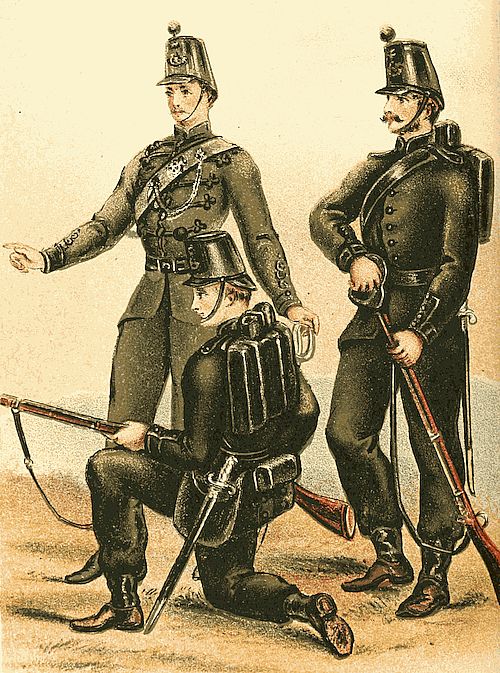
RIFLE BRIGADE, 1856 TO 1860.