Chapter XLI · AMERICA CORNER—THE ATTACK—CROSSING THE LYS—BOUS—BECQUE—RONCQ—THE PURSUIT TOWARDS THE RIVER SCHELDT—PETIT TOURCOING—AVELGHEM—THE ARMISTICE—COURTRAI AREA—MARCH OVER DEVASTATED AREA VIA ARMENTIERES—BOESINGHEM—BASE DUTIES—THE END.
Reading edition
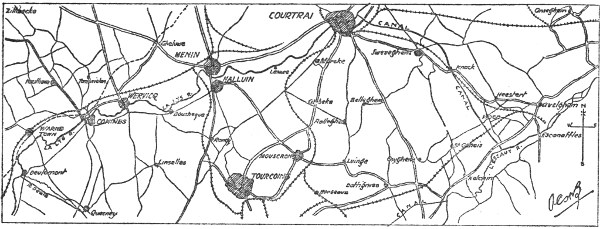
On the 11th of October, 1918, the Battalion left their camp near Wytschaete and marched to take over the line at America Corner, about 1½ miles north of Wervicq. This relief entailed a long march of about 12 miles. The first part was done during the morning, when a halt was made under the cover of a small ridge about a mile west of Houthem. The weather was fine and the enemy artillery did not bother us on this part of the journey. On the way we passed two derelict British Tanks, relics of our advance in 1917. From the halt advance parties of an officer and a few N.C.O.’s from each Company went forward, but it was not until dusk that the Battalion was able to continue their march over the canal bridge at Houthem and thence via Tenbrilen. The roads were difficult, and as the country had been in enemy hands many new tracks and roads had been made, and, together with the darkness and the inevitable rain which accompanies most marches, attacks and reliefs, the latter part of the journey became very trying. The advance parties who left earlier in the day came under very heavy artillery fire near their destination, and were met by large parties of British troops who had been “gassed”—an unpleasant omen. The whole area near America Corner was soaked with gas, and the place was littered with dead horses. The Headquarters of the Battalion we were to relieve had been reduced to the Commanding Officer, who lay on the floor of the dug-out blinded by the gas, while practically all the remainder of Headquarters Company had suffered from the gas shells and had been evacuated. The R.A.M.C. men, who were busy in this gas-stricken zone, which was still being shelled when the advance parties of our Battalion arrived, deserved the highest praise for their devotion to duty. Here, indeed, was a pleasant outlook, and before the Battalion had arrived some of our own advance party had suffered and had to be evacuated, including Acting R.S.M. Dyer, who, unfortunately, was killed later on in the day, an enemy shell landing right on the ambulance car in which he was travelling some six miles farther back. In the evening heavy rain fell, and the Battalion struggled in the dark along the shelled roads which were now covered in thick mud. About 11 p.m. the Battalion arrived at America Corner, and fortunately at that time when the shelling had diminished, only to learn that the Battalions in the line on both flanks were just about to raid the Boche lines. Before the Companies could form up under their guides, a heavy artillery duel opened up, and, of course, every one took immediate cover wherever possible. Luckily only a few minor casualties resulted, and the relief was continued. The Battalion, however, had practically no time to learn anything of their new surroundings before daybreak, as the enemy continued to shell the area throughout the night. When dawn came it was found that we were under observation from the Boche trenches, and that Battalion Headquarters was only a matter of 250 yards from the front enemy trenches, and overlooked by Wervicq Church, where the enemy had an Observation Post. Not that there is anything particularly daring about this fact, but Battalion Headquarters is always the centre of attraction for thousands of runners from rear authorities, asking for the quantity of jam, etc., when the real thing to be considered is the enemy artillery and the preparation for the coming attack. Besides, constant callers always make a place conspicuous, even if that place is in a quiet suburban street, and with the perfect observation of the enemy we had no desire to become conspicuous. Throughout the day the enemy continued to shell the area, devoting much of his “gaseous” attentions on America Corner. Two days were given to us to acquaint ourselves with this sector, and as no movement was possible by day it meant a great deal of night work and practically no rest.
The night before the attack rations were brought up on pack mules by our Quartermaster, Captain Joslin, and his assistant, Lieutenant Wright. Both these officers found great difficulty in persuading the mules to come up with the rations, and the prospect of being heavily shelled on the return journey while in charge of these stupid animals was not encouraging for them. However, they were soon relieved; an orderly put his head into the pill-box entrance and gravely informed them that a shell had just arrived and disposed of their four-footed friends. Wright had a leave warrant for England on the morrow in his pocket, yet he came up to this inferno just to wish us “Cheerio and Good Luck,” although his attendance was not officially necessary.
The attack was ordered for dawn on the 14th of October, and the artillery opened up a most terrific barrage at 5.30 a.m., and after a four minute bombardment of the enemy front lines the attack was launched under the same heavy volume of artillery fire which gradually crept forward. “Jumping-off” lines had been laid out the previous night, and from these the Battalion advanced close on the creeping barrage in which a great number of smoke shells were used. Within 30 minutes of the commencement of the attack, German prisoners poured into our lines; apparently under this fierce artillery fire they had made very little resistance in the front line. No less than 313 prisoners, including 9 officers, passed through our Battalion Headquarters within a half-hour.
The 2/14th attacked on our left and with us were successful in reaching the first objectives near the railway line from Wervicq to Menin.
Some individual cases of gallantry reported were: Sergeant B. Coultard, “B” Company, who, with his Platoon, did yeoman work, and rounded up 45 of the enemy; Corporal C. D. Lodge, “C” Company, with his men cleared the wire defences of a strong point and carried it; Private Oakes, “D” Company, single-handed rushed an enemy pill-box, put 14 of the enemy out of action, with rifle and bombs and then took 10 prisoners. Lance-Corporal J. Barnsfather, “B” Company, and Corporal W. J. Mash, “D” Company, were not far behind in their performances.
All along the line the first rush had succeeded, and under cover of a barrage from our artillery the Battalion halted and consolidated in preparation for a counter-attack. While the attack was proceeding all occupied areas behind the Boche lines were bombarded with a great number of gas shells. Although the resistance from the Boche troops was small, their artillery was not slow in replying to our fire, and a heavy bombardment of the British lines was soon in full swing.
The next step was to exploit this initial success and to push on up to and, if possible, across, the River Lys, whilst the enemy was still disorganised and his guns on the move. On the right this involved the clearing of Wervicq, in whose narrow streets and half broken-down houses there were still a good many machine-guns and snipers. By this time the mist and smoke had gone, and the advance was entirely uncovered in any way, for there was practically no ground cover here. Patrols pushed out towards the Lys as soon as the first objective was gained were held up by machine-gun fire, and, in part, by the old wire that still remained.
From the newly-captured position the ground on our direct front sloped gradually to the River Lys, and it was devoid of all cover; in daylight it was impossible to push forward without incurring unnecessary casualties. In the dusk, however, patrols pushed out and found that the enemy had retired to the farther bank of the river, but had destroyed all the bridges by fire. About midnight, however, “A” Company, under Captain Du Heaume, were able to make a crossing by a bridge which had not been quite destroyed, just to the right of our direct front, and afterwards he was able to take his Company along the farther bank and form a bridgehead near Bousbecque. Under cover of this bridgehead the Sappers, under Major Atkinson, R.E., placed a pontoon bridge across the river, though during the whole of its construction the work was hindered by artillery and machine-gun fire. Just after dawn the remainder of the Battalion crossed the river and occupied Bousbecque, a village which had been badly damaged by our artillery.
We cleared the village and in the early morning were able to form a defensive line on the far outskirts. It was, however, impossible for us to push on any farther, as we were held up on our direct front by a heavily-wired line of trenches known as the Linselles Switch. Furthermore, on our right the situation was not quite clear and heavy fighting was in progress, while the London Scottish on our left were unable to effect a crossing of the Lys owing to the flat nature of the ground to their front, which was swept by machine-gun fire from the high factories on the farther bank nearer Menin. Later in the day, however, the 14th Division had forced a crossing near Wervicq, and were able to push up on our right, and on this flank the enemy gradually withdrew. During the afternoon the London Scottish came over to their right and crossed our pontoon bridge and came into Bousbecque. By this time the enemy had left the Linselles Switch under our pressure, and we were able to occupy the high ground east of the village of Bousbecque from Mont D’Halluin to Roncq. The line was continued on our right by the 31st Division which had then pushed through the 14th Division, while on our left the 2/16th Londons (Queen’s Westminsters) continued the line north-east as far as Reckem, having experienced some hard fighting in crossing the Lys just south of Menin by means of rafts made from old doors, duck-boards, etc. In the evening the London Scottish moved from Bousbecque to Roncq for the night, when they were ordered to continue the pursuit next morning after their night’s rest.
During the night of the 17th of October the Battalion held the Mont D’Halluin—Roncq outpost line, but as the Boche was retreating fast and was not expected to make a real stand until he reached the River Scheldt, the night was peaceful, and the civilians in the neighbourhood gave our men a hearty welcome. In the farm occupied by Battalion Headquarters the Hun had left his playing cards on the table in the middle of a game, while at the piano were fragments of German songs.
The next morning the London Scottish continued the pursuit on the Brigade front, while the 2/15th and 2/16th followed in their wake in column of route, as far as Kruistraat. Not until passing this village did the 2/14th meet any opposition, but on the ridge a couple of miles beyond were many well-placed and concealed enemy machine-guns which arrested their progress. According to plan the Scottish were to have passed over this ridge that day, but in view of this enemy rear-guard were unable to do so. In spite of this temporary hold-up, however, our own Battalion was ordered to billet in farms practically in the firing line. Remarkable as it may seem, the London Scottish support Company was actually behind our Battalion Headquarters, where we were enjoying a nice hot meal, and slept in comfortable beds.
During the night while we slept, however, the 2/14th pushed over the ridge, and the next day we resumed our march forward. Except for the visit of a Boche plane which flew over our column and was brought down by Lewis gun fire, the journey to Aelbeke was without incident. That night we were in comfortable billets in private houses and farms near the town which had been untouched by the ravages of war. The stationmaster where the writer was billeted produced an English Grammar which he had studied for this “day” when British troops should arrive, and consequently spent the evening in questioning us in his laboured English.
On the following days the advance was continued by the 2/14th and 2/16th Battalions, and except for a slight check at Rollinghem, where the enemy had two field guns firing from the market place, little opposition was met. On the 20th these advance Battalions had reached the high ground at St. Genois overlooking the Scheldt, the patrols of the London Scottish actually reaching the banks of the river that night. However, the enemy resistance showed signs of increase, and heavy artillery fire from the farther banks of the river informed us that the Boche was making a stand here. On the same night the Battalion moved forward towards Petit Tourcoing, and were billeted in the farm-houses just behind the St. Genois Ridge.
The advance being held up by the German defences on the east bank of the Scheldt, the Brigade was withdrawn from the line and remained in billets in the Petit Tourcoing area until the end of the month. As much rest as possible was given to the troops, and in the fine autumn weather sports and football were indulged in. The countryside had not been destroyed by war, and looked very clean and beautiful after the desolation of the Messines area, where the ebb and flow of the fighting had destroyed nature for miles around. During our stay here the 30th Divisional Concert Party (“The Optimists”) gave us an excellent evening’s entertainment in one of the large barns, and except for a few practice attacks over the open we had a restful time. The appearance of home-made rafts on a local pond at the end of the month, however, made us think seriously of watery graves in the Scheldt.
On the 1st of November we were ordered to take over the line at Avelghem on the Scheldt, and after a trying march we relieved a Battalion of the King’s Royal Rifles. Although our approach march was disturbed by enemy shelling we suffered no casualties. Avelghem itself was on the banks of the Scheldt and was overlooked by the Mont D’Enclus (150 feet) on the farther bank. Previous to our recent advance the town had been a peaceful market town, but now it was battered to the ground by the German artillery, and the last few civilians were leaving in haste when we arrived. The line held by the Battalion was on the bank of the river in front of the town and extended north as far as Rugge, where a bridgehead on the farther bank had been established.
The care of the bridgehead was entrusted to “B” Company, under Captain Lewis, while the remaining Companies occupied cellars in the town and in the farm-houses near by. Our days were spent underground, as the Boche had complete observation of our lines, but at night our transport brought up rations, and we prepared ourselves for the next day under the ground. Each morning just before dawn the enemy barraged our position with a heavy artillery “strafe”—no doubt anticipating a further attack from us.
On Sunday, the 3rd of November, the Boche concentrated his attentions on Avelghem Church, and in about six hours of constant shelling reduced a most beautiful building into absolute ruin. The following day the Battalion was relieved, and returned as far as Knocke, about four miles farther back. After a night’s rest here a further move was expected and in the evening orders were actually received from Brigade. Billeting parties left for the new area and commenced their work. The Battalion soon followed, accompanied by the inevitable rain, only to be turned back on reaching the new area to find that the change had been cancelled. When we returned to our former homes we found another unit occupying the best places, and it was with difficulty that we found accommodation. However, this crowding only lasted for one night, and the next morning we moved still farther back, a distance of about six miles, just to the north of Belleghem.
On the 9th of November the enemy evacuated Mont D’Enclus, and the next day we were brought forward towards the Scheldt as far as Heerstert, just west of Avelghem. On arriving in the village we found it full of troops and heard rumours that British cavalry had passed through earlier in the day. At the same time, however, a German Taube was hovering overhead, and we anticipated a bombing raid that night. We realised that the Boche had retired so far that his artillery was unlikely to trouble us, but we hated this inquisitive ’plane circling overhead.
That night rumours of an Armistice became prevalent. Every one turned out of his billet and, led by our Drum and Fife Band, we paraded up and down the main street of the village. In the midst of this excitement, however, news came from Brigade that no official news had been received confirming the rumoured cessation of hostilities, and this so depressed us that we gradually faded away one by one to our billets. The next morning ordinary routine was pursued, and no one dared to utter the word “armistice” without receiving disparaging remarks from his hearers.
About 9.0 a.m., however, the official telegram came through and the rumour of the previous night was confirmed. All the excitement of an armistice, however, had been squashed the previous night; the sting had gone. During the afternoon a thanksgiving service was held in the local church. The Battalion remained at Heerstert until the 15th November, and many took advantage of the opportunity of visiting the enemy defences on the banks of the Scheldt under more peaceful conditions than anticipated. A couple of large fatigue parties were furnished for work at Escanaffles on the east of the river, but difficulty arose with regard to the supply of rations, etc., and the Battalion was withdrawn and marched back to the St. Annes Area, south of Courtrai, which had now become an important railhead.
The rest here was much appreciated, and beyond the passing of military transport there were no signs of war. Parades were held in the morning, but the remainder of the day was devoted to games, chiefly football. Passes to Courtrai were freely granted.
A ceremonial parade for the presentation of medal ribbons was held on the 26th of November on the local aerodrome, and beyond the preparation for this parade little demand was made on the energy of the troops.
On the 30th of November orders were received to move back still further to the St. Omer area, and this necessitated a five days’ trek. The first day’s halt was made at Linselles, where we saw the terrible effect of the British artillery fire during the attack over the River Lys in October, and also the wanton destruction of the Hun hordes, who had deliberately broken furniture and mirrors, and had slashed the covering from upholstered furniture. The night’s billets were very uncomfortable, but as it was for one night only no one troubled. The next day we proceeded to Verlighem, and here we were quartered in an extensive hut encampment which the Germans had cleverly concealed from aerial observation, in a thick wood. A comfortable night was spent here in the bunks so recently vacated by our enemies. All along the route to this point were signs of the hurried retreat of the Boche, and we wondered why he had left such strongly-defended points with so little real resistance. In places the wire entanglements were 30 yards in depth, through which no troops could advance without a terrible massacre. The third day’s journey took us to Armentieres, and it was appalling to see this great town practically razed to the ground. Undoubtedly the retiring Hun had blown up many of the fine buildings and churches by mines, and except for a few French troops wandering about the ruins, there was no sign of human habitation. The day’s march ended at Sailly-sur-la-Lys, and here in absolute desolation the cover of dug-outs and tumble-down buildings, the Battalion rested for the night. Opposite Battalion Headquarters on the main road was a huge German cemetery containing no less than nine thousand numbered graves; a grim relic of the heavy fighting in this area in March, 1918, the dates on the crosses being evidence of the period. Many French peasants were wandering aimlessly over the fields, looking for their lost treasures, and it was pathetic to see them building temporary homes with the old material, such as ammunition boxes, corrugated iron, biscuit tins, and so forth, which littered the old battlefield. The following morning the march was continued through Estaires and Merville, and the same devastation greeted us all round. It was not until evening time, when approaching St. Venant, that we met occupied farms where the occupants carried out their daily toil regardless of the adjoining desolation. A short journey on the 4th of December just south of the Nieppe Forest brought us to our destination at Boesinghem, a few miles north-east of Aire, when Lieutenant-Colonel Gaze rejoined from England, and again took over the command. Billets were soon arranged, and improved on our acquaintance—combined with hard work and cleaning, which did a great deal towards this improvement. Arrangements were immediately made for Christmas time, and when the 25th of December arrived everything was carried out with great success, although doubts were entertained until the very last minute as to whether the goods would arrive in time. At Boesinghem touch with our 1st Battalion in the Lillers area was obtained, and inter-Battalion football matches were arranged.
From this time the Battalion commenced to fade away. The fighting over, demobilisation set in, and every day some familiar faces left the Battalion to re-enter civil life. Early in January the Battalion moved to Etaples, where, after a stay of about nine days, they entrained for the Dunkirk area and encamped at Mardyck. In February the Battalion, much depleted in strength, developed into a “General Purposes” Battalion, and carried out Base duties. In the following month they were relieved of these duties, and moved to Pont de Petite Synthe, only to be moved again by train to the Etaples area, first staying at Dannes and then at St. Cecile Plage.
From here “C” and “D” Companies were detailed for duty at a Prisoner of War Camp near Boulogne.
In May a further move was made towards Abbeville, and a new home was found in the Ciquier Area. Demobilisation increased at a great pace, and by September only 155 other ranks remained. Canteen stores were sold to another regiment, and without canteen stores no regiment can exist.