APPENDIX
Reading edition
SUCCESSION OF POSTMASTERS-GENERAL from 1660 to 1836
From 1660 to 1667 the Post Office was in farm, the farmers being—
1660 to 1663. Henry Bishopp. Rent, £21,500.
Bishopp surrendered his patent, which was for seven years, in 1663.
1663 to 1667. (Being residue of Bishopp's term.) Daniel O'Neile. Rent, £21,500. 1667 to 1685. Henry, Earl of Arlington. Rent for later part of the term, £43,000.
Office managed, at first, by Sir John Bennet, Lord Arlington's brother, and afterwards by Colonel Roger Whitley.
1685 to 1689. Lawrence Hyde, Earl of Rochester. (For part of the time Lord Treasurer.)[101]
Office managed by Philip Frowde, Esq., under the title of Governor.
July 1689 to March 1690. Colonel John Wildman. 1690 to 1708. Sir Robert Cotton, Knight, and Sir Thomas Frankland, Bart. 1708 to 1715. Sir Thomas Frankland, Bart., and Sir John Evelyn, Bart. 1715 to 1721. Charles, Lord Cornwallis, and James Craggs, Esq. 1721 to 1725. Edward Carteret, Esq., and Galfridus Walpole, Esq. 1725 to 1732. Edward Carteret, Esq., and Edward Harrison, Esq. Christmas 1732. Edward Carteret alone to Midsummer 1733. 1733 to 1739. Edward Carteret, Esq., and Thomas, Lord Lovell, afterwards Earl of Leicester. 1739 to 1744. Thomas, Lord Lovell, and Sir John Eyles, Bart. 1744 to 1745. Thomas, Earl of Leicester (sometime Lord Lovell) alone. 1745 to 1758. Thomas, Earl of Leicester, and Sir Everard Fawkener, Knight. 1758 to 1759. Thomas, Earl of Leicester, alone. June 2, 1759 to November 27, 1762. William, Earl of Bessborough, and Hon. Robert Hampden. November 27, 1762 to September 23, 1763. John, Earl of Egmont, and Hon. Robert Hampden. September 23, 1763 to July 19, 1765. Thomas, Lord Hyde, and Hon. Robert Hampden. July 19, 1765 to December 29, 1766. William, Earl of Bessborough, and Thomas, Lord Grantham. December 29, 1766 to April 26, 1768. Wills, Earl of Hillsborough, and Francis, Lord Le Despencer. April 26, 1768 to January 16, 1771. John, Earl of Sandwich, and Francis, Lord Le Despencer. January 16, 1771 to December 11, 1781. Francis, Lord Le Despencer, and Right Hon. Henry Frederick Thynne, afterwards Carteret. December 11, 1781 to January 24, 1782. Right Hon. Henry Frederick Carteret (sometime Thynne) alone. January 24 to April 25, 1782. William, Viscount Barrington, and Right Hon. Henry Frederick Carteret. April 25, 1782 to May 1, 1783. Charles, Earl of Tankerville, and Right Hon. Henry Frederick Carteret. May 1, 1783 to January 7, 1784. Thomas, Lord Foley, and Right Hon. Henry Frederick Carteret. January 7, 1784 to September 19, 1786. Charles, Earl of Tankerville, and Right Hon. Henry Frederick Carteret. (Created Baron Carteret, January 29, 1784.) September 19 to December 10, 1786. Thomas, Earl of Clarendon, and Henry Frederick, Lord Carteret. December 10, 1786 to July 6, 1787. Henry Frederick, Lord Carteret, alone. July 6, 1787 to September 19, 1789. Henry Frederick, Lord Carteret, and Thomas, Lord Walsingham. September 19, 1789 to March 13, 1790. Thomas, Lord Walsingham, and John, Earl of Westmorland. March 13, 1790 to July 28, 1794. Thomas, Lord Walsingham, and Philip, Earl of Chesterfield. July 28, 1794 to March 1, 1798. Philip, Earl of Chesterfield, and George, Earl of Leicester. March 1, 1798 to February 27, 1799. George, Earl of Leicester, and William, Lord Auckland. February 27, 1799 to March 31, 1801. William, Lord Auckland, and George, Lord Gower. March 31, 1801 to July 19, 1804. William, Lord Auckland, and Lord Charles Spencer. July 19, 1804 to February 20, 1806. Lord Charles Spencer and James, Duke of Montrose. February 20, 1806 to May 5, 1807. Robert, Earl of Buckinghamshire, and John Joshua, Earl of Carysfort. May 5, 1807 to June 6, 1814. John, Earl of Sandwich, and Thomas, Earl of Chichester. June 6 to September 30, 1814. Thomas, Earl of Chichester, alone. September 30, 1814 to April 6, 1816. Thomas, Earl of Chichester, and Richard, Earl of Clancarty. April 6, 1816 to June 13, 1823. Thomas, Earl of Chichester, and James, Marquess of Salisbury.
Since Lord Salisbury's death on the 13th of June 1823, no second Postmaster-General has been appointed.
June 13, 1823 to July 4, 1826. Thomas, Earl of Chichester. July 4, 1826 to September 17, 1827. Lord Frederick Montague. September 17, 1827 to December 14, 1830. William, Duke of Manchester. December 14, 1830 to July 5, 1834. Charles, Duke of Richmond.
By his first patent, dated the 14th of December 1830, the Duke was appointed Postmaster-General of Great Britain; and by a second patent, dated the 14th of April 1831, he was appointed Postmaster-General of Great Britain and Ireland.
July 5 to December 31, 1834. Francis Nathaniel, Marquess Conyngham. December 31, 1834 to May 8, 1835. William, Lord Maryborough. May 8 to May 30, 1835. Francis Nathaniel, Marquess Conyngham. May 30, 1835, to September 15, 1841. Thomas William, Earl of Lichfield.
SUCCESSION OF SECRETARIES TO THE POST OFFICE down to 1836.
The appointment of Secretary was created by Treasury Warrant dated the 20th of June 1694. 1694 to 1700. Name uncertain; but probably Willboyl.
[In 1694 the Postmasters-General urge the creation of the appointment of Secretary; in 1697 they speak of "having sent our Secretary down to Worcester"; and in October 1701, when reporting on a paper which had been referred to them as far back as June 1699, they explain that "by the death of our late Secretary y^e paper has been mislaid and but very lately recovered." That there was a Secretary during this period is, therefore, beyond doubt.
During the same period the Post Office letter books are written in a handwriting as peculiar as it is good; and in the same handwriting, of the identity of which there can be no question, there is in the Frankland-Blaithwaite correspondence, until lately in the possession of Sir Thomas Phillipps, a letter from the General Post Office dated the 27th of May 1697, and docketed thus, the docket having obviously been written at the time of receipt:—"From Mr. Willboyl, Commissioner of the Post Office." Now, Commissioner of the Post Office he certainly was not, there being at that time no such appointment; but it is probable that he was Secretary, and that with this official title, which had been only recently given, Blaithwaite was not acquainted.]
1700 to 1714. Benjamin Waterhouse. 1714 to 1715. Henry Weston. 1715 to 1721. James Craggs. 1721 to (about) 1730. Joseph Godman. (About) 1730 to 1737. W. Rouse. 1737 to 1738. Thomas Robinson. September 1738 to July 1742. John David Barbutt. July 1742 to December 1762. George Shelvocke. December 1762 to July 1765. Anthony Todd. July 1765 to January 1768. Henry Potts. January 1768 to June 1798. Anthony Todd (again). June 1798 to July 1836. Francis Freeling.
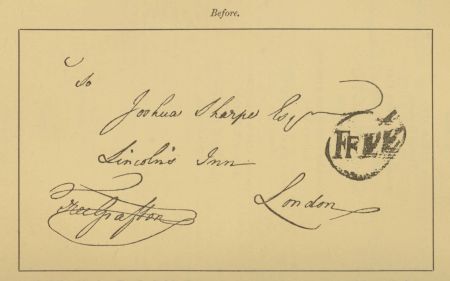
FACSIMILES of FRANKS written before and after 1784, when the obligation to date was imposed. Before. The Duke of Grafton, First Lord of the Treasury from 1766 to 1770, commonly called Junius Grafton from the attacks made upon him by Junius.
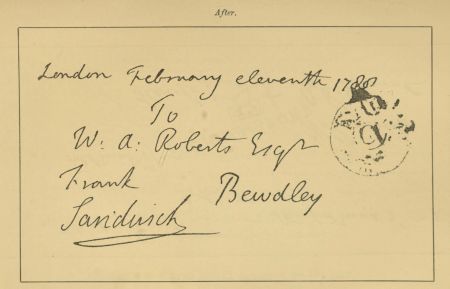
After. The Earl of Sandwich, nicknamed by the satirists of the period Jemmy Twitcher. "See Jemmy Twitcher shambles—stop, stop, thief"—an allusion to his shambling gait. Lord Sandwich was postmaster-general from 1768 to 1771, and afterwards First Lord of the Admiralty.
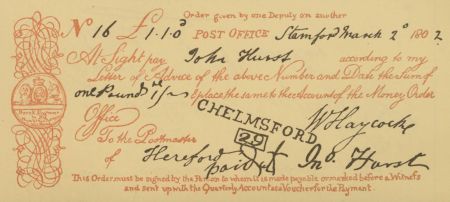
FACSIMILE of a PAID MONEY ORDER of the year 1802.