HISTORY (continued 3)
Reading edition
'As the laws are now construed by the law authorities, the possession of a body for the purpose of dissection, is in itself a misdemeanour, except it be that of a person hanged for murder. The first thing then to be done, is to declare, by an act of the legislature, that dissection, for the purpose of procuring knowledge, that may be useful in medicine and surgery, is legal and proper.
'2. That a dead body should be dissected, is of no consequence to the individual who is no more, but a knowledge of it being so may be distressing to the feelings of the sorrowing friends and relations.
'This sufficiently points out what are the proper subjects for dissection; namely, the bodies of those who die without any friends or relations. In small towns and villages, probably, there are none who die under those circumstances; but in large cities, and especially in the metropolis, there are a great number. Whoever will take the trouble of referring to the Anatomical Committee, will find that, in London, the number of those amount to many more than would be required for the supply of all the anatomical schools. These bodies are now buried at the expense of the public; and, if authorised to do so, the churchwardens and overseers would, in most instances, readily give them up to the teachers of anatomy.
'But it may be argued, in opposition to the adoption of the plan proposed, that it may be considered as a very harsh and arbitrary measure on the part of the legislature to point out any particular class of society as furnishing subjects for dissection, while the other classes are exempt. This objection relates, of course, not to the sense and deliberate judgment, but to the feelings of the public; and it is easily answered. Let it be declared, not who are, but who are not to be dissected. Let it be enacted that dissection is lawful, but that no one is to be dissected contrary to the wishes of his friends or nearest relations. The result will be the same, but the offence to the public feeling, in this last case, will be none at all.
'It may be said also, that there are some individuals who have a horror at being dissected after death, and that it will sometimes happen that a poor man, dying in a workhouse, with no friends around him, will have his sufferings much aggravated, if he believes that his helpless and friendless condition is to lead, as soon as he has breathed his last, to his body being conveyed to an anatomical school. Undoubtedly such feelings ought to be respected. It would be cruel to disregard them; and it is very easy to meet the objection which arises out of them. Let it be declared further, that no one is to be made the subject of dissection who has declared, by his last will and testament, his wish to the contrary.
'Again—it may be considered as wrong, on religious grounds, that any individual should be denied the act of sepulture, and the performance of the funeral service after death. It may be answered to this objection, indeed, that these are mere human institutions, concerning which not one word is said in the Old and New Testament. But there is no occasion to meet it thus. After the body has been dissected, let the remains be inclosed in a coffin, and conveyed to the grave in the usual manner, and with the usual ceremonies; or the funeral service may be read over it previous to dissection.
'There may be some who will, probably, still urge another objection; namely, that the public feeling is so strongly opposed to dissection, and that the lower orders especially are so much prejudiced against it, that a general clamour will be raised if there be any kind of legislation on the subject. But those who argue thus, must have formed their opinions on what they have heard and seen in the country, in villages, and the smaller provincial towns, and can know little of the state of feeling in the larger towns, and especially in London. The fact is, that in London there is no horror of dissection in the abstract. The thing has, in some measure, become familiar to the minds of the inhabitants, and especially of those who belong to the lower orders. Persons who reside in the neighbourhood of an anatomical theatre, continually see boxes and hampers taken into it, which they know to contain subjects for dissection; and such an occurrence scarcely causes an observation among them. It is only when the bodies of their friends and relatives are exhumed and dissected, that their feelings are excited; and, instead of being excited further, these feelings are likely to be allayed by the adoption of a plan for dissection of the unclaimed bodies, inasmuch as it would put a stop to the present traffic with the resurrection-men, and the robbery of the churchyards.
'Nor is the plan proposed to be regarded in the light of a mere experiment. It has been already tried in most parts of the continent of Europe, in Protestant countries as well as Catholic, and it has succeeded perfectly. And surely there is no such peculiarity in the English nation as ought to lead us to believe that that which has succeeded in nations so different as the French and Prussians, the Dutch and the Italians, would not succeed in England also.
'Of course these observations are founded on the supposition that dissection is carried on in a discreet and decent manner; and if it should be recognized by law, and a more abundant supply of subjects should be procured under the sanction of the state, some precautions may be necessary to prevent the evil which would arise from its being too openly practised, or being brought under the notice of the public in a disgusting or offensive shape. It will not be unreasonable to require of the teachers of anatomy that they should preserve a register of all the bodies which they receive for dissection, naming the source from whence they are obtained. It may be proper, on all accounts, to insist that those who undertake to be teachers of anatomy should prove their fitness for the office, by passing a rigid examination before the College of Surgeons of London, Edinburgh, or Dublin, or some other competent tribunal. This will, at any rate, limit the number of anatomical teachers in the best possible manner, namely, by the exclusion of uneducated and ignorant pretenders, and by confining this department of medical instruction to men of industry and science. It may be admitted as a question also, whether, in addition to these measures, it will not be advisable to insist that no one should be permitted to open dissecting-rooms for the admission of students, without a license to do so from the Secretary of State, or from some person specially appointed for the purpose, to whom a satisfactory security must be given for the proper regulation and conduct of the establishment.
'Of the foregoing observations, there are, probably, very few which have a claim to the merit of originality; the subject having been so frequently discussed, especially among medical practitioners, with whom the present obstacles to anatomical instruction have long been a subject of serious anxiety.
'This last circumstance has led to a misapprehension on the part of the public. It is very generally believed that the members of the medical profession are a party concerned, and that they have an interest beyond that which others have in obtaining greater facilities of dissection. This is true, as far as it relates to the teachers of anatomy and the students; but the former are very few in number, and the latter are not of sufficient importance, and are too limited in their acquaintance and connexion for their sentiments to be much regarded, or even to be known. It is not true as to medical practitioners generally: they have laid in their store of knowledge; they rarely find it necessary to return to the labours of the dissecting-room; or if they wish to inspect the dead body for the purpose of satisfying themselves as to a particular point, they have ample opportunities of doing so in the post mortem examinations made for the purpose of ascertaining the cause of a patient's death.
'If the existing race of medical practitioners were so narrow-minded as to consult only their own private interests, they would be pleased to see the rising generation brought up in comparative ignorance, inasmuch as it would make it more difficult for themselves to be superseded in their practice as they advance in years. If they have been more active than others in calling the attention of the legislature to the subject, it has been on purely public grounds; not because they expect or can expect any benefit to themselves, but because their peculiar situation makes them more competent than other individuals can be to form a judgment of the mischiefs which may ultimately arise to the community, if nothing be done to remove the existing evil.'
It must be admitted that the foregoing remarks, emanating from so eminent a man as Mr. Brodie, cannot but possess, at the present juncture, considerable value, as the subject has been again brought before the legislature by Mr. Warburton, and no doubt now exists that, from recent circumstances, some enactments will be passed to legalize dissection, and to facilitate the procuring of bodies for the supply of the anatomical schools. As we shall have occasion to recur to the subject in a future part of our work, we shall now refrain from making any further comments on it, and proceed to the trial of the resurrectionists, for the murder for which they were committed.
The 2nd of December was the day fixed for the trial of the prisoners charged with the murder of the Italian boy; and as early as eight o'clock in the morning the court was crowded to excess.
We cannot but here speak in terms of reprobation of the vexatious conduct pursued by some of the city officers in regard to the admission of persons to the body of the court and the galleries, who, in some respects, had a title to be admitted. Personally speaking, when we presented ourselves at the gate, demanding entrance, as having the key of the box appropriated to the Committee of the City Lands, we were told, in the first place, that the box was full; this was at half-past eight in the morning. On remonstrating with the officer, and expressing our opinion that he was acting reprehensibly in refusing admittance to a person having the key of one of the committee to whom the box belonged, we were met by the objection, that it was by no means improbable but that the common-councilman would come himself. This we declared to be almost an impossible case; for, as we were in possession of his key, it amounted to the proof that he had for that day relinquished his right, and that we were to be regarded, in every respect, as his substitute. Mr. Cope was then sent for, and he declared also that the box was full; that nine persons had obtained admission with one key, and that were he to admit us, we should not be able to find room. We then asked Mr. Cope, how he would act if the common-councilman appeared himself, demanding admittance, and whether he was invested with any power to refuse such an admission to an accredited member of the Corporation, who, as such, possessed a positive right to a seat in that box, of which it was not in the power of Mr. Cope to divest him. Still the plea of the fulness of the box was urged; and finding all remonstrance to be vain, we despatched a friend for the common-councilman himself to come and insist upon his right. In the interval, however, the gate was opened, as if by some talismanic power, and on our entering the box, we found the statement of its being full completely false—two out of the five benches were not occupied at all, nor during the whole of the day was the box ever full.
We have merely adverted to this circumstance, as it may operate as a warning to those who so unjustifiably took upon themselves the power of refusing admittance to a court of justice to individuals invested with an authority to exact admission, and by which act they were, in reality, setting themselves up in opposition, and in actual defiance of the very persons by whom they had been appointed to the offices which they hold.
At nine o'clock the deputy recorder, Mr. Sergeant Arabin, came into the court, when the prisoners, John Bishop, Thomas Williams, and James May, were placed at the bar; and the indictment having been read over, charging them, in one count, with the Wilful Murder of Carlo Ferrari, otherwise Charles Ferrier; and in another with the Wilful Murder of a male person, whose name was unknown. They severally pleaded Not Guilty.
The jury was then sworn, and a short case having been disposed of, at ten o'clock Chief Justice Tindal, Mr. Baron Vaughan, and Mr. Justice Littledale entered the court, with the Lord Mayor and Sheriffs.
The bench was crowded with persons of rank, amongst whom we perceived the Duke of Sussex.
The prisoners were again put to the bar. They seemed but little moved by the awful situation in which they were at that moment placed, and they encountered the inquisitive glances of the assembled crowd with a careless air. Their appearance rather indicated low cunning, than hardened ferocity. In the countenance of Williams, there was something unusually repellent, and on the Duke of Sussex taking his seat, and applying his glass to his eye, Williams appeared to direct his stare full upon his Royal Highness with all imaginable impudence, as if he were almost determined to stare him out of countenance.
Mr. Bodkin having opened the case,
Mr. Adolphus proceeded to state the leading facts of it to the jury. In doing so, he said, that he did not feel it necessary to solicit their most serious attention to it, for he knew it would receive such attention from them, being a case in which the three prisoners at the bar stood charged with the foul crime of murder; and one of which, as persons living in society, they must have heard a great deal for many days past. After paying the usual compliment to the jury, on the ground of their respectability, which, by the bye, would be 'more honoured in the breach than in the observance,' and declaring, as usual, that he never had the honour of addressing a jury more competent by their talents and station in life, to deliver a true and conscientious verdict; he also, as usual, declared himself to be a very humble individual, and that he was fully impressed with the conviction, that a case of such great importance might have been entrusted to far more abler hands than his own. After this positive compliment to the jury, and the negative compliment to himself, the learned counsel proceeded to state, that he was fully aware that the jury knew this to be a case of the greatest and most important interest, and he felt certain, that the gentlemen of the jury required no suggestions from him to induce them to pay the strictest attention to all its details; and having alluded to the interest which it excited out of doors, he was sure that he need scarcely remind them, that they should not allow themselves to be at all swayed by any thing that they might have heard with regard to this case, previously to their entering that box, but that their duty there was merely to judge the case by the evidence which should be laid before them. When he spoke on their deciding on this case according to the evidence which should be laid before them, he begged to say, that there was one point on which he was anxious to call their serious attention. In cases of murder, it often happened that the direct evidence of eye-witnesses could not be produced as to the blow which had been struck or the injury which had been inflicted, and the infliction of which constituted the crime; but it was settled by the constitution of this country, that, in all cases of this kind, a jury might select from the circumstances of the evidence laid before them, such facts as might produce a conviction in their minds as to the guilt of the prisoners charged with the offence. The application of the facts and circumstances of a case for such a purpose was, by the law of the land, vested in a jury constituted as they now were; and it was for them to decide according to the evidence which should be laid before them, as it appeared in their minds; and it was for them, after they had heard the great body of evidence which would be submitted to them in this case, to say whether the prisoners were or were not guilty of the heinous crime laid to their charge. If the facts which would be laid before them, should produce in their minds a conviction of the guilt of the prisoners, he was sure that they would, without hesitation, pronounce a verdict which would consign some, if not all of them, to a certain, speedy, and ignominious death; and he was equally sure, that if an opposite conviction was the result of the evidence, the jury would at once acquit the prisoners at the bar. Without further introduction, he would proceed to state to them the facts which had given rise to this painful and extraordinary inquiry, as he felt justified in calling it, for the murder, to which it had reference, did not appear to have been committed through any of those motives that have ordinarily occasioned the commission of such a crime in this country. It was not to gratify revenge for a wrong done, that the unfortunate victim in this case had been deprived of existence. The minds of his murderers were not stimulated by any passions of that description to the commission of the dreadful deed. Neither wealth nor the other common allurements which influenced the actions of wicked men under such circumstances had impelled them to perpetrate this crime. Nothing but the sordid and base desire to possess themselves of a dead body, in order to sell it for dissection, had induced the prisoners at the bar to commit the crime for which they were now about to answer before a jury of their countrymen. The learned gentleman then proceeded to detail the facts of the case, as they were afterwards stated in the evidence subsequently produced. He dwelt in terms of well-deserved eulogy on the meritorious exertions of Mr. Thomas, the superintendent of police, and of Mr. Corder, the vestry-clerk of St. Paul's, Covent Garden, in prosecuting the inquiry which had led to the trial. He acknowledged that the case depended upon circumstantial evidence, but he contended that a large and well-connected body of circumstantial evidence was, in many cases, superior to the positive testimony of an eye-witness. The judgment of an eye-witness was, in several instances, liable to be deceived; but it was impossible that the jury, after putting all the circumstances of the case together, and weighing them seriously and deliberately, could be mistaken in their judgment. It was for them to say, after doing so, whether the prisoners at the bar were or were not guilty of the crime with which they stood charged. He concluded by repeating his confident expectation that they would give to this important case the deep and serious attention which it deserved, and by expressing his complete reliance on the integrity and good sense of a British jury, which a long life of practice had left him no room to doubt.
William Hill, the first witness called, was then examined by Mr. Clarkson. The witness stated, that he is porter to the dissecting-room at the King's College. At a quarter before twelve o'clock on Saturday, the 5th of November, the bell of the dissecting-room having been rung, he answered it; and having opened the door, he found the two prisoners at the bar, Bishop and May, there. He had known the prisoners before. May asked him if he wanted anything, and he said 'Not particularly.' Witness asked him what he had got; he said, 'A male subject.' Witness asked him what size. He said, 'A boy about fourteen;' and he demanded twelve guineas. Witness said they could not give that price, for they did not particularly want it; but if he would wait, he would acquaint Mr. Partridge, the demonstrator of anatomy, with the matter. He accordingly went to Mr. Partridge, who said he would see them. Witness then went back to them, and told them to go round to the place appropriated for them. When he had got them into the room appropriated for them, Mr. Partridge joined them. They could not agree as to the price. Mr. Partridge said that he would not give twelve guineas for the subject. Witness then heard May tell him he should have it for ten guineas. Mr. Partridge then left them, and went into the dissecting-room. The prisoners then asked witness how it was to be, and whether he would have the subject? Witness then followed Mr. Partridge, and, in consequence of what Mr. Partridge said to him, he returned to the prisoners, and told them that Mr. Partridge would only give nine guineas for the subject. May said, he would be d—d if it should come in for less than ten guineas. May was intoxicated at the time. On his going out to the door, Bishop, taking witness aside, said to him, 'Never mind May, he is drunk. It shall come in for nine guineas in the course of half an hour. They then went away. About a quarter past two o'clock on the same afternoon they returned, in company with the other prisoner, Williams, and a man named Shields. They had a hamper with them. Shields appeared to be employed as the porter for carrying it. May and Bishop carried the hamper into another room, while Williams and May remained where they were. On opening the hamper, a sack containing the body was found in it. May and Bishop remarked that it was a good one, to which observation the witness assented. May, being tipsy, then turned the body very carelessly out of the sack. The witness perceived that the body was unusually fresh; and, in consequence of what struck him with regard to the appearances of it, he went to Mr. Partridge. Previously to his doing so, he asked the prisoners what the subject had died of? They said, they did not know, and that it was no business either of his or theirs. Witness replied, that it certainly was not. The appearances with regard to the body with which he was particularly struck were these:—It appeared different from a body that had been laid in a coffin. The left arm was turned up towards the head, and the fingers of the hand were firmly clenched. In consequence of the opinion which he formed from the appearance of the body, he went to Mr. Partridge, and detailed to him what he had seen, and what he thought about the matter. Mr. Partridge accordingly returned to the room where the body was lying, to have an inspection of it. The prisoners had been removed from that room to the room into which they were originally introduced, and where the other two men were also. Mr. Partridge, without seeing them, after seeing the body, went to the secretary's office. In the mean time, several of the gentlemen connected with the College saw the body, and their suspicions were also excited. Mr. Partridge having returned to the place where the prisoners were, showed them a fifty pound note, and told them he must get that changed, and that then he would pay them. Mr. Partridge having pulled out his purse while speaking to them, and there being some gold in it, Bishop said, 'Give me what money you have, and I will call on Monday for the remainder.' May proposed that Mr. Partridge should give him the fifty pound note, and he would go out and get it changed. Mr. Partridge, smiling, said, 'Oh, no,' and then left them. The prisoners remained waiting after Mr. Partridge had gone. In about a quarter of an hour Mr. Mayo, the Professor of Anatomy at the College, came down with Mr. Rogers, the Police Inspector, and a body of police, and the prisoners were all taken into custody. Before that took place, and while witness was in the room with Bishop, Bishop said to him, 'Pay me only eight guineas in the presence of May; give me the other guinea, and I will give you half-a-crown.' The body was then delivered by the witness to the police, together with the hamper and sack; and having accompanied them to the police-station, in Covent Garden, he saw them delivered into the hands of Mr. Thomas, the Superintendent of Police. Judging by his experience with regard to dead bodies, it was his opinion that this body had not been buried, nor laid in a coffin. He observed that there was no saw-dust about the hair of it.
Cross-examined by Mr. Curwood.—The first conversation he had was with May and Bishop only; Williams did not appear. Williams was in the College, but not in the same room.
Mr. Richard Partridge examined by Mr. Bodkin.—Witness is Demonstrator of Anatomy at the King's College. He was there on Saturday, the 5th of November. A body was brought there that day, and a communication was made to him about it by the witness Hill, about two o'clock in the afternoon. He accordingly went and looked at it. None of the prisoners were present at the time. The body externally exhibited some suspicious appearances, and it was those appearances that induced him to go for the police. The suspicious appearances were a swollen state of the face, bloodshot eyes, freshness of the body, and the rigidity of the limbs. There was likewise a cut over the left temple. The lips were also swollen. There was nothing else in the external appearance of the body that excited his attention. After he had examined the body, he did not recollect whether he went to the place where the prisoners were before he called in the police. He was certain, however, that he went for the police before the circumstance with regard to the fifty pound note took place. On returning to the College, after going for the police, he showed the fifty pound note to May and Bishop, where he found them at the bottom of the stairs, leading to the anatomical department. He then proposed to them that change should be got for the fifty pound note, with the view to detain them until the police arrived.
The following day he made a more minute examination of the body at the police-station, in the presence of other medical men—the external appearances near the muscles were rigid, though less so than on the preceding day, and there was a superficial wound on the temple. Beneath the scalp and the bone there was some contused blood. On opening the body, he found the whole of the chest, breast, &c., in a healthy condition; the stomach was full. The spinal cord and brain were then examined—the brain was perfectly healthy. In cutting through the skin that covers the spinal cord, he found a quantity of coagulated blood in the muscles, and on removing the back part, blood was found on the membrane that envelops the spinal cord. The spinal marrow appeared to be perfectly healthy. From these appearances he thought the external marks of violence were sufficient to produce death. The violence exerted had had an effect on the spinal cord. The violence must have been on the back of the neck. A blow from a stick, he believed, would have caused the appearances he had described. The injuries might not produce instantaneous, but would cause a speedy death.
By Chief Justice Tindal.—Witness believed that the appearances of external violence to the spinal marrow had been caused by a blow or some other species of violence inflicted on the back of the neck.
Examination continued by Mr. Bodkin.—It was the opinion of witness, that the blow of a stick at the back part of the neck might have caused such appearances. He would not positively say, that such an injury would produce an instantaneous death; but he believed that it would cause a very speedy one.
Cross-examined by Mr. Curwood.—On the external examination of the body, he could not discover anything that would have been sufficient to produce death. The extravasation of the blood in the spinal marrow might have produced death. He would not positively say that it did so, but his conclusion was, that it did. He could only arrive at belief, and not at certainty on the subject. He did not think that the appearances which he had mentioned could have been produced by pressure, or any other means besides a blow. At the same time they might have been produced by a blow of something else as well as a stick.
Re-examined by Mr. Bodkin.—On examining the heart, he found it was empty, which was an unusual circumstance. The face too was swollen and flushed, and both these appearances, namely, the empty state of the heart, and the swollen state of the features, have been found in persons who have died suddenly, but not from violence. They have been found in persons who have met with a sudden but a natural death. But the appearances about the spinal cord, and the coagulated blood at the back of the neck, have not been found in persons dying a natural death.
Mr. George Beaman, Surgeon, examined by Mr. Adolphus.—I am a surgeon to the parish of St. Paul's, Covent-garden. On Saturday night, 5th of November, I first saw the body of the deceased. I examined it with other surgeons. The weather, I should remark, at that time was very favourable to the preservation of dead flesh. The body appeared to have died very recently. I should judge that it had died within thirty-six hours. The face appeared swollen, the tongue was also swollen, the eyes prominent and blood-shot, and the tongue was protruding between the lips. The teeth had been all extracted, the gums bruised, and portions of the jaw-bone had been broken and removed with the teeth. There was also the appearance of blood having issued from the gums. Judging from all these circumstances, I should say, that the teeth must have been taken from the gums within two or three hours after death. I examined the throat, neck, and chest, very particularly, and I found no external marks of violence there. On this occasion I observed there was a wound on the forehead, over the left eyebrow: it was about three-quarters of an inch long, and it penetrated through the skin to the bone. A small quantity of blood had oozed from the wound, but that circumstance might have been occasioned by the body falling out of the sack after death. The blood was uncoagulated. I again examined the body on the following day (Sunday) about two o'clock in the afternoon, but I found no further marks of external violence. The limbs, which were decidedly stiff on Saturday night, were not so much so on Sunday. The appearances of the body were such, in my opinion, as to leave no doubt that it had not been regularly laid out. About eight o'clock on the Sunday evening, I examined the body, assisted by Mr. Partridge and others. I washed the throat and neck with a sponge and water carefully, but I found no scratch or mark of violence there. On removing the scalp on the top of the skull, I detected some blood about the size of a crown. Such an appearance as that must have been produced by a blow, given during life. The brain was also examined, and its appearances were precisely such as Mr. Partridge has described. The body was then turned, for the purpose of examining the spinal marrow, and on removing the skin on the back part of the neck, a considerable quantity of coagulated blood, I should think from three to four ounces, was found amongst the muscles there. That blood must have been effused while the subject was alive. On removing a portion of the spine, for the purpose of examining the spinal marrow, a quantity of coagulated blood was found lying in the spinal canal, which, by causing a pressure on the spinal marrow, must have produced death. The bones of the spine were uninjured. The appearances which I have described would be likely to follow from a heavy contusion on the spine, or from the blow of a heavy instrument. There was about an ounce of blood found in the spinal canal. The heart was empty, which is an unusual circumstance, and one that, in my opinion, denotes a sudden death. I mean by a sudden, an instantaneous death, or nearly so, one that takes place in at least two or three minutes. The stomach contained a tolerably full meal, and the contents smelt slightly of rum. Digestion was going on at the time of death. I should think that death occurred about three hours after the meal. On examining the coats of the stomach, after removing its contents for the purpose of having them analyzed, I found them perfectly healthy. From the whole of my observations on the body, I ascribe the death to a blow given on the back of the neck. This observation I have seen verified from experiments which I have witnessed in animals, where the same appearances have followed that species of injury.
Cross-examined by Mr. Barry.—I found no external appearances of violence at the back of the neck. It does not, however, necessarily follow, that the severe blow of a stick on the back of the neck would be followed by a contusion or external marks of violence. It would have produced such a mark if the boy had lived some time after the blow had been given. I agree with Mr. Partridge in the statement, that a flushed appearance of the countenance, and an emptiness of the heart, have been found in cases of sudden death, where no injury has been inflicted. In the course of my practice, I never found the heart empty after death. I do not think that any blow on the top of the head would present the appearances which were found on the back of the neck. Any violence applied to the back of the neck itself, however, whether considerable or not, might produce it. I can hardly think that such appearances would be produced by the falling down of a person in a fit of apoplexy. I will not say that it would be impossible, supposing that his head fell against a hard projecting body. A fall on a hard projecting point might produce such appearances. I will not swear as to the time when the teeth were removed, but I think it highly improbable that twelve hours elapsed after death before their removal.
Re-examined by Mr. Adolphus.—Forming my opinion as to the best of my judgment and experience, I would say that the teeth were removed within two or three hours after death. I have never seen a person die of apoplexy, in which the brain was not injured, but I believe that such cases have occurred in what is called serous apoplexy. There was no serum effused on the boy's brain, nor did it present any unhealthy appearance whatever. He was apparently about fourteen years old, and in no respect did he seem inclined to apoplexy.
By Mr. Baron Vaughan.—I have examined the bodies of many persons that have died of apoplexy, and have always found appearances to account for the death. There have been cases of serous apoplexy recorded, in which it is stated, that no such appearances could be discovered. If the subject, in this instance, died of apoplexy, it did not present any appearance of it.
Mr. Frederick Tyrrell, examined by Mr. Clarkson.—I am one of the surgeons of St. Thomas' Hospital. I have heard the evidence of Mr. Beaman with regard to what he found, and the conclusions that he came to, and in all material points I agree with him. I have never known a case of serous apoplexy in which the appearances on the brain did not sufficiently denote its occurrence. I have been always able to ascertain that a quantity of fluid has been effused in what is termed serous apoplexy, and that itself is sufficient to denote death. I am a lecturer on anatomy and physiology in St. Thomas' Hospital, as well as a surgeon to that institution.
By Mr. Baron Vaughan.—The appearances described in the spinal canal might have been produced by violence, without there being marks of violence on the skin.
John Earle Rogers, examined by Mr. Bodkin.—I am an inspector of police. On Saturday, the 5th of November, I received the body and the hamper from the witness Hill, and gave them into the custody of Mr. Thomas, the superintendent.
John Wilson, a police-officer, sworn.—I apprehended the prisoners at King's College. May resisted a great deal, and struck me, because I would not let him and Bishop talk together.
Joseph Sadler Thomas, examined by Mr. Adolphus.—I am Superintendent of the division of police F. On the afternoon of Saturday, the 5th of November, from certain information I received, I despatched Rogers and Wilson to the King's College. They returned with May and Williams. Before them, Bishop and Shields were brought to the station-house. Rogers also brought the body, sack, and hamper. The body was placed in the back-room in the station-house, with the hamper. The prisoners were all together in the outer room. I asked May what he had to say, for he was charged with having come into the possession of the subject in an improper manner. He replied, 'I have nothing at all to do with it. The subject is that gentleman's, (pointing to Bishop). I merely accompanied him to get the money for it.' I then asked Bishop whose it was; and he said that it was his, and that he was merely removing it from Guy's Hospital to King's College. I then asked Williams what he knew about it. He replied, that he knew nothing about it, and that he had gone with them to the King's College to see the building. I asked Bishop, in the first instance, what he was, and his answer was, 'I am a b—y body snatcher.' I think that all the prisoners at the time, Bishop and May in particular, were labouring under the effects of liquor. May was carried into the station-house on all-fours, and with his smock-frock over his head. The body was taken out of the hamper in my presence, and placed on the table. It struck me as the body of a person that had recently died. I perceived that the teeth had been extracted from it. In consequence of information, I went, on the following Tuesday, to Mr. Thomas Mills, Newington Causeway, and I received twelve teeth, which I now produce. I also went, previously to my going to Mr. Mills, to No. 3, Nova Scotia Gardens, and on the back-room ground-floor found a trunk, now produced. On the 20th of November I went to the same cottage, and making a further search, I found a hairy cap in the front parlour, amongst some dirty linen. I now produce it. I also found a tin can there. Mr. Thomas also produced the sack and hamper in which the body had been brought to the station-house in Covent Garden.
Henry Lock, examined.—I was, in November, waiter at the Fortune of War public-house, Giltspur-street. On Friday, November the 4th, I saw the prisoners there at eleven o'clock in the morning. They had some drink, and went away together about twelve o'clock. There was a strange man with them. About three o'clock in the afternoon of the same day they came again, and remained until about five, and then all three went away together. About eight o'clock on the same evening, they all returned with another man, who appeared to be a coachman. Before the coachman left, one of the prisoners said they had had a ride. About nine o'clock May went to the bar, with something in a handkerchief, which proved to be teeth. I saw him pour water upon the handkerchief, and rub it with his hands. He afterwards opened the handkerchief, and I saw the teeth. I observed to him, that they appeared to be young ones, and were worth two shillings. May said they were worth two pounds to him. The prisoners shortly afterwards left. On the following morning, about eight o'clock, I saw Bishop and Williams, accompanied by Shields. Bishop, addressing Williams, asked, 'What shall we do for a hamper?' Williams made no answer. Bishop requested Shields to go over to the hospital (St. Bartholomew's) to get a hamper, but he refused to go. Bishop then went himself for it, and shortly returned with a hamper. They then all left together, and I never saw them again until they were in custody.
Thomas Wigley, examined.—I am a porter at coach offices. On the 4th of November, about half-past seven o'clock in the evening, I was in the Fortune of War public-house, when Bishop came in, and was followed, in a few minutes after, by May. I heard Bishop say, 'What do you think of our new one? did he not go up to him well, and collar him? was he not a game one?' May said, 'I don't know what you mean.' Bishop said, 'That's all right.' May saw me sitting in the corner of the room all the time. May got up, and went out, and in a few minutes returned, with a handkerchief in his hand, which he was rubbing with his hand. In a few minutes Williams came in, and Bishop observed, 'Here he comes; I knew he was a game one.' Bishop said to May, during the conversation, and before they went away, 'You stick to me, and I will stick to you.'
Cross-examined by Mr. Curwood.—I do not know what Bishop meant by saying to May, 'What do you think of our new one? was he not a game one?'
James Seagrave, driver of a cabriolet, sworn.—On the evening of Friday, the 4th of November, I was, with my cabriolet, on the stand in the Old Bailey. It was about six o'clock in the evening, and having put my nose-bag on my horse, I went into the watering-house to take my tea. I was called out, and saw May and Bishop. May asked me if I wanted a job, and said he had a long job. He took me on one side, and said he wanted me to fetch 'a stiff un,' which I understood to mean a dead body. I told him I did not know, but asked what he would stand? He said he would stand a guinea. I said, that I had not finished my tea, and that my horse had not done his corn. He said, that we would take tea together. I went into the public-house, followed by May and Bishop. They took their seats, and called for tea for two. Some person in the room jogged me by the elbow, and hinted that the men were snatchers, and I determined not to go with them. After tea I went out, and drove my cabriolet to the bottom of the rank. I afterwards saw May and Bishop going up the rank amongst the coaches, and I drove off, leaving them, apparently, making a bargain with the coachmen.
Cross-examined by Mr. Curwood.—I knew that the circumstances which I have mentioned took place on Friday, the 4th of November, because I had to attend on a summons that day, from ten o'clock till three, before the Commissioners in Essex-street. There were four or five persons in the parlour at the watering-house when May and Bishop were there.
Re-examined.—The conversation which I had with May took place outside the watering-house.
Thomas Taverner, the waterman at the coach-stand in the Old Bailey, corroborated the evidence of the preceding witness, as to the application of the prisoners May and Bishop to him for the hire of the cab.
Edward Chandler examined.—I was, on the 4th of November, a porter at the King of Denmark public-house, in the Old Bailey. May and Bishop came in with Seagrave, the cabriolet driver, and they had some tea and a pint of gin together. I observed May put some gin into Bishop's tea, and Bishop asked him, are you going to hocus me, or Burke me? I cannot say whether it was hocus or Burke. I knew May and Bishop before. I do not know what hocus means.
Cross-examined by Mr. Curwood.—I cannot say whether Seagrave had part of the gin or not.
Henry Mann, hackney-coachman, examined.—On Friday, the 4th of November, about five o'clock in the evening, I was on the stand, in Bridge-street, Blackfriars; May and a strange man came to me; May asked, if I would take a fare, and go with him to Bethnal Green. I refused to go. I refused to go because I knew what May was.
George Gissing, a boy, examined.—I am twelve years old. I go to school and to church. My father keeps the Birdcage public-house, Crabtree Road, near Nova Scotia Gardens. On the evening of the 4th of November, about half-past six o'clock, I saw a yellow hackney-chariot draw up, opposite my father's house. It is very near Nova Scotia Gardens. I know Bishop's cottage in Nova Scotia Gardens. It is but a short distance from my father's house. I did not see who got out of the chariot. I afterwards saw the prisoner Williams standing on the fore-wheel of the chariot, talking to the driver. The chariot waited ten or fifteen minutes. The door was open all the time. Williams went down Nova Scotia Gardens, and in ten or fifteen minutes he returned, and got into the chariot; then I saw a strange man carrying a sack in his arms, and Bishop holding up one end of it, they put it in the chariot; Williams put out his hand to help it in. The sack appeared to be heavy, as if something heavy was in it. Bishop and the other man got into the chariot with Williams, and they drove up Crabtree Road, and towards Shoreditch Church, on the road to the city. The strange man was not one of the prisoners, but he had a smock-frock on. Bishop is believed to be Williams's father-in-law, and they kept their wedding at my father's house.
Thomas Trainer, another boy, corroborated the last witness's evidence.—He saw the prisoners, Bishop and Williams, who were both known to him, on the occasion mentioned. Two of the men had smock-frocks on. A woman, named Ann Channell, was present with witness at the time.
Ann Channell examined.—I was passing by the Birdcage public-house, on the evening of Friday, the 4th of November. I saw a hackney-coach stop, and three men get out of it. They went down Nova Scotia Gardens. I did not remain there. Two of the men had smock-frocks on. I did not notice them sufficiently so as to be able to know any of them again.
Thomas Davis sworn.—I am porter to the dissecting-room, Guy's Hospital. On Friday evening, the 4th of November, about seven o'clock, May and Bishop came to the hospital, May carrying a sack. I knew them before, they asked me if I wanted to purchase a subject. I declined to purchase it, and they asked me if I would allow them to leave it in the hospital until the following morning. I acceded to their request, and locked the body up in a room during the night. Next morning, between the hours of eleven and twelve, I saw May and Bishop in the hospital. Having been out, I returned to the hospital, and ascertained that the body had been taken away. I had only seen a foot out of the sack, and I believed it was either that of a boy or a female; it was not large enough for that of a man. The sack produced is similar to that in which the body was.
Cross-examined by Mr. Barry.—I only saw May and Bishop on that occasion. I never saw Williams until the other day.
James Weeks, assistant to the last witness, examined.—On Friday, the 4th of November, I saw Bishop and May bring the sack with a body in it to Guy's Hospital. The sack produced has a hole in it, and resembles that in which the body was brought. The sack was left at the hospital all night. The following morning Bishop, May, Williams, and Shields, came for the body, and I delivered it to them in the same state as I had received it. The night before, May and Bishop directed me not to let it go unless they were both present. They took it away in a hamper, which they brought with them. Shields acted as porter, and carried the hamper. I believe the hamper now produced to be that in which they carried the body away.
Mr. J. Appleton, curator of Grainger's Anatomical Theatre, Webb-street, Borough, examined.—I know the three prisoners. On Friday, November 4th, about half-past seven o'clock in the evening, Bishop and May came and said they had a subject for sale. I asked what it was; they said that it was a fresh subject. I asked whether it was male or female. They replied a boy about fourteen years of age. I declined to purchase it. The next morning they called to make the same offer, but I again declined it. They had not the body with them.
Mr. Thomas Mills examined.—I live at No. 39, Bridge-house-place, Newington Causeway, and am a dentist. On the 4th of November, between nine and ten o'clock in the morning, May called and offered a set of teeth for sale; they were twelve human teeth, six for each jaw. I observed that one of the front teeth was chipped. He offered the set for a guinea. It was then that I observed that one of them was chipped, as that lessened their value. I said that I would give twelve shillings for them, and I remarked that they did not belong to one set. He said, "upon my soul to God, they all belonged to one head not long since, and that the body had never been buried." I gave him twelve shillings for the set. On examining them afterwards, I found that some part of the flesh of the gums was so firmly attached to them, that I imagined they had been violently taken from the head. I found great difficulty in detaching it from them. I remarked to May, that the teeth either belonged to a boy or a female. He replied that they had belonged to a boy, between fourteen and fifteen years of age. Those are the teeth now produced, which I delivered to the superintendent Mr. Thomas.
Cross-examined by Mr. Curwood.—I will swear that the expression used by May was not that the teeth were as fresh as if the body from which they had been taken never was buried.
Augustine Brun (examined through an interpreter, Parragalli, who is also one of the witnesses) deposed, that he was acquainted with the Italian boy, Carlo Ferrari. Witness brought him to this country about two years ago. Carlo stayed with him but about six weeks. Has not seen him since the 28th of July, 1830. Was shown the body of a boy at Covent-garden station-house, on the 19th of November. Recognized it to be the body of the boy Carlo—that is, to the best of his belief. Could not swear positively, the face was so disfigured, and the absence of the teeth so altered the usual expression of the boy's countenance. The hair, size, and form, perfectly corresponded. Had not seen the boy alive since July, 1830; could not, if he was dead.
The last remark occasioned a laugh in the court; but it arose from the inaccurate manner in which Parragalli, the interpreter, put the questions to the witness. In several instances the questions, as put by Parragalli, were wholly different in sense and meaning to those given by the counsel, and thus a degree of perplexity and confusion arose in the answers, which gave an opposite character to the examination than was in reality intended. The interpreter was frequently checked by the court, in consequence of the comments in which he indulged in the answers given by the witness, and in which he appeared to display a zeal, which broke out sometimes into a certain degree of impertinence and frivolity, not at all in character with the solemn investigation which was then pending.
Augustine Brun was cross-examined by Mr. Curwood, when he said, that if he had not heard of the death of the boy, he should have given precisely the same evidence, namely, that he could have inferred from the general appearance of the body, and colour of the hair, that it was that of 'my boy' Carlo Ferrari. If asked at once to whom the body belonged, I should have experienced some difficulty in determining, in consequence of the disfigurement of the face.
Joseph Parragalli, the interpreter to Brun, was then admitted as a witness. Obtained his livelihood by playing an organ and the pandean-pipes. Knew the boy Carlo for the last two years. Saw him alive at half-past two o'clock, in the Regent's Quadrant, on the Saturday four weeks before he saw him dead at the Station-house. Carlo had then a cage with two white mice about his neck; was sure that the boy, whom he saw dead, was the same whom he saw thus accoutred in the Regent's Quadrant (the cap was here put into witness's hands). Would swear that, to the best of his belief, it belonged to the boy Carlo.
Cross-examined by Mr. Barry.—Witness did not know any Italian boys who obtained a livelihood in the manner of the boy Carlo.
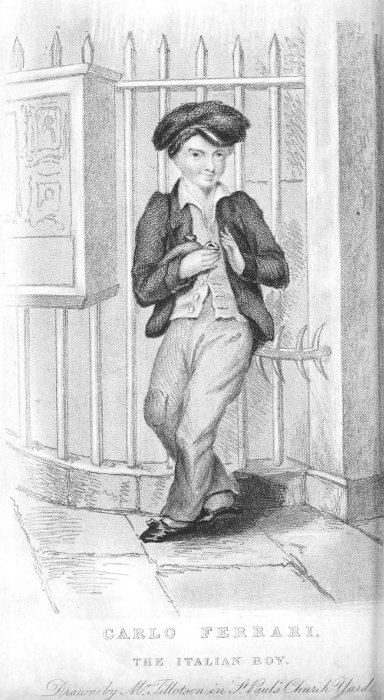
Mary Parragalli, wife of the last witness, also knew the boy Carlo Ferrari. Saw him last on Tuesday the 1st of November, in Oxford-street, at a quarter past twelve o'clock; he had a cage, like a squirrel-cage, with two white mice in it. Did not speak to him; he wore a cap. When shown a dead body at Covent-Garden station-house, on the 6th of November, was positive that it was that of the boy Carlo.
Andrew Colla knew the boy Carlo by sight. Saw him in Oxford-street on Tuesday the 1st of November. On the following Monday saw a body at the station-house, Covent-Garden, which he believes to have been that of Carlo (a cap was here put into the witness's hands). To the best of his belief, it was the cap worn by the Italian boy when he met him in Oxford-street. Carlo had on him a blue coat and grey trowsers. The trowsers had a patch on the knee (a pair of trowsers was here shown to the witness). Believes them to be those worn by the boy Carlo. Is strengthened in his belief by the peculiarity of the stitching. Has not seen the trowsers since the day he met the boy in Oxford-street.
John King, aged ten in December, was acquainted with the nature of an oath.—Lived near Nova Scotia Gardens. On the Thursday before Guy Fawkes's day, saw a boy standing at the corner of the gardens. The boy had a cage suspended by a string round his neck. Had a brown hairy cap (a cap was put into witness's hands). Believes the cap to be that worn by the boy. Knew it by the green facing.
Martha King, aged eleven years, sister of the last witness, gave evidence precisely to the same effect.
Rebecca Baylis lives at No. 1, Virginia-row, Bethnal-green. Her husband is a cabinet-maker. Remembers to have seen, on Thursday the 3d of November, an Italian boy, standing close to the window of her residence. Saw a box suspended from his neck, on the boy's arms. (The cap which had been shown to the preceding witnesses, was here shown to this witness.) Believes the cap to be the same with that worn by the Italian boy. In about a quarter of an hour after, had occasion to go out, I saw the Italian boy standing within two doors of Bishop's residence. The trowsers appear to be like those worn by the boy; could not speak with the same degree of certainty respecting the jacket. The colour was more inclining to the green than that now produced.
John Randall, labourer, lived in Bethnal-green, near Nova Scotia Gardens. Remembers to have seen, on Thursday the 3d of November, an Italian boy standing under the window of the Bird-cage public-house, Nova Scotia Gardens. The boy had a cage with two white mice in his arms. The cage had a box in one part, the other part went round like a squirrel-cage. The boy had on him a brown cap: the cap (here shown to witness) is like that worn by the boy.
Sarah Truby is wife of the landlord of the cottages, Nos. 1, 2 and 3, in Nova Scotia Gardens. On the part of her husband, she let in July, 1830, the cottage No. 3 to Bishop's wife. Bishop and his wife lived there since; let the cottage No. 2 to the prisoner Williams in July last. Williams then went by the name of Head. Williams lived there for six or seven weeks; let the cottage since to a person named Woodcock. There was a well in the garden attached to Bishop's cottage, with a passage to it from the other two cottages. There is a privy at the bottom of the garden of No. 3, which was not open to Nos. 1 and 2, but was to her (witness's) own residence. Has seen Williams frequently, since he left No. 2, in the prisoner's (Bishop's) cottage.
William Woodcock, about twelve years of age, lived with his father at No. 2, Nova Scotia Gardens, next door to the prisoner Bishop's residence. Has seen Williams and his wife frequently of late, in Bishop's cottage; the last time he saw Williams there, was a couple of days before Guy Fawkes' day.
Abraham Keyman keeps the Feathers public-house, Bethnal-green.—On Thursday night the 3d of November, at about a quarter before twelve, Bishop, accompanied by a man in appearance like the prisoner Williams, came to his house and took with him half a gallon of beer, and a quartern of rum: lent them a can to carry the beer; lives within two hundred yards of Bishop's residence (a can was here shown to witness); that was the can he lent to Bishop.
William Woodcock went to reside at No. 2, Nova Scotia Gardens, next door to the prisoner Bishop, on the 17th of October last; lived there till the prisoners were apprehended, but not since; had reason to believe that the prisoner Williams lived along with the prisoner Bishop; does not recollect ever to have seen the prisoner Bishop till he saw him at Bow-street; but saw Williams on two Sundays. On one of these occasions witness was digging in the bottom of the garden attached to his residence No. 2, when he was accosted by the prisoner Williams, and recommended not to dig in that part of the garden, but in another which he pointed out. On the night of Guy Fawkes' day, went to bed about half-past nine. Had been asleep about four hours when he awoke, and heard a noise in the adjoining (Bishop's) cottage. He then roused himself completely from sleep, and distinctly heard the sound of three footsteps. He did not rise, because the noise was not in his own house. He heard a scuffle which lasted for a couple of minutes, when all became silent. After the silence, and before he went again to sleep, he heard the side-entrance door to No. 3 open, and distinctly heard the footsteps of two persons run by his (witness's) window. He also heard the footsteps of one person in No. 3, before the other two returned. There elapsed but about one minute between their going out and return. He then recognized the voice of the prisoner Williams. The partition wall between the cottages was about four inches thick.
On cross-examination, the witness said that he had no particular reason for saying or believing that Williams lived with Bishop, other than he heard it reported, and because he knew him to be his son-in-law. When he heard the scuffle, he did not rise, supposing it to be some family quarrel, with which he had no concern.
Anna Woodcock, wife of the last witness, gave evidence to the effect that the prisoner Williams was an inmate of Bishop's cottage.
Joseph Higgins (of the New Police) was sent by his officer to the cottage, No. 3, Nova Scotia Gardens, tenanted by the prisoner Bishop; and on searching it, found a chisel and some tools. He then went to the prisoner May's lodgings, near the New Kent-road, and found these awls and screws (here shown to the jury). On one of the awls he discovered drops of blood apparently fresh. He also found a pair of breeches, with marks of apparently fresh blood upon them.
Mr. Mills, the dentist, was here recalled for the purpose of examining the awls and tools found at the prisoner May's residence. They were such as would serve to extract teeth in the coarse manner in which those sold to him had been evidently extracted.
Joseph Higgins's examination resumed.—On the 19th of November, he again went to Bishop's residence, accompanied by another policeman. They minutely searched the premises, and with an iron rod probed the garden in several places. The rod met with resistance in one part of the garden, and on digging they discovered a jacket, a pair of trowsers, and a small shirt. In another part they dug up a blue coat, a drab striped waistcoat, altered from man's size so as to fit a boy, and a pair of trowsers with the braces attached to them. The waistcoat had stains of blood on the collar and shoulders. They were buried about twelve inches under the surface, and were covered with cinders and ashes.
The clothes thus dug up were shown to the jury. The trowsers and coat sworn to by preceding witnesses as like to those worn by the Italian boy were part of them.
The evidence of this witness was corroborated by that of James Wadey, the police-officer who accompanied him in his search.
Edward Ward, a child aged six years and a half, was next called. He was previously to being sworn examined as to the nature of an oath. The child, with infantine simplicity, said that he knew it to be a very bad thing to tell a lie; that it was a great sin; and that he who would swear falsely would go to h—l, to be burnt with brimstone and sulphur. He was then sworn.—He stated that he lived with his father near to the Nova Scotia cottages. That a few days before Guy Fawkes's day, his mother having given him a half holiday, he went to Bishop's cottage to play with Bishop's children, three in number, a boy older than himself, a little girl, and a boy about his own age. As a toy, Bishop's children produced a cage, which went round, and which contained two white mice. He never before saw either a cage or mice with Bishop's children. On his return home, he told his brother, who is much older than himself, all the circumstances.
John Ward, brother of the last witness, deposed to the fact of his young brother having told him that he had been playing at Bishop's cottage with Bishop's children, and that their toy was a cage containing two white mice, which went round and round.
Mr. James Corder (the vestry-clerk of Covent-garden) was apprised of the discovery of the body of an Italian boy at King's College, at five o'clock of the evening of Saturday on which it was brought there. At the instance of the parish, a coroner's inquest was held on the body, and proceedings instituted. At the inquest the prisoner Bishop was examined, and was told that he was not called on to criminate himself, to be cautious in his answers, for that what fell from him would be taken down word for word, and might be used so as to affect his life. Witness here read the declarations of the prisoners Bishop, Williams, and May, as given at the coroner's inquest, to the following effect:—
'I dug of the body out of the grave. The reason why I decline to say the grave I took it out of is, that there were two watchmen in the ground, and they intrusted me, and being men of family, I don't wish to "deceive" them. I don't think I can say anything more. I took it for sale to Guy's Hospital, and as they did not want it, I left it there all night and part of the next day, and then I removed it to the King's College. That is all I can say about it. I mean to say that this is the truth. I shall certainly keep it a secret where I got the body. I know nothing as to how it died.'
'May said he wished to say what he knew, and would speak the truth. He then said his name was James May, and that he lived in Dorset-street, Newington. He went into the country on Sunday week, and returned on the evening of Wednesday, and went to Mr. Grainger's, in Webb-street, with a couple of subjects. On the following morning (Thursday) he removed them to Mr. Davis's, at Guy's, and after receiving the money he went away to the Fortune of War, in Smithfield, and stayed there about two or three hours. Between four and five o'clock, to the best of his recollection, he went to Nag's-head-court, Golden-lane, and there he stopped with a female until between eleven and twelve o'clock the next day (Friday). From Golden-lane he went to the Fortune of War again, and stopped drinking there until six o'clock or half-past. Williams and Bishop both came in there, and asked him if he would "stand any thing" to drink, which he did. Bishop then called him out, and asked him where he could get the best price for "things." He told him where he had sold two, meaning Guy's, and he (Bishop) then told him that he had got a good subject, and had been offered eight guineas for it. He (May) replied, that he could get more for it, and then Bishop said that all he could get over nine guineas he might have for himself. He agreed to it, and they went from thence to the Old Bailey, and had some tea at the watering-house there, leaving Williams at the Fortune of War. After tea they called a chariot off the stand, and drove to Bishop's house. When there, Bishop showed him the lad in a box or trunk. He (May) then put it into a sack, and brought it to the chariot, and conveyed it to Mr. Davis's, at Guy's. Mr. Davis said, "You know, John, I cannot take it: because I took two of you yesterday, and I have not got names enough down for one, or I would take it." He (May) then asked him if he could leave the body there that night, and he said he might. Bishop then desired Mr. Davis not to let any person have it, as it was his subject, but to deliver it to his own self. He (May) also told Mr. Davis not to let the body go without him, or he should be money out of pocket. May then went on to say, that he went to his own house and slept there that night, and the next morning he went to Guy's, and Bishop and Shields came in with a hamper, which was taken to King's College, where he was taken into custody.'
'John Williams stated, that in the first place he met Bishop on last Saturday morning (Nov. 5), in Long-lane, Smithfield, and asked him where he was going. He said he was going to the King's College. They then went into the Fortune of War public-house, and after that Bishop went to Guy's Hospital, and then to the King's College. May and the porter met them against the gate. Bishop went in, and he (Williams) asked him to let him go in with him. That was all he had got to say, except that a porter took a basket from the Fortune of War to Guy's Hospital, and he (Williams) helped him part of the way with it.'
William D. Burnaby, magistrate's clerk at Bow-street, was present at the examination of the prisoners at Bow-street, and remembers that when the prisoner May was examined as to the use of the awl found at his residence, he stated that 'that was the instrument he usually employed to punch out the teeth from dead bodies.'
John Kirkman (of the new police) was on duty at the station-house, Covent-garden, when the inquest was held there on the body of the Italian boy. Behind where the prisoners sat was a printed bill relating to the transaction. On seeing it the prisoner Bishop said in a low tone of voice to the prisoner May, 'It was the blood that sold us;' and looking at the bill again, said aloud, 'The marks of violence were only breakings out on the skin.'
Mr. Thomas, the superintendent of police, deposed that on examining the body of the boy it appeared to him that there were marks on the left arm as if from the violent compression of fingers, and there was dirt on the chest. He also saw on the neck, from the forehead to the breast, the traces of blood but clumsily wiped away.
Mr. Adolphus stated that this was the case for the prosecution.
The prisoners were then called upon for their defence.
Mr. Curwood, on the part of the prisoner Williams, said he felt it to be his duty to object to that person's being further proceeded with under the present indictment. That indictment distinctly charged Williams with being a principal in the murder, and he appealed to the Court whether the evidence at all went to bear out the indictment, so far as it applied to that prisoner. It might be that the evidence would go to show that he was an accessory after the crime, but that was quite another question from the present indictment, which distinctly charged him with being a principal.
Lord Chief Justice Tindal could not admit the force of the learned counsel's objection. It would be for the jury to determine not only the fact of guilt or innocence, but the degrees of both.
Mr. Curwood bowed to the decision of the Court, and only performed what he conceived to be his duty in urging the objection.
John Davis was then recalled for the purpose of showing that he had very recently purchased two subjects from the prisoner May. He brought them the day before the date of the murder.
The Court then informed the prisoners, that if they wished to address any observations to the jury on the evidence just given against them, that that was the time.
Three written defences were then read by the officer of the Court.
The prisoner Bishop, in his defence, stated that he was 33 years of age, and had followed the occupation of carrier till the last five years, during which he had occasionally obtained a livelihood by supplying surgeons with subjects. He most solemnly declared that he had never disposed of any body that had not died a natural death. He had been in the habit of obtaining bodies from workhouses, with their clothes on, so that he could have no difficulty in procuring them after a natural death. The statement then went on to describe the localities of the prisoner's residence, in order to show that they admitted of great facilities of ingress and egress, to all persons resident in the neighbourhood. His garden and premises were open to them, and theirs to him. With respect to the clothes found in his garden, he knew nothing. As to the cap, he should be able to prove that it was bought by his wife from a woman named Dodswell, who resided in Old Hoxton Town. The green cape he sewed on himself. The prisoner called upon the jury to divest their minds of all undue prejudices, and judge his case by the evidence alone. By so doing, they would be discharging their duty, and would acquit him of the crime then charged against him. In conclusion, the prisoner declared that neither Williams nor May knew how he procured the body.
Williams's defence briefly stated, that he had never been engaged in the calling of resurrectionist; and had only by accident accompanied Bishop on the occasion of the sale of the Italian boy's body.
May, in his defence, admitted that, for the last six years, he had followed the occupation of supplying the medical schools with anatomical subjects; but disclaimed ever having had anything to do with the sale of bodies which had not died a natural death. The remainder of his defence was a recapitulation of his declaration at the coroner's inquest, to the effect that he had accidentally met with Bishop at the Fortune of War public-house, on the Friday on which the body was taken for sale to Guy's Hospital.
Rosina Carpenter, on behalf of the prisoner May, deposed, that she lived at Macbeth-court, Golden-lane; that she was acquainted with May for the last fourteen or fifteen years. That May came to her between four and five o'clock on Thursday, the 3d of November, and stayed with her till twelve o'clock next day.
On cross-examination, the witness stated, that she had slept several nights with the prisoner May before the 3d of November, and that nobody saw them together on that occasion.
Sarah Truby was recalled, in order to show that she had never, at any time, seen white mice in Bishop's possession.
The prisoner Bishop.—What! did you never see any?
Witness.—No; never.
Bishop.—Not about six months ago? Don't you recollect your cat having killed some in my garden.
Witness.—Never.
Mrs. Mary Dodswell lived at 26, Hoxton Old Town: kept a second-hand clothes and sale shop. Knew the prisoner Bishop's wife. Sold a cap to her about two years ago. The cap was a cloth one, with a black leather cape.
[The cap found at Bishop's, and alleged to have been that worn by the Italian boy, was a brown hair one, with green leather front.]
The prisoner Bishop.—Mrs. Dodswell, don't you recollect your having sold my wife two caps at the same time?
Witness.—No, I sold but one.
On behalf of the prisoner May, Mary Ann Hall and Jane Lewis, who both admitted themselves to be in the habit of 'seeing gentlemen,' were called and examined, in order to show that they lived in the same street with May, and that the appearance of blood on his clothes was wholly owing to an accident which happened to a jackdaw, and which was followed by the loss of blood.
Mr. Thomas (the Police Superintendent) here deposed, that he was inclined to believe, from the glutinous and fresh appearance of the blood on the prisoner May's clothes, that it was shed since his being taken into custody.
The Chief Justice then proceeded to recapitulate the evidence to the jury, first warning them of the justice of founding their decision on the evidence then adduced, without being at all influenced by statements made elsewhere. The indictment contained two counts—one charging the prisoners at the bar with the murder of Carlo Ferrari, an Italian boy; the other with the murder of a boy, name unknown. The jury would learn from this circumstance, that it was by no means necessary that the name of the murdered party should be known, and that all that they need have to decide was, the fact itself. They accordingly would first direct their attention to the determining the fact, whether the body which the prisoners had proffered for sale had come by a natural death or not; and next, whether, if they were of opinion that it had not, the prisoners were the murderers, and to what degree they were implicated. With respect to the first point, he thought they would experience but little trouble after the explicit evidence of the medical gentlemen who had been that day examined, and whose conduct, it was but justice to say, was an honourable rebuke to any calumnious imputations on the medical profession to which the present case may have given birth. The learned Judge then went through the evidence with the most pains-taking minuteness, commenting on those points which, in his mind, would enable the jury to determine the guilt of the prisoners, and their probable share in the crime. The jury had heard evidence which traced the Italian boy close to the premises of Bishop, at twelve o'clock of the 3d of November, on the night of which it was probable the murder was committed. They had evidence also to show, that on that night a scuffle took place in Bishop's cottage, in which Williams's voice was discernible. The evidence, however, to show that May was present, or participated in the actual offence, was by no means decisive; so that the jury would have to determine how far he was, or was not, a principal or accessory. It might be that they would arrive at the conclusion that Bishop alone, or Bishop and Williams, were the criminals, and in such case they would find a verdict of acquittal for May; or it might be, that they would find that all three were equally guilty, or that they were guilty, but not in an equal degree. Their verdict would be according to their decision on this point, rendering it incumbent on them to cautiously weigh those parts of the evidence which bore particularly on Bishop and Williams, and on the other prisoner. He left it to their unbiassed judgment to find according to the evidence which had been submitted to them.
At eight o'clock the jury retired to consider their verdict, and the prisoners were removed from the bar, and taken out of court. The interval between that and the return of the jury was a period of intense anxiety to every one in court; and, as is usual on such occasions, there were various conjectures hazarded as to what would be the verdict as to all the prisoners. That a verdict of 'guilty' would be returned against two of the prisoners—namely, Bishop and Williams,—none who heard the evidence and the summing up of the learned Judge, could entertain any rational doubt; but the same confident opinion by no means existed with respect to the fate of the prisoner May. The general opinion, as far as we could judge from what was passing around us, was, that the circumstantial proof not being, in his case, so strong as it was in that of his fellow-prisoners, the jury would acquit him: but still there were many who thought the proof of a participation in the murder clear and perfect as to all the parties.
These conjectures and speculations were put an end to by the return of the jury at half-past eight o'clock.
The most death-like silence now prevailed through the court, interrupted only by a slight buzz on the re-introduction of the prisoners.
Every eye was now fixed upon them; but though their appearance and manner had undergone a considerable change from what they exhibited at being first placed at the bar, and during the greater part of the trial, they did not seem conscious of the additional interest which their presence at this moment excited. They scarcely raised their eyes as they entered, beyond a glance or two at the jury box.
Bishop advanced to the bar with a heavy step, and with rather a slight bend of the body; his arms hung closely down, and it seemed a kind of relief to him when he took his place to rest his hand on the board before him. His appearance, when he got in front, was that of a man who had been for some time labouring under the most intense mental agony, which had brought on a kind of lethargic stupor. His eye was sunk, and glassy; his nose drawn and pinched; the jaw fallen, and, of course, the mouth open: but occasionally the mouth closed, the lips became compressed, and the shoulders and chest raised, as if he was struggling to repress some violent emotion. After a few efforts of this kind, he became apparently calm, and frequently glanced his eye towards the bench and the jury-box; but this was done without once raising his head. His face had that pallid blueish appearance which so often accompanies and betokens great mental suffering.
Williams came forward with a short quick step; and his whole manner was, we should say, the reverse of that of his companion in guilt. His face had undergone very little change; but in his eye and his manner there was a feverish anxiety, which we did not observe during the trial. When he came in front, and laid his hand on the bar, the rapid movement of his fingers on the board, the frequent shifting of the hand, sometimes letting it hang down for an instant by his side, then replacing it on the board, and then resting his side against the front of the dock, showed the perturbed state of his feelings. Once or twice he gave a glance round the bench and the bar, but after that he seldom took his eye from the jury-box.
May came forward with a more firm step than either of his fellow-prisoners; but his look was that of a man who thought that all chance of life was lost. He seemed desponding; but there appeared that in his despondency which gave an air of—we could not call it daring, or even confidence,—we should rather say, a physical power of endurance, which imparted to his whole manner a more firm bearing than that of the other prisoners. He was very pale, but his eye had not relaxed from that firmness which was observable in his glance throughout the whole of the trial.
Ordinary physiognomists who, without having seen the prisoners, had read the accounts of their examinations at the police-office,—of their habits and mode of living, and the horrible atrocities with which, there is now no doubt, they were familiar,—would have been greatly disappointed in the appearance of all of them as they stood at the bar. There was nothing in the aspect or manner of any of them which betokened a predisposition to anything like the outrage on humanity of which they stood convicted. Thurtell looked, as well as acted, the 'bold-faced villain.' Ings, and one or two others of the companions of Thistlewood, wore in their countenances, almost as strongly as they showed in their deeds, the bold daring of the reckless desperado; but nothing of this kind could be traced in the face of any of the three who were then at the bar. There was something of heaviness in the aspect of Bishop, but altogether his countenance was mild. Williams had that kind of aspect with which men associate the idea of sharpness and cunning, and something of mischief, but nothing of the villain. May, who was the best-looking of the three, had a countenance which most persons would consider open and manly. There was an air of firmness and determination about him; but neither in him nor his companions was there the slightest physiognomical trait of a murderer, according to the common notions on the subject. They were all those kind of vulgar men in appearance of which one sees hundreds every day, without being struck with any indication in them of good or evil disposition.
When the three prisoners were placed at the bar, the names of the jury were called over; and on being asked whether they had agreed to their verdict, they answered that they had.
The question was then put to them, as to each of the prisoners, and they returned as their verdict, that John Bishop, Thomas Williams, alias Head, and James May, were severally Guilty of murder.
The verdict was received in court with becoming silence; but in a moment it was conveyed to the immense multitude assembled outside, who evinced their satisfaction at the result by loud and continued cheering and clapping of hands. To such an extent was this expression of the popular feeling carried, that the windows of the court were obliged to be closed, in order that the voice of the Recorder might be heard in passing sentence.
The prisoners were then severally called upon to say why sentence of death and execution should not be pronounced upon them; but none of them availed themselves of this opportunity of saying anything.
The Recorder then proceeded to pass the awful sentence of death upon them, but was for some moments again interrupted by the renewed shouts of the populace from without. Silence having been restored, the learned Judge proceeded. He began by eulogizing the patient and diligent attention bestowed on their case by the jury, whose verdict was just recorded; and of that jury he might state, what he often had occasion to remark of juries in that box, that nothing but the most satisfactory evidence, and a conviction of the solemn obligation they owed to their Maker and to their country, could induce them to pronounce a verdict which was to consign some of their fellow-men to a disgraceful death. He fully concurred in the verdict they had pronounced, which was supported by the most conclusive evidence.
The prisoner Bishop.—By false evidence, my Lord.
The learned Recorder went on, and addressing himself to the prisoners, observed, that he would not encroach, by any lengthened remarks, on the very short time that was to intervene between their sentence and their appearance in the presence of their Creator. A month had now elapsed since their first committal for this crime, and he hoped that that time had been employed by them in looking back on their past lives,—on the horrible agony which they had inflicted on the feelings of so many of their fellow-men,—and on the dreadful outrage on human nature of which they were now convicted. But, however they might have spent the time past, he earnestly adjured them, by their hopes of mercy, to lose not an instant of the few hours which yet remained to them, in constant prayers to Almighty God for pardon through the merits of their Redeemer. After pointing out to them the spiritual assistance which would be afforded to them in prison, the learned Judge concluded by passing upon each of them the sentence of the law, which was, that each of them be hanged on the following Monday morning, and their bodies be delivered over for dissection and anatomization.
The prisoners heard their sentence, as they had heard the verdict, without any visible alteration in their manner. They stood at the bar, as if expecting that something more would be added. When ordered to be removed, May raised his voice, and, in a firm tone, said, 'I am a murdered man, gentlemen, and that man (pointing to Bishop) knows it.'
The prisoner Williams said, 'We are all murdered men.' He then addressed himself to one or two of the witnesses at the side bar, and said, that before three months they would suffer for the false evidence they had given against him.
Bishop made no observation, but retired from the bar even more absorbed by his awful situation than he had appeared before.
The prisoners were then removed, and in a short time after the crowd outside the court dispersed.
From a momentary forgetfulness on the part of the Recorder, when passing sentence of death upon Bishop, Williams, and May, these wretches nearly escaped the additional judgment of dissection. The Recorder, in the usual manner, had ordered them to be hanged on the following Monday, and was passing on to the end of his address, 'and the Lord have mercy upon your souls,' when Mr. Justice Littledale whispered to the learned gentleman, who then stopped short in the concluding sentence, and ordered their bodies to be given up for dissection.
On Saturday night, when the prisoners were removed each to his cell, attended by his watchman, the person who was placed over Williams saw him grow anxious and uneasy; towards midnight his agitation increased, and the vigilance of his keeper became more marked. Williams observed it, and said, 'Don't be frightened, sir, I am not going to do anything wrong, but I wish to ease my mind. Let me see the Governor.' Mr. Wontner was then called from his bed, and the Rev. Mr. Cotton, the Ordinary, was also in attendance in a few minutes.
When these gentlemen came into the cell, Williams looking at them steadfastly for a moment or two, burst into tears and said, 'Gentlemen, I wish to unburden my mind; I know I am guilty, and I ought to suffer the utmost punishment of the law; I am a murderer, I confess it, but the witnesses were all mistaken as to its being the Italian boy.' He was then urged to relieve his mind as calmly and as coolly as possibly; and, after a strong effort, during which the mental agony which he endured was dreadful, he made a statement, of which the following is the substance:—
On Thursday the 3d of November, he was in the neighbourhood of Smithfield, when he saw a boy, whom he had often observed before, assisting in driving cattle to the market. This boy was about fourteen or fifteen years of age, and exactly corresponded with the description given of the Italian boy. He enticed him from the cattle, and took him to the Fortune of War public-house, and sent for Bishop, who was waiting at another public-house in the neighbourhood for the purpose of receiving communications from him (Williams) as to anything he might do. Bishop came, and they took the boy home to Nova Scotia Gardens, giving him some soup and potatoes by the way. When they got him there, they set him to play with Bishop's children until near dusk, when they gave him some rum, and he became stupified. They (Bishop and Williams) then took him into the garden, and on the way threw him down, and, pushing his head into the water-barrel, sunk into the ground (as already described) held him until he was suffocated. They then conveyed the body back to the house, 'kept it snug' till the next day, when May was applied to, to assist in disposing of it. May had nothing to do with the murder of that boy.
Here the statement concluded. Williams seemed greatly relieved after making his confession, and went to bed and slept soundly.
The Rev. Mr. Williams, according to his promise, also visited Bishop in his cell. The culprit appeared to be aware of his approaching dissolution, and though firm as when he appeared at the bar before the Court at the Old Bailey, yet he appeared to be anxious to make a communication in favour of May. Bishop observed, that as he had no hopes of mercy here, he did not wish an innocent man to suffer for his crimes, and he declared that May was not concerned in the murder of which he had been convicted. He said he was ready to make a confession of the murders in which he had participated. After some hesitation, he admitted that he had been concerned in the commission of three murders, viz.—that of the Italian boy, the murder of Frances Pigburn, and of a drover, a boy who had come to London with cattle from Lincolnshire, which boy the witnesses on his trial had sworn was the Italian boy, to the best of their belief, though he had disposed of that body before.
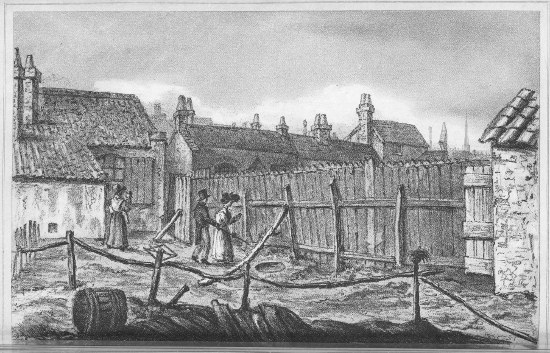
Bishop entered into a minute description, most horrible in its details, of the mode by which he had perpetrated the inhuman murders, and then made the following confession:—
Newgate, December 4.
'I, John Bishop, do hereby declare and confess, that the boy supposed to be the Italian boy was a Lincolnshire boy. I and Williams took him to my house about half-past ten o'clock on the Thursday night, the 3d of November, from the Bell in Smithfield. He walked home with us. Williams promised to give him some work. Williams went with him from the Bell to the Old Bailey watering-house, whilst I went to the Fortune of War. Williams came from the Old Bailey watering-house to the Fortune of War for me, leaving the boy standing at the corner of the court by the watering-house in the Old Bailey. I went directly with Williams to the boy, and we walked then all three to Nova Scotia Gardens, taking a pint of stout at a public-house near Holywell-lane, Shoreditch, on our way, of which we gave the boy a part; we only stayed just to drink it, and walked on to my house, where we arrived at about eleven o'clock. My wife and children, and Mrs. Williams, were not gone to bed, so we put him in the privy, and told him to wait there for us. Williams went in and told them to go to bed, and I stayed in the garden. Williams came out directly, and we both walked out of the garden a little way, to give time for the family getting to bed; we returned in about ten minutes or a quarter of an hour, and listened outside at the window to ascertain whether the family were gone to bed. All was quiet, and we then went to the boy in the privy, and took him into the house; we lighted a candle, and gave the boy some bread and cheese, and after he had eaten, we gave him a cup full of rum, with about half a small phial of laudanum in it. (I had bought the rum the same evening at the Three Tuns, in Smithfield, and the laudanum also in small quantities at different shops.) There was no water or other liquid put in the cup with the rum and laudanum. The boy drank the contents of the cup directly in two draughts, and afterwards a little beer. In about ten minutes he fell asleep on the chair on which he sat, and I removed him from the chair to the floor, and laid him on his side. We then went out and left him there. We had a quartern of gin and a pint of beer at the Feathers, near Shoreditch church, and then went home again, having been away from the boy about twenty minutes. We found him asleep as we had left him. We took him directly, asleep and insensible, into the garden, and tied a cord to his feet to enable us to pull him up by, and I then took him in my arms, and let him slide from them headlong into the well in the garden, whilst Williams held the cord to prevent the body going altogether too low in the well. He was nearly wholly in the water of the well—his feet just above the surface. Williams fastened the other end of the cord round the paling to prevent the body getting beyond our reach. The boy struggled a little with his arms and legs in the water, and the water bubbled for a minute. We waited till these symptoms were past, and then went in doors, and afterwards I think we went out, and walked down Shoreditch to occupy the time, and in about three-quarters of an hour we returned and took him out of the well, by pulling him by the cord attached to his feet: we undressed him in the paved yard, rolled his clothes up, and buried them where they were found by the witness who produced them. We carried the boy into the wash-house, laid him on the floor, and covered him over with a bag. We left him there, and went and had some coffee in Old-street-road, and then (a little before two o'clock on the morning of Friday) went back to my house. We immediately doubled the body up, and put it into a box, which we corded, so that nobody might open it to see what was in it, and then went again, and had some more coffee at the same place in Old-street-road, where we stayed a little while, and then went home to bed—both in the same house, and to our own beds, as usual. We slept till about ten o'clock on Friday morning, when we got up, took breakfast together with the family, and then went both of us to Smithfield, to the Fortune of War. We had something to eat and drink there, and after we had been there about half an hour, May came in. I knew May, but had not seen him for about a fortnight before. He had some rum with me at the bar, Williams remaining in the tap-room. May and I went to the door, I had a smockfrock on, and May asked me where I had bought it; I told him "in Field-lane;" he said he wanted to buy one, and asked me to go with him; I went with him to Field-lane, where he bought a frock at the corner shop; we then went into a clothes-shop in West-street to buy a pair of breeches, but May could not agree about the price; May was rather in liquor, and sent out for some rum, which we and the woman in the shop drank together; May said he would treat her because he had given her a good deal of trouble for nothing. We then returned to the Fortune of War, and joined Williams, and had something more to drink; we waited there a short time, and then Williams and I went to the west end of the town, leaving May at the Fortune of War. Williams and I went to Mr. Tuson's, in Windmill-street, where I saw Mr. Tuson, and offered to sell him a subject, meaning the boy we had left at home. He said he had waited so long for a subject which I had before undertaken to procure, that he had been obliged to buy one the day before. We went from there to Mr. Carpue's, in Dean-street, and offered it to him in the lecture-room with other gentlemen; they asked me if it was fresh; I told them, yes; they told me to wait. I asked them ten guineas, and, after waiting a little, a gentleman there said they would give eight guineas, which I agreed to take, and engaged to carry it there the next morning at ten o'clock. I and Williams then returned to the Fortune of War; we found May in the tap-room, this was about a quarter before four o'clock in the afternoon; we had something to drink again, and I called May out to the outside of the house, and asked what was the best price given for "things"—he said he had sold two the day before for ten guineas each, I think. I told him I had a subject; he asked what sort of one; I said, a boy about fourteen years old, and that I had been offered eight guineas for it: he said if it was his, he would not take it; he could sell it where he sold his for more. I told him that all he could get above nine guineas he might have for himself; we agreed to go presently and get a coach. I and May then went to the bar, had something more to drink; and then, leaving Williams at the Fortune of War, we went and tried to hire a cab in the Old Bailey; the cab-man was at tea at the watering-house, and we went in and spoke to him about a fare, and had also tea there ourselves. Whilst we were at tea, the cab-driver went away, and we found him gone from the stand when we came out; we then went to Bridge-street, Blackfriars, and asked a coachman if he would take such a fare as we wanted; he refused, and we then went to Farringdon-street, where we engaged a yellow chariot. I and May got in, drove to the Fortune of War, and (Williams joining us by the George, in the Old Bailey, on our way) at the Fortune of War we drank something again, and then (about six o'clock) we all three went in the chariot to Nova Scotia Gardens; we went into the wash-house, where I uncorded the trunk, and showed May the body. He asked, "How are the teeth?" I said I had not looked at them. Williams went and fetched a brad-awl from the house, and May took it and forced the teeth out: it is the constant practice to take the teeth out first, because, if the body be lost, the teeth are saved. After the teeth were taken out, we put the body in a bag and took it to the chariot; May and I carried the body, and Williams got first into the coach, and assisted in pulling the body in; we all then drove off to Guy's Hospital, where we saw Mr. Davis, and offered to sell the body to him; he refused, saying that he had bought two the day before of May. I asked him to let us leave it there till the next morning; he consented, and we put it in a little room, the door of which Mr. Davis locked. Williams was, during this, left with the chariot: I told Mr. Davis not to let the subject go to any body unless I was there, for it belonged to me, and May also told him not to let it go unless he was present, or else he should be money out of pocket; I understood this to mean the money paid by May for our teas at the Old Bailey, (about four shillings) and the coach fare, which we had agreed with the coachman should be ten shillings. May had no other interest or right to the money to be obtained for the body, except for such payment, and for what he could get above nine guineas, as I had promised him. May paid the coachman ten shillings on our leaving the hospital, but before we discharged the coach, May and I ran to Mr. Appleton, at Mr. Grainger's school, leaving Williams with the coach. We offered the subject to Mr. Appleton, but he declined to buy it, and May and I then joined Williams, discharged the coach, and went to a public-house close by, and had something to drink. After this we got into a coach in the Borough, and drove again to the Fortune of War, where we had something more to drink; this was about eight o'clock in the evening. We all three stayed there about one hour, and then went out, got a coach in Smithfield, and went towards Old-street-road, stopped in Golden-lane with the coach and drank something, and then on to Old-street. At the corner of Old-street (the Star corner) May got out of the coach and said he was going home, and I and Williams drove to the corner of Union-street, Kingsland-road, where we got out and paid the coach-fare out of money lent us by May (he having advanced to each of us three shillings). We then walked home, and went to bed that night as usual. We had agreed with May on his leaving us to meet him at Guy's Hospital at nine o'clock the next morning (Saturday). I and Williams went at eight o'clock on Saturday morning to the Fortune of War, where we met Shields, the porter, and engaged him to go with us over the water to carry a subject. I asked him to go to St. Bartholomew's Hospital for a hamper which I had seen there; he refused, and I fetched it myself. We had a pint of beer there, and I, and Williams, and Shields, went to Guy's Hospital, Shields carrying the hamper. We met May there. Williams and Shields went to a public-house, whilst I and May went to Mr. Appleton, and offered him the subject again. He again refused to buy it, stating that he did not want it. May and I then joined Shields and Williams, and had some drink, and then left them again, crossed the water in a boat to the King's College, where we inquired of Mr. Hill, the porter, if he wanted a subject; he said he was not particularly in want, but would speak to Mr. Partridge, the demonstrator. Mr. Partridge came, and asked what the subject was. May said, 'a male subject.' Mr. Partridge asked the price. May said, 'twelve guineas.' Mr. Partridge said he could not give so much, and went away. Mr. Hill asked us to stay a few minutes whilst he went after Mr. Partridge, to speak to him again. Hill returned, and said Mr. Partridge would give nine guineas. May said, 'he would be d—d if it should go under ten guineas.' He was in liquor, and on his moving a little way off, I took the opportunity of saying to Hill, that he should come in at nine guineas. I told May, directly after, that I had sold it for nine guineas, and that I would, out of it, pay him what I had of him, and give him something besides. We then got into a cabriolet, and went back to Williams and Shields, at the public-house, where all four had some beef-steaks and beer, and afterwards went to Guy's Hospital, packed the body in the hamper, and put it on Shields' head, telling him to take it to the King's College, where he went, Williams and Shields walking, and I and May riding part of the way in a cab. On reaching the King's College we carried the body into the theatre, and then into a little room, where we took the body out. Mr. Hill looked at it, and asked what it died of. May answered, that he did not know, and it did not concern him. Mr. Hill asked how a cut, which was on the forehead, came. I told him that it was done by May throwing it out of the sack on the stones, which was the truth. Hill told us to remain in the other room, and he would bring in the money. We went into the other room, and waited for some time, when Mr. Partridge came to us, and showed me a fifty pound note, and said he must go and get it changed, for he had not sufficient money without; and he pulled out his purse, and counted three or four sovereigns. I said he might let us have that, and he could give us the remainder on Monday. He said no, he would rather pay it altogether, and went away. We waited some time, when the police-officers came, and took us into custody.