Volume 2 — EUROPE. (continued 2)
Reading edition
Agrippina, the granddaughter of Augustus, was a model of purity in the midst of surrounding corruption. She accompanied her husband Germanicus into Germany, shared in all his toils and dangers, and attached herself to him with the most devoted affection. She often appeared at the head of the troops, appeasing tumults, and encouraging bravery. Tiberius, jealous of virtues that reflected so much dishonor on his own licentious court, entered into machinations against them. Germanicus was poisoned, and Agrippina exiled and treated with the utmost indignity. Despairing of redress, she refused all sustenance, and died.
Arria, the wife of Pætus, not being allowed to accompany her husband to Rome, when he was carried thither to be tried for conspiracy against the government, followed the vessel in a fisherman’s bark hired for the occasion. She exerted every means to save his life; and when she found all her efforts unavailing, she advised him to avoid the disgrace and torture that awaited him, by voluntary death. Seeing that he hesitated, she plunged the dagger into her own heart, and gave it to him with a smile, saying, “It gives me no pain, my Pætus.” In judging of these examples, we must remember that the Romans, in their sternness and stoicism, regarded suicide as a virtue.
Eponina, the wife of Sabinus, lived with her husband concealed in a cave, for several years, rather than desert him at a time of disgrace and danger, the consequence of unsuccessful rebellion. Their retreat was at length discovered; and neither her tears, nor the innocent beauty of two little twins born in the cavern, could soften the heart of Vespasian. The faithful wife was condemned to die with her husband.
Valerius Maximus tells of an illustrious lady, whose mother being condemned to die by famine, the daughter obtained access to her prison, and nourished her with her own milk. When this was discovered, the criminal was pardoned; both mother and daughter were maintained at the public expense; and a temple to Filial Piety was erected near the prison.
Pliny, who lived as late as the time of Trajan, warmly eulogizes the talents and domestic virtues of his wife. He says: “Her taste for literature is inspired by tenderness for me. When I am to speak in public, she places herself as near me as possible, under the cover of her veil, and listens with delight to the praises bestowed upon me. She sings my verses, and untaught adapts them to the lute; love is her only instructer.”
Under the emperors, it was more easy to find women distinguished for talent than for virtue. Julia, the wife of Septimus Severus, was famous for her genius and learning, and for the generous patronage she bestowed on literature. Julia Mammæa, the mother of Alexander Severus, had a mind equally cultivated, with far greater purity of character than her namesake. She educated her son for the throne in a manner so judicious, that his integrity, virtue, and firmness might have effectually checked the tide of corruption, had he not met with an untimely fate.
As learning became fashionable, many acquired it merely for display. Juvenal, speaking of pedantic ladies, says: “They fall on the praises of Virgil, and weigh his merits in the same balance with Homer; they find excuses for Dido’s having stabbed herself, and determine of the beautiful and the sovereign good.”
The Roman women seem to have been less iron-hearted than the Spartans. When the Romans were defeated by Hannibal, women waited at the gates of the city, for news of the returning army. One, who had given up her son for dead, died at the sight of him; and another, having been told that her son was slain, died when the report was contradicted.
The Roman women strongly resembled the Spartans in the deep and active interest they took in public affairs. Upon the death of Brutus, they all clad themselves in deep mourning. In the time of Brennus, they gave all their golden ornaments to ransom the city from the Gauls. In reward for this generosity, the senate ordained that they should be allowed to ride in chariots at the public games, and that funeral orations should thenceforth be pronounced for them, as well as for distinguished men.
After the fatal battle of Cannæ, the women again consecrated all their ornaments to the service of the state. But when the triumvirs attempted to tax them for the expenses of carrying on a civil war, they tried various means to resist the innovation. At last, they chose Hortensia for their speaker, and went in a body to the market-place, to expostulate with the magistrates. The triumvirs, offended at their boldness, wished to drive them away; but the populace grew so tumultuous, that it was deemed prudent to give the women a hearing. Hortensia spoke as follows: “The unhappy women you see here pleading for justice, would never have presumed to appear in this place, had they not first made use of all other means their natural modesty could suggest. Yet the loss of our fathers, brothers, husbands, and children, may sufficiently excuse us; especially when their unhappy deaths are made a pretence for our further misfortunes. You say they had offended you—but what have we women done, that we must be impoverished? Empire, dignities, and honors are not for us; why then should we contribute to a war, in which we can have no manner of interest? Our mothers did indeed assist the republic in the hour of her utmost need; but they were not constrained to sell their houses and lands for that purpose; theirs was the voluntary offering of generosity. If the Gauls or the Parthians were encamped on the banks of the Tiber, you would find us no less zealous in the defence of our country than our mothers were before us; but we are resolved that we will not be connected with civil war. Neither Marius, nor Cæsar, nor Pompey, nor even Sylla himself, who first set up tyranny in Rome, ever thought of compelling us to take part in domestic troubles. Yet you assume the glorious title of reformers of the state! a title which will turn to your eternal infamy, if, without the least regard to the laws of equity, you persist in plundering the lives and fortunes of those who have given you no just cause of offence.”
In consequence of this spirited and eloquent speech, the number of women taxed was reduced from fourteen hundred to four hundred.
When the deification of emperors and heroes became fashionable at Rome, women soon had their statues placed in the temples, and incense burned before them; and these honors, instead of being the reward of virtue, were often bestowed merely to please the corrupt and the powerful. Poppæa, the wife of Nero, a most thoroughly vicious woman, had divine honors paid to her after death; the emperor himself pronounced her eulogium in the rostrum; and more perfumes were burned at her funeral, than Arabia Felix produced in a year.
Messalina, the profligate wife of Claudius, governed the emperor without control. She appeared with him in the senate, placed herself by him on the same tribunal in all public ceremonies, gave audience with him to princes and ambassadors, and did not even abandon him in the courts of justice.
Heliogabalus made his mother and grandmother his colleagues on the throne, and placed them at the head of a female senate, which he instituted to regulate all matters of dress and fashion; this, however, lasted but a short time. Extravagance, both in dress and style of living, went on increasing to such a degree that the details are almost incredible. During the Carthagenian war, when Rome was in great distress, an effort was made to check the growth of this evil, by a law, which ordained that no woman should wear more than half an ounce of gold, have party-colored garments, or be carried to any place within a mile’s distance, unless it was to celebrate some sacred festivals or solemnities. This created much discontent; and eighteen years after, the ladies petitioned to have it repealed. Cato strongly opposed it, and satirized the women for appearing in public to solicit votes; but the tribune Valerius, who presented the petition, urged their cause so eloquently, that the law was abrogated.
When the Greek custom was introduced of reclining full length upon their couches, while they ate their meals, the ladies for a long time continued to sit upon benches, because they considered the new mode inconsistent with modesty; but during the reign of the emperors, they began to imitate the men in this particular. In the early ages they were forbidden the use of wine; their relations were allowed to salute them, as they entered the house, in order to discover whether they had drunk it; and in that case their husbands or parents had a right to punish them. But in later times, they indulged themselves without restraint. Seneca says: “Women pique themselves upon carrying excess in wine as far as the most robust men; like them they pass whole nights at table, and holding a cup filled to the brim, they glory in defying, and even in surpassing them.”
The Romans were in the habit of drinking their crowns; that is to say, the wine in which they had been dipped. Cleopatra, perceiving that Antony was jealous she had designs upon his life, diverted herself with his precautions. At one of their splendid feasts she wore upon her head a crown of flowers, the extremities of which had been poisoned. Antony, being invited to drink the crowns, readily consented; but Cleopatra snatched the cup from his lips, saying, “The garland was poisoned. If I could live without you, I could easily find means for your destruction.”
A love for exciting amusements kept pace with other forms of dissipation. Women, not content with music and dancing, and the entertainments of the theatre, began to delight in horse-races, and the contests of wild beasts and gladiators, during which scenes of cruelty occurred too shocking to be described. Sometimes they fought on the arena with men, at the command of the despotic emperors. The celebration of the Bacchanalian mysteries, in which women took an active part, were a continuation of the most indecent and horrid crimes. In many instances they danced on the stage entirely without clothing, and enjoyed the luxury of public baths promiscuously with the men, totally disregarding the modest regulations of former times.
Roman husbands, from the earliest times, had the power of divorcing their wives whenever they pleased; and afterward the laws were equalized to such a degree, that either party had liberty to demand divorce. If the wife was blameless, she received all her dowry and goods; if culpable, the husband was allowed to retain a sixth part for each child; if she had been unfaithful to him, he kept all the dowry and marriage-presents, even if he had no children by her. Where there was a family, each of the parties settled a proportionable part of their fortune.
Notwithstanding the facility of divorce, five hundred and twenty-one years elapsed without an instance of it in Rome. Carvilius Ruga was the first one who repudiated his wife. He had great affection for her, and parted from her merely because she brought him no children. Notwithstanding this excuse, the Roman citizens were very indignant at the proceeding. But divorces gradually became frequent, and were made upon the slightest pretexts. When Paulus Æmilius repudiated Papiria, his friends said to him, “Is she not wise? Is she not fair? Is she not the mother of fine children?” In reply, he pointed to his shoe, and said, “Is it not fine? Is it not well made? Yet none of you know where it pinches me.” Sulpicius Gallus turned away his wife because she appeared bare-headed in public. Sempronius Sophus separated from his, because she had whispered to a freed-woman. Antistius Vetus did the same because his wife went to some public place of amusement without his knowledge. Cicero separated from Terentia on account of her extravagance and imperious temper; he espoused Publilia, a young heiress, who had been his ward; but he repudiated her for harsh treatment to his daughter Tullia. Cato gave up his wife Martia, by whom he had had several children, that Hortensius might marry her; and when some time after Hortensius died, and left her to inherit his great wealth, to the prejudice of his own son, Cato retook her. Some men married women of tarnished reputation, on purpose to find opportunity to divorce them and retain their dowry.
Polygamy was at no period allowed; and even a plurality of mistresses was prohibited. Mark Antony gave great offence to the Romans by living with Cleopatra during the lifetime of Octavia.
Papirius was accustomed to attend his father to the senate before he assumed the manly robe; and his mother one day inquired what had been debated there. The lad replied, a decree had been passed that every man should be allowed to have two wives. The news spread rapidly; and the next day many women presented themselves to demand that every woman might be allowed two husbands. The senators, surprised at such a strange proposition, did not know how to account for it, until young Papirius explained the mystery. They commended his prudence in thus evading female curiosity, and ordained that no young person, himself excepted, should attend the debates of the senate.
As corruption increased, the women made as bad use of divorce as the men. Seneca says there were some who no longer reckoned the years by the consuls, but by the number of their husbands. St. Jerome speaks with indignation of a man in his time who had buried twenty wives, and of a woman who had buried twenty-two husbands. When Severus ascended the throne, he found no less than three thousand prosecutions against faithless wives. Women of the highest rank unblushingly proclaimed their own licentiousness, and laughed at the appearance of modesty. A long train of cruel and disgusting crimes followed this utter abandonment of principle. At one time there was a general conspiracy to murder all husbands, in order that the last appearance of restraint might be thrown aside. Voluptas had a temple, and was worshipped as a beautiful woman, seated on a throne, and treading virtue beneath her feet.
Augustus, perceiving that facility of divorce, far from tending to promote happiness, only increased discontent, endeavored to restrain it by penalties. He likewise made the laws more severe with regard to infidelity. The father of a faithless wife might put her to death; and if the husband killed her and her gallant, he was not punished by the laws. Fines and banishment were likewise frequently resorted to.
The highest possible encouragement was given to matrimony. When the people were numbered, the censors asked each citizen, “Upon your faith, have you a wife?” and those who had none were subject to a fine. In the tribunals, those who came to make oath were asked, “Upon your faith, have you a horse? Have you a wife?” and unless they could answer these questions in the affirmative, they were not allowed to give testimony. Those who lived in celibacy could not succeed to an inheritance, or legacy, except of their nearest relations, unless they married within one hundred days after the death of the testator. Married men were preferred to all public employments; and the prescribed age was dispensed with in their favor, by taking off as many years as they had legitimate children. They had distinguished places at the theatre and the games, were exempted from guardianships, and other burthensome offices.
But when the condition of the people required laws like these, it was useless to make them. Mere external rewards are as feeble a barrier against the tumult of the passions, as a bar of sand against a rushing stream. The Roman knights loudly demanded that the edicts should be revoked; and many, to avoid the penalties, went through the form of marriage with mere infants. Augustus, to prevent this fraud, forbade any one to contract a girl that was not at least ten years old, that the wedding might be celebrated two years after. Metellus, the censor, said to the people, “If it were possible for us to do without wives, we should escape a very great evil; but it is ordained that we cannot live very happily either with them or without them.”
Such was the diseased state of society, when Christianity came in with its blessed influence, to purify the manners, and give the soul its proper empire over the senses. Many women of the noblest and wealthiest families, surrounded by the seductive allurements of worldly pleasure, renounced them all, for the sake of the strength and consolation they found in the words of Jesus. Undismayed by severe edicts against the new religion, they appeared before the magistrates, and by pronouncing the simple words, “I am a Christian,” calmly resigned themselves to imprisonment, ignominy, and death. Taught by the maxims of the Gospel that it was a duty to love and comfort each other, as members of the same family, they devoted their lives to the relief of the sick, the aged, and the destitute. Beautiful ladies, accustomed to all the luxurious appendages of wealth, might be seen in the huts of poverty, and the cells of disease, performing in the kindest manner the duties of a careful nurse.
In the worst stages of human society, there will ever be seven thousand of Israel who do not bow the knee to Baal; and such a remnant existed in Rome. The graceful form of heathen mythology had some degree of protecting life within it, so long as it was sincerely reverenced; but the vital spark, that at best had glimmered but faintly, was now entirely extinguished, and the beautiful form was crumbling in corruption and decay. The heart, oppressed with a sense of weakness and destitution, called upon the understanding for aid, and received only the lonely echo of its own wants. At such a moment, Christianity was embraced with fervor; and the soul, enraptured with glimpses of its heavenly home, forgot that the narrow pathway lay amid worldly duties, and worldly temptations.
The relation of the sexes to each other had become so gross in its manifested forms, that it was difficult to perceive the pure conservative principle in its inward essence. Hence, though marriage was sanctioned, and solemnized by the most sacred forms, it was regarded as a necessary concession to human weakness, and perpetual celibacy was considered a sublime virtue. This feeling gave rise to the retirement of the cloister, and to solitary hermitages in the midst of the desert. St. Jerome is perhaps the most eloquent advocate of this ideal purity. His writings are full of eulogiums upon Paula, her daughter Eustochium, and other Roman women, who embraced Christianity, and spent whole days and nights in the study of the Scriptures.
Women were peculiarly susceptible to the influence of doctrines whose very essence is gentleness and love. Among the Jews, the number of believing women had been greater than converted men; the same was true of the Romans; and it is an undoubted fact that most nations were brought into Christianity by the influence of a believing queen. By such means the light of the Gospel gradually spread through France, England, part of Germany, Bavaria, Hungary, Bohemia, Lithuania, Poland, and Russia.
The northern nations bore a general resemblance to each other. War and hunting were considered the only honorable occupations for men, and all other employments were left to women and slaves. Even the Visigoths, on the coasts of Spain, left their fields and flocks to the care of women. They had annual meetings, in which those who had shown most skill and industry in agriculture, received public applause. They were bound by law not to give a wife more than the tenth part of their substance.
The Scandinavian women often accompanied the men in plundering excursions, and had all the drudgery to perform. The wives of the ancient Franks were inseparable from their husbands. They lived with them in the camp, where the marriages of their daughters were celebrated by the soldiers, with Scythian, and other warlike dances. A man was allowed but one wife, and was rigorously punished if he left her to marry another.
They could put their wives to death for infidelity; and if they happened to kill them without justifiable cause, in a moment of anger, the law punished them only by a temporary prohibition to bear arms.
The ancient German women could not inherit the estates of their fathers; but by subsequent laws they were permitted to succeed after males of the same degree of kindred.
Women of the northern nations rarely ate and drank with their husbands, but waited upon them at their meals, and afterward shared what was left, with the children. This custom could not have originated in the habit of regarding women as inferior beings; for the whole history of the north proves the existence of an entirely opposite sentiment. It was probably owing, in part, to the circumstance that women were too busy in cooking the food, to wish to eat at the same time with the men; and partly, perhaps, to the fact that these feasts were generally drunken carousals.
The eastern nations imagine the joys of heaven to consist principally in voluptuous love; but northern tribes seem to have believed that they chiefly consisted in drinking. In the Koran, the dying hero is assured that a troop of houries, beautiful as the day, will welcome him with kisses, and lead him to fragrant bowers; but according to the Edda,[2] a crowd of lovely maidens wait on heroes in the halls of Odin, to fill their cups as fast as they can empty them.
In a state of society so turbulent as that we are describing, men had little leisure, and less inclination, for the sciences; women, having better opportunities for observation and experience in common things, acquired great knowledge of simple remedies, and were in fact the only physicians. Their usefulness, virtue, and decorum, procured them an uncommon degree of respect. The institution of marriage was regarded with the utmost reverence, and second marriages were forbidden. Tacitus says: “The strictest regard to virtue characterizes the Germans, and deserves our highest applause. Vice is not made the subject of mirth and raillery, nor is fashion pleaded as an excuse for being corrupt, or for corrupting others. Good customs and manners avail more among these barbarous people, than good laws among such as are more refined. It is a great incitement to courage, that in battle their separate troops, or columns, are not arranged promiscuously, as chance directs, but consist of one united clan, with its relatives. Their dearest pledges are placed in the vicinity, whence may be heard the cries of their women, and the wailing of infants, whom each one accounts the most sacred witnesses and dearest eulogists of his valor. The wounded repair to their wives and mothers, who do not hesitate to number their wounds, and suck the blood that flows from them. Women carry refreshments to those engaged in the contest, and encourage them by exhortations. It is said that armies, when about to give way, have renewed the struggle, moved by the earnest entreaties of the women, for whose sake they dreaded captivity much more than their own. Those German states which were induced to number noble damsels among their hostages, were much more effectually bound to obedience, than those whose hostages consisted only of men. Indeed they deem that something sacred, and capable of prophecy, resides within the female breast; nor do they scorn the advice of women, or neglect their responses.”
The Goths were likewise remarkable for purity of manners. Their laws punished with heavy fines the most trifling departure from scrupulous respect toward women. After the conquest of Rome, they were accustomed to say: “Though we punish profligacy in our own countrymen, we pardon it in the Romans; because they are by nature and education weak, and incapable of reaching to our sublimity of virtue.”
Once, when a civil war arose in ancient Gaul, the women rushed into the midst of the battle, and persuaded the combatants to be reconciled to each other. From that time, the Gauls admitted women to their councils of war, and such disputes as arose between them and their allies were settled by female negotiation. Thus in a treaty with Hannibal, it was stipulated that should any complaints be made against the Carthagenians, it should be settled by their general; but in case of any complaints against the Gauls, it should be referred to their women.
On account of the confusion at times attendant upon the best regulated camp, the strictest laws were made for the protection of northern women, who universally followed the army. The operations of the soldiers were from time to time settled in a council, of which their wives formed a part; and when in danger of defeat, they feared their dishonor more than the swords of the enemy. If a man occasioned a woman the loss of her fair fame, he was obliged to marry her, if she were his equal in rank; if not, he must divide his fortune with her; and if he would not comply with these conditions, he was condemned to death.
The ancient Britons long submitted patiently to the outrageous oppression of the Romans; but when the tyrants scourged their queen Boadicea, and loaded her daughters with insult and abuse, they fought with a desperate fury, that seemed resolved on freedom or extermination. The women themselves joined the army by thousands, and contended with the utmost bravery. “They cared not for the loss of their own lives,” says Holinshed, “so they might die avenged.” The Britons had priests called druids, among whom were women held in the highest veneration.
Female deities are found in the mythology of the north. The Scythians adored Apia, and the Scandinavians Frigga, the consort of Odin, in whose temples sacred fire was kept burning, watched by virgin prophetesses.
In Germany women belonged to the priesthood, and inherited the regal dignity. They often administered the government with a degree of ability that excited the admiration of neighboring nations. The greatest heroes were willing to fight under their banners, and be regulated by their councils; for they imagined them to be guided by oracular wisdom, derived from sources more than human.
Nothing could exceed the desperation of northern women in times of defeat. Proud and jealous of their honor, they were willing to suffer any thing to avoid the indignities that awaited female captives in those days. When the troops of Marius pursued the Ambrones, the women met them with swords and axes, and slaughtered the fugitives as well as their pursuers; for they deemed that no soldier who turned his back upon an enemy ought to survive his shame. They laid hold of the Roman shields, caught at the swords with their naked hands, and suffered themselves to be hacked and hewed to pieces, rather than give up one inch of ground.
When the Romans, a short time after this, penetrated to the camp of the Cimbri, a shocking spectacle presented itself. The women, standing in mourning beside the carriages, killed every one that fled, even their own fathers, brothers, husbands, and sons. They strangled their children, threw them under the horses’ feet, and killed themselves. One was seen slung from the top of a wagon, with a child hanging at each foot. Notwithstanding these efforts to destroy themselves, many were taken prisoners. The female captives earnestly begged to be placed among the vestal virgins, in hopes that a vow of perpetual purity would afford protection to their persons; but the profligate Romans were unworthy to be the masters of such noble-minded women, and they sought refuge in death.
On warlike expeditions, the northern nations were generally accompanied by hoary-headed prophetesses, clothed in long white robes of linen. In their divination they observed the moon, and paid particular attention to the flowing and murmuring of streams. They likewise believed greatly in the efficacy of philtres and love potions.
Powerful northern nobles generally had some venerable sibyl, who directed their councils. Thorbiorga, a Danish enchantress, was consulted by earl Thorchil concerning a famine and pestilence that afflicted Denmark. “A particular seat was prepared for the prophetess, raised some steps above the other seats, and covered with a cushion stuffed with hens’ feathers. She was dressed in a gown of green cloth, buttoned from top to bottom, had a string of glass beads about her neck, and her head covered with the skin of a black lamb, lined with the skin of a white cat; her shoes were of calf’s skin, with the hair on it, tied with thongs, and fastened with brass buttons; her gloves were of white cat’s skin, with the hair inward; she wore a Hunlandic girdle, at which hung a bag containing her magical instruments; and she supported her feeble limbs on a staff adorned with many knobs of brass. As soon as she entered, the whole company rose and saluted her in the most respectful manner. Earl Thorchil advanced, and led her to the seat prepared for her. At supper she ate only a pottage of goat’s milk, and a dish consisting of the hearts of various animals. When asked at what time she would please to tell the things they desired to know, she replied that she would satisfy them fully the next day. Accordingly she put her implements of divination in proper order, and commanded a maiden, named Godreda, to sing the magical song called Wardlokur; which she did with so clear and sweet a voice, that the whole company were ravished with her music; and the prophetess cried out, ‘Now I know many things, which I did not know before! This famine and sickness will soon fly away, and plenty will return next season.’ Then each of the company asked her what they pleased, and she told them all they desired to know.”
The women of the northern nations sometimes fastened their hair in simple knots on the top of the head, but they generally allowed it to flow carelessly over their shoulders. A linen garment without sleeves, with a cloak made of the skins of such animals as their husbands killed in hunting, constituted their best finery. They were generally handsome, with large clear blue eyes, fair complexions, regular features, and majestic forms. Their stately beauty became famous in the songs of their bards. Among these warlike tribes the passion of love was mingled with sentiment, not untinged by veneration. The hero would encounter any dangers, to find favor in the eyes of her he loved, and no success, however brilliant, could compensate for her indifference. Battles were often a number of separate duels fought between those who had rival claims to some fair lady; and in this way the sword often decided marriage and inheritance.
When these barbarians subdued Rome, Christianity passed from the conquered to the conquerors; and being ingrafted on their previous habits, produced that romantic combination of love, religion, and war, that characterized the middle ages.
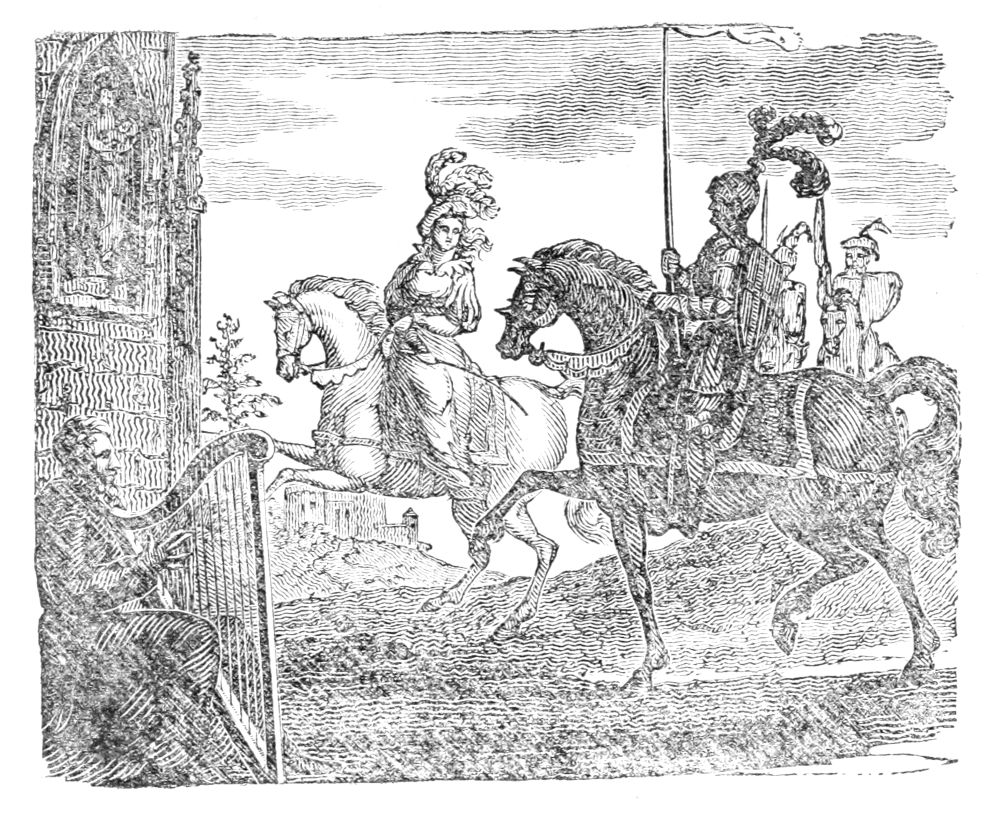
Women attended by knights in armor.