"A new Entertainment, called a
Reading edition
NIGHT
with
PUNCH!
Founded on the Series of Celebrated Papers of that highly humorous Periodical, from the pens of the acknowledged best Comic Writers of the day. Adapted and Arranged by R. B. Peake, Esq. As performed by Mr. W. J. Hammond Forty-two successive nights at the New Strand Theatre.... After which, a Monopolylogue entitled the
LAST MAN;
or,
PUNCH OUT OF TOWN"
—with five characters, all performed by Hammond, the whole reaching its climax when Punch, in propria persona, appeared and sang an "Epilogue Song."
But it was Mrs. Caudle, of course, that offered a bait too tempting to be resisted. There was Mrs. Keeley's authorised "Mrs. Caudle" in town; but simultaneously Mrs. Caudles cropped up in every town in the country. One of these was enacted by Mr. Warren, and his playbill of the Theatre Royal, Gravesend, dated August 7th, 1845, is before me as I write. "The Real Mrs. Caudle," he asserts, "having received an enthusiastic welcome from a Gravesend audience, and being pronounced far superior to any of the counterfeit Representatives, will have the honour of repeating her Curtain Lecture this and to-morrow evenings." "Mrs. Caudle at Gravesend" was, in fact, a "Comic Sketch" by C. Z. Barnett; and the programme decorated with a common engraving in impudent imitation of Leech's immortal cut, contained all the dramatis personæ of Jerrold's little domestic drama, including "Mrs. Caudle (the Original from Punch's Papers), Mr. Warren."
Six years later Mr. Briggs himself was lifted from Punch on to the stage (amongst others) of the Royal Marylebone Theatre, which then assiduously cultivated the equestrian drama. On November 14th, 1851, for the benefit of a lady called Mrs. MORETON BROOKES, there was played a "new grand dramatic equestrian spectacle, entitled the Maid of Saragossa; or, The Dumb Spy and Steed of Arragon—realising Sir David Wilkie's Celebrated Picture." As the Arragon Steed remained on the premises when the curtain fell on the first piece, it was obviously a pity to waste him; so, after he had finished realising Wilkie's picture, and had rested awhile, he stepped out of romance into high comedy, or, as the playbill simply put it—"After which will be presented from Sketches furnished from Punch's Domicile, Fleet Street, a New, Grand, Locomotive, Pedestrian, Equestrian, Go-ahead Extravaganza, entitled
MR. BRIGGS!
Or, House Keeping versus Horse Keeping"—
in which Mr. Briggs was played by Mr. Crowther, and Mrs. Briggs by the fair beneficiaire.
The first dramatic effort of Punch, in his individual quality and personality as a jester, was the pantomime of "King John, or Harlequin and Magna Charta." Punch had at that time become so popular, and was so generally regarded as the incarnation of all that was witty, that a commission was given for a pantomime that was to surpass for wit and humour any pantomime that had ever been written or thought of before. "They have given out," said Alfred Bunn in his vituperative "Word with Punch," "in distinct terms that none but themselves can write a pantomime, and modestly entitled the one they did write 'Punch's Pantomime' ... which they laboured so lustily, but so vainly, to puff into notoriety." It was written in 1842, by Lemon, Jerrold, and Henry Mayhew; but when it was read by the first-named to the Covent Garden Company, by whom it was produced, it was found to contain a great deal of wit, but very little fun. It was extensively amended in response to the representations of the pantomimists, and W. H. Payne managed to make a good deal of his part. The wit, however, militated greatly against the "go" and success of the piece, the prestige of its writers did not help it, and the experiment of a "Punch's Pantomime" was accordingly not repeated.
The cordial sympathy that has bound together so many of Punch's Staff in life has more than once taken the form of kindly charity in death or misfortune. To the performance given on behalf of the unhappy Angus Reach reference is made where the man and his work are considered. For Leigh Hunt—although he was not of the band—a theatrical performance was also given, and realised a large sum, and the benefit in aid of Charles H. Bennett's widow and children was even more successful. That interesting event is described later; but for the sake of history it may be well to reproduce the programme here:—
AMATEUR PERFORMANCE AT THE THEATRE ROYAL, MANCHESTER,
(kindly placed at the disposal of the committee by John Knowles, Esq.,)
MONDAY EVENING, JULY 29, 1867.
To commence with an entirely new and original Triumviretta, in one act and ten tableaux (being a lyrical version of Mr. Maddison Morton's celebrated farce of "Box and Cox"), by Mr. F. C. Burnand, entitled—
COX AND BOX; Or, THE LONG-LOST BROTHERS.
The Lodging, including the Little Second-floor Back Room, has been furnished with
ORIGINAL MUSIC by Mr. ARTHUR SULLIVAN.
John Cox, a Journeyman HatterMr. Quintin
James Box, a Journeyman PrinterMr. G. Du Maurier.
Bouncer, late of the Hampshire Yeomanry, with military reminiscencesMr. Arthur Blunt.
Scene—An elegantly furnished apartment in Bouncer's Mansion.
R. T. PRITCHETT—SHIRLEY BROOKS—MR. ARTHUR LEWIS—MARK LEMON—MR. TWISS—SIR JOHN TENNIEL—ARTHUR CECIL (BLUNT)—HENRY SILVER
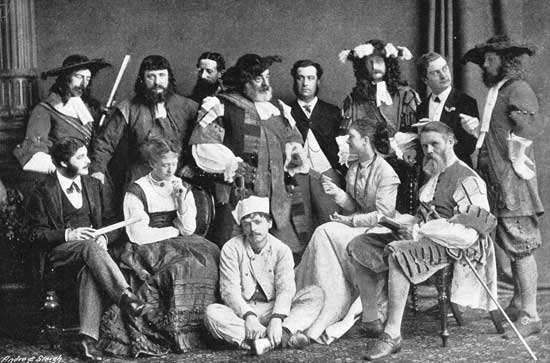
SIR ARTHUR—SULLIVAN—MISS ELLEN TERRY—MR DU MAURIER—MISS KATE TERRY—TOM TAYLOR
FOR CHARLES H. BENNETT'S BENEFIT.
(See p.
132
)
View larger image
(
By Permission of the London. Stereoscopic Company.
)
Tableaux—1. Cox at his looking-glass.—2. Cox and Bouncer, the trial of the hat.—3. The beauties of bacon.—4. Revenons à nos moutons.—5. The stranger!—6. The duel!!—7. The gamblers. The hazard. The false die.—8. "Reading of the will."—9. (A classical study.) Penelope.—10. Knox! et præterea nil.
Mr. SHIRLEY BROOKS will deliver an ADDRESS.
After which will be performed Mr. Tom Taylor's popular Drama,
A SHEEP IN WOLF'S CLOTHING.
Colonel Lord Churchill, of the Life Guards Mr. Mark Lemon.
Colonel Percy Kirke, of Kirke's Lambs Mr. John Tenniel.
Master Jasper Carew Mr. Tom Taylor.
Kester Chedzoy Mr. F. C. Burnand.
Corporal Flintoff Hackett Rasper of Kirke's Lambs Mr. Horace Mayhew. Mr. Henry Silver. Mr. R. T. Pritchett.
John Zoyland, a Locksmith Mr. Shirley Brooks.
Dame Carew, Wife of Jasper Carew (by the kind permission of B. Webster, Esq.) Miss Kate Terry.
Dame Carew, Mother of Jasper Carew Mrs. Stoker.
Sibyl, Daughter of Jasper Carew Miss Florence Terry.
Keziah Mapletoft, Servant to Anne Miss Ellen Terry (Mrs. Watts).
To be followed by J. Offenbach's Bouffonnerie Musicale,
LES DEUX AVEUGLES.
Stanislas GiraffierMons. G. Du Maurier.
Giacomo PatachonMons. Hal. Power.
To conclude with Mr. John Oxenford's Farce, in one Act,
A FAMILY FAILING.
Characters by Messrs. Arthur Blunt, Mark Lemon, Tom Taylor, Henry Silver, and Miss Ellen Terry.
Tickets for the Dress Circle and Stalls, One Guinea each, may be obtained from any Member of the Committee; at the Theatre Royal; from Messrs. Hime and Addison, and Mr. Slater, St. Ann's Square; and Messrs. Forsyth, St. Ann's Street.
On this occasion, says an anonymous writer, "The celebrated cartoonist received the reception of the evening. The audience rose en masse and cheered. Tom Taylor, playing in his own piece the principal character, was, comparatively speaking, nowhere. The most interesting personality of the Punch Staff was unquestionably Tenniel."
Affiliated with Punch, in its membership at least, was that "Guild of Literature and Art" of which Charles Dickens was the father. Its theatrical career began in 1845 at the Royalty Theatre, Soho, at that time called Miss Kelly's, the initial performance being Ben Jonson's "Every Man in his Humour," with Mark Lemon as Brainworm and Dickens as Bobadil. (See p. 137.) On May 15th, 1848, much the same company, in aid of the fund for the endowment of the perpetual curatorship of Shakespeare's house at Stratford-on-Avon, gave the "Merry Wives of Windsor," when Dickens played Shallow; George Cruikshank, Pistol; John Leech, Slender; Mark Lemon, Falstaff; and other characters were represented by George Henry Lewes, John Forster, Dudley Costello, Augustus Egg, R.A., and Mr. Cowden Clarke—a goodly company. Mr. Sala says that Lemon's conception of Falstaff (which was also known to the public through the jovial editor's "readings"), though well understood, was "the worst he ever saw;" but Mrs. Cowden Clarke declared it "a fine embodiment of rich, unctuous raciness, no caricature, rolling greasiness and grossness, no exaggerated vulgarisation of Shakespeare's immortal 'fat knight,' but a florid, rotund, self-indulgent voluptuary—thoroughly at his ease, thoroughly prepared to take advantage of all gratification that might come in his way, and thoroughly preserving the manners of a gentleman accustomed to the companionship of a prince. John Leech's Master Slender," she continues, "was picturesquely true to the gawky, flabby, booty squire.... His mode of sitting on a stile, with his long ungainly legs dangling down ... ever and anon ejaculating his maudlin cuckoo cry of 'Oh sweet Ann Page,' was a delectable treat." Without disrespect to Leech's memory, it may be said that others of his friends did not form a similarly favourable opinion of his histrionic powers.
A company quite as notable in its way was that which played "Not so Bad as We Seem," by Lytton (with whom Punch had made his peace), at Devonshire House, on May 27th, 1851, before the Queen and the Prince Consort, at the instance of the Duke of Devonshire. The playbill deserves to be preserved here, although the only Punch names among the actors are those of Jerrold, Lemon, and Tenniel—the last-named of whom is the only survivor of them all.
Men.
The Duke of Middlesex The Earl of Loftus Peers Attached To the Son of James II., Commonly Called the First Pretender Mr. Frank Stone, A.R.A. Mr. Dudley Costello
Lord Wilmot a Young Man at the Head of the Mode More Than a Century Ago, Son To Lord Loftus Mr. Charles Dickens
Mr. Shadowly Softhead a Young Gentleman From the City, Friend and Double of Lord Wilmot Mr. Douglas Jerrold
Mr. Hardman a Rising Member of Parliament and Adherent To Sir Robert Walpole Mr. John Forster
Sir Geoffrey Thornside a Gentleman of Good Family and Estate Mr. Mark Lemon
Mr. Goodenough Easy in Business, Highly Respectable, and a Friend of Sir Geoffrey Mr. F. W. Topham
Lord le Trimmer Sir Thomas Timid frequenters of Wills' Coffee House Mr. Peter Cunningham Mr. Westland Marston
Mr. Jacob Tonson a Bookseller Mr. Charles Knight
Smart Valet To Lord Wilmot Mr. Wilkie Collins
Hodge Servant To Sir Geoffrey Thornside Mr. John Tenniel
Paddy O'Sullivan Mr. Fallen's Landlord Mr. Robert Bell
Mr. David Fallen Grub Street Author and Pamphleteer Mr. Augustus Egg, A.R.A.
Lord Strongbow, Sir John Bruin, Drawers, Newsmen, Watchmen, &c. &c. Coffee House Loungers
Women.
Lucy Daughter to Sir Geoffrey Thornside Mrs. Compton
Barbara Daughter to Mr. Easy. The Silent Lady of Deadman's Lane. Miss Ellen Chaplin
Date of Play—The Reign of George I. Scene—London.
Time supposed to be occupied, from the noon of the first day to the afternoon of the second.
And, lastly, may be mentioned the performance of Ben Jonson's play at Knebworth, in which, says Vizetelly, Douglas Jerrold, as Master Stephen, showed real talent and power. But the piece is not an entertaining one, as Lord Melbourne—with his bad habit of thinking aloud—bore disconcerting witness in his stall: "I knew well enough that the play would be dull, but not so damnably dull as this!"
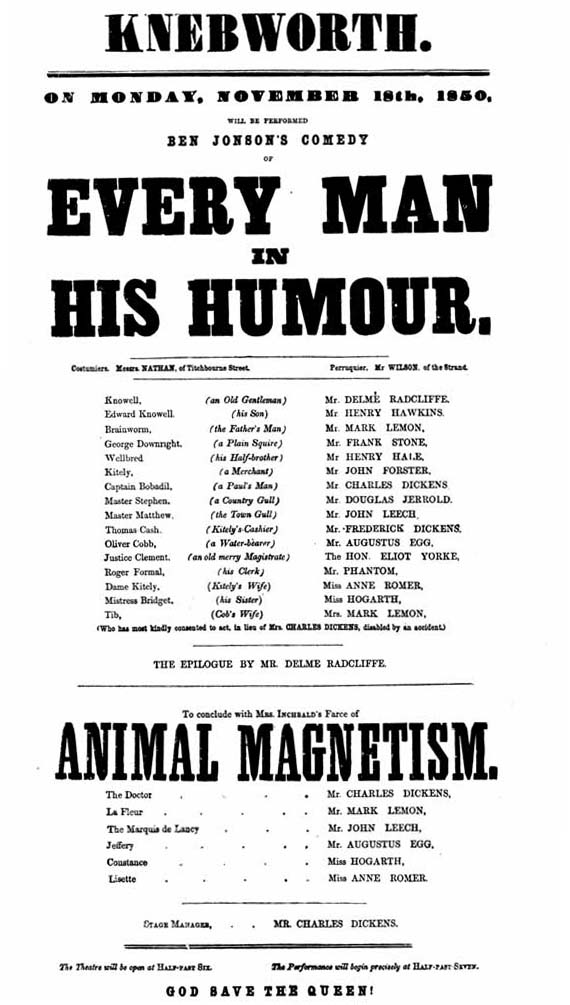
FOR THE GUILD OF LITERATURE AND ART. (See p. 135.)