FOOTNOTES:
Reading edition
A. 1103. This was a year of much distress from the manifold taxes.
A. 1104. It is not easy to describe the misery of this land, which it suffered at this time through the various and manifold oppressions and taxes that never ceased or slackened.
A. 1105. This was a year of great distress from the failure of the fruits, and from the manifold taxes which never ceased.
A. 1110. This was a year of much distress from the taxes which the king raised for his daughter’s dowry.
A. 1118. England paid dearly for all this (i. e., the Norman war) by the manifold taxes which ceased not all this year.
A. 1124. Full heavy a year was this; he who had any property was bereaved of it by heavy taxes and assessments, and he who had none, starved with hunger.
From the edition of J. A. Giles.
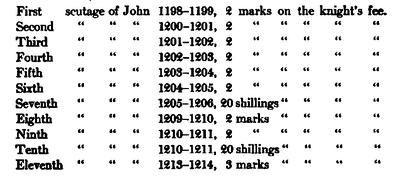
“June 7, 1217, the king mentions a carucage, hidage and aid, ‘quod de præcepto nostro assisum est.’ 1 Rot. Claus. 310.”
“Jan. 9, 1218, Henry mentions a carucage and hidage, ‘quod assisum fuit per consilium regni nostri.’ 1 Rot. Claus. 348.
“Jan. 17, Henry mentions a scutage of two marks on the fee, ‘quod exegimus,’ and
“Jan. 24, ‘scutagium de omnibus feodis militum quæ de nobis tenent in capite, quod ultima assisum fuit per commune consilium regni nostri.’ 1 Rot. Claus. 349.”
1. Carucage of 2 shillings, taken at the coronation of 1220. Ann. Wavereley, quoted in Stubbs, Select Charters, 321, gives no hint of the authority for the levy save that the king “accepit” it. The writ (Sel. Chart. 351) states that it was granted by the Council.
2. Scutage of 10 shillings after the capture of Biham, granted by the Council, 1221. 1 Rot. Claus. 458.
3. Scutage of 2 marks for Welsh War, 1223.
4. Scutage of 2 marks for siege of Bedford.
5. Contribution to crusade 1223, assented to by Council. 1 Rot. Claus. 516.
1. Scutages 1229, 1230, 1231, each for military expeditions. 2 Stubbs, Const. Hist. Eng. 42, note 3.
2. A tenth of all property 1229. Refused by the barons and paid by the clergy. 2 Matt. Par. Hist. Angl. 316.
3. Tallages 1227, 1230, 1234. 1 Dowell, Taxation and Taxes, 52.
4. A fortieth of movables, 14 Sept., 1232, 24,712 marks granted by the Council. 2 Matt. Par. Hist. Angl. 345.
5. Two marks on the knight’s fee on occasion of the marriage of the king’s sister, 1235, granted by the Commune Concilium. 1 Madox, Hist. Ex. 593.
1245. Grant of an aid of 20 shillings “ad filiam maritandam.” 1 Madox, Hist. Ex. 594.
1246. Scutage of three marks on the fee. 2 Stubbs, Const. Hist. Eng. 65, note 5, citing Pipe Roll of 1246.
1248. Noted above.
1249. Appointment of justiciar, chancellor, and treasurer demanded. Failure. 2 Matt. Par. Chron. Maj. trans. Giles, 308-309.
1252. The Pope held Henry to his promise of a Crusade made in 1250, and authorized him to exact a tenth of the revenues of the clergy for three years. The clergy delayed. Henry turned to the barons and asked for a scutage; the barons answered that their reply would depend upon the prelates. 2 Matt. Par. Chron. Maj. trans. Giles, 518-527.
1253. Debate on the above. At last Henry obtained his tenth from the clergy and an aid of 3 marks from the tenants-in-chief for the knighting of his son. The condition was the confirmation of the Charters, and a great oath for his faithful observance of them. 3 Matt. Par. Chron. Maj. trans. Giles, 22-24.
“Rex Vicecomiti Bedeford, et Bukingeham., salutem.... Tibi districte præcipimus, quod præter omnes prædictos venire facias coram consilio nostro apud Westmonasterium in quindena Paschæ proximo futuri, quatuor legales et discretos milites de comitatibus prædictis quos iidem comitatus ad hoc elgerint, vice omnium et singulorum eorundem comitatuum, videlicet duos de uno comitatu et duos de alio, ad providendum, una cum militibus aliorum comitatuum quos ad eundem diem vocari fecimus, quale auxilium nobis in tanta necessitate impendere voluerint. Et tu ipse militibus et aliis de comitatibus prædictis necessitatem nostram et tam urgens negotium nostrum diligenter exponas, et eos ad competens auxilium nobis ad præsens impendendum efficaciter inducas; ita quod prædicti quatuor milites præfato consilio nostro ad prædictum terminum præcise respondere possint super prædicto auxilio pro singulis comitatuum prædictorum.” Stubbs, Select Charters, 376. Translation in Adams and Stephens, Select Documents, 55.
“Item in forma prædicta scribitur civibus Eboraci, civibus Lincolniæ, et ceteris burgis Angliæ, quod mittant in forma prædicta duos de discretioribus, legalioribus et probioribus tam civibus quam burgensibus.
“Item in forma prædicta mandatum est baronibus et probis hominibus Quinque Portuum....” Stubbs, Sel. Charters, 415; 1 Rymer, Foedera, part 2, 93.
Magna Carta abolished illegal exactions on goods retaining only the “ancient and lawful customs” above mentioned. Taxable commodities were wine, wool, and general merchandise. In many instances, in spite of the prohibitions in the Charter, the customs amounted to confiscation. Until the time of Edward I there was unending irregularity in the management of the customs. Merchant strangers, by Cap. 41 of the Great Charter were to have “safe and secure exit from England, and entry to England ... buying and selling by the ancient and right customs, quit from all evil Tolls.”
“And for so much as the mere part of the commonalty of the realm find themselves sore grieved with the maletolt of wools, that is to wit, a toll of forty shillings for every sack of wool, and have made petition to us to release the same; we at their requests have clearly released it, and have granted that we will not take such thing nor any other without their common assent and good will; saving to us and our heirs the custom of wools, skins, and leather, granted before by the commonalty aforesaid. In witness of which things we have caused these our letters to be made patents.” Adams and Stephens, Sel. Doc. 87; Stubbs, Sel. Chart. 495 (French text), and 496 (translation).
Humbly show unto our Sovereign Lord the King, the Lords Spiritual and Temporal, and Commons in Parliament assembled, that whereas it is declared and enacted by a statute made in the reign of King Edward the First, commonly called, Statutum de tallagio non concedendo, that no tallage or aid shall be laid or levied by the king or his heirs in this realm, without the good-will and assent of the Archbishops, Bishops, Earls, Barons, Knights, Burgesses, and other freemen of the commonalty of this realm; and by authority of Parliament holden in the five and twentieth year of the reign of King Edward the Third, it is declared and enacted, that from thenceforth no person shall be compelled to make any loans to the king against his will, because such loans were against reason and the franchise of the land; and by other laws of this realm it is provided, that none should be charged by any charge or imposition, called a Benevolence, nor by such like charge, by which the statutes before mentioned, and the other the good laws and statutes of this realm, your subjects have inherited this freedom, that they should not be compelled to contribute to any tax, tallage, aid, or other like charge, not set by common consent in Parliament:
Yet nevertheless, of late divers commissions directed to sundry commissioners in several counties with instructions have issued, by pretext whereof your people have been in divers places assembled, and required to lend certain sums of money unto your Majesty, and many of them upon their refusal so to do, have had an unlawful oath administered unto them, not warrantable by the laws and statutes of this realm, and have been constrained to become bound to make appearance and give attendance before your Privy Council, and in other places; and others of them have been therefore imprisoned, confined, and sundry other ways molested and disquieted: and divers other charges have been laid and levied upon your people in several counties, by Lords Lieutenants, Deputy Lieutenants, Commissioners for Musters, Justices of the Peace and others, by command or direction from your Majesty or your privy Council, against the laws and free customs of this realm....
And whereas of late great companies of soldiers and marines have been dispersed into divers counties of the realm, and the inhabitants against their wills have been compelled to receive them into their houses, and there to suffer them to sojourn, against the laws and customs of the realm, and to the great grievance and vexation of the people....
They do therefore humbly pray your most Excellent Majesty, that no man hereafter be compelled to make or yield any gift, loan, benevolence, tax, or such like charge, without common consent by Act of Parliament; and that none be called to make answer, or take such oath, or to give attendance, or be confined, or otherwise molested or disquieted concerning the same, or for refusal thereof; ... and that your Majesty will be pleased to remove the said soldiers and marines, and that your people may not be burdened in time to come. 2 Parl. Hist. 374-6. The Petition of Right may also be found in S. R. Gardiner, Constitutional Documents of the Puritan Revolution, 1625-1660, 66-70; Adams and Stephens, Sel. Doc. 339-342. Taswell-Langmead, Eng. Const. Hist. 430-433.
The “parchments in the Tower” might readily have included the following, which exhibits an historical precedent for the ship money:
“1008. Rex Anglorum Aegelredus de ccc. x. cassatis unam trierem, de novem vero loricam et cassidem fieri, et per totam Angliam naves intente praecipit fabricari.” 1 Florentii Wigorniensis Monachi, Chronicon ex Chronicis, 160.
1 Freeman, Norman Conquest, 647, note LL., cites 3 Codex Diplomaticus, 351, to show that before 1008 a levy of ships was not unknown. Archbishops Aelfric upon his death gave to the people of Wiltshire and Kent a ship. Wiltshire is an inland county. It is justifiable, then, to believe that “per totam Angliam” may be taken literally, and that Ethelred really exacted a ship from every 310 hides throughout England.