Chapter III
Reading edition
THE ENGLISH TRANSLATION.
The music of "Elijah" was composed to German words; an English version was therefore necessary. Mendelssohn had no hesitation in assigning the task of making the English translation to Mr. Bartholomew—"the translator par excellence," as he called him—who is so well known as the translator or adaptor of Mendelssohn's "Athalie," "Antigone," "Œdipus," "Lauda Sion," "Walpurgis Night," the Finale to "Loreley," "Christus," and many of his songs and part-songs. Bartholomew also supplied the words of "Hear my Prayer," "which," he says, "its dear and lamented author composed for my paraphrastic version of the 55th Psalm."
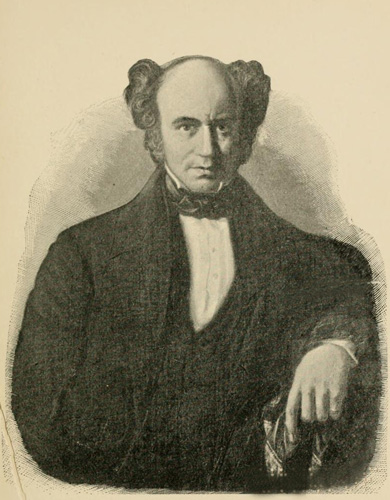
WILLIAM BARTHOLOMEW (1793-1867) The English Translator of Mendelssohn's “Elijah.” From the original Painting, now in the possession of Mrs. Harper.
William Bartholomew (1793-1867) was "a man of many accomplishments—chemist, violin player, and excellent flower painter." In 1841 he submitted to Mendelssohn the libretto of a fairy opera, entitled "Christmas Night's Dream"; and in this way an acquaintance commenced which developed into a close friendship between the two men—a friendship severed only by death.
Here is Mendelssohn's first letter to Bartholomew on the subject of "Elijah."
[Mendelssohn to Bartholomew.]
[Written in English.]
"Leipzig, May 11, 1846.[31]
"My dear Sir,—Many thanks for your kind letter of the 4th, to which I hasten to reply, and to tell you that the oratorio for the Birmingham Festival is not the 'Athalie' (nor the 'Œdipus,' of course), but a much greater, and (to me) more important work than both together; that it is not quite yet finished, but that I write continually to finish it in time; and that I intend sending over the first part (the longest of the two it will have) in the course of the next ten or twelve days. I asked Mr. Moore from Birmingham to have it translated by you, and I have no doubt he will communicate with you about it as soon as he gets my letter, which I wrote four or five days ago; and I beg you will be good enough, if you can undertake it, to try to find some leisure time towards the end of this month, that the Choral parts with English words may be as soon as possible in the hands of the Chorus singers. And pray give it your best English words, for till now I feel so much more interest in this work, than for my others—and I only wish it may last so with me.
"Always very truly yours,
"Felix Mendelssohn-Bartholdy."
The music of "Elijah" came to Bartholomew from Mendelssohn in instalments. The English translation was the subject of a long and elaborate correspondence between the composer and his translator in London. Both were unsparing in the labour they bestowed upon the translation. The following letters show that Mendelssohn went through the English version bar by bar, note by note, syllable by syllable, with an attention to detail which might be termed microscopic. These letters, written in Mendelssohn's own English, and the majority of which are now made public for the first time, cannot fail to be of interest.[32]
A letter from Bartholomew to Mendelssohn may, however, first be quoted, to show the spirit in which the English translator discharged his congenial task.[33]
[Bartholomew to Mendelssohn.]
"2, Walcot Place,
"Hackney, London, June 23, 1846.
"My dear Sir,—I have at last, after toiling day and night, got through the first portion of your noble oratorio. I wish I could render words more worthy of such music. My endeavour has been to keep them as scriptural as possible; and in order that you may be able to judge how far I have succeeded, do me the favour to refer to the verses notified in an English version of the Bible. When the second part, or the parts of that, as they are completed, are sent, I hope we shall have the words in the score written in letters which are readable to us. I know not how so bad a scribe as he who penned the libretto could have been found; words, nay even sentences were omitted, and words changed: leben was written for beten, and there were no references to where the verses might be seen in 'The Book.' All these caused me much perplexity, trouble, and, what is worse than all, loss of time. These, too, enhanced by my journeys to Hobart Place, and the necessity of copying by my own hand all the vocal portion of the score for the engravers, and those parts which you will receive through the medium of Mr. Buxton for your perusal and decision, have rendered my toil, although a labour of love, incessant. The choral portions will this day be in the hands of the engravers; and I trust you will send by every packet each of the pieces yet forthcoming—one at a time—never mind how short, for the time is short—and I want all the time to enable me to do it as well as I can. And the choralists want all the time to rehearse it as often as they can, for the more often it is rehearsed the better.
"No. 6 wants the time; and I hope you will have time to write an overture, or introduction, unless you expressly design there shall be none. I understand they (the Birmingham Directors) have engaged Staudigl, I hope with the intention of giving him the Prophet's part, although it is reported here that Phillips is to sing it. Much will depend on who sings it [the oratorio] so far as the soloists are concerned; but the choruses! they will be the main feature, and the glory of their composer. The Baal Priests' choruses are wrought to a climax truly sublime. Go on, my dear Sir, go on! until you soar with your 'Elijah' on the returning fire to the height from which he called it down!
"Your grateful and obliged
"W. Bartholomew."
[Mendelssohn to Bartholomew.]
[Written in English.]
"Leipzig, July 3, 1846.[34]
"My dear Sir,—Many, many thanks for your kind letter and for your translation of the first part of Elijah. I can but write in great haste, else I would try to say more, and to thank you better for all your kindness. But I will do so in person, and meanwhile I merely say—I thank you most heartily, most sincerely, and I hasten to answer your questions.
"Those words in the choruses which you or I may now or hereafter object to, might, I hope, still be altered in pencil or ink in the parts, if already printed; for if an improvement can be made, it must never be omitted because the printing should be finished. A little more trouble will be amply repaid by a little improvement! And as for the Solo Parts, they must not be printed at all for the Festival, but only written out (copied), and can only be printed together with the pianoforte arrangement, and after the performance. For these accordingly we have time till then, to alter and improve. Pray let Mr. Buxton [Ewer and Co., the English publishers] read all this!
"No. 1. I wish to keep this if possible as in the English Bible version; therefore I propose[35]:—

[Listen]
"No. 5, at the end, I propose to say 'and in our affliction He comforteth us,' and to slur from D to E flat, because I prefer to have the word affliction on the G flat.[36]
"No. 6 {3}. The time is Andante tranquillo. The first words are from Jerem. xxix., 13. And the following from Job xxiii., 3, and I wish to keep these last literally: 'Oh, that I knew (slurred) where I might find Him, that (added note, as you also have) I might come even to His seat' (or 'presence,' perhaps, if the two notes shall not be slurred.)[37] And before the first subject and the first words return, the notes may be altered thus:—


[Listen]
"In No. 7 {5}, I prefer your first idea, 'for He is Lord and God,' to the two others which you propose; and I wish you would have the 'He,' &c., inserted still in the choral parts.
"No. 8 {6}, I prefer an alteration in the notes, and to keep the words:—
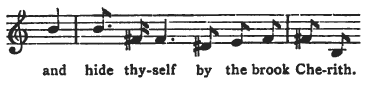
[Listen]
as also—
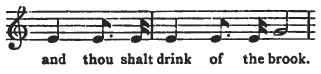
[Listen]

[Listen]
"No. 9 {7}. Pray let the beginning stand as in the Bible, viz.:—

[Listen]
and if the end 'and thus harm thee' can be spared, and it can finish with the words 'against a stone,' I should like it better.
"No. 10 {between 7 and 8}, in the middle I propose again to alter the notes in order to keep the Bible version:—
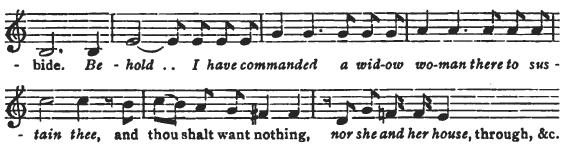
[Listen]
"No. 11[38] {8}. Again the same (bar 16, &c.):—
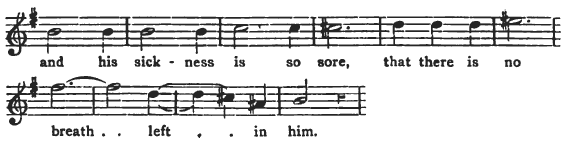
[Listen]
and then—
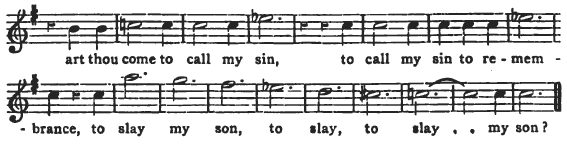
[Listen]
and at the end: 'there is no breath, no breath left in him,' instead of 'exhausted,' etc.

"Then again:—
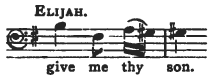
[Listen]
"And instead of 'that he again may live,' I should prefer always as you have at the end, 'that he again may praise Thee.' Again the music should be altered for the Bible version's sake in this:—

[Listen]
"In the following Allegro agitato, I prefer 'thy prayer' to 'thy petition,' and beg you will alter the notes accordingly.
"No. 12 {9}.[39] Is it as scriptural to say 'the men' as 'the man'? And if not, could not the sentence be 'Blessed is the man who fears Him, who delights,' and so on? And what do you like better: the amplification, 'light shining over them,' or to say instead of these words, 'to the upright,' and to slur the two notes thus:—

[Listen]
"Pray do it as you think best.
"At the beginning of No. 13 {10}, I should wish to have the same words as in No. 1, viz.: 'before whom I stand,' instead of 'I tell thee truly.' And instead of 'that the rain may fall,' etc., I should propose:—

[Listen]
which is more according to the Bible. I prefer 'Let him be God' to 'He shall be God' (which you have added in pencil). Instead of 'I, even I alone stand here among you,' I propose the alteration:
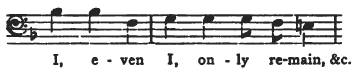
[Listen]
"I prefer 'Invoke your forest gods,' etc., as you do.
"In No. 15 {11}, is not the accent extírpate a wrong one? The syllable tir will always be the first in the bar and the strongest, with a marked accent.
"No. 16. {12}
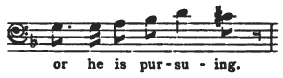
[Listen]
and then—
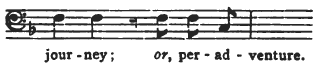
[Listen]
"In No. 18 {13}, could not the words 'with lancets cut yourselves after your manner' be kept?
"No. 20. {14}
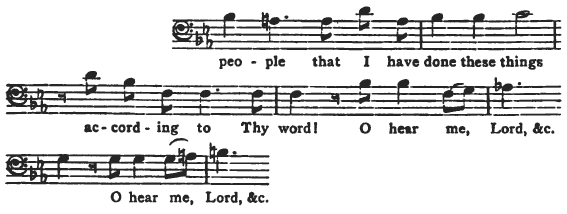
[Listen]
"I prefer 'and let their hearts again be turned,' as you do.
"In No. 22 {16}, could not the end be: 'and we shall have no other god before Him,' or 'the Lord' (from Exodus xx., 3)? Then instead of 'let not a prophet,' I propose:

[Listen]
"In No. 23 {18}, I prefer 'thee' &c., to the other version, according to your remarks. But the end I wish thus:—

[Listen]
"No. 24. {19}
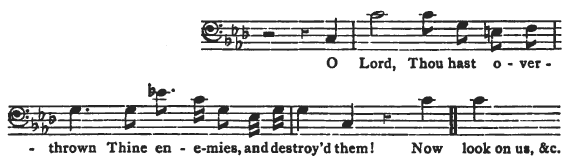
[Listen]
"Then I wish the following notes altered:—
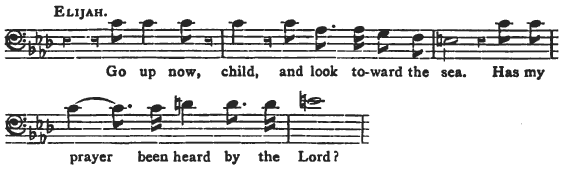
[Listen]
"I also prefer 'the heavens are as brass'—a note might be added. Then afterwards I propose:—

[Listen]
"And afterwards if 'and turn from their sin' seems preferable to you, a note might be added to keep the words as in the Bible. In the following sentence it sounds to me more scriptural to leave the words as in 2 Chronicles vi., 27:—

[Listen]
"Then I wish the notes altered thus:—

[Listen]
"Then also 'the earth is as iron.' And then would you like this:—

[Listen]
"If possible I should wish to have omitted 'I implore Thee,' which does not sound as scriptural to me. If I am wrong, pray leave it; but if not, the words 'to my prayer' might be repeated instead of them. The following is Psalm xxviii., 1:—

[Listen]
and could not the following sentence be thus:—

[Listen]
"Then I prefer—
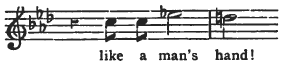
[Listen]
"Instead of 'His boundless,' I propose to omit the G (the first note), and have instead 'for His' (mercies, &c.), and to add afterwards a note (A), in order to say 'endureth for evermore.' I prefer 'The Lord is above them,' to 'is the highest.'
"I am so very sorry you had that trouble with the words! And the first portion of the second part, which I sent off before the receipt of your letter, was again written in German characters. But the numbers you receive with this will, I hope, be legible; and I have made reference to the verses of the Bible, and will continue to do so. With the next packet you will again receive some pieces, and so always on till the whole (at least of the choruses) is in your hands, which I hope shall not last more than a fourthnight (sic). And if there should be something left it would be here or there a solo-piece, which (as it must not be printed) will easily be done and copied in time. You are right, the great question is, Who is to sing the Elijah?—and I am at a loss why I have not yet heard some news respecting this most essential point.
"My intention was to write no Overture, but to begin directly with the curse. I thought it so energetic. But I will certainly think of what you say about an Introduction, although I am afraid it would be a difficult task, and do not know exactly what it should or could mean before that curse. And after it (I first thought to write the Overture after it), the chorus must immediately come in. Now once more excuse the haste and accept the thanks of
"Yours very truly,
"Felix Mendelssohn-Bartholdy."
In regard to the Overture, referred to at the end of the foregoing (very long) letter, it may be interesting to quote an extract from one of Bartholomew's letters to Mendelssohn:—
"I have maturely considered, and, with Mr. K[lingemann], think it will be a new feature, and a fine one, to announce the curse, No. 1. Then let an Introductory-movement be played, expressive, descriptive of the misery of famine—for the chorus (I always thought) comes so very quickly and suddenly after the curse, that there seems to elapse no time to produce its results."
It seems evident that Mendelssohn was indebted to Bartholomew for the suggestion of an Overture to "Elijah." That Mendelssohn accomplished what he calls his "difficult task" we know full well, and Bartholomew must have felt quite satisfied when the composer wrote to him and said, "I have written an Overture, and a long one."
[Mendelssohn to Bartholomew.]
[Written in English.]
"Leipzig, 18th July, 1846.
"My dear Sir,—I received yours of the 9th. And many thanks again! And you copy yourself the solo parts! Whatever your reason may be, I feel what an obligation you confer upon me.
"Now I go on with my remarks about those pieces of the second part which you sent me the translation of, viz.: Nos. 33, 34, and 35. By-the-bye: No. 33 will be altered and another Recit. (for a Soprano) comes in its stead with the next parcel; but the words are the same, and your translation will go quite as well to the new Recit.
"In No. 34 I again wish to alter the notes in order to keep the English scriptural version. And it seems to me so important that this should be done that I hope it is time still to make the alteration in all the choral parts. The beginning I wish altered thus:—

[Listen]
or, if 'passed' must have two syllables:—
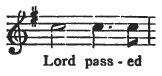
[Listen]
"The end of the first phrase 'as He approached' is not quite agreeable to me; could you not find four syllables instead of them (making the two slurred notes single ones)—e.g., 'as the Lord drew near' (don't laugh), or something in which the accent on the last syllable is strong and decided!
"Then comes:—

[Listen]
"Then again: 'And behold, the Lord passed by.' And at the end again, 'But the Lord was not in the earthquake.' Also the third time: 'But the Lord was not in the fire.'
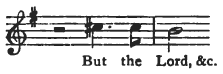
[Listen]
"Then—

[Listen]
(here I think it is quite necessary to keep the scriptural expression at least at the beginning!) And then perhaps: 'And in that voice the Lord came unto him.'
"The instrumental parts are all copied here, and I bring them with me. Excuse the haste of these lines.—Always yours very truly,
"Felix Mendelssohn-Bartholdy."
[Mendelssohn to Bartholomew.]
[Written in English.]
"Leipzig, July 21, 1846.
"My dear Sir,—After I had sent off my last letter to you in the morning, yours of the 14th arrived in the evening. I hasten to answer it, and will send the metronomes in a few days, when the last two pieces of the second part will come.
"You receive to-day all the pieces that were still wanting in the 2nd part, and only the Nos. 36, 37, 38, and 39 are now to come, and will be sent off in a few days (two of them are but short recitatives), so that I hope everything is now safe with regard to rehearsals, &c., &c.
"I am quite of your opinion, that accent is the thing, and I much prefer the alteration of a few notes to a bad accent. So I hope you left 'Be not afraid, saith God the Lord, be not afraid, for I am near,' which seems to me much better than the other. At any rate, I hope to stay 6 or 8 or 10 days in London before the Festival.
"In the song, 'O rest in the Lord' (Sei stille dem Herrn), I beg you will adopt something like the words of Ps. 37, v. 4, instead of the words 'and He will ever keep the righteous'! 'and He shall give thee' does very well with the notes; and there is only another expression, instead of 'the desires of thy heart,' necessary to make it fit the music and everything. And instead of the end 'He will defend thee,' &c., I should prefer also Ps. 37, v. 8, perhaps so: 'and cease from anger, and fret not thyself'; or, 'and cease from anger and forsake the wrath,' which will do with the alteration of one or two notes being not slurred instead of slurred, and vice versâ.
"And pray let always accent go first, especially in the Choruses! And Songs! And Recitatives!
"Always yours very truly,
"Felix Mendelssohn-Bartholdy."
Mendelssohn's request for a good verbal accent throughout the whole translation of his oratorio is frequently expressed in these letters. No less anxious was he to retain, as nearly as possible, the familiar words of the English Bible, in preference to introducing new wordings of well-known texts—e.g., "Oh! that I knew where I might find Him."[40] And when this was not practicable, he would often alter the notes in order to gain his desired end. It is evident from these letters that Mendelssohn knew the English Bible well.
"O rest in the Lord" has attained such widespread popularity that it will come as a surprise to many to learn that, before the first performance, Mendelssohn decided to eliminate this favourite air from his oratorio. When Bartholomew received the manuscript of the song, he found that the melody began thus:—

[Listen]
He at once wrote the following letter to Mendelssohn:—
"2, Walcot Place, Hackney, "July 20, 1846.
"And now, my dear Sir, having done all I can with 'Elijah,' as much as I have of it—having corrected and revised the second proofs of its printed first portion, and made the alterations you suggested—nearly all—one or two remaining for your assistance to complete—I am about to take a great liberty with you, and the impulse which prompts it—be it offensive or not—you must place to the account of the feeling which you or your music has inspired within me. And what is your music but yourself?—the incarnation of your spirit, made material by creation, and thus apparent—apparent through the agency of the body!
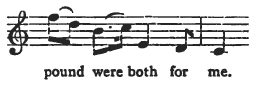
"Do you know a Scotch air, called 'Robin Gray'?[41]

[Listen]
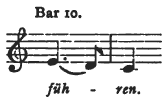
"Now compare the aria (Andante, without a number) 'Sei stille dem Herrn' ['O rest in the Lord'] with it. You may, perhaps, see nothing semblant in the two; but so much warranty have I for thinking that there is, that when Buxton—who brought it to me while I was with Miss Mounsey,[42] examining some of the proofs of your 'Elijah'—heard her, at his request, try it over—I being engaged at the table copying—he said: 'Why that's like "Robin Gray"!' I thought so, ere the above phrase was completed, and Miss Mounsey agreed with our opinions. I said nothing more then, but when I returned home I looked at it again, and at bar 10—look at it!—see the close:—[43]
[Listen] [Listen]
"Other distinct features may be traced, but these two are enough to give it the stamp of at least an imitation, which if you intend it to be, I have nothing further to say on the subject; except that it will lay you open to the impertinence of the saucy boys of the musical press, one of whom has had the audacity to accuse you of copying, borrowing, making your own, the ideas of the little man of the party!...
"Enough of this. Place what I have said to the right side of my friendly account in your ledger lines! If you alter the notation of the song, bring or send me another score of it, and I will take care to place this one only in your own hands. Mr. Klingemann thought I ought to tell you of the coincidence, I having mentioned it to him."
In answer to this letter—which Mendelssohn erroneously considered to be a request to omit the song—came the following reply:—
[Mendelssohn to Bartholomew.]
[Written in English.]
"Leipzig, July 28, 1846.[44]
"My dear Sir,—Here are the metronomes, which I beg you will give the director of the choruses; but tell him that I cannot promise they will be exactly the same, but nearly so, I think.
"Many thanks for your last letter, with the remarks about the song ['O rest in the Lord']. I do not recollect having heard the Scotch ballad to which you allude, and certainly did not think of it, and did not choose to imitate it; but as mine is a song to which I always had an objection (of another kind), and as the ballad seems much known, and the likeness very striking, and before all, as you wish it, I shall leave it out altogether (I think), and have altered the two last bars of the preceding recitative, so that the chorus in F may follow it immediately. Perhaps I shall bring another song in its stead, but I doubt it, and even believe it to be an improvement if it is left out.
"You receive here Nos. 36, 38, and 39. The only piece which is not now in your hands is No. 37, a song of Elijah ['For the mountains shall depart']. And this (and perhaps one song to be introduced in the first part) I shall either send or bring myself, for they will require only few words, and it will be plenty of time to copy the vocal parts, and the instrumental ones I bring over with me. I hope to be in London on the 17th, and beg you will let us have a grand meeting on the 18th, to settle all the questions and the copies of the solo parts.
"Always yours very truly,
"Felix Mendelssohn-Bartholdy."
It may perhaps be as well to complete the history of "O rest in the Lord" before proceeding farther, even at the risk of a little repetition. Mendelssohn does not seem to have liked the implied plagiarism of "Auld Robin Gray," although he says he had an "objection" to his song "O rest in the Lord" "of another kind." He repeated his request that it "must be left out" (see next letter). Bartholomew, however, wrote to him saying: "Why omit the song 'O rest,' when merely a note or two of the melody being changed would completely obliterate the identity, and I think not spoil the song as a whole? If you omit it, and especially upon such a reason as my hint may have afforded, I shall be very much pained."
This last sentence must have so touched Mendelssohn's feelings that he somewhat relented from his former decision. He wrote to Bartholomew: "About the song 'O rest in the Lord,' we will settle everything when we meet." Bartholomew strongly urged him to retain the now familiar air; but even at the eleventh hour (at the rehearsal in London) Mendelssohn still wished to delete it from the oratorio. However, the advice of his friends ultimately prevailed, and "O rest in the Lord" was thereby spared the fate of utter oblivion. Mendelssohn altered the fifth note of the melody (taking it down to C instead of up to G) in order to destroy the supposed "Auld Robin Gray" likeness; but it is amusing to notice that he retained his original note in the coda of the song, where, in two places, the fifth note goes up to G![45]
This break in the continuity of the correspondence may afford an opportunity of mentioning a phrase used by Bartholomew in one of his letters to Mendelssohn, which he calls "Irish Echoes." He says: "We must mind that any notation which may be altered shall not affect the band parts. Excuse my naming this. You do not write Irish Echoes—but yet by altering the notation they may inadvertently arise. Lest you should not know what I mean by an 'Irish Echo,' this may explain it. An Irishman, boasting of his country, said: 'It had an Echo, which, if you said 'How d'ye do?' replied, 'Pretty well, I thank you!'"
But to resume the continuation of the letters:—
[Mendelssohn to Bartholomew.]
[Written in English.]
"Leipzig, August 9, 1846.
"My dear Sir,—I write these lines merely to tell you that I hope to see and speak to you on the 17th or 18th, and to ask you to defer the printing of the words of 'Elijah' in the books till after my arrival if possible. Moscheles writes they want to print the books now, but I really think that a week beforehand is early enough. However, as I do not know how these things are managed in England, I beg that if it must be done before my arrival, you will introduce the following alterations:
"1. After the words of Elijah (the curse), and before the 1st chorus, I should like to have in the books 'Introduction,' or 'Overture,' or some word like this, to let people know that an Overture is coming before the chorus—for I have written one, and a long one.
"2. The song 'Sei stille dem Herrn' ['O rest in the Lord'] must be left out.
"3. The second part of No. 41, 'Er wird öffnen die Augen der Blinden,' must also be left out; so that from the words 'und der Furcht des Herrn' ['and of the fear of the Lord'] it goes immediately to the quartett in B flat 'Wohlan, denn' ['O come, every one that thirsteth']. Pray let the choral people at Birmingham know this directly; it will spare them much time, as the Alla breve is not easy, and as I am sure I will not let it stand. Of course the whole beginning of No. 41, 'Aber einer erscheint, &c.; der wird des Herrn Namen' must stand and not be omitted; merely from the Alla breve, and from the 1st introduction of the words 'Er wird öffnen,' is to be left out.[46]
"Pray excuse all this trouble; and let me thank you in person for all the hard work you have had on my account.
"Always very truly yours,
"Felix Mendelssohn-Bartholdy."
[Mendelssohn to Bartholomew.]
[Written in English.]
"Leipzig, August 10, 1846.
"My dear Sir,—In the letter I wrote to you yesterday I forgot to mention the words of the song which I bring with me (the No. 37 which is still wanting in your score) in case it should be indispensable to have the books printed before my arrival. They are from Isaiah liv., 10, and I find that the English words will apply literally to my music; so I beg you will let No. 37 stand thus in the English version: No. 37, Arioso (Elijah). 'For the mountains shall depart and the hills be removed; but Thy kindness shall not depart from me, neither shall the covenant of Thy peace be removed.'
"Excuse my negligence and the two letters.
"Always yours very truly,
"Felix Mendelssohn-Bartholdy,
"who hopes to see you this day week."
"P.S.—I re-open this letter because I receive this moment yours of the 4th.—Many, many thanks for all the trouble you take. I shall bring an organ part if possible; and be sure that I shall not be dissatisfied with any thing you may have done under your responsibility; I know you too well for that. The synopsis of the second part is quite right, and with the addition of No. 37 (as above) it is all in order. I am certain our conference will not be half so difficult as you anticipate, and in a few hours we will have settled everything. Can we meet on the 18th at Mr. Klingemann's? About the song, 'O rest in the Lord,' we will settle everything when we meet."
Mendelssohn and Bartholomew duly met in London, and the "everything" included numerous finishing touches and alterations, both in regard to the English words and the music. The correspondence between the two men was only temporarily suspended. It was renewed, with all its old characteristics, when "Elijah" was under revision; and the subsequent letters from Mendelssohn to his English translator will be found in Chapter V.—"The Revised Oratorio."