Volume 1 — EDWARD I.
Reading edition
1272.
The English were as yet so little inured to obedience under a regular government, that the death of almost every king, since the conquest, had been attended with disorders, and the council, reflecting on the recent civil wars, and on the animosities which naturally remain after these great convulsions, had reason to apprehend dangerous consequences from the absence of the son and successor of Henry. They therefore hastened to proclaim Prince Edward, to swear allegiance to him, and to summon the states of the kingdom, in order to provide for the public peace in this important conjuncture.[*]
* Rymer, vol. ii. p. 1 Walsing, p. 43. Trivet, p. 239.
Walter Giffard, archbishop of York, the earl of Cornwall, son of Richard, king of the Romans, and the earl of Glocester, were appointed guardians of the realm, and proceeded peaceably to the exercise of their authority, without either meeting with opposition from any of the people, or being disturbed with emulation and faction among themselves. The high character acquired by Edward during the late commotions, his military genius, his success in subduing the rebels, his moderation in settling the kingdom, had procured him great esteem, mixed with affection, among all orders of men; and no one could reasonably entertain hopes of making any advantage of his absence, or of raising disturbance in the nation. The earl of Glocester himself, whose great power and turbulent spirit had excited most jealousy, was forward to give proofs of his allegiance; and the other malecontents, being destitute of a leader, were obliged to remain in submission to the government.
Prince Edward had reached Sicily in his return from the Holy Land, when he received intelligence of the death of his father; and he discovered a deep concern on the occasion. At the same time, he learned the death of an infant son, John whom his princess, Eleanor of Castile, had born him at Acre, in Palestine; and as he appeared much less affected with that misfortune, the king of Sicily expressed a surprise at this difference of sentiment; but was told by Edward, that the death of a son was a loss which he might hope to repair; the death of a father was a loss irreparable.[*]
Edward proceeded homeward; but as he soon learned the quiet settlement of the kingdom, he was in no hurry to take possession of the throne, but spent near a year in France, before he made his appearance in England.
1273.
In his passage by Chalons, in Burgundy, he was challenged by the prince of the country to a tournament which he was preparing; and as Edward excelled in those martial and dangerous exercises, the true image of war, he declined not the opportunity of acquiring honor in that great assembly of the neighboring nobles. But the image of war was here unfortunately turned into the thing itself. Edward and his retinue were so successful in the jousts, that the French knights, provoked at their superiority, made a serious attack upon them, which was repulsed, and much blood was idly shed in the quarrel.[**] This rencounter received the name of the petty battle of Chalons.
1274.
Edward went from Chalons to Paris, and did homage to Philip for the dominions which he held in France.[***] He thence returned to Guienne, and settled that province, which was in some confusion. He made his journey to London through France; in his passage, he accommodated at Montreuil a difference with Margaret, countess of Flanders, heiress of that territory;[****] he was received with joyful acclamations by his people, and was solemnly crowned at Westminster by Robert, archbishop of Canterbury.
* Walsing. p. 44. Trivet. p. 240. ** Walsing. p. 44. Trivet. p. 241. M. West. p. 402. *** Walsing p. 45. **** Rymer. vol. ii. p. 32, 33.
The king immediately applied himself to the reestablishment of his kingdom, and to the correcting of those disorders which the civil commotions and the loose administration of his father had introduced into every part of government. The plan of his policy was equally generous and prudent. He considered the great barons both as the immediate rivals of the crown and oppressors of the people; and he purposed, by an exact distribution of justice, and a rigid execution of the laws, to give at once protection to the inferior orders of the state, and to diminish the arbitrary power of the great, on which their dangerous authority was chiefly founded. Making it a rule in his own conduct to observe, except on extraordinary occasions, the privileges secured to them by the Great Charter, he acquired a right to insist upon their observance of the same charter towards their vassals and inferiors; and he made the crown be regarded by all the gentry and commonalty of the kingdom, as the fountain of justice, and the general asylum against oppression.
1275.
Besides enacting several useful statutes, in a parliament which he summoned at Westminster, he took care to inspect the conduct of all his magistrates and judges, to displace such as were either negligent or corrupt, to provide them with sufficient force for the execution of justice, to extirpate all bands and confederacies of robbers, and to repress those more silent robberies which were committed either by the power of the nobles or under the countenance of public authority. By this rigid administration, the face of the kingdom was soon changed; and order and justice took place of violence and oppression: but amidst the excellent institutions and public-spirited plans of Edward, there still appears somewhat both of the severity of his personal character and of the prejudices of the times.
As the various kinds of malefactors, the murderers, robbers, incendiaries, ravishers, and plunderers, had become so numerous and powerful, that the ordinary ministers of justice, especially in the western counties, were afraid to execute the laws against them, the king found it necessary to provide an extraordinary remedy for the evil; and he erected a new tribunal, which, however useful, would have been deemed in times of more regular liberty, a great stretch of illegal and arbitrary power. It consisted of commissioners, who were empowered to inquire into disorders and crimes of all kinds, and to inflict the proper punishments upon them. The officers charged with this unusual commission, made their circuits throughout the counties of England most infested with this evil, and carried terror into all those parts of the kingdom. In their zeal to punish crimes, they did not sufficiently distinguish between the innocent and guilty; the smallest suspicion became a ground of accusation and trial; the slightest evidence was received against criminals; prisons were crowded with malefactors, real or pretended; severe fines were levied for small offences; and the king, though his exhausted exchequer was supplied by this expedient, found it necessary to stop the course of so great rigor, and after terrifying and dissipating by this tribunal the gangs of disorderly people in England, he prudently annulled the commission;[*] and never afterwards renewed it.
Among the various disorders to which the kingdom was subject, no one was more universally complained of than the adulteration of the coin; and as this crime required more art than the English of that age, who chiefly employed force and violence in their iniquities, were possessed of, the imputation fell upon the Jews.[**] Edward also seems to have indulged a strong prepossession against that nation; and this ill-judged zeal for Christianity being naturally augmented by an expedition to the Holy Land, he let loose the whole rigor of his justice against that unhappy people. Two hundred and eighty of them were hanged at once for this crime in London alone, besides those who suffered in other parts of the kingdom.[***]
* Spel. Gloss, in verbo Trailbaston. But Spelman was either mistaken in placing this commission in the fifth year of the king, or it was renewed in 1305. See Rymer, vol. ii. p. 960. Trivet, p. 838., M. West. p. 450. ** Walsing. p. 48 Heming. vol. i. p. 6. *** T. Wykes, p. 107.
The houses and lands, (for the Jews had of late ventured to make purchases of that kind,) as well as the goods of great multitudes, were sold and confiscated; and the king, lest it should be suspected that the riches of the sufferers were the chief part of their guilt, ordered a moiety of the money raised by these confiscations to be set apart, and bestowed upon such as were willing to be converted to Christianity. But resentment was more prevalent with them than any temptation from their poverty; and very few of them could be induced by interest to embrace the religion of their persecutors. The miseries of this people did not here terminate. Though the arbitrary talliages and exactions levied upon them had yielded a constant and a considerable revenue to the crown, Edward prompted by his zeal and his rapacity, resolved some time after[*] to purge the kingdom entirely of that hated race, and to seize to himself at once their whole property as the reward of his labor.[**] He left them only money sufficient to bear their charges into foreign countries, where new persecutions and extortions awaited them: but the inhabitants of the cinque ports, imitating the bigotry and avidity of their sovereign, despoiled most of them of this small pittance, and even threw many of them into the sea; a crime for which the king, who was determined to be the sole plunderer in his dominions, inflicted a capital punishment upon them. No less than fifteen thousand Jews were at this time robbed of their effects, and banished the kingdom: very few of that nation have since lived in England: and as it is impossible for a nation to subsist without lenders of money, and none will lend without a compensation, the practice of usury, as it was then called, was thenceforth exercised by the English themselves upon their fellow-citizens, or by Lombards and other foreigners. It is very much to be questioned, whether the dealings of these new usurers were equally open and unexceptionable with those of the old. By a law of Richard, it was enacted, that three copies should be made of every bond given to a Jew; one to be put into the hands of a public magistrate, another into those of a man of credit, and a third to remain with the Jew himself.[***] But as the canon law, seconded by the municipal, permitted no Christian to take interest, all transactions of this kind must, after the banishment of the Jews, have become more secret and clandestine, and the lender, of consequence, be paid both for the use of his money, and for the infamy and danger which he incurred by lending it.
* In the year 1290. ** Walsing. p. 54. Heming. vol. i. p. 20. Trivet, p 266. *** Trivet, p. 128.
The great poverty of the crown, though no excuse, was probably the cause of this egregious tyranny exercised against the Jews; but Edward also practised other more honorable means of remedying that evil. He employed a strict frugality in the management and distribution of his revenue: he engaged the parliament to vote him a fifteenth of all movables; the pope to grant him the tenth of all ecclesiastical revenues for three years; and the merchants to consent to a perpetual imposition of half a mark on every sack of wool exported, and a mark on three hundred skins. He also issued commissions to inquire into all encroachments on the royal demesne; into the value of escheats, forfeitures, and Wardships; and into the means of repairing or improving every branch of the revenue.[*] The commissioners, in the execution of their office, began to carry matters too far against the nobility, and to question titles to estates which had been transmitted from father to son for several generations. Earl Warrenne, who had done such eminent service in the late reign, being required to show his titles, drew his sword; and subjoined, that William the bastard had not conquered the kingdom for himself alone: his ancestor was a joint adventurer in the enterprise; and he himself was determined to maintain what had from that period remained unquestioned in his family. The king, sensible of the danger, desisted from making further inquiries of this nature.
1276.
But the active spirit of Edward could not long remain without employment. He soon after undertook an enterprise more prudent for himself, and more advantageous to his people. Lewellyn, prince of Wales, had been deeply engaged with the Mountfort faction; had entered into all their conspiracies against the crown; had frequently fought on their side; and, till the battle of Evesham, so fatal to that party, had employed every expedient to depress the royal cause, and to promote the success of the barons. In the general accommodation made with the vanquished, Lewellyn had also obtained his pardon; but as he was the most powerful, and therefore the most obnoxious vassal of the crown, he had reason to entertain anxiety about his situation, and to dread the future effects of resentment and jealousy in the English monarch. For this reason he determined to provide for his security by maintaining a secret correspondence with his former associates; and he even made his addresses to a daughter of the earl of Leicester, who was sent to him from beyond sea, but being intercepted in her passage near the Isles of Scilly, was detained in the court of England.[**]
* Ann. Waverl.p. 235. ** Walsing. p. 46, 47. Heming. vol. i. p. 5. Trivet, p. 248
This incident increasing the mutual jealousy between Edward and Lewellyn, the latter, when required to come to England, and do homage to the new king, scrupled to put himself in the hands of an enemy, desired a safe-conduct from Edward, insisted upon having the king’s son and other noblemen delivered to him as hostages, and demanded that his consort should previously be set at liberty.[*] The king, having now brought the state to a full settlement, was not displeased with this occasion of exercising his authority, and subduing entirely the principality of Wales. He refused all Lewellyn’s demands, except that of a safe-conduct; sent him repeated summons to perform the duty of a vassal; levied an army to reduce him to obedience; obtained a new aid of a fifteenth from parliament; and marched out with certain assurance of success against the enemy.
1277.
Besides the great disproportion of force between the kingdom and the principality, the circumstances of the two states were entirely reversed; and the same intestine dissensions which had formerly weakened England, now prevailed in Wales, and had even taken place in the reigning family. David and Roderic, brothers to Lewellyn, dispossessed of their inheritance by that prince, had been obliged to have recourse to the protection of Edward, and they seconded with all their interest, which was extensive, his attempts to enslave their native country. The Welsh prince had no resource but in the inaccessible situation of his mountains, which had hitherto, through many ages, defended his forefathers against all attempts of the Saxon and Norman conquerors; and he retired among the hills of Snowdun, resolute to defend himself to the last extremity. But Edward, equally vigorous and cautious, entering by the north with a formidable army, pierced into the heart of the country; and having carefully explored every road before him, and secured every pass behind him, approached the Welsh army in its last retreat. He here avoided the putting to trial the valor of a nation proud of its ancient independence, and inflamed with animosity against its hereditary enemies; and he trusted to the slow, but sure effects of famine, for reducing that people to subjection. The rude and simple manners of the natives, as well as the mountainous situation of their country, had made them entirely neglect tillage, and trust to pasturage alone for their subsistence; a method of life which had hitherto[*] secured them against the irregular attempts of the English, out exposed them to certain ruin, when the conquest of the country was steadily pursued, and prudently planned by Edward. Destitute of magazines, cooped up in a narrow corner, they, as well as their cattle, suffered all the rigors of famine; and Lewellyn, without being able to strike a stroke for his independence, was at last obliged to submit at discretion, and receive the terms imposed upon him by the victor.[**] He bound himself to pay to Edward fifty thousand pounds, as a reparation of damages; to do homage to the crown of England; to permit all the other barons of Wales, except four near Snowdun, to swear fealty to the same crown; to relinquish the country between Cheshire and the River Conway; to settle on his brother Roderic a thousand marks a year, and on David five hundred; and to deliver ten hostages as security for his future submission.[***]
Edward, on the performance of the other articles, remitted to the prince of Wales the payment of the fifty thousand pounds;[****] which were stipulated by treaty, and which, it is probable, the poverty of the country made it absolutely impossible for him to levy. But, notwithstanding this indulgence, complaints of iniquities soon arose on the side of the vanquished: the English, insolent on their easy and bloodless victory, oppressed the inhabitants of the districts which were yielded to them: the lords marchers committed with impunity all kinds of violence on their Welsh neighbors: new and more severe terms were imposed on Lewellyn himself; and Edward, when the prince attended him at Worcester, exacted a promise that he would retain no person in his principality who should be obnoxious to the English monarch.[****]
* Rymer, vol. ii. p. 68. Walsing, p. 46 Trivet, p. 247 ** T. Wykes, p. 105. *** Rymer, vol. ii. p. 88. Walsing. p. 47. Trivet, p. 251. T. Wykes p. 106. **** Rymer, p. 92.
There were other personal insults which raised the indignation of the Welsh, and made them determine rather to encounter a force which they had already experienced to be so much superior, than to bear oppression from the haughty victors. Prince David, seized with the national spirit, made peace with his brother, and promised to concur in the defence of public liberty. The Welsh flew to arms; and Edward, not displeased with the occasion of making his conquest final and absolute, assembled all his military tenants, and advanced into Wales with an army which the inhabitants could not reasonably hope to resist. The situation of the country gave the Welsh at first some advantage over Luke de Tany, one of Edward’s captains, who had passed the Menau with a detachment;[*] but Lewelly, being surprised by Mortimer, was defeated and slain in an action, and two thousand of his followers were put to the sword.[**] David, who succeeded him in the principality, could never collect an army sufficient to face the English; and being chased from hill to hill, and hunted from one retreat to another, was obliged to conceal himself under various disguises, and was at last betrayed in his lurking-place to the enemy.
1283.
Edward sent him in chains to Shrewsbury; and bringing him to a formal trial before all the peers of England, ordered this sovereign prince to be hanged, drawn, and quartered, as a traitor, for defending by arms the liberties of his native country, together with his own hereditary authority.[***] All the Welsh nobility submitted to the conqueror; the laws of England, with the sheriffs and other ministers of justice, were established in that principality; and though it was long before national antipathies were extinguished, and a thorough union attained between the people, yet this important conquest, which it had required eight hundred years fully to effect, was at last, through the abilities of Edward, completed by the English.
1284
The king, sensible that nothing kept alive the ideas of military valor and of ancient glory so much as the traditional poetry of the people, which, assisted by the power of music and the jollity of festivals, made deep impression on the minds of the youth, gathered together all the Welsh bards, and from a barbarous, though not absurd policy, ordered them to be put to death.[****]
* Walsing. p. 50. Heming. vol. i p. 9. Trivet, p. 258. T Wykes, p. 110. ** Heming. vol. i. p. 11. Trivet, p. 257. Ann. Waverl. p. 235. *** Heming. vol. i. p. 12. Trivet, p. 269. Ann Waverl. p. 288 T Wykes, p. 111. M. West. p. 411. **** Sir J. Wynne, p. 15. crown; and henceforth gives a title to the eldest son of the kings of England.
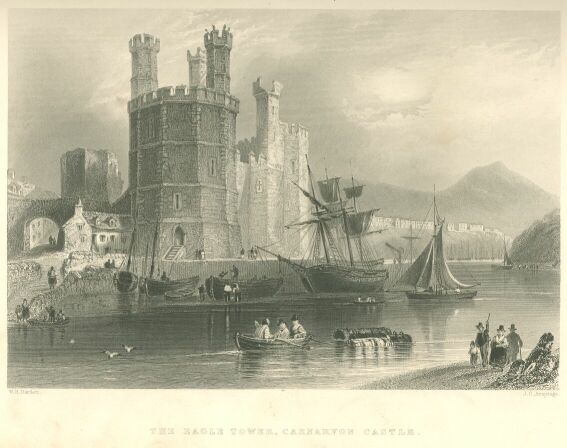
There prevails a vulgar story, which, as it well suits the capacity of the monkish writers, is carefully recorded by them; that Edward, assembling the Welsh, promised to give them a prince of unexceptionable manners, a Welshman by birth, and one who could speak no other language. On their acclamations of joy, and promise of obedience, he invested in the principality his second son, Edward, then an infant, who had been born at Carnarvon. The death of his eldest son Alphonso, soon after, made young Edward heir of the monarchy; the principality of Wales was fully annexed.
ENLARGE
1286.
The settlement of Wales appeared so complete to Edward, that in less than two years after, he went abroad, in order to make peace between Alphonso, king of Arragon, and Philip the Fair, who had lately succeeded his father, Philip the Hardy, on the throne of France.[*] The difference between these two princes had arisen about the kingdom of Sicily, which the pope, after his hopes from England failed him, had bestowed on Charles, brother to St. Lewis, and which was claimed upon other titles by Peter, king of Arragon, father to Alphonso. Edward had powers from both princes to settle the terms of peace, and he succeeded in his endeavors; but as the controversy nowise regards England, we shall not enter into a detail of it. He staid abroad above three years; and on his return found many disorders to have prevailed, both from open violence and from the corruption of justice.
Thomas Chamberlain, a gentleman of some note, had assembled several of his associates at Boston, in Lincolnshire, under pretence of holding a tournament, an exercise practised by the gentry only; but in reality with a view of plundering the rich fair of Boston, and robbing the merchants. To facilitate his purpose, he privately set fire to the town; and while the inhabitants were employed in quenching the flames, the conspirators broke into the booths, and carried off the goods. Chamberlain himself was detected and hanged; but maintained so steadily the point of honor to his accomplices, that he could not be prevailed on, by offers or promises, to discover any of them. Many other instances of robbery and violence broke out in all parts of England; though the singular circumstances attending this conspiracy have made it alone be particularly recorded by historians.[**]
* Rymer, vol. ii. p. 149,150, 174. ** Heming vol. i. p. 16, 17.
1289.
But the corruption of the judges, by which the fountains of justice were poisoned, seemed of still more dangerous consequence. Edward, in order to remedy this prevailing abuse, summoned a parliament, and brought the judges to a trial; where all of them, except two, who were clergymen, were convicted of this flagrant iniquity, were fined, and deposed. The amount of the fines levied upon them is alone a sufficient proof of their guilt; being above one hundred thousand marks, an immense sum in those days, and sufficient to defray the charges of an expensive war between two great kingdoms. The king afterwards made all the new judges swear that they would take no bribes; but his expedient of deposing and fining the old ones, was the more effectual remedy.
We now come to give an account of the state of affairs in Scotland, which gave rise to the most interesting transactions of this reign, and of some of the subsequent; though the intercourse of that kingdom with England, either in peace or war, had hitherto produced so few events of moment, that, to avoid tediousness, we have omitted many of them, and have been very concise in relating the rest. If the Scots had, before this period, any real history worthy of the name, except what they glean from scattered passages in the English historians, those events, however minute, yet being the only foreign transactions of the nation, might deserve a place in it.
Though the government of Scotland had been continually exposed to those factions and convulsions which are incident to all barbarous and to many civilized nations; and though the successions of their kings, the only part of their history which deserves any credit had often been disordered by irregularities and usurpations; the true heir of the royal family had still in the end prevailed, and Alexander III., who had espoused the sister of Edward, probably inherited, after a period of about eight hundred years, and through a succession of males, the sceptre of all the Scottish princes who had governed the nation since its first establishment in the island. This prince died in 1286, by a fall from his horse at Kinghorn,[*] without leaving any male issue, and without any descendant, except Margaret, born of Eric, king of Norway, and of Margaret, daughter of the Scottish monarch. This princess, commonly called the Maid of Norway, though a female, and an infant, and a foreigner, yet being the lawful heir of the kingdom, had, through her grandfather’s care, been recognized successor by the states of Scotland;[**] and on Alexander’s death, the dispositions which had been previously made against that event, appeared so just and prudent, that no disorders, as might naturally be apprehended, ensued in the kingdom.
* Heming. vol. i. p. 29. Trivet, p. 267. ** Rymer, vol. ii. p. 266.
Margaret was acknowledged queen of Scotland; five guardians, the bishops of St. Andrews and Glasgow, the earls of Fife and Buchan, and James, steward of Scotland, entered peaceably upon the administration; and the infant princess, under the protection of Edward, her great uncle, and Eric, her father, who exerted themselves on this occasion, seemed firmly seated on the throne of Scotland. The English monarch was naturally led to build mighty projects on this incident; and having lately, by force of arms, brought Wales under subjection, he attempted, by the marriage of Margaret with his eldest son, Edward, to unite the whole island into one monarchy, and thereby to give it security both against domestic convulsions and foreign invasions.
1290.
The amity which had of late prevailed between the two nations, and which, even in former times, had never been interrupted by any violent wars or injuries, facilitated extremely the execution of this project, so favorable to the happiness and grandeur of both kingdoms; and the states of Scotland readily gave their assent to the English proposals, and even agreed that their young sovereign should be educated in the court of Edward. Anxious, however, for the liberty and independency of their country, they took care to stipulate very equitable conditions, ere they intrusted themselves into the hands of so great and so ambitious a monarch. It was agreed that they should enjoy all their ancient laws, liberties, and customs; that in case young Edward and Margaret should die without issue, the crown of Scotland should revert to the next heir, and should be inherited by him free and independent; that the military tenants of the crown should never be obliged to go out of Scotland, in order to do homage to the sovereign of the united kingdoms, nor the chapters of cathedral, collegiate, or conventual churches, in order to make elections; that the parliaments summoned for Scottish affairs should always be held within the bounds of that kingdom; and that Edward should bind himself, under the penalty of one hundred thousand marks, payable to the pope for the use of the holy wars to observe all these articles.[*]
* Rymer, vol. ii. p. 482.
It is not easy to conceive that two nations could have treated more on a footing of equality than Scotland and England maintained during the whole course of this transaction; and though Edward gave his assent to the article concerning the future independency of the Scottish crown, with a “saving of his former rights,” this reserve gave no alarm to the nobility of Scotland, both because these rights, having hitherto been little heard of had occasioned no disturbance, and because the Scots had so near a prospect of seeing them entirely absorbed in the rights of their sovereignty.
1291.
But this project, so happily formed and so amicably conducted, failed of success, by the sudden death of the Norwegian princess, who expired on her passage to Scotland,[*] and left a very dismal prospect to the kingdom. Though disorders were for the present obviated by the authority of the regency formerly established, the succession itself of the crown was now become an object of dispute; and the regents could not expect that a controversy, which is not usually decided by reason and argument alone, would be peaceably settled by them, or even by the states of the kingdom, amidst so many powerful pretenders. The posterity of William, king of Scotland, the prince taken prisoner by Henry II., being all extinct by the death of Margaret of Norway, the right to the crown devolved on the issue of David, earl of Huntingdon brother to William, whose male line being also extinct, left the succession open to the posterity of his daughters. The earl of Huntingdon had three daughters; Margaret, married to Alan, lord of Galloway, Isabella, wife of Robert Brus or Bruce lord of Annandale, and Adama, who espoused Henry, Lord Hastings. Margaret, the eldest of the sisters, left one daughter, Devergilda, married to John Baliol, by whom she had a son of the same name, one of the present competitors for the crown: Isabella II. bore a son, Robert Bruce, who was now alive, and who also insisted on his claim: Adama III. left a son, John Hastings, who pretended that the kingdom of Scotland, like many other inheritances, was divisible among the three daughters of the earl of Huntingdon, and that he, in right of his mother, had a title to a third of it. Baliol and Bruce united against Hastings, in maintaining that, the kingdom was indivisible; but each of them, supported by plausible reasons, asserted the preference of his own title. Baliol was sprung from the elder branch: Bruce was one degree nearer the common stock: if the principle of representation was regarded, the former had the better claim: if propinquity was considered, the latter was entitled to the preference.[**]
* Heming. vol. i. p. 30. Trivet, p. 268 ** Heming. vol. i. p. 36.
The sentiments of men were divided: all the nobility had taken part on one side or the other: the people followed implicitly their leaders: the two claimants themselves had great power and numerous retainers in Scotland: and it is no wonder that, among a rude people, more accustomed to arms than inured to laws, a controversy of this nature, which could not be decided by any former precedent among them, and which is capable of exciting commotions in the most legal and best established governments, should threaten the state with the most fatal convulsions.
Each century has its peculiar mode in conducting business; and men, guided more by custom than by reason, follow, without inquiry, the manners which are prevalent in their own time. The practice of that age in controversies between states and princes, seems to have been to choose a foreign prince as an equal arbiter, by whom the question was decided, and whose sentence prevented those dismal confusions and disorders, inseparable at all times from war, but which were multiplied a hundred fold, and dispersed into every corner, by the nature of the feudal governments. It was thus that the English king and barons, in the preceding reign, had endeavored to compose their dissensions by a reference to the king of France; and the celebrated integrity of that monarch had prevented all the bad effects which might naturally have been dreaded from so perilous an expedient. It was thus that the kings of France and Arragon, and afterwards other princes, had submitted their controversies to Edward’s judgment; and the remoteness of their states, the great power of the princes, and the little interest which he had on either side, had induced him to acquit himself with honor in his decisions. The parliament of Scotland, therefore, threatened with a furious civil war, and allured by the great reputation of the English monarch, as well as by the present amicable correspondence between the kingdoms, agreed in making a reference to Edward; and Fraser, bishop of St. Andrews, with other deputies, was sent to notify to him their resolution, and to claim his good offices in the present dangers to which they were exposed.[*]
* Heming, vol. i. p. 31.
His inclination, they flattered themselves, led him to prevent their dissensions, and to interpose with a power which none of the competitors would dare to withstand: when this expedient was proposed by one party, the other deemed it dangerous to object to it: indifferent persons thought that the imminent perils of a civil war would thereby be prevented; and no one reflected on the ambitious character of Edward, and the almost certain ruin which must attend a small state divided by faction, when it thus implicitly submits itself to the will of so powerful and encroaching a neighbor.
The temptation was too strong for the virtue of the English monarch to resist. He purposed to lay hold of the present favorable opportunity, and if not to create, at least to revive, his claim of a feudal superiority over Scotland; a claim which had hitherto lain in the deepest obscurity, and which, if ever it had been an object of attention, or had been so much as suspected, would have effectually prevented the Scottish barons from choosing him for an umpire. He well knew that, if this pretension were once submitted to, as it seemed difficult in the present situation of Scotland to oppose it, the absolute sovereignty of that kingdom (which had been the case with Wales) would soon follow; and that one great vassal, cooped up in an island with his liege lord, without resource from foreign powers, without aid from any fellow-vassals, could not long maintain his dominions against the efforts of a mighty kingdom, assisted by all the cavils which the feudal law afforded his superior against him. In pursuit of this great object, very advantageous to England, perhaps in the end no less beneficial to Scotland, but extremely unjust and iniquitous in itself, Edward busied himself in searching for proofs of his pretended superiority; and, instead of looking into his own archives, which, if his claim had been real, must have afforded him numerous records of the homages done by the Scottish princes, and could alone yield him any authentic testimony, he made all the monasteries be ransacked for old chronicles and histories written by Englishmen, and he collected all the passages which seemed anywise to favor his pretensions.[*] Yet even in this method of proceeding, which must have discovered to himself the injustice of his claim, he was far from being fortunate. He began his proofs from the time of Edward the Elder, and continued them through all the subsequent Saxon and Norman times; but produced nothing to his purpose.[**]
* Walsing. p. 55. ** Rymer, vol. ii. p, 559.
The whole amount of his authorities during the Saxon period, when stripped of the bombast and inaccurate style of the monkish historians, is, that the Scots had sometimes been defeated by the English, had received peace on disadvantageous terms, had made submissions to the English monarch, and had even perhaps fallen into some dependence on a power which was so much superior, and which they had not at that time sufficient force to resist. His authorities from the Norman period were, if possible, still less conclusive: the historians indeed make frequent mention of homage done by the northern potentate; but no one of them says that it was done for his kingdom; and several of them declare, in express terms that it was relative only to the fiefs which he enjoyed south of the Tweed;[*] in the same manner, as the king of England himself swore fealty to the French monarch, for the fiefs which he inherited in France. And to such scandalous shifts was Edward reduced, that he quotes a passage from Hoveden[**] where it is asserted that a Scottish king had done homage to England; but he purposely omits the latter part of the sentence, which expresses that this prince did homage for the lands which he held in England.
When William, king of Scotland, was taken prisoner in the battle of Alnwick, he was obliged, for the recovery of his liberty, to swear fealty to the victor for his crown itself. The deed was performed according to all the rites of the feudal law: the record was preserved in the English archives, and is mentioned by all the historians: but as it is the only one of the kind, and as historians speak of this superiority as a great acquisition gained by the fortunate arms of Henry II.,[***] there can remain no doubt that the kingdom of Scotland was, in all former periods, entirely free and independent. Its subjection continued a very few years: King Richard, desirous, before his departure for the Holy Land, to conciliate the friendship of William, renounced that homage, which, he says in express terms, had been extorted by his father; and he only retained the usual homage which had been done by the Scottish princes for the lands which they held in England.
* Hoveden, p. 492, 662. M. Paris, p. 109. M. West. p. 256. ** Page 662. *** Neubr. lib. ii. cap. 4. Knyghton, p. 2392.
But though this transaction rendered the independence of Scotland still more unquestionable, than if no fealty had ever been sworn to the English crown, the Scottish kings, apprised of the point aimed at by their powerful neighbors, seem for a long time to have retained some jealousy on that head, and, in doing homage, to have anxiously obviated all such pretensions. When William, in 1200, did homage to John at Lincoln, he was careful to insert a salvo for his royal dignity;[*] when Alexander III. sent assistance to his father-in-law, Henry III., during the wars of the barons, he previously procured an acknowledgment, that this aid was granted only from friendship, not from any right claimed by the English monarch;[**] and when that same prince was invited to assist at the coronation of this very Edward, he declined attendance till he received a like acknowledgment.[***] 1
But as all these reasons (and stronger could not be produced) were but a feeble rampart against the power of the sword, Edward, carrying with him a great army, which was to enforce his proofs, advanced to the frontiers, and invited the Scottish parliament, and all the competitors, to attend him in the Castle of Norham, a place situated on the southern banks of the Tweed, in order to determine the cause which had been referred to his arbitration. But though this deference seemed due to so great a monarch, and was no more than what his father and the English barons had, in similar circumstances, paid to Lewis IX., the king, careful not to give umbrage, and determined never to produce his claim till it should be too late to think of opposition, sent the Scottish barons an acknowledgment, that, though at that time they passed the frontiers, this step should never be drawn into precedent, or afford the English kings a pretence for exacting a like submission in any future transaction.[****] When the whole Scottish nation had thus unwarily put themselves in his power, Edward opened the conferences at Norham: he informed the parliament, by the mouth of Roger le Brabançon, his chief justiciary, that he was come thither to determine the right among the competitors to their crown; that he was determined to do strict justice to all parties; and that he was entitled to this authority, not in virtue of the reference made to him, but in quality of superior and liege lord of the kingdom.[*****] 2
* Hoveden, p. 811. ** Rymer, vol. ii p 844. *** See note A. at the end of the volume. **** Rymer, vol. ii. p. 539, 845. Walsing. p. 58.
He then produced his proofs of this superiority, which he pretended to be unquestionable, and he required of them an acknowledgment of it; a demand which was superfluous if the fact were already known and avowed, and which plainly betrays Edward’s consciousness of his lame and defective title. The Scottish parliament was astonished at so new a pretension, and answered only by their silence. But the king, in order to maintain the appearance of free and regular proceedings, desired them to remove into their own country, to deliberate upon his claim, to examine his proofs, to propose all their objections, and to inform him of their resolution; and he appointed a plain at Upsettleton, on the northern banks of the Tweed, for that purpose.
When the Scottish barons assembled in this place, though moved with indignation at the injustice of this unexpected claim, and at the fraud with which it had been conducted, they found themselves betrayed into a situation in which it was impossible for them to make any defence for the ancient liberty and independence of their country. The king of England, a martial and politic prince, at the head of a powerful army, lay at a very small distance, and was only separated from them by a river fordable in many places. Though, by a sudden flight, some of them might themselves be, able to make their escape, what hopes could they entertain of securing the kingdom against his future enterprises? Without a head, without union among themselves, attached all of them to different competitors, whose title they had rashly submitted to the decision of this foreign usurper, and who were thereby reduced to an absolute dependence upon him, they could only expect by resistance to entail on themselves and their posterity a more grievous and more destructive servitude. Yet even in this desperate state of their affairs the Scottish barons, as we learn from Walsingham,[*] one of the best historians of that period, had the courage to reply that, till they had a king, they could take no resolution on so momentous a point: the journal of King Edward says, that they made no answer at all;[**] that is, perhaps, no particular answer or objection to Edward’s claim: and by this solution it is possible to reconcile the journal with the historian. The king, therefore, interpreting their silence as consent, addressed himself to the several competitors.
* Page 56. M. West. p. 436. It is said by Hemingford, vol. i, p. 33, that the king menaced violently the Scotch barons, and forced them to compliance, at least to silence. ** Rymer, vol. ii. p. 548. previously to his pronouncing sentence, required their acknowledgment of his superiority.
It is evident from the genealogy of the royal family of Scotland, that there could only be two questions about the succession—that between Baliol and Bruce on the one hand, and Lord Hastings on the other, concerning the partition of the crown: and that between Baliol and Bruce themselves concerning the preference of their respective titles, supposing the kingdom indivisible: yet there appeared on this occasion no less than nine claimants besides; John Comyn or Cummin, lord of Badenoch, Florence, earl of Holland, Patric Dunbar, earl of March, William de Vescey, Robert de Pynkeni, Nicholas de Soules, Patric Galythly, Roger de Mandeville, Robert de Ross; not to mention the king of Norway, who claimed as heir to his daughter Margaret.[*] Some of these competitors were descended from more remote branches of the royal family; others were even sprung from illegitimate children; and as none of them had the least pretence of right, it is natural to conjecture that Edward had secretly encouraged them to appear in the list of claimants, that he might sow the more division among the Scottish nobility, make the cause appear the more intricate, and be able to choose, among a great number, the most obsequious candidate.
But he found them all equally obsequious on this occasion.[**] Robert Bruce was the first that acknowledged Edward’s right of superiority over Scotland; and he had so far foreseen the king’s pretensions, that even in his petition, where he set forth his claim to the crown, he had previously applied to him as liege lord of the kingdom; a step which was not taken by any of the other competitors.[***] They all, however, with seeming willingness, made a like acknowledgment when required; though Baliol, lest he should give offence to the Scottish nation, had taken care to be absent during the first days; and he was the last that recognized the king’s title.[****]
* Walsing. p. 58. ** Rymer, vol. ii. p. 529, 545. Walsing. p. 56. Heming. vol. i. 33, 34. Trivet, p. 260. M. West. p. 415. *** Rymer, vol. ii. p. 577, 578, 579. **** Rymer, vol. ii. p. 546.
Edward next deliberated concerning the method of proceeding in the discussion of this great controversy. He gave orders that Baliol, and such of the competitors as adhered to him should choose forty commissioners; Bruce and his adherents forty more: to these the king added twenty-four Englishmen: he ordered these hundred and four commissioners to examine the cause deliberately among themselves, and make their report to him:[*] and he promised in the ensuing year to give his determination. Meanwhile he pretended that it was requisite to have all the fortresses of Scotland delivered into his hands, in order to enable him, without opposition, to put the true heir in possession of the crown; and this exorbitant demand was complied with, both by the states and by the claimants.[**] The governors also of all the castles immediately resigned their command; except Umfreville, earl of Angus, who refused, without a formal and particular acquittal from the parliament and the several claimants, to surrender his fortresses to so domineering an arbiter, who had given to Scotland so many just reasons of suspicion.[***] Before this assembly broke up, which had fixed such a mark of dishonor on the nation, all the prelates and barons there present swore fealty to Edward; and that prince appointed commissioners to receive a like oath from all the other barons and persons of distinction in Scotland.[****]
* Rymer, vol. ii. p. 555, 556. ** Rymer, vol. ii. p. 529. Walsing. p. 56, 57. *** Rymer, vol. ii. p. 531. **** Rymer, vol. ii p. 573.
The king, having finally made, as he imagined, this important acquisition, left the commissioners to sit at Berwick, and examine the titles of the several competitors who claimed the precarious crown, which Edward was willing for some time to allow the lawful heir to enjoy. He went southwards, both in order to assist at the funeral of his mother, Queen Eleanor, who died about this time, and to compose some differences which had arisen among his principal nobility. Gilbert, earl of Glocester, the greatest baron of the kingdom, had espoused the king’s daughter; and being elated by that alliance, and still more by his own power, which, he thought, set him above the laws, he permitted his bailiffs and vassals to commit violence on the lands of Humphrey Bohun, earl of Hereford, who retaliated the injury by like violence. But this was not a reign in which such illegal proceedings could pass with impunity. Edward procured a sentence against the two earls, committed them both to prison, and would not restore them to their liberty, till he had exacted a fine of one thousand marks from Hereford, and one of ten thousand from his son-in-law.
1292.
During this interval, the titles of John Baliol and of Robert Bruce, whose claims appeared to be the best founded among the competitors for the crown of Scotland, were the subject of general disquisition, as well as of debate among the commissioners. Edward, in order to give greater authority to his intended decision, proposed this general question both to the commissioners and to all the celebrated lawyers in Europe, “Whether a person descended from the elder sister, but farther removed by one degree, were preferable, in the succession of kingdoms, fiefs, and other indivisible inheritances, to one descended from the younger sister, but one degree nearer to the common stock?” This was the true state of the case; and the principle of representation had now gained such ground every where, that a uniform answer was returned to the king in the affirmative. He therefore pronounced sentence in favor of Balioi; and when Bruce, upon this disappointment, joined afterwards Lord Hastings, and claimed a third of the kingdom, which he now pretended to be divisible, Edward, though his interests seemed more to require the partition of Scotland, again pronounced sentence in favor of Baliol. That competitor, upon renewing his oath of fealty to England, was put in possession of the kingdom;[*] all his fortresses were restored to him;[**] and the conduct of Edward, both in the deliberate solemnity of the proceedings, and in the justice of the award, was so far unexceptionable.
1293.
Had the king entertained no other view than that of establishing his superiority over Scotland, though the iniquity of that claim was apparent, and was aggravated by the most egregious breach of trust, he might have fixed his pretensions, and have left that important acquisition to his posterity: but he immediately proceeded in such a manner as made it evident that, not content with this usurpation, he aimed also at the absolute sovereignty and dominion of the kingdom. Instead of gradually inuring the Scots to the yoke, and exerting his rights of superiority with moderation, he encouraged all appeals to England; required King John himself, by six different summons on trivial occasions, to come to London;[***] refused him the privilege of defending his cause by a procurator; and obliged him to appear at the bar of his parliament as a private person.[****]
* Rymer vol. ii. p. 590, 591, 593, 600. ** Rymer, voL ii p. 599. *** Rymer, p. 603, 605, 606, 608, 615, 616. **** Ryley’s Placit. Parl. p. 152, 153.
These humiliating demands were hitherto quite unknown to a king of Scotland: they are, however, the necessary consequence of vassalage by the feudal law; and as there was no preceding instance of such treatment submitted to by a prince of that country, Edward must, from that circumstance alone, had there remained any doubt, have been himself convinced that his claim was altogether a usurpation.[*] 3 But his intention plainly was to enrage Baliol by these indignities, to engage him in rebellion, and to assume the dominion of the state as the punishment of his treason and felony. Accordingly Baliol, though a prince of a soft and gentle spirit, returned into Scotland highly provoked at this usage, and determined at all hazards to vindicate his liberty; and the war which soon after broke out between France and England, gave him a favorable opportunity of executing his purpose.
The violence, robberies, and disorders, to which that age was so subject, were not confined to the licentious barons and their retainers at land: the sea was equally infested with piracy: the feeble execution of the laws had given license to all orders of men: and a general appetite for rapine and revenge, supported by a false point of honor, had also infected the merchants and mariners; and it pushed them, on any provocation, to seek redress by immediate retaliation upon the aggressors. A Norman and an English vessel met off the coast near Bayonne; and both of them having occasion for water, they sent their boats to land, and the several crews came at the same time to the same spring: there ensued a quarrel for the preference: a Norman, drawing his dagger, attempted to stab an Englishman; who, grappling with him, threw his adversary on the ground; and the Norman, as was pretended, falling on his own dagger, was slain.[**] This scuffle between two seamen about water, soon kindled a bloody war between the two nations, and involved a great part of Europe in the quarrel. The mariners of the Norman ship carried their complaints to the French king: Philip, without inquiring into the fact, without demanding redress, bade them take revenge, and trouble him no more about the matter.[***]
* See note C, at the end of the volume. ** Walsing. p. 58. Heming. vol. i. p. 39. *** Walsing. p. 59.
The Normans, who had been more regular than usual in applying to the crown, needed but this hint to proceed to immediate violence. They seized an English ship in the channel; and hanging, along with some dogs, several of the crew on the yard-arm, in presence of their companions, dismissed the vessel; [*] and bade the mariners inform their countrymen that vengeance was now taken for the blood of the Norman killed at Bayonne. This injury, accompanied with so general and deliberate an insult, was resented by the mariners of the cinque ports, who, without carrying any complaint to the king, or waiting for redress, retaliated by committing like barbarities on all French vessels without distinction. The French, provoked by their losses, preyed on the ships of all Edward’s subjects, whether English or Gascon: the sea became a scene of piracy between the nations: the sovereigns, without either seconding or repressing the violence of their subjects, seemed to remain indifferent spectators: the English made private associations with the Irish and Dutch seamen; the French with the Flemish and Genoese;[**] and the animosities of the people on both sides became every day more violent and barbarous. A fleet of two hundred Norman vessels set sail to the south for wine and other commodities; and in their passage seized all the English ships which they met with, hanged the seamen, and seized the goods. The inhabitants of the English seaports, informed of this incident, fitted out a fleet of sixty sail, stronger and better manned than the others, and awaited the enemy on their return. After an obstinate battle, they put them to rout, and sunk, destroyed, or took the greater part of them.[***] No quarter was given; and it is pretended that the loss of the French amounted to fifteen thousand men; which is accounted for by this circumstance, that the Norman fleet was employed in transporting a considerable body of soldiers from the south.
The affair was now become too important to be any longer overlooked by the sovereigns. On Philip’s sending an envoy to demand reparation and restitution, the king despatched the bishop of London to the French court, in order to accommodate the quarrel. He first said, that the English courts of justice were open to all men; and if any Frenchman were injured, he might seek reparation by course of law.[****]
* Heming. vol. i. p. 40. M. West. p. 419. ** Heming. vol. i. p. 40. *** Walsing. p. 60. Trivet, p 274. Chron. Dunst vol. ii. p 609. **** Trivet, p. 275.
He next offered to adjust the matter by private arbiters, or by a personal interview with the king of France, or by a reference either to the pope, or the college of cardinals, or any particular cardinals, agreed on by both parties.[*] The French, probably the more disgusted, as they were hitherto losers in the quarrel, refused all these expedients: the vessels and the goods of merchants were confiscated on both sides: depredations were continued by the Gascons on the western coast of France, as well as by the English in the Channel: Philip cited the king, as duke of Guienne, to appear in his court at Paris, and answer for these offences; and Edward, apprehensive of danger to that province, sent John St. John, an experienced soldier, to Bordeaux, and gave him directions to put Guienne in a posture of defence.[**]
1294.
That he might, however, prevent a final rupture between the nations, the king despatched his brother, Edmond, earl of Lancaster, to Paris; and as this prince had espoused the queen of Navarre, mother to Jane, queen of France, he seemed, on account of that alliance, the most proper person for finding expedients to accommodate the difference. Jane pretended to interpose with her good offices: Mary, the queen dowager, feigned the same amicable disposition: and these two princesses told Edmond, that the circumstance the most difficult to adjust was the point of honor with Philip, who thought himself affronted by the injuries committed against him by his sub-vassals in Guienne; but if Edward would once consent to give him seizin and possession of that province, he would think his honor fully repaired, would engage to restore Guienne immediately, and would accept of a very easy satisfaction for all the other injuries. The king was consulted on the occasion; and as he then found himself in immediate danger of war with the Scots, which he regarded as the more important concern, this politic prince, blinded by his favorite passion for subduing that nation, allowed himself to be deceived by so gross an artifice.[***] He sent his brother orders to sign and execute the treaty with the two queens; Philip solemnly promised to execute his part of it; and the king’s citation to appear in the court of France, was accordingly recalled; but the French monarch was no sooner put in possession of Guienne, than the citation was renewed; Edward was condemned for non-appearance; and Guienne, by a formal sentence, was declared to be forfeited and annexed to the crown.[****]
* Trivet, p. 275. ** Trivet, p. 276. *** Rymer, vol. ii. p. 619, 620. Walsing. p. 61. Heming. vol. i p. 42, 43. Trivet, p. 277. **** Rymer vol. ii p. 620, 622. Walsing. p. 61. Trivet, p. 278.
Edward, fallen into a like snare with that which he himself had spread for the Scots, was enraged; and the more so, as he was justly ashamed of his own conduct, in being so egregiously overreached by the court of France. Sensible of the extreme difficulties which he should encounter in the recovery of Gascony, where he had not retained a single place in his hands, he endeavored to compensate that loss by forming alliances with several princes, who, he projected, should attack France on all quarters, and make a diversion of her forces. Adolphus de Nassau, king of the Romans, entered into a treaty with him for that purpose;[*] as did also Amadæus, count of Savoy, the archbishop of Cologne, the counts of Gueldre and Luxembourg; the duke of Brabant and count of Barre, who had married his two daughters, Margaret and Eleanor: but these alliances were extremely burdensome to his narrow revenues, and proved in the issue entirely ineffectual. More impression was made on Guienne by an English army, which he completed by emptying the jails of many thousand thieves and robbers, who had been confined there for their crimes. So low had the profession of arms fallen, and so much had it degenerated from the estimation in which it stood during the vigor of the feudal system!
1295.
The king himself was detained in England, first by contrary winds,[**] then by his apprehensions of a Scottish invasion, and by a rebellion of the Welsh, whom he repressed and brought again under subjection.[***] The army which he sent to Guienne, was commanded by his nephew, John de Bretagne, earl of Richmond, and under him by St. John, Tibetot, De Vere, and other officers of reputation;[****] who made themselves masters of the town of Bayonne, as well as of Bourg, Blaye, Reole, St. Severe, and other places, which straitened Bordeaux, and cut off its communication both by sea and land.
* Heming. vol, i. p. 51. ** Chron. Dunst. vol. ii. p. 622. *** Walsing. p. 62. Heming. vol. i. p. 55. Trivet, p. 282. Chron Dunst. vol. ii. p. 622. **** Trivet, p. 279.
The favor which the Gascon nobility bore to the English government facilitated these conquests, and seemed to promise still greater successes; but this advantage was soon lost by the misconduct of some of the officers. Philip’s brother, Charles de Valois, who commanded the French armies, having laid siege to Podensac, a small fortress near Reole, obliged Giffard, the governor, to capitulate; and the articles though favorable to the English, left all the Gascons prisoners at discretion, of whom about fifty were hanged by Charles as rebels; a policy by which he both intimidated that people, and produced an irreparable breach between them and the English.[*] That prince immediately attacked Reole, where the earl of Richmond himself commanded; and as the place seemed not tenable, the English general drew his troops to the water side, with an intention of embarking with the greater part of the army. The enraged Gascons fell upon his rear, and at the same time opened their gates to the French, who, besides making themselves masters of the place, took many prisoners of distinction. St. Severe was more vigorously defended by Hugh de Vere, son of the earl of Oxford; but was at last obliged to capitulate. The French king, not content with these successes in Gascony, threatened England with an invasion; and, by a sudden attempt, his troops took and burnt Dover,[**] but were obliged soon after to retire. And in order to make a greater diversion of the English force, and engage Edward in dangerous and important wars, he formed a secret alliance with John Baliol, king of Scotland; the commencement of that strict union which, during so many centuries, was maintained, by mutual interests and necessities, between the French and Scottish nations. John confirmed this alliance by stipulating a marriage between his eldest son and the daughter of Charles de Valois.[***]
* Heming. vol. i. p. 49. ** Trivet, p. 284. Chron. Dunst. vol. ii. p. 642. *** Rymer, vol. ii. p. 680, 681, 695, 697. Heming. vol. i. p. 76. Trivet, i, 285.
The expenses attending these multiplied wars of Edward, and his preparations for war, joined to alterations which had insensibly taken place in the general state of affairs, obliged him to have frequent recourse to parliamentary supplies, introduced the lower orders of the state into the public councils, and laid the foundations of great and important changes in the government.
Though nothing could be worse calculated for cultivating the arts of peace, or maintaining peace itself, than the long subordination of vassalage from the king to the meanest gentleman, and the consequent slavery of the lower people, evils inseparable from the feudal system, that system was never able to fix the state in a proper warlike posture, or give it the full exertion of its power for defence, and still less for offence, against a public enemy. The military tenants, unacquainted with obedience, unexperienced in war, held a rank in the troops by their birth, not by their merits or services; composed a disorderly and consequently a feeble army; and during the few days which they were obliged by their tenures to remain in the field, were often more formidable to their own prince than to foreign powers, against whom they were assembled. The sovereigns came gradually to disuse this cumbersome and dangerous machine, so apt to recoil upon the hand which held it; and exchanging the military service for pecuniary supplies, enlisted forces by means of a contract with particular officers, (such as those the Italians denominate “condottieri,”) whom they dismissed at the end of the war.[*] The barons and knights themselves often entered into these engagements with the prince; and were enabled to fill their bands, both by the authority which they possessed over their vassals and tenants, and from the great numbers of loose, disorderly people whom they found on their estates, and who willingly embraced an opportunity of gratifying their appetite for war and rapine.
Meanwhile the old Gothic fabric, being neglected, went gradually to decay. Though the Conqueror had divided all the lands of England into sixty thousand knights’ fees, the number of these was insensibly diminished by various artifices; and the king at last found that, by putting the law in execution, he could assemble a small part only of the ancient force of the kingdom. It was a usual expedient for men who held of the king or great barons by military tenure, to transfer their land to the church, and receive it back by another tenure, called frankalmoigne, by which they were not bound to per form any service.[**] A law was made against this practice; but the abuse had probably gone far before it was attended to, and probably was not entirely corrected by the new statute, which, like most laws of that age, we may conjecture to have been but feebly executed by the magistrate against the perpetual interest of so many individuals. The constable and mareschal, when they mustered the armies, often in a hurry, and for want of better information, received the service of a baron for fewer knights’ fees than were due by him; and one precedent of this kind was held good against the king, and became ever after a reason for diminishing the service.[***]
* Cotton’s Abr. p. 11. ** Madox, Baronia Anglica, p. 114. *** Madox, Bar. Ang. p 115.
The rolls of knights’ fees were inaccurately kept; no care was taken to correct them before the armies were summoned into the field,[*] it was then too late to think of examining records and charters; and the service was accepted on the footing which the vassal himself was pleased to acknowledge, after all the various subdivisions and conjunctions of property had thrown an obscurity on the nature and extent of his tenure.[**] It is easy to judge of the intricacies which would attend disputes of this kind with individuals; when even the number of military fees belonging to the church, whose property way fixed and unalienable, became the subject of controversy; and we find in particular, that when the bishop of Durham was charged with seventy knights’ fees for the aid levied on occasion of the marriage of Henry II.‘s daughter to the duke of Saxony, the prelate acknowledged ten, and disowned the other sixty.[***] It is not known in what mariner this difference was terminated; but had the question been concerning an armament to defend the kingdom, the bishop’s service would probably have been received without opposition for ten fees; and this rate must also have fixed all his future payments. Pecuniary scutages, therefore, diminished as much as military services;[****] other methods of filling the exchequer, as well as the armies, must be devised: new situations produced new laws and institutions; and the great alterations in the finances and military power of the crown, as well as in private property, were the source of equal innovations in every part of the legislature or civil government.
* We hear only of one king, Henry II., who took this pains; and the record, called Liber Niger Scaccarii, was the result of it. ** Madox, Bar. Ang. p. 116. *** Madox, p. 122. Hist. of the Exch. p. 404. **** In order to pay the sum of one hundred thousand marks, as King Richard’s ransom, twenty shillings were imposed on each knight’s fee. Had the fees remained on the original footing, as settled by the Conqueror, this scutage would have amounted to ninety thousand marks, which was nearly the sum required; but we find that other grievous taxes were imposed to complete it; a certain proof that many frauds and abuses had prevailed in the roll of knights fees.
The exorbitant estates conferred by the Norman on his barons and chieftains, remained not long entire and unimpaired. The landed property was gradually shared out into more hands; and those immense baronies were divided, either by provisions to younger children, by partitions among co-heirs, by sale, or by escheating to the king, who gratified a great number of his courtiers by dealing them out among them in smaller portions. Such moderate estates, as they required economy, and confined the proprietors to live at home, were better calculated for duration; and the order of knights and small barons grew daily more numerous, and began to form a very respectable rank or order in the state. As they were all immediate vassals of the crown by military tenure, they were, by the principles of the feudal law, equally entitled with the greatest barons to a seat in the national or general councils; and this right, though regarded as a privilege which the owners would not entirely relinquish, was also considered as a burden which they desired to be subjected to on extraordinary occasions only. Hence it was provided in the charter of King John, that, while the great barons were summoned to the national council by a particular writ, the small barons, under which appellation the knights were also comprehended, should only be called by a general summons of the sheriff. The distinction between great and small barons, like that between rich and poor, was not exactly defined; but, agreeably to the inaccurate genius of that age, and to the simplicity of ancient government, was left very much to be determined by the discretion of the king and his ministers. It was usual for the prince to require, by a particular summons, the attendance of a baron in one parliament, and to neglect him in future parliaments;[*] nor was this uncertainty ever complained of as an injury. He attended when required: he was better pleased on other occasions to be exempted from the burden: and as he was acknowledged to be of the same order with the greatest barons, it gave them no surprise to see him take his seat in the great council, whether he appeared of his own accord, or by a particular summons from the king. The barons by writ, therefore, began gradually to intermix themselves with the barons by tenure; and, as Camden tells us,[**] from an ancient manuscript now lost, that after the battle of Evesham, a positive law was enacted, prohibiting every baron from appearing in parliament, who was not invited thither by a particular summons, the whole baronage of England held thenceforward their seat by writ, and this important privilege of their tenures was in effect abolished. Only where writs had been regularly continued for some time in one great family, the omission of them would have been regarded as an affront, and even as an injury.
* Chancellor West’s Inquiry into the Manner of creating Peers p. 43, 46, 47, 55. ** In Britain. p 122.
A like alteration gradually took place in the order of earls who were the highest rank of barons. The dignity of an earl, like that of a baron, was anciently territorial and official:[*] he exercised jurisdiction within his county: he levied the third of the fines to his own profit: he was at once a civil and a military magistrate: and though his authority, from the time of the Norman conquest, was hereditary in England, the title was so much connected with the office, that where the king intended to create a new earl, he had no other expedient than to erect a certain territory into a county or earldom, and to bestow it upon the person and his family.[**] But as the sheriffs, who were the vicegerents of the earls, were named by the king, and removable at pleasure, he found them more dependent upon him; and endeavored to throw the whole authority and jurisdiction of the office into their hands. This magistrate was at the head of the finances, and levied all the king’s rents within the county: he assessed at pleasure the talliages of the inhabitants in royal demesne: he had usually committed to him the management of wards, and often of escheats: he presided in the lower courts of judicature: and thus, though inferior to the earl in dignity, he was soon considered, by this union of the judicial and fiscal powers, and by the confidence reposed in him by the king, as much superior to him in authority, and undermined his influence within his own jurisdiction.[***] It became usual, in creating an earl, to give him a fixed salary, commonly about twenty pounds a year, in lieu of his third of the fines: the diminution of his power kept pace with the retrenchment of his profit: and the dignity of earl, instead of being territorial and official, dwindled into personal and titular. Such were the mighty alterations which already had fully taken place, or were gradually advancing, in the house of peers; that is, in the parliament: for there seems anciently to have been no other house.
* Spel. Gloss, in voce Comes. ** Essays on British Antiquities. This practice, however, seems to have been more familiar in Scotland and the kingdoms on the continent, than in England. *** There are instances of princes of the blood who accepted of the office of sheriff. Spel. in voce Vicecomes.
But though the introduction of barons by writ, and of titular earls, had given some increase to royal authority, there were other causes which counterbalanced those innovations, and tended in a higher degree to diminish the power of the sovereign. The disuse into which the feudal militia had in a great measure fallen made the barons almost entirely forget their dependence on the crown: by the diminution of the number of knights’ fees the king had no reasonable compensation when he levied scutages, and exchanged their service for money: the alienations of the crown lands had reduced him to poverty: and above all, the concession of the Great Charter had set bounds to royal power, and had rendered it more difficult and dangerous for the prince to exert any extraordinary act of arbitrary authority. In this situation it was natural for the king to court the friendship of the lesser barons and knights, whose influence was no ways dangerous to him, and who, being exposed to oppression from their powerful neighbors, sought a legal protection under the shadow of the throne. He desired, therefore, to have their presence in parliament, where they served to control the turbulent resolutions of the great. To exact a regular attendance of the whole body would have produced confusion, and would have imposed too heavy a burden upon them. To summon only a few by writ, though it was practised and had a good effect, served not entirely the king’s purpose; because these members had no further authority than attended their personal character, and were eclipsed by the appearance of the more powerful nobility, He therefore dispensed with the attendance of most of the lesser barons in parliament; and in return for this indulgence (for such it was then esteemed) required them to choose in each county a certain number of their own body, whose charges they bore, and who, having gained the confidence, carried with them, of course, the authority of the whole order. This expedient had been practised at different times in the reign of Henry III.,[*] and regularly during that of the present king. The numbers sent up by each county varied at the will of the prince:[**] they took their seat among the other peers; because by their tenure they belonged to that order:[***] the introducing of them into that house scarcely appeared an innovation: and though it was easily in the king’s power, by varying their number, to command the resolutions of the whole parliament this circumstance was little attended to in an age when force was more prevalent than laws, and when a resolution, though taken by the majority of a legal assembly, could not be executed, if it opposed the will of the more powerful minority.
*Rot. Glaus. 38. Hen. III. pp. 7. and 12. d.; as also Ret. Claus 12 Hen. III. m. 1. d. Prynne’s Pref. to Cotton’s Abridgment. ** Brady’s Answer to Petyt, from the records, p 151. *** Brady’s Treatise of Boroughs, App. No. 13.
But there were other important consequences, which followed the diminution and consequent disuse of the ancient feudal militia. The king’s expense in levying and maintaining a military force for every enterprise, was increased beyond what his narrow revenues were able to bear: as the scutages of his military tenants, which were accepted in lieu of their personal service, had fallen to nothing, there were no means of supply but from voluntary aids granted him by the parliament and clergy, or from the talliages which he might levy upon the towns and inhabitants in royal demesne. In the preceding year, Edward had been obliged to exact no less than the sixth of all movables from the laity, and a moiety of all ecclesiastical benefices[*] for his expedition into Poictou, and the suppression of the Welsh: and this distressful situation which was likely often to return upon him and his successors, made him think of a new device, and summon the representatives of all the boroughs to parliament. This period, which is the twenty-third of his reign, seems to be the real and true epoch of the house of commons, and the faint dawn of popular government in England. For the representatives of the counties were only deputies from the smaller barons and lesser nobility; and the former precedent of representatives from the boroughs, who were summoned by the earl of Leicester, was regarded as the act of a violent usurpation, had beer, discontinued in all the subsequent parliaments; and if such a measure had not become necessary on other accounts, that precedent was more likely to blast than give credit to it.
* Brady’s Treatise of Boroughs, p. 31, from the records. Heming vol. i. p. 52. M. West. p. 422. Ryley, p. 462
During the course of several years, the kings of England, in imitation of other European princes, had embraced the salutary policy of encouraging and protecting the lower and more industrious orders of the state; whom they found well disposed to obey the laws and civil magistrate, and whose ingenuity and labor furnish commodities requisite for the ornament of peace and support of war. Though the inhabitants of the country were still left at the disposal of their imperious lords, many attempts were made to give more security and liberty to citizens, and make them enjoy unmolested the fruits of their industry. Boroughs were erected by royal patent within the demesne lands; liberty of trade was conferred upon them; the inhabitants were allowed to farm, at a fixed rent, their own tolls and customs,[*] they were permitted to elect their own magistrates; justice was administered to them by these magistrates, without obliging them to attend the sheriff or county court: and some shadow of independence, by means of these equitable privileges, was gradually acquired by the people.[**] The king, however, retained still the power of levying talliage or taxes upon them at pleasure;[***] and though their poverty and the customs of the age made these demands neither frequent or exorbitant, such unlimited authority in the sovereign was a sensible check upon commerce, and was utterly incompatible with all the principles of a free government. But when the multiplied necessities of the crown produced a greater avidity for supply, the king, whose prerogative entitled him to exact it, found that he had not power sufficient to enforce his edicts, and that it was necessary, before he imposed taxes, to smooth the way for his demand, and to obtain the previous consent of the boroughs, by solicitations, remonstrances, and authority. The inconvenience of transacting this business with every particular borough was soon felt; and Edward became sensible, that the most expeditious way of obtaining supply, was to assemble the deputies of all the boroughs, to lay before them the necessities of the state, to discuss the matter in their presence, and to require their consent to the demands of their sovereign, For this reason, he issued writs to the sheriffs, enjoining them to send to parliament, along with two knights of the shire two deputies from each borough within their county,[****] and these provided with sufficient powers from their community to consent, in their name, to what he and his council should require of them.
* Madox, Firma Burgi, p. 21. ** Brady of Boroughs, App. No. I, 2, 3. *** The king had not only the power of talliating the inhabitants within his own demosnes, but that of granting to particular barons the power of talliating the inhabitants within theirs. See Brady’s Answer to Petyt, p. 118. Madox, Hist, of the Exch. p. 518. *** Writs were issued to about one hundred and twenty cities and boroughs.
“As it is a most equitable rule,” says he, in his preamble to this writ, “that what concerns all should be approved of by all; and common dangers be repelled by united efforts;”[*] a noble principle, which may seem to indicate a liberal mind in the king, and which laid the foundation of a free and an equitable government.
After the election of these deputies by the aldermen and common council, they gave sureties for their attendance before the king and parliament: their charges were respectively borne by the borough which sent them; and they had so little idea of appearing as legislators,—a character extremely wide of their low rank and condition,[**]—that no intelligence could be more disagreeable to any borough, than to find that they must elect, or to any individual than that he was elected, to a trust from which no profit or honor could possibly be derived.[***] They composed not, properly speaking, any essential part of the parliament: they sat apart both from the barons and knights,[****] who disdained to mix with such mean personages: after they had given their consent to the taxes required of them, their business being then finished, they separated, even though the parliament still continued to sit, and to canvass the national business.[*****] And as they all consisted of men who were real burgesses of the place from which they were sent, the sheriff, when he found no person of abilities or wealth sufficient for the office, often used the freedom of omitting particular boroughs in his returns; and as he received the thanks of the people for this indulgence, he gave no displeasure to the court, who levied on all the boroughs, without distinction, the tax agreed to by the majority of deputies.[******]
* Brady of Boroughs, p. 25, 33, from the records. The writs of the parliament immediately preceding, remain: and the return of knights is there required, but not a word of the boroughs: a demonstration that this was the very year in which they commenced. In the year immediately preceding, the taxes were levied by a seeming free consent of each particular borough, beginning with London. Brady of Boroughs, p. 31, 32, 33, from the records. Also his Answer to Petyt, p. 40, 41. ** Reiiquia Spel. p. 64. Prynne’s Pref. to Cotton’s Abridg. and the Abridg. passim. *** Brady of Boroughs, p. 59, 60. **** Brady of Boroughs, p. 37, 38, from the records, and Append. p. 19. Also his Append, to his Answer to Petyt, Record. And his gloss. in verb. Communitas regn. p. 33. Abridg. p. 14. ****** Bradv of Boroughs, p. 52, from the records. There is even an instance in the reign of Edward III., when the king named all the deputies. Brady’s Answer to Petyt, p. 161. If he fairly named the most considerable and creditable burgesses, little exception would be taken; as their business was not to check the king, but to reason with him, and consent to his demands. It was not till the reign of Richard II. that the sheriffs were deprived of the power of omitting boroughs at pleasure. See Stat. at large, 5th Richard II. cap. iv.
The union, however, of the representatives from the boroughs gave gradually more weight to the whole order; and it became customary for them, in return for the supplies which they granted, to prefer petitions to the crown for the redress of any particular grievance, of which they found reason to complain. The more the king’s demands multiplied, the faster these petitions increased both in number and authority; and the prince found it difficult to refuse men whose grants had supported his throne, and to whose assistance he might so soon be again obliged to have recourse. The commons, however, were still much below the rank of legislators.[*] 4 Their petitions, though they received a verbal assent from the throne, were only the rudiments of laws: the judges were afterwards intrusted with the power of putting them into form. and the king, by adding to them the sanction of his authority, and that sometimes without the assent of the nobles, bestowed validity upon them. The age did not refine so much as to perceive the danger of these irregularities. No man was displeased that the sovereign, at the desire of any class of men, should issue an order which appeared only to concern that class; and his predecessors were so near possessing the whole legislative power, that he gave no disgust by assuming it in this seemingly inoffensive manner. But time and further experience gradually opened men’s eyes, and corrected these abuses. It was found that no laws could be fixed for one order of men without affecting the whole; and that the force and efficacy of laws depended entirely on the terms employed in wording them. The house of peers, therefore, the most powerful order in the state, with reason, expected that their assent should be expressly granted to all public ordinances:[**]
* See note D, at the end of the volume. ** In those instances found in Cotton’s Abridgment, where the king appears to answer of himself the petitions of the commons, he probably exerted no more than that power, which was long inherent in the crown, of regulating matters by royal edicts or proclamations.
But no durable or general statute seems ever to have been made by the king from the petition of the commons alone, without the assent of the peers. It is more likely that the peers alone without the commons, would enact statutes, and in the reign of Henry V., the commons required, that no laws should be framed merely upon their petitions, unless the statutes were worded by themselves, and had passed their house in the form of a bill.[*]
But as the same causes which had produced a partition of property continued still to operate, the number of knights and lesser barons, or what the English call the gentry, perpetually increased, and they sunk into a rank still more inferior to the great nobility. The equality of tenure was lost in the great inferiority of power and property; and the house of representatives from the counties was gradually separated from that of the peers, and formed a distinct order in the state.[**] The growth of commerce, meanwhile, augmented the private wealth and consideration of the burgesses; the frequent demands of the crown increased their public importance; and as they resembled the knights of shires in one material circumstance, that of representing particular bodies of men, it no longer appeared unsuitable to unite them together in the same house, and to confound their rights and privileges.[***] 5 Thus the third estate that of the commons, reached at last its present form; and as the country gentlemen made thenceforwards no scruple of appearing as deputies from the boroughs, the distinction between the members was entirely lost, and the lower house acquired thence a great accession of weight and importance in the kingdom. Still, however, the office of this estate was very different from that which it has since exercised with so much advantage to the public. Instead of checking and controlling the authority of the king, they were naturally induced to adhere to him, as the great fountain of law and justice, and to support him against the power of the aristocracy, which at once was the source of oppression to themselves, and disturbed him in the execution of the laws. The king, in his turn, gave countenance to an order of men so useful and so little dangerous: the peers also were obliged to pay them some consideration: and by this means the third estate, formerly so abject in England, as well as in all other European nations, rose by slow degrees to their present importance; and in their progress made arts and commerce, the necessary attendants of liberty and equality, flourish in the kingdom.[****] 6
* Brady’s Answer to Petyt, p. 85, from the records. ** Cotton’s Abridgment, p. 13. *** See note E, at the end of the volume. **** See note F, at the end of the volume.
What sufficiently proves that the commencement of the house of burgesses, who are the true commons, was not an affair of chance, but arose from the necessities of the present situation, is, that Edward, at the very same time, summoned deputies from the inferior clergy, the first that ever met in England,[*] and he required them to impose taxes on their constituents for the public service. Formerly the ecclesiastical benefices bore no part of the burdens of the state: the pope indeed of late had often levied impositions upon them: he had sometimes granted this power to the sovereign:[**] the king himself had in the preceding year exacted, by menaces and violence, a very grievous tax of half the revenues of the clergy: but as this precedent was dangerous, and could not easily be repeated in a government which required the consent of the subject to any extraordinary resolution, Edward found it more prudent to assemble a lower house of convocation, to lay before them his necessities, and to ask some supply. But on this occasion he met with difficulties. Whether that the clergy thought themselves the most independent body in the kingdom, or were disgusted by the former exorbitant impositions, they absolutely refused their assent to the king’s demand of a fifth of their movables; and it was not till a second meeting that, on their persisting in this refusal, he was willing to accept of a tenth. The barons and knights granted him, without hesitation, an eleventh; the burgesses, a seventh. But the clergy still scrupled to meet on the king’s writ, lest by such an instance of obedience they should seem to acknowledge the authority of the temporal power: and this compromise was at last fallen upon, that the king should issue his writ to the archbishop; and that the archbishop should, in consequence of it, summon the clergy, who, as they then appeared to obey their spiritual superior, no longer hesitated to meet in convocation. This expedient, however, was the cause why the ecclesiastics were separated into two houses of convocation, under their several archbishops, and formed not one estate, as in other countries of Europe; which was at first the king’s intention.[***] We now return to the course of our narration.
* Archbishop Wake’s State of the Church of England, p. 235 Brady of Burroughs, p. 34. Gilbert’s Hist, of the Buch. p 46. ** Ann. Waverl. p. 227, 228. T. Wykes, p. 99, 120. *** Gilbert’s Hist, of the Buch. p 51, 54.
Edward, conscious of the reasons of disgust which he had given to the king of Scots, informed of thu dispositions of that people, and expecting the most violent effects of their resentment, which he knew he had so well merited, employed the supplies granted him by his people in making preparations against the hostilities of his northern neighbor. When in this situation, he received intelligence of the treaty secretly concluded between John and Philip; and though uneasy at this concurrence of a French and Scottish war he resolved not to encourage his enemies by a pusillanimous behavior, or by yielding to their united efforts.
1296.
He summoned John to perform the duty of a vassal, and to send him a supply of forces against an invasion from France, with which he was then threatened: he next required that the fortresses of Berwick, Jedburgh, and Roxburgh should be put into his hands as a security during the war; he cited John to appear in an English parliament to be held at Newcastle; and when none of these successive demands were complied with, he marched northward with numerous forces, thirty thousand foot and four thousand horse, to chastise his rebellious vassal. The Scottish nation, who had little reliance on the vigor and abilities of their prince, assigned him a council of twelve noblemen, in whose hands the sovereignty was really lodged, and who put the country in the best posture of which the present distractions would admit. A great army, composed of forty thousand infantry, though supported only by five hundred cavalry advanced to the frontiers; and after a fruitless attempt upon Carlisle, marched eastwards to defend those provinces which Edward was preparing to attack. But some of the most considerable of the Scottish nobles, Robert Bruce, the father and son, the earls of March and Angus, prognosticating the ruin of their country from the concurrence of intestine divisions and a foreign invasion, endeavored here to ingratiate themselves with Edward by an early submission; and the king, encouraged by this favorable incident, led his army into the enemy’s country, and crossed the Tweed without opposition at Coldstream. He then received a message from John, by which that prince, having now procured for himself and his nation Pope Celestine’s dispensation from former oaths, renounced the homage which had been done to England, and set Edward at defiance. This bravado was but ill supported by the military operations of the Scots.
* Rymer, vol. ii. p. 692. Walsing. p. 64. Heming. vol. i. p. 84 Trivet, p. 286. t Heming. vol i. p. 75. ** Rymer, vol. ii. p. 607. Walsing. p. 66. Heming. vol. i. p. 92.
Berwick was already taken by assault: Sir William Douglas, the governor, was made prisoner: above seven thousand of the garrison were put to the sword: and Edward, elated by this great advantage, despatched Earl Warrenne with twelve thousand men to lay siege to Dunbar, which was defended by the flower of the Scottish nobility.
The Scots, sensible of the importance of this place, which, if taken, laid their whole country open to the enemy, advanced with their main army, under the command of the earls of Buchan, Lenox, and Marre, in order to relieve it. Warrenne, not dismayed at the great superiority of their number, marched out to give them battle. He attacked them with great vigor; and as undisciplined troops, when numerous, are but the more exposed to a panic upon any alarm, he soon threw them into confusion, and chased them off the field with great slaughter. The loss of the Scots is said to have amounted to twenty thousand men: the Castle of Dunbar, with all its garrison, surrendered next day to Edward, who, after the battle, had brought up the main body of the English, and who now proceeded with an assured confidence of success. The Castle of Roxburgh was yielded by James, steward of Scotland; and that nobleman, from whom is descended the royal family of Stuart, was again obliged to swear fealty to Edward. After a feeble resistance, the Castles of Edinburgh and Stirling opened their gates to the enemy. All the southern parts were instantly subdued by the English; and to enable them the better to reduce the northern, whose inaccessible situation seemed to give them some more security, Edward sent for a strong reënforcement of Welsh and Irish, who, being accustomed to a desultory kind of war, were the best fitted to pursue the fugitive Scots into the recesses of their lakes and mountains. But the spirit of the nation was already broken by their misfortunes and the feeble and timid Baliol, discontented with his own subjects, and overawed by the English, abandoned all those resources which his people might yet have possessed in this extremity. He hastened to make his submissions to Edward, he expressed the deepest penitence for his disloyalty to his liege lord; and he made a solemn and irrevocable resignation of his crown into the hands of that monarch.[*]