Chapter II
Reading edition
From the Discovery of America to the end of the First Cycle of the Influence of the Metals of the New World on European Currencies, 1493-1660
The last decade of the fifteenth century witnessed the discovery of America, and therein the monetary salvation and resurrection of the Old World. The end of the second quarter of the seventeenth century in its turn witnessed the end of the first phase, and the most important, of the New World upon the destinies of Europe. Practically and historically the century and a half intervening between 1493 and 1660 may be treated as a single cycle with a single aspect. It was a time of unexampled increase in the imports of the precious metals, of equally unexampled rise of prices, and at the same time of feverish instability and want of equilibrium in the monetary systems of Europe. Two general statements may be premised.
1. Broadly speaking—of prices, i.e.—no movement of any note is perceptible, or records itself in legislative enactment until about 1520, so gradual and at first unimportant was the flow of metal from America. What did come at first was not silver so much as gold, and represents the puny and blood-stained plunder of ornaments from the natives. If this import tended to turn the balance in any way, it was in the direction of depreciation of gold as compared with silver. But during this first quarter of the sixteenth century, possibly more influence on the maintaining of equilibrium is to be attributed to the largely increased home production of silver. The silver mining in the Saxon Harz, in Bohemia, and the Tyrol, had received a strong impulse towards the close of the fifteenth century, while gold was obtained during the same period in appreciably greater quantities in the archbishopric of Salzburg, and in Hungary, as well as from Africa.
GENERAL STATEMENT
2. In this second period of European bimetallic history, the centre of European monetary exchanges passes from Italy to the Netherlands. Antwerp takes the place of Venice and Florence. There is a double and deep significance in the fact. It is not merely that the trade route had changed in such a way as to lay the foundation for that development of European commerce, of which England is the highest expression in our own days; it is that by the change was provided a more effective safeguard against precipitate and overwhelming depreciation. The centre of European exchanges—Antwerp in the sixteenth, as London to-day—has always performed one supremest function—that of regulating the flow of metals from the New World by means of exporting the overplus to the East. The drain of silver to the East, discernible from the very birth of European commerce, has been the salvation of Europe, and in providing for it Antwerp acted as the safety-valve of the sixteenth-century system, as London has done since. The importance of the change of the centre of gravity and exchange from Venice to Antwerp lies therefore in this fact. Under the old system of overland and limited trade, Venice could only provide for such puny exchange and flow as the mediæval system of Europe demanded. She would have been unable to cope with such a flood of inflowing metal as the sixteenth century witnessed, and Europe would have been overwhelmed. But the foundations of the commerce of the Netherlands were laid wider. Together with Portugal she opened an extensive empire along the coasts of Africa and in the Indian East; and the very time which gave birth to the revolution in the production of the precious metals in America saw provision made for the regulation of its outflow through the commerce and exchanges of Antwerp to India. In the modern system this would be a theoretically perfect world-mechanism, and its working would be normal and healthy, and the safest indicator of commerce. That it was not so to seventeenth-century Europe was simply due to the existence of a disordered, understood bimetallic system, and the crisis to which the working of this mechanism brought her has perhaps not been since equalled at any point of time.
The underlying causes of this crisis have been already described. The currencies of the trading nations of Europe were all unconsciously bimetallic. Throughout, there was in existence one class who grasped the fact without any knowledge of the theory, and profited by it—the merchant exchangers. There was constant oscillation—change of ratio, and the least alteration of the condition of one metal made it a lever for operations upon the other. These operations were arbitrage merely. They had no relation to the ebb and flow of commerce as modern arbitrage transactions have. It was a financier's opportunity of private gain, and for private gain the system was worked. The ebb and flow of European currencies, which the sixteenth and seventeenth centuries witnessed, were as unnecessary (i.e. for the purposes of her commerce) as they were disastrous.
It is sufficient to indicate the tendency of this argument, and to leave the illustration of it to the following pages.
PRODUCTION OF THE PRECIOUS METALS
To return to the yield of precious metals during the years under discussion. Any estimate must be conjectural, in the absence of the accounts of the Spanish Mints.[9] This understood, it may be thus tabularly represented.
Date. Annual Average Production of Gold. Annual Average Production of Silver. Proportion of Gold in Total. Proportion of Silver in Total.
1493-1520 £800,000 £600,000 57% 43%
1521-45 1,000,000 1,100,000 47% 53%
1545-60 1,200,000 3,850,000 23.6 76.4
1560-80 855,000 3,640,000 20.8 79.2
1581-1600 1,030,000 4,945,000 17.2 82.8
1601-20 1,190,000 4,820,000 19.8 80.2
1621-40 1,157,850 3,916,300 22.8 77.2
1641-60 1,223,400 3,516,500 25.8 74.2
The general tendency of the first years of this period (1493-1520), if discernible at all, seems rather in favour of silver, and to the depreciation of gold. The average ratio was 10.75, speaking very generally, and with every mental reservation as to its applicability at any particular time and place. An equally rough average for the preceding time (see Chapter I.) would give a ratio of 11.28, showing apparently a movement in favour of silver owing to the increased production of gold.
The succeeding quarter of a century, 1521-45, covers the time from the conquest of Mexico to the commencement of the exploitation of the silver mines of Potosi. Looked at from the point of view of prices in Europe,—as evidenced most circumstantially in the Plakkaats of the Netherlands, to which reference will be immediately made,—these years display stability—i.e. a steady maintaining of the advance gradually and already made between the years 1493 and 1520, and chronicled for us in the prices of 1521—rather than any further great and readily perceptible rise. For example in brief. In the Flemish Plakkaats the French crown is quoted at an equivalent of 1 florin 15 1⁄2 stivers in 1499, and of 1 florin 19 stivers in 1522, when an attempt was made to reduce it to 1 florin 15 1⁄2 stivers again. From 1522 to 1548 no further advance, but retrogression rather is quoted thus:—
Date. Florin. Stivers.
1519 French Crown quoted at 1 15 1⁄2
1522 " 1 19
1526 " (Real) 1 19
" (Attempted) 1 15 1⁄2
1539 "(Real) 1 17
" (Attempted) 1 15
1548 " 1 17
1552 " 1 19
This general conclusion will be found quite invariably illustrated in the tables of Netherland coins (below).
With regard to the annual average production of the metal, there is perceptible a slight movement towards the depreciation of silver or in favour of gold. This might naturally be expected to express itself in a somewhat higher ratio. But the differentiation is so slight as hardly thus to indicate itself, and certainly not consistently, so far as the ratio is capable of ascertainment.
In France the ratio in 1519 was 11.76
1540"11.82
In the Netherlands the ratio in 1520"10.68
1540"10.62
In England 1527"11.23
1552"11.1
In Germany 1524"11.38
1551"11.38
CHARACTERISTICS OF THE PERIOD, 1493-1548
Broadly speaking, therefore, there is a certain homogeneity about the first two periods, 1493-1520 and 1520-48, of the new era. These fifty-five years mark a time of general advance on prices achieved by 1520 and maintained unequally up to 1548, but an advance which was steadily and almost fairly level on the two lines of gold and silver, so that the perfectly well-established advance of prices generally is accompanied with no great disturbance of the ratio in itself.
In contrast with this all the succeeding periods have, up to 1660, a distinct character and statistical bearing. An enormous and ever-increasing advance in general prices occurs, but it is no longer, as before, on level lines of the two metals equally. The proportion of the production of the two metals changes, so rich was the yield of the silver mines of Potosi. From being the same with that of gold, the value of silver produced suddenly rises to three times and then to four times that of its rival; and at once the ratio changes, bringing with it all its accompaniment of feverish instability and flux.
STATEMENT OF THE RATIO, 1500-1660
The average result in the ratio was as follows:—
1545-6011.30
1561-8011.50
1581-160011.80
1601-2012.25
1621-4014.00
1641-6014.50
166115.0
As far as can be ascertained the detailed statement of the ratio during the whole period, 1500-1660, is as follows:—
Date.England.Netherlands.France.Spain.Germany (Imperial System).S.W. Germany (Wurtemburg, Strasburg, Colmar).Venice.Date.
1474 9.824 1474
147510.985 1475
148011.555 1480
148311.675 1483
1484 11.37 1484
1489 10.5 11.2 1489
1497 11.8310.755 1497
150610.262 1506
1511 1511
1517 10.31 (Erfürt) 11.32 1517
1519 10.15 11.76 12.04 1519
1524 11.38 1524
1527 12.23 10.03 1527
1529 11.07 1529
153710.760 1537
1539 11.68 1539
1540 10.62 11.82 1540
1542 11.27 1542
1548 11.0 1548
1549 11.86 1549
1550 12.07 1550
1551 11.47 10.83 1551
1552 11.1(Imperial Edict) 1552
1553 11.05 1553
1554 10.70 1554
1559 11.79 11.44 11.55 1559
1560 11.77(Imperial Edict) 1560
1561 10.81 1561
1562 11.01 11.53 1562
156612.294 11.55 1566
1572 12.42 1572
1573 11.76 12.33 1573
1575 11.68 11.11 1575
1576 12.67 1576
1578 10.61 1578
1579 10.62 1579
1582 11.40 1582
1583 10.93 1583
1585 11.63 1585
1586 10.66 1586
1587 12.03 1587
1589 11.21 1589
1590 11.86 1590
1590 11.32 1590
1591 10.95 1591
1593 11.18 1593
1594 11.70 12.34 1594
1596 10.90 11.50 1596
1597 11.78 1597
1597 12.16 1597
1598 11.29 1598
1599 11.05 1599
1601 10.90 11.86 1601
1602 11.88 12.22 1602
1603 11.64 12.24 1603
1605 12.15 12.01 1605
1605 12.49 1605
1606 11.92 1606
1607 12.61 1607
1608 12.16 11.04 1608
1608 12.46 1608
1610 12.54 12.2 1610
1611 13.32 12.08 1611
161213.52 12.30 1612
1613 12.35 1613
1613 12.29 1613
1615 12.03 13.90 12.31 1615
1617 12.58 1617
1618 12.11 1618
1619 12.10 1619
1620 13.34 1620
1621 12.5 1621
1622 12.65 1622
1623 11.64 11.74 1623
1624 13.42 1624
1624 12.58 1624
1626 12.65 1626
1630 10.31 1630
1631 13.42 1631
1633 12.65 1633
1634 15.10 1634
1635 14.80 1635
1636 15.36 1636
1637 15.10 1637
1638 13.39 14.38 1638
1640 14.49 1640
1643 13.5 15.37 1643
1645 14.13 1645
1648 1648
1651 1651
1652 14.13 1652
1653 14.13 1653
1656 14.71 1656
1660 1660
1663 14.43 1663
166516.47 14.39 1665
1667 12.88 1667
1669 14.48 15.13 1669
1679 14.91 1679
1690 15.13 1690
To treat of these countries in detail.
THE NETHERLANDS IN SIXTEENTH CENTURY
Netherlands.
During the period under consideration, the seventeenth century especially, the monetary history of the Netherlands supplies the key to that of the surrounding nations. The history of her monetary exchanges has yet to be written, and of her Mint ordinances very little is accessible, as compared, e.g., with France. But this is more than compensated by the numerous "plakkaats" or proclamations of the tariff of coins, which are to us practical indicators of the rates of exchange. The Netherlands, as has been already said, were the centre of European commerce in the sixteenth and seventeenth centuries, as the Italian States had been in the fourteenth and fifteenth; and every change in the precious metals or in the coins showed itself in the Antwerp Bourse as surely and swiftly as to-day in London. As prompt to take knowledge of these changes as Florence had been two centuries earlier, the authorities tabulated the various coinages which were current in the Low Countries,—and practically that meant the coinage of commercial Europe,—tariffed them against their own by proclamation, and instantly accommodated themselves to each new change or variation of value by a new proclamation and a new tariff. These proclamations, therefore, give us the measure and course of the monetary movements of the time in fullest and most welcome details.
It has been already shown that this action of the government of the Netherlands has a twofold aspect. From one side it expresses and regulates the natural flow and ebb of commerce, just as exchange rates and bullion remittances do to-day. And in this sense it was perfectly normal, healthy, and sound, more especially in so far as it provided for the gradual drawing away overplus metal to the East. But the Governments of Europe were yet under the spell of the delusion as to a balance of trade payable in gold—that delusion which was, later, dignified in history by the name of the mercantile theory. Nor had they yet lost the traces of that mediæval craft and lawlessness which rose from, and prompted to, the mere desire of robbing or pilfering their neighbour's store of precious metal as the first act of self-defence. Further than this the monetary system of Europe—unconsciously bimetallic and with an appalling variety of ratio prevalent at the same moment in different places—lay open, helpless and defenceless, and inviting to the bullionist, financier, or arbitragist. In so far as this element of national greed and dishonesty, or private and unprincipled gain, entered into the legislative enactments of the Netherlands, it condemns them as mercenary, and the monetary straits or tightness, not to say crisis and panic which ensued, as unnecessary and therefore in the highest degree lamentable.
SIXTEENTH-CENTURY ARBITRAGE
In a blind way the age saw what was going on behind the financier's screen, however little it understood the theory of it. In many a sixteenth-century document, preserved among the State papers in the Record Office at London, abuse is piled on the Netherlands for their practices in enticing away the coin of the realm. One of the correspondents of the Privy Council in the days of Elizabeth, 1575, writes thus from the Netherlands: "The Low Country merchants return great stores of money hither by exchanges, and by the proceeds, as the exchange may serve for their purposes, they send away her majesty's coin and bullion into the Low Countries in great quantities, and the rather by reason of the Hollanders trading with the East, by which means the realm will be secretly robbed, if it be not prevented." Twenty years later the whole subject was again gone into, for the fiftieth time, for the advice of the English Privy Council, and it was shown how "foreign exchangers contrived, by arranging a rise or fall in particular monies, to undervalue English monies, and draw them out of the kingdom. Prevention has been vainly attempted by Acts of Parliament, by sending over Sir Thomas Gresham to the Low Countries to complain, and by establishing the office of exchanger, which was discontinued as injurious to the State. A bank was proposed, but the Queen had not to spare the £100,000 needed to start it. It is now proposed to settle the exchange at 10 or 12 per cent., to be fixed yearly, according to the state of affairs, 20 per cent. or more being sometimes paid now."
The naïveté and helplessness of the suggestions contained in these concluding words need not blind us to the real and pressing gravity of the monetary situation to which they relate, and which periodically beset each and every European Government throughout the centuries under consideration.
Such, therefore, is the aspect of these monetary ordinances or plakkaats of the Netherlands in the sixteenth and seventeenth centuries.
To speak of them in detail.
The first of the Low Country proclamations, containing an evaluatie, or tariff, is dated 2nd January 1516, and it marks the commencement of the influence of the American discoveries. (See table below.) By the succeeding proclamation of 4th February 1520, golden reals were substituted for the golden florin. Its provisions remained nominally in force for twenty years or so, but almost immediately the movement towards higher prices made itself felt, and it was in consequence of this, and after fruitless negotiations with the merchants of Antwerp, that Charles V. issued a series of four closely consecutive proclamations (1521, March 1522, 19th June 1524, 25th November 1525). The first three concern gold, the last only bears witness to the rise of silver by attempting to check it and call it down. Similarly, in his ordinance of 10th December 1526, he enacted that the price ruling on the 4th February 1520 should be again used, and should be reached at two drops or intervals, so as to create the less disturbance between debtor and creditor. The ordinance proved fruitless, and was twice renewed, in 1531 and 1539. In spite of them all, the rise in prices against which the authorities tried to fight, continued and had to be recognised. By the ordinance of 11th July 1548 a higher limit of values was permitted. Then, for a dozen years or so, attempts were made, by the proclamations of 23rd March 1552 and 24th October 1559, to make those prices of 1548 the basis, and to compel a return to it in the future, while recognising temporarily the higher prices ruling at the moment. And so the process repeats itself continually—a further rise of prices, complaints of the disorder in the currency and exchanges, and a new evaluatie issued, regulating the exchanges at the higher rate for the moment, and providing for the reduction of prices to previous limits, from and after such and such a date.
In the accompanying table wherever two figures are coupled together thus, 2 4 1 19 } the higher figure represents the price ruling at the date of the ordinance, the lower figure is the price to which return was to be made from and after some date fixed thereby. A simple glance at the tables will show how futile and foredoomed was every such attempt to rule and compel the exchanges. For the explanation of these tables it will be sufficient to give the dates of the Netherlands ordinances, premising that up to 1586 the series was applicable to the whole Netherlands, but that from that date there is a separate series for the Seven United Provinces, and for the Spanish Netherlands.
Netherlands Plakkaats.
27th July 1572.
7th February 1573.
22nd June 1574 (countenances the rise of prices over those of 1572 only until the end of the year).
3rd December 1575.
19th April 1576 (for Holland and Zealand, and to continue for only six months, when, by the ordinance of 25th October of the same year, a considerably lower limit was prescribed).
1579. In this year no less than four plakkaats were issued, with the object of enforcing a reduction of prices, but in vain, and the last of the four, issued on the 19th December, was obliged to recognise some portion of the rise of prices which it was attempted to counteract.
9th October 1581. In less than a year the effect of the strenuous attempt in 1579 had been completely swept away, and a further advance had to be recognised.
From 1586 the series of proclamations divides into two, as has been said, owing to the revolt and establishment of the United Netherlands.
The one set, relating to the Spanish Netherlands, includes proclamations of
30th April 1590, again recognising provisionally a further advance, and renewed on
15th December 1593,
21st October 1594,
16th November 1599,
23rd June 1602 (with some slight alterations),
30th December 1605, attempting to restrain a farther advance,
30th June 1607,
13th May 1609,
30th September 1610,
22nd March 1611, again recognising the inevitable advance.
The last named remained in force until 21st May 1618, with the exception of not being applicable in Volkenburg, Dalen, and Limburg, where the abnormal height to which monies had risen necessitated a special ordinance (4th March 1616), lowering the price to the limit of 22nd March 1611, by five separate three-monthly steps or intervals.
THE PLAKKAATS OF THE UNITED PROVINCES
The second and separate series of monetary ordinances issuing from their High Mightinesses, the States-General of the United Provinces, is remarkably parallel to the above. It begins with the ordinance of 2nd September 1594: "In view of the rising price of gold and silver," it says, a "lessening of that price to the limit of 1586 is ordered at three intervals, 15th September 1594, 10th November, 10th January 1595."
Like the contemporary enactment of the Spanish Netherlands, it proved ineffectual, and a further rise had to be recognised in the ordinance of 2nd March 1596, and again of 2nd April 1603. The preambles of these ordinances, which are preserved in the huge collections of Can and Scheltus, generally recite their purpose of providing against the disorders in the coinage, caused by the daily rise in price, by the greed and licence of the times, and by the inrush of the silver coins of other states. Such is specially the tenor of that of 21st March 1606, one of the most famous of these ordinances. Two years later an attempt was made to reduce prices to the limit of 1606. It proved ineffectual, and by the proclamations of 1st July 1610, 26th September 1615, and 13th February 1619, further advances were recorded. By the last-named, renewed on 5th June 1621, an attempt was made to re-establish the prices of 1610.
So much for the ordinances themselves. It is only necessary to add, for their general elucidation, that they generally contain and prescribe in detail the value of each separate coin circulating in the Low Countries at the particular time, coupled with an engraving of the coin, as an assistance to the people in recognising them. Indeed, some of the ordinances, that of 1606 for instance, contain engravings of upwards of 1000 different pieces—a significant witness to the international welter of coins in the Netherlands exchange. Dissected in detail, with regard to only a few of these coins, the tabular result is as follows:—
THE NETHERLAND PLAKKAATS
German Gold Guldens. (75 to a Mark of Gold, 18 Carats 4 Grs. Fine.) Spanish Ducats. (70 to a Mark of Gold, 23 Carats 7 1⁄2 Grs. Fine.)
Date. Declared Value in Netherlands Currency as by the Plakkaats. Date. Declared Value in Netherlands Currency as by the Plakkaats.
Florins. Stivers. Florins. Stivers.
1499 1 8 1499 1 19
1522 1 10 1522 2 3
1526 1 12 1526 2 4
1 8 1 19
1539 1 9 1539 2 1
1 8 1 19
1548 1 10 1548 2 1
1552 1 11 1552 2 2
1559 1 12 1559 2 5
1572 1 15 1572 2 7
1573 1 19 1573 2 15
1574 1 16 1574 2 13
1575 2 0 1575 3 0
1576 2 0 1576 3 3
1 17 2 12
1577 2 0 1577 3 3
1579 2 3 1579 3 4
2 4 3 0
2 2 2 18
2 3 3 0
1581 2 8 1581 3 6
1590 2 9 1590 3 10
1605 2 10 1599 3 15
1607 2 12 1609 3 19
1609 2 15 1618 4 1
1611 2 16 1⁄2
1618 2 17 1⁄2 United Netherlands.
1586 3 8
United Netherlands.1594 3 12
1586 2 8 3 10
1594 2 12 3 8
2 10 1596 3 9
2 81603 3 16
1596 2 10 3 15 1⁄2
1603 2 14 3 15
1606 2 15 1606 3 16
1608 2 17 1608 4 0
2 16 3 18
2 15 3 16
1610 4 0
1610 & 2 18 1615 4 1
onwards 1619 4 2
1621 4 4
Spanish Pistoles. (36 to a Mark of Gold, 21 Carats 10 Grs. Fine.) French Crowns. (Old, i.e. not "of the Sun," 72 to a Mark of Gold, 22 Carats 4 1⁄2 Grs. Fine)
Date. Declared Value in Netherlands Currency as by the Plakkaats. Date. Declared Value in Netherlands Currency as by the Plakkaats.
Florins. Stivers. Florins. Stivers.
1548 3 12 1499 1 15 1⁄2
1552 3 18 1522 1 19
1559 4 0 1526 1 19
1572 4 4 1 15 1⁄2
1573 4 16 1539 1 17
1574 4 10 1 15
1575 5 0 1548 1 17
1576 5 4 1552 1 19
4 13 1559 2 0
1577 5 4 1572 2 2
1579 5 10 1573 2 9
5 10 1574 2 6
5 5 1575 2 12
5 8 1576 2 13
1581 5 18 1577 2 12
1590 6 4 1579 2 15
1605 6 9 2 15
1607 6 12 2 12 1⁄2
1609 7 0 2 14
1611 7 2 1581 3 0
1618 7 5 1590 3 3
1605 3 6
1607 3 8
1609 3 12
1611 3 12 1⁄2
United Netherlands. 1618 3 14
1586 6 0 United Netherlands.
1594 6 6 1586 3 0
6 3 1594 3 3
6 0 3 1
1596 6 6 3 0
1603 6 15 1603 3 8
1606 6 17 1606 3 10
1608 7 1 1608 3 14
6 19 3 12
6 17 3 10
1610 7 4 1610 3 14
1615 7 6 1615 3 15
1619 7 12 1619 3 16
7 6 3 15
1621 7 12 1621 3 18
English Rose Nobles. (32 to a Mark of Gold, 23 Carats 8 1⁄2 Grs. Fine.) English Sovereigns. (40 to a Mark of Gold.)
Date. Declared Value in Netherlands Currency as by the Plakkaats. Date. Declared Value in Netherlands Currency as by the Plakkaats.
Florins. Stivers. Florins. Stivers.
1499 4 5
1520 4 5 1⁄2 1548 3 0
1522 4 10 1⁄2
1526 4 17 1⁄2 1552 3 0
4 5 1⁄2
1539 4 10 1554 3 0
4 5 1⁄2
1548 4 10 1575 4 4
1552 4 16
1559 5 0 1576 4 6
1572 5 3
1573 6 10 1579 4 8
1574 6 6
1575 7 5
1576 7 10
1577 7 0
1579 8 0
7 10
6 8
6 14
1581 7 4
1590 7 9
1607 8 2
1609 8 10
1611 8 13 United Netherlands.
1618 8 16158651
1594 5 5
United Netherlands. 53
1586 7 12 5 1
1594 8 0 1596 5 2
7 16 1603 5 9
7 12 1606 5 12
1596 7 131608 5 16
1603 8 8 5 14
8 7 5 12
8 6 1610 5 18
1606 8 9
1608 8 16
8 12
8 9
1610 8 16
1619 9 0
8 16
1621 9 0
Philippus Rijder. (67 1⁄2 and subsequently 70 to a Mark of Gold, 23 Carats 8 1⁄2 Grs. Fine.) Burgundian Gulden (or Gulden Andries). (72 to a Mark of Gold, 19 Carats Fine, from 1456 to 1567; later, 75 to a Mark, 18 Carats 6 Grs. Fine.)
Date. Declared Value in Netherlands Currency as by the Plakkaats. Date. Declared Value in Netherlands Currency as by the Plakkaats.
Florins. Stivers. Florins. Stivers.
1499 1 19 1499 1 9
1522 2 3 1522 1 12
1526 2 4 1526 1 13
1 19 1 9
1539 2 11539 1 10
1 19 1 9
1548 2 1 1548 1 11
1552 2 2 1552 1 12
1559 2 5 1559 1 13
1572 2 7 1572 1 15 1⁄2
1573 2 15 1573 1 19
1575 2 18 1574 1 16
1576 3 3 1575 2 0
1577 3 0 1576 2 0
1579 3 3 1 18 1⁄2
3 0 1577 2 2
2 18 1⁄21579 2 3
3 0 1 5
1581 3 6 2 3 1⁄2
1590 3 8 1⁄2 2 4
1610 3 18 1581 2 9
1611 3 19 1590 2 11
1607 2 14
1609 2 17
1611 2 18
United Netherlands.
United Netherlands.
1586 3 8 1586 2 9
1594 3 10 1594 2 13
3 9 2 11
3 8 2 9
1596 3 9 1596 2 11
1603 3 14 1603 2 15
1606 3 15 1606 2 16
1608 3 171608 2 18
3 16 2 17
3 15 2 16
1610 4 0 1610 2 19
German Thaler (Silver). Netherland Rijksdaalder (Silver).
Date. Declared Value in Netherlands Currency as by the Plakkaats. Date. Declared Value in Netherlands Currency as by the Plakkaats.
Florins. Stivers. Florins. Stivers.
1539 1 6 1583 2 2
1 7
1548 1 8 1586 2 5
1552 1 9
1559 1 101594 2 6
1571 1 11
1572 1 12 2 5
1573 1 16
1 14 1603 2 7
1577 1 18
1579 2 1 1608 2 8
1581 2 5
1611 2 11 2 7
United Netherlands.
1586 2 5 United Netherlands.
1594 2 6
2 5
1603 2 7 1610 2 8
1608 2 8
2 7 1619 2 10
1610 2 8
1619 2 10 1621 2 12
1621 2 12
France.
In France the result of the American influx of metals did not make itself felt until the time of Francis I. During his reign the value of the mark of gold increased 33 livres 4 sols. 2 dens., and that of silver 1 livre 10 sols.
The main reduction took place at two periods, 1519 and 1540, and with a consequent change in the ratio slightly in favour of silver. The earliest find in America was gold, and at first this metal shows a tendency to depreciate. Concurrently silver, as the overvalued metal, commenced to disappear from circulation. It was to prevent this export that in 1519 the écu au soleil was advanced to 40 sols., and again in 1532 to 45 sols.—an advance of 12 1⁄2 per cent. The silver testoon was advanced at the same time from 10 sols. to 10 sols. 6 dens., an advance of 5 per cent. Even so equilibrium was not produced, and disorders in the currency continued, along with the prevalence of lower-rated coins. The town of Marseilles complained of it in a petition to the King (8th May 1539), and the important edict of Blois, 1540, which left the écus au soleil untouched at 45 sols., while advancing the testoon to 10 sols. 8 dens., was professedly and purposely issued "to more equalise the silver with the value of the gold, and consequently to make the value of our monies, both red and white, corresponding." Two years later the States-General when they met complained of the lack of currency, and demanded the opening of the Mint at Aix. The request was granted, but without visible result.
The same process of advance, unequally maintained, continued under Henry II. and Charles IX. (see accompanying tables).
TABLE OF THE MOVEMENT OF GOLD & SILVER IN FRANCE 1493-1662.
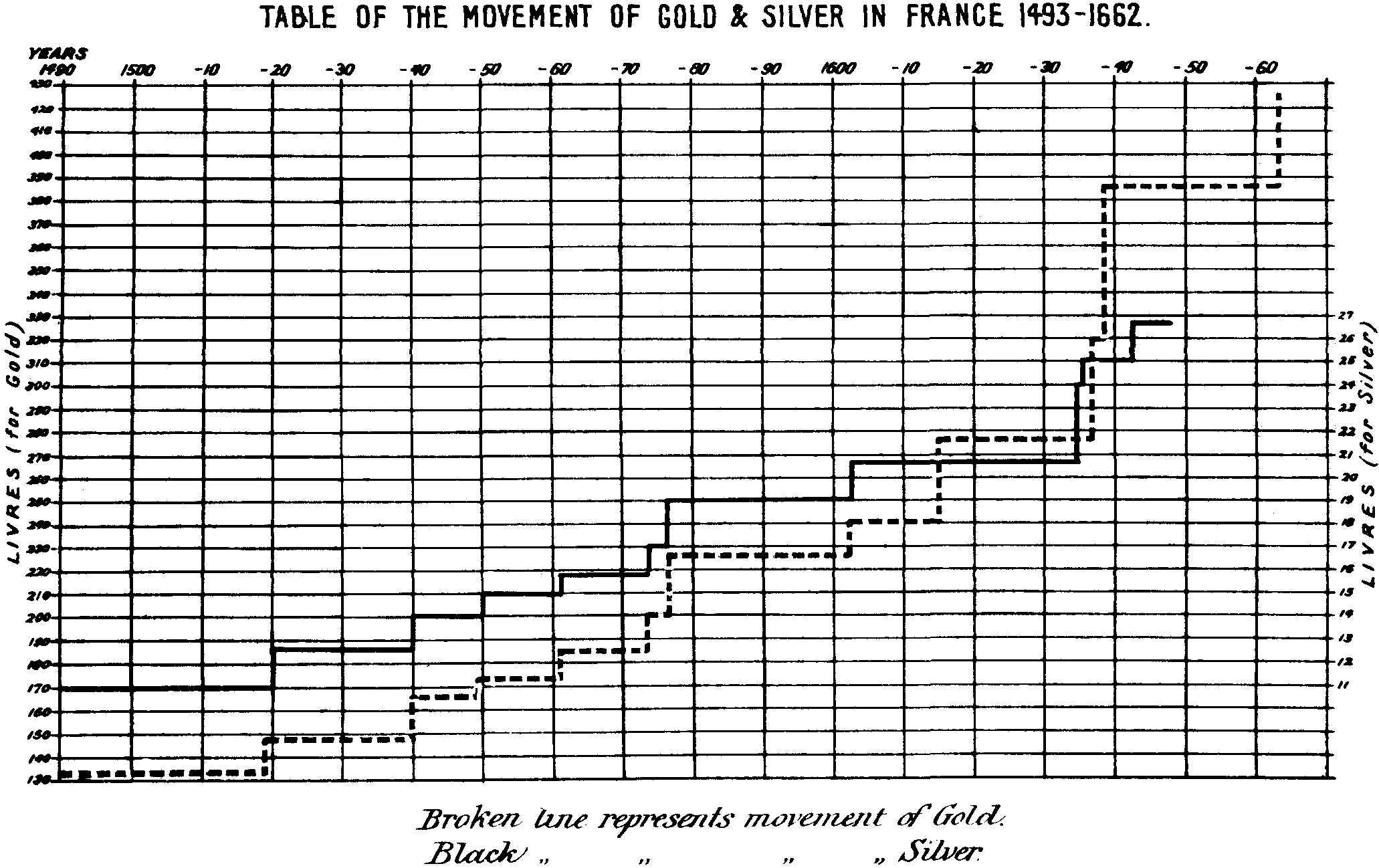
TABLE OF THE MOVEMENT OF GOLD AND SILVER IN FRANCE, 1500-1660
Date.Price of the Mark of Gold.Price of the Mark of Silver.
Livres. Sols. Dens. Livres. Sols. Dens.
1488 130 3 4 11 0 0
1519 147 0 0 12 10 0
1540 165 7 6 14 0 0
1549 172 0 0 15 0 0
1561 185 0 0 15 15 0
1573 200 0 0 17 0 0
1575 222 0 0 19 0 0
1602 240 10 0 20 5 4
1615 278 6 6 ... ... ...
1636 320 0 0 23 10 0
8th May
1636 384 0 0 25 0 0
22nd Sept.
1641 ... ... ... 26 10 0
1662 423 10 11 ... ... ...
FRANCE: THE MINT INQUIRY OF 1575
In the case of the latter monarch it is expressly stated that the change, which was effected in 1573, when the ratio was established at 11.77, had been preceded by a period during which "the people" had of themselves augmented the value of the écu d'or to 54 sols. At this limit the Government was obliged to fix it, but by the year 1577 it had risen successively to 58, 60, and 65 sols. The evil, as it was thought to be, of the advance of the monies was attributed to the caprice and unscrupulousness of "the people," and the King called several councils of experts to discuss the matter. Still the process continued unabated, and on the 19th December 1575, Henry III. assembled the States-General. The cour des monnaies—the officials of the Mint—at once approached him with a petition. Their representation is of peculiar significance:—
"In spite of the bad police prevailing, we draw in times of peace twice as much silver from abroad as the foreigners draw from us. If the reform we advocate were adopted we should double this net gain.... Between us and the Netherlands and Germany, where we generally trade, there is this difference, that 6 écus, at the price at which they are exposed here, only come to 5 in the said places, which has induced a sudden and enormous dearness in the merchandise which we export from there, and besides has caused us a great disorder—to wit, that the merchants have transported all our douzains and other billon money, to save themselves from the loss they would have had to incur in settling in écus or in any foreign species of gold or silver on which, at the price they are current at by the caprice of the people, there would be a loss in settlement of 15, 20, and 25 per cent.... The cause of the enhancement of prices proceeds from the malice of several who turn into bullion the best of your coins in order to fill the kingdom with others of less goodness, enriching themselves thus with the blood and misery of the people....
FRANCE: THE REFORM OF 1577
"The remedy is to lower the rate of the monies.... The écus ought to come down to 50 sols., but for the present we would consent to it being put at 60, awaiting a further reduction. The currency of all foreign coins ought to be prohibited as the chief cause of these evils. For although by all your ordinances they have been valued according to the price of the écu, yet the people have always increased them more than they have your own monies, so that the écu at this moment, to be in accordance, ought to pass for 78 sols. This arises from the craft of the foreigner, and the only exceptions of importance are the reals and pistoles of Spain, which are of known goodness and profit to the melter. They have never brought us harm, but, on the other hand, they are being melted down all over France, and at the present rate the foreigner gets a profit of about 7 livres on the mark of them, so that we advise prohibition of their circulation. Finally, we advise to do away with the old reckoning by livres and sols, and substitute for it the reckoning by écus."
The States-General, adopting in part the weakest suggestion of this remarkable paper, fixed the écus at 65 sols. The Mint officials at once represented that this only increased the evil. Henry accordingly assembled at Pontoise a conference of experts, and as the outcome of their deliberations decided on the adoption of the chief recommendation of the Mint officials' representation. By his proclamation of 13th November 1577, the reckoning by livres was abolished and that of gold écus substituted, values of under 1 écu or 60 sols. to be settled in divisional coinage, and circulation of all foreign coins prohibited, with the exception of Spanish and Portuguese gold ducats. It was forbidden to constrain payment of any sum above 100 sols. in billon money, and in sums below that amount to present more than the third of the total sum in such billon money.
FRANCE: FAILURE OF THE REFORM OF 1577
This extraordinary and, on the whole, admirably planned reformation merits so much detail because of the intense importance of its bearing. It in effect anticipated the reformation which was only accomplished in England in our own century. So far as it was actually put in practice it made France monometallic. The instinct of the time had found its way to a comprehension of the evil before it, and of the remedy. The evil was due to a badly-regulated, weltering, bimetallic system; the remedy was a monometallic system. It matters little that such terms were not in use and that the theory of the matter was not enunciated. The essential point was that the fact, the situation, was grasped in practice for a moment, dimly it may be, yet sufficiently to illustrate the whole antecedent and succeeding event. As a matter of fact the ordinance remained practically in great part a dead letter. That it did so—that it did not accomplish its purpose—has been attributed to the malheur, the unhappiness, of the time. It was due to no such thing. It was due to the simple fact that in the ordinance two quite distinct, and one of them impossible, reforms were projected. The attempt to tie down the écu to 60 sols. was foredoomed to failure, and as the eye of contemporaries was fixed more entirely on prices rather than on method of tender, the most significant part of the ordinance passed out of mind; already by the time of the death of Henry III., "the people," it is again said, had increased the écu to 64 sols. On the 30th March 1594 a proclamation was issued to call it down to the value prescribed by the celebrated declaration of 1577, i.e. 60 sols. but, finding it impossible, the whole system created by that declaration was abolished (September 1602); the reckoning by écus was done away with, and the old system of reckoning by livres returned to; the gold écu was tariffed at 65 sols., and the circulation of foreign monies was again permitted. Henry IV., in his proclamation abolishing the almost invulnerable system established by Henry III., attributes to the attempts at working that system "the present dearness of everything." It is almost impossible fully to represent the unwisdom of this counter-reformation. To the eye of the then legislator there was only one evil—the rising of prices. If levelly effected it was, as a matter of fact, no evil at all—far the reverse indeed, and he did not need to concern himself about it at all. Besides, it was irresistible. The evil that escaped his eye, or to which he was blind, was that unceasing process of flux which was caused by the different ratios prevailing in different parts of Europe. The scheme of Henry III. would have proved effective, where no other measure or scheme of the time was or could be, and its abrogation in 1602 by Henry IV. removed a bulwark and a barrier, and made way for catastrophe.
Le Blanc considers that this repeal of the system established in 1577, itself failed of its purpose, because the increase of prices still continued. "In the seven years of peace which followed the ordinance of 1602, the depreciation of the gold écu was as much as it had been in the preceding sixty-five years of war and trouble." The simple truth was, that it was much more likely to increase in time of peace and trade activity than in time of war. The point to notice was not at all how much the écu did depreciate, but the relativity of such its depreciation with that of the standard currency of other countries, and the monetary disorder which the inequality of ratio and of rate of depreciation induced.
Alarmed beyond measure at the evident failure of his plans, Henry IV. summoned monetary conferences of his wisest and best, and they were not even suspended by his assassination. The complaint again was, that the permission to circulate foreign monies had led to the transport of all the good coinage, to the ruin of commerce and great general disorder. Assemblies were held all over France in the trading towns, and the result of the advice of their delegates was the proclamation of 5th December 1614 (issued early in 1615). By this proclamation silver monies were left untouched, the tariff of the gold écu was increased from 65 to 75 sols., and the value of the mark of gold proportionally increased. The ratio was thereby altered from 12.01 to 13.90. It is hardly too much to say that this step and alteration in the ratio saved France from the catastrophe which befell England and Germany in 1622 and 1623. The arrangement established in 1615 endured unaltered until 1636, when a slight reduction in the ratio was made to 13.61 (on the 8th May). Two months later it was found that so serious an export of good coinage was ensuing that "our kingdom would be entirely stripped of good currency, to our great damage, etc." A proclamation was accordingly issued (28th June 1636) attempting to regulate the course of exchange. The effort was vain, and on the following 22nd September the ratio was suddenly and violently altered to 15.36.[10]
FRANCE: THE REFORM OF 1640
A glance at the ratio prevalent in other countries will show how masterful was this act of France, but it carried with it the seeds of its own punishment. Such is the nature of the bimetallic law that any overshooting of the ratio, on no matter which side,—in favour of silver or in favour of gold,—establishes a differentiation, and the differentiation at once gives to the one metal a fulcrum or lever point—a purchasing power—against the other, and the undervalued metal, whichever it is, at once tends to disappear. Four years after this autocratic measure of France, it was found that her currency was in so depreciated a state, through exchange, that the only pieces current were lacking one-third of their full weight.
The recoinage established by her proclamation of 31st March 1640, which established the new louis d'or, was intended as a complete and permanent remedy, and it may reasonably claim the praise of having effected so much. The alteration of the ratio established in 1640-41 by this recoinage (from 15.36 to 14.49) was only made after most serious deliberation. Monetary conferences of experts were held at Paris; and it was found, after careful assays of all the monies of the surrounding nations, that the prevailing ratios (1640-1) were at one and the same time—
Germany12:1
Milan12:1
Flanders and Netherlands12.5:1
England13.33
It was therefore decided to adopt a higher ratio than all these, viz. 13.5.[11]
The history of the few years succeeding this measure is most instructive. The depreciation of monies continued, and on the 4th April 1652 a proclamation was issued, forbidding the currency of certain old monies of France, and again attempting to restrain the course of the exchanges; and three years later, 1655, under pretext that false moneyers were imitating the louis d'or and the silver écus, the minting of lis d'argent (lilies of gold and silver) was resolved upon. "But," says Le Blanc, "everybody knows that the true motive was the same as when a little later they resolved on the minting of 4-sol. pieces. Under the above pretext, the ratio basis of 1641 was broken. Remonstrances were vain until experience proved their weight, and the minting of the lis d'or had to be discontinued. The pieces already minted received a value of 7 livres, and to correspond the louis d'or was increased to 11 livres, by proclamation 15th March 1656." As silver was left untouched, the resulting alteration of the ratio was from 13 1⁄2 to 14 5⁄7.
Florence.
With the advance of Antwerp as the centre of European exchanges in the fifteenth century, the mercantile pre-eminence of Florence and Venice decayed, and their monetary history loses its former prime importance. But they by no means thereby lose their interest for us. Instead of profiting as of yore by every veer in the winds of exchanges, they are at the mercy of them, as was every other country outside the charmed circle of the Netherlands. The influence of the changed conditions in the production of the precious metals, due to the discovery of America, does not show itself in Florence before 1531, when (4th August) the price was by law advanced. Three years later, 5th March 1534, it was found that the state was receiving damage from the foreign monies circulating, and that the only native coin circulating was in a worn and depreciated state. A recoinage was accordingly ordered, circulation of all foreign monies of silver was forbidden, and all payments and contracts were commanded to be made in gold scudi of the state. In order to inform the commercial element, the Mint masters were further ordered to make trial every fifteen days of the value of any foreign scudi, and to publish the result.
There is a wonderful simplicity about this enactment. In order to defend themselves from a flood of cheap and cheapening silver, the Florentine authorities adopted a virtual gold monometallism. That the enactment was not permanently regarded and kept can only be attributed to the strength of commercial custom, and to a true perception in the mercantile community at large of the essential difficulty of the problem and its remedy. The Florentines were simply obliged to circulate all coins, gold as well as silver, because such was the universal custom of mediæval Europe. By 1552 silver foreign monies were again current in Florence, in such quantities and with such effects on the native gold currency, that they had to be again prohibited and banished (by law of 18th May 1552); renewed three years later (28th February 1555), and again in 1557 (29th April). Indeed, within the period here treated of, up to, i.e., 1660, there is a series of thirteen or fourteen separate re-enactments of the prohibition relating to these monies and the depreciated Florentine billon money ("quattrini neri"). If, during this period, Florence had occupied the commanding position that Antwerp did, quite unique interest would attach to the record of this monetary policy or experiment. But not being in that position, and being, too, quite apparently unable to enforce her own enactments in her own territory, even this merely depressive policy was partially broken down. In so far as it was broken down she lay at the mercy of the monetary changes around her, and of the Netherland financiers, as did every other country of Europe. By the law of 5th April 1630, all species of foreign ducatoons were prohibited, "in consideration that, within the short time they have been introduced, so great a quantity, and of such differing standards, has been imported from the various foreign Mints." Five years later the gold coin was in so depreciated a state as to call for legislative interference (9th February 1635, renewed on 5th February 1645); and again in 1661 (3rd February) it was found necessary to prohibit the circulation of the silver reals of Peru and every other kind of Spanish silver, except at bullion value. These are only a few from a long list of similar enactments, but they serve adequately to show the trend of events on small as well as large fields of operations. What an amount of commercial disturbance and disaster lies behind the dry details of these legal enactments, the case of England will serve to show.
Germany.
The monetary history of Germany is one of extreme confusion and intricacy. The lack of coercive power in the central authority—in the Emperor himself—was as conspicuously displayed in the monetary ordinances of the empire as in the political sphere. The imperial edicts were disregarded, and each separate circle of the empire, or each separate prince or union of princes, left to shift or act for themselves. Amid all the confusion of such a disorganised and reeling system sufficient is perceptible to indicate the broad tendency of events, and to show how closely analogous was her experience to that of Europe generally within the same period.
In Germany, as in the Netherlands, France, and England, the influence of the discovery of America only begins to express itself about 1520, and in the usual way—influx, movements and disorders in the currency and ratio, and general complaints. In 1520 a monetary convention was summoned to meet at Forchheim. This was followed by the debate in the Reichstag at Nürnberg (1522), where great complaints were made of the unusable, false, and depreciated coinage, "due to the stealing away and exchanging abroad of the gold gulden and silver coins." It was in consequence of the representations of this Reichstag that the first of the series of three imperial Mint ordinances was issued by Charles V. (at Esslingen, 1524). The main details of this ordinance will be found in the accompanying tables and in Appendix V.
The effect of the first imperial ordinance was to change the ratio from something between 10 and 11 to 11.38. The gulden was raised from 17s. 4 pf. to 17s. 6 pf. All foreign gold was to be taken at equivalent rates, and whoever gave more for foreign coins of gold was to suffer a heavy penalty. Further, the export of gold and silver was forbidden, on pain of life and goods.
The ordinance remained a dead letter, and the monetary disorder of the country only increased.
THE MOVEMENT OF SILVER IN GERMANY, 1459-1621, ILLUSTRATED BY THE MOVEMENT OF THE SILVER GROSCHEN, ACCORDING TO IMPERIAL AND OTHER MINT REGULATIONS.
(
See preceding Table on p.
30
.
)
Date. Cologne Mark coined into Pieces.Alloy.Equivalent Value in Convention Money.Treaty or Ordinance.
Loths.Grs. Krtzrs. Pfnge.
1501 126 6 1 3 2 37⁄42Treaty of Dukes Henry and Erick of Brunswick and Bishop Barthold of Hildesheim, with the States of Brunswick, Hildesheim, Hanover, Lübeck, and Göttingen.
1510 160 6 0 2 3 1⁄4Göttingen.
1524 136 12 0 6 2 8⁄17First imperial Mint edict of Charles V. at Esslingen.
3 1 4⁄11
(1⁄2 Groat)
1533 123 7 0 4 1 3⁄4Augsburg Mint edict.
153591 47⁄131 8 0 62 101⁄874Mint treaty between Ferdinand and the Counts Palatine of the Rhine and the States of Augsburg and Ulm.
155194 1⁄2 7 5 53 59⁄567Second imperial Mint edict of Charles V. at Augsburg. (Remained inoperative like that of 1524, supra.)
100 7 6 5 2
1558 88 6 9 5 2 7⁄44Saxony Mint ordinances.
1559 108 1⁄2 8 0 52 26⁄217Mint ordinance of Ferdinand I.
1572 " " 0 " "Edict of the Lower Saxony Circle.
1610 234 14 4 42 82⁄351Edict of the Lower Saxony Circle.
1617 144 8 0 4 0 2⁄3Edict of the Lower Saxony Circle.
1622 108 1⁄2 8 0 52 26⁄217Edict of the Upper and Lower Saxony Circle.
THE MOVEMENT OF GOLD IN GERMANY, 1495-1621, ILLUSTRATED BY THE MOVEMENT OF THE GOLD GULDEN (RHENISCHE GULDEN), ACCORDING TO IMPERIAL AND OTHER MINT REGULATIONS.
(
See preceding Table on p.
31
.
)
Date.Cologne Mark coined into Pieces.Alloy.Equivalent Value in Convention Money.Treaty or Ordinance.
24 Crts.12 Grains.Flrns.Krtzs. Pfnge.
150671 1⁄3186 gold 3 60 132⁄7597Treaty between Bamberg, Würzburg, and Brandenburg.
36 silver
150971 1⁄3186 gold 3 61 3185⁄7597Frankfort Mint ordinance.
40 silver
1524 89 22 ... 2 543 5019⁄6369Imperial Mint edict of Charles V. at Esslingen.
155171 1⁄3186 gold 3 60 3682⁄7597Imperial Mint edict of Charles V. at Augsburg.
38 silver
1559 72186 gold 3 41 2267⁄3834Imperial Mint ordinance of Ferdinand I.
38 silver
GERMANY: THE THREE IMPERIAL EDICTS
In 1530 the Reichstag of Augsburg demanded the holding of a council, in order to enforce the late edict, and for a due consideration of the monetary situation. Several attempts were made with this object, but fruitlessly, and the princes of the empire fell back on the only feasible but fatal plan of smaller Mint conventions between contiguous states. There is an endless series of these, and they render the history of German currency a perfect jungle of intricacies. Nine years later (1539), a monetary convention was summoned to meet at Augsburg by Ferdinand, heir to the empire. It proved fruitless. Again, in 1548, after the expiry of a similar period, the Reichstag at Augsburg declared for another monetary convention to relieve the disorder. The opinions of certain deputies to this convention, which met on the 8th October 1550, were as follows: "For fifty or even eighty years and more the ratio between gold and silver has been between 12 and 13. But in a gulden of those days there was an equivalence of more silver than in seventy-six of our kreutzers. Since then we apprise the Rhenish gold gulden and kreutzers less than foreign nations. Therefore France and England seek them."[12]
A thorough inquest into the subject, or evaluation, was therefore ordered, and it was in accordance with the advice of the convention and with the report of the evaluation that the second imperial Mint edict was issued at Augsburg, 1551. This edict was drawn up on a ratio of 10.83 as a basis, and, as might be reasonably expected from the different ratios ruling abroad at the time, it proved as inoperative as its predecessor. The succeeding ten years witnessed a rise in the relative value of gold, or depreciation in that of silver, and the third and last of these imperial Mint edicts, that of the Emperor Ferdinand, issued at Augsburg, 19th August 1559, fixed a higher ratio, viz. 11.44. The Rhenish gulden was raised from 72 to 75 kreutzers. The increasing production of silver indicated by this change is still more clearly marked in the resumption of the coining of the imperial thalers, at the instigation of the Reichstag at Augsburg, 30th May 1566. The advice of this Reichstag was the outcome of the monetary convention held at Nördlingen two years earlier, at which strong complaints were appointed to be made before the Reichstag of the weak state of the coin, and of its under-valuation.
In matter of fact, the Mint edict of 1559 remained a dead letter; nominally, however, it continued in force up to 1600, although no less than seven attempts were made at succeeding diets, from 1566 to 1596, to enforce it and bring it up to date. In the Reichstag of Speyer, 1570, complaints were made of the universal loss arising from the non-observance of the edict. In place of an imperial coinage, nothing circulated but foreign and counterfeit coins, and the necessaries of life had risen to a prohibitive height. Similar were the complaints at the succeeding diets at Frankfort, 1571, and at Regensburg, 12th October 1576, at which last Ferdinand's edict was again re-enacted, with a command that the Burgundian circle and the Swiss should conform themselves to it. Bitter complaints were made of the bad state of the gold and silver coinage, and of the enrichment of the exchangers on the Rhine. The circulation of Dutch and Swiss thalers was forbidden because of the loss by exchange, and the export of all gold and silver again forbidden. As an instance of the depreciation prevalent in the coinage, it was noted that the silver albus had lost one-third of its weight, so that thirty-six were needed to purchase one gold gulden, whereas formerly twenty-six were equivalent.
GERMANY: DISORDERS OF 1580
Four years later, 1580, Ferdinand, as Archduke of Austria, issued a fresh tariff, with the object of checking exports, and in 1582 the states, having consulted as to the condition of the coinage, strongly advised a renewal of the prohibition of the export of coin, especially by the Italians. This advice was adopted in the Reichstag of Augsburg, which met seventeen days later, 20th September 1582. The preamble of the Act then and there passed speaks of the export of a good portion of the native currency, and of the unmeasured rise of prices, coupled with the circulation of forbidden foreign specie, large and small.
This resolution of the Reichstag was followed by the enacting of the Mint edict of 10th December 1582. It proved as futile as any of the others; and two years later, July 1584, the deputies of the three circles of Franconia, Swabia, and Bavaria complained that within the four years immediately preceding several millions had left the country by way of the Rhine provinces for the Netherlands, very little going to Italy by comparison.
On this representation another useless edict was issued by the Emperor Rudolph II., and in the following year the merchants at Frankfort Fair found themselves obliged to agree upon a tariff of ducats and Reichs-thalers. The Philipps-thaler was put at eighty-two kreutzers, and the Reichs-thaler, which, by the Imperial Mint edict still nominally in force, should have been at sixty-eight kreutzers, was put at seventy-four. This arrangement of the merchants established a ratio between gold and silver of 11.4.
Certain of these same merchants, examined as to their opinion of the method of the export in January 1586, explained that it went by way of Nürnberg, and that the arbitrage was attended with 9 or 10 per cent. profit.
GERMANY: THE KIPPER UND WIPPER ZEIT
Nominally, however—or in theory—the arrangement of 1559 continued the unenforced law of the land up to 1600, underneath all these attempts at revision and underneath the different regulations of the various monetary unions of contiguous circles or states. With the latter date commences that extraordinary movement of monetary depreciation and panic which is known as the "Kipper und Wipper" period. In great part the extraordinary acuteness of the panic which ensued was due to internal monetary confusion of Germany, but that internal confusion simply ministered to the export of all good specie and metal, and in the end it became simply a money corner. The movement began by a coining of the lower denominations of monies on a different and depreciated footing or basis. The specie thaler began to part company from the current thaler, and to rise to more than the 24 silver groschen or 36 Marien groschen, to which by the Mint edict of 1559 it was declared equivalent. By 1618 it had risen to 1 thaler 6 silver groschen (= 48 Marien groschen), by 1620 to 2 current thaler, by 1621 to between 7 and 8 current thaler, while the ducat had risen to 13 florins 30 kreutzers.
Tabularly the statement of the movement of the Reichs-thaler is this:—
Date. Florin. Krtzers. Date. Florin. Krtzers.
1582 1 8 1621Jan. 2 20
1587 1 9Feb. 2 24
1590 1 10 March 2 30
1594 1 11 April 2 36
1596 1 12 May 25 2 48
1603 1 14 May 31 3 15
1604 1 14 June 3 6
1605 1 15 July 3 15
1607 1 16 Aug. 4 0
1608 1 20 Aug. 10 3 15[A]
1609June 15 1 22 Sept. 4 30[A]
July 7 Oct. 5 0[A]
Dec. 19 1 24 Nov. 5 30[A]
1610 1 24 Dec. 6 30[A]
1613Sept. 1 26 Dec. 20 3 15
1614Aug. 1 28 1622 Jan. 18 7 30[B]
1615March 1 28 Jan. 27 4 30
Nov. 1 1 24 Feb. 10 10 0[C]
Nov. 17 1 30 Mar. 10 0[C]
1616 1 30 Mar. 12 6 0
1617 1 30 June 16 3 15[A]
1618 1 32 Oct. 5 0[B]
1619Oct. 1 48 Nov. 6 0[B]
Dec. 2 4 1623 April 1 30
1620June 2 8 And at this last figure standing up to 1669.
Nov. 9 2 20
The course of the gold gulden which could be given is exactly parallel.
This table speaks volumes. It marks the acuteness of the monetary panic and crisis of 1621-22—the central time of the commercial ruin induced by the disorder of the Kipper und Wipper Zeit. The pamphleteer and polemic literature of this crisis is as rich and instructive as any which has accompanied the bimetallic agitation and silver question of our later days.
At Hamburg the thaler, which had gradually risen from an equivalence of 24 schillingen to 33 schillingen in 1609, had a correspondingly excited course during these years.
Schillingen.Pfennige.Schillingen.Pfennige.
Oct. 1609 36 0July 1618 42 6
1610-13 37 0Sept. 43 0
Dec. 1614 37 6Nov. 44 0
Aug. 1615 38 9Sept. 1619 46 6
Jan. 1616 40 0Oct. 48 0
Aug. 41 0Aug. 1620 52 0
April 1617 40 6Feb. 1621 53 0
Aug. 41 0Mar. 54 6
Sept. 41 6May 54 0
Nov. 42 0May 1622 48 0
It was in anticipation of the approaching disorder that on the 3rd of March 1609 a Mint treaty had been made between Mecklenburg, Schleswig-Holstein, Lübeck, and Hamburg, "for protection against the Mint disorder, which is most disastrous to land and people, and to take precaution against the advance of the larger silver specie." Seven years later, on the 10th January 1616, the merchants and financiers of Hamburg drew up a petition complaining that, through the monetary disorder, trade and exchange was being driven from the city, as within a short period the exchange with Frankfort had fallen from 74 kreutzer (=32 schillingen Lübeck) to 62 kreutzer (=32 schillingen Lübeck), and the exchange with Amsterdam from 46 stivers (=32 schillingen Lübeck) to 39 stivers. To the Senate's proposal for the erection of an exchange bank, the merchants would, however, have nothing to say, considering it unnecessary and dangerous, and called for the suppression of the notes which the merchants had brought into use to facilitate their settlements.
Three years later, however, the Senate declared more strongly for the establishment of a bank, premising in the preamble of their resolution that "it is many ways known and plain how disastrous a disorder has hitherto been in the currency, both from the rise of the larger silver species and from the excessive importation of smaller depreciated specie, whereby not only private individuals but also common interests, as churches, hospitals, widows, and orphans are greatly pinched in their incomes."
GERMANY: HAMBURG IN 1619
It was as the outcome of this resolution that the celebrated Hamburg bank was instituted in 1619, the later life of which was to become of so much importance for the monetary and commercial history of North Germany.
The curious point to observe is the short time—a few months merely—by which the crisis in Germany preceded that in England, and the analogy of some of the manifestations, although there were no such Mint and coinage disorders in England as had aggravated and in the first place partly induced the movement in Germany.
In 1623 a great Mint deputation from all the circles was held, and in accordance with its representations the new imperial basis was established, which remained in force until the conclusion of the period of which we here treat. By that basis the mark of silver was coined into 9 Reichs thalers 2 groschen. The thaler was fixed at 90 kreutzers, the gold gulden at 1 florin 44 kreutzers, and the ducat at 2 florins 20 kreutzers. This disposition remained the Mint law over all the weary, disastrous period of the Thirty Years' War, which is practically a blank for the monetary history of Germany. It is not until 1665—the opening of a fresh period—that complaints of the state of the lower denominations of the coinage are again heard. But how far this quiescence is to be attributed to the economic wisdom of the settlement of 1623, or to the mute, dumb, inarticulate agony of Germany during that strife when her commerce, much more even than her national life, was suspended, is hidden from us in almost complete darkness.
Spain.
SPAIN: FUNCTION IN SEVENTEENTH CENTURY
During the sixteenth and seventeenth centuries the function of Spain was a very simple one in the European system. She was the receiver and distributor of the metallic wealth and finds of the New World, and accomplished her task perfectly naturally and efficiently. But it was at the cost of her political and commercial future and greatness. If Spain had been a commercially independent nation, growing for herself and supplying herself with her own manufactures, the metallic wealth of the New World would have stayed much longer in her lap, and Europe would have starved. But she was not. She produced little, and manufactured less, and the ill-gotten, blood-stained gain, which flowed to her shores from America, served only to feed an impractical vanity and to further unfit the nation for manufacturing and commercial life. The, to her, disastrous influence of Spain's shortlived empire endure to-day, for she is still as unfitted as ever by temperament and natural training for mercantile life. Such is the penalty her dower of New World gold and silver brought her. Finding she could purchase anything and everything with this gold and silver, she threw herself into her work of conquest, and let commerce go. Her manufactures came to her from England and the Netherlands—countries she sought to conquer and enslave; and thither her gold went in exchange, and before the century was out those countries had risen exulting over her. But the point to notice is this. Assuming this distributing function as her own and proper one, the only condition essential to its proper fulfilment was the maintaining of an absolutely unimpeachable coinage. The rapidity with which the precious metals left her possession was simply due to the fact that Spain did so maintain her coinage and for a sufficiently lengthened period. The goodness of her coins exalted them above the prevailing rates in France and the Netherlands, and they were eagerly sought in consequence. The monies that did not, and could not, normally leave her possession by ordinary way of trade left her by means of arbitrages working on the system of bimetallism, which existed unacknowledged.[13] It was this commanding quality of the Spanish coins that led to the adoption of their system by France in 1641. That in the case of Spain we hear no complaints of depletion of coinage and commercial disturbance resulting therefrom, such as mark the history of the other countries of Europe, is simply due to the fact that her stock of metals was continually being replenished, and that she had no commerce to be disturbed. The gold and silver of America came to her in a steady stream and left her for the Netherlands and elsewhere in a stream as steady; and so long as that flow was turned through her dominion, so long as the main sources of precious metal-mining were American, and the product a monopoly-possession of Spain, she stood above, and felt no immediate harm from, the bimetallic law which insatiably sucked away her wealth. Until the time came, therefore, when she lost her monopolist position in this matter the monetary history of Spain is free from those features of disturbance, commercial agitation, monetary conferences and edicts, which are common to the rest of Europe, and consist merely of a record of Mint ordinances regulating the fineness of her coins and slowly adjusting them to the general movements of the century. Only in the case of the first of these—the edict of Juan and Don Carlos, 1537, by which the standard of coronas and escudos was fixed at 22 quilates, "which is the standard of the greater escudos of France and Italy"—has the enactment any comparative or international bearing.
For sixty-one years after the settlement of 1497 there had been no alteration of the monetary system. In 1523 the Cortes of Valladolid had petitioned the King, Charles I., to lower the standard and content of the gold coin, "so that in weight and value they may pass equal with the crowns of the sun which are made in France, so that by these means they will no longer draw our gold from the kingdom." In its ignorance this Cortes also demanded that the silver monies should be reduced and issued on a relatively depreciated footing. It was a matter of thirteen years before Charles yielded and adopted the measure suggested, in the edict of 1537, already referred to, and it may be safely said that by the time of its adoption the need for the measure had passed away. Any disturbance and loss of her stock of precious metals caused by the general movement which marks itself in European history about 1519-20, and which shows itself in Spain in the petition of the Cortes of 1523, was quickly redressed by the inrush of metals from America. Finding gold and silver come to her easily, Spain cared little how they went. After the edict of 1537 there is only one complaint of the export of coin recorded in the legislative enactments of the country, viz. in 1552, when it was decided to alter the alloy of the billon money in order to avoid its exportation, "as we are given to understand that its intrinsic value is greater in other countries than here."
SPAIN: PASSIVE ATTITUDE
The Mint edicts of Spain during the years 1500-1660 simply follow in the wake of the general movements of prices in Europe generally. The authorities were perfectly passive to the export of the precious metals, and no attempt was made to manipulate the ratio in such a way as to arrest the outflow. The conduct of Philip II., in 1566, in still further raising the denomination of the gold coins by one-seventh has the same passive aspect, although it has been attributed to a mere base desire on the part of Philip to fill his depleted treasury by a partial debasement. A comparison of the movements of metals and prices in France and Spain will show that the advance was only normal and general, and the further changes which were made in 1609 and 1612 have this same normal character, and call for no comment. At the points enumerated it is quite evident that Spain merely and mechanically followed the general trend of the precious metals and prices through the century. There is no expression of aggrievement, either slight or acute, at the precious metals leaving her. While every other country was occupied seriously, sometimes desperately, with the question of how to guard their stocks of them, the eyes of the Spanish Government and the nation's mind were fixed only on conquest and imperial growth. The cost of her empire was such that at the accession of Philip III., 1598, the national debt was over a hundred million ducats, an absolutely unparalleled sum for the time. When, therefore, the Spanish Government began the enormous issues of base billon money which mark the reign of Philip IV., it is to be looked upon as a financial, or treasury, or budget expedient, and totally unconnected with any currency movement, pure and simple. These issues were so great that, in 1625, the premium on gold and silver, as compared with billon monies, was fixed at 10 per cent.; in 1636, at 25 and 28 per cent.; and, in September 1641, at 50 per cent. (See account of Spanish monies, Appendix III.)
Such base monies always tend to become the only visible currency of a land. But, save as thereby facilitating the denudation of Spain's store of precious metals, this matter of the depreciation of her billon money has practically little or no relation to the general movements of the two precious metals which we are investigating. It has more resemblance to an over-issued and depreciated paper currency.
Of that ebb and flow, that oscillation and instability in the metals, which make the study of the other currency histories of Europe during this period so instructive an object-lesson of the effect and influence of a bimetallic law and system, Spain shows not a trace. She received the metals in a steady stream, and emitted them in a steady stream. They poured through her. Her function was that of distributor, and she performed it. When the time came that her monopoly of the metals ceased, her remedy against the ruin of a bimetallic law was removed, and she became as signal an instance of its malignant operation as any—France, England, or Germany. Until that time came she had her remedy against immediate ruin in her yearly argosy, with its blood- and toil-stained tribute.
England.
To come to England.
ENGLAND, 1500-1660
The following tables give a succinct synopsis of the general course of her gold and silver coinage during this period:—
TABLE OF ENGLISH SILVER COINS, 1500-1660.
Date.Denomination. Weight in Troy Grains.Date.Denomination. Weight in Troy Grains.
1504 Penny, 12 1552 Penny, 8
Groat, 48 Shilling, 96
Shilling, 144
1553 Penny, 8
1527 Penny, 10 1⁄2 Groat, 32
Groat, 42 1⁄2 Shilling, 96
1543 Penny, 10 1560 Penny, 8
Groat, 40 Groat, 32
Shilling, 120
1601 Penny, 7 3⁄4
1549 Shilling, 80 Shilling, 92 3⁄4
TABLE OF THE ENGLISH GOLD COINS, 1500-1660.
Date.Denomination.Weight in Troy Grains. Fineness. Equivalents.
Carats.Grains.
Henry VII.,1489Sovereign, 240 23 3 1⁄2£1 0 0
Henry VIII.,1527Rose Nobel or Rial, 120 23 3 1⁄2 0 11 3
Sovereign, 240 23 3 1⁄2 1 2 6
1544Angel, 80 22 0 0 8 0
Crown, 57 21⁄67 22 0 0 5 0
Pound, 200 22 0 1 0 0
1545Crown, 48 20 0 0 5 0
Pound,192 20 0 1 0 0
Edward VI.,1549Pound,169 7⁄17 20 0 1 0 0
1550Angel, 80 23 3 1⁄2 0 8 0
Sovereign,240 23 3 1⁄2 1 4 0
1551Pound,178 8⁄11 22 0 1 0 0
Mary,1553Angel, 80 23 3 1⁄2 0 6 8
Elizabeth,1558Angel, 80 23 3 1⁄2 0 10 0
Sovereign,240 23 3 1⁄2 1 10 0
Pound,174 8⁄11 22 0 1 0 0
1601Angel, 78 66⁄73 22 0 0 10 0
Pound,171 61⁄67 22 0 1 0 0
James I.,1603Pound,171 61⁄67 22 0 1 10 0
1604Unit and its fractions, the Double Cr., British Crown, and Thistle Crown,154 2⁄3 22 0 1 0 0
1605Angel, 71 1⁄9 23 3 1⁄2 0 10 0
1610Angel, 71 1⁄9 23 3 1⁄2 0 11 0
Gold raised 10 p. ct.Unit,154 26⁄31 22 0 1 2 0
1619Angel, 64 11⁄15 23 3 1⁄2 0 11 0
Charles I.1625Angel, 64 11⁄15 23 3 1⁄2 0 10 0
Unit,140 20⁄41 22 0 1 0 0
TABLE OF THE VALUE IN PENCE OF THE GRAIN OF GOLD
(
23 c. 3
1
⁄
2
gr. Fine
)
IN THE VARIOUS GOLD COINAGES OF ENGLAND, 1500-1660.
Date. Pence per Grain. Date. Pence per Grain.
1527 1.125 1601 1.626
1544 (22 carats) 1.281 1603 (22 carats) 2.236
1545 (20 carats) 1.470 1604 1.655
1549 (22 carats) 1.518 1605 1.27
1550 1.2 1610 1.856
1551 (22 carats) 1.425 1619 2.052
1553 1.0 1625 1.851
1558 1.5 1625 (22 carats) 1.838
1558 (22 carats) 1.425
TABLE OF THE MOVEMENT OF GOLD & SILVER IN ENGLAND 1500-1680
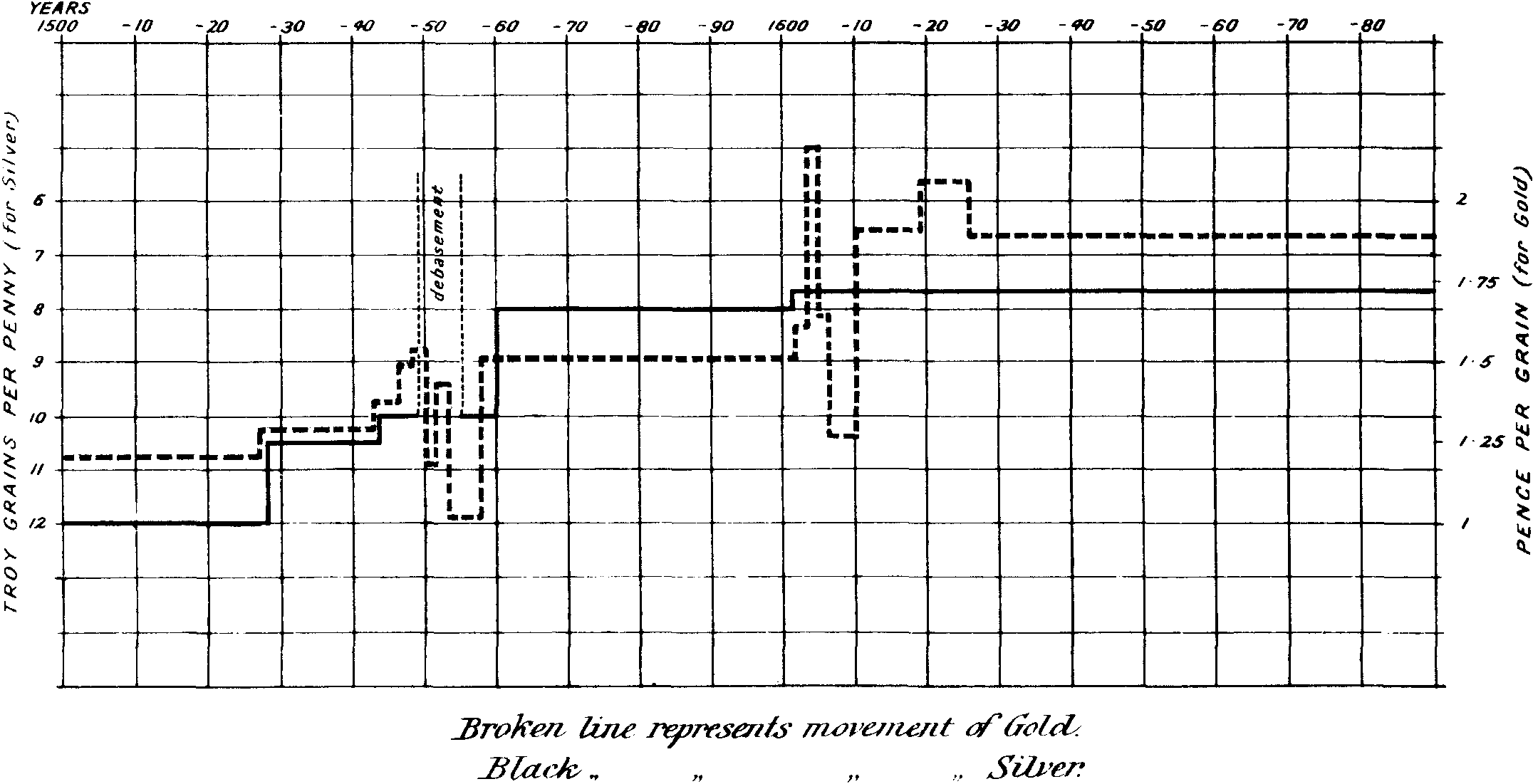
The testimony of these tables is perfectly general. They establish, roughly speaking, just such an advance of price as befell the whole of Europe. They do not witness the oscillation in the coinage, and the commercial disaster due to the action of bimetallic law. For the evidence of this latter, however, there is ample store of material in the State papers of England throughout the period.
The moment prices began to rise on the Continent good English gold tended to disappear and flow away, being replaced by continental coins of lower contents (or higher denomination). The stress of this practical diminution of the currency was made all the greater by the simple fact that the increasing trade which accompanied such rise of prices demanded an expanding rather than a contracting currency.
WOLSEY'S ADMINISTRATION OF THE MINT
The very year, therefore, 1519, which marks the commencement of the rise for the Continent generally, marks the commencement also of agitation in England with regard to the supply of the precious metals. There is preserved among the State papers at the English Record Office a paper of advice from a German of the name of Herman King to Wolsey, dating in June 1519, "How to provide bullion from Germany for this realm with the greatest profit." He advises contracting for a fixed supply of metal at a certain price, which he puts down, and adds: "If Wolsey will appoint a person to receive the money, I will engage to deliver 2000 or 4000 marks weight yearly at this price, but it must be secretly, as, if the purveyor were discovered, he would be in great danger, and the (German) princes would not suffer any silver to depart because of their own Mints."
Four years later the effects of the exchange had made themselves so felt that Henry was obliged to make a treaty with the Emperor, Charles V., "for the reformation of old and new money," 1523. An attempt was made to tie down the chief coins in exchange—the gold real of Flanders, the gold carolus and the double carolus of Spain—and it was further agreed (Article IV.) that no new money of Germany, Italy, Spain, France, or elsewhere, should be given in payment to English merchants, unless it had a fixed value in sterling money by consent of both princes.
In December of the following year Wolsey was meditating sending commissioners to the Low Countries to require that all monies valued too high should be reduced to their normal rate, but he was informed by Knight, resident at Mechlyn, that, "having spoken with several who hear daily the council's opinion, they think it is not likely to be done while the war continues, as the chief merchandise now is finances; and, besides, as their 'goldes' are highly esteemed in France, if they lower them they will all be carried thither."
Any such method of procedure as this of Wolsey's was bound to be futile, and Henry's Government fell back on the much wiser plan of altering the denomination of the coins. On the 24th July 1526, a commission was issued to Wolsey "for increasing the sterling value of the coinage to an equality with the rates of foreign currency." The reciting information contained in the commission itself is perfectly succinct and clear in its bearing—"one pound weight of angel gold (i.e. 23 carats 3 1⁄2 grs. fine) is worth, in current money, £27; by alloy of 1⁄11 it is worth £29, 6s., of which 11s. is allowed the Mint master for coining. In return he gives the merchants 108 crowns of the rose, at 5s., really worth but 4s. 10 1⁄2d., which makes £26, 6s. 8d. So that there is a clear gain of 48s. 4d."
The investigations of the commission were followed by a proclamation on the 22nd August 1526, fixing an altered tariff of exchange. Crowns of the sun were put at 4s. 6d., which only four years before had been at 4s. 4d., while the ducat was raised from 4s. 6d. to 4s. 8d.
Finding the enhancing of the gold and the export of specie still continue, an inquest was held, on the 30th October 1526, into the fineness and value of the coins. As a result of the verdict of the jury, a second proclamation was issued in the same year, dated November 5th, "to check the exportation of specie arising from the increased value of currency on the Continent." The sovereign was put at 22s. 6d. (having previously been rated at 20s. 6d.), and other gold coins in proportion. Silver coinage was to pass at previous rates, but a new issue was to be made, in which the ounce Troy was to be coined into 3s. 9d. Finally, foreign ducats were to be taken as bullion, no rate of exchange being even fixed.
At the same time Wolsey was attempting to negotiate for a supply of gold from Antwerp to replenish the currency. On this subject there exists a curious letter from his agent in Antwerp, dated 21st November 1526. "These two days," says Hacket, "I have been trying to agree with the principal merchants about the exchange, but none would make any bargain, as you (Wolsey) have limited me to 4s. 6d. for the ducat, and as a ducat of such gold as they would be bound to pay would be worth 4s. 10d. in the Mint. They must receive either ducats, or a crown of the sun and a groat, for every ducat, or the same in angellets. The best thing would be for one or two of their factors to see you (Wolsey). The gold can be kept at home for 2 or 3 more per cent., for they would be glad to give that to take it out of the realm."
The new coinage of 1527 was in complete accordance with the proclamation of the preceding November. As far as the tariff or absolute exchange was concerned, it served to redress the balance, and thus to bring the English coin abreast of the continental. In the matter of the ratio, however, hardly any change was made. In the coins of the old standard (i.e. 23 carats 3 1⁄2 grs.) the ratio remained as before, 1:11 151⁄755; in those of the new standard (i.e. 22 carats) it was raised slightly (to 1:11 59⁄220). Neither in the appointment of the exchange, however, nor in the matter of the ratio, could the measure be more than temporarily successful under the conditions. The necessity remained as constantly as ever to watch the changing continental tariff, and to accommodate the English system to it. One State paper, dating apparently in 1529, thus pictures the situation at the time:—
"Disputes in London between English, Italian, Flemish, and Spanish merchants, as to the exchange, because of the last edict about gold. The writer knows of the importation of 100,000 crowns and £10,000 in gold, which will be exported again unless care is taken. In Flanders, directly after this proclamation, gold was publicly put at a higher price than before—a noble at 24 groats," and so on. The writer, therefore, recommends that the searchers at the various ports should be warned to attend to their duty and see that no gold was carried away from the realm.
ENGLAND AND THE NETHERLANDS IN 1537
No recoinage, however, or change in the Mint rates, occurred for some years, and it must be taken as primâ facie evidence that the basis of 1527 continued for some years efficient, and witnessed a steady growth in the circulation, accompanying a steady expanse of trade and prices. In 1535, however, complaints were again heard of the conveyance of coins out of the realm, and on the 15th July a proclamation was issued against it. This movement is perfectly well authenticated. On the 10th of May 1537, Hutton, writing from Brussels to Thomas Cromwell, says: "Gold was formerly carried out of the realm [i.e. of England] for gain; now great sums are sent hither [i.e. to the Netherlands] in sterling groats [i.e. in silver]. This will both diminish the coin at home [i.e. in England] and injure the sale of cloth, for here are but three sorts of money current—crowns of the sun, sterling groats, and 'Riders Gelderus' coined in Guelderland." On the 6th of August the same hand writes, again from Brussels: "Exchange is stopped, and much money like to be conveyed over [i.e. hither], though all coins should be called down here.... The act made for money will stop the [English] trade in kerseys, and great sums will be conveyed out of the realm [of England to the Netherlands]."
That the flow-out of gold in 1526 should change into a flow-out of silver in 1539 was simply due to the alteration of the continental ratio. The relatively great depreciation of silver only begins in 1550. Up to that time the general trend of the two metals was on level lines, but with occasional traces or evidence of an appreciation of silver or relative depreciation of gold. At such a moment the lower-rated, i.e. cheaper, English silver inevitably tended to flow out in the very teeth of searchers and legislators. At almost the same time—and as showing at once how international this trade in money or "finances" was, and how confused, and conflicting the monetary system of Europe was, with a flow-out in one direction and a flow-in from another—the English merchants at their Calais Fair reported great gain of the precious metals. "We have very good sale of clothes," writes a merchant to the King on the 27th August 1538; "here is great plenty of money, which causes all wares to be dear. Your subjects will bring back above £3000 sterling in angels and ducats. We seek all the angels here and give a penny in the piece to have them to carry home, so that I trust there will be few left here in a short time."
THE CURRENCY MEASURES OF 1544
The threatened rise of monetary denomination on the part of the Netherlands was accomplished by their ordinance of 15th April 1539, and almost immediately Henry found himself necessitated to change the basis of his currency from that established in 1527. In 1542 the silver penny was reduced from 10 1⁄2 to 10 grains, and shortly after 1544 the angel was advanced from 7s. 6d. to 8s. The proclamation which enforced the change is dated 16th May 1544. Gold was raised from 45s. to 48s. the oz., and silver from 3s. 9d. to 4s. In the purchase price of the two metals, therefore, there was no change in the ratio, but calculating on the basis of the issue price, i.e. the pieces issued from the Mint, the alteration of ratio was from 11 59⁄220 to 10 10⁄23. In the proclamation the change was attributed to "the enhancement of the prices of these metals beyond the sea, as well in Flanders as in France, which would have drawn all the coins out of the realm if a remedy had not been applied. And although the customers of the ports of the kingdom had been ordered to put in execution the statutes for the conservation of the coins, yet for the great gain they were still secretly carried abroad."
The coinage measures, therefore, of the year 1544, when justly considered, do not possess the aspect which has been generally attributed to them. It is incorrect to look upon them as the tentative beginning of that debasement of the coinage which disgraced the later years of the reign of Henry VIII. and the days of his son Edward VI. The measures of 1544 were simply acts of justifiable self-defence and currency safeguard. The real debasement began two years later, in 1545-46, when, by indenture, the silver coins (testoons) were reduced from 10 oz. to 4 oz. fine silver, the 2 oz. of alloy in the former case being increased to 8 oz. in the latter. In 1550 the content of fine silver in the testoon was further reduced to 3 oz.
The plan of this history makes it incumbent to treat questions of debasement as standing apart from the subject-matter of the book, which is restricted to the natural and normal ebb and flow of the precious metals, due to the action of bimetallic law. The operation of debasing a coinage—of lowering it, that is, so far and so arbitrarily as to remove it at once from the action of natural law of prices ruling around—means an arrestation of natural economic processes and laws, and the events which follow thereupon stand apart from such laws and ought to be treated as so separate. In reality, debasements always favoured the action of this malignant bimetallic law, and the fact might possibly lead one to attribute to the normal action of a natural law what is in three-fourths of it due to arbitrary action of government.
It would be, therefore, unfair to treat of debasements in a history of bimetallism.
Given, however, the above standpoint, and mental reservation of deduction and innuendo, it is permissible to treat of this debasement as showing how or in what way a debasement does actually facilitate the malignant action of bimetallic law.[14] Further, the present instance of debasement is the only one on record in English currency history, and the testimonies regarding it are of extreme interest.
THE TUDOR DEBASEMENT
For the purpose of external or foreign trade, a debasement of currency is fatuous and pernicious. The coins are estimated at their content of pure metal, and the international exchange is so rated. The consequence is an apparent rise of foreign prices proportioned to the extent of the debasement. This at once unsettles internal or home trade prices, and they rise to the same level, but with such inequality of motion as may happen to follow from friction, local ignorance, want of communication, or from the intricacies of trade. The inequality of exchange-coinage rates which results from this is the bullionist's or the financier's opportunity, and swiftly and invisibly the good species—or any, bad or good, upon which any differential profit can be had—disappear from circulation. The consequence is that the rising prices which instituted the process are no longer accompanied by an expanding or increasing volume of currency, but, on the contrary, with an enormous decrease in the total of acceptable or efficient currency. Hence come decay of trade, and ruin of town and country.
This is no paper, a priori argument. It is the patent unmistakable statement of history and fact.
The staple trade of England in the sixteenth and seventeenth centuries was woollen. Coventry was one of the considerable seats of the industry, and known as a flourishing and wealthy town. In the third year of Edward VI.—the time when this debasement of our coinage reached the lowest point—its trade was gone, and its population had sunk to 3000, "whereas within memory there had been 15,000."
In the extraordinary "Dialogue concerning the common weal of this realm of England," the scene of which was probably laid in this very decayed town of Coventry, the advance of prices, and the general tendency of the above argument, is more than amply borne out. "I have well experience thereof," says the "cappe" or hat manufacturer, "for I am fain to give my journeymen 2d. a day more than I was wont to do, and yet they say they cannot sufficiently live thereon. The city which was heretofore well inhabited and wealthy (as ye know every one of you) is fallen for lack of occupiers to great desolation and poverty."
"So the most part of all the towns of England," quoth the merchant, "London excepted; and not only the good towns are decayed sore in their houses, streets, and other buildings, but also the country in their highways and bridges; for such poverty reigneth everywhere that few men have so much to spare as they may give anything to the reparation of such ways, bridges, and common easements. There is such a general dearth of all things as I never knew the like, not only of things growing within this realm, but also of all other merchandise that we bye beyond the seas, as silks, wines, oils, etc. I wot well all these do cost me more now by the third part well than they did but seven years ago."
"Such of us," says the knight, "as do abide in the country still can not with £200 a year keep that house that we might have done with 200 marks but sixteen years ago."
The course of the enhancement of foreign prices is thus argued between the merchant and the doctor.
Merchant.—"We that be merchants pay dearer for everything that cometh over the sea, even by the third part well. And because they of beyond the sea will not receive our money for their wares, as they were glad in past times to do, we are fain to buy English wares for them, and that doth cost us dearer by the third part, yea almost the one-half, dearer than they did before time, for we pay 8s. for a yard of cloth that within these ten years we might have bought for 4s. 8d. When we have thus dear bought outlandish ware, then we have not so good vent of them again as we have had before time, by reason there be not so many buyers, for lack of power, though indeed in such things as we sell we consider the price we bought them at."
Doctor.—"I doubt not if any men have licked themselves whole [i.e. recovered the loss] you be the same, for what odds soever there happen to be in exchange of things, you that be merchants can espy it anon. Ye lurched some of the coin as soon as ever ye perceived the price of that to be enhanced. Ye, by and by perceiving what was to be won thereon beyond the sea, raked all the old coin for the most part in this realm and found the means to have it carried over, so as little was left behind within this realm of such old coin [i.e., good undebased coin], at this day, which in my opinion is a great cause of this dearth that we have now of all things." "Thereby" he adds again, speaking of this "basing or rather corrupting of our coin and treasure, we have devised a way for the strangers, not only to buy our gold and silver for brass, and not only to exhaust this realm of treasure, but also to buy our chief commodities in manner for nothing. It was thought it should have been a means not only to bring our treasure home, but to bring much of others, but the experience hath so plainly declared the contrary, so as it were a very dullards part to be in doubt thereof,... Do you not see that our coin is discredited already among strangers, which evermore desired to serve us before all other nations at all our needs for the goodness of our coins; and now they let us have nothing from them, but only for our commodities, as wool, felt, tallow, butter, cheese, tin, and lead. And whereas before time they were wont to bring us for the same either good gold or silver, or else equally necessary commodities again, now they send us other trifles as I spake of before, as glasses, gelly pots, tennis balls, papers, girdles, brooches, etc.... As I told you in your ear before, they send us brass for our treasure of gold and silver, and for our said commodities I warrant you you see neither gold nor silver brought over unto us as it was here before used, and no marvel. To what purpose should they bring silver or gold hither, where the same is not esteemed. Therefore I have heard say of a truth, and I believe it the rather to be true, because it is likely that since our coin hath been debased and altered, strangers have counterfeited our coin, and found the means to have great masses transported hither, and here uttered it as well for our gold and silver as for our chief commodity; which thing I report me to you what inconvenience it may bring the King's highness, and this realm, if it be suffered, and that in brief time.... And besides this, have you not made proclamations that our old coin specially of gold, that it should not be current here above such a price? Is not that the readiest way to drive away our gold from us, as everything will go where it is most esteemed? And therefore our treasure goeth over in ships.... I hear say that in France and Flanders, there goeth abroad such [brass and billon] coin at these days, but that doth not exile all other good coin, but they be current withal, and plenty thereof, howsoever they use it. Therefore I think it wisdom we did learn of them how we might use the one and the other keeping either of them of like rate as they do so, that they should never desire any of our coin for any greater value than they be esteemed at with them nor we theirs for any greater estimate with us than with them, and then we should be sure to keep our treasure at a stay. And as for recovering of old treasure that is already gone, there might be order that some commodity of ours were so restrained from them that it should not be sold but for silver or gold, or for the third-part or half in such coins as is universally current, and thus chiefly our treasure might be recovered by the use of means."